Honesty in the Time of COVID

I tested positive for COVID last Monday. My husband (with whom I have been exchanging exhalations since 1975) tested positive at home three days earlier, but my rapid test was negative then. We did drive-thru PCR testing, got our mutually positive results in 23 hours, and less than an hour after that, even though I am 2000 miles away from home, I got a friendly call from my local health department.

We’re going to be fine, thanks, due to vaccinations and booster shots. But I have been thinking about social reluctance to share the fact that one has been infected. Back in 2020, isolated from everyone and wiping down groceries, I collected the most credible articles on SARS-CoV-2 I could find—dozens of them, with overlapping and sometimes conflicting information. One of them said that the coronavirus, uncontrolled, would eventually infect 60-70% of Americans and could kill as many as a million of us.

At the time, it was a horrifying prospect. A million deaths? Unthinkable. Tragic. Preventable. And this was before those trucks rolled out of the Pfizer plant in Kalamazoo.

I set out to be an Agent of Control, a rule-follower, a curve-flattener. It’s kind of the person I’ve been all my life: Bookish Goody Two-shoes. I was hooked on the nightly cable news—Outbreaks at meat-cutting plants in the Midwest! Crisis in NOLA! Refrigerated morgue trucks in New York City! (Those exclamation points are not sardonic, by the way.)

As the first cases emerged in my rather remote rural county, that same health department (which has been, IMHO, a sterling example of competent public service) released only the sketchiest of information about where and how people were getting sick—fully HIPAA compliant.

Most of what I knew about who had come down with the virus came from personal relationships and gossip. There were cases all around me, per HD statistics, in my rural zip code, but I didn’t know who—and the first ugly anti-mask scuffles had cropped up in front of the grocery mart at the only gas station in town. It’s also the only place to get liquor, so it’s pretty much the town square.

I have a friend whose father died of COVID in the summer of 2020. He was very elderly (and old-school stubborn, refusing to mask or let her shop for him). My friend was his primary caregiver for the last decades of his life; when he died, she included the fact that he’d died of COVID in the newspaper obituary.

Doing so set off a family firestorm. Her older siblings were furious—how he died was nobody’s business! He had lived in this area all his life—why shame him? Just say that he went to be with his Lord and Savior, yada yada.

I don’t get that.

At that point, we had already experienced the rolling failures of the Trump administration—the obfuscation and misinformation, the easily refuted faux-optimistic proclamations, the refusal to mask, the scarf lady’s cringing when Trump suggested that bleach might do the trick, if hydroxychloroquine didn’t.

People who caught COVID-19 hadn’t done anything shameful. They’d been unlucky (and, in his case, vulnerable and a little reckless), but they weren’t bad people. Ironically, his church was the county-wide nexus for local anti-masking protests.

Nothing about catching the virus, it seems to me, needs to be secret. What we know about who is getting sick, and how—and even who died from the coronavirus—is public health information, plain and simple. Not private or classified. And certainly not shameful. Do we look back, 100 years later, on the mostly young and healthy victims of the 1918 flu pandemic as anything other than unfortunate?

It’s this cognitive dissonance that intrigues me. What kind of people deny the very real existence of a deadly virus, willingly endangering others? Why wasn’t the emergence of the pandemic a 9/11 moment, a chance for us all to pull together as other nations did? Letting everyone know when you were infected, and when you were cleared—so they could help you, and you could help them, later? How did ‘I’ll pray for you’ morph into ‘pretend you’re not sick?’

Friends teach in a building where over half of the children were absent for several days running in November. Interviewed for the local news, the superintendent claimed that yes, indeed, there were over two hundred children out sick. However, their (here it comes) ‘research’ showed that almost none of the students who were ill contracted it at school, even though there was no mask mandate. This is a patently ridiculous statement, but people seemed to accept it.

I realize that thousands of articles and blogs have been written about America, Selfish Nation—and worse. In spite of President Biden’s attempts to be a good global citizen, our problems are now spilling over borders:

When you live next to a junkie, you can expect something flaming to land in your backyard eventually. America is a political-anger junkie; the trucker convoy is something flaming that has landed in our backyard. 

I just finished There is Nothing for You Here: Finding Opportunity in the 21st Century by Fiona Hill. (Read this book. Right now.) Hill deftly ties our national response to the corona virus to something much greater than mere mismanagement—many nations have veered from good to unhelpful decisions and policies while anxiously dealing with a brand-new virus. But in the home of the brave:

Trump played personal and polarizing politics, rather than made policy. Not only the livelihoods but the lives of Americans were at stake. We needed to get our house, America, in order, not just fixate on which man was in the ‘people’s house.’

National unity and purpose, facing a common enemy, have been sacrificed in order for one side to ‘win.’ It’s demoralizing.

I’m hoping my follow-up test tomorrow will be negative. And I’m sharing the news—I got COVID, somewhere—because I want my cautious, civic-minded friends to know that being triple-jabbed means that a positive test isn’t necessarily scary. It hasn’t been fun, being sick, but knowing I wasn’t going to die, thanks to science, and that my local public health officials were tracking me helped immensely.

We’ll get through this together. Maybe.

The Highly Unqualified Teacher

Remember the early days of No Child Left Behind? When everyone was trying to figure out precisely who was a ‘highly qualified’ teacher, under federal regulations?

Here is a sample state document—15 pages’ worth—of the required coursework, majors and minors, certifications, licensure tests and ongoing professional development credits that a classroom teacher needed to be deemed highly qualified, under NCLB. Your mileage, in other states, may vary—but not much. The feds were all about making sure the most capable and knowledgeable folks were in front of our public school classrooms.

Or so they said.

At the time, the education community protested: WE should be the ones to determine whether someone (a certified someone, with a college degree, of course) is qualified to teach X! We have seen that person in action!

But federal guidelines, and states that rolled over for them, caused havoc in public schools across the country. In my middle school, it meant that a beloved veteran– but elementary-certified–8th grade English teacher found himself teaching 3rd grade, one of many personnel shuffles.

Teachers with advanced degrees went back to take courses they could have taught themselves. Rural districts, where one Science teacher covered Biology, Earth Science, and Chemistry and Physics in alternate years, found themselves with a host of ‘unqualified’ teachers who’d been on the job, doing yeoman work, for years.

An avalanche of irritated hoop-jumping ensued.  So that all teachers could be highly qualified. Professional. Experts in their fields. On paper, anyway.

That was then.

There’s been a lot of press lately about the lack of qualified substitute teachers as we navigate a raging global pandemic. States are lowering—really, seriously lowering—the bar to get temporary but warm bodies in classrooms, to keep school doors open.

But chronic substitute shortages have been around (poorly-paid canaries in the teacher preparation coalmine) for decades. I spent three full (non-consecutive) years of my life substitute teaching, in addition to occasional sub gigs as a retired teacher. It usually takes an adult beverage for me to share the details of how those year-long stints came about, but my experience is confirmation that substitute teaching on a day-by-day basis is pretty random.

Some days, the kids are actually moving forward—the teacher has left solid plans and it’s clear that you’re in a place where order is the daily norm. Other days? I once was assigned a 5th grade and arrived to find these plans: ‘Reading—groups. Math—division. Science—rockets.’ That was all—six words.  Try to imagine a well-meaning school bus driver-turned-sub attempting to make lemonade out of that for seven hours.

It’s not the substitute teacher pool I’m worried about right now, however. It’s last-ditch moves (after more than a decade of warnings) to fix the leaky teacher pipeline during a pandemic that are really scary. Worth pointing out: if there were ample trained teachers available to work, and acceptable conditions for them (including compensation), the substitute problem would shrink and vanish.

But first, teaching, as a career, must be reconceptualized. We’re rapidly moving in the wrong direction on that score.

It is entirely possible to create an effective and enthusiastic teacher workforce, state by state. It would take time, money and research-based pedagogical expertise, but we, too, could have a uniformly professional teacher pool.  State and school-based leaders have proposed viable plans to begin doing just that.

We could also find alternative ways to bring job-changers and other school staff into the classroom, by dedicating real money and programming into mentoring, on-the-job professional learning, and skill/content development for those who want a longer-term career in teaching.

What doesn’t help is uninformed legislation to get highly UNqualified teachers into schools right away—and highly publicized hand-wringing over the pandemic-driven ‘crisis’ of unstaffed classrooms. It’s a crisis, all right, but it’s a temporary crisis (and one produced by bad education policies over time, more than COVID).

Speaking of bad policy, there’s a bill currently in the MI legislature to allow college students studying education to become teachers of record. These are not student teachers or even students who have been admitted to candidacy in a selective teacher training program. They’re just college students who wish to teach one day, maybe:

The bill differentiates these aspiring teachers from “student teachers.” The uncertified teachers allowed under the new bill would be paid for their work, and, unlike when working as a student teacher, the bill would allow them to teach completely on their own, without a mentor present in the room.

The bill’s sponsor, Rep. Pamela Hornberger (R) (ironically, a former art teacher) said this:  

“We’re at the point where we’re voting to put anyone with a pulse and breathing in a classroom to sub. We need to do something.”

Well, yeah. We needed to do something decades ago, but we followed our usual ‘starve public education’ modus operandi, and it caught up with us during an unanticipated public health crisis. So now we’re hoping ‘aspiring’ 19 year-olds will bail us out?

Bad policy on top of bad policy.

But this feels like more than another dumb idea from a Republican legislator (the MI Department of Ed, the teachers’ unions, universities and Democrats are all adamantly opposed, by the way). It feels like just another strategy to weaken and compromise public education by further de-professionalizing teaching.

Lower the bar into teaching, because EMERGENCY! Then, demand that new and inexperienced teachers share a years’ worth of lesson plans, assignments and ‘topics’ so they can be scrutinized by fired-up parents, or cost their district five percent of its already meager state funding.

Kind of makes you wish for the good old days when the bad policy was at least nominally trying to do the right thing by building some highly qualified teachers.

Legislators’ Guide to Making Useful Education Policy, v. 2.0

I recently attended a virtual kickoff rally for Betsy Coffia, who is running for the MI State House, in the newly drawn 103rd district. I first met Betsy after she ran—unsuccessfully—for the old state House seat, more than eight years ago. We met on-line, and she wanted to meet face to face, over coffee.

Betsy asked lots of questions; we had a great conversation. Although she had worked briefly for Head Start, she admitted there were lots of theories and ideas in education policy she found murky. Personally, I was charmed by a candidate who was still hungry to know about ed policy from the perspective of a veteran teacher. In the next cycle, Betsy ran for County Commission and won—twice.

Betsy said (in 2014): “Wouldn’t it be great if there were a guide for legislators to making useful education policy?” So I sketched out one and put it up on my Education Week blog—and from there, it was picked up by Phi Delta Kappan, among other media outlets. It drew lots of commentary—mostly positive.

I just pulled it out. And wow. You wouldn’t think things would be all that different, in eight years. The 2014 version below. Comments about changes in education policy-making—the 2022 version—follow the list of ten.

#1. You don’t know education just because you went to school.

Even if you were paying attention in high school, your perspective as a student was extremely narrow and is now obsolete. Study the issues, which are more complex and resistant to change than you think. Here’s a brief list of things that, in my experience, legislators don’t know diddly about:

  • A cooperative classroom and how to achieve it
  • Formative assessment
  • Effect of class size on daily practice (not test scores)
  • Difference between standards and curriculum
  • Special education
  • Research-based value of recess and exercise
  • Differentiation vs. tracking
  • What quality teaching looks like in practice
  • The fact that ALL learning is socially constructed.

And on and on.

#2. Plan to pay many non-photo op visits to lots of schools. Do things while you’re there. Read with 3rd graders. Sit in on a high school government class or small-group discussion about Shakespeare. Play badminton in a coed gym class. Take garden-variety teachers out for coffee after your visit; let them talk, and just listen. Resist the urge to share the “good news” about legislation you’re cosponsoring. Ask questions instead.

#3. Take the tests that kids have to take. Then you’ll understand why “achievement data” and what to do with it are sources of high anxiety for public schools, teachers, and students.

#4. Be picky about what you read, listen to, and believe. Media is not fair and balanced. In an online world, information and sexy, upbeat story lines are for sale. At the very least, read both sides, with your crap detector on full alert. Consider that media often enshrines flat-out lies in the public consciousness simply because they’re a good headline or the deliverer is charismatic.

#5. Examine your assumptions. When teachers roll out unsubstantiated chestnuts (“No wonder he’s the way he is—just look at his parents!”), it’s teacher lounge talk. But, when elected officials say clueless things, voters pay attention. For example: “Incompetent teachers are being allowed to teach, and substandard service is being tolerated.” Whatever your deepest convictions about unions, teacher pay, urban poverty, or kids today, check those biases at the door. Represent everyone in your district, not just the people who agree with you.

#6. Follow the money, not the party. A lot of what’s happening in education “reform” today is centered around taking advantage of the large, previously untapped market of K-12 education. Before you get on any partisan policy bandwagon just for the thrill of passing a law, ask yourself: Who really benefits from this? Who loses?

#7. Remember you were elected to represent your constituents’ goals and desires, not some special interest group. Even if the prepackaged legislation is slick and convenient and the Koch brothers are willing to fly you someplace warm with golf courses, do the work yourself. Looking yourself in the mirror will be a lot easier in the morning.

#8. Be like Rob Portman. Change your mind and your public proclamations when the evidence is convincing. Changing your mind — if you do it publicly, and don’t try to sneak the shifts past voters with tap dancing and weasel language — makes you stronger, demonstrating that you have confidence in your own core values and leadership. After all, Diane Ravitch altered her views and earned herself a few million devotees.

Corollary: Admit when you don’t understand value-added methodology, the reason STEM is so hot, or constructivism in mathematics education. There is nothing more pathetic than a legislator trying to act like he knows something by tossing out a few buzzwords.

#9. Big and bold gets headlines, but tinkering around the edges gets results. Want to raise teacher quality? Don’t endorse firing the “lowest” quintile, publicly rank-ordering them in the newspaper, or bringing in untrained but photogenic Ivy Leaguers. Do it the old-fashioned way: careful recruitment, building teachers’ skills and knowledge, investing in their capacity and leadership over time.

#10. Honor our democratic foundations. Public education is the most democratic of our institutions, one of our best ideas as Americans. Public schools may be tattered and behind the technological curve, but systematically destroying the infrastructure of public education is profoundly selfish and immoral. Don’t be that legislator.
– – – – – – – – – – – – – – – – – – – –

From the perspective of 2022:
Some of these are evergreen–#10 especially, but I could add a half-dozen bullet points (the so-called Science of Reading, for example) to #1, as things around which most legislators have zero expertise. The invitation to visit classrooms (#2) once a foundational strategy of reformy organizations like Teach Plus, is defunct in the time of COVID.

Suggesting that legislators take statewide assessments (so they can learn about the tests’ irrelevance and weaknesses) seems downright quaint now. We’re using admittedly bogus test data from 2021 to proclaim that poor kids suffered more under remote learning (which may have also saved their lives, but oh well… learning loss!) Because hundreds of non-profits would have to close if there were no giant data sets to analyze—testing went on, under conditions rendering the results invalid.

Actual policy-making skill, tailored to real needs rather than outside organizations’ agendas—numbers 4, 5, 6 and 7—has grown considerably worse. This is a result of four years of Betsy DeVos, increasingly divisive rhetoric in the media, a poorly managed pandemic, unregulated social media, and the fact that one of our two major political parties has decided that winning is the only thing that matters and to hell with the public good. Public education is now, essentially, for sale.

I’m trying to imagine any teacher cheerily saying to any Republican representative: Check your biases at the door! Those days are over—and the way Glenn Youngkin used deceptive education policy promises to win an election ought to be a cautionary tale for all of us. So much for civic engagement and community-building. So much for re-thinking and all the other blah-blah about improving schools. The action now is locked and loaded, standing on the Capitol steps.

I was really stunned to re-read #9, to remember that there was once a time when ‘big thinkers’ in education were talking about lopping off the lowest-achieving teachers. Now, of course, we’re inviting bus drivers and lunch ladies to substitute teach.  As Peter Greene notes:  It is amazing how quickly some folks have pivoted from “We must ensure teacher and educational quality” to “We must get students into a building with the word ‘school’ in its name no matter what actually happens once we’re inside.” It turns out that an awful lot of that big talk about educational excellence and quality was insincere posturing and as long as we can get schools open and students stuffed inside with something resembling a probably-responsible adult with a pulse, that’s good enough. 

I am optimistic enough to think that writing ten new talking points for writing good education policy is something that might be useful—at some point in the future, if not today. One thing I learned from reading Ibram X Kendi is that most social beliefs and practices are, when you dig deep enough, driven by decades, even centuries, of policy. And, of course, money.

Plus ca change…

What a Long, Strange Trip It’s Been: Five Decades of Ed Reform

Four days ago, I wrote a Blog of Despair—all about the forthcoming demise (or destruction, take your pick) of America’s best idea: public education. I’m not backing down from that conviction; I think the more or less permanent downfall of public schooling is inescapable, unless there are major, sudden shifts in public and political opinion.

One of my former students, now a mother with two school-aged boys, commented on the blog: If we could start over and build education from scratch, what would it look like? 

First—I have to admit that I’m proud of Kendra for asking the kind of question that doctoral students at research universities have been noodling over (without transformational results) since forever.

While there are optimistic legislative packages and snazzy new tools, most real change in education feels sluggish, rather random and exceedingly difficult to analyze. The idea of starting from scratch lies under most reform—charter schools were originally touted as a way to get rid of red tape and innovate. (Pause for cynical laughter.)

The thing is: transformational change involves determination and investment. It’s uncomfortable, expensive—and it takes time. Most change in public schools is driven by forces—financial, technical, social—outside of education. We’re not very visionary or intentional about education.

Education policy thinkers tend to be Stephen Covey-esque in the upbeat, step-wise way they approach change: anticipate, arrange, administer and assess. That’s how we got No Child Left Behind, which was supposed to be the Grand Strategy to identify inequities, raise and equalize standards (a word meaning different things to different stakeholders), harass teachers into somehow teaching better, and then test diligently to ensure accountability.

But– no plan on such a scale succeeds unquestionably. NCLB may have changed the tenor of the conversation, but over two decades of No Child, in various incarnations, have come and gone– and we’re still considering why the results are proof that you can spend billions and not improve education in any meaningful way.

I have been a teacher in five distinct decades, each with its own policy slogans, public perceptions and real problems. We’ve been “at a turning point” more times than I can count. We have surfed the rising tide of mediocrity and been embarrassed by the soft bigotry of our low expectations.  But what has really changed in classrooms? What’s the net impact on actual practice?

My–admittedly ultra-personal and non-scientific–report on Five Decades of American Education:

The Seventies: Got my first full-time, regular-paycheck teaching job in 1975–something of a miracle, as there was a teacher glut in Michigan. Was hired because the principal needed someone right away and we were on the same humor wavelength in the interview.

Soon learned that there was no district curriculum for music or any other subjects. Chose my own teaching materials from catalogs–wasn’t that a curriculum? Taught whatever and however I wanted–no instructional oversight, no mandated materials and nothing resembling “professional development.”

Heard “don’t smile until Christmas” about 50 times from other teachers, sum total of any “mentoring” I got.  Saw teachers smack kids (still permitted by law)–and heard lots of lounge talk about chaos that would happen if the right to paddle was taken away.

I was pink-slipped in Years Two, Three, Four and Six. Was always called back–once because of a lawsuit, after registering for unemployment. All of this was tied to precarious, locally voted school funding.

Gave statewide tests–the MEAPs, then a basic-skills check–but nobody considered them a big deal. Was happy that Jimmy Carter instituted a cabinet position for education–about time! Had a few friends who taught in Detroit–envied their superior facilities, resources and paychecks. Teaching seemed like a fulfilling, creative, and very autonomous job. Most days, it was lots of fun.

The Eighties:  Economic downturn in the early 80s meant further pink-slipping and annual changes of building/teaching assignment necessitated by constant personnel shifts. Had daily loads of up to 400 students in two buildings and–since any certified MI teacher could teach any subject to 7th and 8th graders–a year of teaching math. All of this change was oddly invigorating, if exhausting.

Finished a masters degree in Gifted Education, a popular cafeteria-style ed specialty (like Career Ed, Distance Learning, etc.). Got serious about teaching. Read many books, took fake sick days to observe admired teachers in other districts. Sought leadership roles in Music Ed organizations. Downright hungry for professional conversations.

None of this was required, encouraged or even noticed by the district, which did institute its own curriculum benchmarks in the 80s. Teachers called these curriculum guides “the black notebooks.” Problem: not enough time, staff or resources to teach all the good things in the black notebooks.

Reagan’s release of “A Nation at Risk” interpreted by colleagues as rhetorical excess and unionized-teacher bashing, an imperialistic extension of right-wing momentum gained in the air traffic controllers’ strike. Hoped it would blow over, but having to listen to Bill Bennett’s nostalgic morality fables was nauseating. Still giving the MEAPs, which got harder in the 80s. Took leadership roles in the union–since they were the only teacher leadership roles available.

The Nineties: Decade opens with some optimism. H.W. Bush’s Goals 2000 are kind of inane–First in the world in math and science! –but there’s the sense that policymakers are paying attention, and the belief that public education can and should improve.

Visit Detroit, shocked to see decayed and racially polarized schools–what happened in the last 15 years? Outstate Michigan residents, tired of seeing wealthy suburban schools funded at four times the rate of rural and urban-rust schools, pass a funding bill to get rid of property taxes as source, using sales tax instead. Outstate schools ecstatic as times are flush–auto industry will last forever!

Real and substantive school improvement begins to impact daily practice. There are national standards and benchmarks in most subjects, and teacher committees to update, align, discuss. Required mentoring for new colleagues. Performance assessments, and portfolios of student work. Required professional learning as opposed to blow-off in-service days, although the quality is still iffy.

Further upgrades in the MEAPs, including hands-on tasks for kids, new constructivist tests for science, social studies and writing. Better assessments begin to drive instruction. New teacher hiring done by colleagues. Plus–fab new instructional toy arrives in classrooms: the computer, full of infinite possibilities for teaching and learning. Some teachers begin experimenting immediately; others are intimidated.

Best Secretary of Education ever–Dick Riley–provides eight years of continuity of purpose and coherent policy. Education is still a local-control thing; Feds just there to ensure equity, promote innovation. National certification identifying accomplished teaching becomes reality. Next stop: real leadership roles for exemplary teachers, whose expertise will help policymakers solve problems. Nagging worry: all of this still takes money–and a growing number of poor kids are still completely underserved.

The Naughts: A slow U-turn in policy and conventional wisdom. We’re not gradually improving, after all–in fact, we’re an international educational joke.  All public schools (not just poor/urban schools) are bad. Decidedly awful–and the people who work and believe in them are intellectual dimbulbs who care only about their inflated salaries. How would they handle this in Singapore? China? India? We must compete!

Buzzword of the decade: data. Every person with a computer sees data analysis as the solution. In the lunchroom, colleagues express skepticism about the Texas Miracle even before it’s exposed as just another Data Hustle. Some of the best teachers in the building discover they are not Highly Qualified. Meanwhile, the worst teachers in the building–genuine stinkers–look good under NCLB regs.

We begin administering tests to third graders–and relinquish development of performance assessments that tell us real things about kids’ writing, number sense, comprehension, familiarity with the scientific method. No time for that now–the data-driven race to the top has begun even before it’s formally named.

Saw well-regarded suburban districts become defensive and start advertising as schools of choice. Urban and rural districts were shamed. Teacher preparation institutions–even the good ones– scorned. Paradox of the decade: We must have the smartest teachers! But should they bother studying the science of teaching? Or stay in the classroom for more than a couple of years? No. With data, we can replace teachers as often and as efficiently as we replace technologies.

The Twenty-Tens: The decade begins with the depressing realization that the Obama administration has fully bought into the privatizing, standardizing “accountability” movement, where no child can go untested. There are tweaks to NCLB, but the idea that we can accurately measure teaching/learning excellence through data becomes embedded wisdom. Federal policy demands grow—and competitive financial incentives are dangled in front of states to meet questionable regulatory goals that do little to innovate or improve schools.

The Common Core State (sic) Standards are launched, adopted, fleshed out with assessments and aligned instructional materials during the first half of the decade. Teachers have lots of complaints, but are knocked down by the big systemic wave of federally-driven homogenization. Mid-decade, however, community pushback against the Common Core strengthens—another silver bullet with no results—and its trajectory rapidly descends. Baby Boomer teachers, like me, the core of the profession (for better and worse), leave the field; the conventional teacher pipeline begins to dry up, along with the concept of teacher professionalism.

Now retired, I visit classrooms every week, as substitute, volunteer, special instructor or teacher coach. Every school I visit still looks and feels familiar—the crowded hallways, the marginal hot-lunch pizza, the goofy Things Kids Say. Things have changed since the 1970s, and not for the better, but school is still school.

And then, there’s an election.

The day after the 2016 election, a group of middle schoolers in Royal Oak, Michigan is videotaped shouting ‘Build That Wall!’ to a cluster of Hispanic kids, in the lunchroom. Four years of destroying useful education policy and practice ensue, led by a cartoonishly incompetent Education Secretary and newly emboldened, racist policy-makers. Things in public education go from bad to So Much Worse.

And then came the pandemic.

In April of 2020, I wrote a wildly optimistic blog titled A Dozen Good Things that Could (Just Maybe) Happen as a Result of this Pandemic. I mention this, because I have often, like Kendra, asked myself how I would change public education, if I could start from scratch. I genuinely believed that a pandemic could serve as a cleared slate, a turning point, for our social institutions. Maybe it’s too early to give up on that idea—a reclamation of public education’s mission—but I’m not optimistic.

I would sketch the last 50 years of public education as a bobbling, but slowly rising curve through the 70s, 80s and 90s, with a downturn at Y2K, falling gradually until the last five years, after which the line plummets due south, rapidly. Way south.

A long, strange trip indeed.

The Demise of Genuinely Public Education

“Censorship reflects a society’s lack of confidence in itself. It is a hallmark of an authoritarian regime.”

Potter Stewart, Supreme Court Justice

There is no more local-politics issue than public education.

From Mom gossip about teachers, watching Little Leaguers play, to intense competition for valedictory honors with all the teenaged strivers loading up on useless AP credits—any community’s buzz continually includes trash-talking the local public schools.

The charter school movement tried to take advantage of this, co-opting public education by taking its best features (it’s free, it’s local) and blending them with private school features (selectivity, glossy PR). This has resulted in more waste, fraud and abuse—the very things public schools were accused of, before charters were even invented. In the process, charters drew significant resources away from genuinely public schools.

This is, of course, old news. Charters, vouchers, unhappy parents, ‘education savings accounts’ and court decisions shifting resources away from common schools have been with us for more than a century.

My first political activity, in fact, was phone-banking against a voucher initiative in MI in 1978 (it went down, 3 to 1—like two subsequent voucher proposals). The first time I went to a heated school board meeting, to defend my district’s well-designed sex education curriculum, was even earlier.

Public education has always been under-resourced, contentious and subject to the community it serves. The people who work in public education have always been underpaid, but generally aspire to improve society by helping kids. There are exceptions, of course, but years of history and research bear this out.

You might think I’d be used to this, what with all the banned books, slashed programs (often my own) and vehement parent rhetoric in my personal past. You might think I would be applying the evergreen ‘this too will pass’ theory to what’s happening today, confident that the pendulum will swing, the pandemic angst will fade, and we’ll be back to our highly imperfect normal: public education under siege, but still standing.

It’s taken some time for me to come to this opinion, but I foresee the end of what we currently call public education.

The tipping point is a global pandemic—but the great, battered ship of public ed has been taking incoming fire for a long time. Chunks of its initial purpose and mission—an educated citizenry, democratic equality, a broad introduction to the real world and the humanities—have been regularly chipped off. Something new and malevolent, however, has taken root: an overt push to use public education and already pissed-off parents to win elections.

Today, NPR posted an article entitled ‘Teachers are on the Front Lines in January 6th Culture War.’

It’s a pretty good piece, featuring an array of teachers and curricular experts discussing the difficulties of teaching current events on the anniversary of the January 6th insurrection, after the nation and the Republican party has had a year to, you know, just get over it.

There are brave teachers in MA and MT who are planning to show news videos and discuss the root causes and eventual outcomes. But there’s also a special ed teacher (and regional chapter chair of Moms for Liberty) in Indiana, who’s sticking to math and English, in an effort to be ‘unbiased.’

Unbiased against what? Protecting the rights of camo-clad faux-military marauders to despoil the U.S. Capitol and threaten the lives of Members of Congress? Not willing to sway student thinking about the peaceful transfer of power? Trying to stay neutral on the topic of domestic terrorism?

Just whom are we censoring here? And whom are we protecting?

The story ends with a quote from a middle school teacher, Dylan Huiskan: Not addressing the attack is to suggest that the civic ideals we teach exist in a vacuum and don’t have any real-world application, that civic knowledge is mere trivia.

Veteran public school teachers like me have spent decades developing real-world content discipline applications for our students. We have fought against sterile data-driven education, the relentless pursuit of test scores, the pushing Science and Social Studies and the Arts out of the curriculum. We’ve been trying to DE-trivialize education, professionalizing our own work in the process.

But now we’ve got teachers who think their colleagues are indoctrinating students, by showing them actual live news footage, or discussing an event that happened within their short memory and has huge impact on their own futures as American citizens.

Things are falling apart. We have been crushed by an unexpected medical disaster. One of our two political parties has gone off the rails.  Civility is deadand oh yeah, the planet is fighting back after years of heedless neglect.

And now, we’ve decided to warn teachers—teachers! –not to tell the truth.

As a blogger, I have repeatedly asserted the truism that American schools, often the target of political and media scorn, merely reflect the communities they serve. If that is true—and if democracy is indeed threatened by the events of 2020 and January 6th, then our public schools are threatened as well.

Once, years ago, I wrote a blog using the phrase ‘data Nazis’ and a friend I respect, and trust, chastised me. Use logic and facts, he said. You weaken your arguments when you oversell and hype the danger.

 But maybe the next Civil War is here. Maybe public schools will become a tool for the wrong side:

 Nobody wants what’s coming, so nobody wants to see what’s coming.

On the eve of the first civil war, the most intelligent, the most informed, the most dedicated people in the United States could not see it coming. Even when Confederate soldiers began their bombardment of Fort Sumter, nobody believed that conflict was inevitable. The north was so unprepared for the war they had no weapons.

Is that overkill? Unclear.

But if it’s not—what are our weapons against losing genuinely public education?

Six Gigantic Problems, Six Wrong Solutions in Public Education

So here we are, at our local schools, trying to stay afloat, with daily crises incoming.

The adults who are still bravely teaching, teaching, teaching (+ making administrative and child welfare decisions) in spite of the fact that the world seems to be on fire around them, need help. Don’t take my word—just read pretty much any educator-written blog from 2021.

When we have massive social problems, how do we generate and roll out solutions?

The answer is: Policy.

Policy is how we mounted a successful response before, during and after World Wars, developed and refined sequential national transportation and communication systems, and came back from significant economic depressions. We can point to any number of policy-driven transformations in these United States.

Once policy is put in place, and implemented, we can see its real-world effects. Optimally, the policy will be tweaked until it does what it’s supposed to do: solve the problem. Or at least move things in the right direction.

Yes, it’s infinitely more complex than that—designing good policy is way more than guesswork and a good feeling about how to fix the trouble.  And yes, policies sometimes make things worse. Way worse.

I would argue that public education is one area where terrible policy is now endemic—and sometimes, after clear failure, overlaid with even worse policy. The sheer dispersal of decision-making responsibility is part of the reason. There are legislative levels—federal/state/local—and a whole array of other organizations (the PTA) and people (the Athletic Director, the Union president) who have policy-making roles, assigned as well as assumed.

In fact, it’s hard to think of an education-related policy that has effectively and sustainably worked, beyond the granddaddy of all ed policy: a free, high-quality, fully public education for every American child, no matter what they bring to the table.

Lately, this wrong-policy trend in education has been on steroids—both the frightening gravity of the problems as well as the foolish, even ludicrous suggestions to address them.

A few examples:

PROBLEM: School shooting in Michigan

WRONG SOLUTION: (from a member of the State School Board, no less)—eliminating the attendance requirement for children to go to school in Michigan. State Board of Education member and Republican Tom McMillin posted this suggestion on Facebook last week, saying the “state needs to stop dictating terms of education of our kids.”  You may wonder how McMillin construed this as a solution to mass shootings, but he claimed parents could improve their children’s mental health by keeping them home for as long as they chose.

PROBLEM: Underfunded schools, leading to low salaries and lack of resources

WRONG SOLUTION: A Cash Stampede with teachers on their knees, grabbing dollar bills, in competition with other teachers.  I’ve seen this horrible video compared to the Hunger Games, but to me–with the cheering audience teachers on their knees, scrambling to pay for the tools they need to work– I am picturing the Christians and the lions, at the Colosseum in Rome. So amusing!  BTW, you don’t have to be a policy expert to see what the only real solution to this problem is.

PROBLEM:
Student mental health crisis, due to the isolation and uncertainty of being a child during a global pandemic

WRONG SOLUTION: Deciding that Social-Emotional Learning initiatives, whether they be commercial programs or merely a group of educators trying to help kids get through the first worldwide crisis in their lifetime, are somehow tied to Critical Race Theory, and therefore should be formally banned in our classrooms. Or that SEL is a ‘perilous’ waste of time and money, stealing time from Algebra. There are many viable ways to address the mental health crisis. All will be multi-faceted, and involve an array of attentive and thoughtful adults, determined to buoy the children in their care.

PROBLEM: Not enough teachers, not enough subs, not enough bus drivers

WRONG SOLUTION: Lowering the bar to get warm bodies in classrooms or behind the wheel. Or hiring year-long unqualified substitutes because the requirements for subs are less. Once again, there are many viable policy options to fix this. Suggesting we throw up our hands and let anybody in our classrooms is not only counterproductive—it’s dangerous.

PROBLEM: Student scores on standardized tests remain stagnant, or go down

WRONG SOLUTION: Fix the teachers, through rigorous evaluation of their behaviors and ‘success,’ including those same test scores. If this solution feels convoluted—well, the idea that a mountain of data could serve as a spur to improve practice has never worked particularly well, anywhere. It’s a data-focused non-problem, with a data-focused solution, neither of which matter much, in the real outcomes we want from public education.

PROBLEM: As COVID numbers rise, merely coming to school is stressful. Widespread absences and anxiety.

WRONG SOLUTION: Adding more half-days to the school schedule. This one started out on the right track—less time exposed to unvaccinated children, pre-planned time away from face-to-face learning. But, as most districts have learned, asking for Wednesday afternoons off is not likely to endear you to parents, who have pushed for full-time school in a pandemic, because they need to work.  Less time in school and more technology-focused interaction is probably where we’re headed anyway, like it or not. Four-day weeks. Virtual conferencing. On-line lessons. The new normal. But let’s not worsen the child care crisis in the process.

There have been some good suggestions for addressing issues bubbling up in 2021, the best of which are coming from those closest to the work. And there have been some heavily recycled, proven-wrong policy frameworks that the same old policy creators having been pushing for two decades now, thrown out to see if they’ll stick, when everyone’s distracted by the ongoing dumpster fire.

Where should policy-creators get their ideas about solving big problems?

Because we are living in a completely different world now than we were two years ago, we should look first at the proposed solutions from people who are up close and personal with the problem. The people who are still, in spite of the danger and frustration, willing to be public school educators.

One last thing, for those who would like to tailor solutions to ‘the marketplace’ rather than the common good: Problems in public education are also problems in private and quasi-private (read: charter) schools. School violence, student mental health, the empty teacher pipeline, lack of resources—they’re apparent across the country, in all kinds of schools.

I got a heart-tugging message from a friend who is Principal in a small Catholic elementary school on the border of Detroit, a couple days after the shooting in Oxford. Local police had alerted her to threats that were ‘terrorist in nature,’ suggesting the school close down. But in consultation with her staff, they thought students (who had lost many relatives and caregivers over the past year) would be safer in school.

She said it was a fairly normal day, although she couldn’t wait for the dismissal bell. Then, she went home and threw up.

She wrote:

I am so done with all of this. My job is no longer one of an educational leader. I am an emergency manager around pandemic, school safety, bad weather conditions that flood our school or knock the boiler out… It is rare, very rare to have anything to do with education. I want to return to overseas international schools where the innocence has not been stolen from children. What we have here in the USA is worse than when I fled Sudan due to a revolution. I could understand a revolution. This I do not understand.

Me, either.

Should School Staff Be Charged in the Student Shootings in Michigan?

I waited for the headlines, and here they came: Oxford School District Likely to Be Sued Over ShootingsFurther tart media observations: What does it take to get suspended from Oxford High or searched after violent scribbles? And: Red flags the superintendent blandly describes as “concerning drawings and written statements” that alarmed his teacher.

If I were only seeing these remarks on right-leaning media (where public schools are all presumed to be guilty of So Many Things—including blandness), I wouldn’t be surprised.

But I’m also seeing remarks trying to pinpoint blame for this shooting  posted on teacher/education/lefty sites—by teachers blaming weak-on-discipline administrators, university professors going after mush-mouthed PR-driven superintendents, and school leaders saying their hands are legally tied, when it comes to searching backpacks and booting kids out of a public school without due process.

I’ve read perhaps a dozen lengthy descriptions of what happened, including a detailed timeline provided by the district superintendent, who keeps stressing that the Oxford Schools want to be transparent.

And frankly, my take-away—this is incredibly sad—is that school folks did what they reasonably should have in this instance, and that nothing will cause real change (including metal detectors, more school resource officers, tripling the number of guidance counselors and requiring clear plastic backpacks), until there is a national, minds-and-hearts shift. Gun control, yes, but also a different political ecology.

There’s a whole complex of reasons why American students are surrounded each and every day by allowed, even encouraged, violence.

I was a classroom teacher for more than 32 years, most in the same district, all but one year in secondary schools. I have had students who committed grisly murders. I have students who are currently in prison for major crimes (including one dude who scratched an epithet into a brand-new tuba when he was in the 7th grade). I had kids who sold weed and pharmeceuticals. A handful of my former students took their own lives, or the lives of others, in various ways. One of my students burned down his own house. On purpose.

Each and every one of these students was white, and attended school in a small-town-values kind of place.

Sometimes, there are obvious signs. Sometimes, not. Some kids grow up and out of their worst behavior. Others, who appear to be quiet or moody, turn out to be capable of unspeakable actions. Contrary to what some believe, there is no infallible ‘check for mental health’ procedure.

The worst-behaved student I ever had—a daily pain in the ass who disrupted the entire school building with his rambunctious and hostile behavior —is now a multi-million dollar real estate salesman.

Many years ago, a HS student in a nearby district brought a gun to school, and showed it to a friend. This was in the zero tolerance/punk prisons era—and he was expelled and sent to Juvie. It was in the local newspapers. Because he was a minor, his name was never printed.

A month or two later, I got a new student in the HS band, a tenor sax player. I asked where he went to school previously, and he told me: the next district over. He was a good player, and quickly made friends. The more I got to know him, the more I appreciated his wit, kindness and intelligence. I took him on a band trip to Toronto. He graduated.

Later, of course, the school counselor caught me in the hallway and informed me that he was the kid who brought the gun to school. Thought you should know, she said. You weren’t here when we had the meeting about accepting him.

Social media comments proclaim that any kid who sketched weapons with blood dripping, or penned a self-doom/anti-social message in gothic lettering that caught a teacher’s eye, should be searched immediately then sent home. Pronto.

But–kids draw and paste all kinds of stuff in their notebooks and on their homework—everything from swastikas to oversized anatomical features. Think: video games.

Are we seeing incipient violent tendencies—or teenage boredom? Who gets to judge? The fact is, we don’t generally kick kids out of school for their immature drawings or weird teenage behavior—unless there’s a pattern, over time.

The fact that two teachers reported ‘concerning’ drawings and cell phone use to find ammunition, over the space of a couple of days, means that the adults in school actually were tracking this child. They asked his parents to take him home, and get him immediate counseling. They shared their fears. And the parents refused.

I was struck by one of the superintendent’s remarks—that if they had forced the child out of the building, when the parents refused to take him, the boy would have been home alone. Hanging behind that remark is another fear educators are dealing with during a mental health crisis: What happens when depressed children are home alone, and there are weapons?

I had a student once, a 7th grade girl, who wrote little notes to me, about her feelings of being ugly, a dork, not having friends, and so on. I tried to pay special attention to her, but the language became more frightening– ‘What will they think when I’m gone?’ I took the problem to the school counselor. She asked: Do you think this girl would harm herself, or is she just seeking attention?

I honestly didn’t think she would. I thought she was just lonely. But I still wanted a referral to the counselor, and a parent call. The counselor agreed, but said that parent calls of that nature often didn’t go well. The school might be seen as high-handed and intrusive, telling a family their child had talked about suicide.

Still, she was willing to do it. Because it was the next step. There are protocols for this kind of thing, she said. We follow them.

Would that all parents tried to do the right things, too.

You’ve probably noticed that there are Moms for Liberty organizations and now, faux legal strategies for parents to demand the rights they already have,  popping up like mushrooms, to keep those high-handed, mask-demanding schools in their place, to press forward on incendiary social issues. The climate for productive school-parent conversations (never a given), has been negatively impacted by living through a highly stressful pandemic and its emotional aftermath.

The core resource for well-functioning schools is—and always has been—trust. All good school practice—public/private/rich/poor—hinges on relational trust.

When parents don’t trust schools to have their kids’ best interests at heart, we’re all in trouble. When there is a deliberate push to de-stabilize school boards and overrun safety rules, the trouble gets worse. Without some measure of trust, we can never help the kids who need our help most.

My heart goes out to all the educational staff in the Oxford Schools, working through the worst that can happen in a school community.

Thank you, as the saying goes, for your service. I wish you and your school healing.

‘Self-Care’ vs. Sustainable Leadership

I once was on a panel at a Governors Summit on Education in Michigan. The topic was ‘teacher leadership.’ It was the usual format—each panelist gets a pre-determined number of minutes to pontificate (which they invariably overrun)—and then (theoretically) there is open discussion among the panelists, and questions from the audience. The line-up was: A state legislator, a representative from one of Michigan’s two teacher unions, and me.

I was the first speaker and started with the premise—copped from Roland Barth—that if all students can learn, then all teachers can lead. I fleshed that idea out, a bit—that practicing teachers need a voice at the policy-making table, that teachers’ control over their own professional work would enhance their practice and enthusiasm for teaching, as well as their efficacy. And so on.

Legislator was the second speaker and he strongly disagreed. He asserted that his role, over so-called teacher leadership, was oversight. Teachers are public employees who need to be kept on a tight rein; their work rigorously evaluated. If they want to lead, they can lead their second-graders out to the playground for recess (audience laughs). He and his colleagues were the rule-makers and goal setters, not teachers.

Then the union guy spoke. And he, too, felt that ‘all teachers can lead’ was a falsehood. Teachers had no business sticking their nose into policy. That was the union’s job. And it was an administrators’ job to lead a district or building—and suffer the consequences of failure. He knew plenty of teachers who were excellent classroom practitioners but didn’t have the skills, desire or moxie to lead. If they wanted to lead, they should run for a position in their union, or get administrative certification. Applause.

Because the Summit was on a weekday, the hundreds of people sitting in the ballroom were mostly legislators or their staffers, heavily from the Governor’s party, plus university and Department of Ed folks, and reporters. Not teachers.

Although I enjoyed a delicious, expensive banquet lunch afterward, I met nobody whose thinking was aligned with mine, re: organic teacher leadership.

Not a great experience. But telling.

Now, many years later, I still believe that experienced teachers want to lead, and are well-positioned to inform the conversation around education policy.

In fact, I think a lot of what happened to Democrats in Virginia—in a race they should have won handily—had to do with suppressing the threat of genuine teacher voices around what gets taught in real classrooms, maybe taking down public education in the process. Plus the utter disruption of a pandemic–and racism, of course.

Teachers are under siege. It’s not surprising that free-floating angst, generated by a highly disruptive pandemic, has been aimed at public schools. It happens cyclically—everything from rising pregnancy rates to chronic illiteracy in poverty-ridden neighborhoods is blamed on educators.

Because–you know what’s coming–everyone went to school and thinks they understand schooling. A pandemic that shuts the entire system down, however, is exponentially catastrophic, impacting everyone. Anger at public schools, even for made-up reasons, is inevitable. It’s the nearest target.

For the last century or so, teachers have been an increasingly female workforce, seriously underpaid and subject to increasingly rigid control from government and on-site leadership. Pretty much the model my co-panelists understood and defended: Some of us make the decisions, others do the work. And hey—enjoy your summers!

But it’s a relatively young and inexperienced teacher workforce now, and the frightening stories about teachers leaving, in droves, with nobody to replace them, ought to force the education community to ask themselves: What would keep the EXPERIENCED TEACHERS WE ALREADY HAVE (sorry) in the classroom for a couple more years, until we rebuild a leaky pipeline?

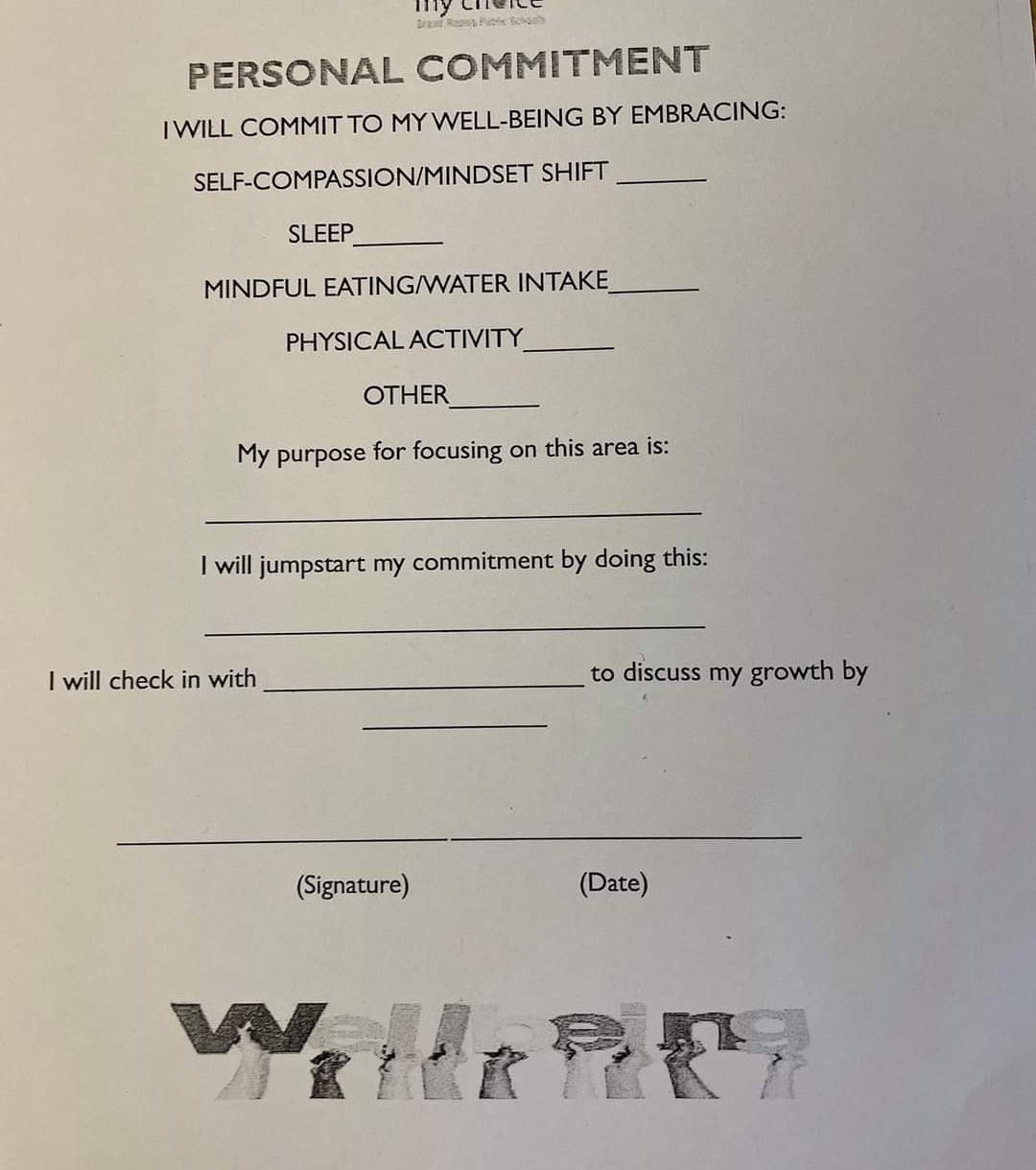
Well, it isn’t the ‘Wellbeing’ worksheet (see photo, below), which feels like one of those make-work reproducible masters teachers used to pull out on a sub day. Self-care dittos.

Here—fill this out. Feel better! Clearly, whoever designed this worksheet does not understand the relationship between drinking more water and the one three-minute window per day when peeing is possible.

Look, I understand that there’s no easy remedy for the conditions teachers are working under: Angry parents. Lies about the curriculum. Anti-vaxxer moms and virus daredevils. What could a school leader who really wanted to support her staff do?

Grow a backbone. Support public education. Here’s a list of 14 viable suggestions for doing that.

Hiring the best possible people, paying them fairly, giving them time to work collaboratively, honoring their expertise, and releasing their creativity? How does that sound as a recipe for school-based self-care?

What do teachers want? What all professionals want: Autonomy. Mastery. Purpose.

When Teachers Write about Their Practice

My fellow edu-blogger, Peter Greene, just put up another great blog. This happens with some regularity, and if you’re not reading his stuff, you should be. Not just the ready-for-primetime Forbes pieces, but his more free-wheeling personal blog.

Greene writes, with a certain edge, about a variety of education topics, and he has receipts for his opinions. When I read his words, I am right back at C lunch, listening to the veteran teachers I worked with grumble and snicker about the people who were trying to ‘fix’ schools. And didn’t have a clue about how schools worked, or what happened in real classrooms.

How could you know that every class is a balancing act—attention, content, challenge—whether your students are six or sixteen, unless you’d spent considerable time in front of a classroom? And did so recently—not 40 years ago, when we didn’t expect kindergarteners to read and everyone to take Algebra II?

As we wrestle with ‘To Mask or Not to Mask’ and just what Critical Race Theory actually is and isn’t, we need to hear lots more from experienced teachers.  Greene’s aforementioned blog, titled How I Taught Controversial Texts, is precisely what persuadable parents should read right now.

Persuadable parents are those who genuinely care more about the education their children are getting than scoring political points, or throwing their weight around. They’re curious; they want the best for their children. They may be liberal or conservative, Republican or Democrat—but they’re mostly wondering ‘What kinds of things might our kids talk about in class? What will they learn?’

Well, Peter Greene tells you. In doing so, he condenses decades worth of teacher wisdom into a few pithy paragraphs, around ideas like this:

Teachers often say that students are welcome to their own opinions in the classroom, but students will wait to see if you mean it, or if this is a class where you get points for agreeing with the teacher. So you have to show them. Once students believe that they really don’t have to agree with you, all sorts of good stuff can happen.

Offer perspectives, but let them wrangle. Let them have the argument in their own voices.

 Students are where they are. Despite all the panic over teacher indoctrination, the fact is that you will rarely budge the needle on the beliefs that they bring from home.

Don’t get out the controversial stuff before you’ve built an environment of trust, respect, and safety.

There’s more—read it here—but Greene sounded like every good teacher I ever worked with: a person with a deep understanding of their students and a strong sense of the content and activities that would push those kids to think deeply and express themselves clearly.

Of course, my teaching career in a small town in Michigan and Peter Greene’s career in a small town in Pennsylvania overlapped considerably—and we both spent a long time teaching in one place, where families learn to trust teachers.

Teaching has changed radically in the immediate past, mostly due to terrible policy-making at multiple levels, policies that have chipped away at teachers’ professional work and judgment. The pandemic explains only some of those bad decisions.

It’s time we started listening to the unfiltered voices of teachers.

I spent several years reading 12-page portfolio entries, coaching for teachers seeking National Board Certification. I was always amazed at the differing ways teachers wrote about their practice.

It was an honor to tap into their thinking (and watch videos of their lessons). For some, explaining their choices and results seemed to come naturally, something they did every day. They could explicate and justify their learning goals, and included language like Peter Greene used: Trust. Respect. Safety. Let them have the argument in their own voices.

The National Board’s word for this kind of practice is reflection. But teaching public school in 2021 doesn’t leave much time for introspection, planning learning goals and checking for results. Having your state legislature pile on doesn’t lead to better teaching or learning, either.

We seem to be at a kind of awful tipping point: Who’s in charge of teachers’ lessons?

Writing about what it’s like to be in the classroom now may be the only way well-meaning parents get some insight into ordinary life in schools–the constant effort to turn students of all ages into engaged and curious citizens, good neighbors and conscientious workers. Especially difficult now, when their young lives have been seriously impacted by an uncontrolled virus.

Keep sharing your perspectives, teachers. We need to hear from you.

Need Teachers?

Like every other state in the union, Michigan is scrambling for teachers.

This is, of course, utterly unsurprising. We’ve all absorbed the message: Treat people like crapola for long enough, and nothing—not even an enticing starting salary (in Montana) of $32K–will lure them into the classroom. That starting salary is, by the way, $15K under Montana’s definition of a living wage.

Not many independently well-off citizens want to become certified teachers, working for fun and pocket change. Gone are the days when teaching could be seen as an easy, optional second income. Especially these days, when teaching could kill you.

Rebuilding the teacher pipeline is actually something we could do. The infrastructure and research necessary for producing fully qualified, even dynamic, public school teachers is in place, and can be expanded and enhanced. All it would take is adequate funding and a commitment to solving a few thorny issues in public education.

Such as respect for the profession, and an acknowledgement of the stabilizing role public school teachers play in American society. For starters.

Done well, there could be a turnaround—in, oh, a decade or so. In the meantime, however…

The MI Department of Education recently sent out thousands of letters to retired teachers, asking them if they’d like to come back, promising to facilitate re-certification procedures, smoothing a temporary path back into the classroom to help stressed local districts. They also pledged to provide some Title II funding for districts to ‘Grow Their Own’ teachers (support staff and other promising candidates) and urged districts to use newly available money to significantly raise early-career teachers’ salaries.

All good, right?

The response from retired teachers was somewhere between bitter and scornful. NOW you want us to come back? When we’re old and more vulnerable to this deadly virus? When you underpaid us and cut support from the schools and kids we served for the last two decades? NOW we’re valuable?

I get it.

But I can’t help thinking that MI is doing the right thing, in asking recently retired teachers to come back. That’s certainly a better response than lowering the bar, letting uncertified, untrained folks, with/without college degrees, into the classroom as the teacher of record. People who see teaching as a temporary job.

A few years back, newly retired teachers in Michigan were not welcomed back as substitute teachers. Legislation in MI limited retired teachers’ work in public schools, claiming that drawing a pension and substitute teaching was ‘double dipping’—as if picking up an extra 75 bucks a couple times a week was unfairly greedy, rather than a gesture of support for currently practicing teachers and local schools.

All of this speaks to a larger, harder-to-define problem around the labor force in public ed. Teachers aren’t simply taking early retirement or walking off the job because they hate remote learning or they’re sick of filling in for colleagues when there are no subs. Teachers are suffering a collapse of morale.

And they’re not alone—2.9% of the American workforce, 4.3 million people, quit their jobs at the end of summer. Since the beginning of the pandemic, seven million workers have just dropped out.

Some of them, undoubtedly, were teachers. If 3% of the workforce in a medium sized school district—1000 employees, say—decided the pay/reward equation wasn’t worth it anymore, a district could easily lose 30 people. That would impact everything from bus routes to reading programs.

And those are national figures—it’s hard to calculate just what pandemic teaching in a politically crazed world has done to the public school instructional force. A teacher friend says all conversations about education right now center on: burnout, early retirement, sub shortages, anger & frustration, mental distress and growing & unreasonable expectations.

That’s quite a list. And the profession will be in crisis for some time to come, even if everybody stopped yelling and started working on rebuilding our public education system tomorrow.

It’s worth asking: Cui bono?

Who benefits from this scenario–a constant churn of teachers at the lowest steps of the salary scale, and a re-conceptualizing of the teacher as technician, ‘managing’ learning remotely, teaching as starter career? Who is trying to strip money and professionalism from public education?

It’s that harder-to-define problem. It’s not just about filling classrooms in 2021; it’s about what teaching will look like in 10 years. Teaching has always been a morally-driven job. Unless you are experiencing joy—or at least satisfaction—in your job, it’s unsustainable.

To his credit, Michael Rice, State Superintendent, and the MI Department of Ed, proposed some reasonable policy solutions for producing more qualified teachers, in addition to asking the old ones to come back. They begin with tuition reimbursement for prospective teachers who make a commitment to teaching, and education loan forgiveness for current and future teachers.

They would provide college scholarships for high school seniors who want to teach, and improve access to university ed schools and teacher preparation programs. Better mentoring. License reciprocity with other states. All good ideas. Will they fly?

Michael Rice: If we expect a major commitment from a wave of young people as our next generation of educators in our great state, the least we can do is to make sure that they don’t go into debt to perform this all-important public service.

That—and a major uptick in salaries—would help. But the thing needed most—public trust in teacher professionalism and community schools—is tangled in ugly politics.