Some Thoughts about National Board Certification

I am a National Board Certified Teacher. The National Board for Professional Teaching Standards (NBPTS) influenced a big chunk of my professional life and practice, and I remain—pretty much—a fan.

The founding ideas around the creation of an assessment that identified accomplished teaching drew me in, back in the mid-90s. I wasn’t sure, back then, that there could ever be a valid, reliable way to evaluate quality—or inadequate—teaching. I thought it was like Supreme Court Justice Potter Stewart’s remark about hard-core pornography: I know it when I see it.

Remember—this was before NCLB, and the advent of mandated testing for all public school children, beginning in the third grade. Some states (mine, for example) had been using statewide assessments for years, but nobody was talking about identifying or comparing teacher effectiveness by their students’ test scores– a ridiculous thought, given all the variables.

I was intrigued by the NBPTS process, and signed up to sit for certification as an Early Adolescence Generalist, paying my own fee ($2500, if I remember correctly) and (kind of recklessly) jumping in. The National Board, in 1995, did not offer an assessment for music teachers, so I decided to teach my 300 middle school band students ‘generalist’ lessons in math, language arts, science and social studies. I would NEVER recommend this, knowing what I learned, but I scored well and became a National Board Certified Teacher (NBCT).

Most people, including ed policy experts, university educators and teachers who have not experienced certification do not fully understand the National Board process (although many think they do). It’s difficult to explain, especially to educators and researchers whose entire careers have been shadowed by our national love affair with standardized testing.

The National Board asks teachers to hold their practice up to a set of teacher-created pedagogical and content-based standards, custom-written for various disciplinary and developmental levels. Teachers then reflect on how well their practice aligns with these standards, using videotapes of lessons, student work products across time and written self-evaluation. They also sit for on-demand examinations of their relevant content knowledge. Candidates’ portfolios and content exams were scored by teachers who taught the same subjects, at the same level.

It’s rigorous, and grueling—and often confusing for teachers who have never been asked the deep questions posed by the process: What is your convincing evidence that Student A understands ____? What misconceptions are evident in Student B’s remarks about ______? What other strategies have you tried to build competence in ________? Why is it important for students to have fluency in ______________? And so on, 12-20 pages for each of multiple portfolio tasks.

Many teachers—myself included—say that going through the National Board process was the best, most useful and personalized, professional development they ever had. I became a true-blue believer in the process. I then worked as a Teacher in Residence for NBPTS for two years and was part of a national team that devised the music assessment.

I was working for the National Board in their Outreach and Teacher Leadership departments when NCLB passed, 25 years ago. You could immediately see how NCLB’s foregrounding standardized testing would clash with the things most valued by the NBPTS principles and standards (again, established by actual teachers, not lawmakers, data-crunchers or education publishers).

The NBPTS standards were built on the idea of teacher expertise—knowing their students deeply, mastery of their subject discipline, possession of a full pedagogical tool bag—and continuous reflection on evidence of what was going well and what needed changing in their day to day practice.

NCLB, on the other hand, put faith in test scores as the only valid means of comparing schools (and, eventually, teachers)–and allocating carrots and sticks. There were lots of new rules to follow: the Highly Qualified Teacher requirements, for example, wiped out my NB certificate (Early Adolescence Generalist) which honored the classic middle-grades teacher who taught all subjects.

NBPTS was in the process of rolling out a number of new certificates, recruiting teachers to sit for certification, and building financial rewards for NBCTs into state policy and local contracts. They were becoming more corporate, changing a number of policies to streamline the business, something they probably needed to do to stay alive in the new political milieu.

One of the things that was proposed: machine scoring of teacher portfolios and/or content exams. NBCTs were adamantly opposed to the very idea. Many NBCTs, having had the positive experience of going through the process, had become scorers (a job only practicing teachers were allowed to do) in the summer. Others became candidate support providers, working with colleagues to examine their practice, building little communities that studied the standards, videotaping each other’s lessons and having productive conversations about teaching and learning.

The thought of saving money by machine-scoring parts of the assessment was a betrayal of the teacher leadership piece of NB certification—helping colleagues to understand and improve their own practice. Who would embrace an assessment that was evaluated by a bot?  Not teachers whose work had been fairly judged. The National Board later eliminated their Teacher Leadership department. It was not a money-maker.

I left the National Board when they moved to Washington, DC, and returned to my music classroom, but continued, for a while, to help candidates and do workshops with schools or teacher associations that were interested in the NBPTS process. I have many NBCT friends who still do NB work, in spite of changes to NB certification that were less than teacher-friendly. I am now an outside—albeit informed—observer.

Recently, on a candidate support page, the question of using AI to write portfolio briefs emerged. A candidate had shared a draft analysis of her own teaching to an NBCT, who worried that the piece was so ‘well-written’ that it appeared to be composed by ChatGPT. The NBCT encouraged the candidate to think about ways that might make her writing seem more… human.

Now—writing skill is NOT assessed in the National Board process. Clarity of thought, presentation of believable evidence, convincing analysis of student progress—all of these are important, but smooth prose and impeccable syntax, not so much. I was struck by the idea that someone might think about using AI to write what’s supposed to be one’s own rationale and justification for things done as a teacher. The product could only be incoherent, if grammatically sound, slop.

Even worse—and here we have to, unsurprisingly, travel to Texas—some states are now questioning the National Board’s core contribution to teaching and learning: professional standards.

As Peter Greene reports:

 NBTC hasn’t been hugely successful in Texas– only about 1,178 out of 320,000 teachers have the certification. But it looks that’s 1,178 too many for some legislators. Because “tolerance.”

That’s correct. The NBPTS standards, for all ages and subjects, encourage equity and inclusion of all kids and embrace the diverse range of students taught in American public schools. In Texas, they’re trying to yank the very modest stipends given to TX teachers who have achieved National Board Certification.

Because money talks. Not all states offer a financial reward to NBCTs or contribute to certification fees. And many NBCTs are like me—curious about defining the markers of good teaching, convinced that all kids deserve an accomplished teacher. The money is seldom enough to make the 200-400 hour intensive challenge of certification worthwhile.

In earlier days, NBPTS got a lot of bipartisan support—a way to reward hard-working, demonstrably effective teachers that wasn’t graduate credit hours or seniority. Right to work states were fans of paying a handful of excellent teachers a little more cash, knowing that teachers are capitalists, too.

It’s ironic that it might be right-wing politics and AI that damage a worthwhile endeavor to improve teaching. Or maybe the word is predictable.

This Guy Used to Be My Congressman

And now he wants to be my senator. Again. Meet Mike Rogers.

I spent most of my life and nearly all of my teaching career in Livingston County, Michigan—a ruby-red, rural-turning-suburban area in the ring outside Detroit. My first principal used to refer to our school district as the far edge of white flight—folks with enough resources to move to a bucolic county with lots of land for their ten-acre dream homes, an hour-long commute into the city, and a population that is 94% white and less than 1% Black.

Although I have always identified as a Democrat, I used to vote in the Republican primary, because it was the only way I had some say in who was representing me in local offices and the state legislature. Beginning in 1995, Mike Rogers was my state senator, and later, my representative in Congress. He was, at the time, very much a country club Republican—bland, moderate, uncontroversial and generally well-liked. I never voted for him, but I knew lots of people who did. I also didn’t fear him.

Rogers’ family was well-known in Livingston County. His dad was a public school administrator and football coach, and his mother ran the Chamber of Commerce. One of his brothers was in the state legislature. He won local elections by wide margins, but when he decided to run for Congress, in 2000, squeaked into office by 111 votes. It was redmap gerrymandering that made his subsequent elections ironclad.

Rogers and I lived in the same small town for most of his political career. I used to see him in Meijers and at local events, shaking hands. Once, we were both on a panel at a Chamber of Commerce breakfast where the topic was education policy. Mr. Rogers’ take on education, as a congressman, was that the feds had no business making or even influencing education policy—he was Mr. Local Control. He asked me, his designated foil, what purpose a federal Education Department served.

My answer was two-fold: First, a national Ed Department can serve as center for policy research on best practices and ideas in public education, economies of scale. Why re-invent the wheel in 50 states?

But far more important was the federal role in promoting and ensuring equity and protecting civil rights. I reminded him that the original ESEA, passed in 1965, was designed to provide resources for our neediest students, to help level the playing field for millions of baby-boomer students whose states or districts weren’t particularly interested in equity.

Not Michigan! he scoffed, ignoring the obvious example of Detroit Public Schools, 50 miles down the road, a city that many of his constituents escaped, after the auto industry built enormous wealth on the backs of immigrant laborers. But who cares about children in a city whose resources have been extracted? Not his problem.

After the panel dispersed, Rogers was surrounded by obsequious local businessmen—and I hurried back to my 3rd hour class, which a colleague was generously covering until my return.

In 2015, Mike Rogers decided not to run for Congress anymore. He launched a career in radio—a kind of mild-mannered Rush Limbaugh—and moved to Florida, where he was happily ensconced in Cape Coral for nearly a decade, starting new businesses, and serving as a defense lobbyist and National Security expert for CNN. He occasionally put out feelers to see if there was a possibility of becoming President.

But. Rogers has miraculously rediscovered his Michigan roots,and is now running—for the second time– for an open Senate seat in the mitten state. He has always been a pro-NRA, anti-abortion guy, but he’s moved hard to the ugly Trumpian right; in his last senate race in 2024, he castigated his former employer, the FBI, claiming they were on a witch hunt to take down Trump for political purposes. He called the DOJ “corrupt.” 

That, of course, was two years ago. Now, he’s All Trump, All the Time.  He’s an election denier. He’s trying to raise doubts about the MI senate election he lost, in 2024. What he said two years ago about the DOJ—well, that no longer applies. They’re good guys now.

As for public education, he’s also changed his tune, now endorsing federal influence over creeping wokeness, saying that  “schools care more now about social engineering than, as my father used to say, readin’, writin’ and ‘rithmetic.”

Expect to hear that little bon mot often on the Rogers campaign trail this fall, along with finger-pointing about DEI and the weaponization of empathy. Plus a whole lot of anti-Muslim, free-floating racism.

Remember– Mike Rogers used to present as a country club Republican, hometown boy made good, moderate conservative, ex-FBI, and deficit-cutter.

But what happens to sort-of moderate Republicans, these days? They get primaried after one term. They get criticized by Tucker Carlson.They can’t maintain leadership in the House. Or Senate. They get the message: move rightward, appease Trump, sometimes by groveling–or get out of the way.

Mr. Rogers is perfectly willing to do whatever it takes to please The King. In 2024, he bought a tear-down lakeside cottage in Michigan, moved in with his sister-in-law in his old hometown to run his campaign, and started building a new home on the lake. Which could be his Michigan address should he win, but an easy, lucrative place to sell should he lose. No risk, reward either way.

He still owns the Cape Coral mansion.

There are lots of reasons to distrust Mike Rogers, beginning with his “go as the wind blows” beliefs and policies (and place of residence). There are lots of Republicans who fall into that camp—Tommy Tuberville springs to mind.

But I keep thinking about that Chamber of Commerce breakfast, where MY sitting congressman didn’t see why children in Michigan deserved equity.


Ridiculous Headlines about Public Education

I’ve been writing about education policy and practice for more than 25 years, in my local newspaper (gratis), for an education nonprofit (paid), for Education Week (the journal of record for ed policy, also paid) and in my own personal blog, Teacher in a Strange Land, where I am definitely Not Paid.

When I started, back in the late 90s, I actually thought that we were living in hard times, from the standpoint of informed practice and useful education policy. What I see now, of course, is that I didn’t have a clue as to how messed up things could get. Or how the intersection of public education and politics could destroy so much good work and good will.

We have reached the point where the Onion-esque Eyes on Meme might be the most accurate representation of the daily lives of teachers:

$38,000 Master’s Degree Finally Pays Off with $61 More per Month

Parent Asks About Extra Credit at Meet the Teacher Night, Nine Days Before Anything is Assigned

And so on. Hilarious.

But shouldn’t teachers be soaking up critical commentary about ed policy, the destruction of the federal Department of Education, the latest trends and promising practices?

Well, maybe not. I am still routinely scanning the mainstream education press (such as it is). Here’s a sampling of recent headlines:

Talking About Menopause Is No Longer Taboo. Here’s Why That’s Good for Teachers

Quote: “Menopause is being recognized not only as a women’s health issue but as one that affects all of society—including the teacher workforce—three-quarters of whom are women.”

Kind of has that college freshman-term paper feel to it, no? And–good for teachers? How?

How about: Test Scores have Plunged, but Voters Aren’t Making Schools a Top Political Issue  

Missing subtitle: Like Chalkbeat wants them to.

Or: Chronic Absenteeism is Linked to Slower Academic Recovery in Math, Reading

Well, duh, say teachers everywhere.

Then there’s this: Can the Prospect of 3rd Grade Retention Improve Early Literacy? Yes, Study Says 

Response: No, Another Study Says.

Next up: Principals Can’t Manage Teacher Morale Alone. Enter the Go-Between

The thrust of this piece seems to be that managing the usual emotional, daily-grind aspects of K12 school administration (personal conflicts, new programs, novice teachers, etc.) should be outsourced to assistant principals and ‘teacher leaders’ because principals have too much important work to do. Those teachers and APs apparently can squeeze even more on to their plates, because there’s no associated plan to pay them more or reduce their workload in order to be a ‘go-between’—my nomination for the worst title you could bestow on a dedicated teaching colleague.

And this: The Ed. Department Calls for a Crackdown on Teacher Sexual Misconduct

So—is sexual misconduct on the rise? Of course not. But while they’re demolishing the oversight of public education, it’s always good to, you know, flood the zone with scary claims. “Parents should never have to wonder whether their kids’ school employs and protects sexual predators,” Secretary of Education Linda McMahon said in a (wildly ironic) statement.

This is a good spot for me to talk about working as a teacher blogger for Education Week. My experience there was a good one, but I used to hear all the time from friends who sent me EdWeek op-eds they disagreed with, charging EdWeek with being right-wing or bought off by publishers.

Education Week—like the New York Times or the Wall Street Journal—is a business. They accept ads. They promote (and sometimes host) commercial programs. And they also invite a wide range of commentary, from teacher unions to pro-voucher politicians. In 2026, if you want to read one side of any educational issue, you’ll need to explore blogs, newsletters and substacks. I printed what I wanted to print, when blogging for Education Week. In nine years, I never had a piece pulled or even edited, beyond the occasional comma or headline.

The state of education journalism has not improved—better innovations, more useful research, informed commentary from practitioners–over the last 25 years. It’s become more divided, operating on the principle of “he who has the power and grant money makes the rules.” And lately, it’s been overwhelmed by stories about AI.

Here, without commentary, are a collection of AI-related headlines in the education press:

How to Use Paper to Teach About AI and Cutting-Edge Tech

Can AI Help Students Learn Social-Emotional Skills?

How an English Teacher Helps Students Find their Voices in the Age of AI

In the Race to Build Smarter AI, We Forgot to Build Smarter Humans (Opinion)

How Educators Can Encourage AI Skill-Building Without Being Tech Cheerleaders

Taken together, what do these headlines tell us? Isn’t the point of AI to trust large language models to answer our questions, without having to develop a unique voice, use paper-and-pencil methods of communicating or calculating, or spend countless hours learning to play nice with our peers?

Smarter humans via AI? Doubtful.

Looping. It’s Not New. It’s Not a Panacea.

One of the most enduring truisms about public education is the existence of The Pendulum—the belief that trends in curriculum and instruction tend to repeat themselves, swinging back and forth over time between two distinct, even opposing models.

The most obvious example is the Reading Wars—both the binary presentation (there are two ways to teach reading, and my way is best) and the free-floating hostility toward anyone suggesting that teaching reading isn’t a matter of adopting The One True Way. 

The Reading Wars—a term I loathe—have been heating up periodically for the last century. It’s not surprising that veteran educators who have had measurable and observable success in teaching reading really hate being told that their go-to instructional strategies, honed by trial and error, are wrong.

Here’s the thing about that pendulum: it’s not precisely the right metaphor. Education should embrace experimentation, observation and change. Because students change, and the world changes. What goes around comes around—but maybe with a new twist, or new insight. Not much is “settled science.”

If teaching were a true profession (a topic for another blog), it would be understood as a practice, founded on core principles and knowledge, but built by individual skills and strengths within a particular context.

 Just as with any other profession, there would be the presumption of mastery—that a teacher’s experience is valuable, their judgment based on having fine-tuned their understanding of instructional issues and how to solve learning problems. But in real life, teachers are more likely to be subject to trends and laws and commerce and even political winds.

For example: When everyone was excited about new Chromebooks for all, third grade teachers were told that cursive writing was obsolete. Keyboarding was the future. But—then there was positive research on brain development via cursive writing, and ka-boom. Cursive is back. Unless it’s not.

When teachers are directed what and even how to teach, they are not using that well-honed judgment. And more teacher judgment means less pendulum, waiting around for what you know works in your classroom to be OK again, or sneaking cursive lessons to your 3rd graders because you saw it help your previous 3rd graders, practicing their cursive in letters to grandparents.

I was amused to see the headline “Charter School Finds Looping Strategy Benefits Youngest Students,” in Education Week. The video article suggests that looping (combining two grades in one classroom, with older half leaving as a new, younger half comes in) is an innovative idea. These are preschool students—3 and 4 year olds—so there’s a lot of happy talk about how the 4 year olds have an extra year of school under their tiny belts, and act as leaders for the incoming 3 year olds.

Especially with very young children, having the same teacher for two years—in a true looping or multi-age setup—could have some benefits. But there was the sense that the folks in this school had found an entirely new instructional concept with amazing benefits.

In the 1990s, I got involved in a one-year experiment in a multi-age/looping classroom in the district where I taught, and my kids went to school.

I learned about multi-age classrooms from Dr. Ellen Thompson, whom I met at a Teacher of the Year conference—she was Vermont’s Teacher of the Year in 1993. Ellen was a strong proponent of flexing the age groupings of elementary students, of really getting to know kids and their families instead of one-and-done. She had been teaching in a three-grade classroom for years and did an amazing, research-substantiated presentation on the benefits of multi-age classrooms.

Back home, my son’s first grade teacher had also been reading about multi-age classrooms and looping (which is how you get multi-age classes embedded in a traditional, grade-by-grade setting). She wanted to try it–and had a 2nd grade teacher who would partner with her.

Now, I loved this teacher. My son was doing really well in her classroom. The idea of having her again next year, in a Grade 1 / 2 looping classroom was really appealing. But there was a great deal of pushback from administrators (because they were in charge of any change) and from the union. Mainly—and this is a very important point—because they’d been trying for years to get rid of split-grade classrooms to even out class sizes.

But they agreed to try a one-year pilot of two multi-grade 1 /2 classrooms. And we were in, although more than one second grade teacher expressed regret they wouldn’t have my son in their class. What happened next was surprising to me.

Parents (who had to agree to place their student in a deliberately structured multi-age setting) shied away from the idea, seeing it as just another split, something they’d been told to avoid if possible. The assumption was that the 2nd graders in the 1 /2 split were “behind.” A mother in the Little League bleachers told me that the multiage classroom was for 2nd graders who couldn’t read, which I personally knew was far from the truth.

None of my son’s friends were in his class. And he never talked about being a leader for his first grade classmates. It turned out to be just another year of schooling. And it made me understand that context—the settled-in assumptions made by an education community—trump lots of innovative ideas. The pilot lasted one year.

So it was interesting to see looping swing, like a pendulum, across the radar again.  I wish them every success.

LIFTing Kids Higher

I am a volunteer in a homegrown program to support middle and high school students in my (small, rural) county. Entitled LIFT—Leelanau Investing for Teens—it’s a program designed to give middle school and HS kids something valuable: a safe (free) place to hang out, stuff to do and friends to talk to, in the long and sometimes empty hours after school.

I was attracted to this idea because my own band room was frequently a place for secondary band students to hang out after school, jamming on the drum set and spreading snack detritus all over the floor.  I quickly recognized the idea that elementary children need childcare after school, but 6th graders are fine on their own was baloney. Maybe even dangerous baloney. A safe, supervised place to go could, in the long run, be a life saver for young teens.

I generally volunteer on Wednesdays, which is Homework Day. Kids with missing assignments can drop by for help in getting them completed. I’m one of the few volunteers who isn’t intimidated by MS math, having taught it for two years. HS students can also get community service hours (20 required, in my district) by volunteering to help the MS kids with their homework—and MS students definitely prefer working with HS kids. You’re role models, we tell the HS students. And they like that.

All good. A program that started in one school has expanded to all four public schools in the county. Entirely funded by grants and donations, there are paid coordinators in every school, and a host of adult volunteers like me who show up as evidence that we care about teenagers in our community.

I was thinking about LIFT when I read Peter Greene’s piece, How You Made Them Feel. He makes a salient point: it’s not a teacher’s job to make kids feel good—it’s our job to make them learn something. If they feel good about that genuine accomplishment, great—and if a teacher keeps pushing and handholding and (jargon alert!) scaffolding to get them there, also great. But we’re not responsible for their self-esteem, beyond what new skills and being part of a learning community yield.

If we’re encouraging anything at LIFT, it’s being part of a community—the LIFT program at my school lets kids check their phones after school (which restricts phone use during the academic day), for a half hour. Then—programming begins and phones are stowed until pickup time. What I have been noticing is that, more and more, kids prefer to chat—IRL, person to person—during that first half hour. Snacks are also free and readily available, often donated by community members. Kids loaf on the donated couches and beanbags, to decompress and make jokes. It’s pretty much perfect, when you’re 13.

I’ve been volunteering in this program for two school years (and one summer). We have not had disciplinary issues, beyond horseplay and the occasional rude remark, which are par for the course with middle schoolers (and addressed by volunteers, who are trained). According to EdWeek, student misbehavior tops the list of things—a long list—that are currently stressing teachers out.

Misbehavior tops educators’ stressors:

‘For novice and veteran teachers alike, student misbehavior is the most common cause of stress, according to new RAND Corp. data. More teachers consider behavior management among their top three stressors than any other aspect of the workplace.’

Maybe it’s just this particular school but speaking as a person with decades of experience in disruptive student misconduct, the two and a half hours of LIFT go by swiftly and smoothly, whether there is a craft to make, a game of Uno, a movie to watch, a bike ride or catching up on homework.

I know, in my gut, that it’s good work, a lifeline for kids who need activities and peers. When one of our LIFT kids tells us they won’t be coming for a while, because they got a part in the play or decided to go out for softball, it feels like a victory.

As a retired teacher, it’s also a good way to use my own skills. I think, all the time, about retired teachers and how they can support public schools in substantive ways.

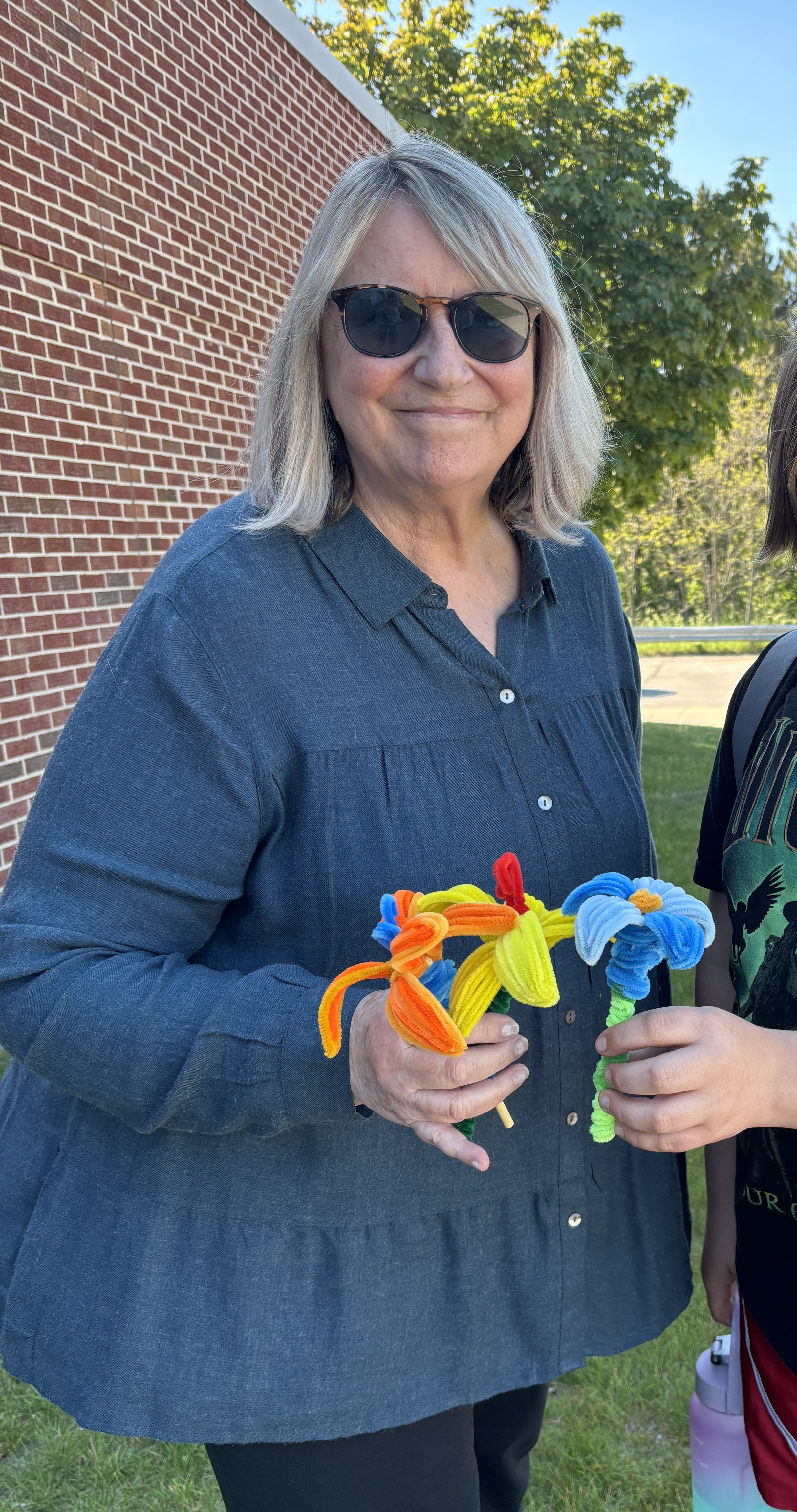
On my last day of volunteering this year, the craft for the day was making pipe-cleaner flowers. You might think this activity would not appeal to jaded middle schoolers, especially boys. You would be wrong. Turns out that making stuff is fun, and an avenue for wacky creativity.

We spent 90 minutes bending pipe cleaners, directed by three super-cute HS girls who exemplified role modeling and laughed with their pupils when things fell apart. I had to clip a LIFT kid out of the photo below, per privacy rules, but trust me—they were having a blast.

Such a simple idea. Such good work.

The Rule of the Free Market in Education

I spent 30-odd years teaching in a medium-sized school district that nearly doubled in size during that time period. Which meant that we kept outgrowing our facilities, asking for new schools via bond issues, and moving kids around to accommodate their educational needs.

In fact, the first year I taught in this district, our overcrowded middle school (grades 5-8) was on split sessions. I arrived at school at 6:30 a.m. and taught from 7:00 a.m. until noon. The guy who shared my classroom taught from 12:15 until 5:15 p.m.

Classes were 42 minutes long, with a 20-minute “nutrition break”—supervised by teachers—between 3rd and 4th period. Every teacher shared a classroom, all their textbooks and equipment. This was in the era before Xerox machines in every building, so making copies for instructional materials happened at the lone ditto machine (take a deep, alcohol-and-acetone scented breath) in the office. None of this was good.

Still, it often took multiple tries to get a millage or bond issue passed to build adequate space. And when those new buildings were completed, it was obvious that parents would want their children to enjoy the outcomes of their YES vote and send little Jason to the new school, the one with the computer lab.

There were no charter schools and the nearest Catholic high schools (one for girls, one for boys) were 35 or 40 miles away. You’d think we had a educational monopoly and could do what we wanted. But we were firmly under the control of the school board, as conservative and traditional a group of dairy farmers and local business owners as you can imagine.

The school board’s m.o.: How much does this cost? Can we get it cheaper? Is this some new-fangled educational fad, or something our students really need? Couldn’t we squeeze a couple more years out of the Social Studies series, and just have teachers tell the students that the USSR doesn’t exist anymore?

Every single board member ran on fiscal responsibility, with their own personal definition of ‘frills’—things that may have been nice but would cost more. Things like music, art and in-building libraries. The theory was: just because there was supply didn’t mean we should demand. As long as there was a football field and a big gymnasium, the rest of the programming we offered was on a “don’t ask for more or we’ll cut you completely” basis.

That was then.

We were a total free-market district with deep local control, run by large landowners and businessmen, supported by the taxes they (and all our modest rural families) paid. I wish I had a dollar for every time I heard a school board member or cranky old farmer say we were offering “just a basic education” at a board meeting.

What changed?

Technology, for starters. There was a long stretch of time beginning in the 90s when every millage election promised computers as irresistible selling point, giving kids ‘what they need for the future.’ Federal policy also ramped up grade 3-8 testing a quarter-century ago, simultaneously introducing a kind of fear-based ‘accountability.’

But the biggest change was the introduction of ‘choice’—a word that demands quotes. I would argue that my early experiences– school board members in overalls worried about overspending–was actually a kind of choice.

If you chose to live there, back then, you were either a farmer, or living on what used to be farmland, sold for development because the taxes were too high. You had to accept the fact that your rural school had shortened days, leaky buildings and overcrowded classrooms.

Three foreign languages and AP courses and 8-hour secondary days with time for an orchestra? Not here. Go back to those greedy, high-tax big-city districts around Detroit. So, yes, there was also a racist thread running through all the free-choosing.

Peter Greene sums up this attachment to the idea of unleashing free market forces and choice in education, the myths behind this tunnel vision, in this terrific piece. He covers all the things I came to see, teaching in one district for decades: We don’t want to share resources. We’re afraid of what ‘those kids’ would teach our kids. Competition is how to make schools and student learning better. People can realistically vote with their feet. The free market always works.

The idea that you can always get what you want, if you have enough money and power, has exponentially multiplied in the past couple of decades, supported by policy and legislation. It has nothing to do with improving student learning or innovations in teaching or curriculum, things that should change over time. As my friend and Michigan State School Board member, Dr. Mitchell Robinson asks:

Why is “zero government interference” right for some families, but “strong accountability” is demanded for those who send their kids to public schools?

Has any of this resulted in improvement, to any metric of school success, from parent satisfaction to (unreliable) standardized test scores? No.

Peter Greene gets the last word: School choice doesn’t have to be constructed on a framework of market dynamics. In fact, school choice could be done much better without those things– provided we accept the notion that the goal is to get the best possible education to every student, regardless of zip code. We could do it, if the goal were actual educational choice and not the conversion of a public societal good into one more commodities market.

This is the building where I interviewed for the job that lasted four decades.

Let’s Pay Teachers Overtime

The title of the article made me laugh out loud: Should Teachers Get Overtime?

Subtitle: EdWeek Readers have some thoughts.

I’ll bet they do. Fortunately, the readers who responded to EdWeek’s LinkedIn poll obviously had some experience in teacher compensation, not to mention common sense. Because the answer to this question is obviously that teachers ought to be paid fully professional salaries, since it’s a professional job. Starting now.

Back in 2007, I took part in a teacher-led consortium that explored teacher pay. We followed the time-honored education practice of saving the world one white paper at a time, and produced a thick, glossy report filled with suggestions on how to pay teachers for their special skills and performance, enhancing recruitment and retention. We firmly rejected the common belief that paying teachers for their students’ test scores would do anything good for education–but allowed that the single-scale salary schedule had some flaws and might be tweaked.

Mostly, we were looking for ways to pay experienced, proven educators enough to honor their hard-won expertise and, over time, give them additional leadership responsibilities without forcing them out of the classroom. There were 18 “recognized” teachers in the group, union and non-union, and we didn’t agree on all aspects of what professional compensation looked like, other than the fact that teachers were significantly underpaid for the service they provided to their communities.

There was one thing we all agreed on, however: teaching is not, never has been, a 9 to 5, punch in and out, job. Teachers generally get extra compensation for teaching an extra hour (giving up contractually granted planning time)–or for coaching, and other after-school programming.

But–as commenters on the EdWeek piece noted–if we were to, say, offer teachers money for staying late to read 150 essays and provide written feedback, or to grade dozens of constructed-response math tests, districts would run out of money by October. Or, as one cynical commenter noted, teachers would quickly be forbidden to do anything above and beyond, because it would be deemed too expensive. So–counterproductive.

It’s worth noting that our report on changing teacher pay for good reasons was written nearly 20 years ago, and while there have been a handful of alternative compensation models since (and also plenty of glossy reports), even EdWeek–seriously, one assumes–is still asking readers if teachers should get overtime.

Bummer.

It’s Not about Cheating

Recent conversation with a contemporary (a man who worked in sales all his life, and whose grandchildren attend a Christian school):

Him: So what do you think about AI? How will your public schools deal with the fact that AI is going to control all jobs in the future?

Me: AI will certainly have an impact on the job market, but I don’t think the future of work is written in stone. As with all technologies, experience will tell us whether AI is actually useful in enhancing learning in any way. Lots of things that sound good in education turn out to be oversold or hype. Or even counterproductive.

Him: But isn’t AI going to make it impossible to tell who’s cheating? That’s what I’d be worried about if I was a teacher.

Me: What do you mean by cheating?

Him: Well, kids will get AI to write their papers and do their assignments. And teachers won’t know who wrote the paper and will be forced to give it a good grade. And if everyone gets good grades, there will be grade inflation, so it will be hard to pick out the really smart students for the top colleges.

Me: It’s not about cheating. It’s about actual learning. Students learn by doing the work, including making mistakes—whether that work is putting two blocks with three blocks to make five blocks, or testing pond water samples, producing an original haiku in class–or writing a research paper. When people talk about AI and cheating, they’re usually thinking about writing assignments—but there are many more paths to learning, K-12, than writing a paper or answering questions on a worksheet. Besides, teachers who know their students well, and have seen their skills in action, will understand how an AI-constructed response would compare to an actual response.

Him: (dubious) I suppose sharp teachers can catch them that way. Besides, you’ll have more time to ferret out cheaters when AI starts grading student work and writing your lesson plans.

Me: Only someone who knows the students and knows the usual flow of content and skills at that level can write useful lesson plans. And assessing student work is how teachers observe what their students have learned, and what they need next. I personally don’t see AI as being particularly useful in developing instructional materials, either. It certainly can’t develop relationships with kids or inspire them.

Him: Of course, this would all be different for you, as a band director—AI will change everything for regular teachers but maybe not for you. If band even exists as a class any more.

———–

Sigh. This conversation actually happened. And the man I was talking to was not an idiot. He had some magazine-article background knowledge about AI, saw its impact as inevitable and teachers as unfortunately unionized Luddites, unwilling to adapt to a rapidly changing world.

He was also right about musical performing groups—as a K-12 musical specialist, I have been having these conversations about electronic alternatives to learning to play an instrument or sing for three decades. Who would want to go to the trouble, a well-meaning friend who teaches English asked me, to learn to play the bassoon? Or even worry about singing in tune, now that auto-tune is available to fix hot musical stars’ vocal uncertainties?Why not grab a bunch of keyboards and software? Isn’t that all the instruction musicians need to, you know, put out musical content?  

The great danger of using the range of AI products in the classroom has nothing to do with cheating, per se. Fact is, students have been cheating—in the ways we usually perceive as academic cheating—forever.

From writing dates on a shirt cuff to paying someone to take your SATs, cheating is deeply embedded in academic practice. If there is a potentially positive outcome here, it might be disconnecting old ideas about plagiarism and cheating. Instead, we might be teaching our students to assess information they are presented with, comparing it to different analyses, perhaps rooting out alternative facts that aren’t really factual.

Fact is: plagiarism is ill-defined, in an era when students have access to the Library of Congress in their raggedy jeans pockets: “Anybody who embarks on a study of plagiarism hoping for bright lines is in for a foggy shock. One of the pleasing facets of plagiarism is that it doesn’t exist—not in the eyes of the law, that is, and especially not if those eyes are American. There is intellectual-property law, and a law that prohibits the trafficking of counterfeit goods. There are laws against copyright infringement. If plagiarists are sent to prison, however, it will not be because they have filched a slice of poetry, or half a juicy ballad, and passed it off as their own. Plagiarism is not a crime. It is a sin.’”

Here’s another fact: Large language models that support the kinds of AI K-12 teachers and students are being urged to adopt are constructed of plagiarized, if you will, content. Speaking of cheating.

But it’s the original point that matters most here: AI in its various platforms robs students of doing the actual work of learning: absorbing, comprehending, analyzing, synthesizing and so on. I would like to think that this is the reason that states and school districts are banning the use of cellphones in the classroom—to prevent students from believing that graded products represent actual learning.

I would also assert that learn-by-doing classes that require groups of learners (like band and choir, debate, drama and so many others) reward students for all the right habits: working together, interdependence, ongoing skill building toward a clear goal, aesthetic pleasure. Creativity, the antithesis of AI use.

Philosophy professor Kate Manne wrote a terrific piece about preventing her university students from using AI, and how it all worked out:  “I feel strongly, as I explained, that their AI use will prevent me from doing my job in helping them to grow as thinkers and writers.” Spoiler alert: students produced such superior work and thinking that she cancelled the final exam. Read the piece. It’s solid evidence.

Pushback against AI is not and never has been about cheating. It’s about genuine learning.

I Read the News Today, Oh Boy

When I first heard about influencers, I thought—in my predictable Baby Boomer way—that the whole idea was ridiculous. People whose ‘career’ was influencing other people, paid for by subscriptions and sponsorships? Shallow people, famous for being famous, possessed of zero actual expertise, espousing fake ideas and images to make (lots of) money?

But it turns out that influencers are in it for something more than money: actual influence.

In politics, they have become ‘an infestation’:   “The internet is teeming with thousands of micro- and nano-influencers looking to make a name for themselves. These smaller influencers still have very engaged and loyal followers—making them important communication tools for campaigns. But they often lack an understanding of how politics works—or, more specifically, an appreciation for the tradeoffs that often must be made—and tend to spread content that revolves around conflict and misinformation.”

That’s what happens when you try to buy clout. You get what you pay for.

Over the past couple of years, I find that I have mostly stopped watching or reading the daily news in its conventional forms—newspapers, television, radio. I’m still consuming huge quantities of news, op-eds and information, but I like to think I’m paying for the most credible and valuable online content, verified facts and analysis.

Are my curated news providers giving me reliable information, and multiple trustworthy perspectives? Or are they just trying to influence me?

Here’s an example, from one of my daily reads, Bridge Magazine, a centrist, Michigan-focused news outlet:

“Schools are in trouble. Test scores don’t lie: Michigan ranks 44th for fourth-grade reading; less than 1 in 3 high school graduates are considered ready for college.”

First of all—it should be ‘fewer’ than one in three graduates. And that figure is erroneously measured by the SAT scores of all the HS juniors in Michigan, who are mandated to take the test whether they’re college-bound or not. Those scores are then compared to a subset of seniors in other states who are preparing to attend colleges that require a good SAT score for admission. Apples and oranges.

More importantly—test scores do lie, all the time. They’re also misinterpreted by journalists, some of whom probably mean well, but are being paid to make a particular point. Influencing your average reader to believe that Michigan public schools are failing, for example, tossing off context-free “data” as if it were God’s honest truth.

I am old enough to remember the first time I watched Fox News and began thinking about a future where there was no mainstream POV, and ordinary Joes could purchase the media stream that fit their beliefs. It seemed shocking at the time—but look. Here we are. At a point in history where the President of the United States gleefully posts an AI-generated video of himself wearing a crown and flying an airplane that drops shit on his constituents.  

Republicans are known to be far more aggressive at paying off social media influencers than Democrats. Pay-for-post schemes have been rampant throughout the conservative commentariat during the Trump years (as studiously documented by Will Sommer). One reason being that there is just a lot more money at play.”

What do educators do when the students whose intellectual growth they are entrusted with believe things that are false and dangerous—because the influence of the internet has led them there? When the most important content and character-building discussions in school are suspect—or banned?Or when, God help us, the President’s “Special Advisor” suggests that we shouldn’t be teaching undocumented students at all?

What is our moral obligation to the kids we teach, when it comes to truth—and how they form their own opinions and civic engagement?

There’s a growing movement to expose lies and fact-check what gets circulated via social media. But how do we teach our students to be wary and cautious, to look at the background and motivation of those who put content out into the universe we share?

Also this: some influencers are doing good, sharing content that mainstream media is prevented or discouraged from programming. Some of my Facebook friends have had an amazing impact on my tiny northern Michigan community, simply by sharing their anger over what’s happening in the White House. There are days when I think we may get through this yet, just on the strength of local truth-tellers and people who act as social connectors.

Thoughts that make me feel better about where we get our news and how we interpret that news, both national stories and education stories:
“A funny thing happened on the way to the erasure of American history in favor of a whitewashed authoritarianism. The American people began to preserve the truth of who we have been.”                                Heather Cox Richardson

“You need to tell your story. If you are not telling your story, someone else is telling your story for you.” In an era where school choice has increased competition in K–12 public education, that statement has never been more relevant or more urgent.                                                                        Greg Wyman

What are you reading? Who do you believe?

Gifted and Talented Redux

I got my master’s degree in gifted education—actually, a master’s in curriculum and instruction with an emphasis on identifying and serving gifted students, but whatever. At the time—the 1980s—I was focused on the ‘talented’ part, as a music teacher.

What could I do, I wondered, to better understand and challenge the exceptionally proficient students who showed up in my band room? There had only been a handful, at that time, students who leapt over my pedestrian instruction, right into credible Mozart concertos in the 6th grade, relying on recordings and (this sounds so quaint) library books about the great composers and their style characteristics.

I had many thoughtful conversations with people in my master’s classes, in my building, and fellow band directors (whose advice was generally directed toward private lessons and summer camps–the ‘better teacher/better cohort’ theory). But overall, takeaways on who was gifted and what to do about it were murky.

One person’s budding genius was another teacher’s ho-hum. A lot of it had to do with perceived student effort, and very little was about digging gifts and talents or even preferences and goals out of kids who were content to skate by.

Also, lots of kids who had exceptional natural talent in playing instruments were not so gifted in other areas, and therefore not interesting to the guy teaching Algebra II to 7th graders. Just because you can flawlessly pick up salsa rhythms with all four of your limbs or produce a crystalline high C on the trumpet doesn’t mean you’re… gifted. Or so it seemed.

I’ve written many pieces—here, here, here, here and here, for example—about giftedness. Invariably, they draw nasty comments. It’s very much a tender spot for parents of bright children who worry that their children are not being adequately challenged. Or are ignored by their teachers because so many other kids are struggling or misbehaving. I get it.

But I also know that talents and gifts are randomly distributed across school populations and have to be developed over time, with the cooperation of the identified GT student. I was struck by this quote from a spokesperson for Mayor Zohran Mamdani, reflecting on the mayoral decision not to test kindergarteners to determine who’s gifted:

This administration does not believe in G. & T. evaluation for kindergartners. But that’s not the same as eliminating advanced opportunities across all grades. 

My thoughts, precisely.

I recognize that NY City is unique—such a diverse population, so many school options, such hot politicking and parent-pleasing—but I fully agree with the mayor (or his advisor, more likely): Testing five-year olds for giftedness is ridiculous and bound to siphon off disadvantaged kids before they’ve really had a chance to, you know, go to school and learn stuff.

It’s the ultimate, rigged-end game: the outcomes of inequality, right out of the chute. Dividing the herd, yet again. Why? How does that help us?

If I had faith in any test to identify extraordinary, socially useful intelligence, skills, or creativity, I might feel differently. But I don’t. What I do believe is that all children deserve a rich and challenging education, whether a test identifies them as potentially brainy or sub-par. You just never know what role they might play, eventually, in making the world better.

Since more than half of American teens now admit to using chatbots to do “research” that they may not be able to evaluate for veracity, to write and calculate for them, it’s going to get harder and harder to distinguish students who produce genuinely brilliant work from those who are merely good at disguising where that work product originated.

We still need brilliant original work—not to feed the AI maw, but to enlighten ourselves, cure diseases, prevent wars, create peace, to explore, entertain and inspire. We need the indisputably brilliant kid who plays salsa rhythms but forgets to turn in his social studies worksheets for some reason. Because he has gifts to share.

We need a new definition of ‘gifted’—and maybe one for ‘talented’ as well. We need to stop accepting the assertion that machines are helping students learn better than human interaction and judgment. And most of all—we need to stop cutting kids off at the pass, sorting and labeling them when they’re in kindergarten.

Photo:sanbeiji (Creative Commons)