
Teachers—or Teacher Unions? Or maybe—Neither.

You see it all the time, in the media.

How Teacher Unions became a Political Powerhouse

Republicans grill teachers’ union head on COVID classroom closures

How Teacher Unions Failed Students during the Pandemic

And this nasty little bit of hyperbole:
How the Teachers Union Broke Public Education

Those unreasonable, greedy, demanding teachers—umm, unions– insisting on masks and ventilation during a lethal global pandemic. Boldly asking for wage increases, that bring them closer to other employees with college degrees and a desirable skillset.

But what about that delightful third grade teacher who let your shy daughter know that her drawings and poems were amazing, building her confidence? Or the HS Math teacher who wrote four letters for your son, getting him into Michigan Tech, his life’s dream?

Well—those are individual teachers. The good ones. Not the union. Which is evil. (Since sarcasm often doesn’t translate well in blogs, I am compelled to point out flaws in the “teachers aren’t unions” dichotomy.)

A few points:

  • “The union” is made up of teachers, not “bosses” or—insult alert! —“thugs.” Teachers. Local unions are led by local teachers, a large majority of whom are also full-time in the classroom.
  • Only 31 of the 51 states (and D.C.) have collective bargaining privileges.While other states have chapters of professional associations, including but not limited to affiliates of the NEA and AFT, bargaining is limited or prohibited. Associations exist to protect teachers and provide things that teachers need, from insurance to professional development—things they would get under a collective bargaining agreement.
  • In states with stronger unions and collective bargaining privileges, the bargaining happens at the district level, often between employees of the district—colleagues. Which is as it should be—making joint decisions about best use of available resources, in the best interests of both the students and the adults who organize and deliver education. Of course, this process is messy and fraught, but tax-supported public goods and services are often messy. It’s called democracy.
  • Things that are good for teachers (a health-conscious environment, adequate materials and resources, an orderly school climate, a threat-free atmosphere, respect for teacher judgment) are also good for all kids.
  • Who to fire first in an economic downturn?  The temptation to fire the most expensive employees is always present, in any business. Experienced employees often cost more; there are reasons experienced folks are kept on—their ability to manage difficult customers or tolerate uncertainty. Sometimes, it’s a matter of honoring loyalty and accrued skills.

So the Mackinac Center is dead wrong when it writes:  Merit pay systems allow a school district to pay teachers according to their performance. The teacher who performs well and teaches students effectively is likely to be rewarded with higher pay. The teacher who consistently underperforms is dismissed.

Measuring teacher performance via test data is impossible. Tests and scores are deeply flawed. And one family’s genius teacher who saved Jason is another family’s weirdo with a ponytail.  There are teachers who underperform, even teachers who should be fired. And that decision should be made by the district that hired the teacher, not a grid comparing student testing data. Pitting teachers against one another for salary bonuses is a recipe for disgruntlement. And invites cheating.  Not to mention shutting down the already-shaky qualified teacher pipeline.

So why are politicians—OK, Republican politicians—claiming we need to break the back of the teachers’ unions?How can they praise individual teachers as essential workers but excoriate the associations that represent them? Isn’t that incoherent thinking?

I was struck by Representative Brian Mast (R—FL)’s post this week, claiming: Unions worked hard to keep parents out of their children’s classrooms and have gone so far as to treat concerned parents as domestic terrorists for speaking up at school board meetings.

 Mast pumps up the House Republicans’ Parents Rights bill:

Here are the five basic rights the House Republicans outlined:

  • Parents have the right to know what’s being taught in schools and to see reading material.
  • Parents have the right to be heard.
  • Parents have the right to see the school budget and spending.
  • Parents have the right to protect their child’s privacy.
  • Parents have the right to be updated on any violent activity at school.

So here’s the thing. Parents have always had the right to know what’s going on in their public schools, and have always been invited to attend school board meetings (unless the people THEY ELECTED are meeting in secret—in which case, it’s not a Congressional problem). They have always been able to share concerns about curriculum—from constructivist Math to Sex Education—and vote on school taxation initiatives. I only WISH that more parents were worried about protecting their child’s academic testing data—the scariest privacy issue in 2023.

School administrators and board members loathe being publicly called out or yelled at; they are forced to be responsive to parent commentary—it’s their job.

And very little of this—the rights of parents–has anything at all to do with local teacher unions, who function as a convenient scapegoat, a collective noun that allows those who would like to see public education destroyed point fingers at someone, anyone, and call them a terrorist.

For shame.  
Middle Schoolers: The Myth and the Reality

Among the worst ideas I’ve ever heard, regarding young people and how to develop their knowledge and skills, is this one: Let’s let 14 year-olds serve alcohol in bars and restaurants!

Really? We’re going to let eighth graders wait on adults, bringing them booze, asking if they’d like another, assessing their levels of inebriation? Young, barely teenaged girls “handling” older men, massaging their inebriated egos in hopes of a bigger tip?

Would these be the same young teenagers we don’t trust to select their own pleasure reading, share their own observations about racism and sexism in the classroom, or choose how they want to be identified?

I taught full-time for 32 years, only one of which did not include teaching middle school. I love teaching middle school. Sometimes, I think—in terms of my cynical, low-brow sense of humor anyway—I never really left the seventh grade.

I repeat: I love teaching middle school, and I really love kids in those middle grades.

Tell people that you taught middle school band for more than 30 years, and the first comment you get back will be some variant on “OMG, God bless you” or commentary re: how dreadful it is to parent a person who’s 13 years old—The hormones! The backtalk! — and therefore, how epically horrible it must be to try to teach these kids something, in batches of 30.  

Or, in my case, in batches of 60+, where each student is holding a noisemaker.

Actually, while there were certainly days when I wondered whether I might not be better off selling real estate, teaching middle school music was mostly deeply rewarding and often fun. And in case you think this was because I was teaching an elective, I also taught seventh grade math for two years (once in the 1980s, the second time in 2005), as well as an ESL class and an academic support class where there were fewer than 10 students and classroom management was way more difficult than my 65-piece eighth grade band.

Here’s my honed theory of teaching middle school, in a nutshell: We don’t give middle schoolers enough real responsibilities or credit for their ongoing moral development. They are smart and curious enough to wrestle with big questions and read challenging texts (with some scaffolding). They are trying to figure out what kind of world they will inherit, and are often anxious about the job current adult leaders are doing. This anxiety has exponentially grown by watching adults navigate a global pandemic, stand by as states go up in flames, and try to get themselves elected through the use of lies, cheating and bullying.

Still, middle-grades kids will rise to do a credible job of almost any task we set before them, if they see a point in doing the work.  And when they complain of being treated like children, they’re usually right—every time I hear teachers recommend shutting down privileges we afford adults (using the bathroom when needed, for example, or being given some grace around a missing pencil), I cringe.

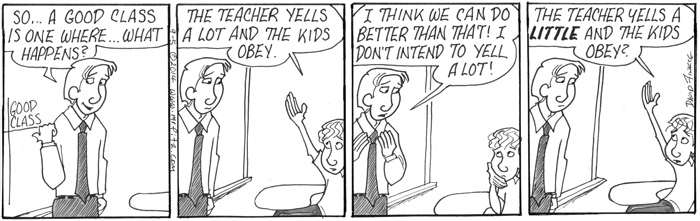
Treating young adolescents as if they can’t reasonably manage their own behavior almost always results in their doing precisely that: acting irresponsibly. A well-run classroom is not achieved by imposing a long list of rules, or threats of escalating punishments. It happens, over time, when students understand that you a) like them, b) respect them, and c) think they are capable of doing the work you have to do together, whether that’s single-variable equations or discussing core democratic values.

Over those three decades of teaching middle school, did I sometimes fail to achieve those goals? Absolutely. And did I have students who exhibited appalling behaviors, ranging from mean-girls cruelty to risking bodily harm? Sure.

But the longer I taught, the higher I raised the achievement hoops, and time after time, my pre-adolescent students came through. We have always underestimated the ability of middle-grades students to discuss, write, solve problems, explore issues and help their communities. We are always too quick to pigeonhole them, based on their immaturity. We have let middle school become a kind of punch line.

Which is why I find it interesting that some states, trying to solve ongoing post-pandemic labor shortages caused by adults who are unwilling to work for subsistence wages and are now demanding better job opportunities, are turning to young teenagers. Whether this is child labor or “developing workplace skills” depends on your point of view.

But there are better ways to incorporate the nascent adult skills that middle schoolers want to display than having them deliver alcoholic drinks to adults, or do other jobs that adults refuse to do for piddling money. I think about all the times I took the middle school jazz band, for example, to the nursing home or the school for developmentally disabled students—and how willing they were, with a little coaching, to make those lives better, to interact with people who were profoundly different.

Perhaps the best way to develop middle-grades students is to offer them opportunities to develop adult trust in their capacity.

Several years ago, my school had a pilot program in community service. Students earned points for shoveling neighbors’ walks, being “counselors” at elementary after-school gymnastics or basketball programs, or “student leadership” activities like planning and decorating for school dances. All students, over the course of a year, had to earn a set number of points, reported and signed off on by their parents.

One mother sent in a form awarding her daughter points for family babysitting. The 14 year-old daughter had four younger siblings, two who were not yet in school, and her mother depended on her to come home right after school, and watch the kids, so she could work outside the home.

This seemed like a no-brainer to me. Tending four children (and, by the way, completing your homework, something this girl always did) was a major responsibility for a girl in middle school. But the counselor argued that it wasn’t “community service,” just a family expectation.

The point of having a community service program was to build students’ skills and awareness of their place in—duh—the community, to emphasize that healthy communities depend on volunteering and interdependency. To show middle schoolers that their work and skills were already valued, even though they were, say, 12 years old.

The program was eventually scrapped over issues like defining “community service.” Which I would call an adult failure to understand the considerable capacities of middle school students.

Middle schoolers can be trusted to do lots of things; my 30 years in their company gave me ample proof of that. It’s the adults who can’t be trusted in the proposal that they serve drinks.

I Had a Dream about the First Day of School…

The “Teachers Report” day, that is. We all have dreams about the day the kids come back, and some of them are doozies, the kind where we’re not wearing pants or the kids run amuck.

But this was a lovely dream about the day that’s usually sucked up by re-learning about Blood-borne Pathogens, the latest silver-bullet curriculum initiative designed to raise those scores, and pointless, endless announcements.

It went like this:

7:15 am Over the P.A., we hear strains of Morning Mood. The Principal begins speaking.

Good morning, Ore Creek Middle School! (in his best Robin Williams voice) Welcome home!
Here’s the plan for today: You’ll all be working in your rooms all day.

The office will be open all day for you to request and immediately pick up supplies. We have parent volunteers to help with this, because the office staff is super-busy, of course.

 We’ve also set up a coffee station which will be replenished with hot beverages all morning, and there’s a box of donuts and muffins for you. Sign up for a slot to use the copy machines—we’ve rented an extra one for the week. I’ll be visiting each of your rooms at some point today, to say hello and answer any questions you may have about 2023-24.

From 11:30 to noon, there is a smorgasbord lunch, prepared by parent volunteers, in the cafeteria. Take a break, have a great lunch to fuel the rest of your day, and meet our new staff members then.

The library will be open all day, but remember—our media specialist is also setting up her room. I have hired extra IT support to staff a help desk all afternoon. Email IThelp@OreCreek if you want a visit from them this afternoon.

I will be sending you an email at the end of the day full of important announcements and a link to the required Blood-borne pathogens training. Sorry, gang—I know this is old news for most of you but the state requires it. You have two weeks to complete it. I’ll send reminders to those who still need to take care of this. Our first staff meeting will be in two weeks, once things get rolling.

I know that many of you have already been in, some for several days. On behalf of the district, I thank you for your dedication. I will be in over the weekend, if you have more to do, so the building will be open.

One last thing—several of us will be heading to Spike’s after school. In addition to their usual (cough) libations, Spike has set up lemonade and iced tea, on the house, for Ore Creek staff. Now—open your doors and give our custodians a hearty round of applause for making the building look so spiffy.

Hey. A teacher can dream…