How People Vote. How People Choose a “Good” School. Is it Common Sense?

When my son—a Korean adoptee—was in 5th grade, he had a student teacher who was Korean-American. Alex idolized Mr. Thacker, one of the very few Asian faces in our 96% white community. Mr. Thacker took him fishing. When the district hired Mr. Thacker to teach 6th grade, I requested that Alex be placed in Mr. Thacker’s class the following year.

Alex’s 5th grade teacher caught me in the hallway after school, at the end of the year. You know Mr. Thacker is a newbie teacher, she said—and there are some excellent choices among the 6th grade veterans. This will be his first year of teaching. Someday, he’s going to be a great teacher, but…

I’d already had that conversation in my head—and gone with my heart. What mattered most to me was having a great role model. Even if that role model was still filling his instructional toolkit and mastering the curriculum. Kids learn more when they’re seen, acknowledged for who they are.

I think that’s how people vote, as well. When the candidate—for County Commission, Township Supervisor or President—acknowledges YOU and your beliefs, rings your chimes, you’re going to vote for them. Even if they’re racist, traitorous and don’t make a lot of sense.

Some of this is partisan, some mere habit. But driving downstate, along the western Michigan coastline last week, through largely white, economically stressed communities, I was stunned by the number of Trump signs. These are the people who think they were better off when their loved ones were dying from COVID but gas, which OPEC couldn’t get rid of, was $2 a gallon.

A couple days after Trump was elected, in 2016, there was a dust-up in a middle school cafeteria in Royal Oak, Michigan, with kids shouting “Build That Wall.”  It was handled quickly by school personnel, but a video surfaced, and was widely shared by teachers.

Here it comes, we said to each other. Chaos and racism have been set loose.

For anyone who has spent lots of time in a classroom, it’s clear that the attitudes and speech and actions of the wider world (and especially parents) show up– quickly– in the things their children do and say in school.

The campaign to demean public schools and teachers, ongoing since 2016 (and put on steroids in the pages of Project 2025), is reflected in the despicable remarks of the right-wing commentariat. Despicable remarks about Gus Walz and Ella Emhoff—not going to link to those—and top-of-ticket candidates will draw some voters in.  And those remarks will harm kids. Kids in our schools.

It’s easy to label them low-information voters—they are, in fact. But they’re also responding to old beliefs and stereotypes. They’ve been explicitly taught to reject mainstream media and fact-checking. They go with their gut and “their own research,” such as it is.

From a great piece in New Yorker:

Scott, who works in private equity, stuck by his guns… “I think Monica goes directly to sources of information.” This, he suggested, was not the right approach. “Use common sense,” he went on. “Food is much higher now. There’s so many things against restaurants right now.” The Biden-Harris Administration was at fault, he concluded. “They created this.” 

Maybe “common sense” isn’t all that it’s cracked up to be. Or easy to define.

Maybe “common sense” lies in a PR firm’s ability to give people license to embrace their biases, as well as their fantasies: Morning in America.  Boots, not flip-flops.  Make America Great Again.

With the wave of education ‘reform’ that started when Boots-not-Flipflops took office, and tried to recreate the Faux Texas Miracle nationally, lots of people who should have known better got on board. Tests! That’s the ticket! Now we’ll know how to identify a good school—data!

School choice orgs and spokespersons revved up the charters/vouchers machine. Every child deserves a good school—who could disagree? Not me, certainly.

But as the whole NCLB juggernaut lurched along, many of those reformers were dismayed to notice what choices untrained, garden-variety parents valued: Winning sports teams. Transportation. After-school childcare.  Programming for their kids that didn’t necessarily result in higher test scores, like an orchestra, drama club or robotics.

Maybe people choose schools—or teachers—the same way they vote. With their gut.

I taught school with guys like Tim Walz for more than three decades—the coach who taught Social Studies. Walz, as Jan Ressenger notes in this fine piece, is an unabashed apologist for public education:

What does it mean that after two decades of attacks—first with No Child Left Behind’s branding schools by their test scores as “failing,” and now since 2019, with blaming schools and teachers for school closures during COVID—someone running for Vice President of the United States just casually drops a comment celebrating public schools as America’s great contribution?

My favorite Tim Walz meme, making the rounds right now: This is a real thing that happened: Tim Walz was inducted into the West Mankato HS Sports Hall of Fame. He stuck around after the ceremony to help put the chairs away.

As I said—I know this guy. And thousands like him. The kind of teacher and coach who draws families to the local school, so their kids can have a role model. Someone who sees their kids and acknowledges them for who they are.

For those who think this is low-information, sentimental baloney: Walz, a former public school teacher and football coach in Mankato, Minnesota, draws on his experience as an educator to inform his political persona and policy beliefs, saying in a 2007 interview with Education Week—after he was elected to Congress—that teachers are “more grounded in what people really care about.”

As governor of Minnesota, he acted on that philosophy of caring by pushing for and signing into law a $72 billion state budget in May 2023 that significantly increased funding for the state’s public schools, provided for a new $1,750-per-child tax creditfree college tuition for families earning less than $80,000 per year, funding for free school meals for K-12 students statewide, and paid sick leave for workers, as well as a paid family and medical leave.

So there’s your policy.

As for Mr. Thacker? Still teaching. Still taking kids fishing. Still the kind of guy who hangs around and helps put the chairs away.

Ten Non-Standard Ideas for the Beginning of the School Year

I had a colleague, a long-time third grade teacher, who spent most of August sorting books into leveled baskets, going steady with the laminating machine, and running up colorful curtains for the door to her classroom. Her husband, a secondary social studies teacher, would mark the beginning of the school year by wandering around the house, trying to find his thermos. This was immensely irritating to her, of course. But it’s hard to say who was the better teacher.

I had more than 30 first days of school as a teacher. Here’s my—very non-standard—advice for teachers, on gearing up for the new year.

1. Don’t work too hard at unimportant things, like fancy bulletin boards. The most important thing you can do before school starts is think about the curriculum and the kids you’re teaching. You’re not likely to achieve a high-functioning, intellectually cooking Day One, anyway. You’re aiming for Day Four or maybe Day Eleven, once you have a sense of who’s sitting in the desks (or on the floor), and how to get them to work together.

This is not a half-baked “make it up as you go along” theory of instruction, by the way. I know that curriculum has never been less open to creativity—and Important Metrics are looming. You’ve got a big job to do. But—as the salesman says, in The Music Man—you gotta know the territory.

2. Walk around the building and say hello to all of your colleagues. Even if the interaction lasts 30 seconds, and you’re not particularly fond of the teacher / aide / principal / secretary / custodian in question. There is nothing more effective than a school building where adults get along, respect each other and have the same goals. I am always amazed when teachers bitterly complain about the kids bickering in their classrooms, then proceed to ignore or castigate their fellow staff members. Build a few relationships. Welcome newbies. Thank the custodians for the shiny floors.

3. When it comes to advance planning, keep your options open. Don’t write detailed lesson plans for a semester. Plan for a week, maybe, just to ensure you have enough rabbits to pull out of your stovepipe and keep the kiddies busy. Set overarching goals, for sure. But it’s folly to think you have the flow of instruction and learning for the next six weeks under your control. The watchword: learn as you go.

4. Corollary: For now, plan grandly, not precisely. Think about the things students need to know for the next decade, not the next standardized test or unit quiz. Not even the end-of-course or college admissions exams. Focus on things they need to master and understand before adulthood.

Very soon, you will be dealing with the ordinary grind: daily lesson plans—plus assemblies, field trips, plays, the school newspaper, the spelling bee, the science fair, yada yada. Those are the trees. Think about the forest. What do you want your students to take away, forever, from your teaching? Which big ideas? What critical skills? It’s easy to forget the grand picture, once the year gets rolling. Take the time to do it now. Dream.

5. Make your classroom a pleasant place for you, too. In addition to being a place where students learn, it’s the place where you work, both with and without kids. (And, yes, I spent a year on a cart, so I know this recommendation may seem specious.) Most of us teach in a place that, stripped to its essentials, feels institutional, to some degree—if not downright unsightly. Find a way to have comfortable seating, task lighting, pictures or tchotchkes that make you smile. It doesn’t have to be pretty and color-coordinated—many wonderful classrooms have that “kids’ playroom/teenage basement” aura. Still, forget those admonitions about too much personalizing—a classroom should feel like home.

6. Don’t make Day One “rules” day. Your classroom procedures are very important, a hinge for functioning productively, establishing the relationships and trust necessary for individual engagement and group discussions. Introduce these strategies and systems on days when it’s likely your students will remember them and get a chance to practice them. This is especially important for secondary teachers, whose students will likely experience a mind-numbing, forgettable parade of Teacher Rules on Day One.

7. Instead, give students a taste of disciplinary knowledge on the first day of school. Teach something, using your most engaging instructional techniques. Perhaps a game, a round-robin, a quick-response exercise with no wrong answers. Bonus points for something involving physical movement. Beware of empty ice-breakers or team-building exercises—your goal is to have students going out the door saying “I think this class is going to be fun, and I already learned something.”

8. Keep your expectations about the first few days modest. You will probably be nervous (and have bad dreams), even if you’ve been teaching for 30 years—I always did. The students will be keyed up, too—it takes a couple days for them to settle in and behave as they usually do. Wait for your teacher buzz to kick in—that happy moment when you see engagement, maybe even laughter, and you know you’re on the right track. It takes a while, but when it happens, it’s like the first flower in the spring garden.

9. It’s the first day of school for parents and families, too. They’re at home, wanting to know that their kids are OK, that this year will be a good one for little Tyler. One idea for immediate parent engagement that I used for many years (thanks to Middleweb): asking parents to tell you about their child, in a million words or less. Very simple, and very powerful.

10. Tie your classroom to the world.  Even if you teach kindergarten—or chemistry—you can’t avoid election-based chatter in your classroom. Use the daily news as backdrop for modeling civil interactions and substantive debate on the content you teach. Read picture books on immigration. Take your AP Stats class to polling sites. Assign your physical education students to watch YouTube videos of the Olympics for amazing physical feats as well as examples of sportsmanship. What are YOU currently watching, reading or discussing? Share. Help your students analyze issues or find role models.

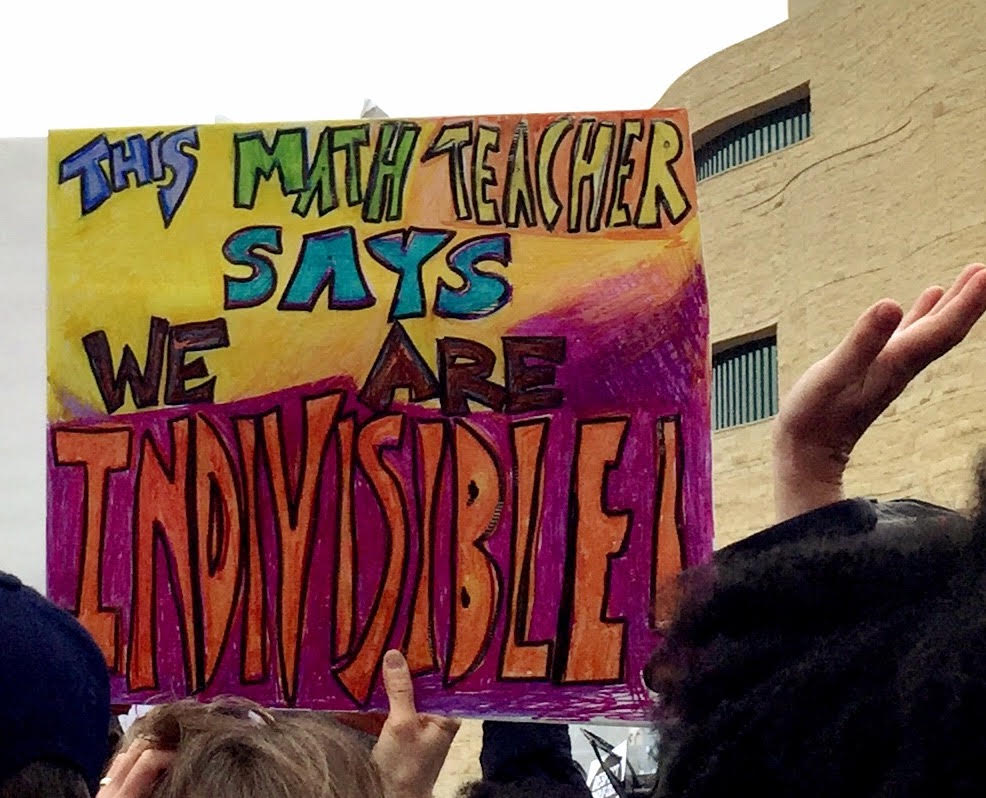
Hysterical Women

Truth nugget: Education policy is 100% shaped and impacted by the fact that three-quarters of the education workforce is female.

Another truth nugget: After Trump was elected in 2016, over a million women descended on Washington DC to march against what he stood for.

And now, after the events of Summer 2024? Well, do your own math, draw your own conclusions. Maybe start your own organization and host a national call.

As the inimitable Dahlia Lithwick noted: The court granted itself the imperial authority to confer upon the president powers of a king, but although Justices Sonia Sotomayor and Ketanji Brown Jackson said as much in their respective dissents, it fell to Big Daddy Chief Justice Roberts to intone to his readers that their aggregated dissents strike “a tone of chilling doom that is wholly disproportionate to what the Court actually does today.” Implying that the dissenters were overreacting, and without ever attempting to address the substance of their claims, Roberts accused them of “fear mongering on the basis of extreme hypotheticals about a future where the President ‘feels empowered to violate federal criminal law.’”

In other words, sit down ladies. You’re hysterical. We don’t appreciate your chilling doom or your extreme hypotheticals. A President who feels empowered to violate federal law? Hahaha! That could never happen!

This type of response could come in handy for pacifying those whose policy/practice wheelhouse is education. It’s a familiar tone policing strategy for those of us whose professional lives revolve around the classroom, especially in public schools. You’re overreacting! It’s only bus duty! What’s one more kid in your class? Why can’t you maintain control over 24 second graders on Zoom?

But. What if women were united to push the ed policy envelope?   Connie Schultz, wife of the SENIOR Senator from Ohio, Sherrod Brown, has some wise words about what happens when women organize: I know that something else—something glorious—often happens when women gather for a cause. I think of it as coming home.

More wise words, these from Kate Manne:

Many of you are now in the same position I am in: all in for Harris as the person who can beat Trump and head off the incalculable threat facing our country. We are terrified as/for girls, women, and any person who can get pregnant. We are terrified as/for the racially marginalized people who Trump has firmly in his sightlines. We are terrified for trans and queer folks who would face existential threats to their well-being and very existence under the next Trump administration. We are terrified for whatever semblance of democracy that remains and might perhaps be rebuilt. The list goes on. There is no question that Harris’s candidacy will open up a torrent of misogynoir, the intersection of misogyny and racism (particularly anti-Black racism, although Harris is also of course South Asian). It’s our job to fight it in our circles and even ourselves.

Do women have the power to transform thinking about the bedrock value of a strong public education system, in the face of Project 2025? Just a reminder:

Trump tells voters on his campaign site a few ways he would manage education:

  • Cut federal funding for schools that are “pushing critical race theory or gender ideology on our children” and open civil rights investigations into them for race-based discrimination.
  • End access for trans youth to sports.
  • Create a body that will certify teachers who “embrace patriotic values”.
  • Reward districts that get rid of teacher tenure.
  • Adopt a parents’ bill of rights.
  • Implement direct elections of school principals by parents.

That last suggestion is sheer folly, by the way —any teacher OR school administrator will tell you that it’s a recipe for never-ending chaos and enmity in schools. Besides, parents can run for the local School Board or elect people to that Board who will select appropriate school leaders for the community. I personally have seen, on multiple occasions, a group of parents make things hot for a principal, via a democratic process involving their elected board. I have also seen good administrators protected—by the same Board—from a single outraged, vindictive parent.

Kate Manne is right when she says we need to fight bad policy and reprehensible candidates “in our circles” and even in our selves. And nobody is going to fight against misogyny and racism more effectively than the people who are impacted. Therefore, protecting your public school may be most effectively accomplished by women, gathering for a cause.

Don’t want public education to be taken down by the slings and arrows of Moms4Liberty and Project 2025? Talk to your friends. Put up a sign. Donate. Volunteer. Organize in Zoom circles. Repeat vigorously for the next 82 days.

Derek Thompson of The Atlantic points out, in a revealing column that …parties aren’t remotely united by gender. After all, millions of women will vote for Trump this year. But the parties are sharply divided by their cultural attitudes toward gender roles and the experience of being a man or woman in America. When the VOTER Survey asked participants how society treats, or ought to treat, men and women, the gender gap exploded. Sixty-one percent of Democrats said women face “a lot” or “a great deal” of discrimination while only 19 percent of Republicans said so. In this case, the gender-attitude gap was more than six times larger than the more commonly discussed gender gap.

With a majority-female workforce, change will come only when women demand policy that invests in public education. Women teachers, often working mothers, value tenure. Women teachers do not want mandated certification of their “patriotic values.” And they don’t want a President or Congress that embraces the horror show of Project 2025, especially when it comes to education.

Reminder: The Chief Justice of the Supreme Court called his female colleagues “fear-mongers, on the basis of extreme hypotheticals.” In writing.