LIFTing Kids Higher

I am a volunteer in a homegrown program to support middle and high school students in my (small, rural) county. Entitled LIFT—Leelanau Investing for Teens—it’s a program designed to give middle school and HS kids something valuable: a safe (free) place to hang out, stuff to do and friends to talk to, in the long and sometimes empty hours after school.

I was attracted to this idea because my own band room was frequently a place for secondary band students to hang out after school, jamming on the drum set and spreading snack detritus all over the floor.  I quickly recognized the idea that elementary children need childcare after school, but 6th graders are fine on their own was baloney. Maybe even dangerous baloney. A safe, supervised place to go could, in the long run, be a life saver for young teens.

I generally volunteer on Wednesdays, which is Homework Day. Kids with missing assignments can drop by for help in getting them completed. I’m one of the few volunteers who isn’t intimidated by MS math, having taught it for two years. HS students can also get community service hours (20 required, in my district) by volunteering to help the MS kids with their homework—and MS students definitely prefer working with HS kids. You’re role models, we tell the HS students. And they like that.

All good. A program that started in one school has expanded to all four public schools in the county. Entirely funded by grants and donations, there are paid coordinators in every school, and a host of adult volunteers like me who show up as evidence that we care about teenagers in our community.

I was thinking about LIFT when I read Peter Greene’s piece, How You Made Them Feel. He makes a salient point: it’s not a teacher’s job to make kids feel good—it’s our job to make them learn something. If they feel good about that genuine accomplishment, great—and if a teacher keeps pushing and handholding and (jargon alert!) scaffolding to get them there, also great. But we’re not responsible for their self-esteem, beyond what new skills and being part of a learning community yield.

If we’re encouraging anything at LIFT, it’s being part of a community—the LIFT program at my school lets kids check their phones after school (which restricts phone use during the academic day), for a half hour. Then—programming begins and phones are stowed until pickup time. What I have been noticing is that, more and more, kids prefer to chat—IRL, person to person—during that first half hour. Snacks are also free and readily available, often donated by community members. Kids loaf on the donated couches and beanbags, to decompress and make jokes. It’s pretty much perfect, when you’re 13.

I’ve been volunteering in this program for two school years (and one summer). We have not had disciplinary issues, beyond horseplay and the occasional rude remark, which are par for the course with middle schoolers (and addressed by volunteers, who are trained). According to EdWeek, student misbehavior tops the list of things—a long list—that are currently stressing teachers out.

Misbehavior tops educators’ stressors:

‘For novice and veteran teachers alike, student misbehavior is the most common cause of stress, according to new RAND Corp. data. More teachers consider behavior management among their top three stressors than any other aspect of the workplace.’

Maybe it’s just this particular school but speaking as a person with decades of experience in disruptive student misconduct, the two and a half hours of LIFT go by swiftly and smoothly, whether there is a craft to make, a game of Uno, a movie to watch, a bike ride or catching up on homework.

I know, in my gut, that it’s good work, a lifeline for kids who need activities and peers. When one of our LIFT kids tells us they won’t be coming for a while, because they got a part in the play or decided to go out for softball, it feels like a victory.

As a retired teacher, it’s also a good way to use my own skills. I think, all the time, about retired teachers and how they can support public schools in substantive ways.

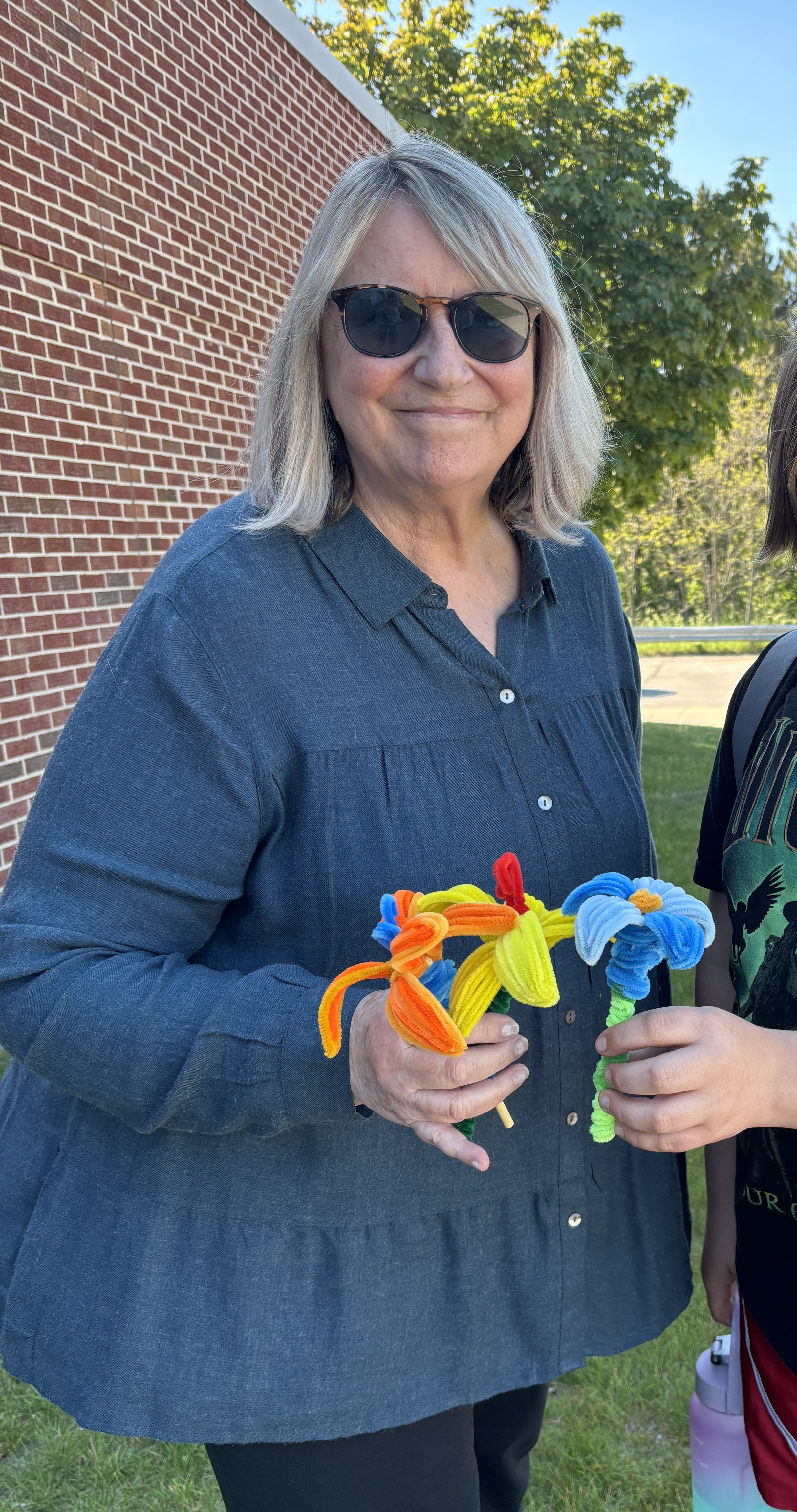
On my last day of volunteering this year, the craft for the day was making pipe-cleaner flowers. You might think this activity would not appeal to jaded middle schoolers, especially boys. You would be wrong. Turns out that making stuff is fun, and an avenue for wacky creativity.

We spent 90 minutes bending pipe cleaners, directed by three super-cute HS girls who exemplified role modeling and laughed with their pupils when things fell apart. I had to clip a LIFT kid out of the photo below, per privacy rules, but trust me—they were having a blast.

Such a simple idea. Such good work.

Can AI Handle Parent-Teacher Conferences?

Please?

Here’s the actual headline: Teacher-Parent Meetings Can Be Tense. Can AI Simulations Help?

If you’ve waded around in mainstream edu-media lately, you don’t really need to read the article. Its bottom line is predictable, first chastising teacher preparation institutes for not teaching novice teachers how to handle ‘challenging’ P-T conferences, then suggesting that a little practice with a specially designed chatbot will make you ready for Jason’s Mom when she comes in, loaded for bear

To presumably add weight to the core message of the article, the first example shared is that of a former insurance litigator-turned-teacher who finds that simulated parent conferences upped his game, when real parents came in and said their child was misbehaving because he was ‘bored.’

The novice teacher was stunned at how close to reality the simulation was—and (bless his heart) found a way to genuinely listen to parents rather than pointing out that ‘bored’ was not the correct descriptor. Unruly, maybe. Rebellious. Even pre-delinquent.

But of course, being professionally tactful and actually hoping to make classroom interactions better, teachers don’t share their darker thoughts with parents. If they have to give unwelcome news, they use the sandwich technique’ of surrounding unpleasant feedback with positive observations and hopeful solutions.

I couldn’t help wondering, in reading the article, if Former Insurance Litigator had not handled malicious lawyers on either side of insurance claims. Part of becoming a teacher (or a lawyer, nurse, pastor, or the guy behind the register at the 7-11) is dealing with unpleasant feedback.

Speaking personally, the most nerve-wracking parent-teacher conferences I had were very early in my career, when I was 23 and most of the parents I was meeting were a couple of decades older. My experience in professional skills before that was limited to waiting tables and working at Kentucky Fried Chicken, unlike someone who had been practicing insurance law.

But I learned how to listen without judgment. And I learned how to face unhappy parents, and believe in myself as the fully qualified teacher in the exchange. Back-of-envelope calculation of how many P-T conferences and IEPs I was part of, in 30+ years: somewhere between seven and ten thousand (music teachers have lots of students).

Not all of them were warm and fuzzy, but an overwhelming majority were, at the very least, cordial. And perhaps a dozen were memorably awful—way more than ‘tense’—although never in ways that an AI simulation could anticipate.

I actually liked meeting my students’ parents, a lot. Meeting parents is insight into how to teach their children better—it often explains a great deal about why particular kids behave as they do in the classroom. Outsourcing problems in communicating with parents to AI-created examples and model answers is a fool’s game.

What I’m waiting for is the AI-only conference, with parents accessing teacher avatars who give them a synopsis of what’s in the gradebook, and run surveillance film of the kid’s behavior in the classroom.

So efficient! So cheap! And that’s what we’re going for, right?

Maybe There Really Is a Learning Recession. But It’s Not What You’re Thinking.

You know how sometimes a headline will catch your eye and you’ll engage in a brief wrestling match with your intelligence and judgment: Is this clickbait? Is this AI? Could this, in any sense of the word, be real?

Here’s the headline that triggered that response in me: Who’s Responsible for Toilet Training? Schools or Families?

Here’s the gist, from an Education Week survey: Most [teacher] respondents agreed that, compared with two years ago, students are struggling more with basic skills and tasks—from following instructions to tying their own shoes and, in some instances, personal care, including toileting.

Mind you—we’re not talking about children with significant disabilities or the occasional kindergarten accident. We’re talking about the expectation that children will handle their own bathroom needs when they’re five years old vs. the prospect of teachers dealing with toilet assistance for 30 children, some of whom are still wearing pull-ups.

In addition, of course, to literacy, numeracy and putting on their snowsuits.

I have lots of teacher friends. Those in early childhood classrooms have been concerned about those basic skills and tasks for more than a few years now. They’re not calling it a learning recession—which is a stupid label—but they are noticing downward trends in the markers of independence that students bring to school. They’ve got stories.

Anne Lutz Fernandez, commenting on the “learning recession” designation in a new report gets this exactly right: Teachers and professors nationwide have been sounding the alarm for some time about the declines in student skills, knowledge, and behavior they’ve been seeing firsthand, much of which can’t be measured by standardized tests. But test scores are all that many political and educational leaders heed when it comes to school success.

I’m old enough to remember the rollout of No Child Left Behind—the dismay, once we realized that third grade would become the first year when children would be defined annually by their test scores. We were accustomed to standardized assessments—Michigan was giving the statewide MEAP test in 1970, in 4th, 7th and 10th grades—but it was easy to see that the general public would soon rely on test scores as the only reliable indicator of student progress.

It was also easy to see that those annual tests would begin to drive instruction, re-focus curriculum and put pressure on schools to raise scores. What we didn’t foresee, initially, was the long tail: statistical voodoo that calculated an individual teacher’s ‘value added,’ for example. Or closing down schools, often community centers in poor neighborhoods, with low test numbers. Or the pre-test pep assemblies, the frantic search for curricula that would boost scores, the third grade flunk rulesNot to mention the cheating.

What I find interesting in the “learning recession” talk is the approximate date that the test scores began going down: around 2013. Which would be the time when all K-12 students had experienced the Brave New World of NCLB and its subsequent federal incarnations.

Seniors graduating in 2013 would have taken all the standardized tests and experienced all the efforts to <cough> raise the data bar. From that point on, it should have been a steady upward climb. But no.

It was also, of course, just about the time 7th graders began asking for their own phones and one-to-one Chromebooks were district selling points. There is resistance to blaming sagging test scores on technology—when you spend a huge percentage of a district budget on tech hardware, software and training, it’s hard to admit you’ve been bamboozled.

Anne Lutz Fernandez, again: The problem with this phraseology [learning recession] is that it frames the crisis as one not of culture or human systems but one of business and economics. A key legacy of the accountability regime and its heavy reliance on standardized testing is the inability of politicians and pundits to see or discuss the work of schools in other terms.

Bingo. We might begin by admitting that test scores aren’t truth. And if test scores peaked and then diminished, it might have something to do with that fact. Nobody—including 3rd graders—wants to be defined by a number. When you’re old enough to understand that your test scores are more important to your school (and, perhaps, your teacher) than you, motivation for trying hard might diminish as well.

But that’s a cultural issue—like five year-olds who have not mastered toileting yet. If there is a recession, it touches many ordinary skills that are part of growing up and self-management, and it reflects on the world our youngest schoolchildren inhabit.

A culture fraught with disrespect, parental indifference to schools and learning, a lack of healthy play and human relationships. A country where AI memes serve as news, and political leaders lie and lie and lie. Where teaching is no longer defined as a profession.

If there is a learning recession, fixing it won’t happen by ratcheting up the stakes, once again. It calls for a new vision of which learning is important, and a new commitment to the children of this nation, as well as public education, which is—or used to be—America’s best idea.

The Rule of the Free Market in Education

I spent 30-odd years teaching in a medium-sized school district that nearly doubled in size during that time period. Which meant that we kept outgrowing our facilities, asking for new schools via bond issues, and moving kids around to accommodate their educational needs.

In fact, the first year I taught in this district, our overcrowded middle school (grades 5-8) was on split sessions. I arrived at school at 6:30 a.m. and taught from 7:00 a.m. until noon. The guy who shared my classroom taught from 12:15 until 5:15 p.m.

Classes were 42 minutes long, with a 20-minute “nutrition break”—supervised by teachers—between 3rd and 4th period. Every teacher shared a classroom, all their textbooks and equipment. This was in the era before Xerox machines in every building, so making copies for instructional materials happened at the lone ditto machine (take a deep, alcohol-and-acetone scented breath) in the office. None of this was good.

Still, it often took multiple tries to get a millage or bond issue passed to build adequate space. And when those new buildings were completed, it was obvious that parents would want their children to enjoy the outcomes of their YES vote and send little Jason to the new school, the one with the computer lab.

There were no charter schools and the nearest Catholic high schools (one for girls, one for boys) were 35 or 40 miles away. You’d think we had a educational monopoly and could do what we wanted. But we were firmly under the control of the school board, as conservative and traditional a group of dairy farmers and local business owners as you can imagine.

The school board’s m.o.: How much does this cost? Can we get it cheaper? Is this some new-fangled educational fad, or something our students really need? Couldn’t we squeeze a couple more years out of the Social Studies series, and just have teachers tell the students that the USSR doesn’t exist anymore?

Every single board member ran on fiscal responsibility, with their own personal definition of ‘frills’—things that may have been nice but would cost more. Things like music, art and in-building libraries. The theory was: just because there was supply didn’t mean we should demand. As long as there was a football field and a big gymnasium, the rest of the programming we offered was on a “don’t ask for more or we’ll cut you completely” basis.

That was then.

We were a total free-market district with deep local control, run by large landowners and businessmen, supported by the taxes they (and all our modest rural families) paid. I wish I had a dollar for every time I heard a school board member or cranky old farmer say we were offering “just a basic education” at a board meeting.

What changed?

Technology, for starters. There was a long stretch of time beginning in the 90s when every millage election promised computers as irresistible selling point, giving kids ‘what they need for the future.’ Federal policy also ramped up grade 3-8 testing a quarter-century ago, simultaneously introducing a kind of fear-based ‘accountability.’

But the biggest change was the introduction of ‘choice’—a word that demands quotes. I would argue that my early experiences– school board members in overalls worried about overspending–was actually a kind of choice.

If you chose to live there, back then, you were either a farmer, or living on what used to be farmland, sold for development because the taxes were too high. You had to accept the fact that your rural school had shortened days, leaky buildings and overcrowded classrooms.

Three foreign languages and AP courses and 8-hour secondary days with time for an orchestra? Not here. Go back to those greedy, high-tax big-city districts around Detroit. So, yes, there was also a racist thread running through all the free-choosing.

Peter Greene sums up this attachment to the idea of unleashing free market forces and choice in education, the myths behind this tunnel vision, in this terrific piece. He covers all the things I came to see, teaching in one district for decades: We don’t want to share resources. We’re afraid of what ‘those kids’ would teach our kids. Competition is how to make schools and student learning better. People can realistically vote with their feet. The free market always works.

The idea that you can always get what you want, if you have enough money and power, has exponentially multiplied in the past couple of decades, supported by policy and legislation. It has nothing to do with improving student learning or innovations in teaching or curriculum, things that should change over time. As my friend and Michigan State School Board member, Dr. Mitchell Robinson asks:

Why is “zero government interference” right for some families, but “strong accountability” is demanded for those who send their kids to public schools?

Has any of this resulted in improvement, to any metric of school success, from parent satisfaction to (unreliable) standardized test scores? No.

Peter Greene gets the last word: School choice doesn’t have to be constructed on a framework of market dynamics. In fact, school choice could be done much better without those things– provided we accept the notion that the goal is to get the best possible education to every student, regardless of zip code. We could do it, if the goal were actual educational choice and not the conversion of a public societal good into one more commodities market.

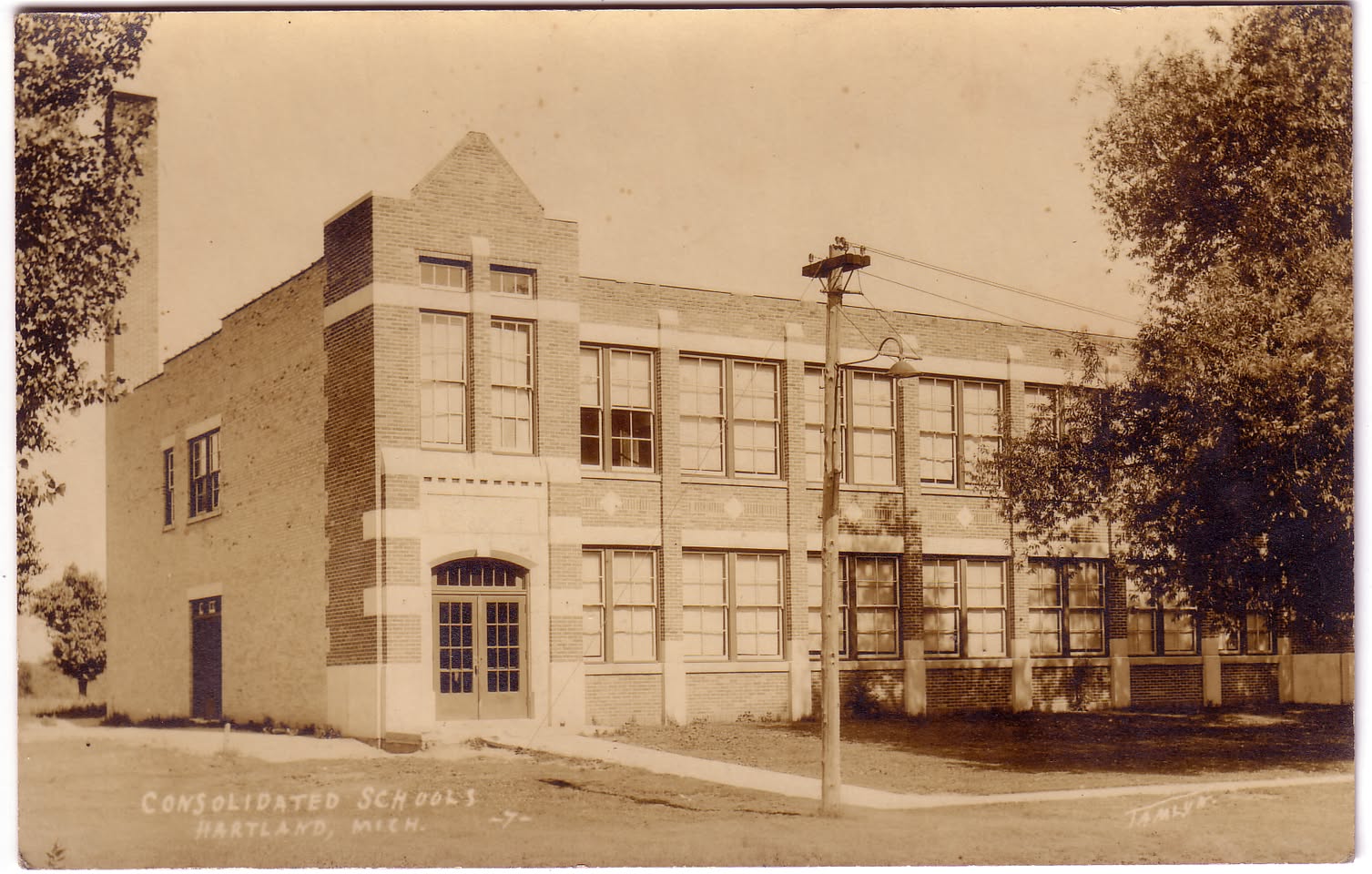
This is the building where I interviewed for the job that lasted four decades.

 What Has Your Mother Given You?

Confession: I appropriated this prompt from Steven Bechloss, who provides such a thought-starter most Saturdays. He wrote about Ann Dunham, Barack Obama’s mother—inspiring—and, in what can only be described as striking contrast, the mothers of Lee Harvey Oswald (angry, controlling) and Nixon (per Nixon, a saint).

I’ve never been very excited about Mother’s Day. For starters, I disagree with the stylebooks’ use and placement of the apostrophe. What if you have two moms—and you love ‘em both the same? Why not just Mothers Day—acknowledging mothers without possessing one? But I digress.

Which may be something I got from my mother, who could turn a five-minute straightforward narrative into a half-hour of (amusing) verbal wandering around in backstory.  She also had a wicked sense of humor—she was Class Cut-up in her Muskegon (MI) HS yearbook, 1945.

My most memorable moments with my mom were not classic mother-daughter rituals. She never helped me pick out a wedding dress, and wasn’t present when I married my husband, in a judge’s chambers. She wasn’t there when I was in childbirth. She seldom commented on my major life decisions. We didn’t have long, rambling phone conversations because they would have been long distance—and her monetary meter would have been running.

But when I was in college, and came home late from summer jobs, we lay on either end of the couch eating ice cream and watching Johnny Carson and laughing at nothing much until tears ran down our cheeks. I always knew my mother loved me, and was proud of me, and that was enough.

The last words I said to my mother were “Love you,” and she replied, “Love you too, honey,” and then I hung up, and got on an airplane to Florida, for an education conference. I was awakened by a phone call early the next morning, telling me she was gone, at age 73, of a cerebral hemorrhage. It seemed like the final injustice, gone so soon, for a woman who lost her father at age seven, her husband at 52, and suffered a catastrophic health event a couple of weeks after she retired at 65, one that kept her hospitalized for months.

I know lots of people who have Mother Stories—adventurous moms, politically savvy wine moms of either party, domineering moms, crazy moms. I’ve heard people say that their mother was their biggest cheerleader, or nit-picky, never satisfied with their children’s life outcomes.

But not my mother. She never bailed me out, but she never made me feel like a failure, either. Instead, she was… steadfast. And kind of low-key and snarky. Fun to hang with, someone who took life as it came.

I think Steven Bechloss was looking at three typical models of mothers—the ones who shaped their sons for better or worse. During my 35 years in the classroom, I saw mothers who were high achievers and expected the same of their children. I saw bitter and controlling moms—and some who thought their sons could do no wrong, even when the evidence was flashing red, right in front of them.

But it always seemed to me that children are not possessions or projects or even direct reflections of their mothers. Good parenting helps, of course, but in the end, kids are born with self-determination, their own temperament and personality.      

I’m glad my mother let me be myself. I think it’s a practice worth considering, on Mothers (no apostrophe) Day.

Hate Definitely Has a Home Here

If there’s one question on the minds of my friend group these days—old friends, fellow teachers, new acquaintances, anyone paying attention—it’s this: How can anyone, let alone a third of the population, look at current events in the United States in the past year, and believe that we are on the right track, doing OK, making our people and nation stronger?

I don’t really have to spell it out, although I am mindful of Rachel Bitecofer’s principle: repeated negative messaging works in electionsbecause voters will  only be mad about what we tell them to be mad about.

So here’s the bottom line: we are in real trouble, as a nation, on dozens of fronts, beginning with the fact that we are being lied tovicious lies, filthy lies, heedless lies—on the regular. Even teaching the truth about history and science in ordinary classrooms, museums and national parks has been explicitly forbidden, plaques removed, educators silenced.

Teaching has never been easy, but it’s really a miracle that so many fine teachers are still in the classroom and finding some satisfaction in their work there. According to an EdWeek Research Center survey on teacher morale, teachers described their feelings about teaching as a very lukewarm positive—a +13 on a 200-point scale, ranging from -100 to +100.

Last year, teachers were slightly more positive, at +18, but that’s hardly a ringing endorsement of the world’s most important and rewarding profession. Interesting nugget: teachers in Arkansas reported the highest morale (+24); Pennsylvania, the lowest (+1). Make of that what you will.

Which is why I loved reading Paper Girl: A Memoir of Home and Family in a Fractured America by Beth Macy.  Macy, who also wrote Dopesick, a book that helped me understand opioid addiction, travels to her hometown of Urbana, Ohio, once a thriving town with good schools and a solid middle class. She was looking for reasons that people there voted—three-quarters of them—for Trump.

Among her heroes, the people who are still seeking to preserve what’s good and healthy in a failing Midwestern town, are teachers. The teachers she interviews, and whose work with and dedication to Urbana’s public school students is fierce and clear-eyed, are one of the last walls between kids making headway in life, and disaster. 

Macy also remembers the teachers who helped her get away from a working-class background with the help of Pell grants, talent and a lot of luck. Her siblings were not so lucky—one of the most painful parts of her narrative are conversations with her brother and sisters, and her niece who suffered from a stepparent’s abuse.

It is through these conversations and seeing how despair and the empty promises of preachers and politicians impact the down and out, that I began to understand who votes for powerful liars, and why.

It also helps explain why Americans hate each other:
The Pew Research Center finds that 53% of American adults describe the morality and ethics of our fellow citizens as “bad” (ranging from “somewhat bad” to “very bad”). In the 24 other countries polled by Pew, most people called their fellow citizens somewhat good or very good. At the opposite end of the spectrum from the United States is Canada, where 92% say their fellow Canadians are good, while just 7% say they’re bad.

Macy does a superb job of weaving anecdotes and memoir about growing up in a town that feels very familiar to me, also a Midwestern girl. She analyzes just what went wrong, much of it having to do with international trade, the dangerous equity gap, decades of negative political messaging about welfare queens. The demise of empathy, and the rise of right-wing pole-barn churches with fundamentalist men at the pulpit. Greed. Racism. Sexism.

Although the book won a number of awards (and was one of Barack Obama’s favorite books in 2025), I found the comments from readers enlightening. Either people loved it, finding that it deepened their understanding of just what is happening in the forgotten little towns across the country—or they hated it, believing Macy is encouraging people to talk to the enemy.

Which is a strategy that has not worked, commenters say. Unless we fight back—the “pound the negative message” model—we keep losing ground. Forget people in your past, your family. They’re the ones who voted him in. The enemy.

Who’s right?

I looked for a photo of Beth Macy and discovered she’s running for Congress in a ruby-red district in Virginia. It’s apparent to me (if not to her readers) that she’s willing to fight hard against the damage to our democracy.

She’s also right about teachers—especially those with the courage to stand up for truth, for the kids they serve, no matter their prospects. Donation sent.

Here in northern Michigan, an elderly gentleman who’s spent his life working for progressive causes was so upset about seeing Barack and Michelle Obama portrayed as apes that he called his neighbor, offering to fund signs to place around our small county, saying HATE HAS NO HOME HERE. She honored his request, designing and ordering signs.

During this process, the gentleman died. The signs will be ready next week, and planting one at the end of my driveway will be both advocacy and memorial. What I’d really like to see is a couple of those signs posted around our local school. Because that’s one of the few places where hate speech and hate actions are actively discouraged and prohibited.

Read Paper Girl.  If you’re like me, you’ll love it.

Gifted and Talented Redux

I got my master’s degree in gifted education—actually, a master’s in curriculum and instruction with an emphasis on identifying and serving gifted students, but whatever. At the time—the 1980s—I was focused on the ‘talented’ part, as a music teacher.

What could I do, I wondered, to better understand and challenge the exceptionally proficient students who showed up in my band room? There had only been a handful, at that time, students who leapt over my pedestrian instruction, right into credible Mozart concertos in the 6th grade, relying on recordings and (this sounds so quaint) library books about the great composers and their style characteristics.

I had many thoughtful conversations with people in my master’s classes, in my building, and fellow band directors (whose advice was generally directed toward private lessons and summer camps–the ‘better teacher/better cohort’ theory). But overall, takeaways on who was gifted and what to do about it were murky.

One person’s budding genius was another teacher’s ho-hum. A lot of it had to do with perceived student effort, and very little was about digging gifts and talents or even preferences and goals out of kids who were content to skate by.

Also, lots of kids who had exceptional natural talent in playing instruments were not so gifted in other areas, and therefore not interesting to the guy teaching Algebra II to 7th graders. Just because you can flawlessly pick up salsa rhythms with all four of your limbs or produce a crystalline high C on the trumpet doesn’t mean you’re… gifted. Or so it seemed.

I’ve written many pieces—here, here, here, here and here, for example—about giftedness. Invariably, they draw nasty comments. It’s very much a tender spot for parents of bright children who worry that their children are not being adequately challenged. Or are ignored by their teachers because so many other kids are struggling or misbehaving. I get it.

But I also know that talents and gifts are randomly distributed across school populations and have to be developed over time, with the cooperation of the identified GT student. I was struck by this quote from a spokesperson for Mayor Zohran Mamdani, reflecting on the mayoral decision not to test kindergarteners to determine who’s gifted:

This administration does not believe in G. & T. evaluation for kindergartners. But that’s not the same as eliminating advanced opportunities across all grades. 

My thoughts, precisely.

I recognize that NY City is unique—such a diverse population, so many school options, such hot politicking and parent-pleasing—but I fully agree with the mayor (or his advisor, more likely): Testing five-year olds for giftedness is ridiculous and bound to siphon off disadvantaged kids before they’ve really had a chance to, you know, go to school and learn stuff.

It’s the ultimate, rigged-end game: the outcomes of inequality, right out of the chute. Dividing the herd, yet again. Why? How does that help us?

If I had faith in any test to identify extraordinary, socially useful intelligence, skills, or creativity, I might feel differently. But I don’t. What I do believe is that all children deserve a rich and challenging education, whether a test identifies them as potentially brainy or sub-par. You just never know what role they might play, eventually, in making the world better.

Since more than half of American teens now admit to using chatbots to do “research” that they may not be able to evaluate for veracity, to write and calculate for them, it’s going to get harder and harder to distinguish students who produce genuinely brilliant work from those who are merely good at disguising where that work product originated.

We still need brilliant original work—not to feed the AI maw, but to enlighten ourselves, cure diseases, prevent wars, create peace, to explore, entertain and inspire. We need the indisputably brilliant kid who plays salsa rhythms but forgets to turn in his social studies worksheets for some reason. Because he has gifts to share.

We need a new definition of ‘gifted’—and maybe one for ‘talented’ as well. We need to stop accepting the assertion that machines are helping students learn better than human interaction and judgment. And most of all—we need to stop cutting kids off at the pass, sorting and labeling them when they’re in kindergarten.

Photo:sanbeiji (Creative Commons)

Sex Education, v. 2026.0

The Michigan State Board of Education approved a new set of guidelines for sex education in Michigan public schools late last year. They heard copious commentary from the public, worked with experts, teachers and parents, and settled on a revision that included informing students—just the facts—about varying ways that humans express their sexuality and gender.

As a parent and veteran teacher, I’ve been through many iterations of sex ed curricula, local and state, decades’ worth of changes and hot issues, explosive board meetings and muttered accusations. I’ve heard many parents express worry that their precious children—no snark—might be learning something that they don’t talk about at home.

They don’t express it like that, of course, but that’s what it usually comes down to—fear. Fear of other peoples’ values, fear of change, fear that their own child will not follow a single, approved track into adulthood. As if avoiding exposure to things we don’t approve of will mean our children won’t be tempted by them. (Snorting.)

Speaking personally, I was always grateful that my kids had a no-nonsense health and sex education teacher. I was glad that they discussed embarrassing things, boys and girls together, in a factual way. And that their teacher had a sense of humor in addition to good information.

IMHO, sex ed is one of those “takes a village” things, especially when kids are utterly surrounded by—even drowning in—graphic sexual images, language and concepts, many of them inappropriate, to use a teacher word. What is appropriate is bringing these ideas up in a classroom full of other 7th graders and dispassionately telling kids the truth.

I read through the revised version—skimmed it, noting the places where the language I was familiar with from back when my kids were in 7th grade had changed (this was the first revision in over 20 years). It all seemed pretty normal, developmentally appropriate, and so on. What hadn’t changed was the parental right to opt students out of all sex education lessons—guaranteed. In addition, every school district needs a parent advisory committee to tailor the curriculum or address questions.

What’s different in 2026? Sex education has become partisan. It’s always been politicized, with opinions across the spectrum on the value of reproductive health and sexual hygiene as school subjects vs. family prerogatives. But now, there’s a Republican POV and a Democratic perspective:

At an Oversight Committee meeting, House Republicans questioned Interim State Superintendent Sue Carnell about how many genders there are and the reasoning behind the department’s proposal [to update sex education guidelines]. 

This time-wasting challenge to a standard policy revision all seems to be rolled into a right-wing pushback on what they call ‘woke’– the US Department of Education’s proscription on ending anything to do with diversity via “Dear Colleague”  letter, for example, or FL Governor Ron Desantis vacating the Board at New College. The new MI sex ed guidelines passed 6-2, on party lines, as MI State Board members are elected rather than appointed—an option that Republicans (perhaps too optimistically) have endorsed in the past.

 But wait! you might be saying—didn’t that letter threatening schools (and, natch, school administrators) with funding cuts if DEI programs (to be defined by ED) were discovered on campus get struck down? Here’s one take on that:

Trump’s Department of Education conceded defeat on its unconstitutional directive to cut federal funding from any school with DEI programs. After the National Education Association and the ACLU sued, a federal court permanently invalidated the order—it can’t be enforced against anyone, anywhere, ever again.

As a lifelong educator, however, I agree with Peter Greene—this is a minor setback for the anti-woke Russ Vought types, perhaps, but there are many more ways for the feds (and compliant states) to stick their lily white fingers into the running of our nation’s schools. So many things to mess with, flooding zone after zone, dividing the resistance, blurring lines.

You could require Bible readings in public schools, for instance.

You could gut decades of work from actual K-12 history teachers by creating a junky, misleading History Rocks curriculum. From the NYT’s Jessica Grose:

I spent the last week talking to public school parents who were not excited to hear that the Secretary [Linda McMahon] was coming to Alabama, Illinois, New Jersey and Connecticut because of the extremely conservative, anti-L.G.B.T.Q. and Christian makeup of the America 250 Civics Education Coalition. They were concerned that this tour was part of a larger Trumpian effort to whitewash American history.

Bingo. But it’s just one large drop in the anti-woke bucket.

This week, they came after Michigan’s new sex-ed guidelines:

The U.S. Department of Justice has opened an investigation into three Michigan public school districts — Detroit Public Schools, Lansing Public Schools and Godfrey-Lee Public Schools, a small district in Kent County — for inclusion of “sexual orientation and gender ideology” content in the districts’ K-12 curricula. 

Here’s the letter they sent to these districts. It’s filled with lofty language about parental rights, vague but intimidating threats—we’re launching a federal investigation into your school!—and pages of demands for a truckload of specific documents and verifications, all due in six weeks.

I can’t figure out how ED (what remains of it) chose these districts to torment. Detroit and Lansing are large, urban districts where a diligent attempt to meet the federal investigation requirements would be incredibly onerous, to say the least. Godfrey-Lee is a small district (1700 students) in a suburb southwest of Grand Rapids. Ninety percent of its students are minorities; most of its students are living in poverty.

The superintendent told the press that there have been no charges, and they’ll cooperate fully—but what the hell? Was there a complaint? Is it just random harassment? Or perhaps their state legislators were the real target, since the feds couldn’t get to the State Board of Education and punish them for doing what they were elected to do: revise policy.

Bottom line: this is none of the US Dept of Education’s business.

Sex education—the reality of teaching it, not what pages of policy prescribe—is always going to happen in classrooms, shaped by teacher discretion and students’ questions. The best we can hope for is a no-nonsense, caring teacher with a sense of humor and good information.   

Does Love Really Make the World (or Classroom) Go ‘Round?

Some years ago, when talk radio ruled the discourse, I was listening to a national teacher union leader talk with a right-leaning—and nationally recognized—radio host. The topic was teachers as catalysts for improving public education.

The union leader mentioned National Board Certification as a model for identifying teacher leaders, the kinds of folks whose classroom expertise was validated, whose ideas about advancing public school achievement could be valuable.

Radio host: So what do these so-called nationally certified teachers have to do to prove they’re good?

Union leader: Well, they are assessed on five core principles of pedagogical excellence. The first one is knowledge of their students, and what they need to succeed. Teachers need to be committed to their students and their learning.

Radio host (full of snark): So good teachers just have to love the kids? Hug ‘em until they drop out?

That conversation—which could have featured any of the podcasters grabbing the public ear in 2026—is familiar. Lots of media figures seem to feel that the cure for “fixing” public schools is coming down hard on kids, raising the bar, forcing them to pull up their (nonexistent) bootstraps and get to work, damn it.

I thought about that conversation when I read this headline:

Valentine’s Day events around Minneapolis take on the ‘horrors of the world’in the Minneapolis Star.

Tag line: After a heavy start to the year, some Minneapolis residents are using Valentine’s Day to love thy neighbor.

Bingo. ‘Love thy neighbor’ is currently working in besieged communities like the Twin Cities. It works in the classroom. In fact, getting along is Job #1 in classrooms.

Kindness. Patience. Respect, a two-way street.

And then—and only then—engagement. Communication and collaboration. Joy, even. Deep learning.

Why is that so hard to believe—or understand? Human beings seldom respond to fear, threats, isolation or humiliation. They shut down—or fight back. People who relish the idea that the modern-day equivalent of smacking kids’ hands with a ruler is a productive idea are wrong.

From the National Education Policy Center newsletter:

…70% [of surveyed U.S. principals] said that “[s]tudents from immigrant families have expressed concerns about their well-being or the well-being of their families due to policies
or political rhetoric related to immigrants.” These impacts on schools across the nation are shockingly pervasive, and those impacts can be devastating, even for those students not directly targeted. “Fear undermines the ability of public schools to foster a civic community,” [survey author John] Rogers told Education Week last month.

This is unsurprising—and none of this is new. The ecology of school success has always centered on relationships. When everyone—and this includes teachers—feels comfortable and part of the community, stuff gets done.

In fact, Herbert J. Taylor created a set of ethical guidelines for the Rotary Club in 1932 that might be useful for anyone concerned with kids’ well-being in 2026. It consists of four questions to guide all our decisions:

  1. Is it the TRUTH? 2. Is it FAIR to all concerned? 3. Will it build GOODWILL and BETTER FRIENDSHIPS? 4. Will it be BENEFICIAL to all concerned?

Is our government using any of these old-fashioned, even corny, principles to guide their actions around immigration? Or election security? Or ethical business practice?

Do we have to love our students? No. That’s not reality—or practical.

But caring for each other may be the only thing that will save us, in these dark times.
Happy Valentine’s Day.

ICE: Not your friendly neighborhood cops

I was talking with an acquaintance, and made a comment about ICE being reported in Leelanau County. Don’t you want to see illegal immigrants gone? she asked. Besides, they’re only picking up the ones with a criminal record.

I was dumbfounded. I knew she was likely a Republican; our points of contact have nothing to do with politics. But still– it came as a shock to know that she felt ICE was doing good, justifiable work– keeping her safe, here in nearly all-white Leelanau County.

This didn’t feel political. It felt personal. How could anyone who’s paying attention to the news support an out-of-control federal agency, ripping families apart and harming American citizens, with our tax dollars? Could you be a good person while accepting government-sponsored violence against innocent people?

There were lots of questions I could have asked, researched and validated arguments to be made, beginning with data about the non-criminals and citizens who have been detained. But–shamefully, I admit–I said nothing, just changed the subject to the reason we were meeting.

Thinking it over, I resolved not to just ‘let it go’ anymore. It’s true that many of these folks have made up their mind and are impervious to facts. And, at this moment, nobody is out in the streets when the wind chill is 25 below.

But–thinking people, actual good citizens, care about the people who live in and serve their communities. We are not seeing public safety being played out. We are seeing the base of a presidential posse–men with vicious grudges and biases empowered to destroy public services and schools. We all need to speak up.

Even when it’s socially awkward or unlikely to change minds.

Why? Well– read the article below. It’s a gift article, so you can read the whole thing.