The Demise of Genuinely Public Education

“Censorship reflects a society’s lack of confidence in itself. It is a hallmark of an authoritarian regime.”

Potter Stewart, Supreme Court Justice

There is no more local-politics issue than public education.

From Mom gossip about teachers, watching Little Leaguers play, to intense competition for valedictory honors with all the teenaged strivers loading up on useless AP credits—any community’s buzz continually includes trash-talking the local public schools.

The charter school movement tried to take advantage of this, co-opting public education by taking its best features (it’s free, it’s local) and blending them with private school features (selectivity, glossy PR). This has resulted in more waste, fraud and abuse—the very things public schools were accused of, before charters were even invented. In the process, charters drew significant resources away from genuinely public schools.

This is, of course, old news. Charters, vouchers, unhappy parents, ‘education savings accounts’ and court decisions shifting resources away from common schools have been with us for more than a century.

My first political activity, in fact, was phone-banking against a voucher initiative in MI in 1978 (it went down, 3 to 1—like two subsequent voucher proposals). The first time I went to a heated school board meeting, to defend my district’s well-designed sex education curriculum, was even earlier.

Public education has always been under-resourced, contentious and subject to the community it serves. The people who work in public education have always been underpaid, but generally aspire to improve society by helping kids. There are exceptions, of course, but years of history and research bear this out.

You might think I’d be used to this, what with all the banned books, slashed programs (often my own) and vehement parent rhetoric in my personal past. You might think I would be applying the evergreen ‘this too will pass’ theory to what’s happening today, confident that the pendulum will swing, the pandemic angst will fade, and we’ll be back to our highly imperfect normal: public education under siege, but still standing.

It’s taken some time for me to come to this opinion, but I foresee the end of what we currently call public education.

The tipping point is a global pandemic—but the great, battered ship of public ed has been taking incoming fire for a long time. Chunks of its initial purpose and mission—an educated citizenry, democratic equality, a broad introduction to the real world and the humanities—have been regularly chipped off. Something new and malevolent, however, has taken root: an overt push to use public education and already pissed-off parents to win elections.

Today, NPR posted an article entitled ‘Teachers are on the Front Lines in January 6th Culture War.’

It’s a pretty good piece, featuring an array of teachers and curricular experts discussing the difficulties of teaching current events on the anniversary of the January 6th insurrection, after the nation and the Republican party has had a year to, you know, just get over it.

There are brave teachers in MA and MT who are planning to show news videos and discuss the root causes and eventual outcomes. But there’s also a special ed teacher (and regional chapter chair of Moms for Liberty) in Indiana, who’s sticking to math and English, in an effort to be ‘unbiased.’

Unbiased against what? Protecting the rights of camo-clad faux-military marauders to despoil the U.S. Capitol and threaten the lives of Members of Congress? Not willing to sway student thinking about the peaceful transfer of power? Trying to stay neutral on the topic of domestic terrorism?

Just whom are we censoring here? And whom are we protecting?

The story ends with a quote from a middle school teacher, Dylan Huiskan: Not addressing the attack is to suggest that the civic ideals we teach exist in a vacuum and don’t have any real-world application, that civic knowledge is mere trivia.

Veteran public school teachers like me have spent decades developing real-world content discipline applications for our students. We have fought against sterile data-driven education, the relentless pursuit of test scores, the pushing Science and Social Studies and the Arts out of the curriculum. We’ve been trying to DE-trivialize education, professionalizing our own work in the process.

But now we’ve got teachers who think their colleagues are indoctrinating students, by showing them actual live news footage, or discussing an event that happened within their short memory and has huge impact on their own futures as American citizens.

Things are falling apart. We have been crushed by an unexpected medical disaster. One of our two political parties has gone off the rails.  Civility is deadand oh yeah, the planet is fighting back after years of heedless neglect.

And now, we’ve decided to warn teachers—teachers! –not to tell the truth.

As a blogger, I have repeatedly asserted the truism that American schools, often the target of political and media scorn, merely reflect the communities they serve. If that is true—and if democracy is indeed threatened by the events of 2020 and January 6th, then our public schools are threatened as well.

Once, years ago, I wrote a blog using the phrase ‘data Nazis’ and a friend I respect, and trust, chastised me. Use logic and facts, he said. You weaken your arguments when you oversell and hype the danger.

 But maybe the next Civil War is here. Maybe public schools will become a tool for the wrong side:

 Nobody wants what’s coming, so nobody wants to see what’s coming.

On the eve of the first civil war, the most intelligent, the most informed, the most dedicated people in the United States could not see it coming. Even when Confederate soldiers began their bombardment of Fort Sumter, nobody believed that conflict was inevitable. The north was so unprepared for the war they had no weapons.

Is that overkill? Unclear.

But if it’s not—what are our weapons against losing genuinely public education?

Six Gigantic Problems, Six Wrong Solutions in Public Education

So here we are, at our local schools, trying to stay afloat, with daily crises incoming.

The adults who are still bravely teaching, teaching, teaching (+ making administrative and child welfare decisions) in spite of the fact that the world seems to be on fire around them, need help. Don’t take my word—just read pretty much any educator-written blog from 2021.

When we have massive social problems, how do we generate and roll out solutions?

The answer is: Policy.

Policy is how we mounted a successful response before, during and after World Wars, developed and refined sequential national transportation and communication systems, and came back from significant economic depressions. We can point to any number of policy-driven transformations in these United States.

Once policy is put in place, and implemented, we can see its real-world effects. Optimally, the policy will be tweaked until it does what it’s supposed to do: solve the problem. Or at least move things in the right direction.

Yes, it’s infinitely more complex than that—designing good policy is way more than guesswork and a good feeling about how to fix the trouble.  And yes, policies sometimes make things worse. Way worse.

I would argue that public education is one area where terrible policy is now endemic—and sometimes, after clear failure, overlaid with even worse policy. The sheer dispersal of decision-making responsibility is part of the reason. There are legislative levels—federal/state/local—and a whole array of other organizations (the PTA) and people (the Athletic Director, the Union president) who have policy-making roles, assigned as well as assumed.

In fact, it’s hard to think of an education-related policy that has effectively and sustainably worked, beyond the granddaddy of all ed policy: a free, high-quality, fully public education for every American child, no matter what they bring to the table.

Lately, this wrong-policy trend in education has been on steroids—both the frightening gravity of the problems as well as the foolish, even ludicrous suggestions to address them.

A few examples:

PROBLEM: School shooting in Michigan

WRONG SOLUTION: (from a member of the State School Board, no less)—eliminating the attendance requirement for children to go to school in Michigan. State Board of Education member and Republican Tom McMillin posted this suggestion on Facebook last week, saying the “state needs to stop dictating terms of education of our kids.”  You may wonder how McMillin construed this as a solution to mass shootings, but he claimed parents could improve their children’s mental health by keeping them home for as long as they chose.

PROBLEM: Underfunded schools, leading to low salaries and lack of resources

WRONG SOLUTION: A Cash Stampede with teachers on their knees, grabbing dollar bills, in competition with other teachers.  I’ve seen this horrible video compared to the Hunger Games, but to me–with the cheering audience teachers on their knees, scrambling to pay for the tools they need to work– I am picturing the Christians and the lions, at the Colosseum in Rome. So amusing!  BTW, you don’t have to be a policy expert to see what the only real solution to this problem is.

PROBLEM:
Student mental health crisis, due to the isolation and uncertainty of being a child during a global pandemic

WRONG SOLUTION: Deciding that Social-Emotional Learning initiatives, whether they be commercial programs or merely a group of educators trying to help kids get through the first worldwide crisis in their lifetime, are somehow tied to Critical Race Theory, and therefore should be formally banned in our classrooms. Or that SEL is a ‘perilous’ waste of time and money, stealing time from Algebra. There are many viable ways to address the mental health crisis. All will be multi-faceted, and involve an array of attentive and thoughtful adults, determined to buoy the children in their care.

PROBLEM: Not enough teachers, not enough subs, not enough bus drivers

WRONG SOLUTION: Lowering the bar to get warm bodies in classrooms or behind the wheel. Or hiring year-long unqualified substitutes because the requirements for subs are less. Once again, there are many viable policy options to fix this. Suggesting we throw up our hands and let anybody in our classrooms is not only counterproductive—it’s dangerous.

PROBLEM: Student scores on standardized tests remain stagnant, or go down

WRONG SOLUTION: Fix the teachers, through rigorous evaluation of their behaviors and ‘success,’ including those same test scores. If this solution feels convoluted—well, the idea that a mountain of data could serve as a spur to improve practice has never worked particularly well, anywhere. It’s a data-focused non-problem, with a data-focused solution, neither of which matter much, in the real outcomes we want from public education.

PROBLEM: As COVID numbers rise, merely coming to school is stressful. Widespread absences and anxiety.

WRONG SOLUTION: Adding more half-days to the school schedule. This one started out on the right track—less time exposed to unvaccinated children, pre-planned time away from face-to-face learning. But, as most districts have learned, asking for Wednesday afternoons off is not likely to endear you to parents, who have pushed for full-time school in a pandemic, because they need to work.  Less time in school and more technology-focused interaction is probably where we’re headed anyway, like it or not. Four-day weeks. Virtual conferencing. On-line lessons. The new normal. But let’s not worsen the child care crisis in the process.

There have been some good suggestions for addressing issues bubbling up in 2021, the best of which are coming from those closest to the work. And there have been some heavily recycled, proven-wrong policy frameworks that the same old policy creators having been pushing for two decades now, thrown out to see if they’ll stick, when everyone’s distracted by the ongoing dumpster fire.

Where should policy-creators get their ideas about solving big problems?

Because we are living in a completely different world now than we were two years ago, we should look first at the proposed solutions from people who are up close and personal with the problem. The people who are still, in spite of the danger and frustration, willing to be public school educators.

One last thing, for those who would like to tailor solutions to ‘the marketplace’ rather than the common good: Problems in public education are also problems in private and quasi-private (read: charter) schools. School violence, student mental health, the empty teacher pipeline, lack of resources—they’re apparent across the country, in all kinds of schools.

I got a heart-tugging message from a friend who is Principal in a small Catholic elementary school on the border of Detroit, a couple days after the shooting in Oxford. Local police had alerted her to threats that were ‘terrorist in nature,’ suggesting the school close down. But in consultation with her staff, they thought students (who had lost many relatives and caregivers over the past year) would be safer in school.

She said it was a fairly normal day, although she couldn’t wait for the dismissal bell. Then, she went home and threw up.

She wrote:

I am so done with all of this. My job is no longer one of an educational leader. I am an emergency manager around pandemic, school safety, bad weather conditions that flood our school or knock the boiler out… It is rare, very rare to have anything to do with education. I want to return to overseas international schools where the innocence has not been stolen from children. What we have here in the USA is worse than when I fled Sudan due to a revolution. I could understand a revolution. This I do not understand.

Me, either.

Should School Staff Be Charged in the Student Shootings in Michigan?

I waited for the headlines, and here they came: Oxford School District Likely to Be Sued Over ShootingsFurther tart media observations: What does it take to get suspended from Oxford High or searched after violent scribbles? And: Red flags the superintendent blandly describes as “concerning drawings and written statements” that alarmed his teacher.

If I were only seeing these remarks on right-leaning media (where public schools are all presumed to be guilty of So Many Things—including blandness), I wouldn’t be surprised.

But I’m also seeing remarks trying to pinpoint blame for this shooting  posted on teacher/education/lefty sites—by teachers blaming weak-on-discipline administrators, university professors going after mush-mouthed PR-driven superintendents, and school leaders saying their hands are legally tied, when it comes to searching backpacks and booting kids out of a public school without due process.

I’ve read perhaps a dozen lengthy descriptions of what happened, including a detailed timeline provided by the district superintendent, who keeps stressing that the Oxford Schools want to be transparent.

And frankly, my take-away—this is incredibly sad—is that school folks did what they reasonably should have in this instance, and that nothing will cause real change (including metal detectors, more school resource officers, tripling the number of guidance counselors and requiring clear plastic backpacks), until there is a national, minds-and-hearts shift. Gun control, yes, but also a different political ecology.

There’s a whole complex of reasons why American students are surrounded each and every day by allowed, even encouraged, violence.

I was a classroom teacher for more than 32 years, most in the same district, all but one year in secondary schools. I have had students who committed grisly murders. I have students who are currently in prison for major crimes (including one dude who scratched an epithet into a brand-new tuba when he was in the 7th grade). I had kids who sold weed and pharmeceuticals. A handful of my former students took their own lives, or the lives of others, in various ways. One of my students burned down his own house. On purpose.

Each and every one of these students was white, and attended school in a small-town-values kind of place.

Sometimes, there are obvious signs. Sometimes, not. Some kids grow up and out of their worst behavior. Others, who appear to be quiet or moody, turn out to be capable of unspeakable actions. Contrary to what some believe, there is no infallible ‘check for mental health’ procedure.

The worst-behaved student I ever had—a daily pain in the ass who disrupted the entire school building with his rambunctious and hostile behavior —is now a multi-million dollar real estate salesman.

Many years ago, a HS student in a nearby district brought a gun to school, and showed it to a friend. This was in the zero tolerance/punk prisons era—and he was expelled and sent to Juvie. It was in the local newspapers. Because he was a minor, his name was never printed.

A month or two later, I got a new student in the HS band, a tenor sax player. I asked where he went to school previously, and he told me: the next district over. He was a good player, and quickly made friends. The more I got to know him, the more I appreciated his wit, kindness and intelligence. I took him on a band trip to Toronto. He graduated.

Later, of course, the school counselor caught me in the hallway and informed me that he was the kid who brought the gun to school. Thought you should know, she said. You weren’t here when we had the meeting about accepting him.

Social media comments proclaim that any kid who sketched weapons with blood dripping, or penned a self-doom/anti-social message in gothic lettering that caught a teacher’s eye, should be searched immediately then sent home. Pronto.

But–kids draw and paste all kinds of stuff in their notebooks and on their homework—everything from swastikas to oversized anatomical features. Think: video games.

Are we seeing incipient violent tendencies—or teenage boredom? Who gets to judge? The fact is, we don’t generally kick kids out of school for their immature drawings or weird teenage behavior—unless there’s a pattern, over time.

The fact that two teachers reported ‘concerning’ drawings and cell phone use to find ammunition, over the space of a couple of days, means that the adults in school actually were tracking this child. They asked his parents to take him home, and get him immediate counseling. They shared their fears. And the parents refused.

I was struck by one of the superintendent’s remarks—that if they had forced the child out of the building, when the parents refused to take him, the boy would have been home alone. Hanging behind that remark is another fear educators are dealing with during a mental health crisis: What happens when depressed children are home alone, and there are weapons?

I had a student once, a 7th grade girl, who wrote little notes to me, about her feelings of being ugly, a dork, not having friends, and so on. I tried to pay special attention to her, but the language became more frightening– ‘What will they think when I’m gone?’ I took the problem to the school counselor. She asked: Do you think this girl would harm herself, or is she just seeking attention?

I honestly didn’t think she would. I thought she was just lonely. But I still wanted a referral to the counselor, and a parent call. The counselor agreed, but said that parent calls of that nature often didn’t go well. The school might be seen as high-handed and intrusive, telling a family their child had talked about suicide.

Still, she was willing to do it. Because it was the next step. There are protocols for this kind of thing, she said. We follow them.

Would that all parents tried to do the right things, too.

You’ve probably noticed that there are Moms for Liberty organizations and now, faux legal strategies for parents to demand the rights they already have,  popping up like mushrooms, to keep those high-handed, mask-demanding schools in their place, to press forward on incendiary social issues. The climate for productive school-parent conversations (never a given), has been negatively impacted by living through a highly stressful pandemic and its emotional aftermath.

The core resource for well-functioning schools is—and always has been—trust. All good school practice—public/private/rich/poor—hinges on relational trust.

When parents don’t trust schools to have their kids’ best interests at heart, we’re all in trouble. When there is a deliberate push to de-stabilize school boards and overrun safety rules, the trouble gets worse. Without some measure of trust, we can never help the kids who need our help most.

My heart goes out to all the educational staff in the Oxford Schools, working through the worst that can happen in a school community.

Thank you, as the saying goes, for your service. I wish you and your school healing.

Violence and Threats in Schools: Who’s Responsible?

It’s been a terrible week for teachers in southeastern Michigan. A terrible week for students and families and school communities as well. Early yesterday morning, school districts—by my count, at least 60, but that was an early tally*—began announcing that out of the proverbial abundance of caution, they were closing down for two days.

They’re not closing due to COVID (although Michigan’s school-based infection rates are ghastly at the moment). They’re shutting down because of spiraling threats of in-school violence, spread on social media.

School leaders are terrified. Not one of them wants to be the next school where an angry, disaffected kid shoots off more than his mouth.

I have dozens of friends who teach near Oxford, site of Tuesday’s massacre in Oakland County, and know many others who have children or grandchildren in the district.

I have been reading their social media threads: First, the reassurance that they’re fine. Then, sharing of how they knew the students who were injured or killed: a friend of their daughter’s, their babysitter, the boy who was in their second grade class, years ago. Sometimes, anger over the words and actions of the shooter’s parents. Photos of the dead, and #OxfordStrong hashtags.

Then, inevitably, the conversation turns to blame. Copies of the two messages of reassurance sent by Oxford school administrators to parents earlier this month—saying hey, we know about these threats and we’re doing something—are shared. There are repeated acknowledgements that the school followed all the recommended safety protocols. So how did this happen?

Two things—true things—are repeated endlessly in these dialogues. The first is that the nation exposed its true values nine years ago after the slaughter at Sandy Hook Elementary, choosing unrestricted gun ownership over the lives of children. The second is that we need a greater understanding and focus on mental health. In our schools, of course.

What is often missing from these heart-wrenching discussions is the fact that schools are just like malls and movie theatres and churches and political rallies—stages for playing out what it means to be an American citizen in 2021, our deepest principles and beliefs.

Despite selfless and heroic actions, despite good parenting and good teaching and due diligence on the part of school administrators and counselors—we live in a pretty ugly country right now.

We live in a country where Kyle Rittenhouse walked free. Where senators and governors boldly lie about election results. Where parents, urged by astro-turf organizations, mob board meetings to protest the teaching of facts and requiring masks in a deadly pandemic. Where thousands of brutal insurrectionists attacked our most sacred building and democratic processes, led by the President of the United States.

Also this: the Oxford HS shooter lives in a state where a gang of angry young men conspired to kidnap and execute the Governor, fantasizing about taking her to a remote location and ‘putting her on trial.

None of this mitigates the reprehensible behavior of this teenager. He is fully responsible for what he did. But it’s worth thinking about the unique context of growing up in America, the people respected as leaders in this nation, the ruthless tactics used to acquire and maintain power and ‘freedom.’

As Eugene Robinson said: I wonder if the people of Oxford, Mich., feel they have more freedom today than they did before Tuesday.

There are kids like [Ethan Crumbley] in high schools around the world. But only in the United States do we enable them to express their teenage angst by bringing guns to school and opening fire on the students, teachers and administrators they see as their tormentors. Only in this country do we make it easier for youths to get their hands on a handgun or an assault rifle than to work up the courage to ask a classmate out on a date.

This is not new. Kids have been threatening violence, mayhem and self-harm in schools for decades. My (nice/white/suburban) school district was plagued, off and on for years, by a series of bomb threats.  Legislation alone is ineffective, although strong restrictions on possession of firearms would be a good start.

That leaves us with the broad recommendation that we need more attention to mental health, everyone’s favorite ‘solution’ to the problem of social violence. I always wonder just what people think enhanced mental health services look like, in schools. Who’s in charge? What do they do?

I am a strong believer in school counseling, but anyone who’s worked in a school knows that counselors—if they even exist—are stretched over multiple responsibilities and way too many students.

The urgent, squeaky wheels for counselors are often standardized test administration, scheduling and college applications, not dealing with individual students’ bitterness or rage. If we had ten times as many qualified counselors, it would only be a band-aid on mental health for children. Compared to other nations, we have miles to go.

However. Riled-up parents now see social-emotional learning as just another intrusion into their parental rights.

Rick Hess and Robert Pondiscio portray social-emotional learning efforts as ‘perilous’—pointing out that teachers aren’t trained therapists. They fret about all the trigonometry and Brit Lit that won’t be learned, all the drooping test scores, as teachers strive to nurture their students’ emotional health, before tackling the periodic table.

I would argue that public school teachers in America understand the simple fact that kids can’t learn when they’re anxious, depressed, or hostile. Everyone’s running their own informal, ad hoc SEL program, all the time.

It’s called caring about your students.
* Per Bridge Magazine, over 150 school districts in Michigan shut down, as a precaution.

Flyover in SE Michigan yesterday–4 jets in the ‘missing man’ formation.

‘Self-Care’ vs. Sustainable Leadership

I once was on a panel at a Governors Summit on Education in Michigan. The topic was ‘teacher leadership.’ It was the usual format—each panelist gets a pre-determined number of minutes to pontificate (which they invariably overrun)—and then (theoretically) there is open discussion among the panelists, and questions from the audience. The line-up was: A state legislator, a representative from one of Michigan’s two teacher unions, and me.

I was the first speaker and started with the premise—copped from Roland Barth—that if all students can learn, then all teachers can lead. I fleshed that idea out, a bit—that practicing teachers need a voice at the policy-making table, that teachers’ control over their own professional work would enhance their practice and enthusiasm for teaching, as well as their efficacy. And so on.

Legislator was the second speaker and he strongly disagreed. He asserted that his role, over so-called teacher leadership, was oversight. Teachers are public employees who need to be kept on a tight rein; their work rigorously evaluated. If they want to lead, they can lead their second-graders out to the playground for recess (audience laughs). He and his colleagues were the rule-makers and goal setters, not teachers.

Then the union guy spoke. And he, too, felt that ‘all teachers can lead’ was a falsehood. Teachers had no business sticking their nose into policy. That was the union’s job. And it was an administrators’ job to lead a district or building—and suffer the consequences of failure. He knew plenty of teachers who were excellent classroom practitioners but didn’t have the skills, desire or moxie to lead. If they wanted to lead, they should run for a position in their union, or get administrative certification. Applause.

Because the Summit was on a weekday, the hundreds of people sitting in the ballroom were mostly legislators or their staffers, heavily from the Governor’s party, plus university and Department of Ed folks, and reporters. Not teachers.

Although I enjoyed a delicious, expensive banquet lunch afterward, I met nobody whose thinking was aligned with mine, re: organic teacher leadership.

Not a great experience. But telling.

Now, many years later, I still believe that experienced teachers want to lead, and are well-positioned to inform the conversation around education policy.

In fact, I think a lot of what happened to Democrats in Virginia—in a race they should have won handily—had to do with suppressing the threat of genuine teacher voices around what gets taught in real classrooms, maybe taking down public education in the process. Plus the utter disruption of a pandemic–and racism, of course.

Teachers are under siege. It’s not surprising that free-floating angst, generated by a highly disruptive pandemic, has been aimed at public schools. It happens cyclically—everything from rising pregnancy rates to chronic illiteracy in poverty-ridden neighborhoods is blamed on educators.

Because–you know what’s coming–everyone went to school and thinks they understand schooling. A pandemic that shuts the entire system down, however, is exponentially catastrophic, impacting everyone. Anger at public schools, even for made-up reasons, is inevitable. It’s the nearest target.

For the last century or so, teachers have been an increasingly female workforce, seriously underpaid and subject to increasingly rigid control from government and on-site leadership. Pretty much the model my co-panelists understood and defended: Some of us make the decisions, others do the work. And hey—enjoy your summers!

But it’s a relatively young and inexperienced teacher workforce now, and the frightening stories about teachers leaving, in droves, with nobody to replace them, ought to force the education community to ask themselves: What would keep the EXPERIENCED TEACHERS WE ALREADY HAVE (sorry) in the classroom for a couple more years, until we rebuild a leaky pipeline?

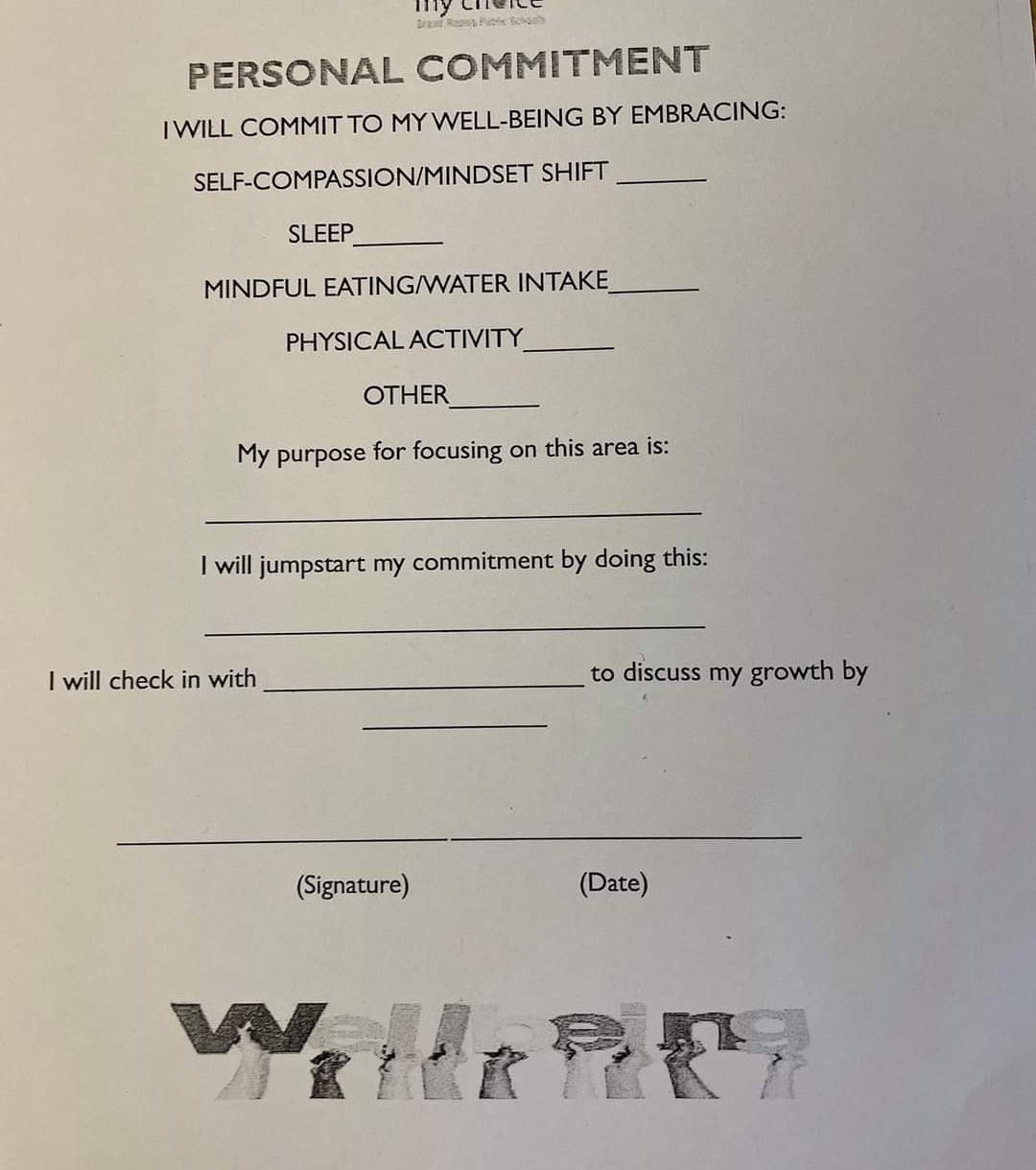
Well, it isn’t the ‘Wellbeing’ worksheet (see photo, below), which feels like one of those make-work reproducible masters teachers used to pull out on a sub day. Self-care dittos.

Here—fill this out. Feel better! Clearly, whoever designed this worksheet does not understand the relationship between drinking more water and the one three-minute window per day when peeing is possible.

Look, I understand that there’s no easy remedy for the conditions teachers are working under: Angry parents. Lies about the curriculum. Anti-vaxxer moms and virus daredevils. What could a school leader who really wanted to support her staff do?

Grow a backbone. Support public education. Here’s a list of 14 viable suggestions for doing that.

Hiring the best possible people, paying them fairly, giving them time to work collaboratively, honoring their expertise, and releasing their creativity? How does that sound as a recipe for school-based self-care?

What do teachers want? What all professionals want: Autonomy. Mastery. Purpose.

When Teachers Write about Their Practice

My fellow edu-blogger, Peter Greene, just put up another great blog. This happens with some regularity, and if you’re not reading his stuff, you should be. Not just the ready-for-primetime Forbes pieces, but his more free-wheeling personal blog.

Greene writes, with a certain edge, about a variety of education topics, and he has receipts for his opinions. When I read his words, I am right back at C lunch, listening to the veteran teachers I worked with grumble and snicker about the people who were trying to ‘fix’ schools. And didn’t have a clue about how schools worked, or what happened in real classrooms.

How could you know that every class is a balancing act—attention, content, challenge—whether your students are six or sixteen, unless you’d spent considerable time in front of a classroom? And did so recently—not 40 years ago, when we didn’t expect kindergarteners to read and everyone to take Algebra II?

As we wrestle with ‘To Mask or Not to Mask’ and just what Critical Race Theory actually is and isn’t, we need to hear lots more from experienced teachers.  Greene’s aforementioned blog, titled How I Taught Controversial Texts, is precisely what persuadable parents should read right now.

Persuadable parents are those who genuinely care more about the education their children are getting than scoring political points, or throwing their weight around. They’re curious; they want the best for their children. They may be liberal or conservative, Republican or Democrat—but they’re mostly wondering ‘What kinds of things might our kids talk about in class? What will they learn?’

Well, Peter Greene tells you. In doing so, he condenses decades worth of teacher wisdom into a few pithy paragraphs, around ideas like this:

Teachers often say that students are welcome to their own opinions in the classroom, but students will wait to see if you mean it, or if this is a class where you get points for agreeing with the teacher. So you have to show them. Once students believe that they really don’t have to agree with you, all sorts of good stuff can happen.

Offer perspectives, but let them wrangle. Let them have the argument in their own voices.

 Students are where they are. Despite all the panic over teacher indoctrination, the fact is that you will rarely budge the needle on the beliefs that they bring from home.

Don’t get out the controversial stuff before you’ve built an environment of trust, respect, and safety.

There’s more—read it here—but Greene sounded like every good teacher I ever worked with: a person with a deep understanding of their students and a strong sense of the content and activities that would push those kids to think deeply and express themselves clearly.

Of course, my teaching career in a small town in Michigan and Peter Greene’s career in a small town in Pennsylvania overlapped considerably—and we both spent a long time teaching in one place, where families learn to trust teachers.

Teaching has changed radically in the immediate past, mostly due to terrible policy-making at multiple levels, policies that have chipped away at teachers’ professional work and judgment. The pandemic explains only some of those bad decisions.

It’s time we started listening to the unfiltered voices of teachers.

I spent several years reading 12-page portfolio entries, coaching for teachers seeking National Board Certification. I was always amazed at the differing ways teachers wrote about their practice.

It was an honor to tap into their thinking (and watch videos of their lessons). For some, explaining their choices and results seemed to come naturally, something they did every day. They could explicate and justify their learning goals, and included language like Peter Greene used: Trust. Respect. Safety. Let them have the argument in their own voices.

The National Board’s word for this kind of practice is reflection. But teaching public school in 2021 doesn’t leave much time for introspection, planning learning goals and checking for results. Having your state legislature pile on doesn’t lead to better teaching or learning, either.

We seem to be at a kind of awful tipping point: Who’s in charge of teachers’ lessons?

Writing about what it’s like to be in the classroom now may be the only way well-meaning parents get some insight into ordinary life in schools–the constant effort to turn students of all ages into engaged and curious citizens, good neighbors and conscientious workers. Especially difficult now, when their young lives have been seriously impacted by an uncontrolled virus.

Keep sharing your perspectives, teachers. We need to hear from you.