Santa Claus is Comin’ to Town. Or Not.

As I write, the TV pundits are out in full force on this four-day holiday weekend. I can hear their voices in the next room, saying: ‘Wall. Build the Wall. Steel-slat Wall. There will be no wall, wall, wall.’

It’s deeply ironic, isn’t it? As every other medium is sharing messages of joy and peace—caring for those with all kinds of needs, highlighting the season of giving and forgiving, yada yada—our duly elected President is using his incredible authority to reinforce naked dominance, even outright cruelty, over those same needy folks, at this moment. No joy and peace for you, asylum seekers!

The antidote, for me, has been (more irony) social media, seeing holiday memories, wishes and celebrations pictured on friends’ timelines. I don’t know how many dogs in Santa hats it takes to push the crisis at the border out of mind, temporarily—but I’m down to see them all. We need a little harmony and mirth, before returning to the cause of preserving democracy.

The most heartening things I’ve seen in the past week have come from the schools and classrooms of my educator friends—kids singing, jingle bells ringing, cookies being decorated, trips to the reindeer farm, and stories read. I know that each teacher, PK-12, is struggling with how much ‘holiday’ to inject into the daily life of their classroom—as if they had control over the commercialized Christmas madness that descends on the nation, mid-November.

It’s always a judgment call, for public school educators. How to honor all traditions, sacred and secular? How to walk the fine line between what ‘most people’ celebrate and what is actually happening in the homes of the children in our care, some of whom are decidedly not celebrating anything? How to determine whether a holiday-related story or activity or essential question is worthy of inclusion in a custom-tailored curriculum for our particular students? Probably most pressing: How to keep a lid on the mounting excitement (and dread) and keep kids moving forward?

It’s especially difficult for colleagues who teach music. I have often thought that there should be a whole required course in the university music education curriculum on incorporating cultural traditions respectfully and without running afoul of community expectations. The ACLU has some incredibly useful materials for educators and civic organizations on community celebrations, a widely misunderstood topic (see: The not-really-a ‘War on Christmas’).

Many music teachers, especially those at the elementary level, default to the secular (which often sprang from sacred roots, when traced back) and end up with a lot of Santa Claus music, of dubious worth, or weather-related ‘winter’ tunes which are wildly inappropriate in Arizona and Florida.

I’m not criticizing—it’s really tricky. The longer one teaches in a particular community, the easier it becomes to reconcile December programming with democratic values, but issues always bubble up. Two stories:

#1. I am mentoring a promising, enthusiastic first-year elementary music teacher in my district, although we teach in different buildings. She’s putting together a winter-themed program for December. It looks great to me. My son is in the building where she teaches, and he likes the songs he’s learning. A couple of weeks before the concert date, her principal (an overt born-again Christian) instructs her to end the program with ‘Silent Night.’ He pictures the whole auditorium singing along—and he’ll pop for those flickering fake candles.

She mentions this to other teachers in the lunchroom. They’re outraged. It’s against the law! Just tell him no!  (Note: there are lots of other issues with this principal, beyond separation of church and state.) She comes to me, her official mentor, asking for advice.

Has she had a conversation with him about how appropriate it is to end a program with such an iconic Christian tune? Has she mentioned how little time she has with each group, to explicate what ‘round yon Virgin’ means to your average first grader? Answer: Yes.  And he is adamant. It’s what he wants, and he has directed her to do this.

My advice? Perhaps first-year teachers, even those who know better, have to do what the principal directs.  Her colleagues should understand—they know him, plus they want to keep her on staff, because she’s talented and the kids love her.  Next year, or when she gets tenure, she will be in a better position to choose her own curricular materials and defend them.

That was then.  Today, I might give her different guidance. What do you think?

#2. I am teaching elementary music myself, in a K-5 building. We are preparing for a December assembly for parents and families, during the day—very casual and fun, just a chance to sing and jingle, on the day before winter break.

A first-grader’s father makes an appointment to see me.  I am prepared. I have met, many times, with parents who have different faith traditions, and have always been able to craft a satisfactory solution to holiday programming.

The father is a minister at a fundamentalist church in the district. He’s come to direct me not to mention Santa Claus in my classroom. No stories about Santa. No songs about Santa. No Santa hats or decorations.  He’s perfectly happy for us to sing ‘Away in a Manger’ (his suggestion), but please—no ‘Jolly Old St. Nicholas.’ He and his wife have always told their children The Truth about Christmas: there is no Santa Claus, and kids whose parents promote this myth are lying to their children.

Well. While making sure the first-grade songs don’t include Santa is not a problem, some of the other classes have started working on Santa-related songs, including the 5th graders’ very clever rendition of ‘Mr. Santa’ to the tune of ‘Mr. Sandman’ with some cool bom-bom-bom-bom harmonies at the beginning, even a little half-baked counterpoint.

Fifth graders don’t believe in Santa Claus (unless it’s beneficial to their gift tallies), but they’re OK with singing about him. Nobody believes the Beatles lived in a yellow submarine, but we’re all willing to join in on the chorus. Right?

I tried to explain this to the minister; I would avoid directly mentioning or singing about Santa Claus in his daughter’s presence (nor did I want her to spill the beans to horrified Little Believers in her classroom, an evergreen issue for early childhood educators). But I couldn’t take Santa out of the entire program.

He smirked. He thanked me for my time and told me his daughter would not be attending the program. All in all, probably for the best, because—trust me—even when teachers try to excise symbolic representations of the holiday for the best of reasons, somehow Santa Claus keeps comin’ to town. Jolly-old-saint-nick

Christmas Time: Minefield for Teachers


Several years ago, in an effort to make the building look festive as parents visited for various events, my middle school principal suggested mandated a Christmas door decorating contest in December. Each homeroom would choose a theme and embellish their classroom doors to match. Naturally, it was a contest—with the winning homeroom scoring donuts and cocoa.

I had some reservations about this. Competitive decorating—for a holiday that represents only one faith-ish tradition—is really not kosher, so to speak, in a public school. Even with a fairly uniform—middle class, non-diverse—student population, embracing a range of celebrations and ‘reasons for the season’ has always been my M.O., the way to meld parent expectations around a December concert, and teach students that mankind, in arctic and temperate zones anyway, has marked the Solstice as celestial turning point. Everything else, from Santa Claus to midnight Mass, came later.

Besides, enforced cheer can be anxiety-producing for many students in December, even in a school district where a very large majority of students celebrate Christmas in their homes.  There are always children whose grandmother is seriously ill, whose dad has lost his job, whose parents have split and are now experiencing two, or more, less-than-Hallmark celebrations, marked by tears and disappointment.

In fact, the longer you live, the more you realize that sweetness and light at the holidays happens only sometimes. When you’re genuinely mature, you can come to seriously appreciate the bittersweet holiday, the annual opportunity to reflect on the ups and downs of life, the quiet pleasures of memory.

But not if you’re, say, twelve—and wondering why other kids get Force One hand-operated drones, and you’re just hoping to have dinner with someone who cares about you.

One year during the weeks leading up to the winter break, I asked my students to write about what they planned to do during their time off. Most wrote things like, “see my cousins,” “get a new gaming system,” and “go skiing.” However, one of my students turned in a blank piece of paper with just his name on it. When I asked him why he didn’t write anything, he reluctantly told me that he wasn’t excited for the break. He said all winter break meant to him was two weeks at home alone while his mother was passed out on the couch. No tree. No family dinners. Not even any presents.

I was discussing this minefield with three of my friends who are veteran teachers. One said:

The year I moved from elementary to HS remedial, I loved every minute until about Thanksgiving… I finally went into my principal’s office and admitted I was a terrible teacher and I wasn’t doing anything right. She gently explained the difference between what my littles were anticipating, and my bigs. How holidays were dreaded… It helped me right the ship and look at my students with new eyes.

And another wrote:

I taught homeless children for nearly two decades. There were two times a year when we’d see them cry as they left the building. One was Christmas and the other was the end of the school year! Having come from a supportive family with family traditions around the holidays, I can only imagine what these youngsters endured.

Lest you think this holiday stress is a function of poverty, here’s a comment from a teacher at a private boarding school:

The period between Thanksgiving break and winter break is one of the most stressful of the year here. Whatever the nature of the home life each kid may have, the adjustment on return from a break always takes some time as does anticipation of and preparation for an upcoming break. Additionally, some international students go out on a home stay here rather than returning to their home. All this means some kids feel they are in non-stop transition, which is really hard. Advisors and our school counselor, being aware of this, do what we can to make ourselves available to kids however they may need us.


When my homeroom of 8th graders heard about the door decorating contest, they immediately recognized it for what it was: a sugar-laced bribe. While many of the doors in the building began sporting live greenery, battery-pack flashing lights and construction paper fireplaces, our door was blank and undecorated as the deadline approached.

Finally, one of the girls (it’s always a young woman who takes the lead on a project like this) covered the door in brown butcher paper and wrote ‘What Do You Really Want for Christmas?’ at the top. We left magic markers next to the door and invited everyone on the 8th grade hallway to participate. *

What happened next was low-key but amazing. Students wrote about noble things—true peace on earth, healing the planet—but also their private needs:  No fighting at my house. My brother comes home from the hospital. I get to see my friends from my old school.

Students stuck things to the door with glue sticks—notes from friends, grades ripped from the top of assignments. It became a graffiti wall, untidy and the opposite of celebratory.

I wasn’t there when the teacher-judges came around but can only imagine their faces as they saw Mrs. Flanagan’s cop-out door.  So very un-Christmasy—but maybe not.

We didn’t win. But we had cocoa anyway.

*See commenter Cara’s remark below–she’s right, it was a sexist thing to say. And not accurate.4303131636_fd8630a77b_b

Helicopter Mom Comes for Lunch

It happened maybe 20 years ago, but I remember it clearly—because it was so unusual.

I was teaching a middle school band class, and there was a knock on the door. I went to answer—and it was David’s mother, holding a big shopping bag.  I turned to call David to the door, assuming he’d forgotten something at home, and good ol’ stay-at-home Mom was rescuing him.  But she stopped me.

Keeping out of the class’s line of vision in the hall, she reached into her bag and pulled out a small pie. With potholders. “I don’t want David to see me,” she said. “But I was baking this morning, and wanted him to have pie, fresh out of the oven, for lunch.”

I took the pie, gingerly, and she set off down the hallway.  The pie smelled and looked fantastic. I carried it back into the classroom and set it on a bookcase. There were plenty of remarks: How come Mrs. Flanagan got a pie and they were stuck with cafeteria food? Could they have some? Whose mom was sucking up to the teacher?

I explained that it wasn’t for me. And because it would be obvious who’d be eating the pie in ten minutes, I told them it belonged to David—a quiet, cooperative trumpet player. David’s face got beet red, as I settled the class down for the final few minutes of instruction. When the bell rang, he picked up the pie—and the potholders—but waited until everyone was out of the room to leave.  He didn’t look like someone who’d just been given the best school lunch ever. In fact, he looked mortified.

In the teachers’ lounge, my colleagues were discussing another pie delivery, made to David’s sister.  It wasn’t a kindly, delighted conversation. In fact, the other teacher who had taken a secret pie drop-off was expertly mimicking Mom’s tiny, high-pitched voice: You know how pies are best when they’re warm? It’s her favorite kind!

The general—ruthless—conversation was around parents who can’t let their children go to school, damn it, like every other kid, and be unspoiled and un-special for seven hours a day.  Make them a pie at home. Don’t bring it to school. And the same goes for their mittens.

I tended then—and now—to agree. School is, by its nature, a group experience, where we learn more than long division and state capitols. It’s a place where we learn to take turns, take only what we need, wait for others to speak and tough it out when things don’t go our way. There’s a reason why Robert Fulghum made a mint by laying out why everything we need to know is learned in kindergarten.

In 30+ years in the classroom, I’ve met plenty of parents who wanted special favors for their children. Some seemed reasonable, others merely a way to excuse their children or mitigate their child’s very natural and productive struggle with difficult challenges. The parent who frequently runs interference for their child is not doing them any favors, in the long run.

This is, of course, generalizing. Some kids deserve and benefit from a break, or special treatment. These are judgment calls, case by case situations. This is why we want thoughtful and kind people working in schools—to decide whether Johnny needs a hand up or a kick in the pants in his journey toward becoming civilized.

Parent involvement in, and monitoring of, daily life at school, however, has undeniably increased. The ‘choice’ movement—where disgruntled parents can easily choose another (free) school for their child—has enhanced (or exacerbated, take your pick) helicopter parenting.  Don’t like the curriculum or the teacher—or your children’s classmates? Pick another school. Plenty of choices available.

I was stunned to read, in the Atlantic, no less, that schools are trying to decide how to deal with an influx of parents wanting to eat lunch with their children.

What could be wrong with Dad wanting to pop in once a month and chow down on sloppy joes and carrot sticks with his second grader?  School lunches last about 25 minutes, and it would be a treat for most elementary school children to see a parent’s friendly face. It could strengthen the school-home bond. Perhaps even improve behavior in the cafeteria, with a couple of extra adults around.

Then I read the story.

There were the parents who brought pizza for their kid and his friends, leaving other kids envious. The moms who worried about their kids being picky eaters and not getting optimum nutrition. The one who just wanted to know more about what goes in her child’s day:

“You see what people are eating, not eating, see which kids are throwing food, talking too loud, who is sitting by themselves. It’s a chance to poke in on your kids’ day that you wouldn’t get if you didn’t have lunch with them.”

It’s the very definition of helicopter parenting—all about the judging, the disapproval, the social arbitration, the inability to let a child make her own friends and choices. And woe to the school that tries to put brakes and limits on eating lunch with your child, as often as you choose.

There’s a shift happening here, toward individualizing education and a consumerist perspective on a public good. Sometimes a cigar is just a cigar and a school lunch just a school lunch. But the story made me uneasy. Power and control over small things in public schools can lead to power and control over bigger things.  A little pie today, the whole enchilada tomorrow.    school-lunch-830x553

 Batch Processing Students on an Assembly Line Using the Factory Model

There’s a revealing little clip in ‘Waiting for Superman’—the feel-bad documentary that was designed to damn public education before revealing and promoting its amazing new successor, charter schools. WFS was loaded with such cartoon animations, weak analogies and essentially irrelevant video captures from TV shows and industrial films from the bad old days (meaning always) when public education utterly failed students. This particular clip shows groups of students on conveyer belts being transported to their destinies as either well-educated ‘leaders’ or, alas, farms and factories, based on the schools they attend.

The belabored point being: a better education (now available by lottery!) would save kids—just like Superman does— from what, generations ago, were considered the natural outcomes of their station in life. Education—not parent income—as magic carpet to a materially good life.

I am heartily sick of reading about the also-inherited, traditional ‘failings’ of public education. I don’t want to read another column about the Committee of Ten and how, 125 years ago, they got it all wrong and now we’re stuck with a useless curriculum and ineffective instruction techniques. I don’t want to hear about the factory model of schooling and how clueless, timid, non-disruptive folk are running public schools like egg crates, isolating teachers and students in age-related cohorts, unwilling to innovate.

Ten to one, the proposed solution involves a whole lot of expensive technology, to ‘individualize’ or ‘personalize’ education for each and every child. But this isn’t a blog about kids and endless screens and profit-making and using unfair metrics to compare students’ memorization skills.

It’s about the concept that much of what happens in school, right now, with students in batches and the same curriculum and instruction being delivered to all 4th graders, factory-like, rather than custom-tailored is not always a bad thing. Sometimes, those old habits work pretty well. A great teacher can build a fine learning community (a phrase I don’t always trust) and teach the kids’ socks off. It happens every day.

And furthermore, people already doing the actual work—teachers—are a lot more amenable to carefully thought-out change, when you don’t refer to their current practice as an ‘assembly line.’

Hanging out on Twitter, I caught this comment from Dr. Tony Wagner, well-known author, presenter and expert on disruption and 21st Century education.

Tony Wagner‏ @DrTonyWagner 


Yes. Our assembly line education system was designed to both sort kids and also to batch process large numbers of immigrants & kids from farms to teach basic literacy & numeracy for the industrial era. Think of it as the “Model T” of education. Now we need “Tesla” schools.

Bearing in mind that he’s Dr. Tony Wagner (author of six books, as he points out during some contentious discussion following the next tweet), and I am just a small-potatoes teacher blogger, I nevertheless was irritated enough to respond:

nancyflanagan‏ @nancyflanagan Nov 20

If you really want to transform public education, please stop using dismissive language like ‘batch process’ and ‘sort kids’ and ‘factory model.’ Your zingy ‘Tesla’ comment overlooks the millions in R&D spent on cars, but not on kids.

Dr. Tony Wagner Replying to @nancyflanagan

.@nancyflanagan My comments describe a system’s intent & is historically accurate. It is not a criticism of teachers who do their best in spite of a bad system design. I was one. And I agree that we need more $ for education. Tesla is an analogy for system redesign & edu R&D.

nancyflanagan‏ @nancyflanagan Nov 20 Replying to @DrTonyWagner

‘Assembly line,’ etc. *may* be historically derived, but are still a rank insult to the creative, humane work of modern educators, who don’t see kids as widgets. If you want genuine change, begin w/ those already leading it, not slam-tweets damning the ‘system.’

Because that’s the thing. All folks who are serious about dramatically changing an outmoded educational system feel they have to start by verbally tearing down time-honored practices first. It’s not a quid pro quo—supporting and strengthening what’s good in our community schools does not necessitate name-calling or castigating everything that we’ve been doing for years. Things like circle time, class discussion, reading silently or out loud, Q &A, on-demand writing, group work and games have not outlived their purpose and efficacy. Working with others doesn’t get old.

There are plenty of successful nations who are ‘batch processing’ children in same-age cohorts and getting good outcomes.  Here are 12 recommendations from Finland via the Hechinger Institute (sorry—I know—Finland again) on how to improve American public schools and not one of them suggests that we further ‘individualize’ education, using fine-tuned technologies. Instead, the focus is on community, trust and the well-being of children.

And please—can we stop saying that while a physician from 1918 would not recognize a surgical theatre from 2018, but classrooms today look pretty much the same? In addition to being false—there have been sweeping changes in purposes, practices and technologies at every level—it also overlooks the fact that most of our old-fashioned classrooms look that way because they’ve been seriously neglected for decades.

I do need to note that Dr. Wagner did not shy away from conversation on the Twitter exchange, even when challenged by more sharply articulate tweets than mine. But he has great influence in Ed World. He and other big-name commenters should not be recycling disrespectful ‘factory school’ language. It’s harmful, not helpful.


Black Friday. It’s Not a Thing, Really.

If this is Tuesday, tomorrow is Thanksgiving Eve. And Friday is the day after Thanksgiving, an excellent time to put up your sparkly, festive outdoor lights, weather permitting. Or read a book, supplemented by leftover pie with extra whipped cream, now that you don’t have to share. Or see friends who are home for a few days. In fact, there are dozens of healthy, life-affirming things you can do on Friday.

It’s not a good day to shop, however.  https_mashable.comwp-contentgalleryugly-turkeysugly-turkey-5

Don’t get me wrong. It’s fine to shop early for gifts for your beloveds, and even those you don’t particularly care for but feel compelled to gift in the holiday season. The fun of gift-giving comes from knowing the recipient well and savoring the pleasure of their joy and surprise. That shopping, however, can happen in July or the first week of December or via the internet at some random midnight. Just don’t do it on Friday.

Friday is not ‘black’ in any sense. It’s merely the day after a national holiday–a day when frisky kids hoping for parental attention are out of school, when you may need to burn off a few calories, and when your residual musing about gratitude (thanks-giving, that is) may lead you to a day spent in profitable thought about the good, shareable things in your life. A day for people. Even (and I am deeply suspicious of this word) your blessings.

I do understand that it’s the day merchants want to recoup their ‘losses’ and turn them into a solid month of profit–black ink. More profit than last year, actually. This is kind of like the way the school reformers press to see this year’s test scores top last year’s. Every year must be bigger and better.

Everyone calls this ‘growth.’ There are famous, full-blown clubs for growth, replete with Republican operants, innovative strategies to reward greed, and probably secret handshakes. Growth is supposed to be the One Big Thing we all desire and pursue

But I have to ask: What do you owe these sellers and commercial interests? Why are you responding to their glitzy loss-leader bait, loading your shopping carts and packing the icy parking lot, to get a TV at 50% off? In addition to feeling tired and cranky, do you feel manipulated? You should

What impulse in our nature draws us to such a ‘bargain?’  Whatever it is, it wasn’t always part of the American story.  Early Christmases–even those in the 20th century–were far simpler but no less joyful. One of Bill McKibben’s early books was about celebrating the holiday with a $100 limit on spending, relying instead on creativity.

Most of us would consider this wistfully, then conclude that, given our obligations and habits, and the expectations of others, it’s impossible. But what if it weren’t? Most world religious customs see the ancient, cyclical return of the light as a time for celebration, and have stories and rituals associated with fending off the darkness. It’s not about spending. It’s about love and tradition.

Ignoring Black Friday is a great place to start. Black Friday was not widely recognized until the 1980s in most parts of the country. Like Sweetest Day gifts and Presidents’ Weekend sales, it was invented by folks who want your money.

Think for yourself. Black Friday is not really a thing.

Why Don’t People Vote for Public Education?

She’s a longtime friend, although we haven’t seen each other face to face in years. She lives in a very rural part of my (geographically large) state. She’s a picture-sharing, hands-on grandmother and a talented gardener. And–she’s a creative, award-winning veteran teacher, respected by generations of kids and parents in her remote school district. I wish I had a dollar for every time someone has praised her patience, skill and dedication in the classroom.

Yesterday, this woman, vocal advocate of second chances for students, expressing gratitude and innovative math, was infuriated. Not only did a school bond issue go down in flames on Tuesday, the same citizens in her town enthusiastically voted to approve recreational marijuana use.

She let off more than a little steam online and was uncharacteristically bitter.  It wasn’t just about the asbestos in the walls, laughably old technology and sketchy outdated heating systems. (Think: Michigan winters, 125+ inches of snow. Seriously.)

It was about what her students perceive when they enter that building: this is what my community thinks is ‘good enough’ for me and my classmates.

More than 100 comments bloomed, from sympathetic friends across the country and right there in her hometown. Much of it was commiserating about how little the citizenry cares for public education. There were dozens of thank-yous from parents and students, testifying to her proficiency in teaching, patience and kindness, and there was plenty of anger over misplaced values. Short-term personal gratification ahead of better prospects for the next generation, that kind of thing.

She was right to be furious.

In Michigan, a state where per-pupil funding is not based on property taxes but is calculated by a unique –notice I didn’t say ‘fair’ or ‘effective’–formula developed in the 1990s, the only say voters have in determining how much of their tax contribution goes to schools is around bond issues. Voters can say yes to updating schools or building new ones. Bricks and mortar stuff—but not salaries or materials, operating expenses.

It’s ironic, this ability to vote on crumbling facilities—the new roof necessary because of ice dams or the toxic plume behind the bus garage—while all the dazzling stuff that the Tony Wagners of the world think will transform learning and make kids ready for the 21st century is not fundable by taxpayer voting.

And I’m not referring just to computers and other digital technologies (although my friend lives in a place where a high-speed connection and feature-loaded personal devices are by no means a given).  I’m talking about small, custom-tailored classes, personnel capable of dealing with personalized learning needs, and constantly updated materials. It all costs money, something that isn’t immediately obvious in the glossy pictures of ‘21st century’ high school students in their coffee-shop learning pods.

My friend has done more than the average teacher to personalize her practice and facilitate an unsexy version of 21st century learning. She has been recognized for innovative use of technology (vitally important in distance learning), but it’s way more than that. She feeds kids (literally and metaphorically) and clothes them and loves them as her own. And she worries about what they’re learning and how it impacts their future. She stays current. She hasn’t given up.

Naturally, there were comments about people in this underemployed area being unable to feed their families. That’s not just blowing smoke (of any flavor). Rural poverty is typical in this part of Michigan. And voting against taxation is a time-honored tradition in Red America, even if it means your kid attends a school where the drinking water isn’t safe, like this one.

I’ve heard parents say, repeatedly, that they can’t afford to say yes to even a slight increase. And I know the answer isn’t in scolding them for their purchasing choices or other financial values. We have lost our middle class and our working-class folks aren’t keeping up, economically. What we need, really, is a higher minimum wage and better jobs, the kind that make it possible to stretch a household budget and invest in your community.

It’s a systemic, deep-rooted problem. And it’s complicated by the fact that many ‘no’ voters feel powerless about so many things—they don’t control the cost of gas or groceries, they can’t find a new job, but they can say no to a bond issue. They can rationalize it by saying kids ‘don’t need’ fancy new amenities.

You can understand why charter schools, put up quickly and initially funded by for-profit CMOs, have curb appeal in rural areas.

The saddest comment came from a woman who noted that the school was the ‘beating heart’ of this tiny town. That, I think, is what this comes down to. We have lost our appreciation for place-based education, for having a common purpose of making things better for the next generation. We’ve been encouraged to focus on ourselves.

We have political role models whose greatest accomplishments have come from cheating others, on full display this week.

All politics are local—and there’s nothing more local than a school bond issue. I’m glad my friend shared her disappointment and resentment, because she lives there, too, and is part of the community. Today was Parent-Teacher conference day, and she posted a cheery message about how important it is to know more about her students. This is what democracy looks like–saying your piece, then moving ahead. It’s what we did on Tuesday.

She’ll survive. I have my doubts about public education.sad-505857_960_720


What a Difference a Decade Makes

I’ve been rooting around in my old blog files—especially the ones from October of 2008, when I was glued to the Presidential debates and surfing a fine emotional edge: Would Americans bitterly disappoint me by stealth-voting, at the last minute, for Geezer McCain and his no-account Veep?

Immediately following the 2008 election, I wrote a blog called ‘The Audacity of Pie’ which urged people to relax, celebrate and give thanks. There would be plenty of time to choose exactly the right Secretary of Education and devise plans to revitalize public education. Because everything was different, now.

And that was an election where pretty much everyone and everything I voted for won.

Fast-forward ten years, to a point where the late, lamented John McCain is regarded as a great statesman, compared to his fellow Republican senators. And just about everyone I know is biting their nails as they drive to the next candidate forum, canvass training or fundraiser.

So yeah—hope and change can be pretty ephemeral.

My friend Sabrina Joy Stevens posted this on her Facebook page yesterday:

I am very worried about people tying their emotional well-being and sense of empowerment to the outcomes of elections.

Bingo.  The rich thread that followed was a reflection on all the weariness, heartache and righteous anger this election has generated: Older folks remembering the ebullience of other, long-forgotten political victories that ultimately did not yield Woodstock Nation. A present-day acknowledgement that it’s not just about winning elections—lives and livelihoods are at stake. Potentially frightening after-effects of a Democratic triumph. Reminders to breathe.

Are we exhausting ourselves—mailing postcards, knocking doors, phone-banking, watching the same hideous stories on MSNBC, wondering how it could get any worse—only to find that whatever happens on Tuesday night is anti-climactic, at best?

Wisdom from Sabrina: Voting is nowhere near the *only* way we build or exert power, many people have been systematically barred from doing even that bare minimum, and people believing that “your vote is your [only] voice” is a key reason why we’re in this mess in the first place.

When the Blue Wave or Blue Trickle occurs, it is only the first step in a long, long march. This can’t be turned around in two years, or four. Anyone who studies political movements knows that it can take decades or centuries to permanently move the needle, change hearts and minds, turn the great ship, choose your metaphor.

And just when things seem to be coming right, the arc of justice bending, slightly, in the right direction, all of your earnest organizing, your rosy vision, goes to smash.

I don’t ever want to wake up to a morning like November 9, 2016 again. But I’m old enough to know that I might. Money talks, and it doesn’t often speak from the perspective of integrity or equity. We’re a self-loving, wealth-loving rugged-individualist kind of nation, in spite of our uniquely democratic origins and our rhetoric.

We are not trained, in school, as other cultures are, to be part of a coherent community, to wait for the last person to cross the finish line. We value and recognize champions, and are willing to overlook the cheating and inequity it takes to make certain people perpetual winners. No matter who’s in the White House or calling the shots in Congress or the Supreme Court, this is who we seem to be.

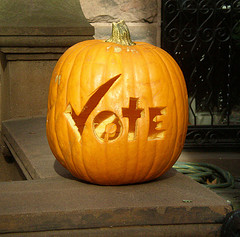
It’s going to take a lot more than an election to change that. The difference between 2008 and 2016 campaigns should be overwhelming proof of our muddled, even corrupt, national values.votepumpkin

I feel no guilt or regret about occasionally taking a mental health break from the elect-good-candidates grind. Even laughing, sometimes. But where I draw my real strength is from community. That’s been the best part of the past two years: identifying people who are as appalled as I am by what’s happened to democracy.  

I have learned so much from people—old friends and new—in this two-year cycle. From the women I met, briefly, at rest stops on the Pennsylvania Turnpike, en route to Washington D.C. for the Women’s March. From the Indivisible group that sprang up in my county. From women who never dreamed they’d run for office, but somehow are standing for election on Tuesday.

That’s something we can feel good about—no matter how the voting comes out. That’s the real foundation of change—people.

Follow Me into the Voting Booth

downloadActually—it’s one of those little tri-fold plastic visual shields, set in front of an uncomfortable metal folding chair, in the Solon Township Hall, a white clapboard building just as quaint and folksy as you might imagine a northern Michigan polling place to be. But what happens there is powerful and predictive. This is, as the saying goes, what democracy looks like, here in Leelanau County.

In August, before the Primary, I did something I’ve not done before: I told my Facebook community who I planned to vote for, in the gubernatorial race, and why. I did not expect a conversation—perhaps a few upward thumbs– but a long and rich thread bubbled up, including two or three commenters who found my logic ‘disappointing’ or worse.

It was the antithesis of a word we’re hearing a lot lately: tribal, left vs. right. In fact, it was a kind of state-wide town hall-ish discussion where my friends and acquaintances put forth diverse viewpoints, in real time, on what this state needs. Even the people who thought I was making the wrong—WRONG!! Angry Face! —choice had rational, if heated, things to say.

And a couple weeks after the primary, while at breakfast, a friend whose transparent values and good intentions are her trademark told me she had changed her mind, after reading the discussion. On my Facebook page. I felt ridiculously proud. Not because she’d embraced the same candidate as me—but because people had come to my virtual home to seriously talk politics. Democracy.

I will not be voting until November 6th. I am eligible, as a <cough> senior citizen, to vote absentee in Michigan, but for many reasons, I like to push my own ballot through the machine. I’ll be working as an election challenger, too.

I’m voting for Democrats, mainly. This isn’t always the case; years ago, I routinely voted in the Republican primary, because I lived in such a red county that the primary was the only place I had any discretionary power over who would be making the laws I had to live by. There have been other reasons to split my ticket.

Still, this is a year to tip the scales in favor of the good-guy party, seeing as how Republicans across the country are currently providing a garish, sickening illustration of feckless and corrupt conduct. Go blue, no matter what. More interesting to me than the candidates this year are the statewide proposals. There are three, and it is my fond (and probably unrealistic) hope that social studies teachers all over Michigan are discussing them in class. In reverse order:

Proposal Three is the easy one. In fact, it’s a no-brainer. It’s a proposal that makes voting easier and brings MI in line with most other states: early voting, automatic registration, straight-ticket voting to shorten lines, more reasons and flexibility around absentee voting. It’s the ultimate tidying-up of outdated, anti-democratic voting practice in the Mitten State.  Anyone who took Civics in high school ought to vote YES.

Proposal Two is the anti-gerrymandering proposal. It’s drawn a lot more attention than Prop Three—in fact, anti-Prop Two ads were just pulled from a couple dozen radio stations after an emergency court filing proved they were flat-out lies. The Republicans are terrified of this one; Michigan is one of the most heavily gerrymandered states, through a series of backroom efforts designed to disenfranchise people of color and left-leaning communities.  Michiganders vote blue in every election, overall, but end up with more red representation. That’s wrong.

Am I convinced that the plan Voters Not Politicians (who sponsored this proposal) came up with is perfect? Not at all. I attended early VNP meetings where various gerrymander-busting tactics—going through the courts, for example—were examined.

I came away understanding that there is no foolproof or cheap way to get rid of the scourge of the party in power picking their voters. I fully expect there will be hiccups, even battles, along the way. But something needs to be done. I’m sick of political parties—both of them– using inequitable and unfair means to hoard power. It’s also wrong. YES on Two.

Proposal One is about regulating the recreational use of marijuana. I’m voting YES.

This might be surprising to some of my fellow educators who worry about making it easier for students to access pot. I want to stress that I’ve been worried about schoolkids and harmful drug use for forty years. I actually think regulating marijuana, limiting sales of a state-controlled product to those who are 21, and giving the police clear guardrails about prosecuting sales and use, are good things.

My reasons echo those of Carol Siemon, a Lansing prosecutor who wrote a powerful op-ed on why Proposal One is a good idea:    

 “All too often, young adults and persons of color were swept up in the dragnet of drug enforcement and the “tough on crime mentality.” Today, data supports that the arrest rate of African American males is 3.3 higher than the arrest rate for white males for possession of marijuana.

Marijuana prohibition hasn’t worked and continuing to enforce this failed law is an exercise in futility. The cost is too high in so many ways. It’s time to draw this industry out of the black market, regulate and tax it, and free up law enforcement resources to concentrate on serious issues that truly impact our state’s quality of life — issues like the opioid epidemic, guns, domestic violence, and other violent crime.”
Remember, Carol Siemon is a respected county prosecutor, not a potential merchant or regular user. She looked at police data on teen drug use and driving safety from Colorado and Washington and finds that threats about an increase in accidents are unsubstantiated.

You might think I’m excited about the tax ‘windfall,’ a third of which is promised to schools. Michigan is not taxing marijuana as heavily as Colorado and Washington, so the word is more like ‘trickle’ than windfall.  I am also skeptical about any promises to help fund schools through set-aside taxes. We’ve been down that road before. Many times. There are dozens of shell games the legislature can play when funding schools. What we need is education-friendly legislators, something we can also address on November 6th.

Besides, schools should not have to depend on the marijuana market to get new tools and materials.

That’s what I think. How about you?

Opportunity Knocks and Grade Level Answers the Door

Last month, Ed World was abuzz over a flashy new report from TNTP, the refurbished face of The New Teacher Project.  The New Teacher Project was a super-reformy org originally started by Michelle Rhee to promote the idea of placing smart, eager (and also cheap) college grads with superior content knowledge, like Michelle, in needy classrooms, replacing the tired old ineffective dishrag teachers slogging along there.

TNTP has morphed into another grant-funded report-writing nonprofit, surfing the reformy trends and saving the world, one white paper or glossy report at a time. You really need to take a look at the report, because it’s uber-slick, from its title–The Opportunity Myth— to its multi-directional graphics and catchy bullet points.

Its main point: Most students are doing work below grade level. And we should immediately change that, so students can reach their potential, which seems to mean getting into competitive colleges and becoming neuroscientists.

‘That’s the opportunity myth. It means that at every grade level, in every district, for students of every demographic background, school is not honoring their aspirations or setting them up for success—in their next grade, in college, and in whatever they want to do down the road.’ 

Notice—every grade level, every district, every demographic is currently being failed by… schools, which are not setting them up to succeed. Because ‘schools’ are not giving students grade-level work.

How does TNTP know this? Because they amassed a huge data set—20,000 samples of student work!—from students and teachers in five school districts. That’s right—five districts, including three urban, one rural (where all the white kids were) and one charter district. Anyone who’s ever corrected papers knows that 20,000 pieces of student work could easily be the annual total for two or three secondary math teachers—although it certainly sounds like a big, impressive data number. Extrapolating the numbers from five districts to the entire public education system? That’s a data fail.

Peter Greene does a wonderful job of deconstructing the research and the flabby, well-duh recommendations—which begin with the following statement:

 ‘We readily acknowledge that we don’t have a detailed operational plan to improve student experiences at scale. But we believe it’s time to…return to the basic guiding principle that brings us to this work: the right of every student to learn what they need to reach their goals. But we think we know where to begin, and it starts with making students’ daily experiences the center of our work.’

That statement is the dead giveaway that the report, research and recommendations were crafted by non-teachers, who were ‘trained’ to compare a daily assignment to what the Common Core (masquerading as ‘College and Career standards’ in this report) says Any Given Student ought to know and be able to do in, say, 5th or 11th grade.

Because—honestly—I don’t know any teacher who doesn’t believe students have a right to pursue high and worthwhile goals. And ‘students’ daily experiences’ are pretty much the entire point of teaching.

The weakest link in the report, however—the core assertion that marks it as just more pearl-clutching sludge– is all the fussing over ‘grade-level’ work.

Some observations:

  • As a metric, ‘grade level’ is pretty wobbly. We’re all familiar with the fact that kindergarten is the new first grade, and that national standards have pushed everything from algebra to frog dissection down a level or two, whether students are developmentally ready or not. We have increasing numbers of students whose native tongue is something other than English, policy churn and students moving in and out of schools due to ‘choice.’ What Arne Duncan called ‘the same goalposts’ has never been reality.
  • We need to meet students where they are. There’s no point in following college readiness standards and a pacing guide if the students haven’t absorbed today’s lesson or last year’s core content. All those lessons deemed too easy by TNTP might have been exactly what the students needed to move forward.
  • In any given class, even in a highly tracked system, there are students at multiple points on the understanding/application spectrum. And in two weeks, most of them will be someplace else. Some will have leapt ahead. Others will be stuck. And some, for some inexplicable reason, will be in retrograde, with skills once mastered having dribbled off. It’s the teacher’s job to give them all something to do, something that will either add new knowledge, provide practice opportunities, or extend their understanding. Planning lessons is the proverbial moving target, a fact that standards creators and those wishing to ‘re-imagine’ school as more uniform seem to have missed.
  • The use of student work samples to evaluate instruction means the research analysis—comparing the samples to standards—was based on tangible items: paper-based assignments, artifacts created using computers, and so on. Things. This seems to ignore that fact that lots of valuable student work cannot be photographed and sent digitally to ‘analysts.’ It leaves out many types of assignments and assessment models: discussion, observation, silent reading, role plays, student leadership in group learning, model-making, movement, conversations with a teacher. It leaves out things that cannot be assessed but are critical for learning—imagination and play.
  • It’s worth remembering that grade levels (and assigning students to age-similar groups) are arbitrary. And–it’s a journey, not a race. Deciding when to accelerate is a function of experienced judgment on the part of the teacher. I have seen students cover six months’ worth of content in three, once some core ideas took root—and that was in my class made up of students in four so-called grade levels, 9th through 12th

If the purpose of school is giving students tools to pursue their goals, judiciously increasing the difficulty level of their work is only one aspect of successful outcomes. Students need to feel a sense of safety and belonging before the small successes can accrue.  Skipping that step is folly. The range of what students learn in school is vast, and much of it is not measurable.

Probably the most irritating aspect of the report was snapshot profiles of individual students, where the report’s authors reveal their background biases. There’s the immigrant girl headed for a career in medicine: Her father wants her to go to college, so she can avoid the kind of suffering he’s experienced working in a local factory. Remember when unionized skilled factory workers were the backbone of the economic growth of the nation—a job that supported a family, not something to be ashamed of?

And then there’s the student who is torn between boredom and frustration. Sometimes, she finishes her work after 20 minutes, and is bored. But sometimes, she doesn’t understand the work and is frustrated. To me, this sounds like a typical kid in a well-functioning school—one where some things are easy and others hard. The kind of kid who carries a paperback to fill time in one class but needs after-school tutoring in another subject.

The TNTP report, however, sympathizes–her teachers, they claim, should be hitting the magic instructional sweet spot, the zone of proximal development, day after day. Each lesson should be just challenging enough to engage interest, but not too difficult. Otherwise, says the report, months will be wasted every year. Return on investment will be inadequate.

And with that, it becomes clear just who’s on the hook here. And just who has never had to deal with the messy, chaotic, non-standardized, glorious, rewarding job of classroom teaching.

landaff_1940s

Yearbooks

I was editor of my high school yearbook. It was way more work than I anticipated when I took on the job–and because our yearbook wasn’t distributed until August, long after graduation and right before school started, the page proofs weren’t due until after school was out. Which meant I spent the first few weeks of summer slapping final edits on pages, in between shifts at a waterfront breakfast joint favored by 5:00 a.m. fishing enthusiasts and old men who wanted 14 ‘bottomless’ coffee refills and left quarter tips.

If I flirted with them, that is. And I needed every quarter, because I was going off to college–the first in my family–in three months.

As a doctoral student in Education Policy, many decades later, one of my ProSeminar assignments was choosing an educational artifact, analyzing and contrasting three diverse examples of that item, over time. Most of my colleagues chose prestigious, chart-laden reports from non-profits or the federal government on a single topic–mathematics education changes over time, say, or uses of standardized testing data.

I chose yearbooks. I was in possession of my mother’s HS yearbook (Class of ’45), my own yearbook (Class of ’69) and my son’s yearbook (Class of 2006). And I knew something about how yearbooks were put together, whose voices and photos would predominate, and about how easy it was to sneak in juicy little personalized bits that seem uproarious at the time, but may have been overlooked by the faculty sponsor.

Besides the obvious surface features–color photos, fashion and 200 self-indulgent pages– there some distinct differences, over the 60+ years between the oldest and most recent yearbooks. You can tell a great deal about school climate and the socio-economic prospects of the students from a school yearbook, in addition to observing a revealing sketch of critical cultural issues in America at the time.

The ’45 yearbook was sparse, including headshots, nicknames and future plans of students, plus tiny pictures of faculty. There were a few group photos of clubs and events, but no sports teams, no Homecoming queen, no prom. Instead, there was a sober, black-bordered page of boys (and these were indeed boys) who had already lost their lives in WWII, and another page featuring service photos of classmates who had dropped out of HS to join the military. Girls outnumbered boys perhaps three to one in the class that was actually graduating in May.

All students were identified by their course of study–general, business, vocational, college prep.  Most boys in the graduating class were college prep, and my mother had written which branch of the service they entered, post-graduation. Next to one, she even wrote ‘4F.’ Even though both V-E and V-J Days were celebrated immediately after the graduation of this Class of ’45, my mother tracked, with her handy-dandy fountain pen, the classmates who enlisted anyway and went off, presumably to mop up, and those who returned to faithful girlfriends and G.E.D. diplomas.

Life seemed to be about growing up quickly and doing your duty. Kind of the original no-excuses curriculum and climate.

A mere 24 years later, the 1969 volume was infused with Essence of Baby Boomer, from the hippy-dippy cover to the e.e. cummings-like lack of capital letters in page titles and names. Classes had been de-tracked, and nobody was labeled by their scholastic prowess or future educational plans. There was an eight-page photo essay based on a Beatles tune, and lots and lots of sports pages. Other than cheerleading and synchronized swimming, these pages were boys-only features.

The original ESEA was passed in 1965, and four years later, because of the law, my previously all-white, blue collar high school had been integrated. Why? Because we had a newly built school with extra classrooms (unlike overcrowded, older school districts in the mid-1960s). We could house something new: a program for students who needed a ‘special education’ setting. A majority of the newly identified special ed students were black, and were bused from the city to the unzoned outer edge of town, where I lived, to a different school.

I remember asking a teacher about the new kids–who were mostly in self-contained classrooms in 1967-69, mingling with us only at lunch and in physical education–and she said our equalized tax base was low, and we got money for taking these students, money that was needed because we had a smaller revenue stream than other local districts.

It was my introduction to the general inadequacy and inequity of school finance, but I didn’t realize it at the time. I was operating on the ‘Be True to Your School’ model of pride and loyalty, rah rah, sis boom bah. It never occurred to me that, because I lived on the working-class side of town, my school got less money, and the budget had to stretch further. Or that the first kids in my county to be labeled ‘special ed’ were collected out of their home schools and went across town to a school that was underfunded.

My son’s yearbook is twice as thick as mine, and filled with color shots of graduates, plus a paragraph of personal in-jokes and reminiscing for each. There’s a lot more focus on events–casual shots from dances, parties, contests and games. The big difference in 2006 is girls. More girls in leadership roles, the exit of the Future Homemakers club, and an abundance of girls in sports. They’re everywhere.

There are forty pages in the back of the book–in the place where older yearbooks have ads from local businesses–filled with space purchased by parents to celebrate their graduates. These tributes often include a shot of the graduate as a toddler or kindergartener, plus some humble bragging about all the student’s achievements and college plans.

Buying more space in the yearbook to advertise (is that the right word?) your kid is pricey, but lots of parents seemed to see this as one of the embedded costs of having a high school graduate–nearly half the class participated, in quarter / half / full-page increments of parental praise. I’m not criticizing parents for feeling proud of their kids. I’m wondering about parents who absolutely can’t spare the money, feeling bad about their kid not getting a half-page accolade when they’ve worked hard and done well. Kind of puts a different spin on yearbooks, when they’re funded by the folks whose kids are the stars.

Brett Kavanaugh’s yearbook seems to come from a vastly different socio-economic context than any that I studied–but there are some of the same classic yearbook elements that tell us lots about who he is.

Primarily– the now well-known graduation photo with his smart-ass, ‘let’s see what I can get past the faculty advisor,’ guy-joke paragraph of memories. The ones about the Devil’s Triangle, the 100 Keg Club, the truly despicable shaming of a girl (Renate) from a nearby school and the rest of his little witticisms.

In 1982, I had been teaching for 10 years. I can tell you that a faculty advisor who let that stuff be printed was either asleep on the job or (more likely) simply reflecting the prevailing norms at Georgetown Prep, unworried about the boys being jerks because that kind of behavior was common.  Kavanaugh’s personal yearbook memories were similar to what other boys wrote–there were eight of them tormenting poor Renate. The yearbook caught the flavor of the culture around there in 1982. Preppies on the loose.

When Kavanaugh was asked, by Senator Patrick Leahy, about text from his yearbook, he sneered. Oh, he said–we’re gonna talk about my yearbook now?

It’s surprising what you can learn from a high school yearbook.