A Semi-Elderly Teacher’s Reflection on the Digital World and Education

So—I’m a retired teacher, with more than three and a half decades of classroom practice under my belt. Supposedly, I should be sitting at home, enjoying sunsets and repeating how glad I am that I’m no longer in the classroom.

I actually know a few retired teachers like that—glad to be golfing, disinterested in educational politics—but not many. For those of us who invested our lives in public education, what’s happening in public schools right now is an insult to the low-paid, little-understood work we did to build good citizens in divergent communities; it’s a betrayal of our commitment to our students.

Watching curricula being destroyed and public schools defunded by voucher schemes is soul-crushing. Maybe the most frustrating thing is the naïve belief that technology is going to save us, that students most need screen-delivered, standardized content, not face-to-face human relationships with well-educated adults, who can help them make sense of disciplinary knowledge.

Every aspect of becoming truly educated depends on our students’ ability to comprehend and evaluate information. To think that students aren’t negatively impacted by the unfiltered digital stew surrounding them is worse than naïve. We have not served our students well, offering up their test data (legally mandated, of course) to corporations, or letting them zone out digitally, while in school with their fellow humans.

I remember, back in the 1990s, my colleagues’ collective consternation over Mortal Kombat and Grand Theft Auto, when they were the hot ticket with our middle schoolers. Does spending six hours a day in front of a screen, shooting things or wrecking cars, have an impact on students’ curiosity or kindness or any other pro-social habits? Guess we were going to find out.

I thought of that when I read this headline: Uvalde families sue Instagram and Call of Duty maker over deadly school attack. ‘Unholy trinity’ of Instagram, Activision and Daniel Defense accused of ‘working to convert alienated boys into mass shooters.’

The NYTimes recently ran a feature article on a family whose 13-year old daughter was spending her whole ninth-grade school year without the internet, a phone, a computer or even a camera with a screen.

The benefits of learning to live without dependence on social media seemed pretty obvious to me. Communication with her family would happen the old-fashioned way: letters, via snail mail. A school year like that—this was a boarding school, in the Australian wild, hundreds of miles from home—could shape a personality, even a lifetime. A year at this school also costs $55,000.

So—some people are willing to pay big bucks for their children to develop apart from 24/7 connectivity. And there seems to be a building wave of acknowledgement that digital media has done a number on teenagers. Not to mention our neighborhoods, civic organizations, schools and families.

Half of all adults in America get ‘at least some’ of their news from social media. And the results of that—the mistrust of mainstream media, the ease of delivery, the alternative facts—means that ‘truth’ is illusive in the political realm, a situation that matters greatly right now.

We used to argue, back in the day, about the advisability of using white boards, if the ability to ‘publish’ student work online would make them more motivated, and whether calculators would render students unable to, well, calculate. One-to-one devices were going to be the saving grace.

But it turns out that corporations were way ahead of us—Google, Facebook, Instagram, Amazon, X, Tik-Tok—and pretty much in control of what our students see and potentially think. For better and for (much) worse, schools are now fighting for their share of the attention economy.

Social media outsources the monitoring and managing of this colossal data load to poorly paid workers in Africa and Asia. Ever had your innocent Facebook post taken down as “inappropriate?” That’s why. Mis-information and dis-information are now central to public life.

No, technology and digital media are not going to save us, or drag our schools into the 21st century. Technology, in fact, has made possible the distribution of propaganda that threatens our lives and core beliefs. And social media harvests its core product—information and content—from us. And from our children. For free.

I just finished reading (old-fashioned book) Our Biggest Fight, the in-print manifesto of Project Liberty:leading a movement of people who want to take back control of their lives in the digital age by reclaiming a voice, choice, and stake in a better internet.’ 

Sounds good, no? I’m less sanguine than the CEO of Project Liberty, Frank McCourt Jr.. about the prospect of a citizen-led withdrawal from the addictive hold social media has on American adults, and especially on American kids. McCourt says we need great stories to turn this around, and reclaim the power of the internet—and I’m not saying he’s wrong. Only that teachers and schools have been trying to tell great, non-digital stories about our history and values for decades, and it’s an uphill battle.

You may have noticed that this semi-elderly retired teacher has so far avoided the topic of AI. I’m only too familiar with being pitched on the magical powers of a developing technological marvel to make things “easier” for schools, teachers, learning, etc. etc. Peter Greene has posted a number of great blogs on the folly of believing AI is what we educators have been waiting for.

Here’s Sarah Kendzior’s take:

What gets marketed as “artificial intelligence” is plagiarism: scraped off bits of real people’s ideas, devoid of context or credit.

Google’s AI Overview is worse, though. It seems set on killing you.

“How many rocks should I eat each day?” people asked Google. AI Overview responded that people should eat at least one small rock per day because they contain healthy vitamins and nutrients. The source was an Onion article, but AI cannot discern satire.

And so it goes.

Memorial Day, 2024

I’m not much of a flag waver, really. I always thought that author James Baldwin captured my feelings precisely in Notes of a Native Son when he wrote:

I love America more than any other country in the world, and, exactly for this reason, I insist on the right to criticize her perpetually.

These days, perpetual criticism is essential. We are headed into dark times, redefining the meaning of patriotism and sacrifice. It’s easy to lose faith in our government and the grand experiment—all men created equal—that founded this nation. It’s easy to let hope die as we face another white-knuckle election.

Memorial Day has always seemed like a great lesson for public school children to learn: gratitude and civics.  

When parents would call, a few days before the parade, and say—hey, Jason won’t be at the parade Monday because we have company coming for a day at the lake, I never responded with anger or points-off punishments.

But I would feel sad about the missed opportunity for students and their families to take a couple of hours to honor our own history, our own heroes. Memorial Day services are one of the few chances we get to put our communal, democratic values on display, without glorifying war or violence.

I believe, heart and soul, in the shining but imperfect ideals of a democratic education –equality under the law, the American common school, a free, high-quality education for all children, simply because they deserve it. Thirty-plus years of teaching school have given me a hard crust of cynicism about many things related to education and America. But I never lost my enthusiasm for the Memorial Day parade.

For 25 years, my middle school band students marched through the small town where I taught and lived, in the Memorial Day Parade. There was a whole set of traditions around this event, which grew larger and more complicated every year: the aural passing down of our special drum cadences from the self-appointed 8th grade drumline leaders, mending the color guard flags originally purchased through a pizza sale back in ’88, and patching up hand-me-down snares and sousaphones scrounged from the high school.

There was never a budget for this–-middle schools don’t typically have marching bands–-but somehow there were always T-shirts, and cold drinks at the end of the parade route. We had a stunning handmade banner that two moms whipped up with lots of lamé and sequins. In my last year, we marched nearly 300 students, on a morning when the sky was a sapphire blue and Air Force jets flew overhead as we rounded the corner by the cemetery.

This took up a fair amount of teaching time. I would get on my knees and beg colleagues for 20 minutes on the Friday before the parade, to assemble five bands into a single marching unit and take a few spins around the parking lot. One year, as I was trying to get the back of the band to master pinwheel corners, the front rank (rambunctious 8th grade trombones) marched right up the sidewalk, opened the front doors, and led the band, playing America the Beautiful at top volume, through the school hallways. By the time I sprinted up to the head of the band (and the principal popped, red-faced, out of his office), marching through the school was a done deal–and became yet another annual tradition.

I was always clear with my students about the meaning and purpose of Memorial Day. They would occasionally whine about how boring America the Beautiful was–-Mr. Holland’s band played Louie, Louie, right? I explained that they were old enough to dedicate a morning to thanking local patriots and acknowledging the sacrifices made by Americans over centuries. Older people, watching them march by, would be pleased to hear traditional music. It was about respect.

We do this, I told them, to remember and honor those who made it possible for you to live in this beautiful little town, in this safe world. People like my Uncle Don, who died in February 1945, part of the Fourth Marine Division which stormed Iwo Jima. Or Ray Shineldecker and Joey Hoeker, two high school classmates who lost their lives in Viet Nam. I had lots of funny stories to tell about Joey, who lived around the corner in my old neighborhood–a big, goofy kid who was what guidance counselors in the 1960s called “not college material.”

On our last band trip to Washington D.C., after performing on the steps of the Lincoln Memorial, I was loading tympani onto the buses as my students toured the Mall. A few girls came running up, calling “Mrs. Flanagan! We found him!” Found who, I asked.

Joey Hoeker, of course–on the Wall. And I lost it, right in front of all those kids.

I thank those who served and sacrificed so I can love my country, and criticize it, too. A hat tip to all the band teachers and student musicians who help make Memorial Day meaningful this weekend. And to hero teachers and band directors everywhere– donating yet another weekend to the community –please keep teaching, in spite of everything.

Just Who is Trashing Public Education?

Get ready for a big dump–a deliberately chosen word–of anti-public education blah-blah over the next five months. It’s about all the right wing’s got, for one thing–and it’s one of those issues that everybody has an opinion on, whether they went to public school. have children in public schools, or neither.

Public education is so big and so variable that there’s always something to get upset about. There’s always one teacher who made your child miserable, one assigned book that raises hackles, one policy that feels flat-out wrongheaded. There’s also someone, somewhere, who admires that teacher, feels that book is a classic and stoutly defends whatever it is—Getting rid of recess? The faux science of phonics? Sex education that promotes abstinence? —that someone else finds ridiculous or reprehensible.

Not to mention—teaching is the largest profession in the country. So many teachers, so many public schools, so much opportunity to find fault.

In other words, public education is the low-hanging fruit of political calculation. Always has been, in fact.

A few years back, when folks were going gaga over Hillbilly Elegy, seeing it as the true story of how one could rise above one’s station (speaking of blahblah)—the main thing that irritated me about ol’ J.D. Vance was his nastiness about public education. Vance has since parlayed a best-seller that appealed to those who think a degree from Yale equates to arriving at the top, into a political career—and putting the screws to affirmative action, in case anyone of color tries to enjoy the same leg-up he did.

J.D. Vance’s education—K-12, the military, Ohio State—was entirely in public institutions until he got into Yale Law School. He doesn’t have anything good to say about public ed, but it was free and available to him, a kid from the wrong side of the tracks. When I read Rick Hess’s nauseating interview with Corey DeAngelis in Education Week, I had a flashback to ol’ J.D., intimating that he achieved success entirely on his own, without help from that first grade teacher who taught him how to read and play nice with others.

DeAngelis says:

I went to government schools my entire K–12 education in San Antonio, Texas. However, I attended a magnet high school, which was a great opportunity. Other families should have education options as well, and those options shouldn’t be limited to schools run by the government. Education funding should follow students to the public, private, charter, or home school that best meets their needs. I later researched the effects of school choice initiatives during my Ph.D. in education policy at the University of Arkansas’ Department of Education Reform.

So—just to clarify—Corey DeAngelis went to public schools K-12, for his BA and MA degrees (University of Texas), as well as a stint in a PUBLICLY FUNDED program at the notoriously right-focused University of Arkansas. That’s approximately 22 years, give or take, of public education, the nation-building institution DeAngelis now openly seeks to destroy.

I’m not going to provide quotes from the EdWeek piece, because anyone reading this already knows the hyperbolic, insulting gist—lazy, dumb, unions, low bar, failing, yada yada. He takes particular aim at the unions—although it absolutely wasn’t the unions—shutting down schools during a global pandemic. He paints schools’ turn-on-a-dime efforts to hold classes on Zoom as an opportunity for clueless parents to see, first-hand, evidence of how bad instruction is. He never mentions, of course, the teachers, students and school staff who died from COVID exposure.

Enough of duplicitous public school critics. My point is this:

The people who trash public education—not a particular school, classroom or curricular issue, but the general idea of government-sponsored opportunity to learn how to be a good, productive American citizen—have a very specific, disruptive ax to grind:

I got what I needed. I don’t really care about anybody else.

This goes for your local Militant Moms 4 Whatever on a Mission, out there complaining about books and school plays and songs and health class. It’s not about parents’ “rights.” It’s about control. And never about the other families and kids, who may have very different values and needs.

It’s about taking the ‘public’ out of public education. And it’s 100% politically driven.

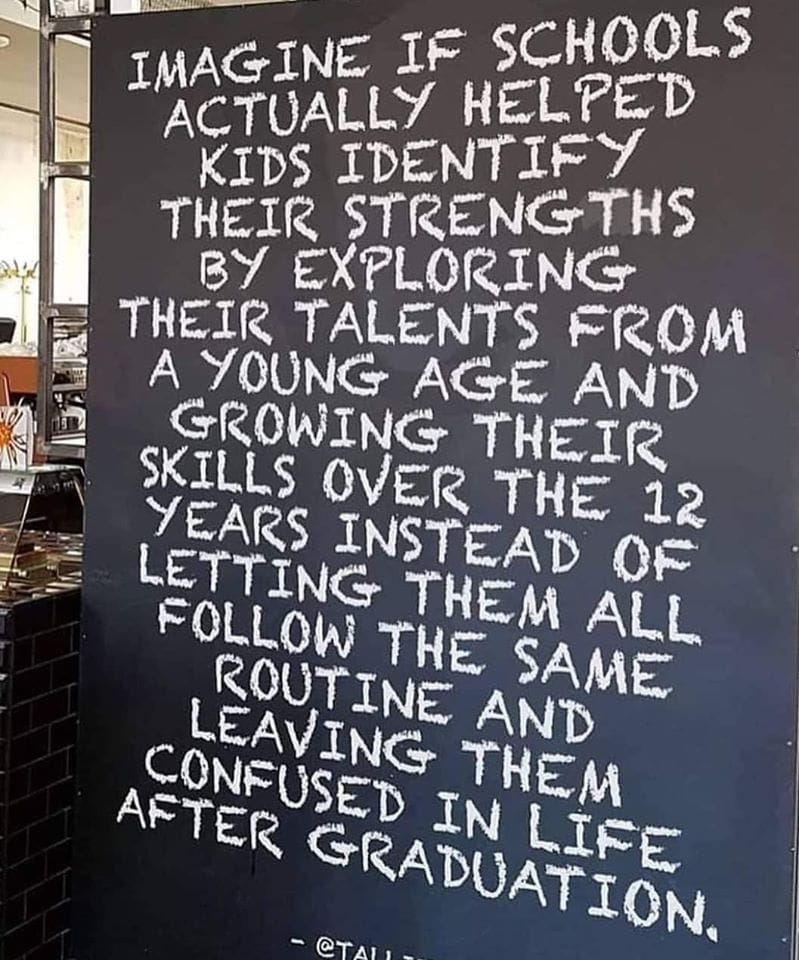
Occasionally, you’ll see someone put forth a visionary principle for public education, like the meme that wonders why schools don’t focus on their students’ strengths. Wouldn’t that be lovely?

Small classes, focused on individual talents and gifts, kind of like Corey DeAngelis’s magnet school. A warm and welcoming community of learners. Ample resources. Ask yourself WHY we don’t have that in every public school (worth noting: some schools get pretty close).

It’s not because educators—or schools, if you will– don’t want to meet student needs. They do.

Just who is trashing public education—and what are THEIR ultimate goals?

What about Homeschooling?

Families who choose to homeschool their children have never been on my negative/activist radar, as a veteran public school educator. I have had both positive and not-so-positive experiences with students who were homeschooled–from a pair of shy, well-behaved sisters who fit seamlessly into the middle school music program due to years of independent music lessons, to a sweet boy who had never really learned to read in the 7th grade and tended to wander aimlessly around the music room, once his mother finally decided to send him to school at age 12.

My ambivalence about homeschooling is likely because I became a teacher in a time when homeschoolers were often young hippie parents who worried that schools would suppress their children’s natural gifts in favor of compliance and standardization.

This was the era of Paulo Freire and Summerhill, and—perhaps my favorite book about education— “Teaching as a Subversive Activity,” by Neil Postman and Charles Weingartner. The subtitle is worth mentioning:  A No-Holds-Barred Assault on Outdated Teaching Methods-with Dramatic and Practical Proposals on How Education Can Be Made Relevant to Today’s World. (1971)

Today, homeschoolers are often escaping what they see as Godless classroom chaos, or a curriculum that acknowledges certain truths about our diversity and honest national history. The pandemic and its aftermath pushed parents on both sides of the masking question into involuntary home academics, and left people frustrated.

So much for drama and relevance, letting children direct their own learning, at their pace and honoring their interests. Instead, as David Labaree and Deborah Malizia note:

Schooling moved from a shared learning and cultural experience that generated a sense of community and common purpose to an individual competition for the grades, credits, extra-curricular achievements and degrees that determine students’ future life chances.

Once college enrollments surged in the mid-20th century, the struggle became a contest to gain admission into the most selective college possible. Rising levels of income inequality have only intensified the competition. One result is the devastating increase in student stress and social disconnection, in a setting where every student becomes a potential adversary in the race for extrinsic achievement, and the relentless pressure hurts students at all levels. 

This is not how schools were supposed to evolve—they were supposed to be sites for building citizenship, democratic equality and opportunity. But here we are.

Still. If Mama wants to educate her little ones at home, I’m OK with that, as long as my tax dollars are not paying for skiing lessons or $500 LEGO sets, part of a misguided voucher scheme.

We are likely to see those kiddos at some point, in the public system, perhaps middle school or high school when the home-school teacher’s curricular expertise across the board founders. Or when one of the kids wants to play in the band, join the chess club or the public school basketball team.

Just as public schools have tried to adapt to their surroundings and unplanned events, like a global pandemic, families have tried to custom-tailor their children’s education. I’m not saying that I think all of those pull-your-kids-out choices were good ones –thinking here about that 12-yr old non-reader, or kids whose parents reject the idea of getting along with people who are very different from you, in a pluralistic society.

But–a strong public school system, built on quality teaching and rich curriculum, still can serve multiple perspectives in a healthy  community, including the desire to educate one’s children at home.

Where I get off the homeschooling train is when homeschoolers refuse to follow community-driven policies. Vaccinations, for example. If you want a free, high-quality public education, or the opportunity to use public schools, at any point, as a springboard for your children’s ultimate goals, you may have to follow a few rules.

The Michigan Legislature is currently considering a registry of all school-age children. Homeschoolers would have to, by law, notify the state that they were homeschooling their children. Beyond that—things like curriculum and testing, which are largely controlled by legislation, for example—there is a great deal of freedom for homeschoolers.

This feels like common sense to me, much like a census or licensing vehicles. Where are the kids being homeschooled—are there are large number in a particular district? Why? Can we expect to see them return to the public school and prepare for that? Where are the kids who are not being schooled at all, home or otherwise—and are they safe? Why do homeschoolers find a simple registry threatening?

It’s interesting how many homeschoolers see this as government interference. Given the increases in homeschooling, this seems like critical data to have: Michigan is home to roughly 1.7 million school-age children, and 1.36 million are in public schools, while 182,000 are in private schools, according to 2022 Census data. That would leave about 150,000 students who are either homeschooled or have dropped out.

That’s a lot of kids. I’d be willing to bet that not all of them are being lovingly homeschooled by teachers with the skills to help them move forward academically.

The Grinch Who Stole Teacher Appreciation Week

I’ve always been of the opinion that teachers get so few routine perks in their professional lives they deserve every random treat or award that meanders their way–from sticky little misspelled mash notes to free use of a leased SUV.

After all, there aren’t many workplaces where professionals end up providing their own materials, cleaning services and professional development. There aren’t many college-educated specialists who gladly share their expertise for free–or attend a weekend conference on their own dime, then arrive at work on Monday morning, without a thought for “comp time.” Because if they didn’t show up, someone would have to pay. And it shouldn’t be the teacher next door, or their students.

For these reasons, and a hundred more, nobody begrudges teachers the tokens of appreciation that come their way this week, from the handmade construction-paper cards to the potluck lunch from the PTA. I love it when teachers invite their former students to check in on Facebook–or when they post their stats (years of experience, states/countries/schools, degrees, subjects and so on). It’s good to see colleagues reclaim their honor or share a few points of pride.

But it’s time we asked ourselves just who gets ‘appreciated’ once a year–and whose work is considered vital, essential, and fully professional year-round, with no need for annual symbolic gestures. There’s something about Teacher Appreciation Week that smacks of a pat on the head for being willing to go the distance without adequate compensation or support. We’re supposed to persist and excel ‘for the kids’–a phrase that teachers rightfully perceive as specious and manipulative.

It doesn’t help that National Charter Schools Week is scheduled right after Teacher Appreciation Week (not an accident, folks). The Center for Education Reform, an organization that promotes charter schools, posted the following about Teacher Appreciation week:

‘Rather than evolve and adapt to changes in the 180-year-old factory model system of education, rather than create a new path for teachers that supports their growth over mandating uniformity and lock step acceptance of rules, [teacher associations] have dug in their heels and decided character assassination and anti-charter propaganda is best.’

So much for boosting the spirits and self-respect of teachers during their special week, eh?

Actually, I don’t know a single teacher who isn’t interested in growth–or doing a little rule-breaking, evolving and adapting. In fact, the current walk-outs, anti-voucher campaigns and eloquent education blogs are evidence that teachers are no longer satisfied with flowery sentiments or coffee mugs.

Teachers are telling their communities and state leaders that they’re sick of being underpaid do-gooders and want not only adequate salaries but control over their professional work. They want the resources necessary to succeed—but also a measure of autonomy, acknowledgment of their acquired expertise.

Perhaps teachers are tired of waiting for policymakers to speak to the fact that their working conditions and public respect–measured by classroom authority, as well as wages and benefits–are diminishing every year. Maybe teachers are ready to demand what they need and deserve, rather than hang around hoping to be ‘appreciated’ every May.

Is this a lasting change? Will exasperated teachers not rest until they’ve transformed public education?

Here’s a few crucial but often forgotten facts: In number, teachers are the largest profession in the United States. And collectively, they have the power to demand and win changes to funding and salaries. It’s a stark reminder in our post-Pandemic revival of labor influence.

Policymakers have long relied on teachers’ hearts growing three sizes through the magic of watching children light up with the joy of learning, yada yada. But as the Grinch himself might say–magic doesn’t pay the rent.