I remember learning–perhaps in a grad class or professional development session, years ago–that boys didn’t like to read about girl things. You know—relationships, communication, emotions, the finer points of making a home or enriching family life. Boys wanted to read stories about adventures, we were told. Starring, naturally, other boys.
Ergo, if we wanted to turn boys into enthusiastic readers, we needed books where boys did boy stuff—creeks, animals, cars, fights, danger, you name it. Write it and they will come.
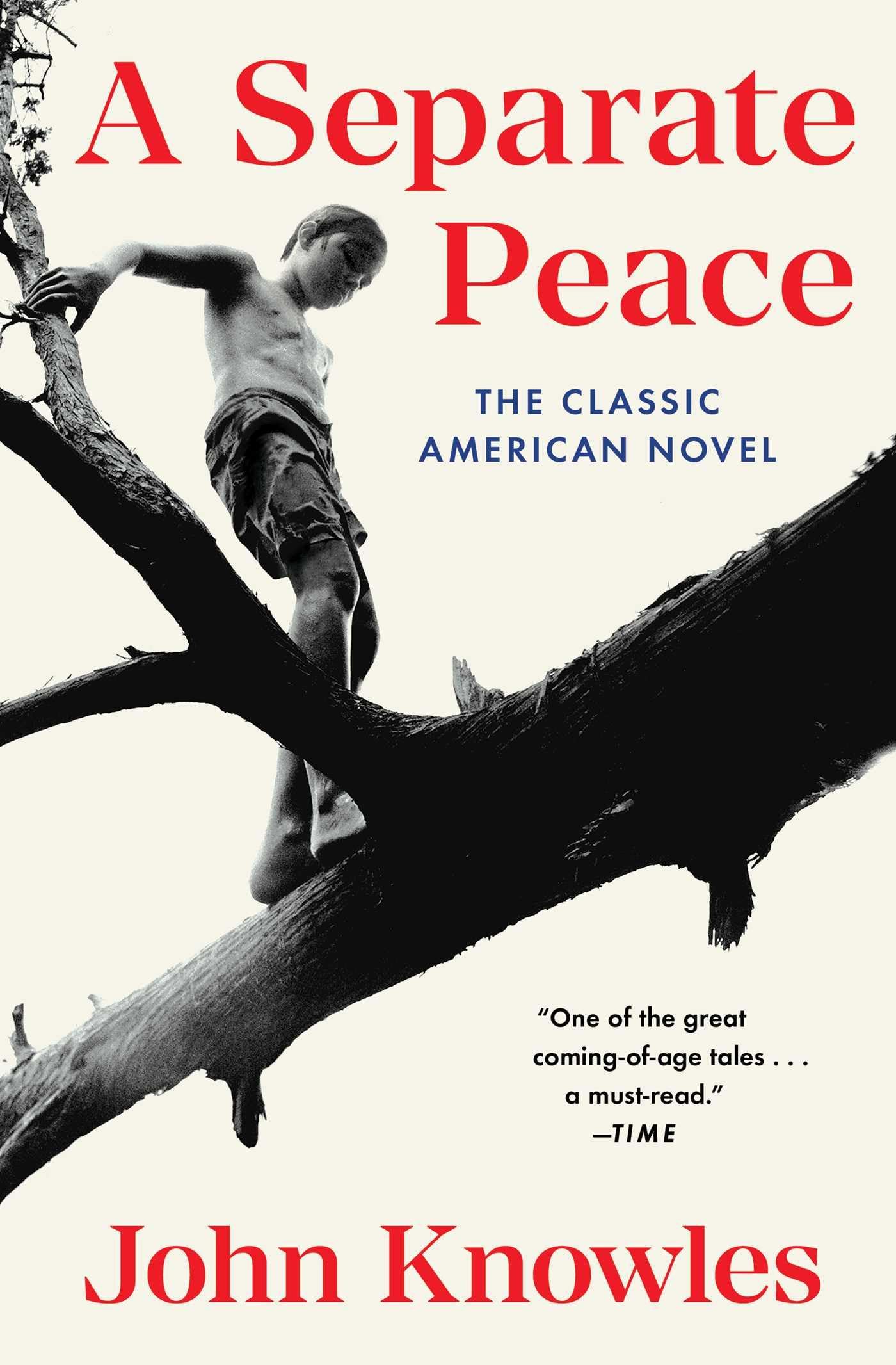
I thought about this when re-reading A Separate Peace this month. My book club is doing a “Books You’ve Already Read—or should have read” month, and I thought it was time to re-read a book that I put on my Top Ten list for decades.
(Seriously—I kept continuously updated top ten lists of books, movies and LPs until I had both children and a full-time job. There are still some gems on those lists—but also some really embarrassing stuff.)
I wouldn’t, however, call Separate Peace an embarrassing pick. I read it in high school, although not as a class novel. In the late 60s, my public high school adopted a choice-based language arts curriculum. Instead of English 9/10/etc, there was an array of semester-long courses. I took journalism, speed reading and Great Books, a totally wonderful class where students did nothing but read books, then journal their impressions.
There was a list of great books (SP was on it), but you could also deviate, with the teacher’s permission. It was that teacher—Mrs. Palmer—who introduced me to Daphne du Maurier, Virginia Woolf, and Madeleine L’Engel.
It’s hard for me to put my finger now on why I loved Separate Peace so much. Partly, it was the boarding school setting—what it would be like to live in dorms, with other students whose parents weren’t scraping to pay the mortgage, for whom college was a certainty, not a stretch.
Mostly, though, I think it was because—spoiler—there’s a death in the book, under unusual circumstances, leading the reader (this teenaged reader, anyway) to muse on Big Meaningful Issues. In case you’re wondering whether I noticed the homoerotic flavor of the relationship between the narrator and his best friend, the answer (1969) is no and (2025) yes.
But here’s what really jumped out at me, some 50+ years later: there are no women in this book. Aside from a couple of sentences mentioning a screechy school nurse, and a sentence describing a classmate’s mother as kindly, there is zero female presence in this book. There’s plenty of adventure, danger, scrapes and disobedience. Even a student-led tribunal, and a World War. But not a single woman, or girl.
From a recent article in The Guardian, about a newly formed publishing house that intends to publish only books by men:
Cook said the publishing landscape has changed “dramatically” over the past 15 years as a reaction to the “prevailing toxic male-dominated literary scene of the 80s, 90s and noughties”. Now, “excitement and energy around new and adventurous fiction is around female authors – and this is only right as a timely corrective”.
“This new breed of young female authors, spearheaded by Sally Rooney et al, ushered in a renaissance for literary fiction by women, giving rise to a situation where stories by new male authors are often overlooked, with a perception that the male voice is problematic,” he said.
Hunh. I wasn’t really paying attention to any toxic literary scene in the 1980s and 90s, due to the aforementioned family and job. But I was still reading a lot—and was deeply involved in whether and what my students were reading. Or not reading.
It was a time when getting any kind of reading material—from comic books to Captain Underpants— into kids’ hands was the prescription for reluctant readers. There was a rolling bookshelf in my band room, filled with books about music and musicians. Some had some vaguely naughty photos. I purchased all of them, and they were well used.
My take on any reduction in male readers in the 21st century is that omnipresent screens, not problematic masculine voices, are responsible.
Still. What I notice about this (well-meant, I assume) announcement is that it only took a couple of decades for men to perceive that women were “ushering in a renaissance,” then set up their own literary clubhouse, no girls allowed.
There’s also this:
Less than half of parents find it fun to read aloud to their children, new research shows. Only 40% of parents with children aged 0 to 13 agreed that “reading books to my child is fun for me”, according to a survey conducted by Nielsen and publisher HarperCollins. The survey shows a steep decline in the number of parents reading aloud to young children, with 41% of 0- to four-year-olds now being read to frequently, down from 64% in 2012.
A significant gender disparity was identified, with 29% of 0- to two-year-old boys being read to every day or nearly every day compared with 44% of girls of the same age.
Plus this, ominously: Many parents focus on the literacy element of reading, seeing it as a skill, rather than encouraging a love for reading in their children.
So—who’s not reading, and why?
If you talk to the Science of Reading crowd, boys’ reading difficulties and reluctance to read can be laid at the feet of teachers who were never taught the only correct protocols for reading instruction, or—worse—fail to use them with fidelity, a word I have come to loathe when applied to pedagogy.
And since the overwhelming majority of early-grades teachers are women, this can be construed as another way in which women are not paying attention to the needs of boys. But it’s so much more complex than phonemic awareness, yada yada.
The Great Books class at my high school only lasted a few years, then fell when the “cafeteria curriculum” became outmoded, in favor of … what? I forget. Back to Basics? One of our cyclical returns to The Canon—in which white male-authored books have literally always been deemed more worthy of study?
All children deserve to be read to, daily, even when they’re able to read themselves. Stories about both boys and girls. Because that’s how they learn to be curious about the real world.
 Teacher in a strange land
EXCELLENT POINTS!
LikeLiked by 1 person
Nancy, the last 8 years I have read aloud in class Andy Weir’s “The Martian”. Every day, 2 or 3 pages to start the class. My room usually goes silent when I pick up the book. I often hear requests to read just a little more.
These are ninth graders and I teach earth science, so the novel is a good fit for my instruction. There is a lot of problem solving and application of the scientific method, but what strikes me is how…”thirsty” some of my students are to be read to. My wife and I often read to each other. Listening to someone read is pleasant and I really think that my kids miss this experience. They close their eyes and let my words carry them along with the story.
I love doing it, and will continue until I retire. I encourage all teachers to consider reading out loud for a few minutes each day, no matter the age of the students, or the class.
LikeLiked by 1 person
I love this comment! I used to read to my students, too. A biography of Scott Joplin, even poetry (I had a poem titled “If Mozart were alive today, he’d be playing rock and roll”).
LikeLike
Years and years ago I had to point out that our tenth grade reading list–Lord of the Flies, Separate Peace, Julius Caesar, and one other I’ve since forgotten– featured virtually no female characters and maybe we could fix that. That was a fun conversation.Side note. I went to one summer session at Philips Exeter Academy, the real life prep school Knowles wrote about. On the first day they showed us the movie that was mostly shot there. The tree had been long since cut down, but the stream was still there, a dribble so tiny that you could easily stand with one foot on either side and step in it without getting your ankles wet. If the tree was more than three feet high, then those boys were idiots.
LikeLiked by 1 person
As you have no doubt noticed, virtually all instrumental music is historically written by men. In the past couple of decades, women composers have started to show up on school and community band programs. There’s even a famous case of a well-known school band composer (Larry Clark) who tried to cash in (correct phrase) on the search for female composers and ethnic music by posing as a Japanese woman. When this was revealed, guess who was infuriated– and who saw it as just another case of writing under a pseudonym?
I play in a regional wind symphony, and have suggested to our conductor that we feature or at least include pieces by women composers in our repertoire. First, he asked if the pieces were worthy of our rehearsal time (read: hard enough, real literature, not just training pieces). Then he seemed to think that including pieces by women would be a kind of gimmick. I guess we have our own musical canon.
LikeLike
Are Women the Cause of Reluctance to Read?
Of course! It’s all our fault. Always.
My daughter was pregnant while a continent away from home. I regularly had calls from her, worried about one thing or another. One afternoon I answered my phone and she was in tears. What if she doesn’t love to read?
That three year old has enough books for a small preschool and takes reading to be as essential and routine as eating. Were that every child did as well.
LikeLike