Six Gigantic Problems, Six Wrong Solutions in Public Education

So here we are, at our local schools, trying to stay afloat, with daily crises incoming.

The adults who are still bravely teaching, teaching, teaching (+ making administrative and child welfare decisions) in spite of the fact that the world seems to be on fire around them, need help. Don’t take my word—just read pretty much any educator-written blog from 2021.

When we have massive social problems, how do we generate and roll out solutions?

The answer is: Policy.

Policy is how we mounted a successful response before, during and after World Wars, developed and refined sequential national transportation and communication systems, and came back from significant economic depressions. We can point to any number of policy-driven transformations in these United States.

Once policy is put in place, and implemented, we can see its real-world effects. Optimally, the policy will be tweaked until it does what it’s supposed to do: solve the problem. Or at least move things in the right direction.

Yes, it’s infinitely more complex than that—designing good policy is way more than guesswork and a good feeling about how to fix the trouble.  And yes, policies sometimes make things worse. Way worse.

I would argue that public education is one area where terrible policy is now endemic—and sometimes, after clear failure, overlaid with even worse policy. The sheer dispersal of decision-making responsibility is part of the reason. There are legislative levels—federal/state/local—and a whole array of other organizations (the PTA) and people (the Athletic Director, the Union president) who have policy-making roles, assigned as well as assumed.

In fact, it’s hard to think of an education-related policy that has effectively and sustainably worked, beyond the granddaddy of all ed policy: a free, high-quality, fully public education for every American child, no matter what they bring to the table.

Lately, this wrong-policy trend in education has been on steroids—both the frightening gravity of the problems as well as the foolish, even ludicrous suggestions to address them.

A few examples:

PROBLEM: School shooting in Michigan

WRONG SOLUTION: (from a member of the State School Board, no less)—eliminating the attendance requirement for children to go to school in Michigan. State Board of Education member and Republican Tom McMillin posted this suggestion on Facebook last week, saying the “state needs to stop dictating terms of education of our kids.”  You may wonder how McMillin construed this as a solution to mass shootings, but he claimed parents could improve their children’s mental health by keeping them home for as long as they chose.

PROBLEM: Underfunded schools, leading to low salaries and lack of resources

WRONG SOLUTION: A Cash Stampede with teachers on their knees, grabbing dollar bills, in competition with other teachers.  I’ve seen this horrible video compared to the Hunger Games, but to me–with the cheering audience teachers on their knees, scrambling to pay for the tools they need to work– I am picturing the Christians and the lions, at the Colosseum in Rome. So amusing!  BTW, you don’t have to be a policy expert to see what the only real solution to this problem is.

PROBLEM:
Student mental health crisis, due to the isolation and uncertainty of being a child during a global pandemic

WRONG SOLUTION: Deciding that Social-Emotional Learning initiatives, whether they be commercial programs or merely a group of educators trying to help kids get through the first worldwide crisis in their lifetime, are somehow tied to Critical Race Theory, and therefore should be formally banned in our classrooms. Or that SEL is a ‘perilous’ waste of time and money, stealing time from Algebra. There are many viable ways to address the mental health crisis. All will be multi-faceted, and involve an array of attentive and thoughtful adults, determined to buoy the children in their care.

PROBLEM: Not enough teachers, not enough subs, not enough bus drivers

WRONG SOLUTION: Lowering the bar to get warm bodies in classrooms or behind the wheel. Or hiring year-long unqualified substitutes because the requirements for subs are less. Once again, there are many viable policy options to fix this. Suggesting we throw up our hands and let anybody in our classrooms is not only counterproductive—it’s dangerous.

PROBLEM: Student scores on standardized tests remain stagnant, or go down

WRONG SOLUTION: Fix the teachers, through rigorous evaluation of their behaviors and ‘success,’ including those same test scores. If this solution feels convoluted—well, the idea that a mountain of data could serve as a spur to improve practice has never worked particularly well, anywhere. It’s a data-focused non-problem, with a data-focused solution, neither of which matter much, in the real outcomes we want from public education.

PROBLEM: As COVID numbers rise, merely coming to school is stressful. Widespread absences and anxiety.

WRONG SOLUTION: Adding more half-days to the school schedule. This one started out on the right track—less time exposed to unvaccinated children, pre-planned time away from face-to-face learning. But, as most districts have learned, asking for Wednesday afternoons off is not likely to endear you to parents, who have pushed for full-time school in a pandemic, because they need to work.  Less time in school and more technology-focused interaction is probably where we’re headed anyway, like it or not. Four-day weeks. Virtual conferencing. On-line lessons. The new normal. But let’s not worsen the child care crisis in the process.

There have been some good suggestions for addressing issues bubbling up in 2021, the best of which are coming from those closest to the work. And there have been some heavily recycled, proven-wrong policy frameworks that the same old policy creators having been pushing for two decades now, thrown out to see if they’ll stick, when everyone’s distracted by the ongoing dumpster fire.

Where should policy-creators get their ideas about solving big problems?

Because we are living in a completely different world now than we were two years ago, we should look first at the proposed solutions from people who are up close and personal with the problem. The people who are still, in spite of the danger and frustration, willing to be public school educators.

One last thing, for those who would like to tailor solutions to ‘the marketplace’ rather than the common good: Problems in public education are also problems in private and quasi-private (read: charter) schools. School violence, student mental health, the empty teacher pipeline, lack of resources—they’re apparent across the country, in all kinds of schools.

I got a heart-tugging message from a friend who is Principal in a small Catholic elementary school on the border of Detroit, a couple days after the shooting in Oxford. Local police had alerted her to threats that were ‘terrorist in nature,’ suggesting the school close down. But in consultation with her staff, they thought students (who had lost many relatives and caregivers over the past year) would be safer in school.

She said it was a fairly normal day, although she couldn’t wait for the dismissal bell. Then, she went home and threw up.

She wrote:

I am so done with all of this. My job is no longer one of an educational leader. I am an emergency manager around pandemic, school safety, bad weather conditions that flood our school or knock the boiler out… It is rare, very rare to have anything to do with education. I want to return to overseas international schools where the innocence has not been stolen from children. What we have here in the USA is worse than when I fled Sudan due to a revolution. I could understand a revolution. This I do not understand.

Me, either.

Should School Staff Be Charged in the Student Shootings in Michigan?

I waited for the headlines, and here they came: Oxford School District Likely to Be Sued Over ShootingsFurther tart media observations: What does it take to get suspended from Oxford High or searched after violent scribbles? And: Red flags the superintendent blandly describes as “concerning drawings and written statements” that alarmed his teacher.

If I were only seeing these remarks on right-leaning media (where public schools are all presumed to be guilty of So Many Things—including blandness), I wouldn’t be surprised.

But I’m also seeing remarks trying to pinpoint blame for this shooting  posted on teacher/education/lefty sites—by teachers blaming weak-on-discipline administrators, university professors going after mush-mouthed PR-driven superintendents, and school leaders saying their hands are legally tied, when it comes to searching backpacks and booting kids out of a public school without due process.

I’ve read perhaps a dozen lengthy descriptions of what happened, including a detailed timeline provided by the district superintendent, who keeps stressing that the Oxford Schools want to be transparent.

And frankly, my take-away—this is incredibly sad—is that school folks did what they reasonably should have in this instance, and that nothing will cause real change (including metal detectors, more school resource officers, tripling the number of guidance counselors and requiring clear plastic backpacks), until there is a national, minds-and-hearts shift. Gun control, yes, but also a different political ecology.

There’s a whole complex of reasons why American students are surrounded each and every day by allowed, even encouraged, violence.

I was a classroom teacher for more than 32 years, most in the same district, all but one year in secondary schools. I have had students who committed grisly murders. I have students who are currently in prison for major crimes (including one dude who scratched an epithet into a brand-new tuba when he was in the 7th grade). I had kids who sold weed and pharmeceuticals. A handful of my former students took their own lives, or the lives of others, in various ways. One of my students burned down his own house. On purpose.

Each and every one of these students was white, and attended school in a small-town-values kind of place.

Sometimes, there are obvious signs. Sometimes, not. Some kids grow up and out of their worst behavior. Others, who appear to be quiet or moody, turn out to be capable of unspeakable actions. Contrary to what some believe, there is no infallible ‘check for mental health’ procedure.

The worst-behaved student I ever had—a daily pain in the ass who disrupted the entire school building with his rambunctious and hostile behavior —is now a multi-million dollar real estate salesman.

Many years ago, a HS student in a nearby district brought a gun to school, and showed it to a friend. This was in the zero tolerance/punk prisons era—and he was expelled and sent to Juvie. It was in the local newspapers. Because he was a minor, his name was never printed.

A month or two later, I got a new student in the HS band, a tenor sax player. I asked where he went to school previously, and he told me: the next district over. He was a good player, and quickly made friends. The more I got to know him, the more I appreciated his wit, kindness and intelligence. I took him on a band trip to Toronto. He graduated.

Later, of course, the school counselor caught me in the hallway and informed me that he was the kid who brought the gun to school. Thought you should know, she said. You weren’t here when we had the meeting about accepting him.

Social media comments proclaim that any kid who sketched weapons with blood dripping, or penned a self-doom/anti-social message in gothic lettering that caught a teacher’s eye, should be searched immediately then sent home. Pronto.

But–kids draw and paste all kinds of stuff in their notebooks and on their homework—everything from swastikas to oversized anatomical features. Think: video games.

Are we seeing incipient violent tendencies—or teenage boredom? Who gets to judge? The fact is, we don’t generally kick kids out of school for their immature drawings or weird teenage behavior—unless there’s a pattern, over time.

The fact that two teachers reported ‘concerning’ drawings and cell phone use to find ammunition, over the space of a couple of days, means that the adults in school actually were tracking this child. They asked his parents to take him home, and get him immediate counseling. They shared their fears. And the parents refused.

I was struck by one of the superintendent’s remarks—that if they had forced the child out of the building, when the parents refused to take him, the boy would have been home alone. Hanging behind that remark is another fear educators are dealing with during a mental health crisis: What happens when depressed children are home alone, and there are weapons?

I had a student once, a 7th grade girl, who wrote little notes to me, about her feelings of being ugly, a dork, not having friends, and so on. I tried to pay special attention to her, but the language became more frightening– ‘What will they think when I’m gone?’ I took the problem to the school counselor. She asked: Do you think this girl would harm herself, or is she just seeking attention?

I honestly didn’t think she would. I thought she was just lonely. But I still wanted a referral to the counselor, and a parent call. The counselor agreed, but said that parent calls of that nature often didn’t go well. The school might be seen as high-handed and intrusive, telling a family their child had talked about suicide.

Still, she was willing to do it. Because it was the next step. There are protocols for this kind of thing, she said. We follow them.

Would that all parents tried to do the right things, too.

You’ve probably noticed that there are Moms for Liberty organizations and now, faux legal strategies for parents to demand the rights they already have,  popping up like mushrooms, to keep those high-handed, mask-demanding schools in their place, to press forward on incendiary social issues. The climate for productive school-parent conversations (never a given), has been negatively impacted by living through a highly stressful pandemic and its emotional aftermath.

The core resource for well-functioning schools is—and always has been—trust. All good school practice—public/private/rich/poor—hinges on relational trust.

When parents don’t trust schools to have their kids’ best interests at heart, we’re all in trouble. When there is a deliberate push to de-stabilize school boards and overrun safety rules, the trouble gets worse. Without some measure of trust, we can never help the kids who need our help most.

My heart goes out to all the educational staff in the Oxford Schools, working through the worst that can happen in a school community.

Thank you, as the saying goes, for your service. I wish you and your school healing.

Violence and Threats in Schools: Who’s Responsible?

It’s been a terrible week for teachers in southeastern Michigan. A terrible week for students and families and school communities as well. Early yesterday morning, school districts—by my count, at least 60, but that was an early tally*—began announcing that out of the proverbial abundance of caution, they were closing down for two days.

They’re not closing due to COVID (although Michigan’s school-based infection rates are ghastly at the moment). They’re shutting down because of spiraling threats of in-school violence, spread on social media.

School leaders are terrified. Not one of them wants to be the next school where an angry, disaffected kid shoots off more than his mouth.

I have dozens of friends who teach near Oxford, site of Tuesday’s massacre in Oakland County, and know many others who have children or grandchildren in the district.

I have been reading their social media threads: First, the reassurance that they’re fine. Then, sharing of how they knew the students who were injured or killed: a friend of their daughter’s, their babysitter, the boy who was in their second grade class, years ago. Sometimes, anger over the words and actions of the shooter’s parents. Photos of the dead, and #OxfordStrong hashtags.

Then, inevitably, the conversation turns to blame. Copies of the two messages of reassurance sent by Oxford school administrators to parents earlier this month—saying hey, we know about these threats and we’re doing something—are shared. There are repeated acknowledgements that the school followed all the recommended safety protocols. So how did this happen?

Two things—true things—are repeated endlessly in these dialogues. The first is that the nation exposed its true values nine years ago after the slaughter at Sandy Hook Elementary, choosing unrestricted gun ownership over the lives of children. The second is that we need a greater understanding and focus on mental health. In our schools, of course.

What is often missing from these heart-wrenching discussions is the fact that schools are just like malls and movie theatres and churches and political rallies—stages for playing out what it means to be an American citizen in 2021, our deepest principles and beliefs.

Despite selfless and heroic actions, despite good parenting and good teaching and due diligence on the part of school administrators and counselors—we live in a pretty ugly country right now.

We live in a country where Kyle Rittenhouse walked free. Where senators and governors boldly lie about election results. Where parents, urged by astro-turf organizations, mob board meetings to protest the teaching of facts and requiring masks in a deadly pandemic. Where thousands of brutal insurrectionists attacked our most sacred building and democratic processes, led by the President of the United States.

Also this: the Oxford HS shooter lives in a state where a gang of angry young men conspired to kidnap and execute the Governor, fantasizing about taking her to a remote location and ‘putting her on trial.

None of this mitigates the reprehensible behavior of this teenager. He is fully responsible for what he did. But it’s worth thinking about the unique context of growing up in America, the people respected as leaders in this nation, the ruthless tactics used to acquire and maintain power and ‘freedom.’

As Eugene Robinson said: I wonder if the people of Oxford, Mich., feel they have more freedom today than they did before Tuesday.

There are kids like [Ethan Crumbley] in high schools around the world. But only in the United States do we enable them to express their teenage angst by bringing guns to school and opening fire on the students, teachers and administrators they see as their tormentors. Only in this country do we make it easier for youths to get their hands on a handgun or an assault rifle than to work up the courage to ask a classmate out on a date.

This is not new. Kids have been threatening violence, mayhem and self-harm in schools for decades. My (nice/white/suburban) school district was plagued, off and on for years, by a series of bomb threats.  Legislation alone is ineffective, although strong restrictions on possession of firearms would be a good start.

That leaves us with the broad recommendation that we need more attention to mental health, everyone’s favorite ‘solution’ to the problem of social violence. I always wonder just what people think enhanced mental health services look like, in schools. Who’s in charge? What do they do?

I am a strong believer in school counseling, but anyone who’s worked in a school knows that counselors—if they even exist—are stretched over multiple responsibilities and way too many students.

The urgent, squeaky wheels for counselors are often standardized test administration, scheduling and college applications, not dealing with individual students’ bitterness or rage. If we had ten times as many qualified counselors, it would only be a band-aid on mental health for children. Compared to other nations, we have miles to go.

However. Riled-up parents now see social-emotional learning as just another intrusion into their parental rights.

Rick Hess and Robert Pondiscio portray social-emotional learning efforts as ‘perilous’—pointing out that teachers aren’t trained therapists. They fret about all the trigonometry and Brit Lit that won’t be learned, all the drooping test scores, as teachers strive to nurture their students’ emotional health, before tackling the periodic table.

I would argue that public school teachers in America understand the simple fact that kids can’t learn when they’re anxious, depressed, or hostile. Everyone’s running their own informal, ad hoc SEL program, all the time.

It’s called caring about your students.
* Per Bridge Magazine, over 150 school districts in Michigan shut down, as a precaution.

Flyover in SE Michigan yesterday–4 jets in the ‘missing man’ formation.

‘Self-Care’ vs. Sustainable Leadership

I once was on a panel at a Governors Summit on Education in Michigan. The topic was ‘teacher leadership.’ It was the usual format—each panelist gets a pre-determined number of minutes to pontificate (which they invariably overrun)—and then (theoretically) there is open discussion among the panelists, and questions from the audience. The line-up was: A state legislator, a representative from one of Michigan’s two teacher unions, and me.

I was the first speaker and started with the premise—copped from Roland Barth—that if all students can learn, then all teachers can lead. I fleshed that idea out, a bit—that practicing teachers need a voice at the policy-making table, that teachers’ control over their own professional work would enhance their practice and enthusiasm for teaching, as well as their efficacy. And so on.

Legislator was the second speaker and he strongly disagreed. He asserted that his role, over so-called teacher leadership, was oversight. Teachers are public employees who need to be kept on a tight rein; their work rigorously evaluated. If they want to lead, they can lead their second-graders out to the playground for recess (audience laughs). He and his colleagues were the rule-makers and goal setters, not teachers.

Then the union guy spoke. And he, too, felt that ‘all teachers can lead’ was a falsehood. Teachers had no business sticking their nose into policy. That was the union’s job. And it was an administrators’ job to lead a district or building—and suffer the consequences of failure. He knew plenty of teachers who were excellent classroom practitioners but didn’t have the skills, desire or moxie to lead. If they wanted to lead, they should run for a position in their union, or get administrative certification. Applause.

Because the Summit was on a weekday, the hundreds of people sitting in the ballroom were mostly legislators or their staffers, heavily from the Governor’s party, plus university and Department of Ed folks, and reporters. Not teachers.

Although I enjoyed a delicious, expensive banquet lunch afterward, I met nobody whose thinking was aligned with mine, re: organic teacher leadership.

Not a great experience. But telling.

Now, many years later, I still believe that experienced teachers want to lead, and are well-positioned to inform the conversation around education policy.

In fact, I think a lot of what happened to Democrats in Virginia—in a race they should have won handily—had to do with suppressing the threat of genuine teacher voices around what gets taught in real classrooms, maybe taking down public education in the process. Plus the utter disruption of a pandemic–and racism, of course.

Teachers are under siege. It’s not surprising that free-floating angst, generated by a highly disruptive pandemic, has been aimed at public schools. It happens cyclically—everything from rising pregnancy rates to chronic illiteracy in poverty-ridden neighborhoods is blamed on educators.

Because–you know what’s coming–everyone went to school and thinks they understand schooling. A pandemic that shuts the entire system down, however, is exponentially catastrophic, impacting everyone. Anger at public schools, even for made-up reasons, is inevitable. It’s the nearest target.

For the last century or so, teachers have been an increasingly female workforce, seriously underpaid and subject to increasingly rigid control from government and on-site leadership. Pretty much the model my co-panelists understood and defended: Some of us make the decisions, others do the work. And hey—enjoy your summers!

But it’s a relatively young and inexperienced teacher workforce now, and the frightening stories about teachers leaving, in droves, with nobody to replace them, ought to force the education community to ask themselves: What would keep the EXPERIENCED TEACHERS WE ALREADY HAVE (sorry) in the classroom for a couple more years, until we rebuild a leaky pipeline?

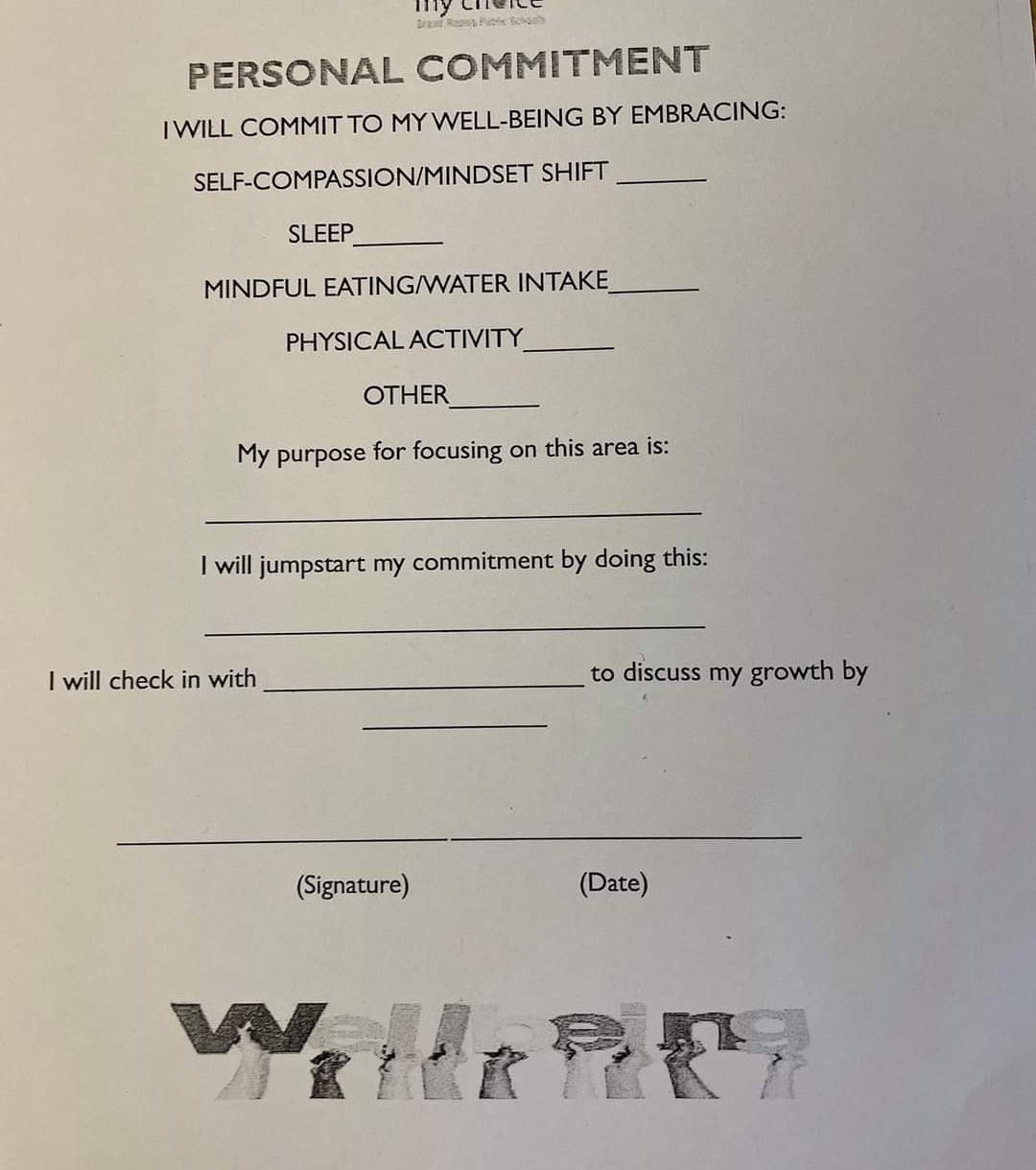
Well, it isn’t the ‘Wellbeing’ worksheet (see photo, below), which feels like one of those make-work reproducible masters teachers used to pull out on a sub day. Self-care dittos.

Here—fill this out. Feel better! Clearly, whoever designed this worksheet does not understand the relationship between drinking more water and the one three-minute window per day when peeing is possible.

Look, I understand that there’s no easy remedy for the conditions teachers are working under: Angry parents. Lies about the curriculum. Anti-vaxxer moms and virus daredevils. What could a school leader who really wanted to support her staff do?

Grow a backbone. Support public education. Here’s a list of 14 viable suggestions for doing that.

Hiring the best possible people, paying them fairly, giving them time to work collaboratively, honoring their expertise, and releasing their creativity? How does that sound as a recipe for school-based self-care?

What do teachers want? What all professionals want: Autonomy. Mastery. Purpose.

A Halloween Story

I took this Halloween photo on our deck, around 6:15 p.m. For about 10 minutes, there were these shocking pink clouds, and then–in less than minute–they were gone.

I am always introspective on Halloween. Since we moved here, we haven’t had trick-or-treaters (might have something to do with the 750-ft uphill driveway and not being able to see the house from the road). But the night is always filled with a kind of sorrow for me; I resonate more with All Souls/All Saints–the thin time of year–than costumes and candy.

In 1972, 49 years ago today, I was living in Mio, Michigan. I was newly married (may he RIP), and had a job at the drugstore in town. I worked with a teenaged boy, Jerry, who came in after school to sweep and clean up before we closed at 5:00 p.m. It was a boring job, but I liked Jerry, who was learning to play saxophone in Mio’s new band program.

I heard, from neighbors and teachers in town, that Mio kids went on a rampage every Halloween. The owner of the drugstore boarded up his windows, as did many other businesses. I was a little skeptical of the stories I heard, which seemed to be many levels above soaping windows and rotten egg-tossing. More like smashing windows and spray-painting buildings and slashing tires.

I made myself some coffee (a new pleasure for me) and waited with candy but nobody came. I could hear kids screaming in the streets. And then, around 9:00, sirens.

We didn’t hear the story until the next morning. A group of kids (five or six of them) stole a car. None of them had a drivers license. A 15-yr old boy drove the car a few miles out of town and hit a tree, while going at a ridiculous speed. All but one of his passengers (a younger sister) were killed in the crash.

I have looked for the story since, in newspaper archives, but could never find it, to clarify my old memory. I believe four kids (the oldest 15) were killed and the youngest girl survived.

One of the kids who was killed was Jerry.

I have had many happy, joyous Halloweens since 1972, especially when my children were young and we lived in a family-friendly neighborhood.

Tonight, seeing the beautiful sky, I was reminded that if Jerry were still alive, he’d be old enough to retire.

Stay safe out there, everyone. It’s a beautiful world. Stick around as long as you can.

Need Teachers?

Like every other state in the union, Michigan is scrambling for teachers.

This is, of course, utterly unsurprising. We’ve all absorbed the message: Treat people like crapola for long enough, and nothing—not even an enticing starting salary (in Montana) of $32K–will lure them into the classroom. That starting salary is, by the way, $15K under Montana’s definition of a living wage.

Not many independently well-off citizens want to become certified teachers, working for fun and pocket change. Gone are the days when teaching could be seen as an easy, optional second income. Especially these days, when teaching could kill you.

Rebuilding the teacher pipeline is actually something we could do. The infrastructure and research necessary for producing fully qualified, even dynamic, public school teachers is in place, and can be expanded and enhanced. All it would take is adequate funding and a commitment to solving a few thorny issues in public education.

Such as respect for the profession, and an acknowledgement of the stabilizing role public school teachers play in American society. For starters.

Done well, there could be a turnaround—in, oh, a decade or so. In the meantime, however…

The MI Department of Education recently sent out thousands of letters to retired teachers, asking them if they’d like to come back, promising to facilitate re-certification procedures, smoothing a temporary path back into the classroom to help stressed local districts. They also pledged to provide some Title II funding for districts to ‘Grow Their Own’ teachers (support staff and other promising candidates) and urged districts to use newly available money to significantly raise early-career teachers’ salaries.

All good, right?

The response from retired teachers was somewhere between bitter and scornful. NOW you want us to come back? When we’re old and more vulnerable to this deadly virus? When you underpaid us and cut support from the schools and kids we served for the last two decades? NOW we’re valuable?

I get it.

But I can’t help thinking that MI is doing the right thing, in asking recently retired teachers to come back. That’s certainly a better response than lowering the bar, letting uncertified, untrained folks, with/without college degrees, into the classroom as the teacher of record. People who see teaching as a temporary job.

A few years back, newly retired teachers in Michigan were not welcomed back as substitute teachers. Legislation in MI limited retired teachers’ work in public schools, claiming that drawing a pension and substitute teaching was ‘double dipping’—as if picking up an extra 75 bucks a couple times a week was unfairly greedy, rather than a gesture of support for currently practicing teachers and local schools.

All of this speaks to a larger, harder-to-define problem around the labor force in public ed. Teachers aren’t simply taking early retirement or walking off the job because they hate remote learning or they’re sick of filling in for colleagues when there are no subs. Teachers are suffering a collapse of morale.

And they’re not alone—2.9% of the American workforce, 4.3 million people, quit their jobs at the end of summer. Since the beginning of the pandemic, seven million workers have just dropped out.

Some of them, undoubtedly, were teachers. If 3% of the workforce in a medium sized school district—1000 employees, say—decided the pay/reward equation wasn’t worth it anymore, a district could easily lose 30 people. That would impact everything from bus routes to reading programs.

And those are national figures—it’s hard to calculate just what pandemic teaching in a politically crazed world has done to the public school instructional force. A teacher friend says all conversations about education right now center on: burnout, early retirement, sub shortages, anger & frustration, mental distress and growing & unreasonable expectations.

That’s quite a list. And the profession will be in crisis for some time to come, even if everybody stopped yelling and started working on rebuilding our public education system tomorrow.

It’s worth asking: Cui bono?

Who benefits from this scenario–a constant churn of teachers at the lowest steps of the salary scale, and a re-conceptualizing of the teacher as technician, ‘managing’ learning remotely, teaching as starter career? Who is trying to strip money and professionalism from public education?

It’s that harder-to-define problem. It’s not just about filling classrooms in 2021; it’s about what teaching will look like in 10 years. Teaching has always been a morally-driven job. Unless you are experiencing joy—or at least satisfaction—in your job, it’s unsustainable.

To his credit, Michael Rice, State Superintendent, and the MI Department of Ed, proposed some reasonable policy solutions for producing more qualified teachers, in addition to asking the old ones to come back. They begin with tuition reimbursement for prospective teachers who make a commitment to teaching, and education loan forgiveness for current and future teachers.

They would provide college scholarships for high school seniors who want to teach, and improve access to university ed schools and teacher preparation programs. Better mentoring. License reciprocity with other states. All good ideas. Will they fly?

Michael Rice: If we expect a major commitment from a wave of young people as our next generation of educators in our great state, the least we can do is to make sure that they don’t go into debt to perform this all-important public service.

That—and a major uptick in salaries—would help. But the thing needed most—public trust in teacher professionalism and community schools—is tangled in ugly politics.

Nobody Hates the Gifted

Apparently, Bill de Blasio, Mayor of NYC (at the moment, anyway) is promoting a plan to overhaul the Gifted and Talented program in NYC schools. The old G/T program would be replacedby a program that offers the possibility of accelerated learning to students in the later years of elementary school. And the test given to kindergarten students to screen for the gifted program, already suspended in part because the city’s advisory school board refused to renew it last year, would be permanently ended.’

This action has– predictably– made some people really mad.

Headlines about de Blasio ‘hating’ the gifted and the ‘war on the gifted’ popped up. New Yorker magazine re-ran their archived article on How to Raise a Prodigy. Eric Adams, who won the NYC Mayoral primary, has suggested he would keep the program as it is now—which seems to be more about tweaking de Blasio than any principle-driven stand on education policy.

As noted, all of this is unsurprising. America has been arguing about gifted education for at least half a century, without actually addressing the problems associated with setting aside assets to select our brightest children and develop special programming for them.

In the case of NYC schools, most of this boils down to inequities—the appalling idea that intellectual ‘merit’ is quantifiable and much more likely to turn up, for some unknown reason, in well-off white children. Or that rising kindergarten students ‘gained access to the program via a high-stakes exam that some families pay tutors to help their children prepare for. Or that all of this was a response to a particularly well-organized and vocal group of privileged parents.

Let me say it again: NYC was testing children as they entered kindergarten, and siphoning them off to special classes for the gifted. Given the unprecedented education issues in play right now, beginning with a deadly virus and a lack of qualified staff, NYC was right to put gifted education in the back seat, as a problem to be better addressed later.

To be clear, I believe we could do a much better job of encouraging and challenging our gifted students. I am strongly in favor of every teacher in America looking for students’ strengths, pushing them to develop that potential, encouraging them to find new passions and interests.

I taught many flat-out brilliant students, and have a master’s degree in gifted education. Giftedness is a real thing—although it is vastly broader and more comprehensive than a skill set ascertained by testing five-year-olds.

I have never met a teacher or school administrator who ‘hated’ the gifted or resented children who bring special talents and assets to the classroom. Nor do I believe it is harmful for bright children to spend their days with peers who learn differently.

We will all spend our lives living and interacting with people who are both smarter and less capable than we are. That’s a core value of public education.

A couple of years ago, Andy Smarick wrote a piece for Atlantic, entitled The Contradiction at the Heart of Public Education. Tag line: Gifted education puts in tension two equally treasured American ideals: egalitarianism and individualism.

Smarick starts out with some good points about competing philosophies—should we honor individual gifts rather than seeking first to level a playing field? Then he shifts to all the reform efforts that supposedly addressed that level playing field: Charter schools. Vouchers. Teach for America. School-finance lawsuits. No Child Left Behind.

He says this: In hindsight, it is striking how little discussion we had in the reform community about how these efforts did or did not address the needs of kids who were excelling, or how these initiatives were landing on non-disadvantaged communities—places where parents liked things just as they were. That lack of self-reflection led to a decade of humbling for reformers.

He winds up with the cliché you see in all the literature put out by organizations supporting specialized programming for the gifted: When schools don’t foster the growth of the highest-potential young people, the public loses something. Beneficial technologies might not be invented, and profound works of art might not be created.

Clearly, Mr. Smarick has not been in many public schools lately, with their (sarcasm alert) cutting-edge technologies and comprehensive arts offerings for children.

But–on the subject of what we’re losing by not skimming off the most academically capable while they’re still wearing sneakers with flashing lights: Think about the most gifted and inspiring people you know. The folks who developed the vaccines that are saving our lives, perhaps, or the MacArthur Genius awardees.  

Did they owe their overwhelming success to taking part in a selective program in middle school? Or was it something else nurturing the spark that drove them to succeed?

I’ve been reading a lot about Colin Powell this week, who graduated from a public high school in the Bronx, then went to City College, where joining ROTC led him to a path of outstanding national and international public service. Would being identified as gifted as a first grader have changed anything about his trajectory?

I believe there are two core issues that should–yes, should–make us cautious about special programming for the gifted: Resource allocation and identification.

Resource allocation is the variable that all schools, districts and states must wrestle with, putting their money where their values are. Paying to test academically promising children, then isolating them for ‘special’ instruction, is arguably a misuse of education’s most valuable resource: attention and instruction from a creative and skilled teacher. Nobody ever talks about the middle-of-the-pack child and what precious contributions they won’t make to society unless they get instruction custom-tailored for their needs.

I could name a dozen things that need urgent attention in public education, beginning with recruiting and fairly paying more of those creative and skilled teachers, and addressing the deplorable state of school funding. It is not wrong to prioritize educational needs—and it’s more like triage in 2021. The worst strategy is using scarce resources to avoid parent complaints. When you’re juggling more needs than available solutions, it’s important to see the big picture, not just respond to demands.

Earlier, I mentioned my degree in gifted education. I took a graduate-level class in Identifying the Gifted as part of my coursework, in which we took some of the tests available at the time, studied IQ distribution charts and argued about who was and was not ‘gifted’.

In sixteen weeks, the class never developed a consensus about giftedness, who was deserving–a word I came to loathe–of more consideration, unique instruction, special academic goodies. Giftedness is an incredibly difficult concept to define—and many children don’t come into or fully realize their abilities until they have gone to school, met a mentor, or had a revelatory experience that leads them into a lifelong passion.

After completing the master’s, I worked for about a decade on programming for G/T students. I was mostly interested in my student musicians, some of whom were exceptionally talented and creative. I pushed for G/T programming at my school and in the region, and sought special, challenging experiences in the arts for these kids.

We finally got a commitment from a local university to host a weekend program for gifted middle schoolers, who would stay overnight in the dorms (it was May; university students had gone home). They would choose one of three tracks to explore—the environment, great literature or the arts—and meet professionals from their field, engage in some challenging activities and discuss what they’d learned.

I submitted one of my students’ names—a girl whose proficiency and love for her instrument was extraordinary. The program coordinator called me up and told me to choose someone else, because the student I nominated ‘wasn’t gifted.’ I’m looking at her scores right now, she said. She’s barely above average.

I talked about her exceptional ability as a musician. I don’t know, the coordinator said. I hate to waste the money on someone who may not benefit. And there it was: resource allocation and identification.

Nobody hates the gifted. In fact, we may not even know who they are.

 The Book We Need Now

Had I known when I was younger what these students were sharing, I would have been liberated from a social and emotional paralysis–a paralysis that arose from never knowing enough of my own history to identify the lies I was being old: lies about what slavery was and what it did to people; lies about what came after our supposed emancipation; lies about why our country looks the way it does today. (Clint Smith)

In this shocking era, when states are passing ill-advised, deceptive laws to prohibit K-12 students from knowing about the sickening, wounding realities of their own history, we truly need a book like Clint Smith’s How the Word Is Passed: A Reckoning with the History of Slavery Across America.

The students Smith is referencing, above, are performing as part of a rich Juneteenth celebration on Galveston Island, TX. They were part of a six-week summer program sponsored by the Children’s Defense Fund, designed to teach children the real story about where they live and what happened there.

Don’t all children need to know about the place they come from? Its triumphs and failures?

In the book, Smith—then a doctoral student at Harvard—visits a number of historical sites around the country that chronicle the record of slavery and its impact on every aspect of American life. He begins at Monticello, sharing his conversations with two white women in his tour group who had no idea who Sally Hemings was– the enslaved woman who gave birth to four surviving children by Thomas Jefferson. These older women, interested in ‘seeing history,’ are astonished to hear about the 600 human beings owned by the great statesman.

Each of the chapters is distinct, featuring plantations, graveyards and annual memorials. The chapter on Angola Prison, in Louisiana, is grim, beginning with its original purpose, in the Reconstruction era: to round up, then house, a low-cost workforce for plantation owners who can no longer rely on the enslaved. The chapter on New York City makes clear that nobody north of the Mason-Dixon line can claim that slavery only existed in the South.

The chapter on Goree’ Island takes us to coastal West Africa, where captured Africans were sent off to their new lives (or deaths) as enslaved workers, and includes this quote from the curator of the House of Slaves, a museum on the Island:

After the discovery of America, because of the development of sugarcane plantations, cotton, coffee, rice cultivation, they forced the [Native Americans] to work for them. And it was because the Natives died in great number that they turned to Africa, to replace the Natives with Africans.

And there it is—this is and always has been about gross economic development. How to make money off exploitive and unpaid labor of others, and the ugly rationalizations used to defend such ugly practices. And how far back this goes—long before the Middle Passage.

In a time when employers are begging for workers after a deadly pandemic (that some employers denied or downplayed), this is a particularly resonant message.

This is, indeed, the book we need now.

Smith tells us, in an Afterword, that he went to many more places than the seven he describes in great detail in this volume. That suggests that there are always places nearby—places where students have been, places they are familiar with—that can serve as testimony and memory of our local history.

As educators, it is up to us to teach that history. This is what all the anti-‘CRT’ protestors fear: the truth.

Smith illustrates that learning the truth is never divisive. It may be painful, and may produce rage—but knowing how this country was built, whose backs and hands produced the wealth and power only some of us enjoy is the cornerstone of building a more equitable society. The truth can unite us, over time. But we have to listen to each other.

Clint Smith is a published poet, and he writes like a poet and storyteller–there is lots of detail and description. Once you get past an expectation of fact-based academic writing, you begin to appreciate his nuanced depictions of people and places, the colorful, palm-strewn islands and damp, gray prison cells. Smith adds only enough data and dry content to enrich, not drown, the narration.

The book is easy to read. I read it one chapter at a time (which I recommend), pausing between to absorb and think, because each segment shares a unique perspective. Smith reiterates, in a dozen ways, that slavery didn’t start in Africa, and African-American history didn’t begin with the capture and selling of human beings.

It was a global wickedness, economically driven, but it still impacts America–the idea and the reality of America–deeply. We can’t get past it until we know the history.

Read this book.

Nice White–Resentful–Parent Syndrome

I worked in the same school district for more than 30 years. Mostly, I taught music—band, choir, elementary music—but occasionally other things: Seventh grade Math (two years), English as a Second Language (for which I was totally unqualified), and a class called Homework Hall.

This was a kind of holding cell where kids who had lots of missing assignments were sent–pulled from elective classes–to receive coaching toward filling in the empty boxes in their teachers’ grade books. A second chance to pass classes they would otherwise fail. A way to protect their permanent record, so to speak.

Back then, the county was a cluster of pretty little all-white towns, interspersed with farmland. When I applied for a teaching position, in the mid-70s, the principal called the village where I got my job “the far edge of white flight.” He was right. More and more people were pushing outward from Detroit, claiming they were looking for a more bucolic setting, and then being surprised when they had to provide their own water, septic and garbage pickup.

Still, it was a good job, and they were hard to come by in 1975. Parents—many of whom had grown up in the area—came to concerts and parent-teacher conferences. They took their kids to the library and volunteered to lead scout troops. They rented band instruments for their children and coached Little League. For a long time—decades—I thought teaching there was ‘easy.’

True, there were worrisome things—the town where my cute, second-floor Mary Tyler Moore apartment was had a reputation as the home of the Michigan Ku Klux Klan. There was lots of local trash talk about Flint (30 miles north) and Detroit (50 miles to the east)—although the area’s transition from rural farmland to outlying suburb was driven, economically, by the auto industry, centered in those two cities.

White flight, indeed. My middle school students occasionally made unfiltered, racist remarks—things they’d likely heard at home—but I was never afraid to call them out. That was then.

Here’s a one-minute video that will tell you all you need to know about this town in 2021, shot earlier this week: Click here.

If you haven’t listened to the NY Times podcast series ‘Nice White Parents’, I heartily recommend it. The tagline captures it all: If you want to understand what’s wrong with our public schools, you have to look at what is arguably the most powerful force in shaping them: white parents.

I no longer live in that town. I moved four hours north several years ago. And guess what? There are lots of ‘nice’ white parents here, too. The stakes are now higher, and student actions are no longer limited to random, clueless remarks. There is outright cruelty—and stormy, ugly school board and county commission meetings.

Sometimes, a kind of common sense prevails—but nice white parents have experience in complaining and getting some action and relief. As a veteran teacher, I can think of dozens of issues that brought angry parents to school board meetings, from sex education to the math curriculum, from bus routes to which neighborhoods got to attend the new, high-tech elementary school (the well-heeled ones, naturally—because those are the parents who showed up to demand access to the new building).

Homework Hall—that class where students got to make up missing work—was created when nice white parents approached administrators, worried that their kid might be doing a second year in the 7th grade. Nice white parents know how to get what they want. And they’re resentful when they do not succeed.

Here’s what I want to know, in 2021: Who is driving the current pushback against honest, warts-and-all American history and civics in the classroom? Who wants to send their unvaccinated children to school unmasked? Who is demanding that teachers scrap their own, self-acquired libraries—the books teachers buy to provide engaging texts for their students?  

Sarah Schwartz of Education Week: In the months after the 2020 election, former Trump administration officials and allies built up a network of think tanks and donor groups dedicated to continuing to advance his policy agenda. Critical race theory has become a central issue for several of these organizations.

Nice white parents, in other words, are organized and funded. There are partisan threads running through this anger, and differences between parents with a college education and those without. Religion plays a role, as does race and gender.

Political scientist David C. Barker summed it up this way:  The populist/anti-intellectual right absolutely believe that the intellectuals are not only out of touch but are also ungodly and sneaky and therefore think they must be stopped before they ruin America. Meanwhile, the intellectual left really do believe the Trumpers are racist, sexist, homophobic (and so on) authoritarians who can’t spell and are going to destroy the country if they are not stopped.

At the base of all the fury over education policy, however, is the fact that white parents have historically had way more success in shaping school programs and practices. And most of the stories in education journalism come from white journalists.

As Ray Salazar writes:  When journalists come from backgrounds where they usually found success in traditional systems — systems that perpetuate inequality — they report from that worldview, bypassing the insights that would be meaningful to people with a different reality.

That different reality is endangered, along with democracy. Those think tanks and donors supporting Trump’s education policy agenda are made up of nice white parents, not the parents of students who are struggling to learn without adequate broadband, materials and well-trained teachers.

Final point: This isn’t getting any better. Most Republicans now believe the Big Lie. State legislatures are working to limit voter access. Trump is still relevant, the overwhelming favorite in 2024.  The anti-democratic political crisis is worse, not better, than it was in January.

It’s a crisis in public education leadership as well.

What is this World Coming To? No. Seriously.

Does it seem to you as if the logical world has tilted on its axis? Does there seem to be an inordinate amount of destructive mania loose upon the land—shattering norms and making citizens on both the political right and left jumpy? And nasty? Even murderous?

Critical questions: Why? And why now?

I started thinking about this while reading about the TikTok ‘Devious Licks’ campaign, which has sent kids into their public school bathrooms to, you know, steal shit. The soap dispenser, the TP holder, the sink. You name it, if you can rip it off the wall and–key point–videotape the stunt to share on TikTok, you are officially cool. And next month, you’ll get to smack your teacher. What fun. Until you get arrested.

I’ve been bemused by the angst over TikTok’s influence on kids’ behavior. Ridiculous pranks are something teachers are accustomed to—all the way back to stuffing kids in phone booths. From the Tide pod challenge to those goofballs falling off milk crates last summer, there’s always some Stupid Human trick to attract school-age kids. Part of the fun (for kids) is scaring their parents and teachers.  You could put an eye out with that BB gun, son—and so on.

Some would like to pin the blame on TikTok, which now has a billion users per month. But here’s what I thought about: those kids in that Michigan middle school shouting ‘Build that Wall!’ on the day after the 2016 election.

If the elected leader of the Western World is openly promoting lies and cruelty, it shouldn’t be surprising that loosening the lug nuts on your principal’s car seems like a fun and even justifiable caper. After all, he’s annoying and gets in the way of what you and your fellow seventh graders feel like doing.

So many norms—from patient care during a pandemic to moderation in political viewpoints to practicing simple and considerate behaviors to protect ourselves and our neighbors—have been bent or shattered in the past 18 months.

Teachers I know have addressed the roiling surf of tamping down student misbehavior during a pandemic with some low-key, on-the-fly brilliance. A friend reported that his school is encouraging kids to post TikTok videos of random kindnesses—like a crew of high school kids repainting a bathroom wall after the paper towel dispenser took a walk. That kind of thing.

Others have reported deep and serious conversations with their students about issues you would think are universal: Respect for everyone. Stewardship of communal resources. Building a better world.

Some of my best moments as a 30-year classroom veteran, came when there was a crisis—a missing instrument, or someone whose dignity had been damaged by another student. You really can build students’ humanity and kindness by modeling it and talking about it.

But now there are parent organizations and reporting forms to track ordinary classroom exchanges, turning students into—for lack of a better term—snitches. State legislatures are trying to figure out how to prevent students from even talking about race and gender.

As a long-time teacher of teenagers, I say: Good luck with that. You can pass all the laws you want, but kids need adult role models, people who are able to build communities of disparate teenagers, and do some work and learning together. And that’s going to happen a lot less when teachers are threatened by legal or local forces.

Here’s one small and local, but telling, example that I found interesting:
In Hudson, OH, high school some seniors are taking a college course in writing, part of an Early College program. They use a book of writing prompts that includes, in over 600 prompts, perhaps a dozen that are not appropriate for high school students—things about drinking and sex, mostly. A parent sees these, and forms a group that wants to see heads roll: school board members, building administrators and teachers. There’s a Facebook post, and suddenly tens of thousands of people are posting their wrath—This is why we have to pass laws! These teachers exposed my child to filth! Fire ‘em all!

Turns out, however, that the book in question has been used for five years at this school, with no problems, largely because every child who took the course had to have a parent sign-off on a statement acknowledging that the college-level materials used in the course might be considered inappropriate. That’s right—parents had to grant written permission for their child to be exposed to writing prompts about drinking and sex. For five years. But in the divided climate of 2021, it suddenly became a Big Issue, worthy of terminating public employees.

Why? And why now?

 Why do you think kids all over America are destroying public property, then sharing videos of themselves rampaging in the restroom of their local middle school? Where have they seen behavior like this before—adults despoiling a beautiful public building, then posting videos of themselves as ‘patriots’?

It’s hard to say what kind of crisis this is—what’s making people show up at meetings and organize demonstrations? So many social factors, including a pandemic, are making people twitchy.

Still, I’m tired of hearing about the schools ‘failing to teach Civics,’ when the same critics show up at Board meetings to complain about discussions of racism in society. What do they think civics is?

We have a lot of work to do to heal the country, in every sense of the word. Public schools and community colleges could be instrumental in that. Schooling has always reflected what’s going on in the nation—and that’s what all those parents and lawmakers are afraid of, and trying to prevent.