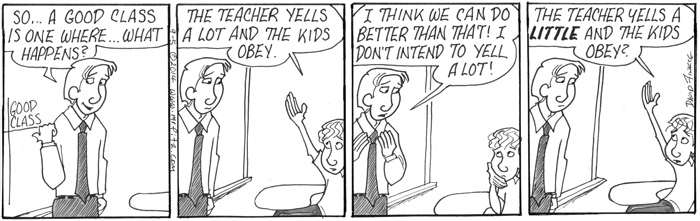
Middle Schoolers: The Myth and the Reality

Among the worst ideas I’ve ever heard, regarding young people and how to develop their knowledge and skills, is this one: Let’s let 14 year-olds serve alcohol in bars and restaurants!

Really? We’re going to let eighth graders wait on adults, bringing them booze, asking if they’d like another, assessing their levels of inebriation? Young, barely teenaged girls “handling” older men, massaging their inebriated egos in hopes of a bigger tip?

Would these be the same young teenagers we don’t trust to select their own pleasure reading, share their own observations about racism and sexism in the classroom, or choose how they want to be identified?

I taught full-time for 32 years, only one of which did not include teaching middle school. I love teaching middle school. Sometimes, I think—in terms of my cynical, low-brow sense of humor anyway—I never really left the seventh grade.

I repeat: I love teaching middle school, and I really love kids in those middle grades.

Tell people that you taught middle school band for more than 30 years, and the first comment you get back will be some variant on “OMG, God bless you” or commentary re: how dreadful it is to parent a person who’s 13 years old—The hormones! The backtalk! — and therefore, how epically horrible it must be to try to teach these kids something, in batches of 30.  

Or, in my case, in batches of 60+, where each student is holding a noisemaker.

Actually, while there were certainly days when I wondered whether I might not be better off selling real estate, teaching middle school music was mostly deeply rewarding and often fun. And in case you think this was because I was teaching an elective, I also taught seventh grade math for two years (once in the 1980s, the second time in 2005), as well as an ESL class and an academic support class where there were fewer than 10 students and classroom management was way more difficult than my 65-piece eighth grade band.

Here’s my honed theory of teaching middle school, in a nutshell: We don’t give middle schoolers enough real responsibilities or credit for their ongoing moral development. They are smart and curious enough to wrestle with big questions and read challenging texts (with some scaffolding). They are trying to figure out what kind of world they will inherit, and are often anxious about the job current adult leaders are doing. This anxiety has exponentially grown by watching adults navigate a global pandemic, stand by as states go up in flames, and try to get themselves elected through the use of lies, cheating and bullying.

Still, middle-grades kids will rise to do a credible job of almost any task we set before them, if they see a point in doing the work.  And when they complain of being treated like children, they’re usually right—every time I hear teachers recommend shutting down privileges we afford adults (using the bathroom when needed, for example, or being given some grace around a missing pencil), I cringe.

Treating young adolescents as if they can’t reasonably manage their own behavior almost always results in their doing precisely that: acting irresponsibly. A well-run classroom is not achieved by imposing a long list of rules, or threats of escalating punishments. It happens, over time, when students understand that you a) like them, b) respect them, and c) think they are capable of doing the work you have to do together, whether that’s single-variable equations or discussing core democratic values.

Over those three decades of teaching middle school, did I sometimes fail to achieve those goals? Absolutely. And did I have students who exhibited appalling behaviors, ranging from mean-girls cruelty to risking bodily harm? Sure.

But the longer I taught, the higher I raised the achievement hoops, and time after time, my pre-adolescent students came through. We have always underestimated the ability of middle-grades students to discuss, write, solve problems, explore issues and help their communities. We are always too quick to pigeonhole them, based on their immaturity. We have let middle school become a kind of punch line.

Which is why I find it interesting that some states, trying to solve ongoing post-pandemic labor shortages caused by adults who are unwilling to work for subsistence wages and are now demanding better job opportunities, are turning to young teenagers. Whether this is child labor or “developing workplace skills” depends on your point of view.

But there are better ways to incorporate the nascent adult skills that middle schoolers want to display than having them deliver alcoholic drinks to adults, or do other jobs that adults refuse to do for piddling money. I think about all the times I took the middle school jazz band, for example, to the nursing home or the school for developmentally disabled students—and how willing they were, with a little coaching, to make those lives better, to interact with people who were profoundly different.

Perhaps the best way to develop middle-grades students is to offer them opportunities to develop adult trust in their capacity.

Several years ago, my school had a pilot program in community service. Students earned points for shoveling neighbors’ walks, being “counselors” at elementary after-school gymnastics or basketball programs, or “student leadership” activities like planning and decorating for school dances. All students, over the course of a year, had to earn a set number of points, reported and signed off on by their parents.

One mother sent in a form awarding her daughter points for family babysitting. The 14 year-old daughter had four younger siblings, two who were not yet in school, and her mother depended on her to come home right after school, and watch the kids, so she could work outside the home.

This seemed like a no-brainer to me. Tending four children (and, by the way, completing your homework, something this girl always did) was a major responsibility for a girl in middle school. But the counselor argued that it wasn’t “community service,” just a family expectation.

The point of having a community service program was to build students’ skills and awareness of their place in—duh—the community, to emphasize that healthy communities depend on volunteering and interdependency. To show middle schoolers that their work and skills were already valued, even though they were, say, 12 years old.

The program was eventually scrapped over issues like defining “community service.” Which I would call an adult failure to understand the considerable capacities of middle school students.

Middle schoolers can be trusted to do lots of things; my 30 years in their company gave me ample proof of that. It’s the adults who can’t be trusted in the proposal that they serve drinks.

The War Against Icebreakers

Best Twitter–is it still Twitter, considering its ugly new Maga-X logo?—thread of the day: A war on icebreakers in upcoming professional development for teachers. The things people report being asked to do range from silly to downright demeaning.

Icebreakers from my own pantheon: Building structures with toothpicks and marshmallows. Holding hands and forming human knots. Lining staff up by length of service to the district. Trust falls. Any number of exercises using chart paper, balls of colored yarn and/or stick-on dots. Also—looking into each others’ eyes for 30 seconds, not breaking eye contact, which was weirdly moving and also kind of creepy.

Once, at the beginning of two days of pre-school year PD, we watched a cool and interesting short video about school climates, and how to determine what individual schools or districts genuinely value, vs. what they say is their mission.

Video asks: How often does the entire school get together—and for what purposes?

Me, in post-video discussion: Our first three scheduled assemblies are the one where we read and discuss the school rules, the fund-raiser assembly where kids are offered prizes for sales to provide basic instructional supplies, and the fall sports assembly. What does that say about our values?

Administrator:

(Later, he sent me an email expressing his anger that I would suggest our collective values are skewed. Which wasn’t precisely true. As a group, I think the staff did have positive values around the students and teaching, and a collaborative spirit, which are all you can ask for, really. Even if we weren’t demonstrating those in routine assemblies.)

In his oldie-but-goodie post “Thirteen Deadly Sins of PD,” Peter Green runs down, more ruthlessly and amusingly than I, the Big Errors PD presenters make. Lame icebreakers for people who already know each other barely gets a mention.  

I actually think there is value in getting the staff together to explore and improve the work they’re doing. And I say this as a music teacher who underwent countless reading-across-the-curriculum and how-our-new-math-series-applies-to-you workshops. There’s value in talk between people who teach the same kids, even if their disciplinary content or instructional practices are different. There’s even value in one of the simplest icebreakers I remember: Taking short walks around the building or outdoors, with a staff member you didn’t know well.

Here’s an exercise I used to use in workshops around Teacher Leadership: draw a teacher leader.

This draw-a-leader technique was one I used, many times, in workshops around teacher leadership, for diverse audiences. I can testify that if you want to clear a room of school administrators, who suddenly have to step out in the hallway for an ‘emergency’ call, start passing out chart paper, crayons and markers, and ask them to draw something.

The Twitter thread notes, repeatedly and vehemently, that exercises in a professional learning session should always be tied to the PD topic presented.  Every veteran presenter knows that turn/talk time, including the ubiquitous practice of sharing notes around new content or a provocative question, runs past the time allotted. People like to talk to each other—or, at least, are willing to listen to what their colleagues say, a break from being lectured.

When staff members talk to each other, it’s a kind of baseline for reflective practice, a low-risk chance to express opinion, share experiences and ask questions. But there’s an underlying fear that teachers are somehow cheating when they teach or enlighten each other, or take the time to argue about the essential nature of their work.  I can’t fully explain this, but I think it’s rooted in hierarchies and the growing, media-fed dismissal of teaching as a true profession.

As Peter Greene notes, at the very least, professional development sessions can hammer home what NOT to do in your own classroom. Anne Lutz Fernandez, in an excellent piece on the teaching crisis, says:

It’s worth noting that teachers have long found the professional development they are offered to be wanting. The report admits that some school leaders “struggled to find and hire high-quality professional learning providers” and “were quite disappointed in the quality of support they received from vendors.” This isn’t new. Back in 2014, the Gates Foundation found only 3 out of 10 teachers were satisfied with their PD.

There’s work to be done, clearly. Here’s one of my own PD failures:

For several terms, I taught an online graduate course on teachers and policy. The teachers who participated frequently did not know each other; sometimes, they came from across a state or across the country. And—just as in a K-12 classroom—not much happens until folks feel comfortable sharing their thoughts. Although the course eventually had Zoom-type meetings, the on-line structure meant self-introductions, shared writing, and conversation threads. Virtual icebreakers.

The first of these asked course participants to share a book about education that was meaningful to them. This turned out to be Not a Great Icebreaker. Many people finally confessed they’d never read a book on education, except for assigned readings in college or grad school. Or—one person would share a book, and the next half-dozen would say “Oh, yeah, I read that, too,” which is a better answer than “I can’t remember any books about education that ever changed my thinking.”

When revising the course, we changed that icebreaker to: Share a link (book, article, cartoon, meme) that illustrates how you understand the education landscape right now. We thought perhaps full-blown books were a heavy lift for practicing educators.

Also not a great icebreaker.

 A couple of people posted things, couched in disclaimers—”I’m probably the only one who thinks this, but…” or excuses “This is all I could find. Is this OK?” And lots of people were unwilling to stick a toe into the conversation. They would tell you their name, what and where they teach—but digging deep into education policy and practice issues with people you don’t know well turns out to be intimidating.

Maybe it’s the Twitter (X) effect: Short and sassy wins the day. Keep your real values close.  Or maybe teachers don’t have enough time to really think about the incredible responsibilities of the work they do. Or maybe it’s the fear that professional learning doesn’t require a workshop or novel content—but happens most effectively when you have B lunch with a couple of sharp colleagues whose ideas you trust.

What Feeds Bias in Education World?

One of the most genuinely enlightening experiences of my professional career was the multi-day bias training offered (at that time) by the National Board for Professional Teaching Standards, required of teachers who were training to score portfolio entries of candidates seeking National Board Certification. The first thing we learned was that bias was inevitable in human judgment—and could be positive as well as negative.

That’s important to remember. Bias is often reflexively construed as harmfulPrejudice, a synonym for bias, is not a word we associate with healthy human interaction. All people, however, bring a basket of predispositions into every aspect of work and life, and it’s hard to extinguish those, even when we’re paying attention. Still, some of those characteristics can be constructive.

The trick is recognizing your own biases, as they emerge, and figuring out where those inherent preferences, dislikes and false beliefs are leading your responses. Not easy to do. But important. As Patricia Devine, a psychology professor and director of the Prejudice Lab at the University of Wisconsin in Madison says:

“There are a lot of people who are very sincere in their renunciation of prejudice. Yet they are vulnerable to habits of mind. Intentions aren’t good enough.”

Worth repeating: Intentions aren’t good enough.

It strikes me that much of what we see in mainstream media about schools, teaching and student achievement is fed by widely held biases. Things like:

Public schools aren’t as good as private schools (because you get what you pay for).

Teachers in high-poverty schools aren’t as skilled as teachers in the well-heeled suburbs.

Getting into a selective college should be every HS graduate’s goal.

Most teachers come from the bottom of the academic barrel, and would have chosen another occupation, if they could.

The “learning loss” children have experienced due to a global pandemic is a crisis and must be fixed immediately; test scores will tell us when all is well again.

I could go on, pretty much ad nauseum. If an education journalist attended a pricey private high school and university, growing up with financial security and a well-fed ego, nurtured in school, it would be natural to carry those biases into reporting on education, making assumptions about the people and institutions who are most responsible for educating the nation’s children. Assumptions, that is, based on nothing more than ground-in thinking, and lack of personal time spent in schools where everyone’s on free and reduced lunch and the textbooks are 25 years old.

And yes—I realize that my own biases about why mainstream reporting on schools and teachers is so often inaccurate are glaringly obvious here.

The situation is worse in state legislatures, where “information” about “policies that work” is sponsored by deep-pockets funders with even deeper biases about the children who most need high-quality instruction, curriculum and resources in the classroom.

And we haven’t even started to talk about racial bias.

Is school the place to start chipping away at biases? Could we—and by “we,” I mean our racist American society—make a dent, a difference, a change in embedded biases by deliberating structuring anti-bias activities and mandating them in public education? Not if a host of Republican hopefuls have their way.

I’m not naïve enough to think that schools could turn hearts and minds in a K-12 generation. But could they do significant good, given the right tools and incentives?

Research doesn’t give us a lot of hope around this question. A study found that pre-school teachers expect bad behavior from black children, especially black boys—and the data indicate that black children are 3.6 times more likely than white children to be suspended. The bias begins in pre-school and plays itself out, endlessly and increasingly as children get older, a self-fulfilling prophecy. It’s hard to see just how bias training could turn this around. But maybe it’s worth a shot.

The most surprising part of the study:

Teachers [were given] a one-paragraph vignette to read, describing a child disrupting a class; there’s hitting, scratching, even toy-throwing. The child in the vignette was randomly assigned what researchers considered a stereotypical name (DeShawn, Latoya, Jake, Emily), and subjects were asked to rate the severity of the behavior on a scale of one to five. White teachers consistently held black students to a lower standard, rating their behavior as less severe than the same behavior of white students. Black teachers, on the other hand, did the opposite, holding black students to a higher standard and rating their behavior as consistently more severe than that of white students.

In the bias training for National Board Certified Teachers, there was a vignette describing a first grade classroom with straight rows and silent, head-down children receiving explicit direct instruction from the teacher: Put your finger on the X. Circle the X. Put your pencil down. All the children receiving direction are black—and the teacher is white.


Invariably, when asked about the quality of the pedagogical strategies, white teachers in the training (all of whom were experienced and interested in improving their practice) responded negatively to the rigid, low-level instruction:

Those poor kids! There’s no warmth or creativity! It’s clear that the teacher has low expectations for these kids.

When the training was held in Prince George’s County, Maryland, however, most of the teachers in the room were black–perhaps 80%. When they read the vignette, they thought the teacher must be doing something right, because all the children were quietly focused. When probed–Isn’t the teaching insultingly simple? —they agreed that yes, this lesson left little room for individual thinking or joy.

They were clear, however, that all children need to be taught to behave respectfully in a classroom, to follow conventions—for their own benefit and safety. They’re black children in a public school where their next teacher may give up on making demands on them all too quickly, teachers said. Plenty of time for creativity and laughing, down the line, but these children don’t seem threatened, simply willing to follow the teacher’s guidance. If you genuinely care about children, you’ll insist that they behave properly.

It was probably the most important thing I learned in bias training—good teachers don’t all see things the same way. What seems obvious to one teacher isn’t clear at all to another, equally committed and skilled, but working with a different set of biases—positive, this time.

Applying that principle of positive bias—let’s let this teacher decide what works best for these kids—is the fundamental building block of teacher professionalism. I may be biased, but I’m always going to cheerlead for teacher judgment and autonomy.

Things that Make Teachers Go Hmmm

For flat-out exhausted teachers, finishing a school year filled with unjust accusations and pointless restrictions, the headline must seem ludicrous: Want to Make $100,000 a Year? Here’s Where You Should Apply.

Turns out it’s a charter school in Detroit, and the spiel initially sounds like they’re seeking the best and brightest teachers (at least 18 of them, anyway) with “strong criteria” to “meet student needs.” The strong criteria? They need to be licensed and certified to teach in Michigan, have five years of experience, and have been rated “highly effective” twice.

It also turns out that only 35 percent of the current staff at the Hundred Grand School is, in fact, certified to teach in Michigan. The charter is essentially soliciting, or perhaps poaching is the more accurate term, a more experienced staff by offering them huge salary increases. Because two-thirds of their professional staff is uncertified. No word on whether any of the current teachers would be considered for the $100K.

My first thought? Where are they getting the money?

Closely followed by imagining a scenario where 18 teachers, identified on Day One by their much-fatter paychecks, are parachuted into an existing staff. And– if you think esprit de corps isn’t really a factor in teaching, you would be wrong.

The tight market for high-quality teachers even seems to be leading Teach for America to a rebranding. A few months ago, TFA was shrinking–Oh No!– but now they’re (get this) focused on training new teachers. Really! I’m serious. Twenty years of asserting that in-depth teacher preparation wasn’t really necessary if the person was smart and well-meaning, and now they’re experts in professional preparation?

The organization said it aims to recruit, retain and develop about 700 teachers in Michigan over the next five years. The announcement comes as Michigan, like other states, struggles to retain qualified teachers, particularly in high-poverty schools, and as far fewer college students choose education as a profession. 

Teach for America was always good at recruiting and marketing. But retaining teachers? And professional development?

The chief complaint about TFA has always been that it was most often a two-years (or less) then-out prospect. Something to burnish the resume’ when you seek a grown-up job in a few years. And TFA teachers had to learn on the job. None of this coursework or field experience nonsense. You’re smart—you’ll figure it out. Catch up.

None of the things Teach for America says it can do in this project—which amount to professionalizing teaching—is in Teach for America’s wheelhouse/origin story. Their job (and they’ve been spectacularly good at getting money and good PR to keep this initiative going) has always been promoting a small group of recent graduates who want to do something different (and, presumably, useful). Save our schools, yada yada, by bringing in some elite temps.

But there has never been a critical mass of practicing TFA teachers in the profession to use their hard-won experience to push for necessary policy change. They take other jobs (easier, better-paying jobs) in education because they can. Or they go to law school. Or work at Morgan Chase.

Teach for America has never been a positive force for change in the teaching profession.  What makes them think teachers will turn to them now?

Hmm. Maybe it’s the $35K bonus teachers earn for being part of Teach for American’s new professional development and teacher leadership programs.

I know all about businesses needing to be nimble and pivot quickly when people stop signing up for your prestigious product, but real professional growth for teachers takes time and experience. You can’t manufacture excellence or buy it. It comes from persistence and dedication. That esprit des corps thing matters, too.

Meanwhile: A bill introduced in the state Senate last month would remove provisions in the Revised School Code that say all teachers and staff in the Detroit Public Schools Community District hired after September 2019 must have their compensation based primarily on job performance, rather than seniority or educational credentials. 

Worth noting: Only teachers in Detroit—not in other districts around the state— were subject to this provision. A financial thumb, pressing down on Detroit public educators, tying them and only them to student test scores, built into the school code.

The common link in all these examples? Money.

Money as teacher lure, money paid to an organization founded on undercutting teacher training and preparation, money for improved testing data, but only if you teach in Detroit.

Hmmm. Maybe we should significantly raise teacher pay across the board. Or recruit candidates by promising better working conditions and sweeping investment in public education. One can dream.

In the meantime, a hearty thank-you to teachers everywhere, winding down.

Would You Recognize a Good Lesson If You Saw It?

Here’s a scary headline: Michigan Democrats Look to Change Teacher Evaluation System.

Not so much the “Democrats” part—although I’d argue that not having a clue about evaluating teachers is common in both parties—but the implication that way fewer than 99% of public school teachers are doing acceptable work:

Consider: During the 2021-2022 school year, 99 percent of Michigan teachers were ranked either highly effective or effective on evaluations.

State Rep. Matt Koleszar, D-Plymouth, chair of the House Education Committee, told Bridge Michigan the state’s teacher evaluation system often leads to school administrators “checking a box” as they monitor teachers rather than using the process to help struggling teachers improve.

“I think when you have a better evaluation system and you’re supporting someone who needs that help and needs (those) resources, that ultimately is going to (filter down) to the student.”

I am decidedly NOT a fan of basing any percentage of a teacher’s evaluation on standardized test scores (it’s 40% in Michigan, under our current, Republican-developed system). And I am a true believer in the statement that teacher practice can be improved—and a good evaluation system (plus—key point—the time, trained personnel and resources to implement such a system) could help.

With so many moving parts, and the current handwringing (and bogus data) around low test scores in students emerging from a global pandemic, re-doing teacher evaluations which might be in place for decades seems precarious at the moment.

The questions, really, are: What are we looking for, in a teacher? What skills and qualities do good teachers exhibit—and are they measurable, with the tools we currently use? What outcomes are most critical for students—and what (easily measured) outcomes disappear quickly?

When the legislature can agree on answers to these questions—with input from the education community and invested parents, of course—let me know. Cynicism aside, how do we streamline teacher evaluation in ways that make it easy to capture and share expertise, help promising teachers build their practice, and excise the folks who shouldn’t be there?

There is, by the way, no shortage of ideas and research around teacher improvement; our international counterparts are already doing a better job of this. Anyone who’s looked at Japanese Lesson Study models, or meta-analyses on building effective learning environments knows this—but investing in viable teacher evaluation systems that also build capacity will not come about with a new written tool or protocol. It will take a new mindset.

Because I spent many years looking at videos of music teachers, while serving as a developer for the National Board’s music assessment, I also understand that there are limitations in evaluating teachers by observing their lessons.

For example: You have to know what the teacher’s learning goals were, going into the lesson, and have some context around who’s in the room. The core competency for nearly all teaching is knowing the students in front of you. You can’t build effective lessons without that knowledge. And that’s hard to evaluate.

I used to teach with a man who didn’t bother to learn the students’ names, because the classes were large—60 or more. His rationale was that learning names was time that could be better spent delivering content. He delivered a whole lot of content, all right, but never got great results, because there was no human relationship glue inspiring students to use that content.

Try to put that into an evaluation tool.

Dr. Mary Kennedy, one of my grad school professors, had a video library of teachers teaching. She would usually show two videos, and then ask us to compare and contrast—and roughly evaluate.  One pair of videos (and discussion) that I remember:

  • A man in a Hawaiian shirt, cargo shorts and flip-flops is facilitating a hands-on science experiment with a half-dozen groups of middle school students, clustered around lab tables. The room is noisy as students manipulate equipment and fill out lab reports, but the teacher is wearing a mic that picks up his comments and students’ questions as he moves from table to table. Several times, when students ask a direct question, he turns it back to them—What do YOU think? Why? Once, he claps his hands and asks the entire class to re-examine the stated purpose of the experiment. There is a beat of quiet, and then students are back to talking and writing. The video picks up students who appear to be off-task, as well, looking at the camera or talking to someone at another table.
  • A young woman is teaching a HS literature class. She is well-dressed and very articulate. The video begins with a Q & A exchange about the assigned reading, with a young man wearing a navy blazer and tie. The questions probe facts from the text—Who is the real victim in this chapter? Does this take place before or after the barn-raising scene and why is that important to the narrative? —and the young man has clearly done the reading, as his answers are all correct. The camera moves back and we see there are about eight teenaged boys in the class, all in blazers. She cold-calls the students, in turn, and they all answer her questions correctly. Other than the questions and short answers, the class is silent.

After watching the two videos, Dr. Kennedy asked: Which was the best lesson? Who was the best teacher? The class was vehemently divided—and remember, these were all graduate students in education. Imagine showing two similar videos to a legislator or one of the Moms 4 Liberty— then asking them to pick out the “best” teacher.

Ironically, the current quest to limit controversy and hot topics in public school classrooms makes it even more difficult to evaluate teacher practice. The best lessons—the ones that stick—are often messy and hard-won. And our best teachers—articulate, student-focused and creative—are being shut down by the very people designing their evaluation procedures.

We used to laugh at the inadequate teacher evaluation checklists—Is the teacher dressed neatly and well-groomed?—prevalent in the 1970s. But we haven’t solved the problem of how to evaluate all teachers fairly and productively. Yet.

Eight Topics Education Bloggers Should Avoid (if they want readers)

I have been blogging for over twenty years—and before that, I wrote the occasional column about teaching for the local newspaper (until The Superintendent sent me a “cease and desist” memo). I have written for a handful of education non-profits, magazines and journals, and spent nine years blogging for Education Week.

When I started blogging, many educators didn’t know what a blog was, and the ones who did spent a lot of time reading and writing about all the Amazing New Tools available, via the miracle of technology. It was an era when financially strapped school districts didn’t hesitate to buy more computers, and everyone wanted to jazz up their lesson plans and see students’ work “published” on the internet. It goes without saying that this was way before Tik-Tok.

Now, I’m writing for myself and anybody who’s interested in reading the thoughts of a veteran educator. Those thoughts aren’t always focused directly on classroom practice, anymore, which was the overt mission of my first paid gigs. Increasingly, my thinking centers on the socio-political reasons for changes in school practice, and what I see as the very real danger that public education might collapse. Even that kind of alarmism is not a sexy, sticky topic for blogs these days, however.

Point being: I’ve been at this for a long time. I’ve written thousands of blogs, columns and op-eds, and observed what gets read and shared, and what sinks like a heavy, published rock. Some of my best work (IMHO, of course) has gone mostly unread. Some tossed-off columns written to meet a deadline got tens of thousands of eyeballs. It’s hard to say what’s going to cause people to read and share a blog.

There are some things, however, that no longer seem to engage teachers (my primary audience) and other education-junkie readers:

#8. Book Reviews  Every now and then, a spectacularly good book about education is published—the kind of book that would help teachers see the work they’re valiantly doing in a new light. I used to teach a graduate course in teacher leadership. One of our icebreakers was naming a favorite book about education. Teachers would routinely admit they hadn’t read an education-related book since college or fulfilling a masters-level coursework requirement. Ironic—and understandable, because working in crisis conditions means you’d prefer to take a break from stress when you read—but also kind of sad.

#7. The Philosophy or Purpose of Education  When Finland gutted and re-did their entire public education system (one that is now deeply admired in the data-driven Western world), they spent years dissecting and re-forming their education goals, before launching an entirely new concept—time that appears to have been well-spent. We don’t do that here. We adopt new programs and slogans on the regular, based mainly on what the people in power think will “work” (to improve data). We resist that deep national conversation about purpose and meaning in education, what our real aims are. We apparently also resist reading about what should matter most.

#6. Teacher Leadership  This one breaks my heart. Teacher leadership and professionalism are at the heart of what I think might save public education, releasing teachers’ moral commitment and creativity in the service of doing right by kids, instead of pursuing goals set by people who haven’t stepped foot in a school for decades. Want to be depressed? Ask practicing educators for their definition of “teacher leadership”—or sit in a teachers’ lounge at lunch and listen to stories of how dedicated and skillful teachers are now treated, in their own workplace. Hint: not as potential leaders.

#5. The Pandemic  Our entire focus, as we move out of a massive global emergency, is trained on two meaningless issues: So-called learning loss—a fancy name for entirely predictable drops in test scores. And a weird obsession with which schools took the risk of meeting face to face, when it was safer for students to be at home.  One might reasonably expect a devastating pandemic to have an impact on students’ emotional well-being as well as endemic confusion about “best practice” during a health emergency. But shouldn’t the questions and initiatives now be around how to support our kids, and figure out what such a traumatic event can teach us all? Instead, there’s all this finger-pointing and blaming. And writing a blog about what positive changes a pandemic might spur gets you zero readers. 

#4. Religion Perhaps you think that religion and public education are two separate things. If so, you are wrong. The intertwining of Church and State—a very bad idea—lies under a lot of the angst in public education in 2023, from book-banning to whatever Hillsdale College is cooking up at the moment. Writing about schools and religion, especially nuanced viewpoints, is a losing proposition. The blogs that get the eyeballs are anti-Christian (on the left) and anti-all non-Christian religions (on the right). Nobody wants to read about a positive role for any religion, like opening church doors to AA or feeding hungry schoolchildren, let alone offering comfort during times of great fear and upheaval.

#3. Racism This one needs an asterisk—because there are plenty of people writing about racism, the most eloquent and productive being those who have lived with its aggressions all their lives. But white women wanting to open a dialogue around racism in schools? Maybe they’re virtue signaling? Writing about racism, and the panoply of school-related issues impacted by systemic bias, is dicey for someone who might be perceived as, well, removed from the action. But as Ijeoma Oluo says in So You Want to Talk About Race? —you have to keep trying. Even if nobody responds.

#2. Research  I’m hardly the first person to write about the disconnect between valid education research and education practice (let alone policymaking) in public schools. And there are readers for pieces that present the most recent grant-funded studies from the Hoover Institution and the folks at Fordham.  Mostly, the commentary is something like: My research is better than your research or Your results don’t mean what you think they do. Even when the research is credible and useful (which isn’t always the case) the audience for genuine research breakthroughs is small and parochial.

#1. Women  I am always fascinated by the fact that teaching is such an overwhelmingly female occupation, and the corresponding chronic disdain for teachers that shapes education policymaking as well as mainstream media. It seems logical that asking a question like “Does the reason teachers make so little money while doing such important work hinge on the fact that they’re mostly female?” would be a hot research topic. But of all the issues I’ve written about in the past 20-odd years, blogs and columns about gender and education get the fewest eyeballs. I’m not sure why—women dominating the teaching profession and the outcomes from that seem to be like the sun coming up in the east: just the way it is.

I used to do blogging workshops, to encourage teachers to write and publish their thinking about education reform and classroom practice. Invariably, the audience would be largely female, but of the prospective bloggers who attended, the ones who followed through with creating a blog (or being hired by someone to write) were most often men. That has changed a bit —there are now more online options for teachers to share their tips and opinions—but I doubt if we’ll ever see four female educators blogging for every man.

Last thought: What blog topics always draw lots of traffic?

  • The Outrage du Jour (weird stuff that happens in schools and then is promptly forgotten)
  • Testing (everybody hates it, and loves reminders that it’s bogus and useless and time-wasting)
  • Wars (the war on teachers, the Reading Wars, the Math Wars, the Recess Wars, etc. etc.)
  • Lists (something about a number in the title)
  • Gifted education (there’s an organized gifted parent legion out there; I recently randomly ran across a man—on another person’s FB page—bragging about ‘ripping Nancy Flanagan a new one’ over a column on gifted education I wrote 10 years ago, a man I don’t know and never exchanged messages with, but who felt absolutely triumphant about… something)

So—what draws you to a particular blog?


Where the Boys Aren’t: Why is Teaching Still a Female-Dominated Profession?

Last week, the Michigan Department of Education named Candice Jackson, a third grade teacher and instructional coach in the Detroit Public Schools Community District, the 2023 Michigan Teacher of the Year.  Hearty congratulations to Ms. Jackson, and my heartfelt wish for an awesome year, packed full of opportunities.  In my (admittedly unasked-for) opinion, teachers in Detroit have been beaten up for decades, but are a talented, determined bunch—teachers with a mission. It’s especially wonderful to see one of them recognized, and their work showcased.

What I found interesting is that all ten of the regional finalists are women. They’re a diverse bunch, too, teaching across the K-12 spectrum in multiple subjects and contexts.

I’m old enough to remember when hiring men to teach in elementary schools was a district goal—we thought that men would serve as role models for younger children and were ecstatic when our new varsity basketball coach was hired to teach kindergarten.

Hiring women as administrators and in secondary jobs that usually went to male candidates (like—cough—band directors) was seen as progressive (by some school boards and hiring committees, anyway); the percentage of women in formerly male-dominated education roles has steadily crept upward.  Over half of school principals are women, in 2023, and a quarter of superintendents are female, a 12% jump over the past two decades.

There’s some research that suggests blended teaching cultures benefits students—that veteran teachers and novice teachers have much to teach each other—and there’s research that supports learning gains when students have teachers of the same race. But what about gender?

The K-12 teaching force has grown increasingly female, although slicing and dicing the numbers is tricky. States where teacher unions are still strong tend to have more male teachers, especially secondary teachers—which may be a function of higher salaries. In Southern, right-to-work states, the percentage of male teachers is lowest—about 18%  of the K-12 workforce in Virginia, Mississippi and Louisiana.

An imprecise but useful stat: about three-fourths of K-12 public school teachers are women, across the United States. Interestingly, there are more men (white men, anyway) teaching in private schools than in public—and for considerably less money.

You may not have noticed, but this week is both National Nurses’ Week as well as Teacher Appreciation Week. A cynical person might wryly suggest that it’s efficient to double up these “honor women” weeks, get all this female recognition nonsense over with and let them get back to their underpaid service jobs.

But something has been happening in nursing careers. There are more men training to become nurses—nearly doubling their numbers from 2008 to 2021—and salaries are rising fast.

As we consider how to stop the hemorrhaging of the teacher workforce, the question might be: What is happening, in K-12 public education, that makes women stay—and excel in—teaching and aspire to school leadership positions? What is driving men away from education jobs? And why would men decide to pursue nursing, but not teaching?

I have some thoughts about that—but need to preface them with a disclaimer: None of this is hard evidence, let alone causal evidence, but it’s pretty clear that the female-dominated teaching profession, once the refuge of intelligent women who wanted interesting careers and couldn’t find them elsewhere, is in trouble.

Money is one obvious reasonalthough male teachers in the U.S. make about $2200 more than female teachers. Teaching is, always has been, a low-paying job, and it’s getting worse. As a society, we’ve moved away from the idea of a male breadwinner and female secondary income—the “my wife is a teacher so she can be home with the kids in the summer” syndrome.

When teacher unions began lobbying (and striking) for more (fair) pay, decades ago, the never-ending source of a low-cost, qualified female workforce for public education dried up. The response was not acknowledging the importance of public schools in building society, and paying up, but pushing back and even vilifying the unions.

But it’s more than salaries—because blaming it all on low salaries implies that women, more than men, are more willing to be servile, working for peanuts because women have always worked for peanuts and a good feeling. When you look at the puff pieces around Teacher Appreciation Week, it’s important to note that Americans have accepted the idea that public education programming and materials (not just salaries) are funded by goodwill, generosity and Donors Choose– and that’s OK.

The United States is also an increasingly technocratic society. We have not gotten over our love affair with STEM education, although it’s clear that fabulous STEM jobs have been way oversold. We don’t value the humanities or important work with very young children, two things that are absolutely dependent on skilled teaching and judgment. In fact, we’ve embarked on yet another wrong-headed reading war with the mislabeled “Science of Reading,” a triumph of misplaced faith in a one-size-for-all, science-will-save-us method for the ultimate individualized task, learning to read. A task, it should be noted, that is overwhelmingly accomplished by women.

I think teaching, despite a lot of empty rhetoric, has steadily lost social prestige. This is ironic, because (trained and certified) teachers today are better prepared and more skilled than teachers of yesteryear. There were enormous strides made, pre-NCLB, in teacher professionalism: increased education, greater selectivity, mentoring, innovative curriculum development, pilot programs in teacher ladders and a marvelous new tool—computers in the classroom.

All of that turned around, c. 2001, and the public education focus shifted from mastery to accountability. Good teaching was less about creativity, community and judgment and more about test scores and competition. If you were looking for autonomy, mastery and purpose, you were less likely to find it in a public school—this might explain why white men still teach in higher numbers in private schools, despite lower overall salaries: because their personal work is acknowledged as central to student success.

You would think that a global pandemic—which was devastating to nursing– would have sent more people out of nursing than teaching, but nursing is a growing profession, with more candidates than the available programs can handle. And more of them men, willing to do difficult, important work.  

The pandemic has upset occupational norms, goals and rewards.  Anyone who’s passed a McDonald’s advertising $21.00/Hour jobs understands that it’s a brave new world, a re-ordering of priorities.

The people who will be standing in front of classrooms in the future, the Gen Z educators who assume schools are for testing and competing, not nurturing, those fully accustomed to shooter drills and recurring violence—will they be willing to just follow orders?

Will we eventually lose the dedicated and talented female education workforce, too?

4

America’s Most Vulnerable and Important Profession

The Teachers: A year inside America’s most vulnerable, important profession (Alexandra Robbins) does what many other books about teaching are not able to do–take the reader right into the classroom, and describe what’s happening, with empathy and perception. There are lots of books about problems in American education, and lots of books that suggest solutions for those problems, but we seldom get to see examples, conversations and the people doing the work.

If you want a drone’s eye view of American public education—where it’s been, what bedevils the century-old movement to improve it—I would recommend Diane Ravitch’s trio of excellent books that follow education reform over the last couple of decades, or A Wolf at the Schoolhouse Door: The Dismantling of Public Education and the Future of School by Jack Schneider and Jennifer Berkshire.

But if you want to see what happens in the classroom and in the lives of teachers, Robbins accomplishes that better than any book I’ve read since Tracy Kidder’s Among Schoolchildren, written in 1989, which now feels like ancient history . The book is a tour de force—every teacher I know who’s read it agrees—unapologetically written from the POV of teachers without feeling the need to make excuses or backpedal.

Robbins chooses three very fine teachers and takes us through one year (immediately pre-pandemic) of their classroom and personal lives, deftly illustrating how those lives overlap, the pile-up of frustrations and issues bleeding into their emotional well-being.

All three teachers have huge and versatile skill sets and genuine dedication to kids as well as subject matter. Interspersed are data and editorial comment about education and current “reforms” (scare quotes are deserved here), as well as real-life anecdotes and comments that reveal just how far teaching and teachers have sunk, in public estimation.

Robbins highlights things that other education books don’t notice or can’t be bothered with–in-building teacher jealousies and vindictiveness, physical violence against teachers, the long-term effects of cuts to things once considered normal in every school, what it’s like to sit in an IEP meeting with a recalcitrant parent or clueless colleague.

One of her teachers is a middle school special education teacher who finds himself taking on every troubled kid, something that school administrators often push, seeing him as the ultimate “male role model.”  Another is an overachieving fourth grade teacher who knocks herself out to be the perfect teacher for every child, leaving her with no time to build a satisfying personal life (and illustrating, to readers, just how arduous differentiated instruction is, even in a building with adequate resources and good teachers).

The third teacher is a 20-year veteran, a sixth grade math teacher who has mastered the delicate art of getting the best out of her students and runs afoul of a clique of punitive teachers who resent her success and want her to punish kids who are doing well in her class for their sins in other classes.

(Here’s a story from my own experience that parallels her problematic relationships with the people who should have her back—feel free to skip it): We’re having a staff meeting, late spring, to talk about the imbalance of students in elective classes. The middle school bands keep getting bigger and bigger. I will have 93 students in my 8th grade band next year. What this means (besides a classroom management nightmare) is that other elective classes will be tiny, because “too many” students want to be in the band. The Woodshop teacher is outspoken—we need to limit the number of students in band, perhaps allowing the 93 students only one semester of band, in order to give him the minimal 12/class that will keep him employed in the building full-time, rather than splitting his time between middle school and high school, or forcing him to teach a second elective subject.

Everyone knows why all those kids want to be in the band, he says. I turn to him, surprised. I have no idea why kids sign up for band, beyond the fact that they like it.  Mrs. Flanagan gives them all As and Bs, he says. If we forced her to use a bell curve like everybody else, we’d see half of them drop out.

I look around. Nobody’s making eye contact, so it’s clear that this has been a topic of conversation before. And there’s some truth there—I do give a lot of Bs and As, mainly because the students are meeting the goals set for the class. Their parents are paying for their instruments and students must practice to do well in class. We do many performances—both band and individual players. The bell curve is stupid; have all my colleagues really been using it?

I can justify everything I do, but I spent the rest of the year eating my lunch in the band room, paranoid about disrupting the building schedule. And the next September, I have all 93 students in my first hour class. Nobody ever shows up to help. The Teachers is full of stories like this—real things that happen. There is no paradise, no perfect school, although there are many vivid examples of teachers bending over backwards for students and colleagues. Why aren’t we honoring this, financially supporting this work, applauding the folks who show up to teach every day, sacrificing their time and energy for other people’s children?

This book is also the first and best description I have read about the impact of the pandemic on teaching and learning. There have been endless articles and research on “learning loss”–all rife with meaningless data and numbers–but nobody talks about the impact of being expected to position family needs as secondary to students’ needs. Robbins gets this right–there is a line between acting morally vs. choosing school over family, a choice that teachers were urged to make, and reviled when they chose their own families and their own health. We have not yet reconciled that, here in America—but the book makes a good start on it.

Highly recommended for everyone, but especially teachers. It’s a fairly fast and facile read, although well-documented with endnotes, and should give teachers a lift, knowing that their work and their dilemmas have been acknowledged.

Thinking about Teachers at the Table

In the fall of 1993, the United States Department of Education (under Richard Riley, Secretary of Education) held what was intended to be the first annual National Teacher Forum. Organized by Terry Dozier, Special Assistant to the Secretary, state Teachers of the Year and their chosen outstanding teacher partners were invited to Washington D.C. to discuss how to bring the teacher voice into policymaking.

I’ve been to lots of conferences and seminars, but few impacted my life as a teacher leader more than the first National Teacher Forum. I can remember, verbatim, phrases—Honor what we know!—and aphorisms we used: Teachers want to be partners in, not objects of, education policy.

The idea of teachers at the policy-making table was downright thrilling. We deserved to be at the table—in fact, it was our table.  Our contributions could make a huge difference in policy around student learning and public school organization. We had answers to education’s persistent questions. Ask us!

We were all assigned a partner in the US Department of Education. We went to workshops (this was where I first heard of National Board Certification). We networked with the legislators and bureaucrats who were making policy around the work we did every day. We were encouraged to start our own state forums for accomplished teachers. Best of all, we started something few of us had heard of before this: an online bulletin board and discussion group. I was a moderator of that group—and still have many professional friends from that time.

I wish I could give you links so you could explore this wonderful program, and read the publications that resulted, but an hour of googling and a scouring of ed.gov have yielded zero information on the Forums (there were eight—the entire initiative and its published results were taken down in 2001, as No Child Left Behind turned education policy in a vastly different direction). I found two publications—Teachers Lead the Way, from the 1997 Forum, and a reprint of the 1994 Forum document, Prisoners of Time, which was apparently (and ironically) co-opted by the Education Commission of the States.

I share all this to illustrate the fact that teachers have long been interested in controlling their own professional work, and willing to share their expertise and perspectives with policymakers. Personally, I’ve been involved in several initiatives to bring teachers to various policy tables. After the National Teacher Forums bit the dust, State Teachers of the Year organized themselves—and even proposed Teachers at the Table legislation (which went nowhere). The idea keeps bubbling up.

Point being: the only people who think having a substantive teacher voice in education policymaking is a great idea are teachers. And, of course, their state and national unions—who represent the broad outlines of teacher-friendly policy via lobbying and advocacy, and are wary of independent teachers proclaiming their teaching expertise makes them policy experts, as well.

Publications and media about the teacher voice haven’t shut down in the intervening 30 years. Independent blogging, non-profits and social media have elevated pieces about the necessity of asking teachers whether a Big Sexy Idea about how to ‘fix’ issues in public education will work (usually, no) and what might actually improve teaching and learning.  

In short, as Jose Vilson says in his TED Master Class, no conversation about education should happen without the teacher voice front and center.

But—as with all things in education—there are caveats in thinking that gathering a group of teachers (even award-winning teachers) and asking for their policy ideas would be the fastest way to better schools.

Teachers aren’t trained to do policy creation and analysis. They can tell you, in excruciating detail, what bad policy does to student learning in their context. But good policy is written with measurable goals and specific outcomes in mind, accompanied by the supports and spurs that will get us there.  It requires imagining not only happy results but unintended consequences.

Policy is not (exclusively) mandates and incentives. Sometimes, it involves capacity-building, persuasion—or overt systemic change, which takes time and accrued data to analyze. Regularly asking teachers to comment on the changes wrought by policy shifts ought to be a no-brainer, however. Acting on educators’ feedback would be even better.

Here’s an example: My state instituted a third-grade retention law in 2016, wherein students who didn’t meet the third-grade standard for reading proficiency would be held back—a mandate, taking away a decision that had always been made by teachers and parents. Half the states in the nation now have similar policiesand politicized policymaking has made other states feel they need to crack down on those lazy eight year-olds.

It’s a terrible policy, for dozens of reasons, beginning with its target audience and punitive nature. In six years, it hasn’t yielded anything beyond angst and anger, much of which has been directed at teachers and schools, not clueless (or, sadly, vindictive) lawmakers.  

The good news here is that MI Governor Whitmer seems poised to sign a bill repealing the third-grade retention mandate. Nevada’s repealed theirs, too. The MI bill’s sponsor, Senator Dayna Polehanki, is a former teacher. A Michigan Teacher of the Year, Leah Porter, testified in hearings.

There’s a role for teachers in examining and fine-tuning education policy—and a strong need for teachers to run for public office to share their experience and expertise. As we said, at the 1993 National Teacher Forum: Honor what we know.

Teacher of the Year: Popularity Contest or Tall Poppy Syndrome?

My opinion on various teacher recognition programs has always been clear and simple: Teachers in America get so little in the way of acknowledgement and perks that every single teacher honored for their excellent work richly deserves the spotlight and whatever rewards come with it.

Teaching, as Lee Shulman famously noted, is impossible. And yet millions of teachers get up every morning and head off to do critical work that benefits our communities–and is also underpaid, misunderstood, phenomenally challenging and complex. If any of them get a public pat on the back, or a tangible bonus, it’s deserved. No question.

So I was surprised to see an article [pay wall] in Education Week, generally considered the educational equivalent of the Gray Lady, with the headline The National Teacher of the Year Award: A ‘Call to Service’ or a ‘Popularity Contest’? :

Past finalists and honorees have said the process of being considered for National Teacher of the Year was a humbling experience that allowed them to advocate for the profession they love. It’s not meant to elevate some teachers at the expense of others, they said, but rather allow them to represent the needs of teachers and students on a national level.

But, but, but—when the five finalists for this year’s National Teacher of the Year award were posted on EdWeek’s Facebook page, there was a flurry of negative comments—over 200, last I checked, beginning with the snark about Teacher of the Year programs being a popularity contest. There was some defense of the National Teacher of the Year program, but the bulk of the comments might be summarized as suspicious, even resentful, of teachers who are singled out for recognition.

Comments clustered around three assertions:

  • Competitions pit teachers against each other. This is a uniquely ‘teacher thing’—the desire to build community and work together is central to running a productive classroom. If you’ve ever been to a teacher award banquet or ceremony, you’ll notice that honored teachers cross the stage humbly, heads down, then “share” the honor with their colleagues and students, if they get to make remarks. Compare that to, say, realtors being rewarded for millions of dollars in sales—pumping their trophy, and promising that next year’s sales will be even higher. The metrics of good teaching are—and absolutely should be—personal and site-specific, unlike other careers where it’s easy to say who is “best.” There were also some spiteful comments of the “I can’t believe they picked this lousy teacher I know” variety.
  • Not all teachers have access to Teacher of the Year or similar awards. There were lots of remarks about the work that teachers needed to do to be considered for an award—papers to write, interviews to schedule, evidence to assemble. All of this takes away from being awesome in the classroom (true). In addition, teachers’ workplace conditions are vastly dissimilar. Some teachers have adequate resources and students whose families have helped them become goal-oriented. Other teachers have none of these things, but do their best anyway. How could that be fair, when assessing a teacher’s impact and outcomes?
  • All teachers are Teacher of the Year for someone. I absolutely agree that all teachers deserve more—lots more—than having one of their colleagues plucked out for a certificate or prize. I concur that teachers everywhere are grossly underpaid for the complexity and importance of the work they do, and—especially these days—unfairly beleaguered. But I’m not sure if this means that outstanding teachers (because there are outstanding teachers) should never be identified and feted. This feels like Tall Poppy Syndrome.

I am interested in all of this because I was Michigan’s Teacher of the Year, in 1993. I am also a National Board Certified Teacher—two very different, but credible teaching awards. I have seen teacher award programs from the inside, and heard all the remarks about defining exceptional teaching made on EdWeek’s Facebook article—some directed at me, of course.

My take: The single most gratifying—and humbling—accolade was being named Teacher of the Year in my medium-sized school district, where I was nominated by another teacher, where my work with students was well-known, and where I was surrounded by highly skilled and supportive colleagues.

Being named Michigan’s Teacher of the Year, by contrast, sort of dropped from the sky. I didn’t seek it (beyond writing and submitting the application, at the urging of my superintendent), and was dumfounded and a little dismayed when I actually won.

Few people understand how different “Teacher of the Year” programs are, district to district and state to state. In some buildings, the same teacher can be named year after year and it does feel like a competition. In some states, the TOY is released from teaching for an entire year, to travel and speak. Other states have significant perks: Leased cars. A seat on the State Board of Education. A wardrobe allowance, since the Teacher of the Year shouldn’t keynote conferences in her denim jumper.

During the year I served as TOY, I was also working full-time, at my regular job teaching 320 middle school band students. The district found (and paid for) subs for days when I had TOY responsibilities, which meant that frequently, teachers in my building were asked to sub when I had to leave early to speak at a banquet, or drive across the Mackinac Bridge to the Upper Peninsula for a workshop. I took every request that I could manage, often paying my own mileage and expenses.

I was out of the classroom 37 days. It was hard on my students—and even harder on my family. I had two small children and my wonderful husband picked up mountains of slack. It was exhausting, and I was glad when it was over. My superintendent put up a green and white road sign at the entrance to the village: Home of Nancy Flanagan, Michigan Teacher of the Year, 1993. Later, my husband retrieved that sign from a dumpster behind the school’s bus garage. C’est la vie.

During that time, I heard lots of sarcastic “famous teacher” remarks—and a few questioning whether I was actually TOY material. Five years later, I sat for National Board Certification, because I wanted to prove that I was indeed an accomplished teacher–to put a metric on the title, to provide evidence, a bona fide seal of approval. It was a great (and similarly exhausting) experience, but it’s worth noting that National Board Certified Teachers hear many of the same remarks about maybe being too big for their teacher britches.

By far the best part of being Michigan Teacher of the Year, however, came in the years after 1993. TOYs are sort of like Jimmy Carter—once you’re out of office, the stress subsides and the opportunities to do good work are endless. I got a gig at Education Week as a teacher-blogger. I discussed professional development on C-Span at the National Governors Association Conference.  I had interesting interactions with Michigan Governors.  I still got to teach.

And—I met incredible people, most of whom are educators. That’s the perk that all teachers should have—the conviction that the nation is filled with good teachers, plus the opportunity to exchange ideas and inspirations, professional goals and camaraderie, all of which is available to any teacher willing to reach out and start a conversation on social media.

I wish all of this year’s awardees the best.