Ten Non-Standard Ideas for the Beginning of the School Year

I had a colleague, a long-time third grade teacher, who spent most of August sorting books into leveled baskets, going steady with the laminating machine, and running up colorful curtains for the door to her classroom. Her husband, a secondary social studies teacher, would mark the beginning of the school year by wandering around the house, trying to find his thermos. This was immensely irritating to her, of course. But it’s hard to say who was the better teacher.

I had more than 30 first days of school as a teacher. Here’s my—very non-standard—advice for teachers, on gearing up for the new year.

1. Don’t work too hard at unimportant things, like fancy bulletin boards. The most important thing you can do before school starts is think about the curriculum and the kids you’re teaching. You’re not likely to achieve a high-functioning, intellectually cooking Day One, anyway. You’re aiming for Day Four or maybe Day Eleven, once you have a sense of who’s sitting in the desks (or on the floor), and how to get them to work together.

This is not a half-baked “make it up as you go along” theory of instruction, by the way. I know that curriculum has never been less open to creativity—and Important Metrics are looming. You’ve got a big job to do. But—as the salesman says, in The Music Man—you gotta know the territory.

2. Walk around the building and say hello to all of your colleagues. Even if the interaction lasts 30 seconds, and you’re not particularly fond of the teacher / aide / principal / secretary / custodian in question. There is nothing more effective than a school building where adults get along, respect each other and have the same goals. I am always amazed when teachers bitterly complain about the kids bickering in their classrooms, then proceed to ignore or castigate their fellow staff members. Build a few relationships. Welcome newbies. Thank the custodians for the shiny floors.

3. When it comes to advance planning, keep your options open. Don’t write detailed lesson plans for a semester. Plan for a week, maybe, just to ensure you have enough rabbits to pull out of your stovepipe and keep the kiddies busy. Set overarching goals, for sure. But it’s folly to think you have the flow of instruction and learning for the next six weeks under your control. The watchword: learn as you go.

4. Corollary: For now, plan grandly, not precisely. Think about the things students need to know for the next decade, not the next standardized test or unit quiz. Not even the end-of-course or college admissions exams. Focus on things they need to master and understand before adulthood.

Very soon, you will be dealing with the ordinary grind: daily lesson plans—plus assemblies, field trips, plays, the school newspaper, the spelling bee, the science fair, yada yada. Those are the trees. Think about the forest. What do you want your students to take away, forever, from your teaching? Which big ideas? What critical skills? It’s easy to forget the grand picture, once the year gets rolling. Take the time to do it now. Dream.

5. Make your classroom a pleasant place for you, too. In addition to being a place where students learn, it’s the place where you work, both with and without kids. (And, yes, I spent a year on a cart, so I know this recommendation may seem specious.) Most of us teach in a place that, stripped to its essentials, feels institutional, to some degree—if not downright unsightly. Find a way to have comfortable seating, task lighting, pictures or tchotchkes that make you smile. It doesn’t have to be pretty and color-coordinated—many wonderful classrooms have that “kids’ playroom/teenage basement” aura. Still, forget those admonitions about too much personalizing—a classroom should feel like home.

6. Don’t make Day One “rules” day. Your classroom procedures are very important, a hinge for functioning productively, establishing the relationships and trust necessary for individual engagement and group discussions. Introduce these strategies and systems on days when it’s likely your students will remember them and get a chance to practice them. This is especially important for secondary teachers, whose students will likely experience a mind-numbing, forgettable parade of Teacher Rules on Day One.

7. Instead, give students a taste of disciplinary knowledge on the first day of school. Teach something, using your most engaging instructional techniques. Perhaps a game, a round-robin, a quick-response exercise with no wrong answers. Bonus points for something involving physical movement. Beware of empty ice-breakers or team-building exercises—your goal is to have students going out the door saying “I think this class is going to be fun, and I already learned something.”

8. Keep your expectations about the first few days modest. You will probably be nervous (and have bad dreams), even if you’ve been teaching for 30 years—I always did. The students will be keyed up, too—it takes a couple days for them to settle in and behave as they usually do. Wait for your teacher buzz to kick in—that happy moment when you see engagement, maybe even laughter, and you know you’re on the right track. It takes a while, but when it happens, it’s like the first flower in the spring garden.

9. It’s the first day of school for parents and families, too. They’re at home, wanting to know that their kids are OK, that this year will be a good one for little Tyler. One idea for immediate parent engagement that I used for many years (thanks to Middleweb): asking parents to tell you about their child, in a million words or less. Very simple, and very powerful.

10. Tie your classroom to the world.  Even if you teach kindergarten—or chemistry—you can’t avoid election-based chatter in your classroom. Use the daily news as backdrop for modeling civil interactions and substantive debate on the content you teach. Read picture books on immigration. Take your AP Stats class to polling sites. Assign your physical education students to watch YouTube videos of the Olympics for amazing physical feats as well as examples of sportsmanship. What are YOU currently watching, reading or discussing? Share. Help your students analyze issues or find role models.

Hysterical Women

Truth nugget: Education policy is 100% shaped and impacted by the fact that three-quarters of the education workforce is female.

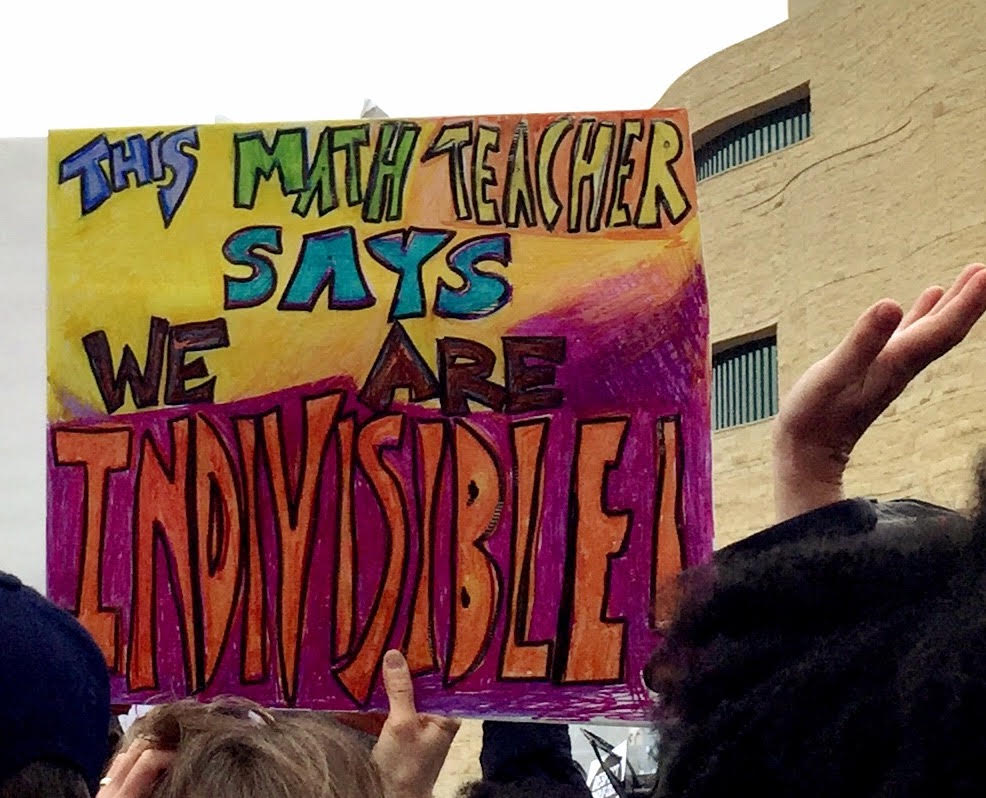
Another truth nugget: After Trump was elected in 2016, over a million women descended on Washington DC to march against what he stood for.

And now, after the events of Summer 2024? Well, do your own math, draw your own conclusions. Maybe start your own organization and host a national call.

As the inimitable Dahlia Lithwick noted: The court granted itself the imperial authority to confer upon the president powers of a king, but although Justices Sonia Sotomayor and Ketanji Brown Jackson said as much in their respective dissents, it fell to Big Daddy Chief Justice Roberts to intone to his readers that their aggregated dissents strike “a tone of chilling doom that is wholly disproportionate to what the Court actually does today.” Implying that the dissenters were overreacting, and without ever attempting to address the substance of their claims, Roberts accused them of “fear mongering on the basis of extreme hypotheticals about a future where the President ‘feels empowered to violate federal criminal law.’”

In other words, sit down ladies. You’re hysterical. We don’t appreciate your chilling doom or your extreme hypotheticals. A President who feels empowered to violate federal law? Hahaha! That could never happen!

This type of response could come in handy for pacifying those whose policy/practice wheelhouse is education. It’s a familiar tone policing strategy for those of us whose professional lives revolve around the classroom, especially in public schools. You’re overreacting! It’s only bus duty! What’s one more kid in your class? Why can’t you maintain control over 24 second graders on Zoom?

But. What if women were united to push the ed policy envelope?   Connie Schultz, wife of the SENIOR Senator from Ohio, Sherrod Brown, has some wise words about what happens when women organize: I know that something else—something glorious—often happens when women gather for a cause. I think of it as coming home.

More wise words, these from Kate Manne:

Many of you are now in the same position I am in: all in for Harris as the person who can beat Trump and head off the incalculable threat facing our country. We are terrified as/for girls, women, and any person who can get pregnant. We are terrified as/for the racially marginalized people who Trump has firmly in his sightlines. We are terrified for trans and queer folks who would face existential threats to their well-being and very existence under the next Trump administration. We are terrified for whatever semblance of democracy that remains and might perhaps be rebuilt. The list goes on. There is no question that Harris’s candidacy will open up a torrent of misogynoir, the intersection of misogyny and racism (particularly anti-Black racism, although Harris is also of course South Asian). It’s our job to fight it in our circles and even ourselves.

Do women have the power to transform thinking about the bedrock value of a strong public education system, in the face of Project 2025? Just a reminder:

Trump tells voters on his campaign site a few ways he would manage education:

  • Cut federal funding for schools that are “pushing critical race theory or gender ideology on our children” and open civil rights investigations into them for race-based discrimination.
  • End access for trans youth to sports.
  • Create a body that will certify teachers who “embrace patriotic values”.
  • Reward districts that get rid of teacher tenure.
  • Adopt a parents’ bill of rights.
  • Implement direct elections of school principals by parents.

That last suggestion is sheer folly, by the way —any teacher OR school administrator will tell you that it’s a recipe for never-ending chaos and enmity in schools. Besides, parents can run for the local School Board or elect people to that Board who will select appropriate school leaders for the community. I personally have seen, on multiple occasions, a group of parents make things hot for a principal, via a democratic process involving their elected board. I have also seen good administrators protected—by the same Board—from a single outraged, vindictive parent.

Kate Manne is right when she says we need to fight bad policy and reprehensible candidates “in our circles” and even in our selves. And nobody is going to fight against misogyny and racism more effectively than the people who are impacted. Therefore, protecting your public school may be most effectively accomplished by women, gathering for a cause.

Don’t want public education to be taken down by the slings and arrows of Moms4Liberty and Project 2025? Talk to your friends. Put up a sign. Donate. Volunteer. Organize in Zoom circles. Repeat vigorously for the next 82 days.

Derek Thompson of The Atlantic points out, in a revealing column that …parties aren’t remotely united by gender. After all, millions of women will vote for Trump this year. But the parties are sharply divided by their cultural attitudes toward gender roles and the experience of being a man or woman in America. When the VOTER Survey asked participants how society treats, or ought to treat, men and women, the gender gap exploded. Sixty-one percent of Democrats said women face “a lot” or “a great deal” of discrimination while only 19 percent of Republicans said so. In this case, the gender-attitude gap was more than six times larger than the more commonly discussed gender gap.

With a majority-female workforce, change will come only when women demand policy that invests in public education. Women teachers, often working mothers, value tenure. Women teachers do not want mandated certification of their “patriotic values.” And they don’t want a President or Congress that embraces the horror show of Project 2025, especially when it comes to education.

Reminder: The Chief Justice of the Supreme Court called his female colleagues “fear-mongers, on the basis of extreme hypotheticals.” In writing.

Woke/Not Woke

A few years back, in 2016, I read a blog post from a national teachers’ union leader, a white woman, proclaiming that she was now woke. I’ve met this woman a few times and have no doubt that she is sincere and well-meaning and totally on the right side of social justice issues, but the blog, about her aha moment, struck me as tone-deaf.

Most of the time, white educators who care about justice are working on opening their minds, at being better humans. Maybe the best white people can do is increase their understanding and awareness of all the injustices that are built into living in the home of the brave. Closer to woke, maybe, but always gazing at justice and equity from a layer of privilege. Doing their best until they can do better, etc. It’s not for us to decide, yup, we’re woke now.

When I read that blog, however, I never anticipated a US Governor would proclaim that his state is where “Woke goes to die.”  As a campaign strategy, no less—a campaign based on freeing people of privilege from any guilt about exercising their biases, discriminatory actions, and outright bigotry against everything from Gay Days at Disney World to telling high school students ugly truths about Black history.

And now, Florida lawmakers are moving full-speed ahead to push minors off social media. They’ve empowered schools to ban cell phones, remove books and limit history lessons, with more restrictions on the way.  Students interviewed in the linked article are incensed—they understand that it’s their learning that’s being limited, not their social lives. They don’t feel protected—they feel cheated.

How did we go from striving for more equity and inclusion as a nation–to proudly announcing that the last thing we want our children to feel is responsibility for the well-being of others? What was the turning point?

Spoiler alert: It’s no coincidence that the Governor who wanted to excise woke-ism thought that strategy would resonate with a particular group of American voters. Having stirred that Group4Liberty up, Desantis is now reaping the consequences, politically, in Florida. Bad ed policy will always catch up to you, with increasing teacher shortages and hollowed-out libraries. And so many headaches and complaints.

When you’re stirring the pot, to get political mileage out of parent anger, you’re doing a grave disservice to the foot soldiers who are teaching in your state, the ones who are trying to put together functioning classrooms full of diverse kids–and then teach them something worth learning.

And, as Peter Greene points out, succinctly: It’s a great thing to have an administrator who will have your back, who will stand between you and the latest flap (and for administrators, it’s a great thing to have a teacher who will take the steps needed to make defending them easier). But it’s a luxury that many teachers don’t have.

Stripping critical topics and materials out of the curriculum because they may be interpreted as ‘woke,’ makes that curriculum sterile and empty. Trying to keep students from accessing their own answers on the internet is futile. And attempting to control teacher behaviors via professional development is downright creepy.

Teachers who are experiencing all of these anti-woke procedures can feel isolated and angry, understanding that the very reason they chose to become teachers—building the next generation—has been abandoned by school leaders with feet of clay.

There are a lot of ways to interpret ‘woke’—but it’s a factor in every school building in America: Who accepts whom? Who is comfortable and able to learn? Who is expected to do well—and who is given short shrift? How do we get along, and respect each other’s differences?There are systems of oppression, however subtle, in every school, public and private.

Woke is defined by the DeSantis administration as “the belief there are systemic injustices in American society and the need to address them,” according to DeSantis’ general counsel, as reported by The Washington Post.

Denying that there is systemic injustice, instead substituting the systemic practice of avoiding unpleasant truths, ducking issues that cause conflict and barring critical thinking by students, is the worst possible basis for making education policy.  Instead, ed policy is now based on chasing test scores, cutting economic corners, and presenting a mendacious view of the world to our future leaders.

If anybody needs to pursue wokeness, it’s school leaders and education policymakers. Because—guess what—there ARE systemic injustices in American society. And one of the purposes of American public schools has traditionally been forming a more perfect union through education. Carol Burris:

In the beginning, the purpose was to create a literate American citizenry to be able to participate in democracy. Our founders realized that if they were going to give citizens the ability to actually shape government through elections, they had to have some knowledge base on which to make decisions.

Returning to the critical question here—how and why did wokeness become something to sneer at, to stamp out of school discussions and materials?

I keep thinking about the video shot at a middle school in Royal Oak, MI right after the 2016 election, with students chanting “Build that wall!” Or the lawsuit filed in 2022 against another Michigan middle school for suppressing the first amendment rights of students, by forcing them to take off their “Let’s Go Brandon” hoodies.

Add in a pandemic, which tilted many perspectives—equity, safety, privilege—and it’s easy to see how the past eight years have caused a political abyss to form. Teachers who forthrightly proclaim they are woke, in 2024, risk being fired.

It’s time for action. Step one: voting.

“My Research is Better than Your Research” Wars

When I retired from teaching (after 32+ years), I enrolled in a doctoral program in Education Policy. (Spoiler: I didn’t finish, although I completed the coursework.) In the first year, I took a required, doctoral-level course in Educational Research.

In every class, we read one to three pieces of research, then discussed the work’s validity and utility, usually in small, mixed groups. It was a big class, with two professors and candidates from all the doctoral programs in education—ed leadership, teacher education, administration, quantitative measurement and ed policy. Once people got over being intimidated, there was a lot of lively disagreement.

There were two HS math teachers in the class; both were enrolled in the graduate program in Administration—wannabe principals or superintendents. They brought in a paper they wrote for an earlier, masters-level class summarizing some action research they’d done in their school, using their own students, comparing two methods of teaching a particular concept.

The design was simple. They planned a unit, using two very different sets of learning activities and strategies (A and B) to be taught over the same amount of time. Each of them taught the A method to one class and the B method to another—four classes in all, two taught the A way and two the B way. All four classes were the same course (Geometry I) and the same general grade level. They gave the students identical pre- and post-tests, and recorded a lot of observed data.

There was a great deal of “teacher talk” in the summary of their results (i.e., factors that couldn’t be controlled—an often-disrupted last hour class, or a particularly talkative group—but also important variables like the kinds of questions students asked and misconceptions revealed in homework). Both teachers admitted that the research results surprised them—one method got significantly better post-test results and would be utilized in re-organizing the class for next year. They encouraged other teachers to do similar experiments.

These were experienced teachers, presenting what they found useful in a low-key research design. And the comments from their fellow students were brutal. For starters, the  teachers used the term ‘action research’ which set off the quantitative measurement folks, who called such work unsupportable, unreliable and worse.

There were questions about their sample pool, their “fidelity” in teaching methods, the fact that their numbers were small, and the results were not generalizable. Several people said that their findings were useless, and the work they did was not research. I was embarrassed for the teachers—many of the students in the course had never been teachers, and their criticisms were harsh and even arrogant.

At that point, I had read dozens of research reports, hundreds of pages filled with incomprehensible (to me) equations and complex theoretical frameworks. I had served as a research assistant doing data analysis on a multi-year grant designed to figure out which pre-packaged curriculum model yielded the best test results. I sat in endless policy seminars where researchers explicated wide-scale “gold standard” studies, wherein the only thing people found convincing were standardized test scores. Bringing up Daniel Koretz or Alfie Kohn or any of the other credible voices who found standardized testing data at least questionable would draw a sneer.

In our small groups, the prevailing opinion was that action research wasn’t really research, and the two teachers’ work was biased garbage. It was the first time I ever argued in my small group that a research study had validity and utility, at least to the researchers, and ought to be given consideration.

In the end, it came down to the fact that small, highly targeted research studies seldom got grants. And grants were the lifeblood of research (and notoriety of the good kind for universities and organizations that depend on grant funding). And we were there to learn how to do the kind of research that generated grants and recognition.

(For an excellent, easy-reading synopsis of “evidence-based” research, see this new piece from Peter Greene.)

I’ve never been a fan of Rick Hess’s RHSU Edu-Scholar Public Influence Rankings, speaking of long, convoluted equations. It’s because of these mashed-up “influence” rankings that people who aren’t educators get spotlights (and money).

So I was surprised to see Hess proclaim that scholars aren’t studying the right research questions:

There are heated debates around gender, race, and politicized curricula. These tend to turn on a crucial empirical claim: Right-wingers insist that classrooms are rife with progressive politicking and left-wingers that such claims are nonsense. Who’s correct? We don’t know, and there’s no research to help sort fact from fiction. Again, I get the challenges. Obtaining access to schools for this kind of research is really difficult, and actually conducting it is even more daunting. Absent such information, though, the debate roars dumbly on, with all parties sure they’re right.

I could tell similar tales about reading instruction, school discipline, chronic absenteeism, and much more. In each case, policymakers or district leaders have repeatedly told me that researchers just aren’t providing them with much that’s helpful. Many in the research community are prone to lament that policymakers and practitioners don’t heed their expertise. But I’ve found that those in and around K–12 schools are hungry for practical insight into what’s actually happening and what to do about it. In other words, there’s a hearty appetite for wisdom, descriptive data, and applied knowledge.

The problem? That’s not the path to success in education research today. The academy tends to reward esoteric econometrics and critical-theory jeremiads. 

Bingo. Esoteric econometrics get grants.

Simple theoretical questions—like “which method produces greater student understanding of decomposing geometric shapes?”—have limited utility. They’re not sexy, and don’t get funding. Maybe what we need to do is stop ranking the most influential researchers in the country, and teach educators how to run small, valid and reliable studies to address important questions in their own practice, and to think more about the theoretical frameworks underlying their work in the classroom.

As Jose Vilson recently wrote:

Teachers ought to name what theories mobilize their work into practice, because more of the world needs to hear what goes into teaching. Treating teachers as automatons easily replaced by artificial intelligence belies the heart of the work. The best teachers I know may not have the words right now to explain why they do what they do, but they most certainly have more clarity about their actions and how they move about the classroom.

In case you were wondering why I became a PhD dropout, it had to do with my dissertation proposal. I had theories and questions around teachers who wanted to lead but didn’t want to leave the classroom. I was in possession of a large survey database from over 2000 self-identified teacher leaders (and permission to use the data).

None of the professors in Ed Policy thought this dissertation was a useful idea, however. The data was qualitative, and as one well-respected professor said– “Ya gotta have numbers!” There were no esoteric econometrics involved—only what teachers said about their efforts to lead–say, doing some action research to inform their own instruction–being shut down.

And so it goes.

My Twelve Best Blogs of 2023

Every December, sites and services that spend the year hoovering up personal information spit out a summary of users’ activity. Call it the year-end quantification-industrial complex. The trend isn’t new. But especially since Spotify hit word-of-mouth marketing gold with its shareable Spotify Wrapped feature, companies of all kinds have been delivering year-end nuggets of data to their users, whether personalized or in aggregate.                                                             Atlantic, December 23, 2023

The year-end quantification-industrial complex. I like that phrase. I really do like Ten Best columns and Biggest Stories and even the Time Person of the Year. There’s something gratifying about a year’s worth of anything, be it books, movies or (my personal favorite), Most Important Trends in Education.

It’s nice to think: Well, that was then, but now we have a clean slate, a fresh start. Even when we know, deep in our brains, that next year will be largely composed of the same old sh*t, plus some disconcerting new sh*t and perhaps the occasional good news. Which means that columns about education policy and practice are, if not evergreen, enduring.

Here are what I think are the best dozen education-related blogs I wrote in 2023. Not necessarily the most popular or most-read—but the ones deserving another look:

I Had a Dream about the First Day of School    actually was one of my most-read blogs. I was wading around in teachers’ August complaints about bad professional development, endless and pointless staff meetings and all the unpaid work involved in classroom re-organization and wrote the blog in about 20 minutes. It struck a nerve.

Sometimes, you know, going in, that a blog will sink like a stone. But you write it anyway. In the case of Girls. Period., the trigger was being asked by a friend, a school social worker, to donate pads and tampons for the middle school girls she served. Bad policy in Florida makes an appearance in this blog, as well. I’m sure some readers found it distasteful. But it applies to girls, half our population. Just saying.

Almost every edu-blogger wrote about book-banning this year, some with photos of empty shelves. My personal take explores the use of the word ‘pornography’ to describe books that have changed students’ lives, and my own first encounter with actual porn.  I Know It when I See It.

The Absolute Folly of Standardization:  ‘The trouble arises when we use the tools of school—instruction, curriculum, assessment—to compare the students in our care, to label them, to sort them into standardized categories when they are very young. To essentially assign their potential. To show contempt for the wide range of human talents.’

Here’s one about the school where I used to teach, after a student filed a lawsuit against school leaders for not protecting her from overtly racist speech and acts. Are Schools Responsible for the Racist Behaviors of Students? What do you think?

Speaking of racism, and charges of “CRT”—Who is Indoctrinating Whom? A reflection on the impact of teachers on our lives and beliefs, for better and worse.

How many times have we heard teachers grumble about education policy that should have been run by teachers—who could have disabused legislators of the notion that they knew something about the way schools work? This ‘teacher at the table’ idea isn’t new: Thinking about Teachers at the Table.

Where the Boys Aren’t: Why is Teaching Still a Female-Dominated Profession? A question that is endlessly fascinating to me, as a woman who embarked on a largely male sub-profession: band director. Blogs about women in education don’t usually draw lots of readers, but this one has statistics and receipts.

Most of the blogging I’ve seen on the (faux) Science of Reading feels like it was created by SOR bots, claiming that they never learned anything about phonics in their teacher training. (Seriously?) Some thoughts about media baloney re: reading instruction. Learning to Read in Middle School.  

I spent most of my career teaching middle school. And I have some thoughts about the rather amazing capabilities of middle school students: Middle Schoolers—the Myth and the Reality.

In a year when unions appear to be making a comeback, teacher unions are still straw-men bad-guys in the war on public ed: Teachers or Teacher Unions? Or Maybe Neither?  Some clear-eyed observations on why we still need teacher unions.

Here’s another heartfelt reflection that went nowhere, but that I think summarizes the heart of successful teaching: being committed to your students, and even fond of them. Almost All You Need is Love.

It’s my sincere hope that you’ll take a look at one or two of these. And if you really want to make my day, subscribe—it’s totally free and easy—to Teacher in a Strange Land.

Happy New Year!

What Happens When “Choice” Schemes Mature

Story from 1993:

I am finishing my year as Michigan Teacher of the Year, a whirlwind of heart-warming honors, random opportunities to speak, and learning just how ed-related organizations will try to co-opt The Teacher Voice. I am attending a 3-day music education conference in the summer, a gift from the Michigan School Vocal Music Assn, staying in a college dorm and actually having a blast, learning useful things and singing great literature, when I get a call from my husband. Yikes.

No cell phones or email at the time, so this is one of those scary moments—the central office crew at Alma College sends an emissary to the rehearsal hall, with the message: call your husband immediately. I take a handful of change and find a pay phone, heart pounding.

Nothing’s wrong at home—but my husband took an urgent call from the MI Chamber of Commerce. They need to speak to me. Today.

Turns out the MI Business Roundtable wants to shoot a TV commercial promoting a campaign to fix public education.They want me, the Teacher of the Year, to star in this commercial. The language, of course, is aspirational—our kids are our most precious resource, yada yada—but one of the aspects of the multi-prong campaign is offering families more choice.

They have set up a classroom, in an elementary school about 30 minutes away, where the filming is to take place. Someone will pick me up— this afternoon—and return me to Alma by dinnertime. They have already cleared this with the Department of Ed; one of my (unpaid) jobs as Teacher of the Year is serving as spokesperson for the Department and the Governor.

So I don the most teacher-like outfit I have on hand—your classic denim jumper—and get into the car with the Chamber of Commerce guy. He has to move his Bible and some Christian study materials to the backseat; he’s been listening to their inspirational cassettes on his long drive up. He’s unfailingly polite and appropriately grateful that I interrupted a summer workshop to film a commercial. He’s also really geeked about this campaign.

It’s not about funding, he says. It’s about freedom. Freedom for families to choose the schools that best fit their kids. But, I say–we turned down a ballot initiative to establish vouchers in Michigan back in 1978, two to one. The people have spoken on this issue. Haven’t they?

No, wait, he says. This is about sending your child to the PUBLIC school you want him to attend. Public schools will be open to all Michigan residents. Doesn’t matter which district you live in—your child can attend the public school of your choice.

Whoa. A half-dozen reasons why this is messy pop into my head. What about Detroit families who want their kids to go to Grosse Pointe—how will that work? What about transportation—if you don’t have a car and driver available every morning, how will your kids get to school? What about families only interested in scouting for the best sports teams? How will administrators plan for enough classrooms and teachers? And what about the value of neighborhood schools, serving as a community center?

Destabilizing those communities and significantly impacting their revenue streams doesn’t even occur to me at that point.

Chamber of Commerce Guy has already figured out that I’m probably a Democrat and union member and believer in public education for all, for better and worse. He’s grinning.

Wouldn’t you like to send YOUR kids to the school of your choice, he says. I note that we already have, by moving to the community where I teach. But what if you couldn’t afford to live there, he replies—if this campaign is successful, every child could attend the school where the Teacher of the Year works her magic. He raises his fist, chuckling—“Free the people!”

I was gobsmacked. I don’t remember much about shooting the commercial, except that it was in a first-grade classroom like those in the ‘50s, with a Palmer method letter border and a framed portrait of George Washington. We adjusted the camera angle to get the American flag in the background. I was holding an apple (which I got to keep, since I missed dinner). The script didn’t mention letting kids in poor schools choose wealthy schools, if they can get there, of course. It was more happy talk, children are our future, blahdy blah.

Mercifully, I have searched repeatedly and have been unable to find a copy of the commercial online, although I have a copy on videocassette buried in a box in my garage.

That was thirty years ago, when school choice was a sexy market-driven idea, whose ultimate ramifications were not well understood by parents or, frankly, by advocacy organizations like the Chamber, or by legislators or bureaucrats. People wanted the “freedom” to choose schools—who doesn’t value freedom?

Today, one in four Michigan children attends a school outside his/her district boundaries.

 The spread of choice statewide has accelerated as Michigan’s public-school enrollment has declined 11 percent to 1.38 million in the past decade, prompting competition among some districts.

Michigan law allows districts to open their doors to students from surrounding districts. Most of the state’s 540 public districts participate in some form, though several do not, including Birmingham, Grosse Pointe and Dearborn schools in metro Detroit. Districts can participate with all schools in their intermediate school district, typically their county, or more broadly with any district.

This article illustrates the consequences, especially for small and struggling districts, threatened by the law. It includes a district-by-district comparison of students lost, gained, and attending school outside their district zone. The winners and losers, in other words. Many of the examples are heartbreaking. Schools must compete—or die, literally. And a lot of the factors that draw in parents are unrelated to academic excellence, outstanding programs or a strong staff.

In fact, when asked, lots of adults defend choice for the sake of… choice. The individual trumps the commons. Caveat emptor. And we’re not even talking about vouchers or religious schools siphoning off money intended for public education.

Has any of this resulted in improvement, to any metric of school success—from parent satisfaction to unreliable-to-meaningless standardized test scores? No.

So why are we so stuck on the freedom to choose?

Dark Headspace—and Teaching

From a great column, by Darrell Ehrlick, on paying attention to the news, in the Michigan Advance:

 I understand the dark headspace a person can occupy after consuming a steady diet of news that seems to indicate a growing danger of authoritarianism; of a broken political system that continues to perpetuate dysfunction instead of listening to a public hungry for cooperation and solutions; of one global crisis after another; and of a global climate catastrophe so profound it threatens the very existence of the human species.

Yeah. That dark headspace.

For several years, since retiring, we have temporarily escaped harsh Michigan winters, spending the month of February in Airbnbs in Arizona. None of them had cable TV packages, so news-watching was limited to MSM, and sometimes, not even that. And eventually, we began to notice how agreeable it was to avoid what was happening in the Trump administration, dodge endless outrage over the January 6th insurrection, and reduce the non-stop anxiety of COVID spikes and variants.

No news, apparently, is good news.

Ehrlick’s point was—as you may have guessed—that it’s now incumbent upon all comfortable Americans to pull their heads out of their sulky discontent over restaurant wait times and gas prices and re-engage with civic responsibility. A republic, if you can keep it, and all that. The title of the piece is: Democracy is on fire. Consider this your wake-up call.

We’re seeing this wake up! language everywhere, lately, and not just in rabid, perennially anti-Trump commentary. As we round the corner into 2024, and the Election Where Nobody Wins gets closer, our obligation to choose wisely looms. Ehrlick is right—when the former leader of the free world is calling his enemies “vermin,” and pre-planning his political revenge tour, and the Speaker of the House can’t distinguish between facts and lies,  we’re in a bad headspace, indeed.

What was once considered hype, rhetorical overkill, playing the fascism card, etc. etc. is beginning to feel important and very credible. To political writers and news analysts, like Darrell Ehrlick—but also to invested citizens, like me. The old saw about being condemned to repeat a past one can’t remember is newly fresh and relevant—and omnipresent in the media.

And—surprise!—our older students are impacted by the same real and important political instability, as well. I think a whole lot of the ugly blah-blah promulgated by Moms for Liberty types is generated by parents’ wishes to keep their children from experiencing that dark and questioning headspace. There are plenty of “cultural chaos agents” ready and willing to help helicopter moms with that goal, then cash in after the election. It also helps to explain why the most zealous M4L acolytes are those with the most to lose by pursuit of diversity and equity. Keeping calm and carrying on while trying to solve problems that impact us all is not a way to preserve privilege.

All they have to do is convince anxious parents that the K-12 sky is falling. That their kids can’t read competitively by age eight, because their instructors are incompetent. That environmental science is promoting clean energy, undercutting the fossil fuel industry. That elementary school teachers are urging first graders to reconsider their gender, when the curriculum actually prescribes a foundation of respect and understanding for other people. That it might be a good idea to totally defund public education, and throw in public libraries and museums as well.

So many manufactured crises. So much to lose.

And although teachers are my favorite people on the planet, I have to admit that a lot of us are also inclined to—cliché alert—close our doors and teach, as policy and negative media opinion swirl around us. I get it. I am intimately familiar with the most pressing concern for teachers, especially novice teachers: What am I going to do tomorrow? And how will it prepare my students for their diverse futures while keeping their standardized test scores up?

Mostly, this is a matter of limited human time and energy. We are firefighters, dealing first with the urgent, and later with the important and long-term issues. Studying worst-case news and opinion—the dark headspace in education—can lead to a kind of paralysis for educators.

Things like choosing the perfect books to expand students’ minds and imaginations– see Mandy Manning’s photo illustration, a mélange of horror books, light and love–become minefields. If we’re not letting our students safely wrestle with the idea of a dark headspace through literature, history, drama and current events, how will they learn to cope?

Shortly after No Child Left Behind (the law to permanently fix all our public schools) was passed, I took a sabbatical—a perk in our local contract—to work for a national non-profit. While there, I spent a lot of time dissecting the new law, and its impact on highly qualified teachers, both the ones who were labeled highly qualified under the law, and the teachers who actually were exemplary, according to their school leaders, parents and students. I went to D.C. and spoke with folks in the Education Department, who were trying to figure out the laws’ outcomes, as well.

When I returned to the school where I taught, I was in a union meeting where the local Communications VP was cluing members in on the new legislation, which he called the ‘Adequate Progress’ law. But don’t worry, he said. Our contract prevents administrators from transferring us because we don’t have the right credentials. I raised my hand and gave my colleagues a quick summary of NCLB—the HQ teacher part, the adequate yearly progress part, the testing part, and more.

Our good contract won’t protect us from requirements of federal law, I explained. There was silence in the room. The idea of federal law mandating testing as early as 3rd grade, of tests determining a teacher’s value, of a district losing control over who is best positioned to teach a grade or subject, of national curricular standards—those were new and terrifying ideas.

Ideas, I might add, that teachers have pretty much absorbed in the intervening 20-odd years. Which ought to be a cautionary tale.

Living in a dark headspace is a call to action.

Do Parents Really Want Control over What Students Learn?

Essentially, nothing has changed since this was first printed, June 2022:

What’s driving the screaming matches at local school board meetings—the ones where organized parent groups show up to have their say about everything from critical race theory to bulletproof doors?

There are a lot of overlapping factors: A nation that’s bitterly divided. The pandemic we’re still dealing with, and its impact on children. Racism, sexism and the fear of losing “rights.” Gun violence. The political upheaval resulting in an insurrection, which played out live, on national TV.

And, of course, money and support from outside sources and organizations, which perceive these ongoing crises as an opportunity to chip away at public education.

I’m no stranger to parent-led fireworks at Board meetings. I’ve witnessed verbal storms over sex education and teacher strikes and girls who wanted to lift weights with the wrestling team.

During my second year of teaching, in October, the School Board decided to lay off 20 teachers (including me) who signed annual contracts in the spring, because an August millage election had failed. They made cuts to programs across the board, and established a pay-to-play model for all HS sports. There was a huge board meeting that went on until the wee hours. And what were the parents upset about? Eliminating foreign languages—or elementary art and music?

No. It was about the football team.

One mom was outraged at being asked to fund her son’s final year on the team. “This is his time to shine! Teachers can always find another job—but my son has only one chance to play football in his senior year!” There were perhaps a hundred teachers at this meeting. You can imagine how that remark went down with them.

My point is this: when parents are angry enough to publicly spout off at a school board meeting, it’s seldom centered around informed disapproval of established curriculum, instruction or even assessments (unless someone has lied to them about what’s going on in their children’s classrooms). Even book banning—a chronic hotspot for school leaders—seldom flares up because a parent carefully read their child’s assigned book and was shocked into action.

What we’re seeing now is something else: an orchestrated and funded effort to demean public education and the people who work in public schools. It’s about power and control. It’s about ginning up fear, using dishonesty as a tool. As John Merrow notes:

Many of the adults who have been disrupting local school board meetings not only do not have children enrolled in those schools; they are classic outside agitators, perhaps even from neighboring states. 

The foundation of recent wrangling over control—parents’ rights, if you will—is thoroughly political and got a big boost when now-Governor Glenn Youngkin promised to strip culturally responsive instruction from schools in VA.

Parents have always had rights—including the right to see what their children are learning, access to instructional materials, the option of observing their child in his classroom, and the opportunity to talk to his teachers about any of these.

Teachers have the responsibility to know the curriculum well, to be able to tell parents why certain materials and teaching strategies were selected.  And—should parents be genuinely concerned about any of these things—the responsibility to justify the value of a particular technique or content, to adapt or offer alternatives.

That, in a nutshell, is good teaching–based on trusting relationships and understanding. Every veteran teacher and school leader reading this has had difficult conversations with parents about what and how their children are learning. It’s part of the job. Always has been.

It’s also one of the reasons many teachers pushed back against the Common Core: the standards didn’t fit the students they were teaching. Driving responsibility for determining standards, curriculum and assessment upwards means that teachers are left with explanation that they’re teaching something because it’s on the state test, even though it may be inappropriate or irrelevant for a particular child.

It’s not just parents who want to strip control from schools. From Education Week:

States have a limited amount of power over what materials teachers use in the classroom. A new report shows how some of them are trying—and succeeding—to wield influence anyway. In the majority of the country, districts operate under local control, meaning that school systems, or sometimes individual schools or teachers, have the ultimate authority in deciding what curriculum is taught.

That means that if states want to influence what teachers are using, they have to get creative about what levers to pull. A new report from the RAND Corporation suggests that some states have managed to do just that.

Look for the phrase ‘High-Quality Instructional Materials’ accompanied by some disdainful blah-blah about how clueless teachers design lessons based on what they see on Pinterest, so professional curriculum deciders need to step in and choose better materials. Well-paid deciders, naturally.

Earlier this year, Jennifer Berkshire found reason for hope:

I’ve spent the last few days talking to voters and candidates in New Hampshire who powered record turnout, resounding wins for public school advocates. One theme keeps coming up. Voters were REPELLED by the extremism of “parents’ rights” groups. This was a backlash to the backlash.

In the meantime, all the shoutin’ has left educators limp and discouraged. From Connecticut teacher Barth Keck:

Nationwide accusations of schools teaching “critical race theory” found their way into Connecticut despite any evidence of its existence or even any accurate explanation of what CRT really means from the critics. Superintendent Freeman “cited letters to the editor and social media posts regarding the school’s teaching and equity policies which imply that ‘parents shouldn’t be trusting the teachers and school administrators who are shaping the experience for their children in Guilford.’” 

I have not felt such pressure personally, aside from comments on social media from those calling me a “groomer” and “brainwasher” of children. Granted, I don’t know these people personally, and the only thing they know about me is that I’m a teacher. But that’s the point: Strategic political posturing has convinced scores of people that, rather than a noble and essential profession, teaching is an insidious endeavor whose primary purpose is to push a far-left agenda.

It’s not about the things parents already have a say in—their children’s learning.

It’s about raising a public ruckus.

A Passionate Education Conference

Thirty-five(ish) years in public education—you’d think I would have attended dozens of professional conferences, coming home with a branded tote bag and a ream of stapled, shovel-ready ideas for my classroom. That’s the way principals in my experience used to frame attendance at a conference: If we choose to give you a $300 stipend to attend a conference, you’d better bring back materials and lessons for your colleagues. Because that’s why we have conferences: to give teachers new tips and tricks.

Teachers know this, but education-related conferences are almost always done on the cheap. Teachers–even teachers who are conference presenters–often pay part or all of their own expenses, get a rollaway bed so three of them can share a hotel room, split up and attend different sessions to absorb the maximum number of ideas, then maybe pop for a margarita before calling home at bedtime. The high life.

In my 30+ years as a school music teacher, my request to get a day off to attend a conference was turned down repeatedly. The reason was usually because I was the only music teacher in the building, so anything I learned would not be shared beyond the band room. There was very limited money in the budget for conferences (or, for that matter, professional memberships or subscriptions) so STEM or Reading Recovery events were prioritized, as being more likely to impact kids scores.

Administrators also go to conferences, leaving their favorite teacher in charge; presumably they’re expected to bring back “results,” as well. Still—going to a conference, even if you are paying your own mileage, lodging, meals and registration fee, is a perk for teachers.

And not for the new materials or lesson plans.

The value of conferences for educators—as with any gathering of professionals—is in structured opportunities to mingle, to learn, to have long, uninterrupted conversations, to build networks of colleagues with similar values. The purpose of any conference is (or should be) inspiration. The big picture. Hanging with a bunch of people who care as much as you do.

In the age of the internet—where most of us can examine materials and swap lesson plans fluidly—the absolute advantage of a face-to-face conference is the talking and listening, in person. Three decades of communicating on-line (and one godawful pandemic), plus all the tech-bro videos and social platforms—and what have we learned? That you miss something when the person you’re talking with isn’t in the room.

I thought about all of these things while attending the Network for Public Education’s 10th anniversary conference in Washington D.C. last weekend. It was a gorgeous fall weekend—the kind of walking weather where a stroll down to the White House might feel preferable to sitting in sessions centered on countering rabid school board races or hostile state takeovers of ‘failing’ schools.

But no. Every one of the six sessions and five keynotes I attended was both stimulating and encouraging. I heard the inimitable Gloria Ladson-Billings speak, and was stunned by what is happening in Florida and Arizona. I got some tips on running for school board in my local district (#2024Goals) and heard stories of redemption, as well as hideous state-based power plays. What reformers used to call ‘disruption’ now feels like intentional destruction, driven by a single, grasping political party. All over the country.

In the 10 years NPE has been meeting, the tenor of this annual conversation has shifted from the corrosive impact of excessive testing and charter school scandals—So. Many. Scandals.— to outright, in-plain-sight privatization of our best national idea: a free, high-quality public education for every child.

The absolute folly of vouchers—check out Josh Cowen’s work—and the political willingness to blur the lines between church and state are terrifying, all right. So why was I feeling encouraged?

For starters, the fact that the NPE is still meeting, 10 years after its founding, funded largely by individual donations and relatively modest foundational contributions, is reassuring. Many of the conference attendees were still paying their own way—or were attending on the dime of another organization created to defend public education. Money is still how things get done, laws get passed, and ideas take root. Knowing that there are articulate and passionate spokespersonsorganizing to protect public education is heartening.

The second thing I noticed was the number of sessions led by women and people of color. The foot soldiers in the war on public education are teachers, nearly 80% of whom are women. I have been to too many education conferences and symposia where the talking heads were white men with terminal degrees (who were not paying for their own registration fees and babysitters).

Don’t misunderstand—some of my most impressive edu-friends are smart and outspoken white men. But education has long been seen as women’s work, and when I look at the dangers looming—vouchers, religious charter schools, well-funded campaigns against “CRT” and sexual and reproductive autonomy—I see white men, clinging to money and power.  If we’re going to stabilize and enhance public education, women need to be at the forefront. One of the most impressive keynotes at the conference: Diane Ravitch moderating a discussion with the two of the most influential labor leaders in the nation—Randi Weingarten of the AFT and Becky Pringle of the NEA (who preached a blistering sermon on those who would deny the value of a public education for all our children).

We built some sight-seeing (and crab-cake eating) into the D.C. journey, including a visit to the Holocaust Museum before heading to the airport. I last visited the Museum shortly after it opened, but its power has not faded. What I found interesting, in 2023, was the three-deep crowds at the display around the Nazi rise to power in the 1930s in Germany.

Twenty-five years ago, that display addressed the eternal question of how so many good German citizens were drawn into a horrendous scheme to conquer their national neighbors and eliminate “undesirables.” It seemed like a temporary madness, driven by economic instability and inherent German nationalism, not to mention a charismatic leader who appealed to a third of the population.

Now, the photos, speeches and commentary feel like a warning.

Public education is not the only thing endangered. It will take hard work and passion to keep the idea of public goods alive and thriving.

{“cameraType”:”Dual”,”macroEnabled”:false,”qualityMode”:2,”deviceTilt”:0.0073067386958260983,”customExposureMode”:0,”extendedExposure”:false,”whiteBalanceProgram”:0,”cameraPosition”:1,”focusMode”:0}

Talking About Public Education: The Good, the Deceptive, and the Destructive

Tired of the articles on how to handle your impermeably asinine relatives as we approach the holidays? Should you try—really, earnestly try—to actively listen to grievances, striving to ferret out some common ground? Or should you prepare an ironclad arsenal of damning facts about the inequitable economy, tax plans, health care and international diplomacy in an effort to demonstrate your well-researched convictions? Or avoid the whole thing by sticking to football and the weather (my personal preference)?

The thing about acrimonious family gatherings is that you have to come back, year after year, for more turkey and more disputes. Most of my family knows where I stand, politically at least, and could not care less. I am an excellent euchre partner, and always bring good desserts, and that’s enough.

The only contentious thing I ever talk about, at holiday hang-outs or on Facebook (our new town square), is education policy. I will talk to just about anybody—persistently and passionately—about schools, and what it would take to make our public education system not merely workable, but beneficial for all kids in the United States.

This is, by the way, a goal that could largely be accomplished. We have the human capital, the resources and the technical knowledge to transform public education over a generation. What we lack is the public will to do so—for children other than our own, at least.

This represents a sea change in our 20th century national approach to public education, that post-war America where the GI Bill and the Baby Boom made tan, rectangular brick elementary schools spring up like mushrooms in the 1950s. Teachers were in high demand, and state universities were adding a new dormitory every year. Education was going to lift us up, make us (here it comes) the greatest nation on earth.

We don’t think that way anymore.

Somewhere in between our rush to put a man on the moon and the advent of computers in all our classrooms, we lost our “public good” mojo, the generous and very American impulse to stir the melting pot and offer all children, our future citizens, a level playing field, educationally. Lots of edu-thinkers trace this to 1983 and the Nation at Risk report, but I think that the origins of losing that spirit of unity are deeper and broader than that.

Recently, I posted an article from American Prospect on my Facebook page—The Proselytizers and the Privatizers: How religious sectarian school voucher extremists made useful idiots of the charter movement (Katherine Stewart). You can read divergent articles on charter schools (the most obvious and deceptive signal of the loss of our sense of “public good” in education) everywhere, but this was a particularly good piece, honest without being accusatory, damning but cautious:

A wing of the charter movement that is ideologically or religiously opposed to “government schools” was present at the charter movement’s creation, and has grown to comprise a sizable segment of the charter universe. With the election of Donald Trump and the appointment of Betsy DeVos as education secretary, it is presently empowered as never before. Public confusion about vouchers and charters continues to create opportunities. A lightly regulated charter school industry could achieve many of the same goals as voucher programs. They could drain funding from traditional public schools, deregulate the education sector, and promote ideological or religious curricula—all without provoking the kind of resistance that vouchers received.

I posted the article because it was true and thoughtful.

I live in Michigan, where charters took root over two decades ago. Like a handful of other states, we now know what happens to public education, including healthy districts, when charter schools damage the perceived desirability of one—thriving, publicly supported—school for all children. It’s happened all over our state, first in the urban and rural districts, struggling to maintain programming and viability, and now in Alpha districts, as their budgets are diminished and their student populations lured to schools that are “safer” (read: whiter).

After I posted the article, the online conversation was revealing. Teachers (and a lot of my Facebook friends are educators) contributed positive commentary. But there was also a fair amount what Stewart calls public confusion.

  • A sense that charter schools are, somehow, de facto, better than public schools—simply by the virtue of the fact that they’re not public, but selective and special.
  • Assertions that public schools (schools I know well, and have worked in) are attended by children who haven’t learned how to behave properly.
  • Blaming teacher unions for doing what unions do: advocating for fairness, serving as backstop for policy that prioritizes the community over individual needs or wants.

None of these things is demonstrably true. The conversation illustrated that many parents and citizens are no longer invested in public education, emotionally or intellectually. School “choice” is seen as parental right, not something that must be personally paid for. There is now agreement with an idea once unthinkable in America: corporations also have a “right” to advertise and sell a for-profit education, using our tax dollars.

Education is a major major public good where we tax the rich in order to provide a public benefit that you get just by right of being a citizen. When they talk about needing to do away with the entitlement mentality, the most problematic entitlement for them is not Medicare or Social Security. It’s education. Education is even more of a problem for them because teachers are trying to encourage kids to think they can do more. And that’s dangerous.

The core of the public confusion around schooling has been carefully cultivated for decades.

It’s worth talking about—the uniquely American principle of a free, high-quality education for every single child—even if the dialogue is heated. We’re in danger of losing the very thing that made us great.