… A Fox host said this weekend that more Americans need to buy artificial Christmas trees because tree farms are needed for AI data centers: “There will be transmission lines that have to go through developments and farms. That’s the nature of a growing economy. Everybody needs to get on board. Buy a fake tree.” (Meidas)
I have never had an artificial tree. Some of my best friends, as the saying goes, have beautiful artificial trees, for all kinds of reasons—convenience, cleanliness, allergies—and I am seriously Not Judging.
But learning from Fox News that I should buy an artificial tree—presumably to make tree farming, a local industry, fail so that the devalued land could be looted for an AI data center—made my holiday blood boil.
Tree farms—like this one—do not despoil the rolling, wooded terrain of northern Michigan, unlike AI data centers. Most are family businesses, employing local people, investing for decades in trimming and watering, for an annual end-of-year payoff. Unlike AI data centers.
You’d think they’d jump at the chance to build a huge data factory—construction jobs in an uncertain economy when unemployment is rising? But no. They knew that “the nature of a growing economy” was going to come back to bite them with ugly power lines, jacked-up utility prices and the loss of 1500 acres of state-owned land.
When Fox News decides that fake trees are patriotic, urging us to buy plastic trees mostly made in China, to support the modern economy, something is very wrong.
But you already knew that.
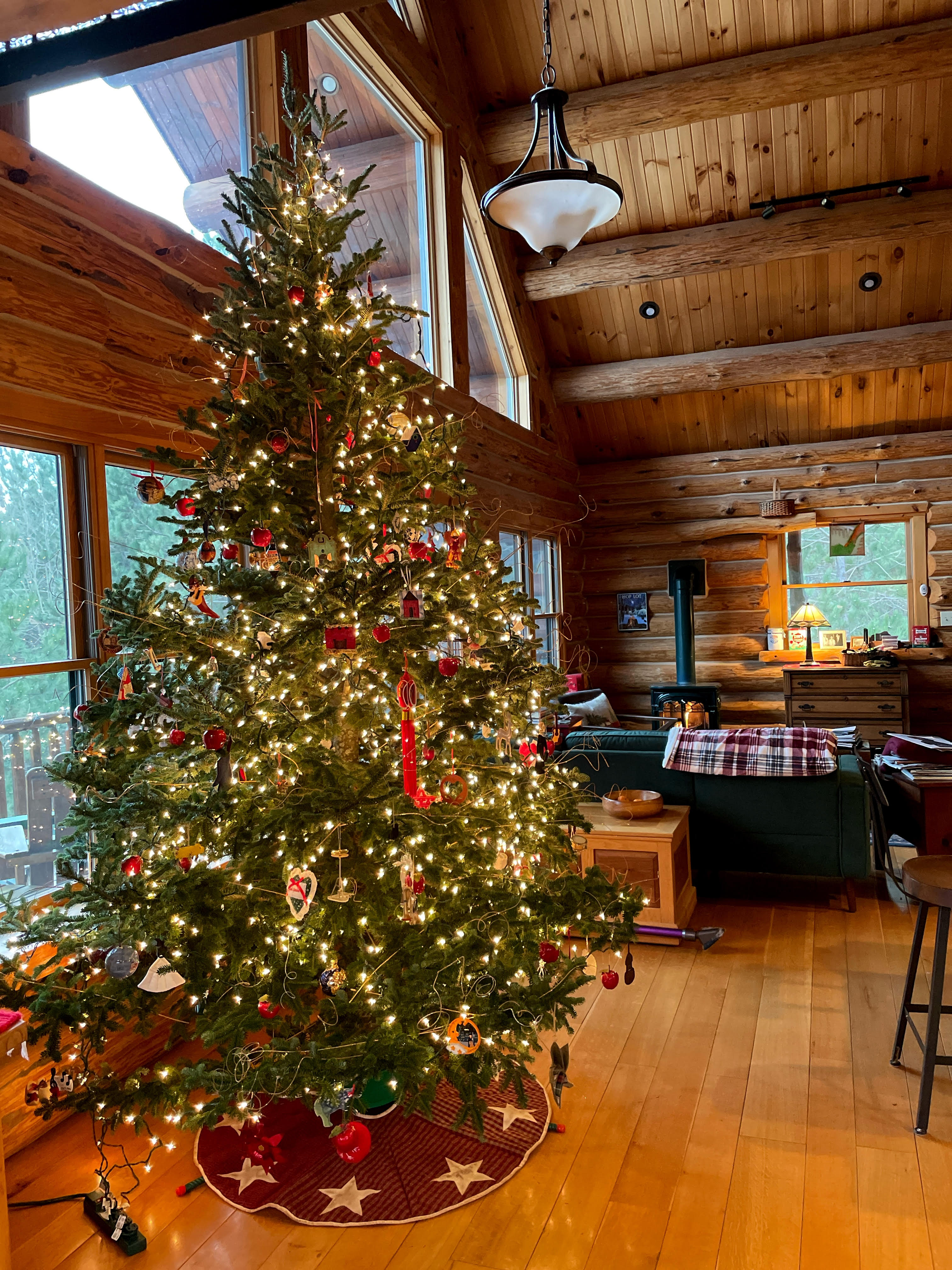
We have purchased beautiful live trees from three different local sources—two of which have gone out of business in the past decade. We are scaling back this year, with a 9-foot Fraser Fir (the photo, a 12-foot Fraser, is from two years ago). Neither of us wants to get on anything higher than a stepstool anymore.
The tree cost $60, a $10 increase over last year, with the elderly, babushka-ed lady at the cash register apologizing to each and every customer. They have to charge more, she says, to stay in business. There are lots of post-teens working—hard—in the miserable cold, probably the same ones who had summer jobs trimming trees with machetes.
Our tree was cut less than 24 hours before we took it home, bundled and tied into the back of our pickup by those same local guys. It can eventually be chipped into mulch. It smells nice.
Best of all, it’s a subtle strike-back at the wave of Artificial “Intelligence” rolling toward us.
O Tannenbaum. Wie Treu sind deine Blatter.
Happy Holidays to all Teacher in a Strange Land readers.
Some years ago, John Dubie, then a high school senior in Vermont, posted a very personal, autobiographical blog entitled “Big Picture Saved My Life.” John meant that statement literally—the Big Picture curriculum and program at South Burlington HS was the thing that kept him going when he was thinking about checking himself out.
I was stunned by the aftermath of the piece, which was picked up, reprinted and dissected in a number of other blogs. I was especially surprised by those commentaries that suggested John’s life was saved by leaving traditional public school.
The irony? Dubie spent much of the blog describing the first eight years of his education in a Catholic school, where he was generally seen as a disruptive loser by the faculty. And– the Big Picture Learning program he credits with making all the difference was housed in a traditional public school, in Burlington, Vermont,
Because I was the person who suggested John tell his story in public, this re-interpretation of his autobiography made me see red. I said as much, in the comments, noting that his generosity shouldn’t become a cheap excuse to slam public education again. I said: What I’m worried about here is protecting a young man who graciously shared a deeply personal reflection having his story–and his face– used to promote the idea that public education sucks.
The response I got: Seriously? Of course public education sucks.
Do public schools suck? Is that the conventional wisdom, the reflexive, global response these days? Do we have to start with the conviction that public education has failed, before we can transform or improve, regenerate or revitalize a fully public system?
All governance models–public, chartered, independent, parochial—have produced exciting schools and disastrous schools. There are plenty of students who thrive under direct-instruction, highly structured, traditional content-delivery models. And others who learn best through self-directed exploration of ideas and subjects that interest them. There is no one best way to learn.
Public education remains the Big Kahuna of governance models in the U.S. Why would you tear down the considerable and historic infrastructure of a system that has educated–however imperfectly–generations of (successful) Americans, instead of updating it, repairing its cracks and flaws and outright malfunctions? Other nations have retrofitted their public systems, using both research and imagination. Why wouldn’t we?
When and where public education is not meeting the needs of students, why is that so? Public education has been radically re-shaped in the last two decades, driven by “reform” policies and experiments that clearly aren’t yielding the expected results (and that’s a very sanguine assessment). If public schools suck, we certainly haven’t found the magic formula to fix them. Probably because the answers involve hard work, multiple strategies and serious investment.
Public education is the only “choice” when other options are exhausted, so public schools are filled with our poorest children, those whose parents cannot provide transportation or uniforms or help with algebra homework. Some of those schools are creatively addressing problems, building communities and family relationships, persisting even if testing data remains low. Do they suck?
Who’s saying that public education sucks–and why are they saying it? For some parents, the fact that their child doesn’t get a custom-tailored learning experience or enough attention is reason enough to believe that all public education is substandard. For others, there is a knee-jerk assumption that the only good education is a series of competitive-admission, high-ticket private schools. Much of the anti-public education drumbeat springs from a politicized, media-fed conviction that public schools have failed, based on testing data alone. You have to ask: What’s in it for the most vocal and persistent public school critics?
You don’t really know what a particular school or classroom is like until you’re there. We’ve all read the polling data that shows parents generally think the schools in their community are pretty good; it’s the schools in other places–scary urban places, or maybe just the next district over, or public schools across the nation–that are terrible. I’ve been in plenty of classrooms in Detroit Community Schools where there was order, curiosity, learning–and joy (and usually, about twice as many kids as there should be). In the middle of poverty, there are pockets of triumphant accomplishment.
Shouldn’t we be shoring up public education, as America’s best idea? Shouldn’t we be investing in repair, enhancement, innovation? Let’s stop with the facile pronouncements on the failure of public education–they reveal failure of imagination and democracy.
“You never change things by fighting existing reality. To change something, build a new model that makes the existing model obsolete.” Buckminster Fuller
But it ain’t like it used to be, all popsicles and playground lanyard-making, a break from routine.
This year, ed reformers are using the Buckminster Fuller principle in a post-pandemic attempt to make traditional schooling—180 days, face to face, the existing reality—die, once and for all. Drown it, in a bathtub full of unvaccinated kids, dispirited teachers and mandated-but-meaningless test data.
If I were excited about the new model, it would be different. But I think we—and by we, I mean veteran public school educators and public education supporters—have missed the opportunity boat, that crisis-opportunity thing the pandemic put in motion.
Not surprising, given what teachers, school leaders and public districts have been dealing with for the past 15 months. Folks are exhausted. Whipped. They desperately need a re-charge (and some are seeking a new job). Even the most articulate and positive thinkers (shout-out to the new MI Teacher of the Year, Leah Porter) admit that this year was a whole new level of challenging.
Meanwhile, in their air-conditioned homes and cubicles, grant-funded reformers (whose updated computers, broadband and tech support are provided by their non-profit, not their own modest household budget) are planning the Next Big Thing: Universal Online Schooling (with class loads of 300 kids). More charters.Vouchers with creative, obfuscating names. Hybrid this and alternative that.
The more imaginative disruptive initiatives they can come up with, the better—each one chips away at good old outmoded public education. The pandemic conveniently paved their way, too, seeding parent mistrust and frustration, and further dividing communities, politically.
Public school teachers are left hoping that vaccines will be approved for second graders, sometime soon, and parents will maybe take their kids to the library this summer.
Education historian Jack Schneider recently posted a can’t-miss Twitter thread, articulately pointing out that we really do have lots of solid information about teaching and learning, as well as school leadership and climate. We know how to build a good school, in context. But we’ve been pretending that schools with high test scores are the One True Way.
We know how to tweak existing reality, in Bucky’s words, and don’t necessarily have to dump the apple cart, make neighborhood schools obsolete and move on to some Big Sexy reform idea rooted in private profit.
Schneider says: Our measures of “good” schools are so impoverished. Our current measures fall short in three ways: they lack the necessary validity, they are woefully undemocratic, and they fail to advance equity. The result is that we have valorized schools with high test scores and engaged in dangerously wishful thinking about “replication” and “scale.” Meanwhile we have blown one opportunity after another to actually invest in strengthening our schools (which, by the way, are better than we give them credit for).
We can’t look to the Biden administration, stuck in Obama-era thinking, to bail out public education. The federal money will help, but lots of it has gone to charters and other anti-public ed measures. If fully public, community-based education can be saved, it’s up to the people who love it best and see its long-term value to the nation.
When it comes to public education, I have been a glass half-full kind of advocate for a long, long time.
Short synopsis: Old white Road Commission member in Leelanau County (Tom Eckerle, 75) makes egregiously racist remark, using the N-word, at a public meeting. When exposed, and contacted by other news outlets, he compounds the ugliness by using the word repeatedly and making eye-rollingly racist comments about Black Lives Matter and Detroit. County erupts in disgust, mostly, with some people defending him. A recall petition is initiated. The other Road Commission members send him a signed letter asking for his resignation. Even the Republican legislator serving the county asks him to resign, after a lengthy conversation to hear what he really thinks. After 48 hours of repeated insistence he will not resign—Tom Eckerle finally does.
And now, of course, if we are smart and principled, the real work begins. And by ‘real work’ I don’t mean all of that under-the-rug sweeping.
I live in Leelanau County. And I can attest that people make racist remarks here all the time. What made this instance unique was not what Mr. Eckerle said (although his blatant use of the N-word was appalling). It was the fact that it was reported, on the front page of the Leelanau Enterprise, as news. If the reporter (who was tuning into the meeting via phone) had just let his crapola go by (and by all accounts, this guy is full of crapola), the only people who would have been offended would be the other Road Commissioners and the two or three people listening in, waiting to discuss road business.
It is worth mentioning that Eckerle’s anti-BLM outburst was triggered by someone asking him to wear a mask. Think that through.
Leelanau County is the ‘little finger’ of the Michigan mitten. It is a peninsula, surrounded by the beautiful waters of Lake Michigan and Grand Traverse Bay, and it is spectacularly beautiful country. We have both a National Park (Sleeping Bear Dunes National Lakeshore) and an Indian reservation, home of the Grand Traverse Band. While the county is outlined by many multi-million dollar waterfront homes, and thriving resort towns, there are also pockets of desperate poverty, an affordable housing crisis and a complete lack of available, reasonably priced broadband for rural consumers.
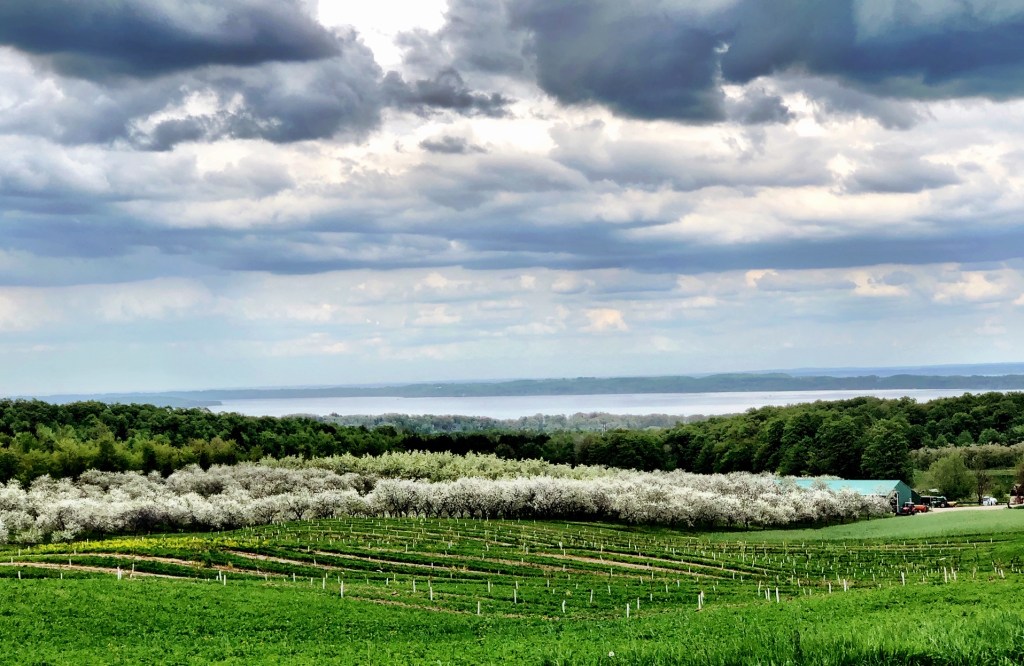
There are only about 22,000 people in Leelanau County, and 94% of them are white. Of the remaining 6%, nearly all are Native American–or Hispanic, most of whom landed here first as migrant fruit pickers (and yes, ICE has recently made arrests here). Historically, the land has been dominated by farmers—especially fruit farmers. When the cherry and apple trees blossom out—hilltop orchards, overlooking lakes– in May, there is no more beautiful place on earth. And now, there are 26 wineries and upscale dining.
Politically, the county has been deep red for more than a century, but the influx of retirees from downstate has been moving some of the resort towns in a bluish direction. The county voted for Obama in 2008 (not in 2012), but there remains a die-hard core group of generational residents who are deeply suspicious of things like unemployment insurance, early childhood education, recycling and fancy-pants internet. Not to mention a Black President.
Many of these folks hold public office. Sometimes, for decades, in family groups. Republican candidates, even if they are known cranks (as Tom Eckerle appears to be), get elected. I once attended a Township Board meeting, to promote a resolution to stop Enbridge Corporation from using a crumbling 65-year old oil pipelinethat runs under the Straits of Mackinac. After we did our pitch, one of the Board members was clearly shocked at what would happen if the pipeline ruptured, and said so—she had not heard about Line 5. The Township Supervisor turned to her (and to her sister, who also sits on the Board) and said, out loud, ‘We’re voting NO, Shirley.’ And they all did.
Just politics in Leelanau County.
After the Eckerle affair, the local Facebook page, where people post beautiful photos of sunsets over lakes (we have lots of inland lakes) and sell their outgrown ski equipment, was alight with comments, running about three-to-one in favor of forcing a resignation.
There was a lot of pearl-clutching, worries about people thinking everyone in Leelanau County was like this–the local economy depends on tourism–and demands that the Governor yank Eckerle. Governor Whitmer said (correctly, in my opinion) that, dreadful as his comments were, it was the voters in Leelanau County who needed to recall him.
There were also way too many comments about his remarks being ‘just a word—one that Black people use all the time’ and cryptic statements about ‘Detroiters’ looting and bringing COVID up here. To paradise. White person paradise.
“Hatred, which has destroyed so much, never failed to destroy the one who hated, and this was an immutable law…..I imagine one of the reasons people cling to their hates so stubbornly is because they sense, once hate is gone, they will be forced to deal with the pain.” (James Baldwin)
People are uber-touchy, even panicky, about the questions around returning to school—it’s a life and death issue, all right, including potentially gambling with our most precious asset: our children.
Like any venture that is launched before all the facts and outcomes are available—marriage and childbirth spring to mind here—both in-person schooling in some fashion and staying home for distance learning have their vocal supporters and detractors.
There’s free-floating hostility, too—accusations of parents ‘dripping privilege’ who are urging public schools to reopen, knowing they have the resources to keep their children safe. There are politicians who just want ‘normal’ again, blaming the media, the left, and public institutions for pumping up panic.
And there are teachers—without whom, students will not go back to school—self-righteously proclaiming that they’re not babysitters.
This is not a new statement. A few years back, there was a meme that made the rounds—the teacher rounds, anyway—comparing the work of teaching to babysitting for 30 children for seven hours a day. Guess what? The babysitter made more money. Way more money. So there!
I was never sure what the moral of the story was. Proof that teachers are grossly underpaid for the important work they do by saying that even babysitters make more money? How is that helpful?
Here’s the thing: All work that is critical and essential in building a functional society has its moments of mundane, even undignified monotony. A nurse friend who works in endoscopy once remarked that she’d spent four years studying chemistry, anatomy and biology, but her chief responsibility in her daily job was holding senior citizens’ butt cheeks apart so they could get a colonoscopy.
Not a pretty picture. And not really representative of her skills and expertise, which are substantial. Still, many of what society considers high-level occupations—hedge fund manager, say– are nothing more than a narrow band of knowledge, social connections and high-speed internet. A lot of important work is commonplace and undervalued. Like taking care of children.
Let’s acknowledge, upfront, that the nation, as we know it, will not function without a robust system of childcare. Let’s also acknowledge that PK-12 public education is the biggest piece of that.
Let’s admit how fortunate we are, to have public schools that keep our children safe, Monday through Friday, but also enriched intellectually—and, in many cases, fed, inspired and given glimpses of a better life. Every parent knows what a relief it is when your children are finally in school full-time, and your own work or interests can take precedence for part of the day, knowing that the kids are, indeed, all right.
Teachers are, in fact, childcare experts. Occasionally, someone suggests that teachers’ jobs consist of dispensing knowledge and instilling standard competencies, no more. This is 100% baloney.
Ask any first-grade teacher how many lost teeth she has processed (using protocols for blood-borne pathogens she must review annually). Ask any seventh-grade teacher how many times he’s had to deal with a sobbing child who’s just been called ‘fat’ by mean girls. Ask any high school teacher who’s attended the funeral of a student lost to cancer, or to suicide.
Go ahead—ask them: Did you care for this child? And was that caring an important part of your job? A lot of what teachers have been doing during the shutdown is a kind of childcare, by the way.
The most dismal years for schools were between 1932 and 1936. By 1939 educators observed that Americans’ desire to maintain and improve public education was very deep rooted.
Of course, attending or teaching school in 1934 didn’t involve a pandemic-level health risk.
There’s been lots of digital ink praising grocery store workers, take-out restaurants and USPS drivers for keeping us fed and informed. But what these folks want is not praise for doing their jobs. They want better wages, personal protection against the virus and good health care, which during a pandemic would include regular, free diagnostic testing.
Teachers want the same things—PPE, a viable workplace, testing/tracing, and acknowledgement that they, too, are indispensable, and valued, front-line workers. Corporations don’t expect workers to do their jobs from home, using personal computers and paying for their own internet—why should schools?
Do we all have to follow the same guidelines?Especially since it’s likely that risk levels and mitigation compliance will change, frequently, over the next few months? More to the point: if schools don’t provide childcare, who will?
I keep thinking about a school where I volunteer. About two-thirds of the students there do not have enough broadband access to attend a Zoom meeting or upload an assignment that includes an image or attachment. Theoretically, half of them have access to a device—which may be a single Smartphone for a whole family.
Every child in this district eats a free hot breakfast and lunch at school. It’s a large rural district with families spread out across the county, so it would take a fleet of buses with wi-fi hotspots and free devices for each child to go full-tilt distance learning—and still, most families could not connect in real time.
We’re talking about in-person school here, at least some of the time–or packets. We’ve lived here for 10 years and can testify that adequate broadband isn’t coming anytime soon—it’s simply not a money-maker in remote rural areas where most students live in poverty.
On the other hand, there is only one class of children per grade, in this school, and the largest class is 16. Some classes are as small as five or six. Unlike the vast majority of schools, there is actually room in the school to social distance. It’s a tight-knit community, and there are just 27 cases of COVID in the county.
Is going back to school riskier—to the whole community— than a patchwork of babysitting neighbors or, more likely, kids staying home alone?
I also keep thinking about this statement: Americans’ desire to maintain and improve public education is very deep rooted. Let’s keep it that way.
On Memorial Day, I have often dusted off an old column I originally wrote a dozen years ago. It’s about how I never lost my love and appreciation for Memorial Day as an opportunity for school bands and community members to commemorate the sacrifices made so we could live peacefully.
It always seemed like a great lesson for public school children to learn: gratitude and civics.
When parents would call, a few days before the parade, and say—hey, Jason won’t be at the parade Monday because we have company coming for a day at the lake, I never responded with anger or points-off punishments.
But I would feel sad about the missed opportunity for students and their families to take a couple of hours to honor our own history, our own heroes. Memorial Day services are one of the few chances we get to put our communal, democratic values on display, without glorifying war or violence.
When we moved up north, I joined a community band and chorus which have been at the heart of a Memorial Day service here for decades. No parade—most band and choir members are retirees. But we’ve played a service in a misty rain as well as blazing sun. It’s always the same: a few patriotic tunes, a speaker, a prayer. Then Taps.
This Memorial Day, there will be no traditional service at the Northport Cemetery. No inspiring message, no Scouts raising the flag, no Village Voices singing ‘The Last Full Measure of Devotion’–and no Community Band playing ‘National Emblem’. It is too risky to bring the town’s residents together to honor the military sacrifices made so we can enjoy life on our beautiful, peaceful peninsula.
Instead, the Northport Community Band will be offering a ‘Rolling Taps’ to those who live in Northport. Sixteen members of the band’s brass section will station themselves around town and, one after the other, play Taps. The tribute will begin at the Northport sign, at the South end of town, moving northward a block at a time, and travel through the Village, each player handing off to the next. The final player will be stationed at the cannon in the Northport Cemetery.
The director of the band found it easy to recruit players. Everyone was pleased to find a way to contribute in keeping a cherished tradition—Memorial Day in Northport—alive. If our grandfathers could storm the beaches at Normandy, one trumpeter said, we can certainly stand on the corner and play Taps. It’s the very least we can do to honor those who sacrificed so much more.
Village residents are welcome to listen from their front porches, their bikes or cars, but are asked to maintain a good distance from brass players as they perform, and refrain from talking or applauding. Taps—originally a bugle call to signal lights out, a time of rest—has become the most solemn military funeral call, a way to thank and say goodbye to those who served their nation.
Much of the Northport Band’s and Village Voices’ summer season has been cancelled. There’s reason to be sad. But there’s also reason to remember sacrifices made. There are sacrifices being made right now, for the health and strength of this nation. Let us continue to keep the flame burning, beginning on Memorial Day.
Day is done. Gone the sun. From the lakes, from the hills, from the sky. All is well. Safely rest. God is nigh.
Because that’s about where the education community is, right now— dealing with one crisis at a time.
We adamantly reject the ed-tech dream of empty classrooms and every kid at home with a device. We know how badly that’s worked, even when teachers had six full months to get to know their students, in person. But we can’t quite wrap our heads around what’s next. When we try, it feels like admitting that the prospect of School As We Knew It is probably down for the count.
Three weeks ago, I wrote a blog suggesting that we start thinking about a modified ‘gap year’—an admission that school would not be the same until we had confirmed medical solutions for combatting the coronavirus. So we might try ginning up some creative ideas about what to do with P-16 students in the intervening year. It was pretty amorphous service-learning stuff, with young adults and older teens combining on-line coursework with outdoor work and safe environmental or community health projects, a CCC or Peace Corps Lite, adapted to 2020.
That blog got lots of pushback, some of it downright hostile, with nearly all the angst coming from teachers. Nope, they said. Not going to let teens pull garlic mustard out of the woods or direct traffic at COVID testing sites. Not going to let them paint or plant or build. They need to learn! In classrooms! Colleges will fail outright if we encourage a gap year. That can’t happen!
Eventually, I realized that this was grief talking. The anger stage of grief—or maybe denial or bargaining, but grief, all right. Something we love, and have invested our lives in, is now impossible, without a lot of too-risky practices. We’re sad. We’re belligerent. We’re not going to let go of our carefully honed practice or our dreams for our children.
Because those are things we can deal with—we’re used to counteracting anti-public education crapola, unfortunately. It’s easy to argue about the rules, and how expensive they would be to implement. It’s easy to say that whoever wrote the rules has never been in a classroom with actual children. It’s easy to complain about not being invited to the table. Again. It’s incredibly easy to shoot down every single strategy, from bus-riding to individually packaged lunches.
Some of these changes could be positive. Keep that in mind.
We have adapted to things before: Seat belts and helmets. No smoking. Airport security. Changes in diet. Cars, instead of horses. Wars. The freaking Internet.
We can do this. In fact, there’s nobody better prepared to re-think how school works than people who work in (and love) schools.
NOW is the time to plan. I know—teachers have worked harder than ever in the past two months and deserve a break. But it’s probably time to consider a year-round calendar, with this summer being the first, planning phase and catch-up time for kids who have dropped off the radar.
If kids have to go to school in smaller groups in the fall (not a bad thing, in general) then we may need split sessions, overlapping terms, staggered transportation schedules. Our first permanent casualty may be 180 days of seat time and three months of summer. In my opinion, overdue.
This would also be a great time to expand project-based and interdisciplinary learning, with students kept in the same small cohorts during their time at school. The usual gripes about PBL and interdisciplinary curriculum center on the fact that they don’t generate higher test scores or rigorous high-level single-discipline learning. But high-quality PBL generates other things—like ingenuity and independence and curiosity. For many teachers, it would be an entirely new way to teach. But change is (sometimes) good.
While good or at least workable ideas are everywhere, this is clearly not something that can be managed via federal or even state fiat. Each school district or region must make their own choices and be prepared to shift again when things go wrong (as they will).
It’s time to think different, Apple said in 1997. Or think differently (as thousands of English teachers corrected).
Some of these changes could be positive. Keep that in mind.
The second wave of school change is now bearing down on teachers, students, and parents. You remember March, right? When Mommy-needs-vodka types were posting hilarious blogs thanking teachers and telling them to go right ahead and teach in their jammies? Because holy cow, teachers were the light of the world.
There were those teacher car parades, and funny Zoom memes, before Zoom bombing and low average attendance figures revealed that this was going to be a long, depressing slog. And now? We’re talking about the drop-forge model of school cuts and how unnecessary classrooms are, anyway.
I’m a music teacher. I know what this means. I’ve been through several cut-to-the-bone-and-beyond school reductions. Several of my music teacher friends and social media acquaintances have been dreading the decisions they fear are coming.
Because it’s not just ‘trimming the extras,’ the evergreen but erroneous argument that music, art, physical education, and other active, non-Big Four subjects are somehow less important than the others. It’s acknowledging that some disciplines—in the ways they’re traditionally taught– are currently more dangerous than others.
We’re not going to be singing in groups, as usual, this fall, or rehearsing the band, or learning how to play the euphonium in a beginners’ class.
I sing in a community chorus and play in two community bands, and we’re out of business for months, perhaps a full year. There is no way that students will be allowed to sit, even six feet apart, and breathe deeply while licking their reeds and blowing warm moist air out of their bells. Students will not be leaning their heads in to harmonize or tune. The science is clear: these are genuinely hazardous behaviors.
Trust me when I tell you that band, choir, orchestra, and general music teachers know all about the little boxed heads making wonderful music on your You Tube. They understand far better than the general public about the costs, skills, and technological resources necessary, even for the simplest collaborative music videos. And they also know that 5th grade beginning band students need years before anyone wants to see 45 of them individually negotiating the app, the mic, the conductor, the click-track, the printed music and—oh yeah, producing the right note.
There’s a reason why listening to a scaled-down Toronto Symphony is so exhilarating as they play Appalachian Spring. It’s because all of those musicians once sat in an orchestra full of 10-year-olds, bowing irregularly and approximating pitch, with their teacher–gently, one hopes–praising then correcting them. They learned to love the music (essential for a career) in the same place. All the beauty and ingenuity we’ve seen emerge in music in the last two months started in someone’s music classroom.
Music has gone in and out of favor in American public education. Choral music, easier and cheaper to organize and accomplish, has been around as part of school curricula much longer than instrumental instruction. Bands, as school-based activities and classes, didn’t really get established much before World War II—and then were largely promoted as contests.When the Baby Boom started filling schools, band and orchestra programs took off, as professionally trained music teachers became available and parents and communities saw the value in a wholesome, challenging group activity leading to a lifelong skill.
But that doesn’t mean that school bands, orchestras and choirs haven’t been cyclically imperiled by budget cuts and what might be called fashion. Ask any band director who’s ever had to start a struggling or deceased program over again (raising hand) how long it takes for band to become ‘cool’ in a school culture again, to gather the resources and community enthusiasm needed to build something really magnetic and valuable.
All arts and elective programs go in and out of popularity. Some school sports falter, as well, because they’re expensive or demanding– and kids have other things to do. I’ve been part of a half-dozen ‘Save Our Band’ campaigns. I have boxes full of handouts in my garage as proof. The most persuasive argument, by the way, was always the one that demonstrated music teachers who instruct large performing groups are highly cost-effective; once you start talking about aesthetics and elevating culture, however, you lose your audience.
So what are we to do, facing the school arts abyss caused by the pandemic?
First, remember that good programs are always generated by good people. Creative teachers will innovate, as much as they can, to keep the flame burning, even when the conditions and resources are suboptimal. Outstanding people—not budgets, not equipment, not festival ratings–are the fuel, and the inspiration, for keeping the music education alive in tough times.
Next, we can shift the paradigm of what a good school music program looks like. Strip it down to its basics—the teaching of melody, harmony, beats and Beatles. Focus on what kids need to enjoy music and understand its role in our lives. There is individual skill-building, of course, but also the lifelong value of musical literacy.
Let go—for now, anyway—of all the traditional events and educational practices you’re accustomed to– the big elementary music performance in the gym, recorder class, the choir concert, marching band shows for football games. Stop thinking about the damage pausing or starting over will do to an established program and focus instead on serving kids. Especially let go of competitions. Think outside the grid and the uniform.
Ask students what they want to learn about music, what turns them on, how they’ve used music during the pandemic. Assume that music teachers themselves should be the ones to create pandemic-friendly programs using new ideas and goals—administrators will have other things to worry about, and you really don’t want them to decide how to ‘fix’ music.
All those ideas are a framework for teaching music without large groups singing or playing—but the reality is that many music teachers won’t get the opportunity to innovate, create or rebuild. They’ll be excised. Many schools will not value teachers’ excellence, or work to find ways to keep the arts alive.
I had a friend ask me why it was important to have school bands and choirs now that technology could provide more ‘individualized’ instruction. Why not use pre-recorded backups and autotune and fun little video creation programs or self-instruction guitar modules for music class? Nobody wants to take bassoon lessons anymore, he said.
I asked the obvious question: Did he play in the band or sing in the choir? No. He played football.
It is the ultimate irony, in this #TeacherAppreciationWeek2020, on the very day that America’s teachers, persisting through the worst educational and global crisis in their careers, are supposed to be honored—that a piece like this would be posted.
Titled How to Make the Coming Teacher Layoffs Hurt Schools and Students Less, with the equally cheery subhead School district leaders may be able to protect their most effective classroom teachers, the piece, in essence, says this: Layoffs are coming. The law now lets you skip over seniority and job protection agreements. So take this opportunity to dump off ‘less-effective’ (and also more expensive) veteran teachers and keep the ones who raise test scores.
But wait! There’s more.
Most states have given up on evaluating teachers in the 2019-2020 school year, either just skipping over this year, because there’s no ‘data’–or using last year’s evaluation. Built into that assumption is that the only true evaluation of teacher efficacy is the test score, but it’s worth the evaluator’s time to ‘pop into’ a virtual classroom. (If there is one, of course.)Where they just might see a veteran teacher, struggling.
Larry also noted that keeping older teachers in the classroom might become a liability issue for health insurance corporations, who can’t be in the greatest financial shape these days. I would also add: What a great opportunity to skim off veteran teachers, those most likely to be union leaders, articulate critics of ‘accountability’-based education, those winning recognition for outstanding pedagogy, even building an audience for their own ideas about what works in the classroom, using social media.
Gone! Like magic!
Any white paper report is driven, ultimately, by its funders. And seeing John Bailey, currently advisor to the Walton Foundation, as co-author, is not reassuring. What are Walton’s underlying goals? Get folks back to work, let the younger (cheaper) teachers take the risk? Stop all this social safety net-building?
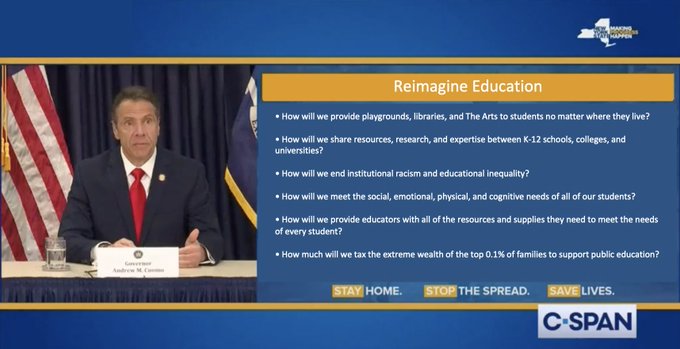
Cuomo’s remarks were a little blurry but seemed to center on the idea that we don’t need no stinkin’ classrooms, now that teachers had proved that technology could sub in for expensive physical spaces and face to face relationships. Thanks, teachers, for your service! Now—get outta here.
Not a good week to be a teacher. If this is appreciation, no thanks. Also, if this is high-quality research and innovation, it’s worth asking—again and again—where is the teacher voice in all this upbeat Rethinking the Future? Because teachers, who have bailed out the system to the best of their abilities, would have plenty to say. Especially the ones who have been around long enough to not be afraid of speaking their minds.
I have a friend who lives in California. His high school senior son, after a lengthy college decision-making process, chose Purdue, in Indiana. Right now, the focus is on the missing final exams and graduation ceremony. But soon, my friend may be sending his child 2000 miles across the country to start college during a pandemic. Because Mitch Daniels, former Republican governor of Indiana, says it’s OK.
There are upwards of three million high school seniors in the United States, right now. That’s a lot of young people being dumped into a dangerous society, college- and career-unready, to borrow a phrase. What do they need most right now? What do students already enrolled or just leaving college need?
Perhaps we ought to ask first what the nation needs, at this moment.
With worries about fall enrollment and a growing understanding that the fall semester, if it happens at all, will likely be taught at least partly online, colleges will have to argue that what they are delivering onscreen is worth as much as what students would have received in the classroom. This, in turn, may force a conversation about what the colleges are actually selling. Although the service they provide is education, the product for which they charge is the college degree—the piece of paper that promises a student will earn eighty-four per cent more in their lifetime than if they had only a high-school diploma. This and similar statistics are what allow so many college students to think of their loans not as astronomical debts but as investments in their future. Now that future is changing in ways none of us can really apprehend.
But. Tick-tock. It’s going to be September in four months.
What if 2020-21 became a national gap year? With a new conception of ‘credits’ and compensation awarded to young people and older volunteers for doing essential work in health care and rebuilding the economy?
I have seen the suggestion that entering college freshmen now consider taking a gap year, as is common in EU nations. Generally, those tentative proposals are immediately followed by all the reasons that a gap year is not feasible. Gap years, it seems, are perceived to be the purview of the wealthy or well-connected, who can ‘afford’ a year off from school, without affecting their eventual life prospects.
But what if large swaths of the population, young and old, were deputized and put to work for a year, or even six months? Returning to full-time school—not to mention full-time work, full-time commercial enterprise, regular civic and religious activities—will not be possible without several guarantees (testing, viable therapies and vaccines, trust in leadership). Those things will not be in place by September. So why not build a short-term Peace Corps-like volunteer force, including students?
Appalachian Magazine also suggested that a 21st century version of the Civilian Conservation Corps be established,with work and training available for unemployed citizens. Our crumbling national infrastructure and underserved public institutions—libraries, schools, parks and the post office, for starters—could provide jobs for a year or two, with the feds picking up the tab (better than unemployment). Workers could fill in critical gaps and pick up new skills along the way.
Why aren’t we thinking about creating these kinds of service opportunities for older students as well? I’m not talking about sending high school kids into dangerous hospitals or grocery stores–although the number of people who learn more from jobs that put them through school, than the actual classes, is legion. I learned more waiting tables at the dockside breakfast restaurant, at dawn on summer mornings, than I did in my college lecture courses with their droning lectures and punch-card quizzes. But there wasn’t a pandemic back then—just mouthy fishermen and lousy tippers.
The main worries about secondary school resuming in September come from packing so many students into classes and hallways. I can envision these students attending school mornings or afternoons only—or every other day—to create social-distancing space, then being sent out into the world to address real problems in the off hours, using data collection and analysis, or creative writing, or civic organizing.
Or more free-lance opportunities with the arts, as this lovely article demonstrates. There are lots of creative and practical things older students can do outside the classroom, especially if they have an internet connection and device and a teaching adult checking in with them frequently.
It seems to me that a wide variety of real tasks—everything from shelf-stocking and pizza-making to park maintenance and painting—might be assigned to teens, short-term, as steps in rebuilding essential businesses, acquiring work experience and doing something productive for towns and neighborhoods. These should be tracked, credited and compensated, perhaps in accounts designed to pay for vocational education, college or starter accounts to start small businesses, down the road. It would also give ambitious kids a realistic, insider look at our new economy.
If we were to concentrate education resources now, it might well be around younger children, who cannot be left alone, and cannot be trusted to distance themselves and maintain cleanliness. If there ever were a time to stringently reduce class size, provide high-quality day care and rich, intensive, more-personalized instruction for young children, it would be now.
Bricks-and-mortar schools and good, reliable childcare programming before and after school free parents to return to work, knowing their children are well cared for. This is the first place that daily temperature testing, masks, bracelets that beep at six feet and sanitation standards should be imposed. If this is our new world, no better place to start than first grade.
Programs like a latter-day CCC or a national health service should be federally funded and administered, but most schools or states would be better off creating their own ad hoc ‘gap’ programs as coronavirus therapies, test-and-trace protocols and vaccines make their way into the world. They will need to feel their way through the difficult developmental space between the crowded middle school cafeteria and a full-blown, live-on-campus college education.
One of my most cherished and repeatedly proven theories about middle school students is that we never give them real, meaningful tasks, or the tools to handle genuine responsibility. Instead we fill their days with rules and ‘practice’ assignments and tests. They can do much more—and high school students can do even more than that– and learn by doing.
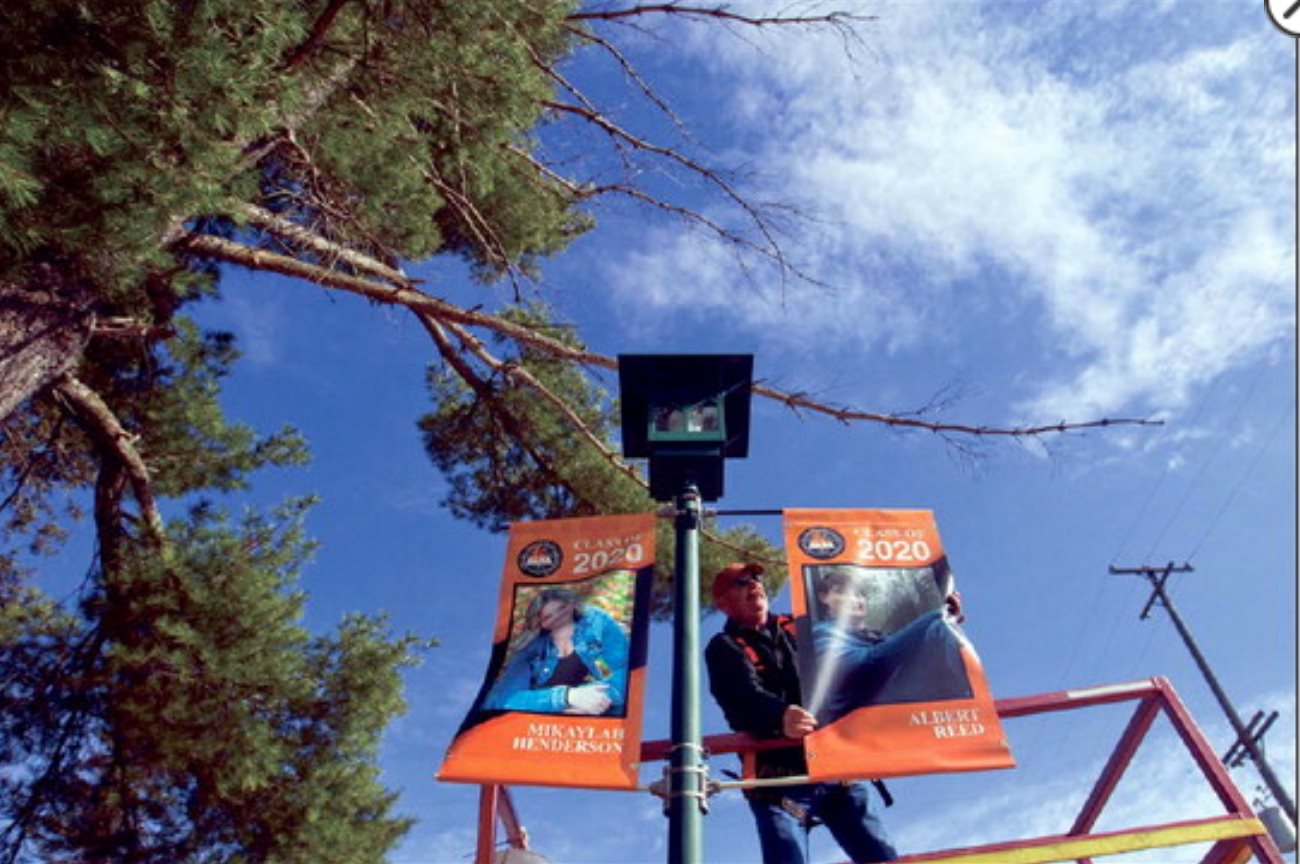
If we’re going to ask what can be done to rebuild, after the corona deluge, we can start with youth. First, we honor their sorrow and pain, as the small town below did, with graduation banners on Main Street for each of the 83 members of the Class of 2020.




 Teacher in a strange land