What Europeans Think of Trump

Just got home from a two-week vacation in the Czech Republic and Germany, including a week in what used to be East Germany. All of us learn from travel, of course, but this trip—planned long before last year’s election—was an incisive tutorial on how the rest of the Western world sees where we’re headed.

As of today, there are warnings against travel to the United States for citizens of Canada, Germany, England, Denmark, Netherlands, and France—probably the easiest and most accessible nations for Americans to visit.

I grew up in Michigan, where Canada hardly felt like a foreign country. I have friends who live in Windsor, but work in Detroit. College students in Michigan have routinely made pilgrimages to Ontario, where the legal drinking age is 19. Losing that easy camaraderie is huge—and that’s without taking into account the auto industry’s dependence on Canadian-made parts and trade.

I was interested and a little anxious about what the vibe would be in Europe. I’m too old for rail passes/backpacks/hostels travel—we’d be staying in hotels and led by English-speaking guides—but if you pay attention, in between historic dates and landmarks, you can hear and see what daily life is like in places that used to be Russian-controlled territories, how they see themselves in the world, and their fears for the United States.

I was also curious about my fellow American travelers. Would they agree with Jim Acosta, who said: Think of the damage done to America’s standing in the world, in the minds of young people across the globe. They see a president who is often out of touch with the real world, thoroughly corrupt and vengeful, beginning his second term launching a crypto scheme and turning government against vulnerable migrants as well as his enemies, both real and imagined.

We began our journey in Prague, a gorgeous medieval city that has been overrun by competing rulers for centuries, part of the Holy Roman Empire as well as the Kingdom of Bohemia. The old core of the city was almost untouched by WWII, but our local walking tour guides–find ‘em on the internet–occasionally pointed out architectural anomalies, calling them Communist buildings, which (local joke) come in three colors: light gray, medium gray and dark gray.

Because the walking tour groups were nationally diverse, the focus was on the enchanting city and its rich history—including the Velvet Revolution of 1989, wherein the Czechs reclaimed their own heritage and autonomy.

Traveling into Germany—the former GDP, East Germany—was revelatory. Guides were excellent—they all knew the historical markers but would often tuck bits of human perspective in their remarks.

  • Our guide in Wittenberg was born in the 1950s and grew up there. In secondary school, she said, she studied Russian. It was the only “foreign” language available. She also studied Russian in college. When she was in her 30s, and the Wall came down, she decided she wanted to learn English—and did. I never wanted to speak another word of Russian, she said darkly.
  • In Potsdam, we visited the estate where the Potsdam conference was held and the iconic photo of Truman, Stalin and Churchill was taken, before Germany was carved up. Potsdam is a beautiful town, including the upscale neighborhood where Vladimir Putin and his KGB comrades lived, in the1980s, considering what other beautiful villages and terrain they might appropriate.
  • In Dresden, we got a quick tutorial on how much of Dresden was bombed into smithereens, in February of 1945. American woman (who should, IMHO, know better) asks the guide: Who bombed this city? The allies, he replies, tactfully. You mean us? She says. Why would we do that? Well, the guide says— revenge, maybe? Later, I hear the woman ask her husband if the Germans are communists, leaving me to wonder just what we are teaching in World History classes.
  • In Torgau, where the allied armies met the Russian army, effectively shoving the tattered German army out of their homeland, April 25, 1945, five days before Hitler took his own life in a bunker. We looked at the site where the armies met, on the Elbe river. Flags from the United States, Russian and Germany have flown there for 75 years, in a memorial. The flagpoles are now empty—and have been since earlier this year, when Germany decided the peace agreement no longer applied.

Our guide in Torgau pointed out that there were a few things—free child care, for one—that made living in East Germany easier (these kindergartens were shut down as “too socialist” after the reunification). On the other hand, the omnipresent occupying Russian soldiers were brutes. His great-grandmother was shot dead in the town square, for resisting the attentions of one of them. He reminded us that Hitler came to power peacefully, and stayed there, courtesy of the Nazi party.

  • Berlin, of course, is a kind of living museum. Most powerful moment in Berlin? The square where, in May of 1933, the Nazis held their first book-burning. There’s a memorial there. Our guide said, quietly: First they burn books. Then, they burn people. But there is a little free library in the square, with hammocks and beanbag chairs. It was a chilly day—but there were children there, reading. Hope.

Everywhere we went, people were kind and hospitable. And honest. Aware of how long it takes to overcome the destruction of a great nation.  As Jen Rubin wrote, this morning:

Other countries, much older than the United States, have gone through grim, even disastrous years, decades, or centuries. And yet in Europe, the spirit of liberal democracy (however imperfect) remains alive and well. A sense of the public good still thrives, and millions of people strive to keep the achievements of Western Civilization from the clutches of fascism, xenophobia, know-nothingism, and conspiracy-mongering. The world is carrying on, albeit with dismay, as Americans struggle through its Dark Age.

Amen.

Are Women the Cause of Reluctance to Read?

I remember learning–perhaps in a grad class or professional development session, years ago–that boys didn’t like to read about girl things. You know—relationships, communication, emotions, the finer points of making a home or enriching family life. Boys wanted to read stories about adventures, we were told. Starring, naturally, other boys.

Ergo, if we wanted to turn boys into enthusiastic readers, we needed books where boys did boy stuff—creeks, animals, cars, fights, danger, you name it. Write it and they will come.

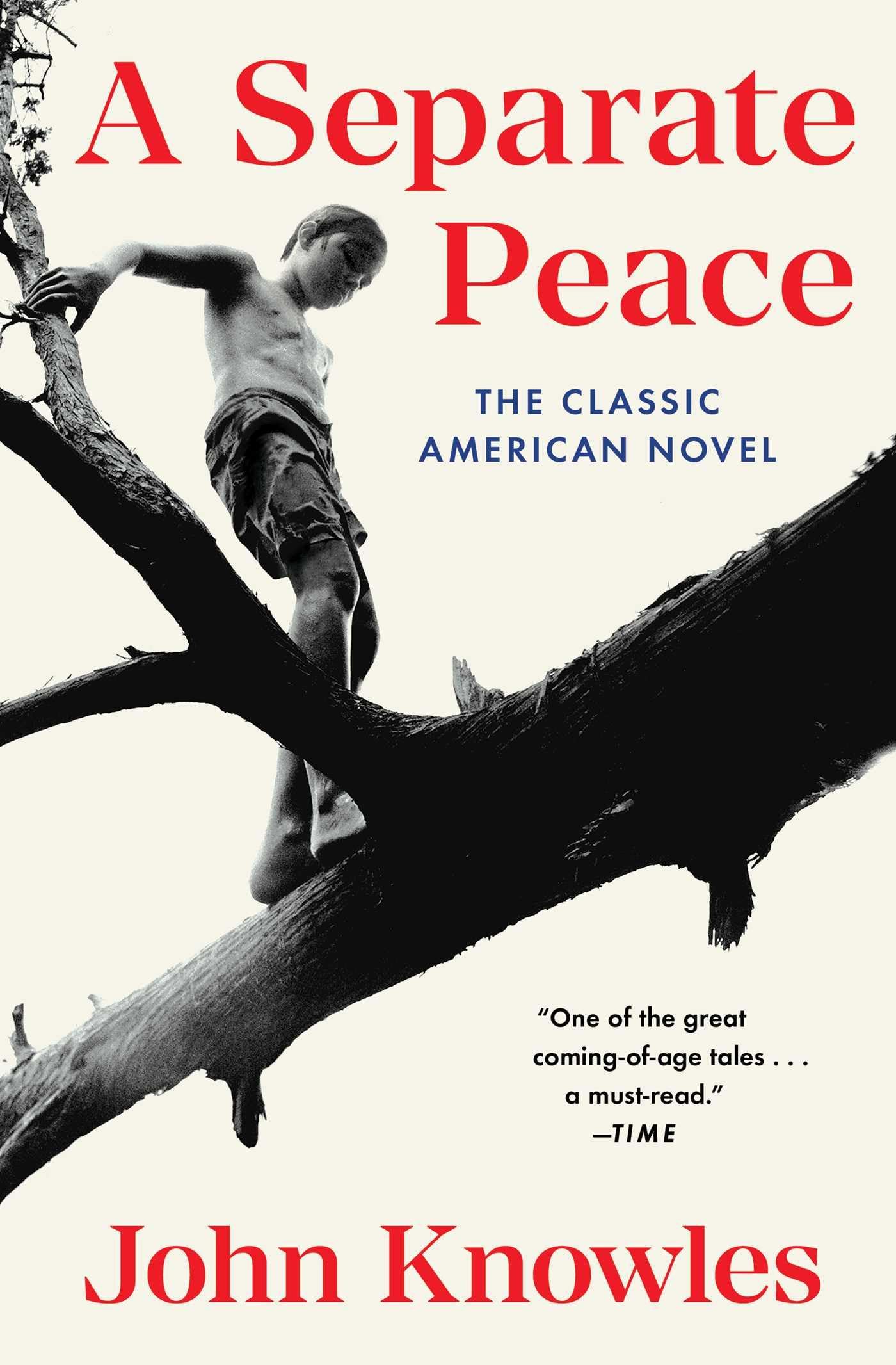
I thought about this when re-reading A Separate Peace this month. My book club is doing a “Books You’ve Already Read—or should have read” month, and I thought it was time to re-read a book that I put on my Top Ten list for decades.

(Seriously—I kept continuously updated top ten lists of books, movies and LPs until I had both children and a full-time job. There are still some gems on those lists—but also some really embarrassing stuff.)

I wouldn’t, however, call Separate Peace an embarrassing pick. I read it in high school, although not as a class novel. In the late 60s, my public high school adopted a choice-based language arts curriculum. Instead of English 9/10/etc, there was an array of semester-long courses. I took journalism, speed reading and Great Books, a totally wonderful class where students did nothing but read books, then journal their impressions.

There was a list of great books (SP was on it), but you could also deviate, with the teacher’s permission. It was that teacher—Mrs. Palmer—who introduced me to Daphne du Maurier, Virginia Woolf, and Madeleine L’Engel.

It’s hard for me to put my finger now on why I loved Separate Peace so much. Partly, it was the boarding school setting—what it would be like to live in dorms, with other students whose parents weren’t scraping to pay the mortgage, for whom college was a certainty, not a stretch.

Mostly, though, I think it was because—spoiler—there’s a death in the book, under unusual circumstances, leading the reader (this teenaged reader, anyway) to muse on Big Meaningful Issues. In case you’re wondering whether I noticed the homoerotic flavor of the relationship between the narrator and his best friend, the answer (1969) is no and (2025) yes.

But here’s what really jumped out at me, some 50+ years later: there are no women in this book. Aside from a couple of sentences mentioning a screechy school nurse, and a sentence describing a classmate’s mother as kindly, there is zero female presence in this book. There’s plenty of adventure, danger, scrapes and disobedience. Even a student-led tribunal, and a World War. But not a single woman, or girl.

From a recent article in The Guardian, about a newly formed publishing house that intends to publish only books by men: 

Cook said the publishing landscape has changed “dramatically” over the past 15 years as a reaction to the “prevailing toxic male-dominated literary scene of the 80s, 90s and noughties”. Now, “excitement and energy around new and adventurous fiction is around female authors – and this is only right as a timely corrective”.

“This new breed of young female authors, spearheaded by Sally Rooney et al, ushered in a renaissance for literary fiction by women, giving rise to a situation where stories by new male authors are often overlooked, with a perception that the male voice is problematic,” he said.

Hunh. I wasn’t really paying attention to any toxic literary scene in the 1980s and 90s, due to the aforementioned family and job. But I was still reading a lot—and was deeply involved in whether and what my students were reading. Or not reading.

It was a time when getting any kind of reading material—from comic books to Captain Underpants— into kids’ hands was the prescription for reluctant readers. There was a rolling bookshelf in my band room, filled with books about music and musicians. Some had some vaguely naughty photos. I purchased all of them, and they were well used.

My take on any reduction in male readers in the 21st century is that omnipresent screens, not problematic masculine voices, are responsible.

Still. What I notice about this (well-meant, I assume) announcement is that it only took a couple of decades for men to perceive that women were “ushering in a renaissance,” then set up their own literary clubhouse, no girls allowed.

There’s also this:
Less than half of parents find it fun to read aloud to their children, new research shows. Only 40% of parents with children aged 0 to 13 agreed that “reading books to my child is fun for me”, according to a survey conducted by Nielsen and publisher HarperCollins. The survey shows a steep decline in the number of parents reading aloud to young children, with 41% of 0- to four-year-olds now being read to frequently, down from 64% in 2012.

A significant gender disparity was identified, with 29% of 0- to two-year-old boys being read to every day or nearly every day compared with 44% of girls of the same age.

Plus this, ominously: Many parents focus on the literacy element of reading, seeing it as a skill, rather than encouraging a love for reading in their children.

So—who’s not reading, and why?

If you talk to the Science of Reading crowd, boys’ reading difficulties and reluctance to read can be laid at the feet of teachers who were never taught the only correct protocols for reading instruction, or—worse—fail to use them with fidelity, a word I have come to loathe when applied to pedagogy.

And since the overwhelming majority of early-grades teachers are women, this can be construed as another way in which women are not paying attention to the needs of boys. But it’s so much more complex than phonemic awareness, yada yada.

The Great Books class at my high school only lasted a few years, then fell when the “cafeteria curriculum” became outmoded, in favor of … what? I forget. Back to Basics? One of our cyclical returns to The Canon—in which white male-authored books have literally always been deemed more worthy of study?

All children deserve to be read to, daily, even when they’re able to read themselves. Stories about both boys and girls. Because that’s how they learn to be curious about the real world.

Version 1.0.0