It’s one of those Facebook things—asking ten people to post ten photos with the hashtag #MyLifeIsGood. No need to explain who’s in the photos, says the meme, but one assumes the pictures will be of family, friends, beautiful vacation spots and how one spends their me time.
If you run the exponential mathematics on that, assuming you have ten cooperative friends—and those friends likewise have ten cooperative–obedient? –friends, and everybody posts ten photos, there will, quickly, be tens of thousands of harvestable images on Facebook, all neatly tagged #MyLifeIsGood.
Now—this isn’t a scold-y post about all the innocent, family-oriented, grateful folks inviting us into their (good) lives: meeting the grandkids, marveling at a Lake Michigan sunset, riding their bikes—and being scammed by Mark Zuckerberg into telling Facebook’s algorithms which ads and promoted articles to send them.
Speaking as a person who once (perhaps naively) called Facebook and other social media sites “our new town square,”I post personal information, as well as shared articles, snarky cartoons and my own blog on Facebook, Twitter and (now) Post.
I ran a political campaign on a Facebook page (now taken down). I have also experienced obvious bots –why do people think older women want a retired Marine General in their life?–and eerily specific products that I swear I just thought about, but never looked for online.
The thing about #MyLifeIsGood, though, is that it feels weird, somehow, to craft a colorful little photo collage about what matters most to you. My own life, frankly, is great right now in a dozen different ways—but searching through my hundreds of photos to display how lucky I am is unsettling somehow. Maybe my life won’t be so great in 2023—who knows? Or maybe there are tender or tragic factors that #GoodLife participants feel they must hide, putting up a false front. None of that is healthy.
The first thing I thought of, getting tagged to take part in the #MyLifeIsGood juggernaut was Randy Newman’s song My Life is Good. Newman’slyrics are biting—with the chorus, ‘MY Life is Good,’ being the worst sort of heedless braggadocio: Don’t get in my way, lesser personage. Because MY life—is good. Too bad about yours.
There’s a verse about teachers:
The other afternoon my wife and I took a little ride into Beverly Hills. Went to the private school our oldest child attends.
Many famous people send their children there.
His teacher says to us: “We have a problem here–this child just will not do a thing I tell him to. He’s such a big old thing. He hurts the other children. All the games they play, he plays so rough.”
Hold it teacher. Wait a minute.
Maybe I’m not understanding the English language. You don’t seem to realize—
MY Life Is Good. My life is good, you old bat.
Unfortunately, veteran teachers recognize this dude (and his wife)—and their entitled child. There’s something distasteful about the idea of simple gratitude for what one has, and pride over what one’s accomplished, morphing into boasts or competition, the antithesis of building genuine community in a classroom.
Or maybe I am way overthinking this.
I am going to post one photo. It’s a photo of my dog, Atticus, who is aging, in his first (and last) Christmas sweater. He is one of the reasons my life is deeply satisfying—and good.
Here’s a story about Crosby, Stills & Nash, and “Teach Your Children Well,” set in my middle school:
The Respect Team (an ad hoc committee) has agreed to do the display case in the front hallway for the whole school year. We want to build honest, respectful relationships in our building–we’re concerned about the building climate. It’s the 1990s, and our students’ behavior has, in our humble opinion, grown coarser and ruder–toward other students, and toward their teachers.
But we know that respect must be earned–and the foundation of respect is not fear, or anger. We can’t punish or publicly condemn our way into the two-way street that is respect. We meet often, suggesting ways to weave discussions and writing about respect into the curriculum. We post students’ writing–poems and short essays–about heroes, people we admire, in the display case. We have a school-wide assembly with a Holocaust survivor. Students create art around the theme of respect.
And then, it’s May. Only one more display case to be responsible for. We’re tapped out of ideas. Plus–well, it’s May. If you’ve been a teacher in May, you know how stressful it is to wind up a school year.
A last-minute, throwaway plan emerges: We’ll get teachers to give us pictures of themselves as teenagers–graduation pics, a school photo, a prom picture. And we’ll type the words of “Teach Your Children Well” using the single computer in the library, blow them up, and–the only place in the school we can do this–print them off!
Teachers grumble. They’re too busy to go through old photos! And what’s the point? So kids will laugh at their haircut? We go to each teacher individually, however, to explain–and eventually all but one or two give us a photo. We do not label the photos by name–just staple them up with the words…
You–who are on the road–must have a code
that you can live by.
And so–become yourself.
Because the past is just a goodbye.
We substitute the word ‘pain’ for the actual C, S, & N word ‘hell’
because we don’t want some hard-ass parent complaining.
And–BOOM. The display case becomes a kid magnet.
And a parent magnet. And a teacher magnet. The principal stands out there, checking the photos–hers is there, too.
Who ARE these people with the bad haircuts–or in their too-short basketball uniform–or the long white gloves and fluffy prom dress? One now-sturdy teacher with three sons gives us her wedding photo, where from her 22-inch waist spills a ballroom gown skirt and train.
There is a certain irony, I realize, in a music teacher writing a piece called ‘Keep Your Hands Off My Curriculum.’ Music education is generally one of those areas that Moms for Faux Liberty types ignore (unless—and this comes from personal experience—it’s critiquing the tunes chosen by the marching band whose entire existence, to some people, hinges on supporting football players).
Who cares what they’re learning? It’s just music! There’s a lot wrong with that assumption, beginning with the universality of music—as human beings, we’re swimming in it—but first, I want to talk about all everyday curriculum, across the K-12 spectrum–and who controls it.
My pitch here is about the individual teacher voice in selecting materials and designing lessons for students, and it’s based on two fundamental teacher competencies: * 1. Knowing your students well, and being committed to their learning.
2. Having deep and always-growing knowledge and pedagogical expertise in the subjects and developmental levels you teach.
The second of these is something that can and should be continuously improved, across a teaching career. It’s the point (if not the actual outcome) of what we call professional development.
The first, however, depends on the individual teacher’s character and temperament, their belief that all students have a right to learn.
Now—I’m not opposed to standards or other common agreements, whatever each state or district calls them, the big buckets of what students should learn and when. Broad standards can organize and sequence curriculum; outlining disciplinary essentials and giving all educators a framework for what students should know and be able to do, at the end of their schooling, is undeniably important.
What I’m saying is that site-specific agreements– what all 9th graders in the district should read, for example, or how to teach the life cycle of a butterfly–ought to be made by those on the front lines. The ones who know the kids, and are committed to their learning.
This idea ought to be glaringly self-evident—to educators, to parents, even to Joe Lunchbucket who watches Fox News. Kids who live in Flint, Michigan may need to know and be able to do different things than kids who live in Dallas—or Anchorage. Who is best positioned to choose engaging materials, develop concepts, deliver instruction, lead discussions and check for learning?
Certainly not Chris Rufo, who seems to be everywhere these days, merrily inserting his personal beliefs into college syllabi and waging gleeful war on beleaguered K-12 public schoolteachers trying dutifully to teach things, it must be noted, prescribed by others.
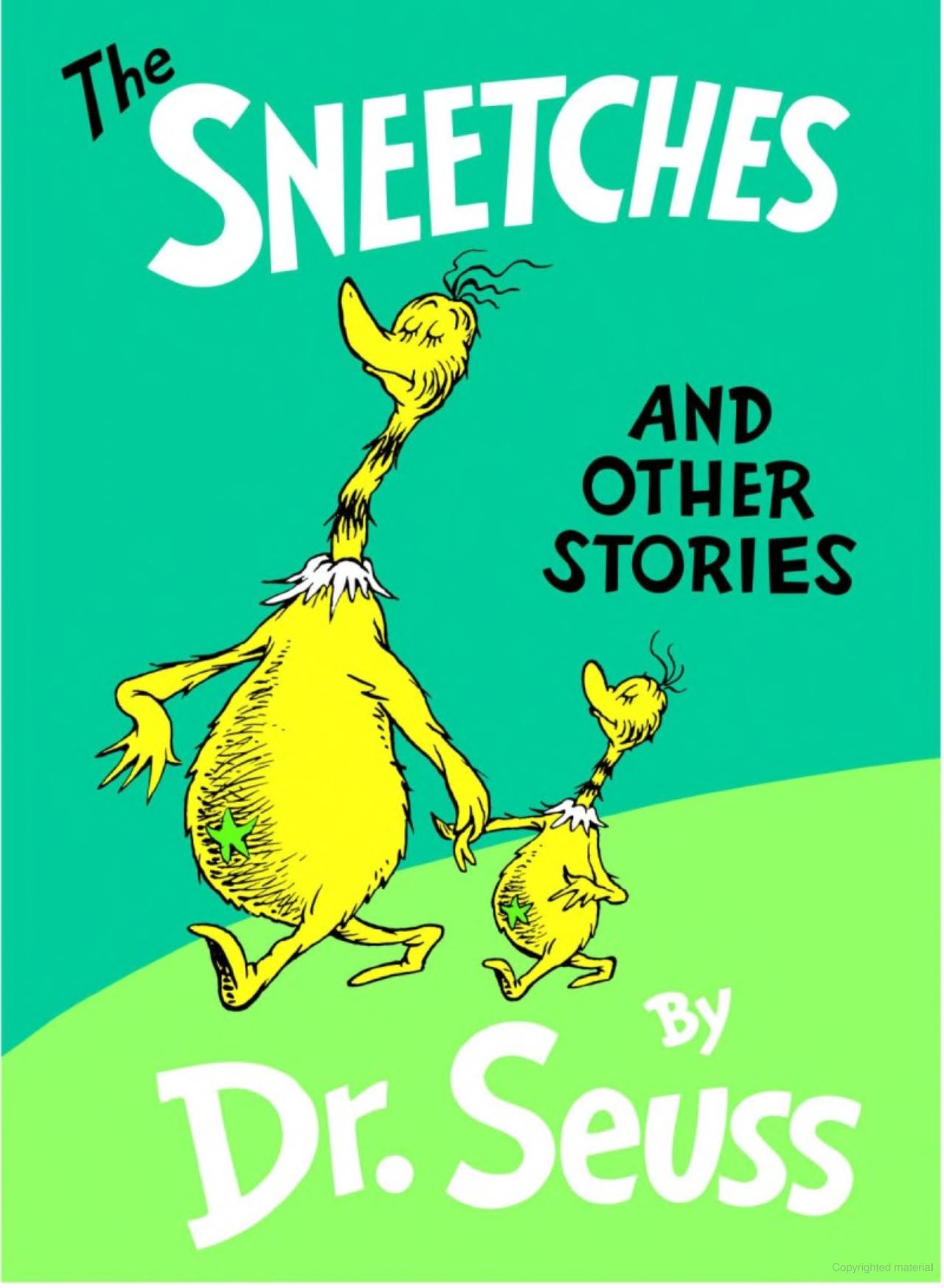
It was the linked article on Rufo—and this piece–that inspired this blog. The story is about an Ohio administrator who interrupts a teacher reading Dr. Seuss’s The Sneetches during a recording session intended for an NPR podcast. A third grader makes a very astute comment; the teacher (Mandy Robek) continues reading, but the admin (Amanda Beeman) shuts that whole thing down:
“It’s almost like what happened back then, how people were treated … Like, disrespected … Like, white people disrespected Black people…,” a third grade student is heard saying on the podcast.
Robek keeps on reading, but it’s shortly after this student’s comment is made on the podcast that Beeman interrupts the reading.
“I just don’t think that this is going to be the discussion that we wanted around economics,” Beeman said on the podcast. “So I’m sorry. We’re going to cut this one off.”
(NPR reporter) Beras tried to tell Beeman that “The Sneetches” is about preferences, open markets and economic loss, but Beeman replied, “I just don’t think it might be appropriate for the third-grade class and for them to have a discussion around it.”
I actually have some empathy for the administrator. She’s totally wrong—kudos to the teacher and the reporter for choosing the book and understanding the relevance of the child’s comment—but I’m sure Beeman envisioned her job security disappearing in a wave of rabid, sign-waving Moms for Control Over Everything at the next school board meeting, and panicked.
But that’s the point here: Educators need to be prepared to defend their curricular choices, with passion, conviction, and carefully considered rationales. Rolling over for the likes of Chris Rufo, the Hillsdale crowd, and dark-money funded and fully politicized organizations who wish to take down public education is not professional behavior.
Once they control what gets said and read in the classroom, the next target will be public libraries. All publicly funded services, the things that build healthy civilization and make diverse communities strong, will be on the chopping block. Ironically, this is about what the Sneetches were trying to teach the kids in Ohio: preferences, open markets and economic loss. What students learn, even in 3rd grade, matters, it seems.
This is a huge issue, wrestling over curriculum and parents’ desires, and it’s been part of public education since the very beginning. No matter how many standards are imposed, or school board meetings disrupted, however, the most critical aspect of instruction remains the individual teacher’s understanding of what is useful and important for the students in their care, and their personal knowledge and skill in delivering those things.
Here’s a story:
In 2008, I was e-mentoring some first-year teachers in an alternative-entry program (in other words, not traditionally trained). They were white teachers, assigned to an all-Black district in eastern North Carolina, country that was once endless tobacco fields. Most of them came from elite universities, and all were laboring under the misconception that they were ‘giving back’ to society. A lot of their conversations were about raising the bar, making a difference, blah blah blah.
It was also the Fall of 2008, when Obama was closing in on the presidency. Students in the school were wild with excitement. One of my mentees, teaching Civics and Government, kept sending me long emails pouring out his concern over the ‘unprofessional’ teachers–the ones who had been there for years. They allowed students to disregard the official curriculum! They spent classroom time talking about this miracle that was about to happen, even letting students campaign. Unethical!
He, of course, maintained that he was sticking to standards and remaining neutral about the race. After all, the students would be taking statewide exams next spring, and he wanted them to score well. He went so far as talking to the principal about his concerns.
I tried to suggest that he was teaching during events that could make history—and incorporating real life into lessons made them more meaningful. I asked if he had conversations with his veteran colleagues, about why they thought abandoning the prescribed curriculum was sometimes okay. Our dialogue got more and more strained, until he basically stopped communicating with me.
This young man had always considered himself an outstanding scholar in the social sciences. His lesson designs (debates, short-writes, small-group discussions, film clips) weren’t bad at all, especially for a newbie. He had some ideas about how to be a good teacher, and passion for the subject matter. What he was missing was knowledge of students and commitment to their learning. When the principal had a pep assembly to celebrate Obama’s victory, he was disgusted. For a public school, this is totally wrong! he wrote.
I have thought of him often—I’m fairly sure he’s not teaching any more. Which is too bad. Because being a master at custom-tailoring worthy curriculum to the students in front of you is a skill that takes time and confidence. It really cannot be outsourced.
There’s yet another thread on Twitter today re: ‘rewarding’ teachers by allowing them to wear jeans on specified Fridays vs. giving them permission to go to lunch (with their students, of course) five minutes early. I have an entire bookcase filled with volumes dedicated to the topic of leadership in schools, but somehow, these casual conversations on social media better reflect what’s really happening than all the blah-blah about Reframing, Maximum Impact, Inspiration, Grit or–God help us–What Works.
The thing is—the success (however you measure success) of a school is almost entirely dependent on the people who work there, and their interactions. There are other factors, of course—resources, the surrounding community, thinking about values—but the best framework for doing right by kids comes from good people who like working together.
I’ve worked under dysfunctional principals, as part of a collegial staff, where teachers rose to mentor and support each other, deftly bypassing administrative snits and roadblocks. I’ve worked with great superintendents, gifted managers—and the occasional evil, ego-bound admin—but I am here to say that the real juice in school-based leadership comes from adults who care about kids and get along well.
Leadership emerges from respect, friendship and trust.
My friend John Spencer thinks the ability to manage is an essential piece of being a real leader:
If a leader focuses solely on new ideas and new initiatives, they run the risk of confusing novelty for innovation. There’s no consistency or sustainability. People miss critical details. Often, the leader is so busy leading, they are unable to step back and maintain what’s already working.
Managing requires the unflattering role of maintenance. Maintenance can feel like drudgery. It can seem inconvenient. It’s a humble part of leadership that often goes unnoticed.
But maintenance is vital. A new bridge can connect people across a city. An unmaintained bridge can be deadly. The best principals I know will say, “I’m not much of a manager,” but they empower teachers to self-manage. They proactively step aside and provide the tools and resources that empower teachers. And in the end, empowered teachers empower students.
One thing John mentions really resonates with me: the inability of a formal leader to step back and maintain what’s already working. I’ve never been in a school—as a teacher, professional development presenter or classroom volunteer—that didn’t have some good aspects, things that needed to be maintained.
I’ve been in schools in deep poverty, the schools that public education vultures can’t wait to shut down, where the building is crumbling, and the playground is literally dangerous. I visited a school where there was one LCD projector in the building, bolted to the library ceiling, and a teacher stood on a table with a broomstick to operate it.
Those teachers—were genuine leaders. They knew the serious limitations they were working with, and kept going despite the environment there. I was merely a person who shared some Powerpoint slides. There were already good things happening in that building, courtesy of the people there. Professional development was superfluous, and they knew it.
Now—there are books about servant leadership and distributed leadership that aim for utilizing expertise rather than following a template for success. I’ve spent the last two decades trying to find a formula for teacher leadership that isn’t about giving someone more work and a small stipend, then labeling them a leader, whether their colleagues consider them leadership material or not. There is an endless parade of articles and commentary from teachers bemoaning the fact that they’re not at the table—they’re on the menu, happy to get a five-minute head start to lunch.
We’re still a long way from normalizing the respect, friendship and trust that are the basis of functional school communities, tailored to the kids they serve.
The issues media believes will dominate public education in 2023 are policy-related: Absenteeism. Mandated retention. Accountability (read: test score fluctuations). Educator shortages. Transparency for charters and vouchers. Funding, funding, funding. And of course, COVID and other viral menaces.
It strikes me that—once again—listening to those who have formed their own communities and informally recognize the leaders among them will have the most success in curbing absenteeism, bringing new, fully qualified teachers into the profession, putting the focus on real learning rather than meaningless data chases, and pushing back—from their own experience—against bad policy.
The conundrum for a public high school social studies teacher teaching about the January 6 insurrection is not to sacrifice one’s credibility while also not pushing one’s own political beliefs on students.
I had an advantage that other teachers trying to thread this needle may not have. I enjoyed the support of colleagues, administrators, students, and parents. You may be a high school teacher working in a less generous environment — one in which local and state politicians have trained their sights on teaching history. You have my thanks and deserve the thanks of all our fellow citizens for your dogged, noble work on behalf of American democracy.
That dogged, noble work? Let’s call it what it is: leadership.
The idea that history is written by the victors is—like most cliches’—an inadequate framework for learning about the powerful forces that have shaped our world. I say this as an American baby boomer, born when the future of the United States seemed limitless, and its citizens were justifiably proud of having saved the world from evil. The history I was taught, in the 1950s-60s, was full of stories about our scrappy upstart nation that freed itself from British colonialism, survived a civil war—then made the world safe for democracy.
When I was in my 20s, I spent a summer backpacking in Europe. I stayed in cheap hostels and went where the Eurail pass would take me. At the very end of the trip, the day before flying home out of Munich, I went to the concentration camp in Dachau.
It was a gray and rainy day, and I had the place nearly to myself. Dachau had been open to tourists for 10 years, but—some 30 years after the camp was liberated—there weren’t many exhibits and no docents, then. That’s not to say that the place felt empty. Far from it.
I’ve been in some historic places in my lifetime, but nothing like Dachau.
The camp—in 1977—was mostly just cleared space, its buildings torn down. There was a bunkhouse or two, and a horrific crematorium to see, some photos on display. But the power of being there was in the voices.
I sat on a bench, under my umbrella, for a long time, listening to and sensing what had happened, around me and under my feet. I can’t explain it any better than that. Whatever evil happened there was not erased, not by a long chalk.
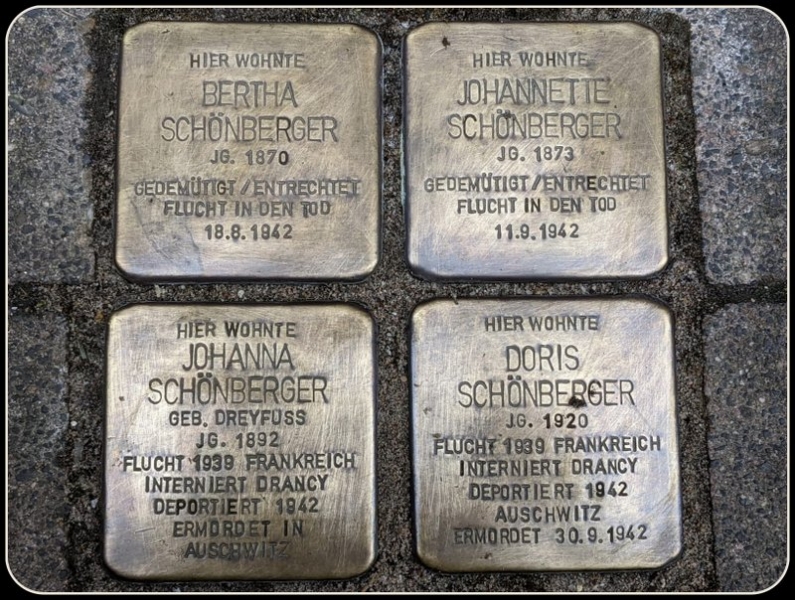
Smith’s piece mentions stumbling stones or solpersteine—small brass plates in the sidewalks of places where Jews once lived or were assembled and sent to their deaths. There are more than 90,000 of these now, in 30 European countries. Schoolchildren raise money to plant more of them.
I was in Germany last month, and our walking tour docents frequently pointed these out. Americans whipped out their phones and took photos. I did not hear voices, but seeing them was sobering. In fact, Smith says that not everyone thinks putting brass plates in places where people can walk on them is the right thing to memorialize the loss of six million people. But, at least, the Germany citizenry is wrestling with the questions around its own guilt. Smith:
In recent years, Americans have seen a shift in our understanding of the country’s history; many now acknowledge the shameful episodes of our past alongside all that there is to be proud of. But reactionary forces today are working with ever-greater fervor to prevent such an honest accounting from taking place. State legislatures across the country are attempting to prevent schools from teaching the very history that explains why our country looks the way it does. School boards are banning books that provide historical perspectives students might not otherwise encounter.
There was, IMHO, way too much celebrating last week over anti-teacher, anti-‘CRT’ school board candidate slates NOT sweeping into power. Data on this, however, is a little murky:
Ballotpedia, a nonpartisan website that tracks U.S. politics, has so far counted 237 school board winners who took a stance on hot-button topics, including race and gender. Of those, 55 percent took the conservative side on at least one issue, compared with 43 percent who took liberal stands (the remainder had mixed positions).
Hardly a resounding victory, and the thing about school boards is that they’re the first access point for anyone with a political beef (real or imagined). You don’t even have to have children in that school, or live in the district.
There is no more important study than our own history. Nancy Pelosi illustrated that beautifully in her graceful step-down speech, as first female Speaker of the House this week. If we can’t learn from our own accomplishments and failures, we’re doomed.
Initially, my parents went to church, so I went with them. Aside from ditching Sunday School with my friend Sue in high school, I never really rebelled against their conservative religious training.
Then I went to college.
I experimented with other faiths—occasionally—on campus, but spent most Sunday mornings sleeping in, procrastinating and regretting my life choices. There followed a long stretch of life where church was not on my to-do list. Then I had kids.
It seemed important to give them some experience with religion. We fumbled around, rejecting churches that embraced the death penalty or excoriated abortion. One church— a campus-based Catholic congregation—refused to baptize our first-born because both of us had been divorced. We settled on a liberal congregation where our kids were part of services and programs. Eventually, I became the music director there.
Since then, I have worked for seven different congregations, my side-hustle of choice. For me, church is not about being saved, whatever that means, or being told what behaviors and beliefs are good or bad.
It’s about finding an inclusive community whose core mission is doing good. And it’s about the music.
There aren’t many places, anymore, where group singing is a regular occurrence. I’m a dedicated, lifelong musician, and much of the world’s musical literature has sacred roots. The central purpose of music is to illustrate powerful ideas, to release emotion, to spark joy. If you’re not getting live, participatory music in church, where can you get it?
I share these personal details, because I am worried about the separation of church and state—and I want to establish myself as a person who is not anti-church or anti-Christian theology (another thing I’ve seen a lot on social media).
I strongly endorse every person’s right to choose and practice any faith tradition or reject the idea of a higher power entirely. Up to you. But please—keep your religion out of government, be that the public school, the statehouse or the county commission. Or the midterm elections.
I used to share my classroom and office with a Catholic congregation that was building a church and paying to use our cafetorium, attached to the band room, for services. Father Dave kept his cassocks and vestments in my office closet, because he often went for a run before mass.
We all got along. But our functions, while in the same physical space, were distinctly different.
What music is OK in schools is a perennial, often heated, topic in social media groups for music teachers. The Kennedy decision isn’t going to help, or clarify. It seems to suggest that Coach Kennedy’s personal beliefs and freedom of religion—expressed by praying ostentatiously on the 50-yard line—did not impact his influence (this is where the proselytizing comes in) on his football players.
Baloney.
I was not a coach, but if I had ever talked to my students in December about a baby born in a manger, sent by God to save the world, I would have to believe that some of them, especially the youngest, would have thought I was telling them something important and real—something that might be On The Test. Unethical, to say the least.
Similarly, I am troubled by Republicans on our County Commission who, in May of 2021, passed a policy on partisan lines, to open Commission meetings with prayer. A flurry of rules, sub-rules and adjustments followed: Only official clergy could pray. From recognized religions. That had real churches. In Leelanau County (meaning that the closest synagogue, across the county line, could not send a representative).
Eventually, after lots of letters and right-wing media attention, the Commission revisited their vote, and settled on a moment of silence. But it took nine months and diverted attention from their real work.
Which raises the question: Whose idea was inserting formal, clergy-led prayer into prosaic local government meetings?
The biggest church in my district makes subtle suggestions about how folks should vote—I read a column on the church’s website this summer, re: which party reflects this particular church’s values, urging congregants to choose that party in the upcoming primaries. I went back to find the piece and insert a link into this blog, but it was no longer there.
Probably because it’s illegal for churches, as tax-exempt organizations, to tell their members how to vote.
Two years ago, at this time, there was a national conversation speculating about what would happen if Donald Trump lost the 2020 election. Barton Gellman, in a much-discussed piece in Atlantic Magazine, posed several scenarios of what might occur if Trump refused to concede.
Gellman was more than prescient, but it all seemed faintly ridiculous at the time. The article quotes Joe Biden, who suggests that Trump might be briskly escorted from the White House if he was refusing to leave, providing us with a mental picture of two big dudes in dark suits and earpieces, frog-marching Trump out of front portico. Bye-bye.
A majority of Republican nominees on the ballot this November for the House, Senate and key statewide offices — 291 in all — have denied or questionedthe outcome of the last presidential election, according to a Washington Post analysis. Although some are running in heavily Democratic areas and are expected to lose, most of the election deniers nominated are likely to win: Of the nearly 300 on the ballot, 171 are running for safely Republican seats. Another 48 will appear on the ballot in tightly contested races.
There’s been a steady drumbeat of concern—the collapse of our faith in free and fair elections means the collapse of American democracy. This election could go horribly wrong.
For the past few months, the County Commission has been hearing from local election deniers during public commentary. It’s a lot of the same people, showing up again and again, repeating stuff they found ‘doing their own research.’ And now, they’re organizing—meeting with the sheriff, calling themselves ‘Patriots.’
Even worse—one of their ringleaders emailed 251 County employees and 336 educators with the following message:
Hi to 336 Leelanau County Educators:
I’m forwarding this message to you that I sent to the Leelanau County Commissioners on October 4, 2022. I got all of your email addresses as directed from the Leelanau County Government website. I have been attending all the Leelanau County Board Meetings since March, and have given the Commissioners [plus all other listed government leaders (262 total)] 13 Flyers showing the massive voter fraud in the 2020 election, which you can read on my [ ] website. I know that you all are very concerned about protecting children. With that in mind, Founding Father Thomas Paine said: “To takeaway (voting) is to reduce a man to slavery.” I’m also concerned about adults marketing the false foundation ‘LGBTQIA+’ to children.
There was lots more, including crazypants attachments, but you get the picture: Election denier (and gay-basher) gets access to all public employees to spew baloney.
It’s one thing for the County Commission to patiently listen to yet another election denier direct them to a random website or to consider the Sheriff’s role in secure elections. It’s another for a local crank to disrupt the work of teaching children about civic values and their personal worth.
Really—teaching is hard enough without having to be harassed by election deniers.
Deniers locally seem to be fixated on Dominion machines, and the need for hand counting paper ballots. The county already uses paper ballots, which are always available for hand counting. Our voting jurisdictions are small—a couple thousand voters, at most. Any race can be (and often is) re-counted by hand. As a candidate who won by a single vote in the primary, I’m all for ‘trust but verify’ in local elections.
Dominion’s $1.3 billion lawsuit against Trump lawyer Sidney Powell, who was a leading figure in pushing the lies that the voting machines were rigged, is also moving forward, although in March she asked a federal judge to dismiss the case against her, saying that “no reasonable person would conclude that [her] statements were truly statements of fact.” On September 28, a federal judge dismissed her countersuit, in which Powell claimed Dominion was suing her “to punish and make an example of her.”
You can’t vandalize fairly run, democratic elections without damaging communities.
Remember Peter Meijer (pronounced MY-er, national news jockeys)? He was the freshman Congressman from Western Michigan with the golden name and the conscience—the one who voted to impeach Trump, post-January 6, as a freshman in the House of Representatives. I say he was a congressman, because he was primaried in August.
The guy who’s running on the Republican ticket in Meijer’s former western Michigan district, John Gibbs, recently said this:
Folks, did you ever think that one day in America, we’d have to worry about schools putting obscene books in their libraries? This is simply insane–we must stop the madness. Voters overwhelmingly oppose sexually explicit books in public school libraries.
Well—folks. I’m not worried about obscene or sexually explicit books in public school libraries. Because there is no madness, no insanity, no pornography in school libraries.
Teachers and school leaders also overwhelmingly oppose sexually explicit books in school libraries. The word we use is ‘inappropriate’—materials are selected by trained school media specialists, who know inappropriate when they see it.
The entire slate of MI Republicans running for statewide or national office, not just Gibbs, is hell-bent on insisting that schools have become (in the past two years) hotbeds of sexual orientation and gender identity transformation, not to mention racial tension and guilt-inducement. They are led in this effort by the Republican candidate for Governor, Tudor Dixon.
What Tudor wants to accomplish is very simple and common sense. She wants to get radical sex and gender theory out of our schools, remove classroom instruction of sexual orientation and gender identity for grades K-3, make sure gender specific sports remain gender specific given biological differences in boys vs. girls and post all curriculum online for parents to see and be involved in their child’s education. Every child deserves a world class education and parents should be in charge of it.
So let’s break this down.
Radical sex and gender theory? (Not a part of the curriculum in any school I’ve been in.)
Classroom instruction on sexual orientation or gender identity for the littles? (Likewise—nope, nope.)
Post all curriculum online? (Sure. Most districts post their standards framework—what gets taught, when– and public high schools in Michigan have adapted the Michigan Merit Curriculum.)
Every child deserves a world class education and parents should be in charge of it. (Right out of the Glenn Youngkin playbook, a statement like this, which is mostly true, really resonates.)
But here’s the truth (from 32 years of classroom experience): What bubbles up in classroom discussions and playgrounds is what’s on the minds of the kids in that classroom. This starts early, in Tudor Dixon’s forbidden zone, grades K-3—like this story about the boy who chose a ‘Frozen’ backpack.
Kids are curious and they’re paying attention to what their parents and their screens (and their friends, and their older siblings) are telling them. I taught music and math, two subjects you’d think were pretty straightforward and controversy-free, but can testify that anytime you get a cluster of kids together, provocative issues emerge.
When politicians say ‘post curriculum online’ and ‘parents should be in charge’ they’re missing the reality of classroom instruction: It’s universally messy and unpredictable, even when it’s highly effective and led by expert teachers. You just don’t know what ideas kids will bring to the classroom.
I think what Dixon wants is to catch teachers talking about Forbidden Subjects raised by students, encouraging parents to be alarmed and dissatisfied. Her campaign is unable to flesh out her policies, however—this article is well worth the read, for examples.
Personally, I have observed parents protest any number of school policies at local school board meetings. Perennially dicey topics? Sex education. ‘New’ math (defined, roughly, as a math program that parents find different from the math program they had in school). Pay-to-play sports (anything about sports will draw a crowd, actually). Your district may vary.
A basic education—reading, writing, math, science, civics—that pushes children to learn essential skills for living and working in a democracy.
Teachers and school employees who understand and care about their child.
Childcare—a nurturing place for their kids to be while parents have other responsibilities.
A decrease in the emphasis on data and competition engendered by annual standardized testing.
Safety—healthy practices, secure premises.
A measure of happiness—all parents want their kids to be happy, and all of them have to learn that happiness cannot be mandated or arranged by schools, although classroom practices can help.
Programming that addresses their child’s unique needs—take your pick: Art, physical education, a library, music, learning about technology, extra-curriculars like sports, drama, leadership opportunities, and so on.
We all love Leelanau’s rural beauty—this is absolutely a ‘common ground’ issue for everyone, Republican or Democrat, who lives here. It’s nice to think that Leelanau could forever be pristine—sparkling lakes, rolling orchards, charming villages. We live in a very desirable place.
The Commission’s job is anticipating—or recognizing—challenges and addressing them.
Is this process always smooth and effective? Of course not. But it’s why you’re elected: to identify and serve the needs of your district, and your county.
And–not all change can be predicted. The pandemic, for example, which served as a divisive and politicized point of contention for countless local government officials, precisely at the time when we were called upon to act in community.
When we first moved to Leelanau County in 2010, my husband and I were both running businesses from home—he had a law practice, and I had a small business providing professional development webinars for teachers. And what we considered adequate internet capacity—we had cable internet prior to moving here—was unavailable. I was curious about why—Leelanau County is rural and rolling, and I understand that poses challenges to providers, but the county is also relatively well-off. Why weren’t providers eager to tap into this market?
Tracking the County Commission’s actions on securing broadband is how I got interested in Leelanau County politics. I heard commissioners describe broadband as a luxury, and the extension of internet services as spoiling our rural character. The Grand Traverse Band has been a willing partner in broadband development for years, but the Commission did not seem interested in working with them.
It took a pandemic and an infusion of federal money to get the Commission off square one, but they have now achieved a momentous first step of mapping internet availability across the entire county, uncovering the fact that 22% of the county had zero access to broadband. Think about how that impacted student learning during the pandemic—and how many clean, small businesses that could support a local tax base were turned away by lack of what is now considered a necessary utility.
Those citizens got wind of the plan and showed up in huge numbers at township meetings to protest. Dollar General withdrew the request—and there are presently two partially completed duplex homes (something we DO need) on the site.
The irony is that Maple City is decidedly rural—there are fruit stands and community-supported agricultural (CSA) businesses everywhere in the area. Could the town use a small, pick-up grocery? Perhaps. But Maple City and hundreds of other modest small towns are now vulnerable to big corporations, with their eyes on the bottom line, rural character be damned.
The changes coming—inexorably—to northwestern Michigan are even larger than the ones we’ve been dealing with, like getting a septic ordinance in place, or resisting unnecessary gravel pits. Climate migration is a real thing, and a beautiful, lightly developed area with ample water and a four-seasons climate is like a magnet for wealthy national and international investors.
Again—the County Commission is elected to identify and serve the needs of Leelanau.
Every governmental jurisdiction needs cooperation and transparency in the way elected officials and appointed workers run the show. Calling for elected officials to get along, keep their mission uppermost in mind, and not engage in power struggles is hardly novel.
Cooperation and transparency have not always been the core principles guiding the work of the Leelanau County Commission—although the Board has very recently made great strides. They have involved the county in the work of identifying and developing attainable housing, building partnerships with non-profits whose goals align with the Board of Commissioners’. Their research and work are bringing fiber optic cable and towers to underserved areas of the county.
The current Commission just passed—after 30 years of wrangling—a septic ordinance to protect the watershed. They have improved relationships with staff at the Government Center—the folks who give you your marriage license, finalize your adoption and ensure that our local elections are well-run. They have expanded recycling programs and established public comment at the beginning and end of every one of their meetings.
All good.
But ten years of observing the County Commission at work proves that these accomplishments were hard fought, a long time in coming, and by no means guaranteed to remain in the next term.
If I could set goals for a strong and productive Leelanau County Commission, the first one would be: Stay in your lane.
The point of have a bi-partisan County Commission is representing all the citizens—the strong progressives as well as the dyed-in-the-wool conservatives. If democracy works the way it’s supposed to, the folks who have lived and farmed in Leelanau for generations will have their views represented, as will those who moved to paradise more recently, and are excited by its beauty and opportunity.
Leelanau County is home to a National Park as well as the GrandTraverse Band Indian Reservation. It’s a mix of rural, agricultural land and high-end resort towns. All of these varied interests and needs must be acknowledged and addressed by the Board of Commissioners. The BOC does not have time for pursuing individual beefs and enthusiasms.
They were residents from all over the county, demonstrating that people are paying attention. Speakers were well-prepared and polite. There was bipartisan cooperation and transparency.







 Teacher in a strange land