Teachers—or Teacher Unions? Or maybe—Neither.

You see it all the time, in the media.

How Teacher Unions became a Political Powerhouse

Republicans grill teachers’ union head on COVID classroom closures

How Teacher Unions Failed Students during the Pandemic

And this nasty little bit of hyperbole:
How the Teachers Union Broke Public Education

Those unreasonable, greedy, demanding teachers—umm, unions– insisting on masks and ventilation during a lethal global pandemic. Boldly asking for wage increases, that bring them closer to other employees with college degrees and a desirable skillset.

But what about that delightful third grade teacher who let your shy daughter know that her drawings and poems were amazing, building her confidence? Or the HS Math teacher who wrote four letters for your son, getting him into Michigan Tech, his life’s dream?

Well—those are individual teachers. The good ones. Not the union. Which is evil. (Since sarcasm often doesn’t translate well in blogs, I am compelled to point out flaws in the “teachers aren’t unions” dichotomy.)

A few points:

  • “The union” is made up of teachers, not “bosses” or—insult alert! —“thugs.” Teachers. Local unions are led by local teachers, a large majority of whom are also full-time in the classroom.
  • Only 31 of the 51 states (and D.C.) have collective bargaining privileges.While other states have chapters of professional associations, including but not limited to affiliates of the NEA and AFT, bargaining is limited or prohibited. Associations exist to protect teachers and provide things that teachers need, from insurance to professional development—things they would get under a collective bargaining agreement.
  • In states with stronger unions and collective bargaining privileges, the bargaining happens at the district level, often between employees of the district—colleagues. Which is as it should be—making joint decisions about best use of available resources, in the best interests of both the students and the adults who organize and deliver education. Of course, this process is messy and fraught, but tax-supported public goods and services are often messy. It’s called democracy.
  • Things that are good for teachers (a health-conscious environment, adequate materials and resources, an orderly school climate, a threat-free atmosphere, respect for teacher judgment) are also good for all kids.
  • Who to fire first in an economic downturn?  The temptation to fire the most expensive employees is always present, in any business. Experienced employees often cost more; there are reasons experienced folks are kept on—their ability to manage difficult customers or tolerate uncertainty. Sometimes, it’s a matter of honoring loyalty and accrued skills.

So the Mackinac Center is dead wrong when it writes:  Merit pay systems allow a school district to pay teachers according to their performance. The teacher who performs well and teaches students effectively is likely to be rewarded with higher pay. The teacher who consistently underperforms is dismissed.

Measuring teacher performance via test data is impossible. Tests and scores are deeply flawed. And one family’s genius teacher who saved Jason is another family’s weirdo with a ponytail.  There are teachers who underperform, even teachers who should be fired. And that decision should be made by the district that hired the teacher, not a grid comparing student testing data. Pitting teachers against one another for salary bonuses is a recipe for disgruntlement. And invites cheating.  Not to mention shutting down the already-shaky qualified teacher pipeline.

So why are politicians—OK, Republican politicians—claiming we need to break the back of the teachers’ unions?How can they praise individual teachers as essential workers but excoriate the associations that represent them? Isn’t that incoherent thinking?

I was struck by Representative Brian Mast (R—FL)’s post this week, claiming: Unions worked hard to keep parents out of their children’s classrooms and have gone so far as to treat concerned parents as domestic terrorists for speaking up at school board meetings.

 Mast pumps up the House Republicans’ Parents Rights bill:

Here are the five basic rights the House Republicans outlined:

  • Parents have the right to know what’s being taught in schools and to see reading material.
  • Parents have the right to be heard.
  • Parents have the right to see the school budget and spending.
  • Parents have the right to protect their child’s privacy.
  • Parents have the right to be updated on any violent activity at school.

So here’s the thing. Parents have always had the right to know what’s going on in their public schools, and have always been invited to attend school board meetings (unless the people THEY ELECTED are meeting in secret—in which case, it’s not a Congressional problem). They have always been able to share concerns about curriculum—from constructivist Math to Sex Education—and vote on school taxation initiatives. I only WISH that more parents were worried about protecting their child’s academic testing data—the scariest privacy issue in 2023.

School administrators and board members loathe being publicly called out or yelled at; they are forced to be responsive to parent commentary—it’s their job.

And very little of this—the rights of parents–has anything at all to do with local teacher unions, who function as a convenient scapegoat, a collective noun that allows those who would like to see public education destroyed point fingers at someone, anyone, and call them a terrorist.

For shame.  

Middle Schoolers: The Myth and the Reality

Among the worst ideas I’ve ever heard, regarding young people and how to develop their knowledge and skills, is this one: Let’s let 14 year-olds serve alcohol in bars and restaurants!

Really? We’re going to let eighth graders wait on adults, bringing them booze, asking if they’d like another, assessing their levels of inebriation? Young, barely teenaged girls “handling” older men, massaging their inebriated egos in hopes of a bigger tip?

Would these be the same young teenagers we don’t trust to select their own pleasure reading, share their own observations about racism and sexism in the classroom, or choose how they want to be identified?

I taught full-time for 32 years, only one of which did not include teaching middle school. I love teaching middle school. Sometimes, I think—in terms of my cynical, low-brow sense of humor anyway—I never really left the seventh grade.

I repeat: I love teaching middle school, and I really love kids in those middle grades.

Tell people that you taught middle school band for more than 30 years, and the first comment you get back will be some variant on “OMG, God bless you” or commentary re: how dreadful it is to parent a person who’s 13 years old—The hormones! The backtalk! — and therefore, how epically horrible it must be to try to teach these kids something, in batches of 30.  

Or, in my case, in batches of 60+, where each student is holding a noisemaker.

Actually, while there were certainly days when I wondered whether I might not be better off selling real estate, teaching middle school music was mostly deeply rewarding and often fun. And in case you think this was because I was teaching an elective, I also taught seventh grade math for two years (once in the 1980s, the second time in 2005), as well as an ESL class and an academic support class where there were fewer than 10 students and classroom management was way more difficult than my 65-piece eighth grade band.

Here’s my honed theory of teaching middle school, in a nutshell: We don’t give middle schoolers enough real responsibilities or credit for their ongoing moral development. They are smart and curious enough to wrestle with big questions and read challenging texts (with some scaffolding). They are trying to figure out what kind of world they will inherit, and are often anxious about the job current adult leaders are doing. This anxiety has exponentially grown by watching adults navigate a global pandemic, stand by as states go up in flames, and try to get themselves elected through the use of lies, cheating and bullying.

Still, middle-grades kids will rise to do a credible job of almost any task we set before them, if they see a point in doing the work.  And when they complain of being treated like children, they’re usually right—every time I hear teachers recommend shutting down privileges we afford adults (using the bathroom when needed, for example, or being given some grace around a missing pencil), I cringe.

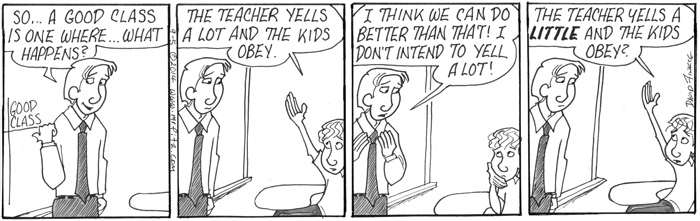
Treating young adolescents as if they can’t reasonably manage their own behavior almost always results in their doing precisely that: acting irresponsibly. A well-run classroom is not achieved by imposing a long list of rules, or threats of escalating punishments. It happens, over time, when students understand that you a) like them, b) respect them, and c) think they are capable of doing the work you have to do together, whether that’s single-variable equations or discussing core democratic values.

Over those three decades of teaching middle school, did I sometimes fail to achieve those goals? Absolutely. And did I have students who exhibited appalling behaviors, ranging from mean-girls cruelty to risking bodily harm? Sure.

But the longer I taught, the higher I raised the achievement hoops, and time after time, my pre-adolescent students came through. We have always underestimated the ability of middle-grades students to discuss, write, solve problems, explore issues and help their communities. We are always too quick to pigeonhole them, based on their immaturity. We have let middle school become a kind of punch line.

Which is why I find it interesting that some states, trying to solve ongoing post-pandemic labor shortages caused by adults who are unwilling to work for subsistence wages and are now demanding better job opportunities, are turning to young teenagers. Whether this is child labor or “developing workplace skills” depends on your point of view.

But there are better ways to incorporate the nascent adult skills that middle schoolers want to display than having them deliver alcoholic drinks to adults, or do other jobs that adults refuse to do for piddling money. I think about all the times I took the middle school jazz band, for example, to the nursing home or the school for developmentally disabled students—and how willing they were, with a little coaching, to make those lives better, to interact with people who were profoundly different.

Perhaps the best way to develop middle-grades students is to offer them opportunities to develop adult trust in their capacity.

Several years ago, my school had a pilot program in community service. Students earned points for shoveling neighbors’ walks, being “counselors” at elementary after-school gymnastics or basketball programs, or “student leadership” activities like planning and decorating for school dances. All students, over the course of a year, had to earn a set number of points, reported and signed off on by their parents.

One mother sent in a form awarding her daughter points for family babysitting. The 14 year-old daughter had four younger siblings, two who were not yet in school, and her mother depended on her to come home right after school, and watch the kids, so she could work outside the home.

This seemed like a no-brainer to me. Tending four children (and, by the way, completing your homework, something this girl always did) was a major responsibility for a girl in middle school. But the counselor argued that it wasn’t “community service,” just a family expectation.

The point of having a community service program was to build students’ skills and awareness of their place in—duh—the community, to emphasize that healthy communities depend on volunteering and interdependency. To show middle schoolers that their work and skills were already valued, even though they were, say, 12 years old.

The program was eventually scrapped over issues like defining “community service.” Which I would call an adult failure to understand the considerable capacities of middle school students.

Middle schoolers can be trusted to do lots of things; my 30 years in their company gave me ample proof of that. It’s the adults who can’t be trusted in the proposal that they serve drinks.

I Had a Dream about the First Day of School…

The “Teachers Report” day, that is. We all have dreams about the day the kids come back, and some of them are doozies, the kind where we’re not wearing pants or the kids run amuck.

But this was a lovely dream about the day that’s usually sucked up by re-learning about Blood-borne Pathogens, the latest silver-bullet curriculum initiative designed to raise those scores, and pointless, endless announcements.

It went like this:

7:15 am Over the P.A., we hear strains of Morning Mood. The Principal begins speaking.

Good morning, Ore Creek Middle School! (in his best Robin Williams voice) Welcome home!
Here’s the plan for today: You’ll all be working in your rooms all day.

The office will be open all day for you to request and immediately pick up supplies. We have parent volunteers to help with this, because the office staff is super-busy, of course.

 We’ve also set up a coffee station which will be replenished with hot beverages all morning, and there’s a box of donuts and muffins for you. Sign up for a slot to use the copy machines—we’ve rented an extra one for the week. I’ll be visiting each of your rooms at some point today, to say hello and answer any questions you may have about 2023-24.

From 11:30 to noon, there is a smorgasbord lunch, prepared by parent volunteers, in the cafeteria. Take a break, have a great lunch to fuel the rest of your day, and meet our new staff members then.

The library will be open all day, but remember—our media specialist is also setting up her room. I have hired extra IT support to staff a help desk all afternoon. Email IThelp@OreCreek if you want a visit from them this afternoon.

I will be sending you an email at the end of the day full of important announcements and a link to the required Blood-borne pathogens training. Sorry, gang—I know this is old news for most of you but the state requires it. You have two weeks to complete it. I’ll send reminders to those who still need to take care of this. Our first staff meeting will be in two weeks, once things get rolling.

I know that many of you have already been in, some for several days. On behalf of the district, I thank you for your dedication. I will be in over the weekend, if you have more to do, so the building will be open.

One last thing—several of us will be heading to Spike’s after school. In addition to their usual (cough) libations, Spike has set up lemonade and iced tea, on the house, for Ore Creek staff. Now—open your doors and give our custodians a hearty round of applause for making the building look so spiffy.

Hey. A teacher can dream…

(Almost) All You Need is Love

Scene: Interview with right-leaning MI media personality, c. 2003, re: National Board Certification

Interviewer: So you say that National Board Certified Teachers—NBCTs– are the cream of the crop. What, specifically, do these teachers do that other teachers don’t?

Me: Well, lots of teachers have the qualities and skills that NBCTs have—but NBCTs have undergone a rigorous assessment of what they know and are able to do. They have studied standards for professional teaching and provided evidence that they are demonstrating those standards.

Interviewer: So what are those rigorous standards that all teachers should be aiming for?

Me: The first one—a foundation for good teaching—is knowing your students well, and being committed to their learning.

Interviewer: Seriously? You’re saying you just have to… (adopts snarky tone) love the kids? Even the bad kids? That’s all it takes?

 —————————————–

In case you’re wondering, the interview did not improve much after this moment. Many folks are laboring under the notion that some teachers have magical, almost indefinable skills that whip classrooms into shape and make learning come alive. Other teachers, presumably, have to rely on a boring combination of content knowledge, discipline and fear.

Nobody expects teachers to love every one of their students—not even the National Board. But teachers who do not develop positive and open working relationships with their students, teachers who believe that their job is dispensing knowledge, then measuring students’ retention of that knowledge, will always be behind the instructional curve and may never become what we think of as a “good teacher.” 

Peter Green, whose work is always worth reading, just wrote a moving and beautiful piece about teaching, in which he says this, about loving our students:  Here’s a big thing I believe about love–it’s not so much a feeling as an action and a choice, a commitment. You can choose to love people, and you can do it based on who you are instead of waiting to be inspired by who they are.

There’s that word, commitment, again. Greene also says this:

Twenty years of modern reform and especially two years of pandemess and CRT panic have worked to drive love and trust out of schools. Since (at least) A Nation at Risk, critics have deliberately ignored and abused the notion that teachers might choose to teach out of love and care, but must instead be threatened with Consequences.

Bingo.

All of this love talk goes a long way toward explaining why—again, and again, and in spite of what sometimes seems like an organized media conspiracy to crush public education—parents (somewhere between 80% and 85%) report being satisfied with their public schools.

If the only information you get about the public schools in your community comes from Moms 4 Liberty, or articles about School Board uproars over book banning and faux accusations of grooming, or the relentless drumbeat of “learning loss” that substitutes quantification for compassion— well, you’re likely to be in the majority of non-parents who think public education is failing.

And let’s be brutally honest—some public schools are so stressed that trust and commitment aren’t in the cards. They are, in fact, failing to be committed to their students, and their students’ learning. These failures show up in inability to hire qualified staff, incoherent curriculum, lack of strong leadership or trust, and general chaos—not test scores.

I like the way Matt Barnum (or whoever wrote his headline) phrased it: Are Parents Mad at Schools?

The data-supported answer is no. No, they’re not.

Because— in spite of the pounding that public schools have taken during and post-pandemic, there is still commitment and caring, teachers who drove around rural districts with stapled-together packets and backpacks full of food. Teachers who persisted in trying to adapt to teaching on-line or outdoors. Teachers who went to school unvaccinated, because their students needed them.

Parents also see, up close and personal, what the impact of a global pandemic has been on their own children— not just the disruption to their normal lives, but the free-floating anxiety around masking, illness in the family, squabbling over vaccines and fear of catching a potentially lethal disease. Children who were sad or bored, whose days lacked the social and intellectual structure of M-F schooling, recess and friends.

What kids need now is not, God help us, “acceleration” techniques to get them to an arbitrary (testable) level of learning. They need the aforementioned structure, knowing what to expect from their world. They need the concern and commitment of their teachers.

What about content— knowledge and skills, the measurable outcomes of school? Here’s a secret: Most of what is learned in school has to be continuously refreshed and applied in order for it to stick and be useful in adult life. Scoring well on a test is not a mark of being well-educated, prepared for adulthood. Human relationships prepare us for life. Content comes and goes.

And bad kids? How do we love them?

I was fortunate. For most of my career as a music teacher, I had students for two to three years, sometimes more. I did come to genuinely love—or at least get along swimmingly with—nearly all of them. I was fond of them, and am curious now about what they’ve done with their lives.

But there was this one kid…

It was a year after I’d been out on leave, and had been assigned to teach a semester-long music class that students did NOT choose. Lots of those students were surly at first, being forced into an elective they didn’t want. It was an uphill climb, but eventually, I started winning them over. I saw them relax and even enjoy the things we were doing. There was laughter. Except for one boy.

He was defiant. He refused to participate. He muttered things about me and his fellow students under his breath. I tried ignoring him. I tried gently looping him into groups. I tried calling him out, but with humor. I kept thinking he just needed to know that I was committed to him, and wouldn’t give up. He remained bitter and overtly hostile. Once, after students had formed groups to create compositions, he picked up his belongings and left the room, for no apparent reason, letting the door slam (of course). He was hard to love.

So I mentioned him in the teachers’ lounge (sometimes, good things happen in the teachers’ lounge). You know about his brother, right? one of my colleagues asked. It turned out that this boy’s older brother had committed suicide in the school parking lot the previous summer. Because I had been gone, I didn’t have a clue. Nobody bothered to tell me.

The semester was almost over. I never did develop any trust with this boy. I would have given him a great deal more emotional space, had I known, and interpreted his anger very differently. I would have tried much harder to love him. Because— and this is often true— students often just need the security that comes with knowing their teachers are committed to them, no matter what.

 I Know It When I See It

“I know it when I see it.”

Supreme Court Justice Potter Stewart, when asked to describe his test for obscenity, in 1964.

When it comes to K-12 curricular materials and library books, what, exactly, is “pornography”— and its corrupt cousin, obscenity? Do you know it when you see it?

Most parents, I think, have a good handle on what they think is appropriate reading / viewing for their children. As the omnipresent meme says, if you don’t want your children to read or watch something, fine—just don’t make everyone else follow your personal rules. I know parents who found Harry Potter frightening and disgusting, and parents who proudly say their children can read anything they like.

I actually think there are plenty of books that don’t belong in school libraries. But I worry way more about parents who let their school-age kids watch an unending stream of violence on TV, then tag along to the shooting range on weekends.

I don’t think books, per se, engender anti-social behaviors, especially when discussion follows reading. And while it would be lovely to think that schools can dish out value-free “content,” any teacher will tell you that managing classroom learning is a daily encounter with weighing and expressing values. The more you sterilize subject matter, boiling it down to a bunch-of-facts curriculum, the less sticky and engaging instruction becomes.

Thus—it bothers me to hear Christopher Rufo call school library books, even certain textbooks, “pornography.” He’s not just talking about sexually explicit stuff, either. He’s talking about a whole range of, well, values that he finds offensive: Delicate and careful discussions about race and discrimination. Questions around gender identity. The use of impious vocabulary. Characters who are decidedly not religious or Christian.

Pornography is something else.

I first encountered pornography in school, ironically enough. When I was in 10th grade, I was in the school play. It was a minor role—a half-dozen lines and maybe 10 minutes on stage. I can’t remember the name of the (forgettable) play, but my character’s name was Bunny. One of the other secondary characters was played by a girl named Pat, who wore copious black eyeliner and carried a metal rat-tail comb in her purse, both grooming tool and potential weapon.

There was a lot of waiting around for our bit on stage. Pat was always reading a paperback, sitting on the metal stairs up to the light booth. I didn’t think of Pat as an avid-reader type, but she was buried in that book. I asked her what she was reading—and she said it was really good, and I could borrow it when she was done.

It was a plain cover—no pictures. I stuck it in my tote bag with my geometry book and took it home. When I opened it up at home, holy tamales. It was—no two ways about it—porn. I read a little, then hid it back in the tote bag. I took it back to school and kept it in my locker for a few days, reading bits here and there—and, I have to admit, being exposed to things I never even heard of or considered.

We’re not talking about Lady Chatterley or Henry Miller or even Anais Nin. This was poorly written, printed on cheap stock, and raunchy. When I gave it back to Pat, she asked if I liked it. I said yes. And that was a true statement, even though it felt like a bomb when it was in my locker.

Did it hurt me, a relatively innocent 15 year old, to read that book? Nah. But there was a reason I kept it sequestered in my locker.

Nor did it hurt me to read Black Like Me, Naked Lunch or Lolita, all of which I read as a teenager.

Kudos to the Michigan Board of Education for proposing and passing a resolution last week supporting school librarians’ work as qualified decision-makers, when it comes to what should be shelved and available in their respective educational contexts (with the two Republican members voting no):

The board’s resolution calls on local school leaders to follow best practices in handling book challenges and affirms that school librarians have the professional skills to select age-appropriate materials. The board’s statement also recognizes that certified librarians have a positive impact on student’s learning and academic outcomes.

One of the two Republicans, Tom McMillin, promptly proposed another resolution to keep (here it comes) “pornography” out of school. That sentiment already exists in the School Code, so that feels just a bit performative, a chance for McMillin to say he fought for kids or some such. A chance to repeatedly use the word “pornography,” as if schools were the source of the actual porn that many teenagers consume.

 My friend, Reverend Jeanne Hansknect, an Episcopal priest, said this, in her comments to the Community Library Board, as they dealt with charges of offering inappropriate literature:  Reading breaks open our limited experiences one book at a time.

And that’s the real shame of restricting kids’ access to books: things that they learn from, and explore at their own pace, are labeled and locked up, making it harder to encourage broad perspectives and critical thinking. Making it harder for teachers to gin up enthusiasm for the basic process of reading, and harder to use language to teach rich, relevant content. Making it harder to look at the most challenging issues for all Americans, and think together about how to solve them.

None of this is really about skills—or even about obscenity or fake pornography.

 It’s about politics. It’s about trigger words like “pornography,” and unsupported accusations.  We know those unsupported words when we see them. And we’re not seeing them in school.

Things that Make Teachers Go Hmmm

For flat-out exhausted teachers, finishing a school year filled with unjust accusations and pointless restrictions, the headline must seem ludicrous: Want to Make $100,000 a Year? Here’s Where You Should Apply.

Turns out it’s a charter school in Detroit, and the spiel initially sounds like they’re seeking the best and brightest teachers (at least 18 of them, anyway) with “strong criteria” to “meet student needs.” The strong criteria? They need to be licensed and certified to teach in Michigan, have five years of experience, and have been rated “highly effective” twice.

It also turns out that only 35 percent of the current staff at the Hundred Grand School is, in fact, certified to teach in Michigan. The charter is essentially soliciting, or perhaps poaching is the more accurate term, a more experienced staff by offering them huge salary increases. Because two-thirds of their professional staff is uncertified. No word on whether any of the current teachers would be considered for the $100K.

My first thought? Where are they getting the money?

Closely followed by imagining a scenario where 18 teachers, identified on Day One by their much-fatter paychecks, are parachuted into an existing staff. And– if you think esprit de corps isn’t really a factor in teaching, you would be wrong.

The tight market for high-quality teachers even seems to be leading Teach for America to a rebranding. A few months ago, TFA was shrinking–Oh No!– but now they’re (get this) focused on training new teachers. Really! I’m serious. Twenty years of asserting that in-depth teacher preparation wasn’t really necessary if the person was smart and well-meaning, and now they’re experts in professional preparation?

The organization said it aims to recruit, retain and develop about 700 teachers in Michigan over the next five years. The announcement comes as Michigan, like other states, struggles to retain qualified teachers, particularly in high-poverty schools, and as far fewer college students choose education as a profession. 

Teach for America was always good at recruiting and marketing. But retaining teachers? And professional development?

The chief complaint about TFA has always been that it was most often a two-years (or less) then-out prospect. Something to burnish the resume’ when you seek a grown-up job in a few years. And TFA teachers had to learn on the job. None of this coursework or field experience nonsense. You’re smart—you’ll figure it out. Catch up.

None of the things Teach for America says it can do in this project—which amount to professionalizing teaching—is in Teach for America’s wheelhouse/origin story. Their job (and they’ve been spectacularly good at getting money and good PR to keep this initiative going) has always been promoting a small group of recent graduates who want to do something different (and, presumably, useful). Save our schools, yada yada, by bringing in some elite temps.

But there has never been a critical mass of practicing TFA teachers in the profession to use their hard-won experience to push for necessary policy change. They take other jobs (easier, better-paying jobs) in education because they can. Or they go to law school. Or work at Morgan Chase.

Teach for America has never been a positive force for change in the teaching profession.  What makes them think teachers will turn to them now?

Hmm. Maybe it’s the $35K bonus teachers earn for being part of Teach for American’s new professional development and teacher leadership programs.

I know all about businesses needing to be nimble and pivot quickly when people stop signing up for your prestigious product, but real professional growth for teachers takes time and experience. You can’t manufacture excellence or buy it. It comes from persistence and dedication. That esprit des corps thing matters, too.

Meanwhile: A bill introduced in the state Senate last month would remove provisions in the Revised School Code that say all teachers and staff in the Detroit Public Schools Community District hired after September 2019 must have their compensation based primarily on job performance, rather than seniority or educational credentials. 

Worth noting: Only teachers in Detroit—not in other districts around the state— were subject to this provision. A financial thumb, pressing down on Detroit public educators, tying them and only them to student test scores, built into the school code.

The common link in all these examples? Money.

Money as teacher lure, money paid to an organization founded on undercutting teacher training and preparation, money for improved testing data, but only if you teach in Detroit.

Hmmm. Maybe we should significantly raise teacher pay across the board. Or recruit candidates by promising better working conditions and sweeping investment in public education. One can dream.

In the meantime, a hearty thank-you to teachers everywhere, winding down.

Memorial Day 2023– Thanks, Band Directors

I’m not much of a flag waver, really. I always thought that author James Baldwin captured my feelings precisely in Notes of a Native Son when he wrote:

I love America more than any other country in the world, and, exactly for this reason, I insist on the right to criticize her perpetually.

These days, perpetual criticism is essential. We are headed into dark times, I think, redefining the meaning of patriotism and sacrifice. It’s easy to lose faith in our government and the grand experiment—all men created equal—that founded this nation. It’s easy to let hope die when our rights have been systematically eroded by power-hungry politicians. When our children are not able to read certain books or study our actual national history, we’re in trouble.

I still believe, however, heart and soul, in the shining but imperfect ideals of a democratic education –equality under the law, the American common school, a free, high-quality education for all children, simply because they deserve it. Thirty years of teaching school have given me a hard crust of cynicism about many things related to education and America. But I never lost my enthusiasm for the Memorial Day parade.

For 25 years, my middle school band students marched through the small town where I taught and lived, in the Memorial Day Parade. There was a whole set of traditions around this event, which grew larger and more complicated every year: the aural passing down of our special drum cadences from the self-appointed 8th grade drumline leaders, mending the color guard flags originally purchased through a pizza sale back in ’88, and patching up hand-me-down snares and sousaphones scrounged from the high school.

There was never a budget for this–middle schools don’t typically have marching bands–but somehow there were always T-shirts, and cold drinks at the end of the parade route. We had a stunning handmade banner that two moms whipped up with lots of lamé and sequins. In my last year, we marched nearly 300 students, on a morning when the sky was a sapphire blue and Air Force jets flew overhead as we rounded the corner by the cemetery.

This took up a fair amount of teaching time. I would get on my knees and beg colleagues for 20 minutes on the Friday before the parade, to assemble five bands into a single marching unit and take a few spins around the parking lot. One year, as I was trying to get the back of the band to master pinwheel corners, the front rank (rambunctious 8th grade trombones) marched right up the sidewalk, opened the front doors, and led the band, playing America the Beautiful at top volume, through the school hallways. By the time I sprinted up to the head of the band (and the principal popped, red-faced, out of his office), marching through the school was a done deal–and became yet another annual tradition.

I was always clear with my students about the meaning and purpose of Memorial Day. They would occasionally whine about how boring America the Beautiful was–Mr. Holland’s band played Louie, Louie, right? I explained that they were old enough to dedicate a morning to thanking local patriots and acknowledging the sacrifices made by Americans over centuries. Older people, watching them march by, would be pleased to hear traditional music. It was about respect.

We do this, I told them, to remember and honor those who made it possible for you to live in this beautiful little town, in this safe world. People like my Uncle Don, who died in February 1945, part of the Fourth Marine Division which stormed Iwo Jima. Or Ray Shineldecker and Joey Hoeker, two high school classmates who lost their lives in Viet Nam. I had lots of funny stories to tell about Joey, who lived around the corner in my old neighborhood–a big, goofy kid who was what guidance counselors in the 1960s called “not college material.”

On our last band trip to Washington D.C., after performing on the steps of the Lincoln Memorial, I was loading tympani onto the buses as my students toured the Mall. A few girls came running up, calling “Mrs. Flanagan! We found him!” Found who, I asked.

Joey Hoeker, of course–on the Wall. And I lost it, right in front of all those kids.

I thank those who served and sacrificed so I can love my country, and criticize it, too. A hat tip to all the band teachers and student musicians who help make Memorial Day meaningful this weekend. And to hero teachers and band directors everywhere– donating yet another weekend to the community –please keep teaching, in spite of everything.

And another hat tip to community bands, providing the same service. I’ll be in Northport, Michigan on Memorial Day–playing Taps from the porch of another flutist, then settling in the cemetery, to play the National Anthem, Sousa marches–and a tribute to the Armed Services. Join us at 10:30 a.m. You won’t be sorry.

Eight Topics Education Bloggers Should Avoid (if they want readers)

I have been blogging for over twenty years—and before that, I wrote the occasional column about teaching for the local newspaper (until The Superintendent sent me a “cease and desist” memo). I have written for a handful of education non-profits, magazines and journals, and spent nine years blogging for Education Week.

When I started blogging, many educators didn’t know what a blog was, and the ones who did spent a lot of time reading and writing about all the Amazing New Tools available, via the miracle of technology. It was an era when financially strapped school districts didn’t hesitate to buy more computers, and everyone wanted to jazz up their lesson plans and see students’ work “published” on the internet. It goes without saying that this was way before Tik-Tok.

Now, I’m writing for myself and anybody who’s interested in reading the thoughts of a veteran educator. Those thoughts aren’t always focused directly on classroom practice, anymore, which was the overt mission of my first paid gigs. Increasingly, my thinking centers on the socio-political reasons for changes in school practice, and what I see as the very real danger that public education might collapse. Even that kind of alarmism is not a sexy, sticky topic for blogs these days, however.

Point being: I’ve been at this for a long time. I’ve written thousands of blogs, columns and op-eds, and observed what gets read and shared, and what sinks like a heavy, published rock. Some of my best work (IMHO, of course) has gone mostly unread. Some tossed-off columns written to meet a deadline got tens of thousands of eyeballs. It’s hard to say what’s going to cause people to read and share a blog.

There are some things, however, that no longer seem to engage teachers (my primary audience) and other education-junkie readers:

#8. Book Reviews  Every now and then, a spectacularly good book about education is published—the kind of book that would help teachers see the work they’re valiantly doing in a new light. I used to teach a graduate course in teacher leadership. One of our icebreakers was naming a favorite book about education. Teachers would routinely admit they hadn’t read an education-related book since college or fulfilling a masters-level coursework requirement. Ironic—and understandable, because working in crisis conditions means you’d prefer to take a break from stress when you read—but also kind of sad.

#7. The Philosophy or Purpose of Education  When Finland gutted and re-did their entire public education system (one that is now deeply admired in the data-driven Western world), they spent years dissecting and re-forming their education goals, before launching an entirely new concept—time that appears to have been well-spent. We don’t do that here. We adopt new programs and slogans on the regular, based mainly on what the people in power think will “work” (to improve data). We resist that deep national conversation about purpose and meaning in education, what our real aims are. We apparently also resist reading about what should matter most.

#6. Teacher Leadership  This one breaks my heart. Teacher leadership and professionalism are at the heart of what I think might save public education, releasing teachers’ moral commitment and creativity in the service of doing right by kids, instead of pursuing goals set by people who haven’t stepped foot in a school for decades. Want to be depressed? Ask practicing educators for their definition of “teacher leadership”—or sit in a teachers’ lounge at lunch and listen to stories of how dedicated and skillful teachers are now treated, in their own workplace. Hint: not as potential leaders.

#5. The Pandemic  Our entire focus, as we move out of a massive global emergency, is trained on two meaningless issues: So-called learning loss—a fancy name for entirely predictable drops in test scores. And a weird obsession with which schools took the risk of meeting face to face, when it was safer for students to be at home.  One might reasonably expect a devastating pandemic to have an impact on students’ emotional well-being as well as endemic confusion about “best practice” during a health emergency. But shouldn’t the questions and initiatives now be around how to support our kids, and figure out what such a traumatic event can teach us all? Instead, there’s all this finger-pointing and blaming. And writing a blog about what positive changes a pandemic might spur gets you zero readers. 

#4. Religion Perhaps you think that religion and public education are two separate things. If so, you are wrong. The intertwining of Church and State—a very bad idea—lies under a lot of the angst in public education in 2023, from book-banning to whatever Hillsdale College is cooking up at the moment. Writing about schools and religion, especially nuanced viewpoints, is a losing proposition. The blogs that get the eyeballs are anti-Christian (on the left) and anti-all non-Christian religions (on the right). Nobody wants to read about a positive role for any religion, like opening church doors to AA or feeding hungry schoolchildren, let alone offering comfort during times of great fear and upheaval.

#3. Racism This one needs an asterisk—because there are plenty of people writing about racism, the most eloquent and productive being those who have lived with its aggressions all their lives. But white women wanting to open a dialogue around racism in schools? Maybe they’re virtue signaling? Writing about racism, and the panoply of school-related issues impacted by systemic bias, is dicey for someone who might be perceived as, well, removed from the action. But as Ijeoma Oluo says in So You Want to Talk About Race? —you have to keep trying. Even if nobody responds.

#2. Research  I’m hardly the first person to write about the disconnect between valid education research and education practice (let alone policymaking) in public schools. And there are readers for pieces that present the most recent grant-funded studies from the Hoover Institution and the folks at Fordham.  Mostly, the commentary is something like: My research is better than your research or Your results don’t mean what you think they do. Even when the research is credible and useful (which isn’t always the case) the audience for genuine research breakthroughs is small and parochial.

#1. Women  I am always fascinated by the fact that teaching is such an overwhelmingly female occupation, and the corresponding chronic disdain for teachers that shapes education policymaking as well as mainstream media. It seems logical that asking a question like “Does the reason teachers make so little money while doing such important work hinge on the fact that they’re mostly female?” would be a hot research topic. But of all the issues I’ve written about in the past 20-odd years, blogs and columns about gender and education get the fewest eyeballs. I’m not sure why—women dominating the teaching profession and the outcomes from that seem to be like the sun coming up in the east: just the way it is.

I used to do blogging workshops, to encourage teachers to write and publish their thinking about education reform and classroom practice. Invariably, the audience would be largely female, but of the prospective bloggers who attended, the ones who followed through with creating a blog (or being hired by someone to write) were most often men. That has changed a bit —there are now more online options for teachers to share their tips and opinions—but I doubt if we’ll ever see four female educators blogging for every man.

Last thought: What blog topics always draw lots of traffic?

  • The Outrage du Jour (weird stuff that happens in schools and then is promptly forgotten)
  • Testing (everybody hates it, and loves reminders that it’s bogus and useless and time-wasting)
  • Wars (the war on teachers, the Reading Wars, the Math Wars, the Recess Wars, etc. etc.)
  • Lists (something about a number in the title)
  • Gifted education (there’s an organized gifted parent legion out there; I recently randomly ran across a man—on another person’s FB page—bragging about ‘ripping Nancy Flanagan a new one’ over a column on gifted education I wrote 10 years ago, a man I don’t know and never exchanged messages with, but who felt absolutely triumphant about… something)

So—what draws you to a particular blog?


The Wreck of the Edmund Fitzgerald and my Middle School Band

With the passing of Gordon Lightfoot, I have been surprised and touched by the number of folks posting Lightfoot lyrics and links. They’re not all aging folkies, either—lots of them are in their 30s and 40s, and some are my former students.

That’s gratifying. One of my best memories about teaching comes from a Gordon Lightfoot song—“The Wreck of the Edmund Fitzgerald.”

It’s worth mentioning that the saga of the Edmund Fitzgerald is very much a Michigan story. When you grow up surrounded by the Great Lakes, you’ve probably spent a vacation or two watching freighters go through locks, or traverse the sightlines in front of your rented cottage. The sinking of the freighter—when the witch of November comes stealin’—has just the right combination of tragedy and seaborne terror to capture the imagination of schoolchildren.

But it is Lightfoot’s ballad, which was released in 1976, exactly one year after the vessel sank, that has kept the tale in memory. Lightfoot considered the song his masterpiece, and I agree. He captures the terrifying scene and the details of the voyage pretty accurately, while giving us lines like:

Does anyone know where the love of God goes
When the waves turn the minutes to hours?
The searchers all say they’d have made Whitefish Bay
If they’d put fifteen more miles behind her
They might have split up or they might have capsized
They may have broke deep and took water
And all that remains is the faces and the names
Of the wives and the sons and the daughters

Listening to the song gives me chills, even today.

 When the song was released, I was teaching in Hartland (I was pretty much always teaching in Hartland…), and the students wanted to play it. I knew what was likely to happen, but when a band arrangement was eventually released—which often occurs years after the song was popular– I bought it.

The beauty of the song (and it IS beautiful) lies in the words. There are only four measures of thematic melodic material (in 12/8 time). There are some slight melodic variations in the intro and interlude, but it’s the same four measures, the same five-chord sequence, through the whole song. Musically speaking, it’s static (that’s a polite word). Lightfoot (and pop/rock artists everywhere) take these music fragments and make them come expressively alive with lyrics and production tricks—wailing guitar improvisations, synthesized backgrounds, strings. But mostly—people are listening to the words.

When the musical palette is “middle school band,” however, there’s not much you can do to vary what becomes the same short tune over and over and over. The kids, after learning the song (which didn’t take long), recognized that: The Wreck of the Edmund Fitzgerald was repetitive and (here comes that word) boring. A whole lot of long notes.  

But–here’s the Lightfoot magic–we turned that band arrangement into a different lesson, around the two questions:

  • Why is the Gordon Lightfoot song so cool and moving, and the band arrangement so…static?
  • What could we add to or change in the band arrangement to make it more interesting, more like the GL song?

It was a great, inspired, discussion– resulting in percussion mallets on brake drums to add noises that sounded like ship’s gear. Someone brought in a ship’s bell, which we added to the intro and final measures. We improvised vocal noises like roaring wind. We fussed with the dynamics–to try to tell a powerful story without words, just moody chords and phrase shaping. We even put bits of the lyrics in the program, and two students read a verse to introduce the song to the audience. (It’s a long song.)

It was also a chance to learn about ballads, and music as storytelling. It turned into the most memorable piece on the concert, judging by parent and student feedback.

Rest well, Gordon Lightfoot. Michigan thanks you.

America’s Most Vulnerable and Important Profession

The Teachers: A year inside America’s most vulnerable, important profession (Alexandra Robbins) does what many other books about teaching are not able to do–take the reader right into the classroom, and describe what’s happening, with empathy and perception. There are lots of books about problems in American education, and lots of books that suggest solutions for those problems, but we seldom get to see examples, conversations and the people doing the work.

If you want a drone’s eye view of American public education—where it’s been, what bedevils the century-old movement to improve it—I would recommend Diane Ravitch’s trio of excellent books that follow education reform over the last couple of decades, or A Wolf at the Schoolhouse Door: The Dismantling of Public Education and the Future of School by Jack Schneider and Jennifer Berkshire.

But if you want to see what happens in the classroom and in the lives of teachers, Robbins accomplishes that better than any book I’ve read since Tracy Kidder’s Among Schoolchildren, written in 1989, which now feels like ancient history . The book is a tour de force—every teacher I know who’s read it agrees—unapologetically written from the POV of teachers without feeling the need to make excuses or backpedal.

Robbins chooses three very fine teachers and takes us through one year (immediately pre-pandemic) of their classroom and personal lives, deftly illustrating how those lives overlap, the pile-up of frustrations and issues bleeding into their emotional well-being.

All three teachers have huge and versatile skill sets and genuine dedication to kids as well as subject matter. Interspersed are data and editorial comment about education and current “reforms” (scare quotes are deserved here), as well as real-life anecdotes and comments that reveal just how far teaching and teachers have sunk, in public estimation.

Robbins highlights things that other education books don’t notice or can’t be bothered with–in-building teacher jealousies and vindictiveness, physical violence against teachers, the long-term effects of cuts to things once considered normal in every school, what it’s like to sit in an IEP meeting with a recalcitrant parent or clueless colleague.

One of her teachers is a middle school special education teacher who finds himself taking on every troubled kid, something that school administrators often push, seeing him as the ultimate “male role model.”  Another is an overachieving fourth grade teacher who knocks herself out to be the perfect teacher for every child, leaving her with no time to build a satisfying personal life (and illustrating, to readers, just how arduous differentiated instruction is, even in a building with adequate resources and good teachers).

The third teacher is a 20-year veteran, a sixth grade math teacher who has mastered the delicate art of getting the best out of her students and runs afoul of a clique of punitive teachers who resent her success and want her to punish kids who are doing well in her class for their sins in other classes.

(Here’s a story from my own experience that parallels her problematic relationships with the people who should have her back—feel free to skip it): We’re having a staff meeting, late spring, to talk about the imbalance of students in elective classes. The middle school bands keep getting bigger and bigger. I will have 93 students in my 8th grade band next year. What this means (besides a classroom management nightmare) is that other elective classes will be tiny, because “too many” students want to be in the band. The Woodshop teacher is outspoken—we need to limit the number of students in band, perhaps allowing the 93 students only one semester of band, in order to give him the minimal 12/class that will keep him employed in the building full-time, rather than splitting his time between middle school and high school, or forcing him to teach a second elective subject.

Everyone knows why all those kids want to be in the band, he says. I turn to him, surprised. I have no idea why kids sign up for band, beyond the fact that they like it.  Mrs. Flanagan gives them all As and Bs, he says. If we forced her to use a bell curve like everybody else, we’d see half of them drop out.

I look around. Nobody’s making eye contact, so it’s clear that this has been a topic of conversation before. And there’s some truth there—I do give a lot of Bs and As, mainly because the students are meeting the goals set for the class. Their parents are paying for their instruments and students must practice to do well in class. We do many performances—both band and individual players. The bell curve is stupid; have all my colleagues really been using it?

I can justify everything I do, but I spent the rest of the year eating my lunch in the band room, paranoid about disrupting the building schedule. And the next September, I have all 93 students in my first hour class. Nobody ever shows up to help. The Teachers is full of stories like this—real things that happen. There is no paradise, no perfect school, although there are many vivid examples of teachers bending over backwards for students and colleagues. Why aren’t we honoring this, financially supporting this work, applauding the folks who show up to teach every day, sacrificing their time and energy for other people’s children?

This book is also the first and best description I have read about the impact of the pandemic on teaching and learning. There have been endless articles and research on “learning loss”–all rife with meaningless data and numbers–but nobody talks about the impact of being expected to position family needs as secondary to students’ needs. Robbins gets this right–there is a line between acting morally vs. choosing school over family, a choice that teachers were urged to make, and reviled when they chose their own families and their own health. We have not yet reconciled that, here in America—but the book makes a good start on it.

Highly recommended for everyone, but especially teachers. It’s a fairly fast and facile read, although well-documented with endnotes, and should give teachers a lift, knowing that their work and their dilemmas have been acknowledged.