What Parents Really Want from Schools

Remember Peter Meijer (pronounced MY-er, national news jockeys)?
He was the freshman Congressman from Western Michigan with the golden name and the conscience—the one who voted to impeach Trump, post-January 6, as a freshman in the House of Representatives. I say he was a congressman, because he was primaried in August.

The guy who’s running on the Republican ticket in Meijer’s former western Michigan district, John Gibbs, recently said this:

Folks, did you ever think that one day in America, we’d have to worry about schools putting obscene books in their libraries? This is simply insane–we must stop the madness. Voters overwhelmingly oppose sexually explicit books in public school libraries.

Well—folks. I’m not worried about obscene or sexually explicit books in public school libraries. Because there is no madness, no insanity, no pornography in school libraries.

Teachers and school leaders also overwhelmingly oppose sexually explicit books in school libraries. The word we use is ‘inappropriate’—materials are selected by trained school media specialists, who know inappropriate when they see it.

The entire slate of MI Republicans running for statewide or national office, not just Gibbs, is hell-bent on insisting that schools have become (in the past two years) hotbeds of sexual orientation and gender identity transformation, not to mention racial tension and guilt-inducement. They are led in this effort by the Republican candidate for Governor, Tudor Dixon.  

What Tudor wants to accomplish is very simple and common sense. She wants to get radical sex and gender theory out of our schools, remove classroom instruction of sexual orientation and gender identity for grades K-3, make sure gender specific sports remain gender specific given biological differences in boys vs. girls and post all curriculum online for parents to see and be involved in their child’s education. Every child deserves a world class education and parents should be in charge of it.

So let’s break this down.

Radical sex and gender theory? (Not a part of the curriculum in any school I’ve been in.)

Classroom instruction on sexual orientation or gender identity for the littles? (Likewise—nope, nope.)

Gender specific sports? (The Michigan High School Athletic Association has a policy adopted in 2012 that determines post-season tournament eligibility for transgender athletes on a case-by-case basis. The group received and approved 10 applications in the past five years—so this is hardly a burning statewide issue.)

Post all curriculum online? (Sure. Most districts post their standards framework—what gets taught, when– and public high schools in Michigan have adapted the Michigan Merit Curriculum.)

Every child deserves a world class education and parents should be in charge of it. (Right out of the Glenn Youngkin playbook, a statement like this, which is mostly true, really resonates.)

But here’s the truth (from 32 years of classroom experience): What bubbles up in classroom discussions and playgrounds is what’s on the minds of the kids in that classroom. This starts early, in Tudor Dixon’s forbidden zone, grades K-3—like this story about the boy who chose a ‘Frozen’ backpack.

Kids are curious and they’re paying attention to what their parents and their screens (and their friends, and their older siblings) are telling them. I taught music and math, two subjects you’d think were pretty straightforward and controversy-free, but can testify that anytime you get a cluster of kids together, provocative issues emerge.

When politicians say ‘post curriculum online’ and ‘parents should be in charge’ they’re missing the reality of classroom instruction: It’s universally messy and unpredictable, even when it’s highly effective and led by expert teachers. You just don’t know what ideas kids will bring to the classroom.

I think what Dixon wants is to catch teachers talking about Forbidden Subjects raised by students, encouraging parents to be alarmed and dissatisfied. Her campaign is unable to flesh out her policies, however—this article is well worth the read, for examples.

Parents absolutely have the right to have input into their child’s public education—but not the education of all children in that school. As a music teacher, parent control over curriculum is particularly challenging during the December holidays. But all teachers, school leaders and school board members have dealt with decision-making around curriculum, instruction and assessment. It’s our job.

To suggest that parents are shut out, or have no say, is just not true. To construct legislation designed to thwart ‘forbidden’ subjects and practices is 100% political, and often funded by outsider groups. Because the reality, in poll after poll after poll, is that public school parents are generally satisfied with their children’s schools.

Personally, I have observed parents protest any number of school policies at local school board meetings. Perennially dicey topics? Sex education. ‘New’ math (defined, roughly, as a math program that parents find different from the math program they had in school). Pay-to-play sports (anything about sports will draw a crowd, actually). Your district may vary.

So what do parents really want? Here’s my unscientific, no-data-just-observation take: 

  • A basic education—reading, writing, math, science, civics—that pushes children to learn essential skills for living and working in a democracy.
  • Teachers and school employees who understand and care about their child.
  • Childcare—a nurturing place for their kids to be while parents have other responsibilities.
  • A decrease in the emphasis on data and competition engendered by annual standardized testing.
  • Safety—healthy practices, secure premises.
  • A measure of happiness—all parents want their kids to be happy, and all of them have to learn that happiness cannot be mandated or arranged by schools, although classroom practices can help.
  • Programming that addresses their child’s unique needs—take your pick: Art, physical education, a library, music, learning about technology, extra-curriculars like sports, drama, leadership opportunities, and so on.
  • Friends.

Peter Meijer (whose name is universally known across Michigan) used a different spelling of his name while in high school to protect his identity.  I am guessing his parents, who could afford any kind of education, wanted the same things for him—a good education, a measure of happiness, programming that helped him realize his goals and dreams. Friends.

Watch out for craven candidates who want to trash public education. They’re not ‘concerned’ or ‘for Liberty’—they’re vandals.

Leelanau Needs to Get Out Ahead of Change

We all love Leelanau’s rural beauty—this is absolutely a ‘common ground’ issue for everyone, Republican or Democrat, who lives here. It’s nice to think that Leelanau could forever be pristine—sparkling lakes, rolling orchards, charming villages. We live in a very desirable place.

But change is coming—as it comes to every community. The trick is anticipating and preparing for that change. When one segment of the County Commission (including my opponent in the District Seven race) decides not to set goals for the upcoming year, they are abdicating the Commission’s responsibility to its constituents.

The Commission’s job is anticipating—or recognizing—challenges and addressing them.

Is this process always smooth and effective? Of course not. But it’s why you’re elected: to identify and serve the needs of your district, and your county.

Because those immediate needs—and the ones we can foresee on the horizon—are very real: Climate change and its impact on agriculture. An array of proposed recreation sites on our lakes, as legacy property owners sell to developers. Eurasian watermilfoil in our largest lake (and the county’s economic engine). A severe shortage of affordable housing (owned and rented), while 40% of the available housing is unoccupied, year-round. A potential uptick in tourism as cruise ships dock in West Bay—and perhaps rail-based tourism as well. The list is long.

And–not all change can be predicted. The pandemic, for example, which served as a divisive and politicized point of contention for countless local government officials, precisely at the time when we were called upon to act in community.

In 2020, a Leelanau County Road Commissioner made national headlines by spewing racist language and thoughts in a public meeting. It was another opportunity to act in community, addressing latent racism in a county where most of the land was deeded, in 1855, to the Grand Traverse Band of Ottawa and Chippewa, and strongly repudiating the Road Commissioner’s thoughts.  Some commissioners wanted to sweep the national embarrassment under the rug, however.

When we first moved to Leelanau County in 2010, my husband and I were both running businesses from home—he had a law practice, and I had a small business providing professional development webinars for teachers. And what we considered adequate internet capacity—we had cable internet prior to moving here—was unavailable. I was curious about why—Leelanau County is rural and rolling, and I understand that poses challenges to providers, but the county is also relatively well-off. Why weren’t providers eager to tap into this market?

Tracking the County Commission’s actions on securing broadband is how I got interested in Leelanau County politics. I heard commissioners describe broadband as a luxury, and the extension of internet services as spoiling our rural character. The Grand Traverse Band has been a willing partner in broadband development for years, but the Commission did not seem interested in working with them.

It took a pandemic and an infusion of federal money to get the Commission off square one, but they have now achieved a momentous first step of mapping internet availability across the entire county, uncovering the fact that 22% of the county had zero access to broadband. Think about how that impacted student learning during the pandemic—and how many clean, small businesses that could support a local tax base were turned away by lack of what is now considered a necessary utility.

There is no better local example of getting out ahead of change than what happened when Dollar General purchased property and applied to build a store in downtown Maple City, declaring that Maple City was a food desert, and the opportunity to buy cheap imported junk and off-brand canned goods would benefit its citizens.

Those citizens got wind of the plan and showed up in huge numbers at township meetings to protest. Dollar General withdrew the request—and there are presently two partially completed duplex homes (something we DO need) on the site. 

The irony is that Maple City is decidedly rural—there are fruit stands and community-supported agricultural (CSA) businesses everywhere in the area. Could the town use a small, pick-up grocery? Perhaps. But Maple City and hundreds of other modest small towns are now vulnerable to big corporations, with their eyes on the bottom line, rural character be damned.

The changes coming—inexorably—to northwestern Michigan are even larger than the ones we’ve been dealing with, like getting a septic ordinance in place, or resisting unnecessary gravel pits.  Climate migration is a real thing, and a beautiful, lightly developed area with ample water and a four-seasons climate is like a magnet for wealthy national and international investors.

Again—the County Commission is elected to identify and serve the needs of Leelanau.

Change is coming. Best to get out ahead of it.

This week’s take from the CSA box.

Leelanau Needs Cooperation and Transparency in Government

Every governmental jurisdiction needs cooperation and transparency in the way elected officials and appointed workers run the show. Calling for elected officials to get along, keep their mission uppermost in mind, and not engage in power struggles is hardly novel.

Cooperation and transparency have not always been the core principles guiding the work of the Leelanau County Commission—although the Board has very recently made great strides. They have involved the county in the work of identifying and developing attainable housing, building partnerships with non-profits whose goals align with the Board of Commissioners’. Their research and work are bringing fiber optic cable and towers to underserved areas of the county.

The current Commission just passed—after 30 years of wrangling—a septic ordinance to protect the watershed. They have improved relationships with staff at the Government Center—the folks who give you your marriage license, finalize your adoption and ensure that our local elections are well-run. They have expanded recycling programs and established public comment at the beginning and end of every one of their meetings.

All good.

But ten years of observing the County Commission at work proves that these accomplishments were hard fought, a long time in coming, and by no means guaranteed to remain in the next term.

In the last cycle, the Commission squabbled over wearing masks to meetings early in the pandemic, and tried to roll back spending on Early Childhood programming that was funded by a referendum, claiming that voters made a mistake, and it was their job to override the public’s wishes. They established mandated prayer at their meetings (but only by Christian clergy from this county). In what appears to be a personal vendetta, Republicans on the BOC attempted to wrest control of county finances and human resources away from the Clerk who has competently handled them for decades.

If I could set goals for a strong and productive Leelanau County Commission, the first one would be: Stay in your lane. 

The point of have a bi-partisan County Commission is representing all the citizens—the strong progressives as well as the dyed-in-the-wool conservatives. If democracy works the way it’s supposed to, the folks who have lived and farmed in Leelanau for generations will have their views represented, as will those who moved to paradise more recently, and are excited by its beauty and opportunity.

Leelanau County is home to a National Park as well as the Grand Traverse Band Indian Reservation. It’s a mix of rural, agricultural land and high-end resort towns. All of these varied interests and needs must be acknowledged and addressed by the Board of Commissioners. The BOC does not have time for pursuing individual beefs and enthusiasms.

Recently, the BOC has been forced into defending our competently and fairly run elections. The County Sheriff (who calls himself a ‘Constitutional Sheriff’) organized a group of election skeptics, ironically meeting in the County Building while the Clerk attended a conference on how to run clean elections.

These factors—‘constitutional’ officials, and election deniers trying to gum up civic processes—are popping up everywhere, even after a drama-free primary season. The Leelanau County Commission isn’t the only civic body trying to stay the course during political upheaval.

But stay the course they must.

There is hope. In Centerville Township, a greatly expanded lakeside campground has been proposed—one that would create an RV village larger than any town in the county, with a water park and three pools (not to mention traffic, septic and lake health concerns). Over 200 people showed up for the first explanation of the proposal, crowding into a vintage building with no air conditioning or restrooms.

They were residents from all over the county, demonstrating that people are paying attention. Speakers were well-prepared and polite. There was bipartisan cooperation and transparency.

It can be done.

Leelanau Needs to Address ‘Poverty in Paradise’

On a cold Sunday in January, a few years ago, Trinity Church in Northport hosted a Sunday afternoon panel discussion on ‘Poverty in Paradise’—hoping to start an ongoing conversation on how Christians could serve their neighbors who weren’t thriving. We set up chairs for 25, but more than 100 people came, standing against the wall, listening to the social workers, educators, local politicians and Tribal leaders talk about the hidden poverty in a county that presents as a natural paradise. 

It was one of the more heartening public meetings I’ve attended—great questions, viable proposals for helping Leelanau residents of all ages, connecting citizens who see it as their duty to help. One man, who owns a successful local business, said he could double his workforce—they had the orders and facilities, he paid well and offered a solid benefit package–if only these new workers didn’t have to drive from Buckley or Kalkaska, where they could afford to live.

Over and over, we heard the refrain: We don’t want Leelanau County to be a necklace of upscale resort towns, spaced along M-22 (the scenic drive that hugs the Lake Michigan and West Bay shoreline). We don’t want the most beautiful natural sites and farmland to be scooped up by international and out-of-state buyers, who see our natural resources as their cash cow.

We want people living here year-round, investing in the county, its residents and businesses. Putting down roots. Sharing in the benefits, building new opportunities. Paying taxes. We want folks with a moderate income: Teachers. Nurses and medical techs. First responders. Construction workers.

At this meeting, there was no dissent around the idea that addressing poverty would be good for everyone—from the million-dollar homeowner to the single mom supporting three kids while working at a nursing home. Businesses need workers (and need to pay them fairly). Schools need students and families. A vibrant service industry is essential, as is a new generation of farmers. When everyone is comfortable and secure, we all benefit.

There are genuinely poor residents here—families and individuals who live below the poverty line. Only about six percent of County residents meet that standard. But 37 percent of county residents are ALICE: asset-limited, income-constrained, employed:

Developed by United Way, ALICE is “a new way of defining and understanding the struggles of households that earn above the federal poverty level, but not enough to afford a bare-bones household budget.” ALICE metrics take into account where families live on a state, county, and township level — and more crucially, what the cost of living is in those areas.

Looking at ALICE numbers tells a different story about Leelanau County…a staggering 43 percent of Leelanau County households cannot afford any unexpected expenses (such as car repairs, health deductibles) or increases in basic expenses (such as food, transportation, childcare, a basic phone plan).

The county government can create or influence policy to provide or incentivize the things that foster equity: Affordable housing. Early childhood programs, healthy public schools and dependable childcare. Reliable public transportation, like convenient BATA buses. Expansion of affordable broadband to every household.

Private and non-profit projects that address housing and food insecurity must be welcomed and nurtured. The Poor Farm Garden, in Kasson Township, raises and distributes hundreds of pounds of fresh vegetables, partnering with Food Rescue of Northwest Michigan and 5Loaves2Fish to donate healthy vegetables to food insecure households in northwestern Michigan, on the same soil as the original County Farm, purchased in 1901 by Leelanau County, to provide for the poor.

Here’s a quote from the Leelanau County Historic Preservation Society: Empathy and compassion is baked into this soil and has survived through this partnership. It also reminds us that after all this time we still have people in need…”

At a recent Township Board meeting, after a discussion about a small-scale affordable housing issue, a man in the audience stood up and said “I’m sick of giving people handouts. If they want to live here, they should come up with the money.”

The problem is—our property values (including that gentleman’s property) are rising precipitously. People have been priced out of their own homes, and are unable to fill jobs, raise families and build lives here. And we need those year-round, employed families.

Investment in programming and services is the rising tide that lifts all boats.

Leelanau Needs to Protect and Cherish Our Beautiful, Fragile Home

If there were ever a local issue that should be 100% non-partisan, it would be protecting our stunningly beautiful peninsula, its rural and small-town character, and our abundance of natural resources.

Surrounded by Grand Traverse Bay and Lake Michigan, Leelanau County has 100 miles of Great Lakes shoreline, 33 inland lakes and incorporates five islands.  We have the second-highest proportion of water area of any county in the United States, behind only Keweenaw County, Michigan.  Sleeping Bear Dunes National Lakeshore, located on the west side of the county, was voted “The Most Beautiful Place in America” by Good Morning America, in 2011.

Water, water everywhere.  Which means keeping our lakes, shorelines and watershed clean and healthy should be Priority One.

Leelanau County is thoroughly rural and agricultural, with a half-dozen charming and unique resort towns running along the outer coastline. Inland lakes and streams are lined with villages, homes, businesses and cottages, many of which were built decades ago and have independent septic systems. It is estimated that 20-40% of those systems are either failing or need attention.

After rejecting a septic inspection ordinance for 30 years, the County Commission recently passed a point-of-sale/transfer septic ordinance—when you’re selling or transferring a property, a septic inspection (and correction, if needed) is now mandated.

My opponent says this is the ‘big arm of government’ coming down on property owners. My take is that such an inspection will not only protect our most precious resource, and economic engine—water—but will protect new buyers from having an unpleasant surprise when their inadequate holding tank or drainage field fails. It’s common sense and a simple first step to protect the watershed.

Recycling is another important factor in keeping Leelanau clean and green. When we moved here in 2010, we were delighted to learn that free recycling bins were available in Cedar, and other locations around the county, funded by a vote made by our fellow citizens. Recycling keeps waste out of the ground and out of the water.

I do understand that recycling centers have sometimes been misused— but recycling (and monitoring recycling centers, or making them more attractive) is something citizens can do, and government can support. It’s a mix of individual responsibility, and good policymaking. It’s one component in protecting the ecosystem we all share.

Another example of individual initiative and policy support is boat-washing, to keep destructive and invasive species out of our lakes. The Lake Leelanau Association and the Grand Traverse Band partnered on this project, to protect lake health and fishing. Plaudits to them—we need more boat washes. County Commissioners should be behind all such plans. That’s what good government is for.

Protecting the natural environment is not a township-by-township or private association issue. Every major change to the landscape impacts interconnected systems: Traffic. The health of our lakes. Farming. Access to recreation, open and wooded spaces. Controlling growth and retaining rural character, while also providing essential housing and services for our citizens and visitors.

When it comes to protecting our land, air and water—we’re all in this together.

Leelanau Needs to Attract and Support Young Families

Shortly after we moved to Leelanau County, results from the 2010 Census were released. On the front page of the local weekly, The Leelanau Enterprise, we learned just how OLD the residents of Leelanau were. Some townships—studded with expensive lakeside homes—had an average age over 60.  We were a county of retirees. And the situation hadn’t improved with 2020 Census data:

In some U.S. counties, the median age is far higher than the national median. According to data from the Census Bureau, in Leelanau County, Michigan, the median age is 54.6 – about 16 years higher than the national median. A reported 30.9% of local residents are 65 and older, while only 16.9% are 18 and under. For context, 15.9% of the U.S. population are 65 or older and 24.1% are 18 and under.

Residents of Leelanau County also appear to be less likely than a typical American to be starting or raising a family. The share of area households that are home to children under the age of 18 is just 19.7%, well below the 30.7% comparable nationwide share.

There are more than 3100 counties in the United States. Six of the top 50 ‘old’ counties in the nation are here in northern Michigan.

This is not healthy, and must be addressed, for a number of reasons:

  • There are four public school districts in Leelanau County, and a great deal of loyalty for the custom-tailored (and free) education they provide. But if there aren’t enough students to guarantee right-sized classes over time, operations are not efficient. Student numbers need to increase or remain stable for families to enjoy the benefits of neighborhood schools—qualified staffing, desirable programming and the building of school communities.
  • The local workforce needs workers who live reasonably near their place of employment. Without a thriving local economy and enough on-site workers, restaurants, small businesses and medical facilities are forced to cut hours and services. Agricultural businesses—utilizing Leelanau County’s unique landscape features—depend on both seasonal and year-round employees as well. The workforce cannot be priced out of decent homes in Leelanau County.

We need young families! And we need to support them (and in doing so, support the older citizens who are drawn to Leelanau County). How do we do this?

The good news is that we have lots of civic-minded problem-solvers in Leelanau County. With the support of the County Commission and local government, and adequate resources, we can make Leelanau County a welcoming place for young families. 

The Politics of the Polka Fest Parade

I live in a wonderful small town in the ‘Little Finger’ of the Michigan mitten. Cedar sits squarely in the center of the Leelanau peninsula, settled a century and a half ago by Polish farmers, whose names are sprinkled across the landscape on businesses, farms and roads. Holy Rosary Catholic Church, established in 1883, is the conservative spiritual home to many of the residents.

In many ways, Leelanau County—a spectacularly beautiful place, surrounded by Lake Michigan and Grand Traverse Bay, and marked by blooming orchards, massive sand dunes and rolling, wooded terrain—is a microcosm of American politics. A half-dozen charming resort towns, multi-million dollar lakeside homes, and more modest interior villages where family roots go deep. All of it built on land that was mostly ceded to the Tribes, in 1855, then promptly platted up and sold to white immigrants anyway.

The Grand Traverse Band of Ottawa and Chippewa Indians are still based here, and we’re home to a National Park, Sleeping Bear Dunes, dubbed The Most Beautiful Place in America.It’s a fantastic place to live—good schools, clean air and water, friendly people. Lots of snow.

But things are changing.

The population is growing older and richer and whiter, around the edges of the county, as wealthy folks from around the globe, looking to escape the ravages of climate change, snap up properties. We need another 600 affordable homes, both rented and owned, to support a plethora of service workers and young families who would like to share the beauty and opportunity. Internet services have been decades behind the rest of the world (although the current County Commission has recently made great strides). And keeping our lakes and shorelines clean should be Job #1—they are the lifeblood of the local economy.

If this is starting to sound like a political ad, that may be because I just got through a primary election, running for County Commissioner in my (mostly rural, heart-of-the-peninsula) district. I love it here, and think we could do a much better job of protecting our assets, bringing in young families, and building community.

I have loved living in Cedar since the first summer we moved here, and learned that the Big Deal Event in Cedar was the annual Polka Festival. We went our first Polkafest parade in 2011—and found it heartwarming. Vintage farm trucks, a dancing pierogi, accordion players on flatbeds and a group of friendly folks in the 60-ish demographic, carrying Vote Blue! signs.

Aha, I thought. Those are my people.

And it turned out that they were. I have been in the parade multiple times since, in election years, marching with Democratic candidates and stalwarts. Singin’ songs and carryin’ signs. The other side was there, too—we’d wave, and they’d wave back. It’s a friendly local parade, and we’re all neighbors.

There was no Polka Festival in 2020—postponed into oblivion, like so many things– and we missed it. There’s round-the-clock dancing in a big white tent, authentic Polish food in Styrofoam containers and a mass in Polish, at Holy Rosary. Not so much fun with a dangerous virus circulating.

Last year, with the Polkafest on again, the local Dems applied to send a marching unit, and were told that the Polkafest Parade was now apolitical—no campaigning, no partisanship. Just a community event.

The previous presidential election and the Big Lie made it a year like no other, of course, and the new rules made sense to me. With so many community traditions, 2021 was supposed to be a return to normal. A chance to have fun together. Let’s leave politics out of it. I was OK with that.

Except that the current County Commissioner (who’s held the seat almost 26 years, and will be my opponent, come November 8) was in the 2021 parade, riding an old red farm tractor with signs wired to its sides, suggesting we re-elect her. She was throwing out candy, too.

The Dems called the parade organizers, afterward, and asked what happened to the apolitical parade. We were told that the rules now stated that elected politicians were allowed, but by invitation only.

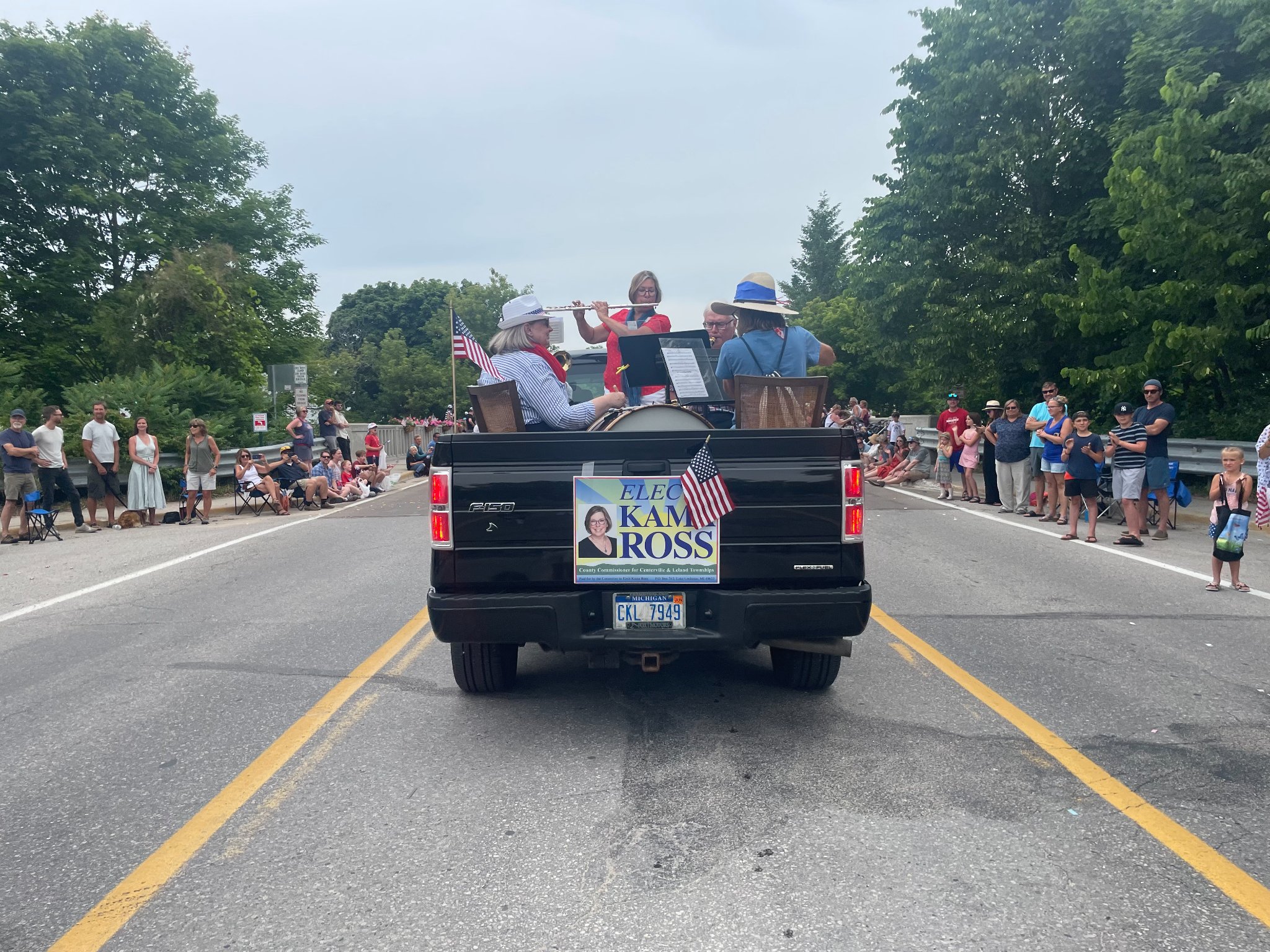
The day after last week’s Primary, I applied to field a polka band for the 2022 parade. I play in a number of local musical groups, including a community band, and knew I could assemble a handful of good musicians and Roll Out the Barrel.

I’d put an “Elect Nancy Flanagan” sign on the side of the truck. It wasn’t an original idea—I was in a small, truck-bed band in the nearby Leland Fourth of July parade, with political signs for a different candidate, and it was really fun.

The rejection came back immediately. No political units, except for (and the organizer made this sentence outsized and bold) “seated official representatives elected by the people, by invitation only”.

There was some back and forth—Did she want a list of seated, duly elected Democrats to invite? No—but in the end the polka band folks I’d recruited, after tossing around the idea of calling ourselves the ‘Step to the Left Polka Band,’ decided to opt out rather than go incognito or risk a public kerfuffle.

Yup. I realize it’s a pretty small slight, an early lesson in politics. Organizers can invite the side they want to be at their event, and turn the other folks away. Those with power win, those without lose. It’s how the game is played. Especially in 2022.

Yet I imagine newcomers to Leelanau County watching the parade, seeing 26-year County Commissioner riding on her tractor, thinking: Why didn’t the Democrats choose to be in this parade? Where is that woman who’s running against her?  

Or maybe they’ll be too busy looking for the dancing pierogi.

Lirty Dies or Wandering the Campaign Trail in ‘22

The Michigan primary is in three weeks, on August 2nd. This is the first pre-election summer I’ve ever been a candidate for anything, so I’m spending more time—what? Thinking politically? Dividing the world into red and blue, R and D? Despairing of the current climate?

Actually, what I’ve been thinking most about is lies. Untruths, mendacities, outright deceit, yada yada—and the party that uses them as bait.

The Capitol Steps –may they rest–a musical comedy group originated over 40 years ago, with a collection of congressional staffers who saw the humor potential in pretty much everything that went down in D.C., had a series of sketches called Lirty Dies.

Lirty Dies were merely phrases with the first letters exchanged—in Capitol Steps parlance, when you WHip their FLurds. A great political tradition: We’re not quite sure what we’re saying; you’re not quite sure what you’re hearing.  Think Herschel Walker.

The problem? Liars win.

This has always been true—plenty of obvious examples in recent history, from the deceptive Trump appointees on the Supreme Court who knew what settled law was, to that dude in Missouri who said that women who were ‘legitimately’ raped could shut that whole thing down.

But in 2022, alternative facts are the norm in every election, from the Big Lie about 2020 to my own small-potatoes campaign for County Commissioner.

In my State Senate district (MI 37th), for example, there are three candidates running on the Democratic ticket. Only one is actually a Democrat. The other two are both Republicans, active in their county parties–and sometime felons, by the way. One of them was quoted as saying, during his podcast on March 31, that the media was trying to destroy the “nuclear family,” with every commercial showing a “biracial mom and dad.” It’s pretty clear who the target audience is.

I’m not really clear on why they think this tactic—running in the party they loathe—will work. There are two actual Republicans running in the primary, so it’s not as if there was nobody to vote for. Just a chance to SPew up real political SCReech, I guess. (That was a Lirty Die.)

Meanwhile, in the Michigan Legislature, the Democrats (the minority party), having been falsely accused by their Republican opponents of being ‘groomers,’ decided to fight back:

As many Republicans push conspiracies about schoolchildren being “groomed” in public schools, a bill introduced by Democrats in the Michigan House that would create a legal pathway to prosecute people who “groom” minors in sexual abuse cases idles, untouched by the Republican majority. 

Partly this is because former (Republican) House Speaker Chatfield is under investigation for actually grooming a 15-yr old girl when he was her teacher at a Christian Academy founded by his father. But mostly, it’s just a ruby-red response to being called out and held accountable for Lirty Dies.

Two weeks ago, the four women running for the Democratic slot in my County Commission district (including me) held an open-air listening session at a local park.  We sent out postcards to likely primary voters to invite them. The weather was perfect, and we had live music and cookies.

The event was a great success—somewhere between 50 and 60 voters showed up, and for two hours, each of us was grilled (or encouraged) by friendly neighbors. People asked good questions about local issues—why our internet infrastructure is inadequate or worse, how to build and repurpose affordable housing, and so on.

The biggest issue is clean water. We live on a peninsula surrounded by Lake Michigan, so passing a mandatory septic ordinance, while the least sexy of issues, is critical.

Midway through the afternoon, an older gentleman and his wife showed up. I greeted him with an outstretched hand, as he passed a table with a fellow Dem collecting signatures for Promote the Vote.  Are they for or against mail-in ballots? He asked. For, I told him.

Mail-in ballots are how the 2020 election was stolen, he said. Oh oh.

I decided to just listen to his issues and concerns. He talked about responsible farming and compost, which seemed to be something we had in common. Then he asked me about my background. I told him I was a retired teacher.

And he proceeded to regurgitate incredible slander about public education, the crapola now floating above every local election: The teachers were teaching kids to hate being white. They were telling lies about history. They were teaching kids about perverted sex (he was embarrassed when he said this, looking down at the ground). There were dirty books, too.

Ironically, his seven children had all attended and graduated from the public school no more than a mile down the road. This is a school where I volunteered—before the pandemic—and that I thought was a good public school, a school that offered a lot of programming for a small district and had a solid staff.

I told him I had been in the classroom for nearly 35 years, then volunteered in three local districts in this county, and I did not believe that teachers routinely did those things. Any teacher who overstepped their bounds in the classroom could and should be called out. By parents—or by an administrator. But this was not the way public education (which is controlled by a locally elected board) worked.

Well, he said. This just started.

He was OK with the school when his kids were there—the teachers were pretty good, and he went to all the football games. But now, he said, teachers have started doing bad things all over the country.

What, specifically? Well, supporting the Blacks, he said. Against the police. Going against the Bible. He struggled to remember what he’d read—some letters, maybe? (No way was I going to fill in the acronym for him. He’d already soaked up too much falsehood.)

You should start volunteering again, he said. Things have really changed in the last couple of years.

I passed him on to another candidate, but he lingered in my mind. Not a bad guy. But he’d been lied to, and he trusted the liars. It was as simple as that.

Lirty Dies.

Voter Linda, chatting with the four candidates for Leelanau County Commission: Allison Zimpfer, Julie Kradel, Mary O’Neill and blog author Nancy Flanagan.

Do Parents Really Want Control Over What Students Learn?

What’s driving the screaming matches at local school board meetings—the ones where organized parent groups show up to have their say about everything from critical race theory to bulletproof doors?

There are a lot of overlapping factors: A nation that’s bitterly divided. The pandemic we’re still dealing with, and its impact on children. Racism, sexism and the fear of losing “rights.” Gun violence. The political upheaval resulting in an insurrection, which played out live, on national TV.

And, of course, money and support from outside sources and organizations, which perceive these ongoing crises as an opportunity to chip away at public education.

I’m no stranger to parent-led fireworks at Board meetings. I’ve witnessed verbal storms over sex education and teacher strikes and girls who wanted to lift weights with the wrestling team.

During my second year of teaching, in October, the School Board decided to lay off 20 teachers (including me) who signed annual contracts in the spring, because an August millage election had failed. They made cuts to programs across the board, and established a pay-to-play model for all HS sports. There was a huge board meeting that went on until the wee hours. And what were the parents upset about? Eliminating foreign languages—or elementary art and music?

No. It was about the football team.

One mom was outraged at being asked to fund her son’s final year on the team. “This is his time to shine! Teachers can always find another job—but my son has only one chance to play football in his senior year!” There were perhaps a hundred teachers at this meeting. You can imagine how that remark went down with them.

My point is this: when parents are angry enough to publicly spout off at a school board meeting, it’s seldom centered around informed disapproval of established curriculum, instruction or even assessments (unless someone has lied to them about what’s going on in their children’s classrooms). Even book banning—a chronic hotspot for school leaders—seldom flares up because a parent carefully read their child’s assigned book and was shocked into action.

What we’re seeing now is something else: an orchestrated and funded effort to demean public education and the people who work in public schools. It’s about power and control. It’s about ginning up fear, using dishonesty as a tool. As John Merrow notes:

Many of the adults who have been disrupting local school board meetings not only do not have children enrolled in those schools; they are classic outside agitators, perhaps even from neighboring states. 

The foundation of recent wrangling over control—parents’ rights, if you will—is thoroughly political and got a big boost when now-Governor Glenn Youngkin promised to strip culturally responsive instruction from schools in VA.

Parents have always had rights—including the right to see what their children are learning, access to instructional materials, the option of observing their child in his classroom, and the opportunity to talk to his teachers about any of these.

Teachers have the responsibility to know the curriculum well, to be able to tell parents why certain materials and teaching strategies were selected.  And—should parents be genuinely concerned about any of these things—the responsibility to justify the value of a particular technique or content, to adapt or offer alternatives.

That, in a nutshell, is good teaching–based on trusting relationships and understanding. Every veteran teacher and school leader reading this has had difficult conversations with parents about what and how their children are learning. It’s part of the job. Always has been.

It’s also one of the reasons many teachers pushed back against the Common Core: the standards didn’t fit the students they were teaching. Driving responsibility for determining standards, curriculum and assessment upwards means that teachers are left with explanation that they’re teaching something because it’s on the state test, even though it may be inappropriate or irrelevant for a particular child.

It’s not just parents who want to strip control from schools. From Education Week:

States have a limited amount of power over what materials teachers use in the classroom. A new report shows how some of them are trying—and succeeding—to wield influence anyway. In the majority of the country, districts operate under local control, meaning that school systems, or sometimes individual schools or teachers, have the ultimate authority in deciding what curriculum is taught.

That means that if states want to influence what teachers are using, they have to get creative about what levers to pull. A new report from the RAND Corporation suggests that some states have managed to do just that.

Look for the phrase ‘High-Quality Instructional Materials’ accompanied by some disdainful blah-blah about how clueless teachers design lessons based on what they see on Pinterest, so professional curriculum deciders need to step in and choose better materials. Well-paid deciders, naturally.

Earlier this year, Jennifer Berkshire found reason for hope:

I’ve spent the last few days talking to voters and candidates in New Hampshire who powered record turnout, resounding wins for public school advocates. One theme keeps coming up. Voters were REPELLED by the extremism of “parents’ rights” groups. This was a backlash to the backlash.

In the meantime, all the shoutin’ has left educators limp and discouraged. From Connecticut teacher Barth Keck:

Nationwide accusations of schools teaching “critical race theory” found their way into Connecticut despite any evidence of its existence or even any accurate explanation of what CRT really means from the critics. Superintendent Freeman “cited letters to the editor and social media posts regarding the school’s teaching and equity policies which imply that ‘parents shouldn’t be trusting the teachers and school administrators who are shaping the experience for their children in Guilford.’” 

I have not felt such pressure personally, aside from comments on social media from those calling me a “groomer” and “brainwasher” of children. Granted, I don’t know these people personally, and the only thing they know about me is that I’m a teacher. But that’s the point: Strategic political posturing has convinced scores of people that, rather than a noble and essential profession, teaching is an insidious endeavor whose primary purpose is to push a far-left agenda.

It’s not about the things parents already have a say in—their children’s learning.

It’s about raising a public ruckus.

Voting is Not Enough to Save Public Education or Keep Schools Safe

Voting is not enough to turn this nation and its communities around, although everyone MUST vote their conscience and core values. It’s a cornerstone strategy in change.

Nor is speaking out enough—although plaudits to every teacher, organization, political candidate and basketball coach who has spoken out against the ugly spasms of hate and violence. More, please—keep talking and keep writing about how we are collectively losing something we once thought invincible: a safe and just democracy.

Even policy will not save us, although it might have a positive impact—the assault weapons ban of 1994 did. Before it expired under George W. Bush’s watch, of course, when the rate of assault-weapon incidents tripled. There were about 400,000 AR-15 style rifles in America before the assault weapons ban went into effect in 1994. Today, there are 20 million.  Policy helps, but is insufficient.

Policy, political power and public discourse are valuable tools—but we need a public uprising, a change in hearts and minds. We can do better. We need to understand how connected we all are, first.

Education depends on safe, orderly, predictable systems—something that the COVID-19 pandemic undermined. It’s taught many of us how interdependent we all are and how interconnected our systems can be.   (Renee Owen, in Education Week.)

Here’s the thing I have been thinking about most, in the wash of grief over the two most recent shootings: The people we lost were community builders, those who sought and worked for safe, orderly and predictable systems in their own lives and towns.  Grandmothers, family caregivers, a retired cop. The supermarket where the Buffalo shooting occurred was a community-driven project to provide grocery shopping in a former food desert.

And the teachers in Uvalde were exactly the kinds of educators we need right now: Committed to kids, thoroughly embedded in the Uvalde community. Skilled veteran teachers. Role models, in a community where over half the citizens speak Spanish at home. They were obviously teaching the children in their care that they were valuable, that they could accomplish great things.

How were they doing this? Safe, orderly and predictable systems that put structure into their work at Robb Elementary School. Until one day, all of those interdependent, interconnected systems failed, and fourth graders were calling 911, begging the police to come and save their lives.

The national conversation right now is centered around what policies, tactics, and personnel could have prevented this.

Several popular-with-Republican theories have been roundly debunked: There were at least 19 good guys with guns who apparently did nothing. The community had already spent more than $600K in ‘hardening’ the building. There was a nine-member local SWAT team to handle shooters on the loose, but they were ‘unavailable.’ The resource officer wasn’t on site, and when he arrived, the shooter walked right past him.

Ted Cruz went with the inane ‘one door’ strategy, proving he’d never dropped his kids off at school—and Sean Hannity talked about trip wires, because those sound cool. That’s enraging, all right—almost as bad as Alex Jones asserting that Sandy Hook never happened.  

All of these ‘solutions’ and strategic assertions are missing the point, however.

Which is: What is there about the United States that breeds domestic terrorism? Especially in young men? We can—and absolutely should—limit access to weapons and ammunition. But why do these disaffected, weapon-toting kids with grudges keep emerging, to threaten peaceful shoppers and innocent fourth graders?

This brings up the question of what we should be aiming for, in public education.

How about this? Human beings who feel accepted as part of a community, and also know they have something to offer that community. You know, the building blocks of successful adulthood– things that make students finish high school with some optimism that the world of independent living and work will pan out for them.

With all the blah-blah about ‘learning loss’ (after a global pandemic, no less) and bogus testing data and parents screaming at school boards—have we taken our eye off what matters most?

Here’s something that made me think—from a piece in the Washington Post about how the gunman presented himself and interacted online:

Many of Ramos’ threats to assault women, the young women added, barely stood out from the undercurrent of sexism that pervades the Internet — something they said they have fought back against but also come to accept.

That made me incredibly sad. Not just empathy for the young women who are (still) fighting sexism. But that the internet, where countless kids hang out 24/7, is precisely where a kid could incubate the idea that shooting up a school would get him attention, establish himself as a badass dude.  

We have a generation of school-aged kids who have experienced significant loss of the safe, orderly and predictable routines found in school for two years. And now, parents are worried that we’re spending too much time on social and emotional issues?

Democrats will tell you their recipe for turning the country in a better direction: Voting. Speaking out. Policy solutions. Using the levers of democracy to save ourselves from a world we don’t want to live in.

But first, we need to stop demonizing those who want to help. The community builders. The teachers in whose classrooms the next shooter now sits.