Do You Hear What I Hear?

Many years ago, in December, we were having burgers and beer in a local pub, with friends. The sound system was pumping out Burl Ives, Bing Crosby and Mariah Carey, all the ‘classic’ Christmas tunes. One of our dinner companions remarked that I must be happy, surrounded by the Christmas music he was sure I loved.

But no.

I do have a thing for Christmas music—always have, dating way back to the LPs my parents got for ‘free’ when they had their snow tires put on. (In super-snowy western Michigan, it’s either snow tires or a winter spent digging yourself out of those scary, two -story snowbanks.) The LPs featured the likes of Eugene Ormandy, Dinah Shore, Steve and Edie, maybe Elvis. A little drummer boy, a little Jesus, a little rock and roll.

My affection for seasonal music has less to do with ‘getting in the spirit’ than seeing what artists and arrangers do with familiar tunes. Over five decades, I’ve performed in or conducted hundreds of Christmas concerts and programs, and there’s always something delicious to sing or play–and just as often, something really banal or obnoxious (lookin’ at you, Frosty the Snowman).

When I finally had my own collection of Christmas LPs and tapes, in the 1970s, I began making Christmas mix cassettes for friends, an excuse to buy more tasty holiday tunes and then turn them into gifts. Some of my long-time favorite albums—Noel by Joan Baez, arranged by Peter Schickele—stem from that period. I made one mix tape per year, and often mail-ordered LPs and tapes from esoteric catalogs or went scavenging through the bins in Ann Arbor record stores in November.

I still have one master tape made each year, beginning in 1976. Unfortunately, I don’t have anything to play them on anymore. With the advent of CDs, in the 1980s, I copied tracks from CDs and LPs on to cassettes. And when I got a computer with the capacity to burn CDs, the copying went both ways, and the buying went on, non-stop. I currently own about 350 holiday-themed CDs.

That’s right. What was once a hobby was now sort of a sickness.

When iTunes emerged, I could not imagine a more perfect way to indulge. I could buy new tunes for 99 cents while in my pajamas and cherry-pick one or two gems off my existing albums. Which I did, with all 350 CDs, yielding an ultimate iTunes cache of about 2500 Christmasy music files.

At that point, I shifted to making individually tailored CD compilations for new friends as well as long-time recipients. Some friends sent mix CDs back. All was perfect, Christmas music nirvana. Until.

Until digital streaming made CD players and iPods obsolete. And–I got a new computer, and in transferring files from the old to the new, iTunes, in its infinite wisdom, deleted all the tunes that I had copied from CDs, keeping only the new, purchased-through-iTunes files. I lost about 1500 songs. And, according to iTunes, they’re not coming back— iTunes is on its last legs, to be supplanted by Apple Music.  New cars don’t even have CD players.

My annual CD-making has gone the way of Christmas cards and staying up until 2:00 a.m. to wrap gifts and assemble toys : Bye Bye.

But just this morning, a friend sent me season’s greetings, mentioning that she’s listening to a CD I made for her in 2017. Another friend said she still listens to the tape I made for her, in 1982. Right now, I’m enjoying a playlist that I made for a friend who had a fatal heart attack, the summer after that particular Christmas. And—joy of joys—there is a constant stream of ‘Listen to this!’ YouTube videos, posted by friends, with fresh and delightful holiday-themed picks.

Do I have favorites? Cuts that went on many tapes and CDs? Yes. And what makes them good has to do with the synchronicity of tune, lyrics and presentation. Some artists I like just plow through standards and lay on the cheesy sentiment (IMHO, Willie Nelson’s Pretty Paper is atrocious). Others know how to make a tune that everybody knows completely unique.

There is a great deal of gorgeous early Christmas music; tunes that have stood the test of centuries, back to when virtually all music was sacred, dedicated to God. It’s not unusual to hear Quem Pastores Laudaveres in the produce section of your supermarket, come November. And there are a handful of songs that justifiably entered the Christmas canon late—Jackson Browne’s Rebel Jesus or Vienna Teng’s Atheist Christmas Carol, grace coming out of the void—but can be welcomed as the world celebrates the coming of the light, whatever your own personal light represents.

It would be impossible for me to choose 10 or 100 Top Christmas Songs, or even top artists. But here are a few I’ve listened to, today, off the top of my head.

Silent Night—the Hollywood Trombones

Joy to the World—the Empire Brass

River—Rosie Thomas

Sussex Mummers Carol—Burning River Brass

Sweet Bells—Kate Rusby

I have a favorite ‘O Holy Night’ (Jewel) and a favorite ‘Sleigh Ride’ (Sam Bush) and a favorite ‘We Three Kings’ (the Roches) and a favorite ‘White Christmas’ (the Mavericks). I have favorite albums (‘Christmas at Beaumont Tower’) and arrangements.  None of these, by the way, comes from Mannheim Steamroller, which tends to give me a headache. Your mileage, of course, may vary.

Hark! Are the herald angels singing?

apple_itunes_store_apps_for_Christmas

Seven Reasons Teachers Trust Each Other More Than…Well, Anyone

When I was a relatively young and inexperienced teacher, it became obvious to me that my school (which I liked and where I wanted to continue teaching) would not ever be providing me with professional learning commensurate with my aspirations—or my intelligence. I wanted to be a better music teacher—better ideas about music literature, better tips on improving my students’ skills and understandings, better insights into classroom management. Better everything.

There were two other band teachers in my district, neither of which was a satisfactory role model. And the professional development my district offered was so generic it was useless. Or worse.

For example, all secondary teachers in the district were subjected to mandated workshops on the Canter Assertive Discipline method, wherein we were supposed to put check marks next to unruly students’ names on the blackboard and send home weekly discipline reports on check-marked outlaws.  At the time, I saw over 200 students a day, in huge classes, with one tiny blackboard already preprinted with music staves.

I was also smart enough to have figured out that I wanted kids to behave responsibly for reasons other than fear, record-keeping and retribution. Other teachers in my building hated the Canter method, too, but brought papers to grade during the workshops. Professional development? Something to endure—don’t expect growth or change.

But there were great instrumental music teachers out there, I knew. I met them at festivals and band directors’ meetings. I heard their bands and orchestras play, and I listened to them talk at lunch, about issues we had in common.  I couldn’t afford to go to statewide conferences—I could barely pay the rent—but I decided to improvise.

For the next five or six years, I took a fake sick day, at least once a year. I called up music teachers whose work I admired and asked if I could spend the day observing their work. Nobody ever said no. I learned something valuable in each of those visits, but one visit—the first—was a standout.

The teacher—Al Johnston at Walled Lake Western HS—was the antithesis of the Lee Canter philosophy of teaching. Al spoke softly but directly to his students, without threats. He filled each hour with purposeful, pre-planned instruction—the kind where you set goals before class, rather than winging it. He was kind, and his students were, class after class, friendly and comfortable with classroom routines.  He knew tons about band literature and told me he’d taken private lessons on instruments where his own skills were shaky—and he’d let the students know he was studying to shore up his weak spots.

After school, he asked if I’d like to see his home office. We went to his house, where his entire basement was filled with cardboard boxes, filing cabinets, LPs, tapes and a drafting table where he wrote marching shows. Everything was neatly labeled and at his fingertips. Wow, I said. You’re so organized. You can go a long, long way on organization, he said.

That was nearly forty years ago, but that one remark reshaped my teaching for years. I began to see everything I learned about being a better music teacher as an information nugget that should be readily retrievable. Sample materials, conducting techniques, tuning strategies, funny stories and memorable concert programs—filed and accessible. There was always something new to add. Stuff got taken out, too, as better ideas emerged.

This was prior to the advent of computers, of course. These days, there are unlimited freely accessible resources online, not the handful of books I relied on in the 1970s, 80s and 90s. There are online conversations involving hundreds of teachers, and videos of great student performances and lesson ideas.

One thing hasn’t changed, however. The people who know the most about what you do, the people who are most likely to move you forward in your quest to be a great teacher, build your personal portfolio of skills and ideas…are teachers.

But not according to Stacey Childress (@NextGenStacey) of NewSchools Venture Fund who is fretting over the fact that teachers have downloaded over one billion pieces of content from one website alone and are using teaching materials, willy-nilly, that have not been vetted by experts. You get a sense of her rising panic in this statement: Full-year comprehensive curricula are far from the only materials teachers use. Supplemental programs have been eating into full-year market share in a big way over the last 15 years

Nearly every teacher surveyed—94%–said they’d used content they found online and a quarter of them find half their materials and lessons ideas there, generating more hand-wringing over the way these freebie materials are supplanting those prepared and vetted by ‘experts’ and offered in the Serious Marketplace of Curricula. Why are teachers resisting the expert-approved core materials and using their own—inexpensive, constantly updated–picks?

From NSVF’s survey: The core textbook was “too hard” and contained examples that were “not sufficiently engaging.” The quotation marks tell you all you need to know about NewSchools Venture Fund’s opinion of teacher judgment.

Further, teachers surveyed confessed that 81% of them trust teachers more than any other source, when it comes to choosing materials and designing lessons. Folks who propose adding expert ratings to popular lesson sharing sites are likely to be disappointed with the results. Teachers are far more influenced by each other than the judgments of experts.

You might wonder why teachers aren’t considered the ultimate experts at deciding what’s too hard (or too easy), or not engaging or downright useless.  Why does NewSchools Venture Fund get to evaluate materials? Here’s their mission statement: We raise contributions from donors and use them to find, fund and support teams of educators and entrepreneurs who are reimagining learning so all children – especially those in underserved communities – have the opportunity to succeed.

In other words, they raise money so they can continue to exist, and influence the education marketplace one white paper at a time. Meanwhile, teachers are saving actual children, 180 days a year, including those in underserved communities.

Why do teachers trust each other? We know our students better than curriculum developers. Shared, teacher-created lessons have been battle-tested and tweaked, rather than aligned to easily tested standards. We are not granted professional autonomy so downloading something new to try can feel a bit like freedom. Developing our own lessons and materials depends on free or inexpensive sources of inspiration, as district resources go toward expensive published materials. A lot of the stuff we’ve been given is not working. Only another teacher can offer practice wisdom.

Thanks, Al. Before the internet, there was your friendship and advice. I owe you.

10980194_10203802407922747_2302171229969319812_o

The Lure of Bad News

I have this Facebook friend—a woman I haven’t seen in decades but who was my actual pal and work partner in high school.  As it happens, with relationships like this—threadbare, based on outgrown commonalities—we have taken two very diverging roads in the yellow wood of life.

And not just politically and socially. She is that person who continually reposts urgent TV reports of missing children, including children who have mercifully been found safe, six months ago. I don’t know where she gets her news and information, but you can count on her to post flamingly incorrect horror stories every three or four days:

Did you know the Obama White House banned nativity scenes?  Not a single flag at the Democratic debate! There once was a time the president was honored, no matter who he was—let’s get that back! Christians are being persecuted! We could feed and house all the homeless in America with what the Democrats have spent on impeachment!

About that last one, which Snopes doesn’t touch—there are an estimated 553, 742 homeless people in the United States. Spending $10K on each homeless person (which might, optimistically, feed them and get them off the streets for six months) would cost us $5.5 billion.  A far cry from the actual costs of investigating the President since 2017, calculated by PolitiFact last month$32 million (minus some $22 million recouped in Paul Manafort’s forfeited real estate).

These numbers are not in the same ballpark. No matter. It’s the shock that counts.

I know what you’re thinking: Unfriend, unfriend, unfriend. Who needs to be connected to someone so benighted, so right-wing?

Well, hmm. Part of the reason I’m still wrinkling my nose at her Boomer memes and posting corrections on her page—no, they found this kid, safe with his dad, in July (confirming link)—is because, I, too, am attracted to bad news.

In fact, we all are, even though the world has always seemed to be bound for hell and things are actually much better now than they used to be.

There is a natural human bias toward bad news. The title of a 1998 article in the Journal of Personality and Social Psychology sums it up: “Negative Information Weighs More Heavily on the Brain.” Negative stimuli get our attention much more than positive stimuli — which makes evolutionary sense for survival. Nice things are enjoyable; bad things can be deadly, so focus on them. And given that, in the news media, attention equals money, we can see the commercial reason for a lack of headlines such as “Millions not going to bed hungry tonight.”

Think about President Trump’s inaugural speech. Here’s how U.S.A. Today described it: Trump delivers populist manifesto that depicted U.S. as a land of abandoned factories, economic angst, rising crime and dystopian “carnage.”

Not exactly morning in America. Or hope and change, asking what we can do for our country. And we now know that wherever the buck stops these days, it is no longer the Oval Office. Instead, the leader of the free world seems focused on the water pressure in our bathrooms.

Which is a perfect illustration of the President’s mastery of the lure of bad news: These pesky water-saving regulations for new plumbing fixtures (designed to be environmentally friendly)! I find them super annoying! Bring back the Niagara flush! Courtesy of Donald J. Trump! You’re welcome!

So much for the planet.

Using trauma, fear and alarm over distressing news—think Shock Doctrine—to move people to action is not new. In fact, crisis is often an opportunity for positive action—being attacked by a foreign enemy, rapid climate change, perfidy at the highest levels of government. There is genuinely bad news—threats to our democracy and the dangerous and growing equity gap. We can and should do more.

So why bother with those who are unduly influenced by genuinely fake news?

Because we’re all vulnerable. Piece in today’s NYT: Foreign meddling was once the most feared source of online deception before critical elections. Now, some candidates themselves are turning to such manipulative tactics.

Apparently, a healthy chunk of the electorate can’t distinguish between fake bad news and real bad news, so candidates feel free to ask the Russians to intervene. Or the bot factories cook up bad news memes on their own. It’s scary.

I’ll keep posting Snopes corrections on my friend’s Facebook page (even though she now says she ‘doesn’t believe in’ Snopes—or PolitiFact). Because that’s the heart of this perilous situation: there is no one trusted source of truth.

Save-Water-Free-Download-PNG

Women and Power

At the very beginning of the 2020 Presidential primary, I sent $5, a one-time donation, to each of four candidates: Elizabeth Warren, Kamala Harris, Amy Klobuchar and Kirsten Gillibrand. I did this because I wanted to see all four of them on the debate stage, and the DNC was counting individual contributors.

What this yielded was a veritable flood of emails asking for donations. I was already getting them from the Sanders campaign (because I donated to him in 2016, also a small-potatoes amount), so this was a lot of email, but it was worth it to see four qualified women debating. We haven’t had that before, and I saw it as one step on the path to equity in electoral politics.

And, although I think it’s unlikely, unless I live to be 100, that I will someday see equity in electoral politics (among dozens of other institutions in the Home of the Free), there are few things I think are more worth pursuing.

When I say ‘equity’ I don’t mean just gender equity—I mean representative equity, being governed by a mix of men, women and people who characterize the entire LGBTQ spectrum, people of color and people of diverse ethnic origin, people who are rich and people who worked as bartenders after gaining a university degree. Young people. Old people. Rural and urban citizens.

Until Congress and State Houses and County Commissions—and, for that matter, school boards and education departments—are representative, we have not achieved real democracy. And considering just how hard some powerholders are fighting to maintain their power, by hook or by crook, this is not a universally admired or pursued principle.

We’re still operating under the subterranean belief that some citizens are more entitled to power than others—generally, the folks who have always held power: rich white men.  Here’s a good example of that, featuring a powerful white man who was the Republicans’ expert witness in the impeachment hearings.

When Kamala Harris dropped out of the race, two days ago, New York Magazine’s The Cut ran this perfect headline: How Are All These Random Men Still Running? Good question.

Zerlina Maxwell, on Twitter: Somewhere a man is typing up his “Why Kamala failed” story and he is not considering race or gender bias and so if you are that man please reconsider your position or read a book.

Keith Boykin, on Twitter: Pete Buttigieg is a 37-year-old mayor of the fourth largest city in Indiana with no federal or state government experience. He was elected with 8,515 votes. Kamala Harris is a 55-year-old US senator from California. She was elected with 7.5 million votes.

Mikel Jollett, on Twitter:  I just saw the news about Kamala Harris withdrawing and all I can think is I would love to live in a country where extremely qualified, brilliant black women could go further in presidential politics than otherwise mediocre white men with a pile of money.

Yup.

I for one am heartily sick of watching folks in my party—the party I am counting on to defeat the hideous disaster now residing in the White House, and set us back on the path toward a more perfect union—squander whatever good will we have built up by being better than the other choice.

I am tired of in-fighting, nasty cracks about Harris being a ‘cop,’ and Warren being a waverer as she tries to thread the public opinion needle on Medicare for All, or Klobuchar eating a salad with a comb.

Most of all, I have had it with men with money calling the shots, in a thousand different ways: Using their media empires, their personal fortunes, their hand-picked surrogates—or running themselves. I’m with Jamie Lee Curtis: Voting for women is more than gender politics. It’s opting to create real change.

Yes, I know—not all women are better choices. Yes, some women have been disastrous leaders (often pushed into policy corners and bad decisions by white men with money), in spite of their promise. And yes, it would be lovely to live in a world where ‘the best’ candidate could be anyone—demographics would not matter, and genuine merit would reign.

We don’t live in that world. We live in a world where, despite 100 years of female suffrage, we haven’t had a woman serve as president. It’s time.

If there’s anything the 2018 mid-terms have taught us, it’s that women elected to power do upset conventional apple carts and rattle cages.

Charles Blow gets the last word:
It seems to me that the questions here are bigger than [Harris’s] missteps, real or perceived. Every campaign has missteps. It is hard to look at this field of candidates and not remember a cascading list of missteps. And many of them have things in their past for which they have apologized. But one question is why missteps are fatal to some campaigns and not others. It is fair to ask what role racism and sexism played in her campaign’s demise. These are two “isms” that are permanent, obvious and unavoidable in American society. It is fair to ask how those features impacted media coverage, or the lack of coverage.

It’s time for some representative equity.

Some power-sharing.

Some change.

khgw-senators_1024

Are Schools Helping to Dumb Down the National Political Conversation?

If there ever was a time when top-notch media analysis skills were crucial for American citizens, the past two weeks were the motherlode of opportunities to sort out manipulated messaging from simple truth.

Dig into that statement a bit. Is it possible to make students better consumers, curators and adjudicators of the digital/media information firehose? Or have schools dumbed down curriculum and academic demands, leading to a heedless citizenry, amusing itself to death? (I didn’t come up with that phrase, BTW—Neil Postman did, long before Facebook, Twitter and Celebrity Apprentice, when cable news was the most dangerous thing on TV.)

The phrase ‘dumbing down’ (or—worse—’dummying down,’ putting emphasis on students’ reputedly flabby brains) has always been anathema to me. I have never—in 40 years of working in classrooms—observed a serious curricular trend toward making things less complex or challenging. In fact, since I started teaching, in the early 1970s, there has been a steady upward push toward what reformy types might call rigor.

States have adopted ‘merit’ curricula, demanding four years of HS math and other course sequences that used to be reserved for the college bound. All public-school students in the nation submit to high-stakes standardized tests annually, beginning when they’re barely eight years old. Seventh graders solve single-variable equations that used be the stuff of ninth grade Algebra. The phrase ‘kindergarten is the new first grade’ is now conventional wisdom in early childhood pedagogy.

Not seeing the dummy-down phenomenon here, except in op-eds by irate business leaders who claim they can’t find the skilled workers they need.

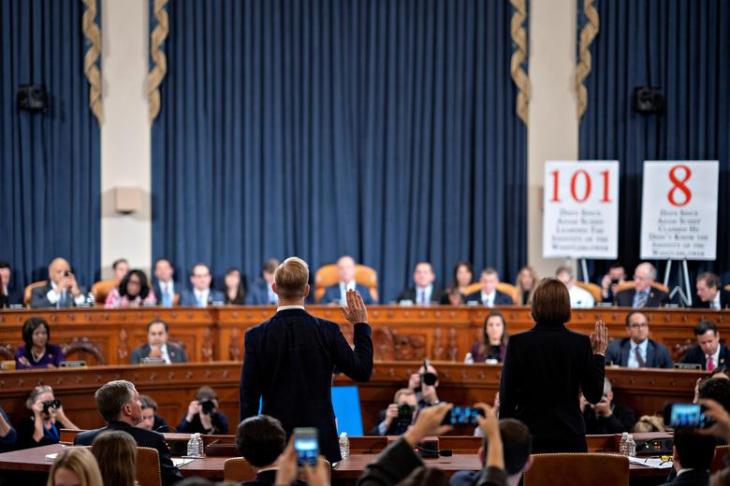
And, of course, some of our Congressional representatives who seemed unable to form rational questions or evaluate and respond to answers when grilling the brave civil servants who sat in front of them last week. Watching and listening, it was easy, over time, to see the obvious chasm between ‘just the facts’ (under oath) and ‘spin, baby, spin’ (not under oath). I kept asking myself: Who is impressed by the shouting, off-topic rants and left-field accusations?

Heather Cox Richardson answered:  Using my eye for propaganda techniques, they reminded me of nothing so much as being a talking head on a documentary. When producers are filming you in that situation, they very carefully ask questions to get a sound bite they can use. It seemed very clear to me that Jordan and Ratcliffe, and especially Nunes, were tangling the witnesses in questions designed to give the questioners short sound bites that they could then make into their own “documentaries.” They were salting the hearings with the language of conspiracies that people who don’t watch Fox cannot understand but which, in their sound bites, can be turned into a narrative that will misrepresent what was said and proven today, marketing it to True Believers who will then continue to support Trump and his party.

And then, as soon as they got their sound bites they would get up and leave.

What I was wondering: Can this ‘eye for propaganda’ be taught? Is it important that our students learn more than facts, timelines and skills? Can they be taught to assess value and truth in all their studies (and I don’t mean just their History, Civics and Government courses)?

Or will they be ripe targets for ‘contagious stories’—simple, emotionally self-validating explanations for current events and issues? Can flagrant lying be ignored or tolerated to maintain the peace, preserve the Republic? We are approaching ‘Germany in the 1930s’ territory here.

Stephen Sawchuk had a provocative piece with a great headline in Education Week: Students Are Really, Really Bad at Spotting Fake News, Misleading Websites. I don’t think it’s only students who are really, really bad—I think it’s the general population, distracted and trying to keep their heads above water, who are finding it hard to get at the truth. It’s all about where you get your news. There is, Sawchuk says:

…alarming evidence that a large majority of students are not well prepared to investigate sources of information for their accuracy, relevance, and quality. And despite more than a decade’s worth of policy chatter about media literacy, whatever schools have been doing doesn’t appear to have been enough to inoculate students against “fake” news. 

It’s doubly concerning given that there are now entire cable-news networks and partisan news sites built around presenting a skewed accounting of facts. Social media hasn’t helped: The atomized nature of online interactions makes it easy to share doctored or fake information. And increasingly, as another recent report coined it, “truth decay” is eroding the notion of objective facts: Americans can’t even agree on a set of basic facts that underpin their arguments or conclusions anymore.

Sawchuk gets this exactly right. I can’t think of a single thing more important, or relevant, in a liberal arts curriculum, K-12, than an investigation of the veracity of news sources. Or teaching kids how, Step One, to be deeply suspicious of pretty much anything that crosses their tiny screens.

It’s not just about sorting out the truthful, centrist sources, and identifying bias in sources. It’s about demonstrating how vulnerable we all are to stories that ring our emotional chimes. Especially kids.

Let me say that again: especially our students. We should be talking about this in schools.

Or else we’re going to end up with more captions like this In rollicking 53-minute conversation, Trump embraces conspiracies, spreads falsehoods and insults opponents—that make it sound like conspiracies, falsehoods and insults were somehow ‘rollicking’ (‘exuberantly lively; amusing’). I know better than to assign blame to the writer—headlines are added later and play by different rules.

But really. Isn’t it time we stopped laughing?

Can schools nurture civic engagement? I think so.

No time like the present.

download

Should a Cooperating Teacher Make Things More ‘Real’ for His Student Teacher?

Thought experiment: You’re a successful veteran male HS teacher, firing on all instructional cylinders. You take your first student teacher. Your classes this year are right where you want them—the students have begun to trust each other and their own ideas and skills. They’re functioning well. And now—you’re going to turn the teaching over to your young, female student teacher.

You think she’s not likely to have such cooperative classes in her first job. In fact, it took you some time to establish good classroom routines, but hey—that was a long time ago. If she teaches your classes, she might think all kids were that amenable and eager to learn. You ask colleagues for some ideas on how to make her student teaching experience more ‘realistic’—planted behavior problems, stump-the-teacher questions, other ideas to put her on the spot? You’re just trying to give her a taste of the challenges she’s likely to meet. Right?


Stop thinking. Experiment over. Your thoughts?

On the education-group Facebook page where I read a post like this—only not a thought experiment– it was heartening to notice that there were perhaps 50 comments and 45 of them were some variation of ‘what a terrible idea’ or ‘please don’t do this.’

Any student teacher is vulnerable, and tentative. She’ll naturally run into plenty of challenges, no matter how well-behaved the group. While your tips and advice are part of the experience of working with a novice teacher, setting her up for faux problems is not really ethical, dude. You’re supposed to be her guide.

And here’s another thing, something none of the first round of commenters mentioned: There might be a gender dynamic here, including some doubt about a young female teacher’s ability to control a class of high school students. How tempting to be the master teacher, stepping in to save the day, when students are subtly encouraged to relax behavior standards for the student teacher.

If this is beginning feel like a personal story, it is.

Back in the stone age, when I was student teaching, I spent the first two months reorganizing and cataloguing the school’s music library. I handled my cooperating teacher’s correspondence and wrote his monthly column for the band directors’ association. My only ‘teaching’ experience was working one-on-one with isolated students who were having difficulty with a musical passage and giving free flute lessons.

I observed the cooperating teacher work with ‘his’ bands for fourteen weeks, and there was never any spare time for me to direct any group—always a concert or festival coming up, and he wasn’t about to give up his rehearsal time.

Finally, the last week of my student teaching, I got up in front of the high school band, to conduct one piece. The cooperating teacher grabbed someone’s trumpet and started ‘playing student’—slouching, chewing gum, talking loudly. He asked questions he knew I couldn’t answer (Should I play that with an alternate fingering?) and made glaring mistakes. He acted like a jerk. The students laughed.

Any credibility I had with them was gone, in five minutes.

And then, in my final evaluation (which I typed up) he wrote: I think Nancy would be better suited to a position teaching elementary music.

Kind of ironic, since I never had any student teaching experience whatsoever in teaching elementary music. Having now taught music, PK-12, general, vocal and instrumental, I can say with confidence that all levels have challenges.

Cooperating teachers carry great weight in the development of a novice teacher. In my case, I learned what not to do. I learned not to be a bully (and there was a lot more bullying from the podium, back in the 1970s—it was a kind of badge of honor to some). I learned not to control students by fear and threats, but to instill cooperation by being authoritative but kind. I learned that the blood-and-thunder school of band directing was not for me—and I could still have top-notch bands.

And I accepted student teachers. I had a few over my 31 years in the music classroom—and they were all women.  Photo: the author as a first-year teacher.firstyr

What is ‘Quality’ Music? Choosing the Best Materials for Our Students.

Back in the day, when I was an early-career teacher, I was sitting at the judges’ lunch table, at a music festival. It was my first time serving as an adjudicator and the other judges were well-known veteran band directors. One of them was expounding on the poor literature choices made by young band directors. He claimed that identifying quality music was becoming a lost art, and that most newly published band music was ‘trash,’ especially compared to the pieces from the early days of school band programs.

It was out of my mouth before I had time to think: What is ‘quality’ music? How do we know it’s worthy?

His answer was mostly eye-rolling at the other men and sputtering—but he ended by saying that his sainted mother used to listen to country music on the radio, and even as a young lad he knew that it was pure garbage. Nobody was correcting him, by the way. Certainly not me.

I did, however, start thinking more about my own judgment in deciding what music would teach my students the most. I looked for appealing pieces that had some modest challenges embedded. I made some mistakes (buying pieces that were so static and repetitive that even the students were able to see how some music is, well, static and repetitive—and boring). But I also picked some winners, pieces I used again and again, music with some cultural depth or technical tests or simply tunes that the kids loved.

Were my curricular go-tos ‘quality’ music? What features, precisely, comprise quality? Is there a set canon of high-quality titles that should be in every library?

And–who gets to say what those works are, in any discipline? Choosing the best anything is a perennial exercise in taste and appraisal—and over time, the definition of ‘quality’ shifts.

English teachers want their students to read and interact with the most delicious texts. Social Studies teachers want to wrestle with relevant issues and science teachers want to engage their students with scientific solutions to existing real-world problems. What’s most useful and attractive now may not have existed 10 years ago.

I trust teachers to sieve through the Big Ideas and choose good concepts and materials. That’s not possible in many schools, however, where all curricular decisions are made above (if that’s the correct preposition) the classroom. Replacing materials also costs money.

There was a piece in Medium recently that got some deserved attention: Dinah, Put Down Your Horn: Blackface Minstrel Songs Don’t Belong in Music Class.  The gist? We need to take a look at the often-racist roots of some American ‘folk music.’

I read about the piece on an Elementary Music Teachers Facebook page. There was a long thread, discussing music that might have problematic origins. Were there ways to get around questionable lyrics while keeping a jaunty, familiar tune? There was a little disagreement—a couple of people upset by ‘political correctness’—but the large majority of the teachers participating thought the article had value in helping them improve their practice by ditching some songs long considered ‘classic.’

Many admitted that all this information was new—and surprising—to them; they could do better. There were comments about high school and college traditional/fight songs with racist roots or references.

I loved reading these conversations. These are questions that teachers should be discussing. Teachers are conscientious for the most part—they want to teach well. They will even occasionally be vulnerable, confessing that they don’t know how to handle a curriculum/instructional dilemma. This discourse supports genuine professional learning.

For music teachers, the next frontier might well be the dearth of music published for school musicians with female or non-white composers.

Composer Dale Trumbore said this:  Let’s talk about quality.

‘I program music based solely on quality.’ ‘I don’t think about race or gender when I program—only whether the music is good.’

This argument is fundamentally flawed. You’re programming based on the quality of music you’ve already heard. If you don’t regularly hear or seek out music by women or composers who aren’t white, their music will never make on to your programs. Lack of quality isn’t the issue here; unconscious programming is.

Is this a key issue for music teachers? It should be. For a dozen reasons—including our old benchmark: quality.

Recently, there was a revelation that a very well-known school band composer, a white man, had been publishing Asian-flavored pieces using a pseudonym that suggested he was a Japanese female. Eventually, he started feeling a bit queasy about the deception (or perhaps his publisher got tired of not having any PR information about ‘Keiko Yamada’). He publicly apologized and recalled all the inventory using his phony name.

The composer, Larry Clark, sat for a long and somewhat rambling interview with Jennifer Jolley, another female composer, explaining, sort of, why he originally chose to use a pseudonym. He is not entirely successful in this effort, although I am certain he now regrets the initial decision. Jolley holds his feet to the fire—it’s a wonderful, in-depth interview. Then she says:

The lingering effects of Clark/Yamada are to magnify the paranoia and cynicism too often experienced by underrepresented composers. It confirms the most extreme sense that the music world is an unfair system rigged in favor of the privileged. 

I think teachers of all subjects are interested in concepts and materials that show their students the system doesn’t have to be rigged in favor of the privileged—that there are things we all should know and can all appreciate. That curricular materials in all subjects can be authentic and inspiring.

I think I know quality materials when I hear and see them. I also think that our definition of curricular quality has to consider diversity and acknowledge change. Some items are evergreen. Others outlive their usefulness.

How do you define quality?

Kentucky

 Don’t Give Them Your Power

Here’s an eye-catching headline: Middle School Student On A Trip To DC Spat On A Black Person At The African American History Museum.

And the follow-up, somehow even more depressing: The principal of the Connecticut middle school said she did not believe the incident was racially motivated.

There’s more rationalizing, in the local paper. The principal is doing what principals do: trying to express that they’re just kids, prone to goofy adolescent misbehaviors, while explaining just how they’re going to sharply address this in school—assemblies, suspensions, whatever’s in the disciplinary toolbox.

But I’m with Greg Johnson, a local civil rights leader, who said ‘spitting in the museum — opened three years ago to highlight the contributions of African Americans and educating visitors about the history of slavery — was itself a racist act.’

As it happens, I visited the African American History Museum for the first time a few months ago, a road trip with two old friends who were also going for the first time. It was absolutely the best adult field trip ever—it’s a fantastic national resource (thinking like a teacher). And also, one tiny and way-overdue step toward recognizing the unsung economic and cultural contributions of the involuntary diaspora of African-Americans in the United States.

There was a lot to see, to appreciate and to learn. The viewing crowd that day was about 2/3 African American and 1/3 Other. There was a grandmother, wrapped in a colorful homemade afghan in her wheelchair, on a toasty June day–being pushed by an adult granddaughter, who dutifully read the posted copy at each showcase or exhibit. Grandma kept saying ‘Imagine that!’ and every time, her granddaughter rolled her eyes and smiled.

There was a young dad, tracking a wander-y five-year-old, simply telling the boy, at his own level, exactly what they were looking at—the maps, the model ships, the heavy, rusted tools of hard labor. The little boy ran ahead. There is a slave cabin, preserved, transported and rebuilt at the museum. Stepping into the doorway, Dad said ‘this is where one or two whole families of enslaved people lived.’ The boy did a 360-degree turnaround. ‘You kiddin’ me?’ he asked.

It was an amazing day. And then, emerging blinking from the core exhibit, a spiraling, detailed history of slavery, into a sunny atrium, we see them. A half-dozen white boys, middle-school aged –I have 30 years of knowing a middle school boy when I see one–coming down the three-story escalator wearing red MAGA caps. They are, astonishingly enough (or maybe not), accompanied by an adult man, also white, who seems cool with the hats.

People around us freeze, seeing them. A teenaged girl is practically snarling to a friend—Look at them! It’s SO disrespectful. They come HERE—in those hats! Her friend puts a hand on her arm.

Don’t give them your power, she says.

There were more kids in MAGA hats, later in the afternoon, gathering at an appointed spot to meet the bus. Their teachers were busy counting and corralling and wouldn’t have appreciated a question from a stranger: Why didn’t you tell your students to remove their hats? Did you tell them what they were going to see—and why a respectful attitude is required for all visitors to this museum?

Hey. I taught middle school for 30 years. I know that the rules and rationales for visiting this museum may have been hammered out by others, leaving the students’ teachers powerless. It’s better for young adolescents to have had this introductory experience than not.  And, true, 13 year-old boys frequently don’t have great judgment. But all that’s just weak sauce.

Students on any field trip need to be prepared, intellectually, for what they’re going to see or do–or the value of toting kids around to see interesting, meaningful places in the world is seriously diminished. Field trips—like all curricular decisions and activities—are based on the principle that taking students out of the building will make them better able to deal with the ideas and challenges of the real world.

And it’s always wrong to be disrespectful, on purpose, in the real world. Always.

In ‘White People are Broken’, Katherine Fugate shares a story about another museum, and still more white kids wearing MAGA hats, who are confronted by a young black man of the same age, who quietly explains to them that their hats make him uncomfortable. Fugate stands silently by the young man, hoping he will see her as an ally. The MAGA hat students are confused, saying it’s their country. It’s everyone’s country, he replies.

Occasionally, you can read columns–or comments–suggesting that teachers should stick strictly to transmitting factual disciplinary content and stay away from values. There is no such thing, however, as opening students’ flip-top heads and pouring in knowledge. All knowledge, skills and judgment are learned in context, through interaction and practice.

A lot of what is learned in school—and through school-based activities—isn’t ‘content,’ or ‘skills’, per se. It’s how the most important knowledge and skills are useless, unless they’re applicable to living. It’s how to be a thoughtful, curious, responsive person in this world. Or not.

Which means that wearing a MAGA hat in the African American Museum of History and Culture is not just a bad fashion choice. It is, instead, a hateful coded message. And spitting is not just an impulsive decision made by someone too young to know better. It’s an act of degradation, indefensible.

After all, it is truly everyone’s country. Make good choices, and don’t relinquish your power to hate.  AfAm Museum


Sweet Child of Mine

Like—one hopes—most Americans, I watch the ongoing story of children separated from their parents at our southern border with horror and sorrow. There will never be anything even approaching reconciliation or forgiveness for the despicable and shameful behavior of those whose hatred and fear of ‘the other’ drives policy enactment like this. My biggest worry is that, with all the other shocks and distractions we’re juggling in 2019, these children will fade into the background.

Last week, we learned that the number of separated and ‘lost’ children is higher than has been reported:  U.S. immigration authorities separated more than 1,500 children from their parents at the Mexico border early in the Trump administration, the ACLU said, bringing the total number of children separated since July 2017 to more than 5,400. Children from that period can be difficult to find because the government had inadequate tracking systems. Volunteers working with the ACLU are searching for some of them and their parents by going door-to-door in Guatemala and Honduras.

One facet of the story I follow even more closely: the very young children who have been recklessly and deliberately removed from their parents, resulting in ‘lost’ identification information, and are put in foster care here, and eventually even deemed eligible for adoption by American parents.

There have been any number of stories about children too young to speak for themselves winding up in places where their parents, who risked everything to bring them to what they hoped was safety, can no longer find or reach them. Often, these parents are not able to get appropriate help, and are deported, leaving children behind.

Bethany Christian Services, a Michigan-based non-profit that took a relatively large number of separated children into foster care over the past two years, has especially come under fire. I have seen memes and stories accusing Bethany (which has accepted donations from the DeVos Foundation for many years) of essentially stealing children for the benefit of white Christian couples who want to adopt.

I know a little about Bethany CS, because it’s the agency we used when we adopted our son Alex, now 31, from Korea. Ironically, we chose Bethany because they had such a good reputation for ensuring that adoptable children were fully available and duly relinquished by their biological parents.

We had heard horror stories about disrupted international adoptions, families who later learned that their adopted children were placed via coercion, or were babies ‘from nowhere,’ whose parentage couldn’t be traced at all. But not with Bethany.

Bethany was also a little pickier than other agencies—insisting on age limits for parents, a stay-at-home parent for the baby’s first six months in America (which we split, each of us taking three months), and a lengthy and rigorous home study process. The ‘Christian’ in their name didn’t really faze us, although we were not church members at that time. Like getting your life insurance from Lutheran Brotherhood, or putting your money in the Catholic Credit Union, it did not seem like a drawback in the international adoption process, which is plenty fraught.

Our caseworker from Bethany carefully guided us through all the steps—adoption, citizenship, and when Alex was 13, a whole-family trip to Korea, where we were able to sit down with a social worker and translator and read his entire file. We also had lunch with his diminutive foster mother, who spent the entire time patting his face and rolling up bulgogi in lettuce leaves for him to eat.

It was always clear to us just how fortunate we were to raise this young man, a gift to our family. Occasionally, low-information people would suggest that Korea was a backward nation and Alex was lucky to have us, but we always knew that wasn’t remotely true—and earnestly sought many opportunities (camps, cultural organizations and travel) to keep in touch with his remarkable heritage.

In the past few years, however—even before hateful border policies—I have become more and more aware of suspicion, even hostility, toward parents who choose international adoptions. Nicole Chung’s All You Can Ever Know filled in some of those blanks. I read more broadly today, including critiques of multi-cultural families built through international fostering and adoption. It’s not as simple as a child needing a home. I get that.

The situation at the border and Bethany Christian Services’ willingness to foster children who have been separated from their parents there put this into sharp focus.  Bethany’s policies about refusing adoptions to LGBTQ families (recently overturned) came under scrutiny. And there was a lot of finger-pointing toward the DeVos family, which has supported Bethany’s work for many years—not surprising, since DeVos charitable giving (and influencing) is everywhere in Grand Rapids, MI, where Bethany is also based. Snopes does a good job of tracking that money and answering other questions about Bethany: here.

I am not defending Bethany Christian Services—but I do hate to see blanket condemnation of international adoption. It’s also true that children should not be warehoused in cages—and that sheltering migrant children is a multi-million dollar business, prone to profiteering and abuse. This is a problem of our own making.

It’s hard to know, any more, where to draw the bright line between well-meaning people wanting to adopt children who need homes and outright, obvious human trafficking. Recently, evangelical Christians have been pushing families to adopt, as a way of demonstrating that they were willing to take care of the children who might otherwise have been aborted:

In 2007, national Christian leaders like celebrity pastor Rick Warren encouraged their followers to shift their focus from issues of “moral purity”—abortion, same-sex marriage, divorce—to something more positive: helping children in need. More than just “pro-life,” it would be a “whole life” response to the longstanding pro-choice challenge that Christians adopt all the children they wanted to be born. It would also be an extension of existing evangelical engagement with global development and health issues. Promoting adoption would help rebrand U.S. evangelicals, from moral scolds to children’s champions.

The premise of the movement was a particularly American response to global child poverty. It was based on the idea that the existence of somewhere between 143 and 210 million vulnerable children around the world—a number that also includes those who live with one parent or extended family, often in poor conditions—constituted an “orphan crisis,” but that there were also 2 billion Christians who could help. If just a fraction of those claiming to be Christians stepped up to adopt, the movement’s leaders argued, parentless and hungry children, as a category, would cease to exist. As one leader put it, the goal was to “get as many people in the church to adopt and adopt as many kids as you can.” 

I find this ominous. I’m the American parent of a child born in Asia, so you might think I would trust that American instincts and institutions for young children in crisis would be good ones. But I no longer have any confidence in ‘American’ ideals, after witnessing what’s happened at our own border.

Alex and Mom cropped

Should Teenage Trick or Treaters Go to Jail?

For 20 years, I lived in a subdivision in the heart of the school district where I was teaching. Halloween was a big deal—we’d get a couple hundred trick-or-treaters if the weather was nice. Many of them were my middle school students, or former students, now in high school. I bought a lot of candy. The good stuff.

I’d put speakers in an open window, and a spooky music playlist on my iPod (remember iPods?)—pieces that were part of my annual spooky-music lesson plan. The kid who asked ‘Is that Night on Bald Mountain?’ would get an extra piece of candy. And the boys who came for candy, left and switched costumes on the street, then came back—twice—got another piece both times and props for ingenuity.

I would dress up. This was easy—same costume every year—because my 8th grade students performed a Halloween-themed concert, and I was always the Wicked Witch of the Band Room.  It’s a perfect time of year for students with two years’ worth of playing experience to prepare a fun program, stretching their musical skills and knowledge.wickedwitch3

The students dressed in costumes. This was a hard sell for some of them, but they were assured that ‘costume’ could mean something very simple—perennially, there were boys in shoulder pads and football jersey, toting their euphoniums into the gym to play Danse Macabre.

My principals, over the decade we did this concert, were supportive—all school leaders love events that bring hundreds of happy parents into the building, especially when small children are welcome.

One principal was open to all students dressing in non-violent costumes when October 31 was a school day. This did not go down well with a subset of the faculty, who felt middle schoolers were too old for such nonsense and that costumes would be a major distraction to learning.

Are your students typically focused and quiet on Halloween? she asked. Well, no. So let’s let them be kids a little longer. Endorse a little good, clean fun in a safe space.

She was right. Halloween, once a neighborhood-based candy grab for little tots, has turned into a major commercial boondoggle with pop-up stores, sexy whatever costumes and a lot of serial-zombie blood and gore.

Telling seventh graders that they’re too old for all the fun and have to stay in the house and do their math homework isn’t likely to change their minds about anything. And just try to keep your HS sophomore home if their friends are out creating minor-league mayhem. Better they should be in their own neighborhoods, toting pillowcases full of loot, or at parties where there’s a parent upstairs.

So how old is too old?

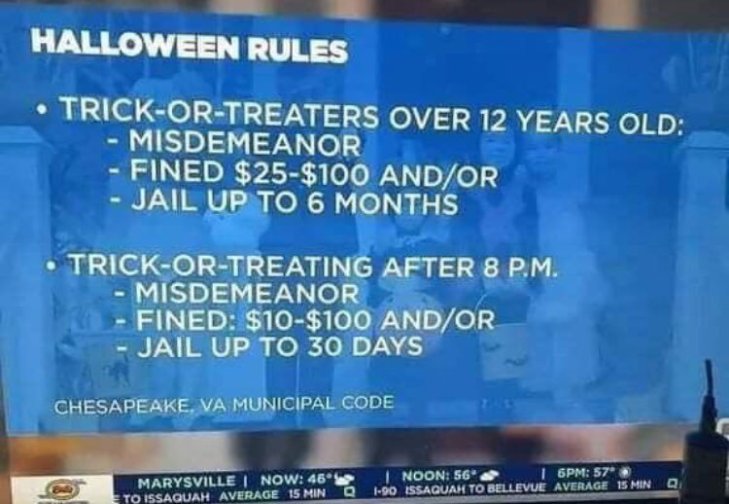
Chesapeake, Virginia says 13 is the age when trick-or-treaters should be fined or sent to jail, for up to six months. No, really. And if you’re out at 8:05 p.m., it’s a misdemeanor.

I don’t know who made up these rules in Chesapeake, but good luck enforcing them.

And pass me another fun-sized Snickers.

EHa28SvW4AAv44c