Blinded by ‘Science’

At a moment when half of our elected officials are resisting Political Science as means of preserving democracy, or Climate Science as a resource for, say, saving the planet, it must be reassuring to some that the Education field, at least, seems to be pursuing Science these days. Aggressively.

Science standards this and scientific method that and exponential STEM everywhere. Because jobs.

Except—that’s not really the case. Currently, the top ten job opportunities in STEM fields are all in the T part of STEM, and there’s actually not much call for biochemists (and not a lot of money to be made, either). In fact, there are 10 times as many graduates in the life sciences as there are jobs. You can teach, of course, but—the party line is that a STEM degree will take you away from pedestrian careers like teaching into the glamorous world of lab coats and bubbling test tubes.

And speaking of…the ‘science of reading’ has bubbled up, again. If you’ve been paying attention, you’ll know that mainstream media is now eagerly printing pieces claiming that we have known all along, for decades, how to teach reading—that it’s ‘settled science.’ For some reason, these articles claim, benighted teachers everywhere have either not adopted this one sure-fire method, or more likely, their university training did not include scientific reading pedagogy.

Those teachers! Those colleges! When will they accept Science and teach all children to read the same way?

More than enough digital ink has been squandered on the Reading Wars (and accompanying smackdowns of the hard-won expertise of veteran early childhood teachers with actual students)—but this focus on Science is a new twist. No more book whisperers, personal literacy journeys or other soft terms of art. Bring on the scientific worksheets!

Insistent nudging of reading teachers toward Science pales in comparison to Ulrich Boser’s recent headline in the Education Post: It’s Time to Help Teachers Discover the Science Behind How Kids Learn.  Boser, according to his bio, is a Senior Fellow, a Founder, a Founding Director, an author and Not a Teacher.

I seldom read anything on Education Post but was drawn to the title, and Boser’s opening statement:  We recently surveyed around 200 K-12 educators from across the U.S. to discover their beliefs about learning. The results were not good—and say a lot about the nation’s system of training educators. 

Whoa. The nation’s teachers and those who train them, cut down in one sweep, by Science.

Now, I’m no scientist but it seems like the thoughts of 200 (out of nearly 4 million) teachers, captured by a survey, might not be the most valid and reliable evidence, but hey– I learned to read via the look-say method, so what do I know?

I went to Ed School in the 1970s, and back then, we all took classes on learning theory and educational psychology—the science behind how kids learn. I don’t remember a great deal—they were always textbook/lecture/test courses (there’s some irony in that).

But I remember covering Plato, Bruner, Vygotsky, Piaget, all the biggies. We learned about Skinner and behaviorism—operant conditioning was all the rage in the 1970s classroom—but that never worked as it was supposed to in my classroom.

I would venture to guess that most experienced teachers remember fragments of learning theory, adapted and applied to what has actually happened in their daily practice. They know, for example, that there is a sweet spot in learning—what Vygotsky called the zone of proximal development—where new learning is both achievable and challenging. I personally know that prior learning—the gestalt–matters a great deal. I learned this when I began teaching beginning band to kids who’d never had elementary music and couldn’t match pitches or keep a steady beat.

Boser makes a lot of claims, beginning with the ever-popular ‘Teachers (97% of them, he says) believe in learning styles but they don’t exist! So there!’ You have to ask yourself this question: If it is true that 97% of teachers believe there is some prima facie validity to learning styles, based on their lying eyes, what exactly are they missing?

He provides lots of statistics-based examples of teachers’ intellectual failures and misunderstandings, then Boser hits us with this:  The overall picture suggests that teachers have weak overall knowledge about learning principles. Out of 17 questions related to learning myths and research-supported teaching strategies, respondents performed only slightly better than chance. Respondents got 8.34 questions correct on average—random guessing would give an average response rate of 6.63.

Boser doesn’t have to spell it out any more plainly. Teachers be dumb.

Having set up a giant straw man of an entire professions’ scientific ignorance, Ulrich Boser tells us what we can do about this dire situation. You guessed it—we can get teachers some professional help. Or, as Boser memorably says: How can we create a learning engineering agenda?

Just so happens that he’s the Founding Director of The Learning Agency (‘Part consultancy, part service provider, part communications firm, the Learning Agency’s difference is the science of expertise’). Also: he did a TED talk.

What about the professional development that teachers routinely get, provided by their schools? Isn’t that supposed to be research-based?  Teachers in Boser’s survey claimed they got their updated knowledge about teaching from workshops, conferences, school-mandated professional development and colleagues, which sounds about right to me.

Boser, however, feels that ‘leading teacher training materials’ featured an ‘astounding lack of science’ and working collaboratively with colleagues merely leads to ‘anecdotal’ sharing, not (yup) ‘hard science.’

I once worked with a second-career teacher who had been a chemist in a large, multinational corporation for 25 years, but wanted to get out of the rat race and be a teacher (his words) at the end of his work life. He did a year-long, night-courses teacher certification program at a four-year university, and a semester of student teaching, for the tradeoff of more satisfying work at a lower salary. He wanted to ‘give back.’

He had no trouble getting a job teaching Chemistry in a suburban school. The principal was thrilled to get a real, live chemist with applied scientific expertise. I was his e-mentor.

When he arrived at school in August, he was shocked to find that he’d been assigned four hours of Chemistry and one hour of AP Chemistry. They were two different courses! Twice as much preparation—and by the way, school was starting, and nobody had given him any lesson plans. I told him to be prepared to create his own lesson plans. Another shock.

We’d never do anything like this at Big Multinational, he said. Why would every teacher create new lesson plans? That wasn’t efficient.

Because, I said, you haven’t met your students yet. You don’t know what they know or what they need now. You’ll be tailoring and tinkering with your plans all year long—and ask the other Chemistry teacher for advice before you start writing.

Would all teachers benefit from a more scientific approach to teaching and learning? Or should they just go on collaborating, sharing ideas with colleagues and field-testing their own methods and strategies, building a practice around their own observations?

Ask a teacher.
71vLzRiLFhL._SS500_

Who Cares about Knowledge—or the Public Good?

I have to start with a confession: I am a PhD dropout.

After 31 years of teaching mostly secondary Instrumental Music, with brief forays into 7th grade math, English as a Second Language, a Gifted Student pull-out program, and random K-12 music courses (which I was actually qualified to teach), I decided to pursue a PhD in Education Policy when I retired.

I wanted to study education policy intensively. I was tired of being the object of education policy and wanted to be a partner in creating that policy.

I wanted to learn everything I could about where the power levers were and figure out how we found ourselves—a wealthy, democratic society which generated the unique idea of a free, high-quality common school for all children—in a such a muddle.

Why I didn’t finish my terminal degree is a subject for a later column–but I genuinely loved all the coursework, especially digging deep into the purposes and history of public education. The single most impressive researcher and thinker I read was David Labaree. His piece, ‘Public Goods, Private Goods: The American Struggle Over Educational Goals’ made more sense to me than any of the hundreds of books, chapters, monographs and articles I read, reviewed and analyzed in white papers.  From the abstract:

This article explores three alternative goals for American education that have been at the root of educational conflicts over the years: democratic equality (schools should focus on preparing citizens), social efficiency (they should focus on training workers) and social mobility (they should prepare individuals to compete for social positions). These goals represent, respectively, the educational perspective of the citizen, the taxpayer and the consumer. Whereas the first two look on education as a public good, the third sees it as a private good… [T]he growing domination of the social mobility goal has reshaped education into a commodity for the purposes of status attainment and has elevated the pursuit of credentials over the acquisition of knowledge.
American Educational Research Journal,                                                                                        Spring, 1997, Vol. 34, No. 1, pp. 39-81.

Written over 20 years ago, before No Child Left Behind, before the monolithic Common Core State (sic) Standards, just as charter schools and whiz-bang classroom technologies were getting a toehold in the national imagination, Labaree provides a durable analysis of what we could lose (democratic equality) and what we could gain (the hot pursuit of credentials over the acquisition of knowledge) if we weren’t careful.

I re-read the piece every year or so, and damned if it isn’t still accurately evaluating our educational choices and outcomes. We don’t hear, anymore, about the melting pot, the rich townie and the poor farm boy rubbing elbows for the greater civic good of genuine opportunity. And when an articulate bartender, also seeking opportunity, gets elected to Congress, there’s a target on her back.

Today, we watch educators hold teach-ins at the southern border, as children are separated from their parents and put in cages. Hollywood celebrities buy test scores and slots in the most prestigious universities.  Social studies are the ugly stepchild in our STEM-focused, credential-driven world.

Labaree was prescient: Who cares about knowledge—or the public good?

Evidently, some (admirable) people do—and they also care about civic engagement and strengthening democracy. There is a movement to revise the traditional three-branches-of-government Civics curriculum by engaging students in the real work of democracy. From Andrea Gabor:

Civics fell victim to the narrowing of curricula under both Presidents George W. Bush and Barack Obama, and to the standardized testing regimen that focused on math, science and English. Worried about economic competition from China, neither Democrats nor Republicans anticipated the recent populist and authoritarian threat to Western democracies that civics education is meant to forestall. The reality is, schools need to do both: prepare students for a global economy and to be engaged citizens in a democracy.

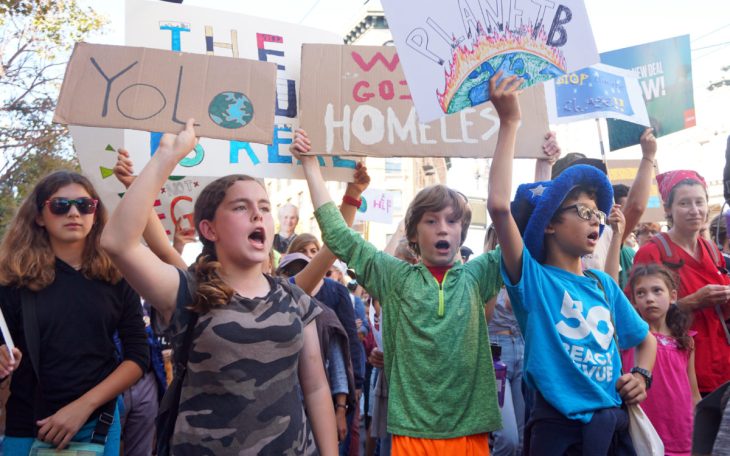
The day after a successful student-led Climate Strike is a great time to be discussing this—and Gabor runs down a list of other projects, large and small, where students have provided action leadership, in addition to traditional ‘school’ tasks, like presentations and papers.

A telling fact: educators driving this project have fears about our now-embedded belief that only tests can reveal student learning. This headline says it all: Could Testing Wreck Civics Education?

It’s a thrilling idea, though, at the intersection of political power and scholarship: Students, encouraged by their Civics teachers, use their new-found knowledge and passion to address issues that have been mired in legislative concrete and acrimony for decades.

Labaree is still writing, bemoaning our love affair with easily imposed standardization and structures rather than investing in the potential of individual children:

Erratic funding, poorly prepared teachers, high turnover, dated textbooks – all of these may impede the socially efficient outcomes of education, but they do not prevent reformers from putting in place the central structure of social efficiency in the school system: a tracked curriculum organized around the idea of education for work. 

This is the central rationale around what education policy has become: Education is work training (and all that implies—compliance, duty, relinquishing power in exchange for a wage, and basic, replicable skills replacing human judgment and creativity). Those who have purchased the right credentials will have other options.

Andrea Gabor slips this into her piece quietly, but it’s the central point here: neither Democrats nor Republicans anticipated the recent populist and authoritarian threat to Western democracies. Once education has been devoted entirely to sustaining the economy, it’s no longer a threat to those currently in power.

Climate-strike-1-1200x750

Why Don’t Democratic Presidential Candidates Talk about Charter Schools?

I was chatting with a group of women last month about the presidential race. All of these women identify as Democrats, and all of them are eager to off-load the current resident of the White House.  We meet monthly, to discuss a current topic, and lately, have closed our gathering by checking in with our current favorites among the candidates. Cory Booker’s name came up.

There was admiration for his smooth, polished presence and rhetoric at debates and on news shows. He was doing well in the debates—and maybe could stand up to Trump, make him look foolish. I interrupted the happy talk: His record on education is terrible. He’s an avowed charter school supporter who nearly destroyed the Newark Public Schools. He’s a big fan of school choice, even vouchers.

I looked around the table at a lot of blank faces. One voice spoke up: So? Why is that so bad?

And then I realized. These women—lovely, principled, left-leaning women—haven’t been fighting the education policy wars for years. One has a grandchild in a charter school.  They want good schools for all kids, but they’re agnostic about alternate school governance. Even a local charter founder spending 41 months in federal prison for tax evasion, having improperly handling millions of public dollars in his quest to establish a lucrative charter chain, didn’t really have much of an impact. That school remains open, drawing over 1000 students from local public districts.

Me? I believe charter schools have done untold damage to public education, and I’ve had twenty years to observe the public money/private management ideology establish itself in Michigan. First, a scattering of alternative-idea boutique schools, another ‘choice’ for picky parents. Then they go after the low-hanging fruit, the schools in deep poverty—and then the healthier districts.  There is now agreement with an idea once unthinkable in America: corporations have a “right” to advertise and sell education, using our tax dollars.

So—no, I cannot be agnostic. In the end, I’d like to see charter schools go away, one at a time, forever, because mountains of evidence have proven that they’re ripe for fraud and malpractice, and because there are far better public-school options, in every city and neighborhood. I think that’s preferable to trying to extinguish or ban charter schools outright—although ending all federal financial support for charters is Step One. That will necessitate a new Secretary of Education. The rest will mean changing hearts and minds—a long, slow process.

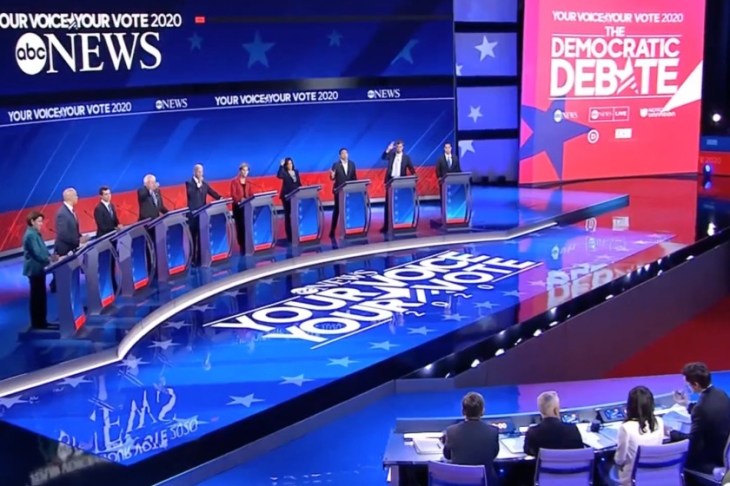
Which is why I’m not surprised that most Democratic candidates have not made bold proclamations about charter schools. In the Democratic debate Thursday night, Andrew Yang—a long-time, vocal charter supporter– was the first candidate to field a question about charter schools, a barbed inquiry that also incorporated Yang’s negative comments about teacher unions.

Yang dissembled with a series of talking points all viewers are likely to agree with—we need to pay teachers more and stop focusing on standardized tests, blah blah. When the question was tossed to Booker, he—surprise!—did the same, burying his long-time pro-charter viewpoints under a flurry of unsubstantiated claims of amazing, transformative success in Newark—his own personal fake news.

Aside from Julien Castro’s remark that charter schools were not better than public schools, a truth that a fair segment of America does not recognize, having been subject to media campaigns saying just the opposite, the rest of the candidates steered clear of the charter question. Lots of them said the right stuff about education, from pre-school and HBCUs, to teacher pay and college loans. But even Bernie Sanders, whose comprehensive platform is openly anti-charter, was mum on charters.

I know why we’re not hearing a lot about charters. Approximately six percent of American schoolchildren attend charter schools. It’s not just Betsy DeVos who’s cheerleading for charters—the Obama administration was charter-friendly. Charter school parents are voters. Charter school policies are made at the state level, and unlike Donald Trump, most Democratic candidates seem to have a clear grasp of the idea that they can’t shut down charter schools, en masse, with a stroke of their Sharpie, should they become President.

For many progressive-side parents, charter schools are a fringe issue. They might live in a state where there aren’t enough charters to change the public-school ecology. Or—they know a family that’s happy with their charter school. Or they’re laboring under the decades-old illusion that schools are locally controlled, and nothing will ever happen to destabilize their public school system.

Asked why they send their children to a charter school, parents in my town talked about things like the young, enthusiastic teachers, the brand-new building, and—uniforms.

Charter teachers are young because there’s a great deal of turnover there; spanking new graduates often can’t get jobs in public schools because staff and programs are being cut, so they turn to charters for employment. That impressive new charter building is entangled in financial malfeasance (with my tax money).  And why aren’t parents more interested in the curriculum, programming and school climate, rather than plaid jumpers and polo shirts? Who knows.

Our citizenry is trained in consumerism—promoting education as just another choice to be made was easy, like FedEx or Blackwater instead of the USPS or the US military. Got a problem with the local public school? Don’t invest your time and money in fixing what’s already there. Pick a new school! It’s the American way.

Education is my issue, but charters are a mere slice of a bigger pie. It was gratifying to simply hear candidates talk about education on the stage. Here’s what I would like to hear from a candidate:

Let’s invest more in fully public education—the kind that’s community-based and has elected oversight. Let’s acknowledge the places where it has crumbled and rebuild them, instead of abandoning them. Let’s work toward more economically and ethnically diverse schools, making them places where building an informed citizenry and developing individual talents—not test scores—are our highest goals.

Did I try to change the minds of my friends? Yes, of course. I told them that Cory Booker palled around with Betsy DeVos. They’re long-time Michiganders, and that was all it took.

download

About That School with the Shooter-Resistant Curved Walls

It’s been all over the news—state and national—recently: Fruitport Community Schools, in Muskegon, Michigan are building a new, state-of-the-art high school addition and revamp, designed to thwart an active shooter. There are curved hallways, and ‘wings’ (protrusions with no structural purpose) to disrupt sight-lines. There are hidey-holes all over the place, in halls and classrooms, special impact-resistant glass, and deluxe alarm and lockdown systems. You can do a walk-through with Kate Snow and the school district’s superintendent, Bob Szymoniak, here.

Feedback on this has generally been negative— a ‘What is this world coming to?’ response. The sub-head in the Daily Mail reads:  School officials in Fruitport, Michigan, spent $48 million to make sure the school would provide greater safety in a catastrophe.

But that’s not precisely true. Voters in the Fruitport district had to approve a tax bond issue for that $48 million—and in Michigan, bond issue money can only be used for buildings and equipment. If schools want to improve staffing, instruction or curriculum or offer special courses, they can only use the state-provided per-pupil grants. (Michigan uses a complex and unusual formula to fund schools, not based on property taxes.)

Michigan also offers district-to-district school choice. If a school in Muskegon wants to offer something special to act as magnet, to bring students outside Fruitport boundaries to that particular school (and capture more per-pupil grants), their options are limited to things that can be bonded by taxpayer vote.

The people of Fruitport voted yes on a $51 million bond issue in 2016 by 180 votes out of 9100 cast, the slimmest of margins. There were failing bond issues in previous years—and the school genuinely needed to add space, update all the buildings in the district and replace buses.

Perhaps the headline should read: School officials spent $48 million on better schools for Fruitport students, including many innovative safety features that other schools don’t have. Subtext: So, if you’re shopping for a super-safe school in these times, if that’s your bottom line, why not send your high school student to Fruitport?

I should mention that I am familiar with this district. Children I love go to school there. I have been treated to their first days of school, last week, via photos and videos. They are happy campers. Their parents, who also attended Fruitport schools, are happy that there’s a new(ish) high school for their little ones, down the road. They are happy that the bond issue passed, finally. Strong communities are built when people pitch in and agree to invest in children.

I see the Superintendent acting as a kind of carnival barker, whether he likes this part of his job or not. I’m sure it can’t be comfortable to advertise your school as where parents want their kids to be, should an active shooter come to town. I would like to think that any school superintendent would rather be promoting the outstanding drama or music program, the elementary libraries and playgrounds, the 15:1 teacher-student ratio. But those things are dependent on operational monies.

School superintendents tend to be evaluated in the long-term not by program enrichment, however, but by tangible results: buildings built, money saved, test scores. When my school opened a new building, the superintendent spent the whole first year doing what Szymoniak did: showing off its innovative features in a series of tours. He saw it as his legacy.

There are things about this flurry of attention that really bother me. The first is that anyone who actually did want to go on a rampage at Fruitport HS has now been given a floorplan and a visual tour of exactly where students might be hiding. It’s worth remembering that Marjorie Stoneman Douglas HS in Parkland, FL had a new security system, armed guards and practice drills, and the students at Sandy Hook lost their lives when the school secretary recognized the shooter and let him in. Both of those killers knew the buildings where the carnage happened.

The second thing is that eliminating clear sight lines makes hallway supervision—a job that falls to teachers and school leaders—far more difficult. Ask any teacher to tell you where students looking for a bit of illicit privacy congregate—that dark stairwell, the science supply closet, the cornfields behind the football stadium.

In the brand-new school where I taught, architects dedicated a large chunk of square footage to a ‘kiva’—a large, circular, open space in the center of the building that had no specific instructional purpose. It was cool looking, but teachers had to get into the center of the room to see who was in there. The staff quickly started calling it ‘Plaza del Tardy.’ But it was the first place that visitors to the new building were taken.

In every article and video about Fruitport HS—and there are dozens—someone says something like ‘You can’t prevent a school shooting with building design, but…’ But perhaps we can save a few lives. Perhaps we can give students a few more seconds to find safety. Perhaps we can reduce harm. Nobody talks about personal relationships or times when a courageous staff member steps forward to talk down a shooter.

In fact, the Fruitport superintendent says this: “Until we can figure out how to stop this (shootings in schools), we’ve got to do something.”  

Perhaps the answer to that dilemma is hiding in plain sight.

24237346-standard


Parents Organize Online to Pressure Schools and Get Rid of Bad Teachers

So there it was, right out in the Twitter open:
Public school parents et al: What if we could use a site like Blind to chat anonymously with other parents at our kids’ school, share concerns and complaints, including about bad teachers, and organize to pressure administrators to do something about it?    @MichaelPetrilli

Appropriately, the very first (polite) comment came from a teacher:

Are you being facetious? @IngridFournier

And…no, no he wasn’t. It’s really frustrating, Petrilli says, to see all the things that are wrong in his child’s public school, and not be able to do anything about it. That weak principal! Etc., etc.

There followed a long string of mostly coherent tweets, centered around salient points: You don’t need an app for that, plenty of ways to form groups. Anonymous chats tend to go sideways, sometimes direly so, and anonymous kvetching solves nothing. This kind of thing is a security/data-sharing nightmare, technologically—especially when you have no idea to whom you’re speaking, online.

That devolved into union-bashing and ‘my kid has a bad math teacher,’ precisely the kind of thing you’d expect to see on the Blind app that Petrilli proposes, only now it’s on Twitter, open to the entire low-information universe.

Petrilli has started further Twitter threads to explore this idea—which is hardly innovative—and, evidently, generate more complaints about public school leadership’s non-responsiveness. He seems impervious to the numerous tweets from teachers asking how unsigned, anger-fueled critiques improve ANYTHING in public education. Especially on the first day of school.

A couple of years ago, I was facilitating a graduate-level course in teacher leadership online. Because we’d had some serious ease-of-use issues with the Blackboard platform, we decided to try a closed, private Facebook page for threaded discussions.

I was surprised by the number of teachers in the class who were reluctant or flat-out unwilling to use Facebook—they had emphatically decided not to participate, at all, in any of the more common social media platforms.

Their schools blocked Facebook and Twitter (and often, other sites where required readings were found), for starters. They pointed out that even if access to the online discussion was password-protected and strictly limited to registered participants, course members from other school districts could copy and share things they wrote on a Facebook page—so nobody could be truly honest in online conversations. Social media discourse seemed both personally dangerous and academically lightweight.

I think this speaks more to where hard-working teachers find themselves today than to the relative merits of a technological platform: Watch your back. Keep your nose clean.

So much for the courage and autonomy underlying authentic teacher leadership.

Commenters on Petrilli’s Twitter thread suggested, wisely, that the place for genuine school improvement might be face to face meetings—the PTA, or another parent group. Instead of organizing in secrecy outside the school, prohibiting administrative access to the conversation–features Petrilli was promoting– why not show up with other parents and try to address a common issue of concern?

That, of course, would be a lot of work, and involve building personal relationships toward a specific goal. It would mean time spent in developing trust, time that many working parents don’t have. Plus–not all principals would welcome, say, a ‘Fix the Math Curriculum’ parent advocacy group. For all our talk about welcoming parents and the essential home-school partnership, we seldom invite parents into our professional work: curriculum, instruction, assessment and classroom management.

There are reasons why: Student privacy. State and local policies. The time and challenges involved in explaining every instructional decision. These things, after all, have traditionally been in the teacher’s purview—but few parents realize how much decision-making power has been handed over to federal and state guidelines.

Still—there has to be a real outlet for parent input on substantive issues. A lot of things parents think they want and need for their children, in my experience, fall into the category of ‘fond memories.’ Where are the textbooks, with their nice columns of information, words to copy and look up, and questions at the end of the chapter? Why don’t kids play dodgeball in P.E. anymore? What do you mean there won’t be spelling tests on Friday?

It can be exhausting to explain why you’re making certain choices.  I was fortunate enough, in the pre-app era, to have a Band Boosters group, with 50-odd parents, that met a half-dozen times per year. It was the place where I defended my teaching decisions to the most involved families, face to face. It wasn’t always easy. I once got into a heated discussion with a school board member’s wife about—get this—spats for the marching band, that resulted in her walking out of the meeting in a fury.

Sometimes, I had to change course. But—whatever was being said about me and my program and my capacity as a teacher (including my decision not to wear spats) was said to my face and witnessed by the most important stakeholders: moms and dads.

Ironically—and again, this is just my experience, and not research—I have found public schools much more open to honest feedback than private or charter schools. One of my two children went to high school at a competitive-admission, all-girls Catholic academy. The school was run by a mothers’ group that met exclusively on Tuesday mornings when working parents could not attend. Many of the mothers were alumni of the school; they controlled hiring, shaped the curriculum and set policy. Their daughters were the obvious beneficiaries, in dozens of ways.

Petrilli is wrong in assuming that all public schools don’t listen to parents, but still seems to be at work developing his secret app to take down school system where his children are, presumably, reading and writing and playing on the monkey bars this morning.

The last word goes to @IngridFournier, the first teacher to respond to Petrilli’s mean-spirited tweet: Imagine if this was dedicated to developing best ways to support the teachers who are working hard, getting it right, and making a positive impact on your child’s life. Such a shame to see the energy used to bring folks down. #exhausted

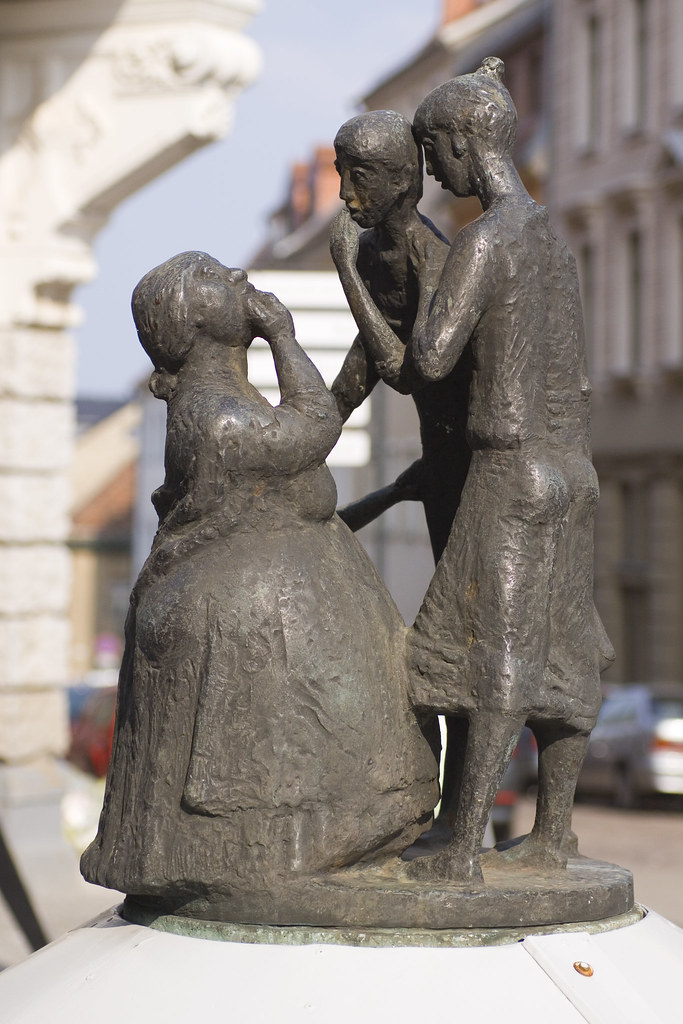
Freiberg, Klatschweiberbrunnen

How Much of Your Formal Education Still Lives in You?

Education is what remains after one has forgotten what one has learned in school.     Albert Einstein

It was a Facebook post that started the conversation—a photo, taken at the Chicago Institute of the Arts by my good friend Kirk Taylor.  Kirk and I taught together for 25+ years, and he was my children’s 8th grade English teacher. The photograph features pointillist painter Georges-Pierre Seurat’s ‘A Sunday on La Grande Jatte,’ surrounded by viewers.

The post had been up less than a day, and already more than 30 of Taylor’s students—and a handful of parents and teaching colleagues– had commented, mostly things like: I love that painting! Sunday in the Park with George! Dot dot dot!

There were also heartfelt messages of thanks from these former students, now adults, for Mr. Taylor’s role in shaping their appreciation of art and music, opening doors to worlds they never considered, the impact he’s had on their lives and career choices. Taylor’s inspired, hand-crafted curriculum changed continuously over the years and included visits to the Detroit Institute of the Arts and the Holocaust Memorial Center as well as student publications, dramatic productions and media analysis.

Midway down the thread, Taylor wrote this:

For those of my former students who studied and enjoyed Seurat’s “A Sunday on La Grande Jatte” and the Sondheim musical, “Sunday in the Park with George,” know that in 2018, the chances of a teacher doing that project are one trillion times zero.

Today’s curricula tend to be totally scripted with little or no room for a teacher to bring his or her appropriate interests and talents into the classroom. What I did way back when would seem a stretch to most in education—both then and now—but consider your takeaway. How much of your formal education have you forgotten, and how much still lives within you and inspires you?

That comment drew forty responses—anger, sorrow, recognition of the fact that public education has changed, radically, and not for the better. Taylor is retired, after some 40 years in the classroom. Things change. But the reverse question to educators remains, ever relevant, and especially timely at the beginning of the school year:

What things are you teaching and nurturing because they will be remembered for life, not because they’re required in the curriculum you’re assigned to teach?

Because nearly every teacher in the United States has been impacted by the Common Core, or their states’ versions of the Common Core and other disciplinary standards, it’s worth wondering about how much mandated content represents knowledge and skills that students will utilize for purposes other than measurement.

What will they need to know when they graduate? What will they need to know when they’re 40 years old? What will they remember?

The whole accountability package—standards, aligned curricular materials, measuring success by test scores—was supposed to improve public education. We would get rid of the so-called ‘incoherent cafeteria curriculum’ that was in place when Kirk and I were young teachers and replace it with ‘high and rigorous,’ tightly controlled standards of learning.

We’ve certainly had enough time—a full K-12 cycle—to see if holding people ‘accountable’ for pre-determined curricula made any difference in test scores. Not so much, it turns out.

What would happen if teachers everywhere felt as free as Kirk did to custom-fit curriculum to their students’ wide-ranging interests and passions? And what happens when teachers base curriculum on their own unique interests?

I’m thinking here about a friend who taught the Civil War battle by battle, building model ramparts and hillocks, and drawing what looked like football plays on the whiteboard—‘and then, the Rebs came streaming over the hill, here, taking the Union entirely by surprise, here…’ One day, he looked up and saw that about 20% of his class was interested (all boys) and the rest of the class had checked out until test time. As he tells the story, it was a startling moment—and made him re-think the way he taught all his History courses.

Quoting Paul Simon: When I think back on all the crap I learned in high school, it’s a wonder I can think at all.  What did YOU learn in school that has been useful and memorable? What was eminently forgettable? What’s the ratio of inspiring stuff to educational drivel—and has that changed?

sunday-afternoon-island-la-grande-jatte-123_2780

Not Funding Schools or Paying Teachers? That’s a ‘You Problem’, Right?

In the school district next to mine—and where I live, all the schools are small and rural—there was an unpaid collective lunch debt in June. As a goodwill gesture, a local craft brewery paid off the debt, $2700, so all the students in Suttons Bay will start the year with a clean slate. There are about 525 kids, PK-12, in the district and roughly half of them meet qualifications for free or reduced lunch.

According to Realtor.Com, the median price of homes for sale in Suttons Bay is $454,000.

You can get a pretty nice house for $450K, almost anywhere in the Midwest. So why are there so many kids on free and reduced lunch in the school district? You can get a hint by noting that the young man who suggested The Mitten Brewing Company pay off students’ lunch debt is both bartender at The Mitten and substitute teacher in Suttons Bay.

There’s poverty in paradise, as Bridge Magazine revealed in a startling series of articles. There are people supporting families on three or four patched-together jobs, often in industries serving the older, wealthier residents in those gorgeous lakefront homes. Lots of those hard-working people have college degrees—the thing that was supposed to keep them ahead of the pack—and student loans.

You could see this as repellent conservative motormouth Ben Shapiro does:

Well, the fact is if you had to work more than one job to have a roof over your head or food on the table, you probably shouldn’t have taken the job that’s not paying you enough. That’d be a you problem.

Does Ben Shapiro think that teachers in Suttons Bay (where the average pay is just north of $50K) have a You problem by accepting a job where they are willing to sacrifice personal well-being in order to teach children? Since the national average pay for teachers is about $60K, and teachers in MS, WV and OK are working for much, much less—does that mean that starry-eyed public school teachers shouldn’t take these shitty jobs, period?

Reading comments on the article about The Mitten paying off the lunch debt, it’s easy to understand that our current local social milieu is not terribly compassionate when it comes to feeding kids a nutritious meal while they’re at school. While the Suttons Bay district feeds everyone, whether they have money or not, commenters seemed to feel that lunch debts were most definitely a You problem—or, rather, a Them problem, with Them being irresponsible seven-year old freeloaders sucking up hot dogs, beans and canned peaches. Not to mention milk.

Pay off their debt now, and they’ll just expect you to do it next year! And slide me another $7 craft beer, OK?

It’s confusing, sorting through the right way to think about this. There are nearby districts that give every child a free breakfast and lunch, rather than try to sort through paperwork poverty credentials or label students. Good for them. And what about teachers who essentially beg for the auxiliary supplies that will make their classrooms more homelike, fun and effective, through #clearthelist or Donors Choose?

Do we hold out until the district gives us everything we want or need? Or do we patch together three or four supplementary strategies to build an engaging teaching practice and a comfortable classroom, relying on our second job to make the car payment for the long commute, when housing in our price range is not available?

Well. I generally find that educators who righteously stand on principle—i.e., the public should pay for public education—are teaching in districts that are relatively well off, and in subjects that are tested and therefore not likely to be eliminated in the next round of budget cuts.

I spent 30 years teaching instrumental music in a suburban school. I did fund-raising every single one of those years to keep the program alive and flourishing. With the help of legions of enthusiastic parents, we bought instruments and music and sent students on out-of-state and international travel experiences. The program was threatened every time there was a budget shortfall, but it never died, because of parent support.

Should public schools pay for everything, from French toast sticks to beakers for the chemistry lab? Unequivocally. Should all public-school teachers make $60K, minimum? Absolutely.

The question is what to do until that happens—and who suffers when the charity and fund-raising end.

We know the answer to that. And we know who will take the long-term, $15/hour substitute positions in districts that can’t find enough teachers.

It’s an Us problem. All of us.

Elmers-School-Glue-2

Fifty Years Ago

I graduated from high school fifty years ago. As graduation years go, it was a pretty dramatic time.

Richard Nixon was sworn in as President in January–and just as the Beatles were winding down, Led Zeppelin released their first album, forming my personal soundtrack in that summer-to-fall of 1969. She’s leaving home. Good times, bad times. Give peace a chance.

It was the first year that the tally of casualties in Viet Nam went down, rather than up—but already too late for some of my older schoolmates. The summer of 1969 was a series of stunning incidents: The Stonewall riots. The Cuyahoga River catching fire. Chappaquiddick. Hurricane Camille. The Manson slayings. Woodstock. The Apollo landing, and the moon walk.

Me? I was working at a Kentucky Fried Chicken. In the space of one summer, I had a meteoric rise from dishwasher and kitchen cleaner, sluicing grease into floor drains, to salad maker, cashier and eventually shift supervisor, in three short months.

On the night of the Apollo landing, I drove to the beach with friends after work. We lay on our backs in the still-warm sand, and looked at the moon—and dreamed of a world where rivers would run clean, politicians would be honest, senseless crime and war would be eradicated, and the moon would merely be our first stop in exploring the universe.  In spite of what now seems like a tsunami of unusually bad news, there was a sense that there really would be a time when we would be free to love whomever we chose, bomber death planes would turn into butterflies, yada yada.

All we had to do was hang on, keep the faith. And—for me— get out of Dodge.

I could not wait to leave my hometown. It’s not like I was headed anyplace unique—a regional state university a couple of hours away, where I had a substantial music scholarship and a work-study. On August 15, 1969, I hitched a ride to Central Michigan University for college orientation. When I got home two days later, my mother gave me the once-over. I thought maybe you were headed to New York for that music festival with all the hippies, she said, wrinkling her nose.

The funny thing is—I was about as far from being a rebellious hippie at that point as any conventional 17-year old with a day job slinging extra-crispy chicken wings. I still wore knee socks and pleated skirts. I ironed my hair. I practiced my flute every day. It was going to be my ticket to a better life.

And that turned out to be true. Although it wasn’t in my plans fifty years ago, I became a teacher, a career I had significantly underestimated in my pre-college life. It was teaching, working in public education, meeting smart and funny colleagues and–OK, I’m just going to say it–inspiring the next generation, that made me what I am today. I’m proud to be a teacher, especially a music teacher. I’ve led a fabulous, colorful, rewarding, blessed life.

But I am saddened, when I think of all the missed opportunities, the great U-turn in what we considered possible, back in 1969. The environment, the government, science and the arts, humanity and justice—whatever happened to ‘we are stardust, we are golden—and we’ve got to get ourselves back to the garden’?

What’s happened to public education, foundational building block of all that progress, is the most discouraging. When I went to CMU, we had to double up in the dormitories because there wasn’t room for the tidal wave of baby boomers, eager to be the first college-educated generation. Public high schools were building science labs, sports stadiums, auditoriums and language labs, funded by parents eager to give their children a good public-school education. There was a shortage of teachers, and the ones I had were newly unionized, seeking better salaries and benefits, and pursuing advanced degrees.

Everything, it seemed, was possible, fifty years ago.

So did I go to the 50 year class reunion? No.

I still work weekends, as music coordinator in a liberal church. There was nobody else to play on the Sunday morning after the reunion, and it’s my job.  Also–I still communicate, often, with the dozen or so people I was closest to in high school. The reunion was a long way to go to see folks who have probably forgotten me.

And—honestly—I was worried about someone showing up in a MAGA cap, then being unable to tamp down my anger about the aforementioned loss of opportunity, plus the kids in cages at the border, the shootings, the corruption at the highest levels of government, and so on.

I’ve never been good at keeping my mouth shut.

But I haven’t given up hope. There will be good nights this week to lie on the beach and watch the Perseid meteor shower, and think about being billion year-old carbon, the golden stardust of faith.

1969

What Can We Expect Schools to Do about White Nationalism?

As the news stories about back-to-back (to-back) shootings emerged, I waited for what was surely coming.

Listening to talk radio while driving for an hour on Sunday morning, the stories from CNN, NPR, MSNBC and Bloomberg were similar: Shock and horror. Informed speculation about root causes. Serious conversation about domestic terrorism and white nationalism. Comments from Democratic presidential candidates (many of whom were moved by anger and frustration to expletives), calling for immediate Congressional action. Thoughtful remarks about gun control.

Then I turned to Fox. They were talking about… video games. And the role of the media (other media, evidently—not Fox, of course). How public schools had taken God out of the equation, leading to moral collapse and failed school policies. How the Internet and digital tools had fomented this crisis, so we all needed to put down our phones. The talk on Fox was all about mental health (another thing that public schools were lax in reporting or fixing). Thoughts and prayers a-plenty, laced with blame for public institutions.

The only thing in common: high praise for first responders.

Two distinct worldviews. Where does public education fit into this picture? If you’re patient, you’ll almost always get to hear what Joe Sixpack thinks ‘the schools’ have done wrong in shaping the next generation and how to fix these errors.

Is it fair for folks on the right to suggest that schools have absconded from their moral duty to imbue students with ethical principles? Should our first impulse be to ‘harden’ schools—or to be anti-racist role models for young children? What part can public schools and teachers play in building a more just and equitable society, reducing hate and violence?

Where do we start? Is it even our job?

First—I believe it is our job. As education thinkers and writers going back to Plato have noted, teaching is a moral calling. Dispensing information and nurturing skills are useless without a value-framed context for applying them. Any teacher who wants to step away from the certainty that what we say and do impacts kids, rippling throughout their lives, needs to think hard about going into real estate, instead.

Also–public education functions as a stage where Americans test and play out their deepest values and convictions.  You can’t escape. Someday, the shooter may come through the front doors of your school, throw the bomb through your open classroom window or threaten a Congressional Representative on your watch.  If you’re lucky, it will only be Jason from 4th hour, challenging you again over his right to paste a Confederate-flag sticker on his history book–but teachers always, always have to be thinking about what kids are taking away from their conversations and lessons.

I’m sure that some parents feel queasy about public school educators declaring their intention to teach in culturally and morally responsive ways. But the latest PDK poll indicates strong support for teaching Civics, and if introducing age-appropriate anti-racism lessons and anti-violence discussions isn’t ‘Civics,’ I don’t know what is.

There has always been confusion and dissension over the purpose of public education, but 45% of teachers view preparing students to be good citizens as public schools’ main goal. This is not an exclusive objective—we still need to be establishing basic academic and life skills; we need to send our kids down the job preparation path, at a minimum.

But it seems to me that underneath all of the things we are trying to accomplish, nurturing the qualities that make a person a good neighbor, parent, worker and community member boil down to citizenship. People who drive hundreds of miles to kill people whose skin color is different, or whose names reflect their families’ country of origin, aren’t good citizens.

How to start? There is a lovely blog (written in 2017) circulating recently, entitled How am I supposed to confront white supremacy and racism on the first day of school?  ‘From the minute my students walk through the door, I want them to know that they are loved and accepted for exactly who they arethat their voices carry power, that they are part of a community.’  It’s filled with beautiful thinking that cuts across subject disciplines and age levels, and gives teachers a moral framework for action.

But I also suggest that we can be far more specific. There are books for small children that address gun violence and racism.  We can build resistance to disinformation. With older students, we can explore the science and data behind mass violence.  We can also teach our students basic American geography and history without whitewash.

And–as trusted citizens, we can pull up our socks and become part of the growing national community of resistance to what is happening, every day, in our government. We can correctly label this, every chance we get, as domestic terrorism.

I can see the hands going up right now—I don’t trust my child’s teacher to teach ‘Moby Dick,’ let alone white nationalism. I’m fearful of my kids’ teachers’ political opinions, because they don’t align with mine. I don’t want some crazy anti-gun teacher criticizing my right to hunt deer.

The problem is–for all their flaws, schools are what we have, the only existing educational infrastructure available for children. I don’t have total faith in schools to accurately illuminate and warn against white nationalism, across the board. But better to start somewhere than declare teachers and schools useless in this war we are all fighting.

I take my inspiration for this perhaps overly optimistic hope from visiting Germany–and learning about how they teach their own history, now. From my own blog:

Our guide began by telling us that the impressive, forbidding structure we were looking at across the placid lake was not a museum. Museums are for sharing cherished cultural artifacts, he said. There are plenty of those in Germany, and we encourage you to visit them. A documentation center, on the other hand, is a public record of a human failure—one for which Germany was responsible. It was Germans’ moral duty to keep the archived memory alive at the Documentation Center, in concentration camps, and courtrooms.

He spoke of regional political differences pre-War, how a country in acute financial distress could be utterly divided about causes and solutions. He talked about generational differences and how it took Germans three full generations to understand how a handful of men turned a fundamentally decent people into killers, persuading those for whom horrific prejudice was just not a deal-breaker, if Germany could be restored to greatness. 

Someone asked the obvious question: How on earth could so many rational people buy into Hitler’s psychosis?

Ah, he said. This is where people from every nation must pay attention. Hitler was a genius at using available media and technology. Crystal radios were made cheap, and the same sticky message—an alternate, economically driven message of national pride—was pumped into all homes. “News” was what the party decided.

Public rallies were enormously effective. A common enemy had been clearly identified, the future was brighter because there was a plan for everyone, not merely the political elites. The ultimate community-building success.

I asked, as a teacher, what German schoolchildren were taught about Germany’s role in World War II. It was part of their national curriculum, he told us. They began with equity and community in early childhood, accepting differences and playing together. When students were 12, they read Anne Frank. Media literacy and logic and an intense focus on preparation for good, attainable, satisfying jobs were part of the program, in addition to history, economics and the predictable disciplines. We do not avoid our history, he said.

So what do you do in America, he asked?

5b78fcfc2000002c0034aad6

Learning to Read

When educators talk about the Reading Wars, they’re not overexaggerating.

With the possible exception of the similarly bitter Math Wars, there’s no pedagogical battlefield more littered with sacred-cow theories, bold statements, unsubstantiated policy and outright acrimony.

Recently, the combat has heated up again, with a handful of irate but organized parents and a spokesperson with good media connections claiming that the ‘science’ of learning to read is ‘settled.’ As if a proclamation about the One Best Way could convince the public (and, even more ridiculous, reading teachers) that if we all just calmed down and standardized reading instruction, every single child could read by the end of first grade, as God intended.

Which was why it was so refreshing to read this from Michelle Strater Gunderson, long-time first grade teacher (and articulate union leader) in the Chicago Public Schools:

It should not be expected for a child to read by the end of first grade. We should only be concerned if the process of learning to read has not yet taken hold. Please debate.

At this writing, there are 65+ comments, all of which boil down to this: No debate. The statement is true (often followed by personal examples of how this race-to-read pressure has done great damage to children).

I have waded into the reading instruction controversy a couple of times—here and here, for example—and always drew irate observations about my lack of credibility as commenter on reading pedagogy, because I am a music teacher. What did I know about teaching kids to read?

It’s true that I am not a traditional reading teacher. Instead, I taught about 5000 (that’s not a typo) kids to read a new language–music–when they were somewhere around ten or eleven years old.

In other words, fifth or sixth graders, developmentally ready to cope with the intellectual task of interpreting symbols, putting them into musical phrases and sequences, while simultaneously thinking about fingers, embouchures and wind production, tone quality, intonation, expression, and reading at a fixed rate. It’s a very complex process, as difficult as phonic awareness, combining sounds into words, and then making meaning.

I did all this in very large, less-than-ideal mixed-instrument (and mixed ‘ability’) groupings, often as many as 50 students in a class. I need to stress here that I am nothing special, in music-teacher world– secondary band, orchestra and choral teachers do this all the time.

Yes, some students come to us with previous experience as music readers, just as some students come to kindergarten already having a fair grasp of decoding and a healthy vocabulary of sight words. Music students may also have developed unhelpful music-reading habits (inability to keep a steady beat, for example, which plays havoc with group instruction). Other students come to the process of learning to read music as ‘failed’ traditional readers, but end up becoming valuable members of our musical groups, because of the adaptation skills they have developed—watching and listening for cues that aren’t apparent to them through visual symbolic interpretation.

I was able to teach kids across a wide spectrum to read music because:

  • My students, at age 10 and above, were developmentally ready for the knowledge work, the interpretation of representative symbols—in current ‘reading expert’ parlance, the ‘codes’ established in Western music.
  • They were strongly motivated.
  • The learning process was both challenging and fun.
  • Strugglers were not singled out, but allowed to make mistakes, anonymously, for a relatively long period of time, until they perceived their own errors, asked for help, or were corrected. Nor were students grouped by any perception of their ability or talent—there were no ‘Bluebird groups’ in beginning band, where the core learning took place.
  • There was little home pressure–not many parents were expecting virtuosos (or cared all that much); it was an elective and it was supposed to be a pleasurable enrichment activity.
  • Learning was non-competitive.
  • There were multiple modes of learning available in every single lesson: Reading accurately (visual). Watching and imitating the teacher or other players until fingers and positions or vocal production felt comfortable (kinesthetic). Listening and matching (auditory). An uncritical acceptance of mistakes as a way to learn (social acceptance), then trying again.

What amazes me is that none of this is ever considered ‘reading instruction’ or ‘the science of learning to play an instrument.’  We just collectively stumble our way through the early stages of learning to play or to sing, using every tool available, having fun while we’re at it. There are schools of thought in music instruction (just as there are in reading pedagogy), but there are no public Music Wars.

Another amazing thing: there is ample evidence that learning to play a musical instrument strengthens all of the innate skills necessary for fluent reading. (Here, and here—and there are dozens more examples in my files.) But I’ve never seen anyone suggest that it would be better to give students supplemental musical instruction when they’re labeled ‘behind’ in reading proficiency (a word I’ve come to mistrust). Instead, we take away the arts and recess, or simply force the child to repeat a grade, repeat the same ineffective reading instruction, believing humiliation is the cure.

Michelle Gunderson is right. We’re pushing too hard, too fast. And it isn’t helping—it’s making things worse.

1280px-BWV847_measures_1-9_Fuga_a_3_voci.svg