
Tucked into the horrific informational gusher of Just How Much This Unnecessary and Ill-Advised War is Costing Us–an analysis of where the Department of Unwanted War has spent last month’s end-of-fiscal-year budget.
Most of the reporting deals with steaks, Alaskan King crab legs and Herman Miller chairs—maybe Pete Hegseth sits in one, in his newly-installed makeup studio?—rightfully contrasting the $93 billion year-end military splurge with cuts in SNAP benefits and school lunches. But there were some other purchases that caught my eye:
“Musical instruments joined the shopping list. A $98,329 Steinway & Sons grand piano, a $26,000 violin, and a $21,750 handmade Japanese flute were among $1.8 million spent on instruments.”
Anyone who’s ever had to monitor a line-item budget for a school program knows about spending it all, to ensure that nobody will think they gave you too much. Buying cautiously or retaining part of this year’s budget to make a big purchase next year, sound like fiscal responsibility but can end up biting you when the red pencils come out.
I say this as a person who knows how much musical instruments cost, and who once tried to use two years’ budgets combined to purchase a very modest used student model tuba. Unsuccessfully.
For many years, my all-in school band budget (for somewhere around 300 students) was $500, all of which had to be spent in the first few weeks of the year. I was fund-raising year-round, but spent the school-provided money first, to ensure there actually was a band budget in upcoming years.
Maintaining a music library and functional instrument inventory—crucial to a successful band program—doesn’t sound so essential when teachers are being laid off or the social studies texts are 20 years old. And demanding an adequate budget figure could (and occasionally did) lead to a decision to eliminate the band program altogether, as a belt-tightening measure.
So yeah—I was deeply curious about how the Department of Defense spent $1.8 million on musical instruments. The Steinway grand piano went to the Air Force Chief of Staff’s home, but a fair amount of googling hasn’t revealed who got the violin or the handmade flute (a Muramatsu). I’d like to think they went to deserving students in Department of Defense Schools—but who knows?
A friend, after reading about the drunken-sailor spending, laughingly commented on how I probably wished I had a $21,700 flute. Thing is, I have more than that invested in my flute, two head joints and two piccolos. A $21K Muramatsu is a nice axe, all right, but it’s easy to spend over $100,000 on a flute with all the bells and whistles and gold.
The most expensive violins in the world—the precious Stradivarius and Guarneri masterworks that can never be duplicated—run $20 million and up. So, while $1.8 million in instruments could buy some really nice stuff, the question remains: who’s using them?
Earlier this month, I paid a visit to the Musical Instrument Museum in Scottsdale, AZ, to see their Magical Flute exhibit.
This was a kind of holy pilgrimage for me; I took over 50 photos of various flutes and walked around goggling the diamond-encrusted James Galway flute (also a Muramatsu) and various owned-by-the-famous instruments.
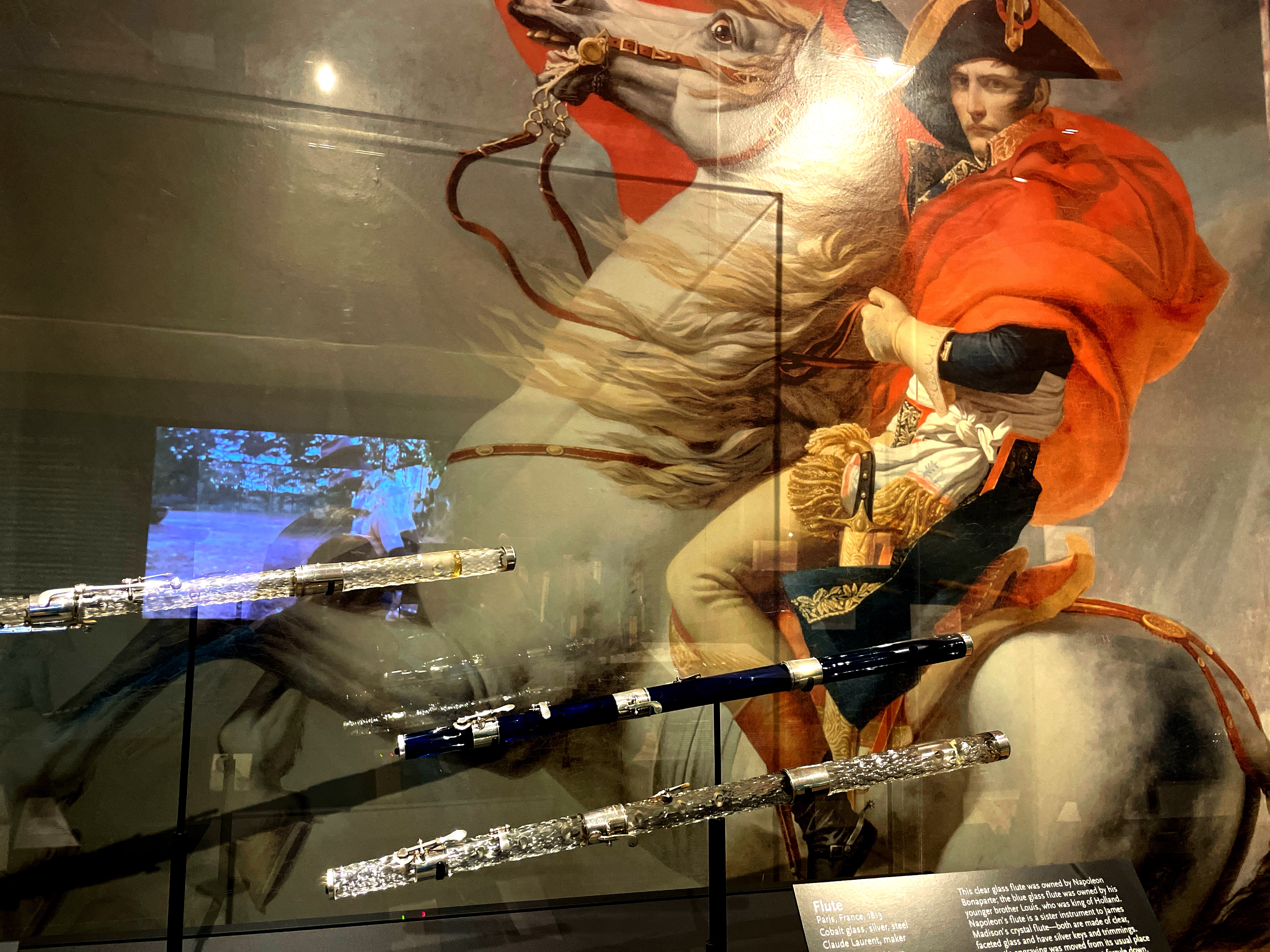
The most remarkable historic flute was a faceted crystal and silver number belonging to Napoleon. After his decisive military and political defeat at Waterloo, friends gave Napoleon the crystal flute as a kind of consolation prize. His brother, Louis, who was king of Holland, got a similar flute made of cobalt glass.
There is no evidence that Napoleon ever played any flute, let alone the crystal beauty. I hope whoever is in possession of the $21.7K Department of Defense flute is playing their heart out.
 Teacher in a strange land
