
What Europeans Think of Trump

Just got home from a two-week vacation in the Czech Republic and Germany, including a week in what used to be East Germany. All of us learn from travel, of course, but this trip—planned long before last year’s election—was an incisive tutorial on how the rest of the Western world sees where we’re headed.

As of today, there are warnings against travel to the United States for citizens of Canada, Germany, England, Denmark, Netherlands, and France—probably the easiest and most accessible nations for Americans to visit.

I grew up in Michigan, where Canada hardly felt like a foreign country. I have friends who live in Windsor, but work in Detroit. College students in Michigan have routinely made pilgrimages to Ontario, where the legal drinking age is 19. Losing that easy camaraderie is huge—and that’s without taking into account the auto industry’s dependence on Canadian-made parts and trade.

I was interested and a little anxious about what the vibe would be in Europe. I’m too old for rail passes/backpacks/hostels travel—we’d be staying in hotels and led by English-speaking guides—but if you pay attention, in between historic dates and landmarks, you can hear and see what daily life is like in places that used to be Russian-controlled territories, how they see themselves in the world, and their fears for the United States.

I was also curious about my fellow American travelers. Would they agree with Jim Acosta, who said: Think of the damage done to America’s standing in the world, in the minds of young people across the globe. They see a president who is often out of touch with the real world, thoroughly corrupt and vengeful, beginning his second term launching a crypto scheme and turning government against vulnerable migrants as well as his enemies, both real and imagined.

We began our journey in Prague, a gorgeous medieval city that has been overrun by competing rulers for centuries, part of the Holy Roman Empire as well as the Kingdom of Bohemia. The old core of the city was almost untouched by WWII, but our local walking tour guides–find ‘em on the internet–occasionally pointed out architectural anomalies, calling them Communist buildings, which (local joke) come in three colors: light gray, medium gray and dark gray.

Because the walking tour groups were nationally diverse, the focus was on the enchanting city and its rich history—including the Velvet Revolution of 1989, wherein the Czechs reclaimed their own heritage and autonomy.

Traveling into Germany—the former GDP, East Germany—was revelatory. Guides were excellent—they all knew the historical markers but would often tuck bits of human perspective in their remarks.

  • Our guide in Wittenberg was born in the 1950s and grew up there. In secondary school, she said, she studied Russian. It was the only “foreign” language available. She also studied Russian in college. When she was in her 30s, and the Wall came down, she decided she wanted to learn English—and did. I never wanted to speak another word of Russian, she said darkly.
  • In Potsdam, we visited the estate where the Potsdam conference was held and the iconic photo of Truman, Stalin and Churchill was taken, before Germany was carved up. Potsdam is a beautiful town, including the upscale neighborhood where Vladimir Putin and his KGB comrades lived, in the1980s, considering what other beautiful villages and terrain they might appropriate.
  • In Dresden, we got a quick tutorial on how much of Dresden was bombed into smithereens, in February of 1945. American woman (who should, IMHO, know better) asks the guide: Who bombed this city? The allies, he replies, tactfully. You mean us? She says. Why would we do that? Well, the guide says— revenge, maybe? Later, I hear the woman ask her husband if the Germans are communists, leaving me to wonder just what we are teaching in World History classes.
  • In Torgau, where the allied armies met the Russian army, effectively shoving the tattered German army out of their homeland, April 25, 1945, five days before Hitler took his own life in a bunker. We looked at the site where the armies met, on the Elbe river. Flags from the United States, Russian and Germany have flown there for 75 years, in a memorial. The flagpoles are now empty—and have been since earlier this year, when Germany decided the peace agreement no longer applied.

Our guide in Torgau pointed out that there were a few things—free child care, for one—that made living in East Germany easier (these kindergartens were shut down as “too socialist” after the reunification). On the other hand, the omnipresent occupying Russian soldiers were brutes. His great-grandmother was shot dead in the town square, for resisting the attentions of one of them. He reminded us that Hitler came to power peacefully, and stayed there, courtesy of the Nazi party.

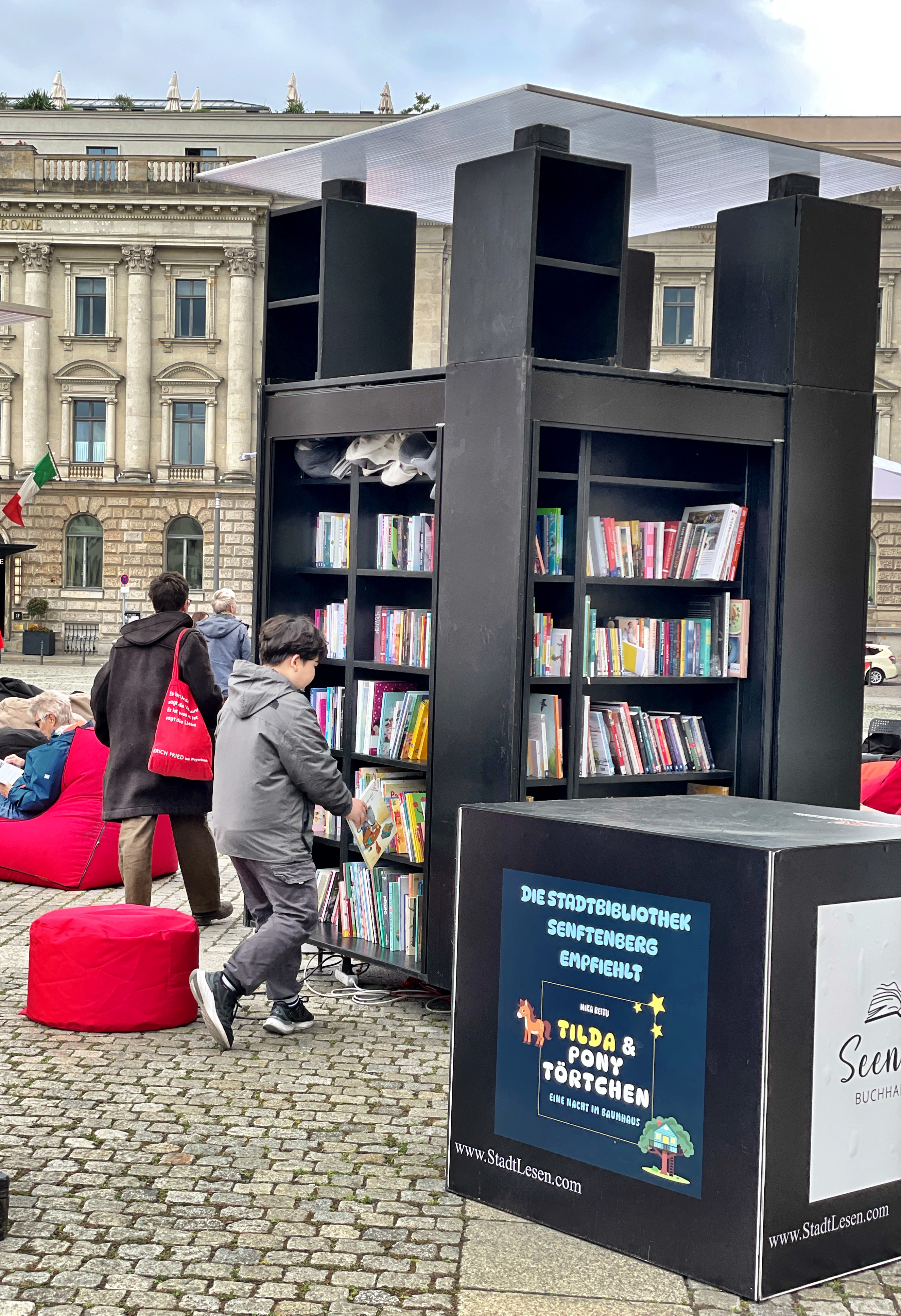
  • Berlin, of course, is a kind of living museum. Most powerful moment in Berlin? The square where, in May of 1933, the Nazis held their first book-burning. There’s a memorial there. Our guide said, quietly: First they burn books. Then, they burn people. But there is a little free library in the square, with hammocks and beanbag chairs. It was a chilly day—but there were children there, reading. Hope.

Everywhere we went, people were kind and hospitable. And honest. Aware of how long it takes to overcome the destruction of a great nation.  As Jen Rubin wrote, this morning:

Other countries, much older than the United States, have gone through grim, even disastrous years, decades, or centuries. And yet in Europe, the spirit of liberal democracy (however imperfect) remains alive and well. A sense of the public good still thrives, and millions of people strive to keep the achievements of Western Civilization from the clutches of fascism, xenophobia, know-nothingism, and conspiracy-mongering. The world is carrying on, albeit with dismay, as Americans struggle through its Dark Age.

Amen.
How Do German Schools Teach Their Political History?

It was Ernest Boyer who declared that public education functions as a stage where Americans test and play out their deepest values and convictions.

Everything that happens around us shows up in public schools. Ask any teacher about keeping the outside world out of classroom dynamics. Ask any scolding pundit or self-righteous parent just how to stick to phonics and fractions when the very ground has shifted.

Can’t be done.

This might be a good place to quote Adolf HitlerHe alone, who owns the youth, gains the future.

A word about playing the Hitler card. I have been justifiably criticized for raising the specter of actual fascism in school politics. This is not a thing to take lightly, I know; hyperbole always weakens an argument.

But I want to write here about a nation that once had a lot of explaining to do on that front, and has—from available evidence—been able, over the long span of three generations, to reconcile their role in what happened in the 1930s and 1940s in Germany, triggering global catastrophe. Maybe we ought to pay attention.

Ten years ago, I had the revelatory experience of touring the Nazi Rally Grounds in Nuremberg, and visiting the Documentation Center there with an extraordinarily well-informed German guide, a doctoral student who was moonlighting as “World War II Tour” escort and educator.

It was a six-hour tour, and pricey, and you could sense the Americans we were traveling with growing weary of the information dump, wondering if the Christmas shop would still be open once the bus dropped us back off on the restored town square.

We wandered around the rally grounds and the man-made lake surrounding the building, once a Nazi headquarters and now the site of an extensive display of memorabilia and analysis. Our guide began by telling us that the impressive, forbidding structure we were looking at across the placid lake was not a museum.

Museums are for sharing cherished cultural artifacts, he said. There are plenty of those in Germany, and we encourage you to visit them. A documentation center, on the other hand, is a public record of a human failure—one for which Germany was responsible. It was Germans’ moral duty to keep the archived memory alive at the Documentation Center, in concentration camps, and courtrooms.

I wasn’t taking notes—I signed up for the tour with little foreknowledge of what I would see, how it would impact me. I remember a great deal of his running spiel. Our guide was an earnest, 30-something man in a plaid shirt, crooked tie and glasses, who carried two notebooks full of tabbed information and could give the veteran who asked precise information about range of Messerschmitt war planes.

A lot of the questions, in fact, came from men asking about military equipment and strategies, and not so many about the Holocaust or impact of the rise of fascism in Europe.

Asked whether Austria had a similar urge to document their own involvement with racial and religious discrimination, our guide made a face and declined to comment. Lesson Number One is that we always speak for ourselves, he said.

He spoke of regional political differences pre-War, how a country in acute financial distress could be utterly divided about causes and solutions. He talked about generational differences and how it took Germans three full generations to understand how a handful of men turned a fundamentally decent people into killers, persuading those for whom horrific prejudice was just not a deal-breaker, if Germany could be restored to greatness.

His grandparents, he said, were impressionable young people, just starting their family, during the rise of the Third Reich. They were gone now, but as a child he had been instructed by his parents not to listen to what Oma said about the terrible war years. She’s old, he’d been told. We’ll respect her for that. Don’t ask, and maybe she won’t tell.

His parents were the generation that bore their parents’ guilt. Then, as grandchildren of the Nazi legacy, his generation could finally claim to have actively worked to make sure it never happened again. In Germany, at least.

Questioned, he shared extensive data about the skinhead movement, a serious worry for the moderate government. But then he compared incidents of far-right violence in Germany to gun violence in America, a sobering contrast for anyone who was inclined to feel superior.

Someone asked the obvious question: How on earth could so many rational people buy into Hitler’s psychosis?

Ah, he said. This is where people from every nation must pay attention. Hitler was a genius at using available media and technology. Crystal radios were made cheap, and the same sticky message—an alternate, economically driven message of national pride—was pumped into all homes. “News” was what the party decided.

Public rallies were enormously effective. The Nuremberg site was chosen because it was cheap and easy to get to by train, and surrounding farms could house families and large groups of people from a single town, camping and sleeping in haylofts.

Everyone could participate—government was no longer centered in the industrial, better-educated north. A common enemy had been clearly identified, the future was brighter because there was a plan for everyone, not merely the political elites. The ultimate community-building success.

A man asked about the crumbling rally grounds, an “amazing historical facility.” Had there been any thought to restoring it? Our guide’s face darkened. “Let it rot,” he said. “Good riddance.”

I asked, as a teacher, what German schoolchildren were taught about Germany’s role in World War II. It was part of their national curriculum, he told us. They began with equity and community in early childhood, accepting differences and playing together. When students were 12, they read Anne Frank.Media literacy and logic and an intense focus on preparation for good, attainable, satisfying jobs were part of the program, in addition to history, economics and the predictable disciplines. We do not avoid our history, he said.

So what do you do in America, he asked?

Back in 2016, an honored fellow at the U.S. Holocaust Museum and recognized expert on World War II was suspended from his job after a parent complained when he pointed out parallels between Nazi Germany and the 2016 election to students. It took a national petition and a global spotlight to get him reinstated.

Also in 2016, in the nation’s leading McNewspaper, Rick Hesse and Checker Finn called the actions of teachers and school leaders attempting to calm their students’ real post-election fears “histrionics.”

That was eight years ago. And look where we are today.