
Diversity and Tracking

If you were in the classroom, as I was for well over three decades, you will have had some experience with tracking— ability grouping, or dividing the class into the Bluebirds, the Orioles and the Buzzards at reading time. And you will know that some teachers strongly resist the impulse to sort and label students, while others endorsed the practice of dividing students by their—key word alert!—perceived differences.

I taught 7th grade math for two (non-consecutive) years. Students were leveled into math groups both times, although the labeling process was different. The first time, there were four levels—Honors, Advanced, Basic and Remedial—and I taught Basic math.

The math faculty, understanding that ability differences were, indeed, perceived rather than scientifically determined—and that skills and understanding were also likely to shift, over the course of a semester or two—proposed testing the students quarterly, using the same test. Any student whose test scores were wildly out of line with their perceived peers could be moved. Up or down.

Except—this was a lot less feasible in practice. Most kids (and their parents) had internalized their math labels. Honors or Advanced? Try suggesting, after nine weeks, that their skills were really… kinda basic.

I also had a couple of kids in my “basic” group who, right off the bat, were obviously sandbagging. Their actual skills and math sense were so far above the norm that I wondered immediately how and why they were placed in the Basic group.

After a few weeks, however, I started to understand how behavior issues impacted the sixth grade teachers’ divvy-up process at the end of the previous year. Act like an attention-seeking four year old? No Honors for you! The only African American kid in the 7th grade? Basic.

Point being: Leveling students, in most academic settings, has limited and conditional value. More importantly, grouping students is often about things totally unrelated to academic ability or potential.

There is probably no education writer who has influenced me more than Alfie Kohn, whose book No Contest inspired me to stop using chairs and challenges, something band directors everywhere see as a normal practice. (I wrote about how that actually improved my school bands, HERE.)

Alfie Kohn just wrote a rather brilliant essay: Heterogenius; Why and How to Stop Dividing People into Us and Them. It’s well worth the read, packed with evidence-based observations and sharp analysis, and incredibly timely in an era when we have to be reminded that diversity, equity and inclusion are actually good goals—especially when teaching children—not merely “DEI,” a catch-all trigger for the people currently in power to run roughshod over the rest of us, including our future citizens.

Here’s a sampling from Kohn’s column, on the measurable, research-supported benefits of diversity:

The idea of minimizing homogeneity has a great deal to recommend it even on a biological level. Genetic diversity allows for adaptation to a changing environment. Species diversity makes for more robust ecosystems. Plant diversity (for example, through crop rotation) protects against pests and disease. Even nature, in other words, seems to be saying “Mix it up!”

As for human interaction, the experience of being in a heterogeneous group not only attenuates tribalism but can enhance performance on various tasks. Social psychologist Adam Galinsky put it this way: “Diversity increases creativity and innovation, promotes higher quality decisions, and enhances economic growth because it spurs deeper information processing and complex thinking…[whereas] homogeneous groups run the risk of narrow mindedness and groupthink (i.e., premature consensus) through misplaced comfort and overconfidence.”

It’s that last quote that explains why Trump, after raving about–and winning an election on—his goal of deporting millions of brown people, has now decided to welcome White “refugees” of European descent from South Africa.

It’s all out in the open now—how politicized the pushback against diversity and equity are. Long-time right-leaning ed-research houses like Fordham keep pumping out anti-diversity reports, in favor of reserving education goodies for the top layer of (white and Asian) HS students. However:

As the report notes, research does support the finding that many students are insufficiently challenged. The research is also mixed on how best to design schools to avoid any students languishing academically. But the report fails to take seriously the decades of research showing the harms of the tracking and ability grouping systems in secondary schools that have stratified opportunities to learn. After muddling the research evidence, the report then recommends the practice most harmful to equity: increased tracking (called, “readiness grouping in separate classrooms”).

Ah. You’re not tracking kids. You’re readiness grouping them. In separate—but decidedly unequal—classrooms.

A blithe quote from the Wall Street Journal:  On day two of his administration, President Trump ordered federal agencies to terminate “diversity, equity and inclusion” programs in the government and combat them in the private sector. The order follows through on his promise to forge a colorblind, merit-based society and to end the engineering of race and sex into every aspect of American life.

Jamelle Bouie: This is the “merit” two-step. First, you strongly imply or state outright that the presence of anyone who isn’t a straight, able-bodied white man is unfair “DEI,” then you argue that just because an institution is all-male and lily-white doesn’t mean there is discrimination. That’s just merit!

Been there. And had those conversations with my fellow math teachers, back then. One of the words to watch for: deserve.

As in: He’s going to be an engineer, like his Dad. He deserves to be in Honors math, even though his score is a little low. Or: She doesn’t turn her homework in—says she has to babysit. Even if she aces the test, she doesn’t deserve to be in Advanced math.

Because tracking (stratifying, merit-based clustering, readiness grouping, whatever) happens at the school level, it is something local schools and districts have some control over, despite Donald Trump’s empty threats against Stuff He Doesn’t Like in schools resulting in pulling federal funding.

Teachers, even threatened, fearful teachers, can hold firm to the time-honored principle of doing their best to challenge every child, to look for and support their strengths, without arbitrarily dividing them into academic stars and lesser lights. They can also honor the principle of diversity, knowing diversity makes a classroom, a school and society stronger.

As Alfie Kohn says:
That’s a message that children need to hear — and to see modeled for them — by the adults in their lives: a commitment to inclusiveness whose implication is that there is no future in tribalism, no justice in “just us.” Every day our kids should watch us encounter and talk about others in a way that highlights how those people are not alien beings; they’re like us with respect to the things that matter — and, at the same time, their qualities can’t be reduced to membership in any category.

Nine Reasons Why Standardized Tests and Grades Shouldn’t Necessarily Match Up

Headline from a recent piece in Education Week: Grades and Standardized Test Scores Aren’t Matching Up. Here’s Why.

Let me give you the gist: Grades are unreliable, whereas standardized test scores scientifically measure real content knowledge. Grades are given by teachers. Therefore, teachers’ grades are not to be trusted, and teachers should receive additional training on how to accurately measure what students know. There’s also a jab at grade inflation, post- pandemic. Who is quoted in the article? That’s right, the College Board and the ACT folks.

From my point of view: a) Sure, additional training for preservice teachers on the art and purpose of assessment would be very useful. b) Also useful: a common understanding of what a grade means. Is it a representation of a student’s progress—or an evaluation of how well they’re meeting pre-set standards—or an educated guess about how the student will do in college?

I don’t think teachers’ grades and standardized tests should, necessarily, measure the same things. Furthermore, standardized tests don’t have relationships with students, or know what the student brought to the table, when starting the course. 

I have written lots about grades as assessment, including the piece I’m including, below, about the Soft Bigotry of Low Grades. It begins with an essay on “low expectations” then morphs into nine points about grading that teachers understand (and argue about).

Whoever wrote the phrase ‘soft bigotry of low expectations’ back in the early days of the Bush (W) administration, was a genius. In one nifty sound bite, the blame for the so-called achievement gap was placed squarely on the shoulders of educators, those barrel-bottom, unimaginative civil servants slogging along in low-paying careers.

Not only were veteran teachers unable to conceive of their students’ success (presumably, getting into a competitive-admissions college)—they were also bigots, kind of. Perhaps they hadn’t read 25 books on racism, been hooked on The Wire, or stayed for two grueling years in a no-excuses charter before heading off to Goldman Sachs. They were just stuck in those dead-end teaching jobs.

Early in the ‘reform’ days—a couple decades ago—Disruptor types were prone to proclaiming that high expectations for all students were, in fact, a positive disruption to what they assumed was the low and unimaginative level of teaching practice endemic in public education. Especially in schools filled with kids who took home backpacks full of peanut butter and whole wheat crackers every Friday.

If only teachers had faith in their students, cracking the academic whip and believing they could someday rise above their circumstances and excel—well, then things would be different. What we needed was new—high and rigorous—standards, better aligned curricula, more sorting-out data. We needed ‘choice’ to remove kids from low-expectations government schools.

And of course, better teachers, teachers who embodied these great expectations and were willing to rip up unacceptable assignments. Even if it made kids cry.

The ‘low expectations’ trope became a thing. The 74 was still printing pieces about it, 18 years later, using phrases like ‘complacency is also still alive and well’ and ‘having teachers who were confident that their students would complete college made a real difference in their college attainment.’

The 74’s suggestions for improvement? You won’t be surprised: higher standards, more testing and raising the cutoff scores, rigorous curriculum—and better teachers, the kind who expected more. Nary a mention of better health care, better jobs with higher wages, better childcare options, better support networks for people in poverty. Or less racism.

When I read that Fordham was releasing a new report entitled Great Expectations: The Impact of Rigorous Grading Practices on Student Achievement, I assumed it would be more of the same: a screed against ‘grade inflation’ that urged teachers to use the threat of bad grades as ‘motivator’ in getting kids to Learn More (and score better on high-stakes tests, quantitative ‘proof’ of learning).

Turns out I was right.  Here’s the first paragraph of the summary:
We know from previous survey research that teachers who hold high expectations for all of their students significantly increase the odds that those young people will go on to complete high school and college. One indicator of teachers’ expectations is their approach to grading—specifically, whether they subject students to more or less rigorous grading practices. Unfortunately, “grade inflation” is pervasive in U.S. high schools, as evidenced by rising GPAs even as SAT scores and other measures of academic performance have held stable or fallen. The result is that a “good” grade is no longer a clear marker of knowledge and skills.

Here’s how my 30-odd years’ worth of grading some 5000 students (at least 35K individual grades) squares with the statement above:

  • High expectations are a good thing, all right—but they are not commensurate with giving more unsatisfactory marks. In fact, being a ‘tough grader’ often means that the teacher is not meeting a substantial chunk of kids where they are, then moving them forward. The easiest thing in the world is giving a low or failing grade and blaming it on the student. The hard thing is figuring out how to help that child achieve at the level he’s capable of.
  • The longer I taught, the higher my expectations were, as I learned what students at different developmental levels were able to do—but that was not reflected in the grades I gave. I assumed it was because I had become a better teacher and was getting better results as my teacher tool bag filled. I could see with my own eyes that I had underestimated what my students could learn and apply, if they chose to work at it.
  • I seriously doubt that teachers’ expectations—as defined here by more rigorous grading– have much, if any, impact on kids’ completing college, or even high school. A teacher who encourages a student to think big, to push herself, to reach for the stars and so on, may indeed have a long-term positive effect on a student, especially one with self-doubts. Setting students on a path to higher education and life success is a long-term, K-12 project, one that can’t be accomplished by teachers alone and certainly not by dropping the grading scale a few points to teach them a lesson.
  • Grades aren’t real, although the argument can be made that they’re more real than a standardized test score (which the report also uses to make the claim that ‘raising the bar’ has a salutary effect on student outcomes). No matter how schools try to standardize grading, the human judgment factor creeps in. As it should. Students see their grades as something ‘given’ by the teacher, no matter how many times teachers insist that grades are ‘earned’ and can be accurately, precisely, mathematically granted.*
  • Grade inflation isn’t real either. I am always amused by disgruntled edu-grouches who insist that Harvard, say, is awash in grade inflation. When an institution turns away 94.6% of the students who have the temerity to apply, why are we shocked when the crème de la crème who are admitted get all A’s?
  • If we were doing our jobs better, by Fordham’s metrics—following rigorous standards, choosing engaging and challenging curricula, assessing frequently—wouldn’t the desired outcome be better grades?
  • The worst kind of grading practice is the bell curve. Curving grades has gone out of fashion, but you still see its aftereffects in reports like this that bemoan the overly high percentage of students whose work is deemed good or superior. If you’ve ever had a class filled with go-getters (and I’ve had many), you’ll know it’s possible to teach to the highest standards and have every child in the class performing at a high level. Someone does NOT have to fail. What the researchers here seem to be endorsing is a curve where students in high-poverty schools are not compared with their peers, but with kids in advantaged schools—then taking the top-scoring kids down a peg or two, for their own good.
  • Bad grades don’t motivate most kids to try harder, although this seems to be the sweeping conclusion of the report, which studied 8th and 9th Algebra students in North Carolina. The researchers noted that students in advantaged schools were more likely to make gains when receiving a lower grade. There are lots of charts and graphs showing how teachers who give lower grades initially cause an uptick in standardized assessment scores eventually. This is more likely to happen if that teacher went to a ‘selective’ college or is an experienced veteran teacher, by the way. As for the poor students who go to rural or urban schools—well, they get good grades that don’t reflect what they’ve really learned. Therefore, maybe we should give them lower grades, too, as an early reality check.
  • I repeat: bad grades don’t usually motivate kids, unless there’s someone at home checking up on them, they plan on going to college and care about their GPA. In that case, a lower grade may serve as a heads-up that more effort may be necessary. Do 8th grade Algebra students and students in advantaged schools where most kids are college bound fit into that category? Yes.

Students who do well in school also know how to study effectively– or seek extra help when something is difficult for them. They’re not as likely to think that the tough-grading Algebra teacher doesn’t like them, or that they’ve finally found a subject they can’t successfully master. Lots of previous successes have given them the confidence to pursue a challenging subject.

What struck me about the report was the facile conclusion that a subset of (higher-achieving) students was motivated by a lower-than-expected grade into learning more.

Extrapolating that into a declaration that tougher grading would lead to higher achievement is giving way to much credence to a cranky-pants theory, the one where a kick in the pants is what kids these days really need.

*In my 30+ year career, I taught math for two years. Prior to that, I collected various data to develop and tweak a defensible grading process for teaching instrumental and vocal music. Music is a challenging discipline in which to assess using hard numbers, trust me; I envied my math teacher friends whose grades were always clean, clear percentages. Then I taught math and discovered—eh, you can juke the stats in math, too, through assignment weighting, partner quizzes (recommended by our math series), late assignment policies, re-takes, homework evaluation policies—and so much more. Grading—in any subject or level– is not science. Never has been.

The Return of the Tradteacher

Been reading about the tradwife lately? Although explicit definitions vary, the general gist is returning to a post-war conception of a stay-at-home wife, most likely with children (or planning for children), in relationships where men make all the family decisions, and control the finances. Reinforcing patriarchal norms and glorifying the satisfying and ‘natural’ role of housewife.

If you’re hearing a touch of cynicism there, well—I lived through a time when the tradwife, even if she was working, could not get a credit card or substantial business loan. While I certainly defend any woman’s right to stay home and support her children and spouse in places other than an outside workplace, the whole “tradwife” schtick (especially combined with the rollback of Roe) makes me itchy.

It also strikes me that tradwives are just another glitzy, social media-driven facet of a larger wave of backlash against a whole lot of un-trad trends in American society: Full-blown reproductive freedom. The continued shrinkage of mainline religions. Honoring personal sex/gender choices. Women running for office and corner offices–and winning. And so on.

I also see lots of pushback against untraditional teaching, curriculum and school organization models. The whole “Science of Reading” battle rings very familiar to those of us who started teaching in the 1970s, when teachers were pushing back against the “Why Johnny Can’t Read” –because teachers theoretically weren’t teaching phonics–crusade in the late 50s.

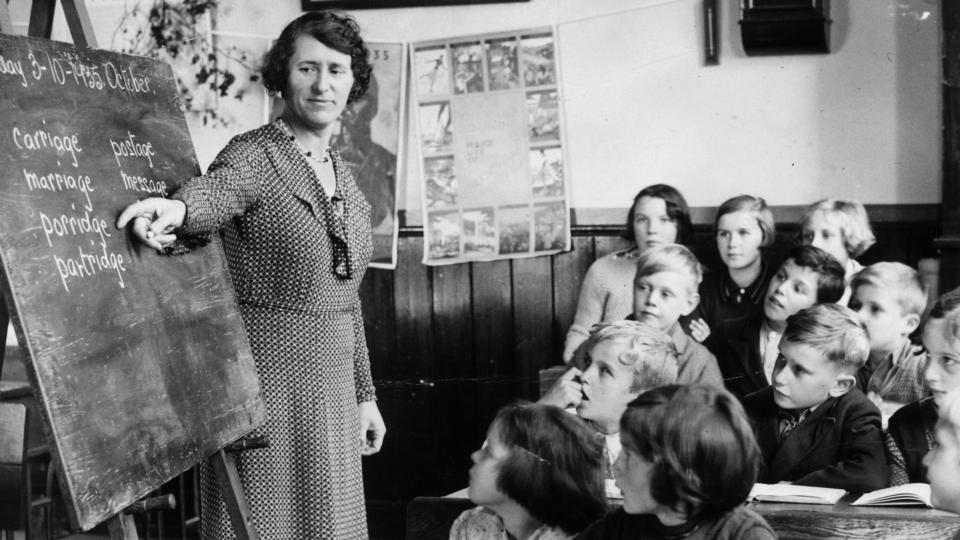
Nearly all of the folks who taught me were tradteachers, using trad methods, and when I entered the classroom, many of my teaching colleagues were 100% traditional-minded as well: Straight rows, direct instruction, textbook-based, daily homework, and off to the principal should you disobey orders. And some of those folks were effective teachers.

But lots of the opinion writing I see from Moms4Liberty, NYT columnists, conservative politicians and ed-bloggers focuses on how different education looks and feels from the classrooms they remember, decades ago—classrooms that may have been racially and economically monolithic, and headed by a series of teachers who did things in the same way.

Peter Greene recently had a good piece about Gloria Jean Merriex, a Florida teacher who broke out of her traditional mold and had some great success. A couple of lines jumped out at me:

Once she had her degree, she chose to teach at Duval Elementary, where for about twenty-five years she was a middle-of-the-road, competent-but-not-exceptional teacher.

Then came No Child Left Behind, and with it, high stakes testing. In Florida, that meant the FCAT, used to give each school a grade, with rewards for A schools and punitive “interventions” for F schools. In 2002, Duval was rated F.

Merriex was troubled. She concluded that if the school was going to be transformed, she would have to transform herself. She dumped the state pacing guides and teaching materials. When she got caught, she begged Duval principal Lee McNealy for a chance to give her methods a try, and McNealy had the guts and trust to give it to her.  Merriex developed materials and approaches of her own, and for the early 2000s, her choices were unconventional. She wrote raps and dances to do with her students for learning math vocabulary and basic processes. She used call and response, movement and arts in the math and reading classroom. If some of her techniques seem less radical twenty years later, that is in part because of her influence.

For many, perhaps most, teachers, their first years in the classroom might look very much like the way those newbies themselves were taught. It was certainly that way for me, wanting to be the World’s Greatest Band Director and following the exact procedures and ideas I had experienced in bands and at music camp in high school. For many years, I too was a competent-but-not-exceptional teacher, like Ms. Merriex.

I also broke out of the traditional mold, and while not all of the things I tried were big successes, I was able to redefine what I wanted students to take away, for the rest of their lives, from being in my classroom. I accomplished many of those goals. I read social media for music teachers now, and I see great changes in thinking about the Big Ideas—from competition to creativity—in music ed.

Traditional teaching—and like tradwives, the definitions are murky—is not always or even often the best bet. Especially if that teacher’s goal is to move every student under her watch forward.

Stanford Professor Jo Boaler is something of an iconoclast in non-traditional math education, and recently–no surprise–there’s been yet another dustup over Boaler’s ideas.

She advocates for ending tracking by ability in math classes, getting rid of timed tests and starting with conceptual understanding before introducing procedures. Most importantly, she wants to elevate the work that students tackle in math classes with more interesting questions that spark genuine curiosity and encourage students to think and wonder. Her goal is to expose students to the beauty of mathematical thinking.

Right there in the first sentence, there are three uber-traditional practices—tracking, timed tests, and doing a series of problems to iron in an algorithm, to get the right answers rather than seeking to understand the concepts underlying the calculation. And who’s out to get Boaler? Well, men who have been the beneficiaries of understanding and excelling at traditional mathematics.

It’s an enormously complex endeavor, teaching. Sticking to the habitual, and ignoring students who check out, only works for awhile. BUT—listen to legislators and parents talk about schooling, and a lot of what you’re hearing is somewhere between nostalgia and flat-out misinformation. The book-banning, faux CRT, Tik-tok blaming, skeptical-of-teachers crowd hasn’t got a clue about what it’s like to teach kids in 2024, beginning with some clarity about the purpose of public education.

As Jess Piper says, in a wonderful column called You Don’t Like It? Move!:

None of us is safe so long as there are folks living in states that are unsafe. They will roll over us first, and you next. The billionaires are using my state AG and other regressive state AGs to file suit to dismantle public schools. They sue to ban abortion and the medicine for self-managed abortions. They sue to stop college loan forgiveness. They sue to overturn civil rights and anti-discrimination policies.

As Piper says—hey, we can’t all move, or teach in a private school where we can craft our own processes, research and convictions. But returning to traditional methods isn’t the policy answer. You have to move forward. It’s the way of the world.