Critical Issues and Minutiae of Public Education

I have been fascinated, in the past 48 hours, by online conversations about the tumultuous political week we have just lived through—especially the comments and questions generated by teachers.

Non-teachers are heartbroken or thrilled or both, by the Biden step-down. They’re nosing out the negative PR and potential VP picks of the presumptive new nominee. There are running threads and analyses around the assassination attempt, a mass shooting where everyone knew the intended (again, presumptive) target, a change from the faceless victims—many children, damn it—of other mass shootings.

So much is in flux. So many building blocks of democracy, teetering on the edge. Including public education.

But we’re approaching (in many parts of the country) the beginning of the school year. Much of the ongoing cyber-conversation around public education centers on clearing back-to-school lists (i.e., teachers begging for essential supplies the school can’t afford), the futility of professional development for yet another silver-bullet reading program, why teachers aren’t paid for setting up their classrooms and other garden-variety School Stuff. The kinds of issues and beefs we see annually.

There are a hundred things that weigh heavily on teachers’ minds as they prepare for another year. What I’m wondering is if teachers are focused on the trees, rather than the destruction of the public education forest. Because focusing on bulletin boards and class lists instead of the section of Project 2025 that deals with education feels do-able, not overwhelming. Or terrifying.

Washington Post advice columnist Carolyn Hax posted a letter about a “rude” teacher who created individual certificates for each of her students at the end of the year. The mother who wrote the letter was upset that individual kids were nicknamed Class Clown and Social Butterfly and–gasp!–her daughter was designated “Miss Manners.” So upset that she reported her ire to the superintendent, after the principal gently suggested these certificates were warm-hearted, not criticisms of children’s character.

Aside from the fact that many parents would be delighted or relieved were their child awarded recognition for having excellent manners—the letter bothered me way more than it should have. Because I have been that teacher, striving at the end of the year to recognize and acknowledge students’ achievements, but also their individual quirks, their signature traits, their contribution to the musical community we built.

Hax rightfully chides the mom for attacking a well-meaning second grade teacher, on the last day of school, no less. But what most folks—non-teachers—will miss is that the success of any teacher, broadly defined, lies in building honest relationships with kids who bring varying intellectual and emotional strengths to school.

Not everyone is an academic superstar or natural helper. Many students will need to be coaxed or cajoled into effort, participation and belonging. Those skills are just as important as content expertise, a full toolbag of instructional techniques and endlessly logged data.

My own end-of-year awards included every band kid. Now—decades later—I still hear from students who remember the last full day of school (after the instruments were all oiled and stored for the summer, the music sorted and filed, and the sink—yuck—cleaned and shiny): The thank-yous. The in-jokes for band members. The Jolly Ranchers. The camaraderie. I recently heard from a woman who remembered winning the “Most Improved Section” award—and she was the only oboe. She included a smiley face.

The Hax column drew hundreds of responses from teachers.

Today, I have been watching teachers on social media saying:  Be kind to the social studies teachers in your building. We’ll be working on overdrive!

Well, yes. You go, teachers. The world is on fire, and your job is to pretend that the only thing that matters is following the prescribed curriculum and keeping your head down in the classroom. We get it—and we love and support you.

But as we launch 2024-25, it is incumbent upon all of us whose livelihoods are not threatened by free speech to keep education policy and the very real threat to public education bubbling up every day on social media and in our friend groups.

 It’s been a wild couple of weeks. But keep your eyes on both the threat and the prize.

I am a Patriot

I am a patriot and I love my country. Because my country is all I know.

Jackson Browne

Of all the things manifested by the upheaval dividing this nation politically, the appropriation of the concept of patriotism by the right wing troubles me the most. Why? Because my country is all I know–and I am loyal to its virtues and principles, while fully recognizing its many tribulations.

I’m sure that every citizen registered to vote in November feels the same way: they’re voting to save the country from sliding into despotism, to secure freedom, the blessings of liberty, yada yada. The fact that the two distinct roads to said patriotism diverge in a black forest of confusion, even violence, is terrifying, however.

Who’s the patriot? And who deserves to have their lives and values suppressed?

Watching the news, and reading—one laborious, revolting chapter at a time—Project 2025, it’s pretty clear that the authors of that document feel that their activist zeal to change the nation is driven by patriotism, their love of country, And if that drifts over the line to white nationalism, well… many of our leading Senators are down with that, too.

It’s funny. One of the things I was never uncomfortable teaching or promoting in the classroom was an explicitly pro-America, patriotic point of view. Musically, and culturally, I endorsed patriotic traditions and celebrated the musical innovations that sprang from so-called melting pot.

Kind of ironic, considering how I felt about the Vietnam war, and the arguments I used to have with my father, a WWII veteran. My country, right or wrong, was his modus operandi. But I thought then, back in the 1970s, and even now, that loving the place where you live, where your ancestors settled, where you’ve put down roots and built community, means you can also be clear-eyed about mending  its every flaw.

I am a patriot. And I love my country.

I love the idea that it took decades of discourse for the early, 18th century Rebels (by no means a majority) to organize in resisting colonial rule, fighting the imposition of taxation without representation (which still resonates today). I think all children in America should know the truth about our Founding Fathers, and their multi-racial legacies.  I think elementary schools should hold mock elections and HS Social Studies teachers should organize voter registration drives. I think flying the national flag—right side up—is everyone’s prerogative.

I also think the Superintendent of Schools in Norman, Oklahoma, who declared “We’re not going to have Bibles in our classrooms”—after a memo from Ryan Walters, their moronic State Superintendent specifying that all OK classrooms will offer Bible-based instruction—is a patriot.

A patriot who understands our foundational principles–the separation of church and state, for example. Perhaps even a patriot who sees citizenship-building, not just job training, as a core purpose of public schools.

Can patriotism be taught?

E.D. Hirsch just published a book in which he states that we can:

 “…transform future citizens into loyal Americans.” Hirsch feels that “patriotism is the universal civil religion that our schools need to support on moral and pragmatic grounds as the glue that holds us together.” He believes the foundation of patriotism is in a shared knowledge base, which all citizens must have to participate together in a community or engage in communication. Hirsch states, “we can create specific standards, so each classroom becomes a speech community whose members all understand what is being said, because they all possess the needed relevant background knowledge.”

This is classic, evidence-free Hirschian blah-blah. If only everyone analyzed the Articles of Confederacy together, or memorized the Gettysburg address, or studied Julius Caesar in the 8th grade (using Hirsch’s handy-dandy curriculum guides, of course), we’d all get a boost of love-yer-country loyalty? Because we’d all be on the same academic wavelength?

Having spent decades hanging out with actual middle schoolers, who were taught a fairly universal set of ideas and skills, I can tell you that more standardization will not make anyone more aware of the virtues or drawbacks of real life in a diverse democracy. Furthermore, the whole idea is vaguely reminiscent of other, failed social movements.

You can model genuine patriotism. You can teach patriotic–and protest–arts and literature, to enlarge students’ perspectives on what it means to endure hardship and sacrifice in the service of one’s country. You can toss out provocative ideas—Should everyone be compelled to recite the Pledge of Allegiance?—and your average fourteen year old will undoubtedly have an opinion, which you can then dissect and examine.

But you can’t make kids love the United States of America.

No T-shirt or baseball cap, let alone a traditional school curriculum, can do that. It comes from maturity, and the heart.

My Country ‘Tis of Thee (Land of Inequity)  Song by Reina del Cid

Does Love Really Make the World (or Classroom) Go ‘Round?

Some years ago, when talk radio ruled the discourse, I was listening to a national teacher union leader talk with a right-leaning—and nationally recognized—radio host. The topic was teachers as catalysts for improving public education. The union leader mentioned National Board Certification as a model for identifying teacher leaders, the kinds of folks whose classroom…

Dispatch from New Mexico

We are in Carlsbad, New Mexico at 5:30 on a Saturday night, hoping to grab a quick dinner at a Chili’s that seems to be THE happening place for families. There are kids running around outdoors—it’s a balmy 70 degrees—while their parents wait for a table. We grab the only two seats at the bar.…

The Fault Line in American politics?

I’ve spent a lot of time considering this graphic. IS education the fault line in American politics? First shock: There are 33 states with more-educated people than (purple) Michigan, where there are world-class colleges and universities. What makes us an under-achiever? 2nd: Consider Trump’s mouth-blabber remark: “I love the poorly educated.” As well he should.…

Just How Bad are Things?

I have to say this: the left side of the aisle has WAY better memes than the right side. From the bold, white-on-black “I Dissent” to the Martha Gelhorn quote“If we mean to keep any control over our world, we must be interested in politics”—Dem-flavored bon mots have more wisdom and wit (“Come celebrate our last Fourth of July!”) than bible-verses-with-guns Tweets from the right.

But damn. This has been a rough few days for those of us who believe Martha Gelhorn was right.

Anne Lamott is right, too: It’s so horrible to have to deal with last night etc without Molly Ivins, but I know exactly what she would say: “Sweetpea, let’s have this conversation in a week or two.”

And for most of us, that’s about the best we can do. Right now.

Wait and see.

Choices will be made. We can decide to live with them, and act accordingly. Or not.

I was in the classroom for a long time. And many times—many, many times—we rode rough political waves, and I would think (after a third millage loss, or the Governor establishing our state-based employees as Right to Work, etc.) that All Was Lost.

I remember thinking, more than once, that we had reached rock bottom as a school district. Maybe it was when the Superintendent hired armed guards to hang around and threaten picketing teachers? And some of those freshly trained armed guards were our recent graduates?

I also remember being pregnant in the 1980s, and having a conversation with a similarly pregnant mother about our reservations at bringing children into the kind of world that would elect Ronald Reagan.

I’d call what I thought was disastrous then, compared to what’s happening right now, a failure of imagination.

That pregnant friend? We had healthy political discussions, once our girls were born, about how to resist the greed and trickle-down economy by teaching our children and students about diversity and equity, the things that made our country great. OUR schools were going to make a difference in kids’ lives. Give them skills—and hope.

That was then, of course.

I never, ever would have predicted what has happened to public education—the organized and well-funded attacks, the false accusations—back then.

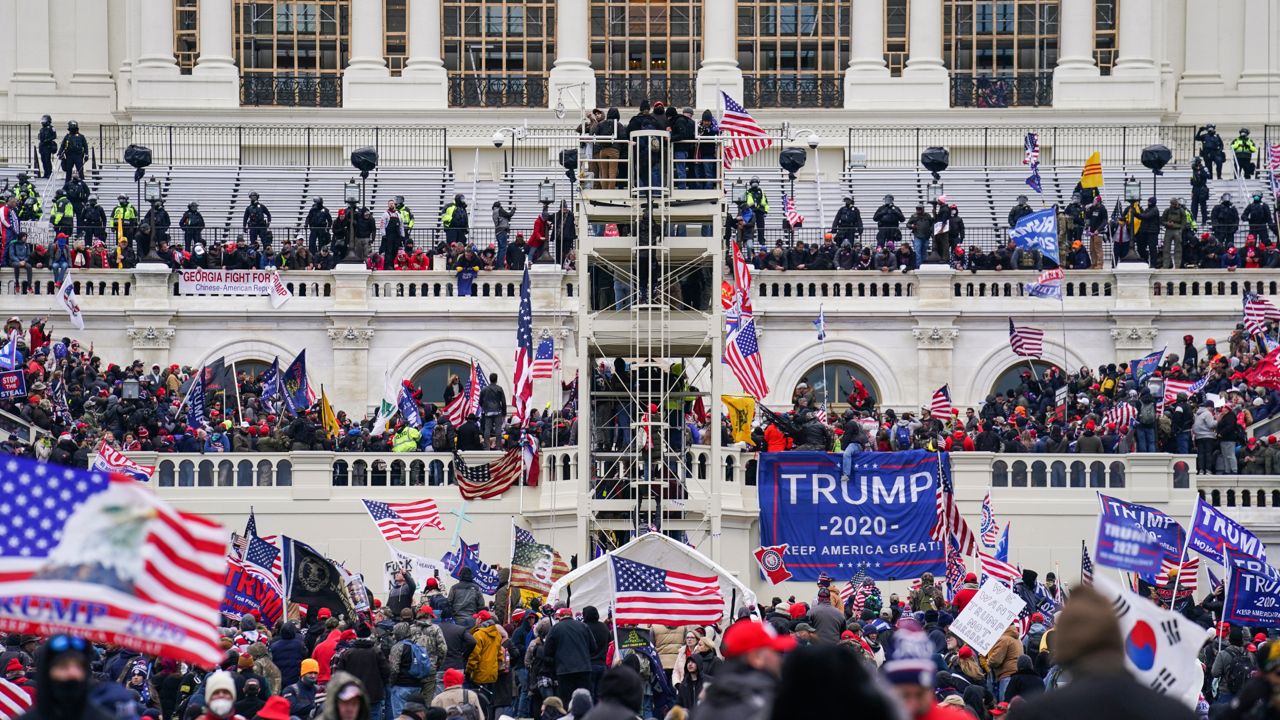
Nor, of course, would I have foreseen the outcomes of the Trump presidency:  the criminal indictments, the election denial, the January 6th insurrection, the collapse of the Supreme Court. The Covid deaths. The loss of reproductive rights, and danger to women’s health.

Yeah, it’s really bad.

But the trick is not losing hope. Thinking creatively, rather than defensively. 

Otto von Bismarck said—Politics is the art of the possible, the attainable… We have certainly been shown what is attainable, this week—overturning centuries of precedent to save one man. But there are possibilities for the left, as well. We need leadership.

What can Joe Citizen do, right now?

Stay informed. Read selectively. Express yourself to friends, with receipts. Stay calm—take your vacation and unplug, and come back ready to pitch in, whatever you can spare, to ensure a safe election. Because this one really matters.

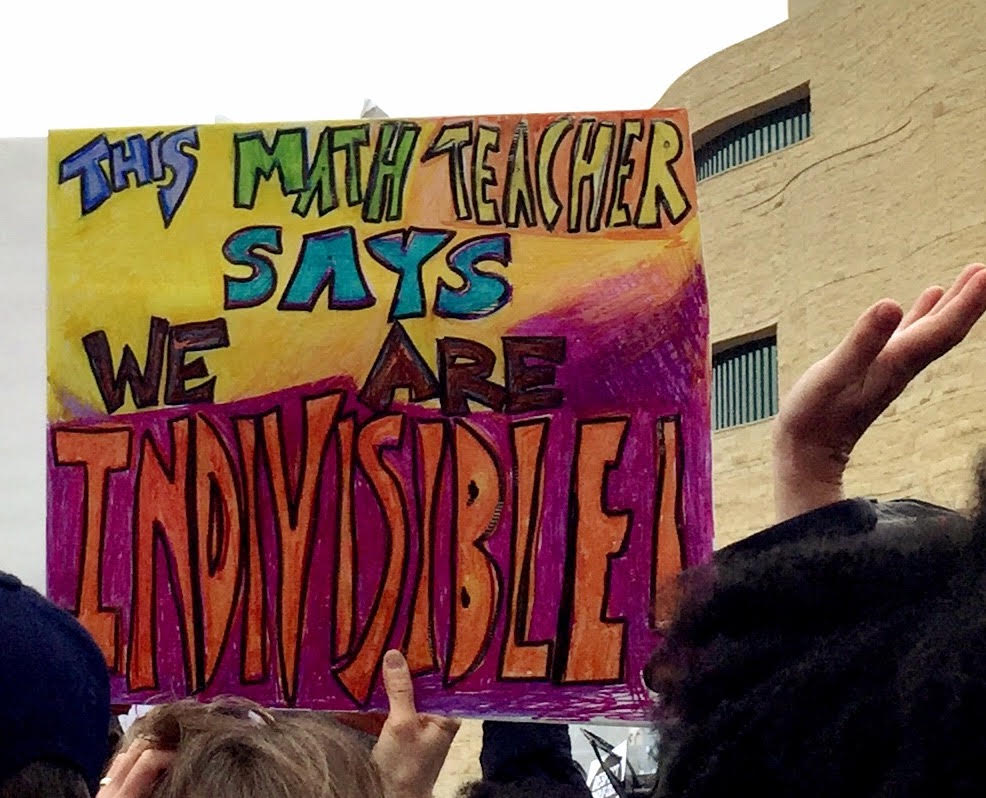
My best friend and I drove down to Washington D.C. in January of 2017, for the Women’s March, to be part of history and to fan the flames of hope. To think: We are not alone. Four years later, the Proud Boys and Oath Keepers and a few thousand friends broke into the Capitol. I am guessing they were there to feel connected as well.

What happened in those four years?

Ignoring the Real World in the Classroom

Are you reading Jess Piper? If not—start now.

Piper is a Missouri educator (among other things) whose commentary on teaching in a bright red state, and having been raised in a fundamentalist church, rings my chimes, again and again. She ran for a position in the MO State Legislature in 2022, and lost—but her blogged reflections on that experience amount to an answer to the question uppermost on my mind in 2024: How can people vote for a confirmed liar and obvious scam artist? Who are these people?

Today, her Substack blog described teaching on January 6, 2021, as the US Capitol was being overrun by Proud Boys, Oath Keepers and assorted other rage-filled people with improvised weapons:

What would I say when I started class?

I told them the truth. I told them the US Capitol was under attack. They asked by whom? Again, I told them the truth. By Americans.

My students wanted me to turn on the news, but I decided against it, fearing they may see something they would never be able to unsee. I am of the Space Shuttle Challenger disaster generation, and I was always overly-careful about what they saw in my classroom.

I don’t remember how much 7th hour accomplished that day, but I’d say it was minimal. I think we talked about what our country was experiencing…the division.

And next, of course, came the classic example of chickenshit leadership in schools: A warning from the Superintendent not to discuss the biggest news story of the year, a story that has had an impact on everyone in the United States for the past three and a half years.

Her story resonated with me. I’m considerably older than Piper, and I can remember many times when teachers in my school were directed by an administrator not to talk about a headline story—stories that were easily, overwhelmingly available and playing constantly via whatever media was being piped into our students’ homes and brains.

I remember discussing Anita Hill—I believed her—in the teachers’ lounge, and watching my male colleagues smirk about Clarence Thomas and a certain Coke can.  Bill Clinton’s affair with Monica Lewinsky—something happening on TV, day in and out–was similarly verboten.

A friend teaching in my district was written up for responding to a question from a student about the Jonestown Massacre, when 901 Americans died by drinking cyanide-laced Kool-Aid, influenced by cult leader Jim Jones. And the Flint Water Crisis, happening 20 miles up the road from my school, was “not in the curriculum” and not to be mentioned in class.

What happens when teachers can’t take questions about the daily news? It makes us look like idiots, for starters. Uninformed content-dispensers, unable to connect facts to causes or outcomes. What have our students learned from our unwillingness to discuss national crises, like 9/11? 

In November of 2000, when the outcome of the Presidential election hung in the balance for more than a month, the room across from mine was occupied by an 8th grade social studies teacher. Every morning, we would stand together in the hallway—bus duty—as students streamed into the building and went to their lockers, talking under our breath about What Was Going on in Florida, the Brooks Brothers riot, and so on.

She’d been directed by administrators not to discuss the election results. I don’t believe I was so warned, but that’s likely because someone thought teachers only talked about things that fell into the realm of their assigned disciplinary standards, and 8th graders took American history.

It was absurd. We were making history, but teachers had to wait until ‘the facts’ had been approved and inserted into textbooks. And you know what they say about who writes history.

There are, of course, times when students aren’t mature enough to process terrible realities and should be shielded. It would be difficult to share stories of what’s happening in Gaza with a class of preschoolers, for example, although children of the same age are tragically losing their brief lives there. There are political, religious and psychological reasons to keep kids innocent of global horrors and inappropriate sexualization.

But even small children are impacted by the Big Issues and Big Stories. If we can teach first-graders what to do when there’s a shooter loose in their school, we can talk—age-appropriately—about why terrible things happen. We should think about devices and platforms—but the only way for children to interpret news stories is via dialogue with an educated adult.

In April of 1994, when Kurt Cobain was discovered dead of a self-inflicted gunshot wound, word of his death was being shared during homeroom, and many of the girls in my class were crying. It would have been an easy call for a traditional band teacher to silently sniff about Nirvana, and steer around any discussion of suicide by starting class.

I wasn’t sure the girls could articulate why they were crying, but it seemed appropriate to say something kind about Cobain’s music, and note the pain he must have felt to contemplate taking his life. Then I stopped talking—and they talked. I think it was a shock to be 13 and have someone’s music speak deeply to you—then learn that the music’s creator didn’t want to live any more.

I don’t remember how long we talked about his death—10 minutes, maybe—before turning to our usual band class. But I do remember the absolute silence in that very large class, when I mentioned Cobain’s name, and how simply acknowledging students’ feelings was a better way to start class than pretending nothing happened.

Jess Piper resigned, after 16 years of teaching English, in February 2021. She was planning to run for office, and you can’t teach school and run for office in Missouri.

Think about that.

A Semi-Elderly Teacher’s Reflection on the Digital World and Education

So—I’m a retired teacher, with more than three and a half decades of classroom practice under my belt. Supposedly, I should be sitting at home, enjoying sunsets and repeating how glad I am that I’m no longer in the classroom.

I actually know a few retired teachers like that—glad to be golfing, disinterested in educational politics—but not many. For those of us who invested our lives in public education, what’s happening in public schools right now is an insult to the low-paid, little-understood work we did to build good citizens in divergent communities; it’s a betrayal of our commitment to our students.

Watching curricula being destroyed and public schools defunded by voucher schemes is soul-crushing. Maybe the most frustrating thing is the naïve belief that technology is going to save us, that students most need screen-delivered, standardized content, not face-to-face human relationships with well-educated adults, who can help them make sense of disciplinary knowledge.

Every aspect of becoming truly educated depends on our students’ ability to comprehend and evaluate information. To think that students aren’t negatively impacted by the unfiltered digital stew surrounding them is worse than naïve. We have not served our students well, offering up their test data (legally mandated, of course) to corporations, or letting them zone out digitally, while in school with their fellow humans.

I remember, back in the 1990s, my colleagues’ collective consternation over Mortal Kombat and Grand Theft Auto, when they were the hot ticket with our middle schoolers. Does spending six hours a day in front of a screen, shooting things or wrecking cars, have an impact on students’ curiosity or kindness or any other pro-social habits? Guess we were going to find out.

I thought of that when I read this headline: Uvalde families sue Instagram and Call of Duty maker over deadly school attack. ‘Unholy trinity’ of Instagram, Activision and Daniel Defense accused of ‘working to convert alienated boys into mass shooters.’

The NYTimes recently ran a feature article on a family whose 13-year old daughter was spending her whole ninth-grade school year without the internet, a phone, a computer or even a camera with a screen.

The benefits of learning to live without dependence on social media seemed pretty obvious to me. Communication with her family would happen the old-fashioned way: letters, via snail mail. A school year like that—this was a boarding school, in the Australian wild, hundreds of miles from home—could shape a personality, even a lifetime. A year at this school also costs $55,000.

So—some people are willing to pay big bucks for their children to develop apart from 24/7 connectivity. And there seems to be a building wave of acknowledgement that digital media has done a number on teenagers. Not to mention our neighborhoods, civic organizations, schools and families.

Half of all adults in America get ‘at least some’ of their news from social media. And the results of that—the mistrust of mainstream media, the ease of delivery, the alternative facts—means that ‘truth’ is illusive in the political realm, a situation that matters greatly right now.

We used to argue, back in the day, about the advisability of using white boards, if the ability to ‘publish’ student work online would make them more motivated, and whether calculators would render students unable to, well, calculate. One-to-one devices were going to be the saving grace.

But it turns out that corporations were way ahead of us—Google, Facebook, Instagram, Amazon, X, Tik-Tok—and pretty much in control of what our students see and potentially think. For better and for (much) worse, schools are now fighting for their share of the attention economy.

Social media outsources the monitoring and managing of this colossal data load to poorly paid workers in Africa and Asia. Ever had your innocent Facebook post taken down as “inappropriate?” That’s why. Mis-information and dis-information are now central to public life.

No, technology and digital media are not going to save us, or drag our schools into the 21st century. Technology, in fact, has made possible the distribution of propaganda that threatens our lives and core beliefs. And social media harvests its core product—information and content—from us. And from our children. For free.

I just finished reading (old-fashioned book) Our Biggest Fight, the in-print manifesto of Project Liberty:leading a movement of people who want to take back control of their lives in the digital age by reclaiming a voice, choice, and stake in a better internet.’ 

Sounds good, no? I’m less sanguine than the CEO of Project Liberty, Frank McCourt Jr.. about the prospect of a citizen-led withdrawal from the addictive hold social media has on American adults, and especially on American kids. McCourt says we need great stories to turn this around, and reclaim the power of the internet—and I’m not saying he’s wrong. Only that teachers and schools have been trying to tell great, non-digital stories about our history and values for decades, and it’s an uphill battle.

You may have noticed that this semi-elderly retired teacher has so far avoided the topic of AI. I’m only too familiar with being pitched on the magical powers of a developing technological marvel to make things “easier” for schools, teachers, learning, etc. etc. Peter Greene has posted a number of great blogs on the folly of believing AI is what we educators have been waiting for.

Here’s Sarah Kendzior’s take:

What gets marketed as “artificial intelligence” is plagiarism: scraped off bits of real people’s ideas, devoid of context or credit.

Google’s AI Overview is worse, though. It seems set on killing you.

“How many rocks should I eat each day?” people asked Google. AI Overview responded that people should eat at least one small rock per day because they contain healthy vitamins and nutrients. The source was an Onion article, but AI cannot discern satire.

And so it goes.

Memorial Day, 2024

I’m not much of a flag waver, really. I always thought that author James Baldwin captured my feelings precisely in Notes of a Native Son when he wrote:

I love America more than any other country in the world, and, exactly for this reason, I insist on the right to criticize her perpetually.

These days, perpetual criticism is essential. We are headed into dark times, redefining the meaning of patriotism and sacrifice. It’s easy to lose faith in our government and the grand experiment—all men created equal—that founded this nation. It’s easy to let hope die as we face another white-knuckle election.

Memorial Day has always seemed like a great lesson for public school children to learn: gratitude and civics.  

When parents would call, a few days before the parade, and say—hey, Jason won’t be at the parade Monday because we have company coming for a day at the lake, I never responded with anger or points-off punishments.

But I would feel sad about the missed opportunity for students and their families to take a couple of hours to honor our own history, our own heroes. Memorial Day services are one of the few chances we get to put our communal, democratic values on display, without glorifying war or violence.

I believe, heart and soul, in the shining but imperfect ideals of a democratic education –equality under the law, the American common school, a free, high-quality education for all children, simply because they deserve it. Thirty-plus years of teaching school have given me a hard crust of cynicism about many things related to education and America. But I never lost my enthusiasm for the Memorial Day parade.

For 25 years, my middle school band students marched through the small town where I taught and lived, in the Memorial Day Parade. There was a whole set of traditions around this event, which grew larger and more complicated every year: the aural passing down of our special drum cadences from the self-appointed 8th grade drumline leaders, mending the color guard flags originally purchased through a pizza sale back in ’88, and patching up hand-me-down snares and sousaphones scrounged from the high school.

There was never a budget for this–-middle schools don’t typically have marching bands–-but somehow there were always T-shirts, and cold drinks at the end of the parade route. We had a stunning handmade banner that two moms whipped up with lots of lamé and sequins. In my last year, we marched nearly 300 students, on a morning when the sky was a sapphire blue and Air Force jets flew overhead as we rounded the corner by the cemetery.

This took up a fair amount of teaching time. I would get on my knees and beg colleagues for 20 minutes on the Friday before the parade, to assemble five bands into a single marching unit and take a few spins around the parking lot. One year, as I was trying to get the back of the band to master pinwheel corners, the front rank (rambunctious 8th grade trombones) marched right up the sidewalk, opened the front doors, and led the band, playing America the Beautiful at top volume, through the school hallways. By the time I sprinted up to the head of the band (and the principal popped, red-faced, out of his office), marching through the school was a done deal–and became yet another annual tradition.

I was always clear with my students about the meaning and purpose of Memorial Day. They would occasionally whine about how boring America the Beautiful was–-Mr. Holland’s band played Louie, Louie, right? I explained that they were old enough to dedicate a morning to thanking local patriots and acknowledging the sacrifices made by Americans over centuries. Older people, watching them march by, would be pleased to hear traditional music. It was about respect.

We do this, I told them, to remember and honor those who made it possible for you to live in this beautiful little town, in this safe world. People like my Uncle Don, who died in February 1945, part of the Fourth Marine Division which stormed Iwo Jima. Or Ray Shineldecker and Joey Hoeker, two high school classmates who lost their lives in Viet Nam. I had lots of funny stories to tell about Joey, who lived around the corner in my old neighborhood–a big, goofy kid who was what guidance counselors in the 1960s called “not college material.”

On our last band trip to Washington D.C., after performing on the steps of the Lincoln Memorial, I was loading tympani onto the buses as my students toured the Mall. A few girls came running up, calling “Mrs. Flanagan! We found him!” Found who, I asked.

Joey Hoeker, of course–on the Wall. And I lost it, right in front of all those kids.

I thank those who served and sacrificed so I can love my country, and criticize it, too. A hat tip to all the band teachers and student musicians who help make Memorial Day meaningful this weekend. And to hero teachers and band directors everywhere– donating yet another weekend to the community –please keep teaching, in spite of everything.

Just Who is Trashing Public Education?

Get ready for a big dump–a deliberately chosen word–of anti-public education blah-blah over the next five months. It’s about all the right wing’s got, for one thing–and it’s one of those issues that everybody has an opinion on, whether they went to public school. have children in public schools, or neither.

Public education is so big and so variable that there’s always something to get upset about. There’s always one teacher who made your child miserable, one assigned book that raises hackles, one policy that feels flat-out wrongheaded. There’s also someone, somewhere, who admires that teacher, feels that book is a classic and stoutly defends whatever it is—Getting rid of recess? The faux science of phonics? Sex education that promotes abstinence? —that someone else finds ridiculous or reprehensible.

Not to mention—teaching is the largest profession in the country. So many teachers, so many public schools, so much opportunity to find fault.

In other words, public education is the low-hanging fruit of political calculation. Always has been, in fact.

A few years back, when folks were going gaga over Hillbilly Elegy, seeing it as the true story of how one could rise above one’s station (speaking of blahblah)—the main thing that irritated me about ol’ J.D. Vance was his nastiness about public education. Vance has since parlayed a best-seller that appealed to those who think a degree from Yale equates to arriving at the top, into a political career—and putting the screws to affirmative action, in case anyone of color tries to enjoy the same leg-up he did.

J.D. Vance’s education—K-12, the military, Ohio State—was entirely in public institutions until he got into Yale Law School. He doesn’t have anything good to say about public ed, but it was free and available to him, a kid from the wrong side of the tracks. When I read Rick Hess’s nauseating interview with Corey DeAngelis in Education Week, I had a flashback to ol’ J.D., intimating that he achieved success entirely on his own, without help from that first grade teacher who taught him how to read and play nice with others.

DeAngelis says:

I went to government schools my entire K–12 education in San Antonio, Texas. However, I attended a magnet high school, which was a great opportunity. Other families should have education options as well, and those options shouldn’t be limited to schools run by the government. Education funding should follow students to the public, private, charter, or home school that best meets their needs. I later researched the effects of school choice initiatives during my Ph.D. in education policy at the University of Arkansas’ Department of Education Reform.

So—just to clarify—Corey DeAngelis went to public schools K-12, for his BA and MA degrees (University of Texas), as well as a stint in a PUBLICLY FUNDED program at the notoriously right-focused University of Arkansas. That’s approximately 22 years, give or take, of public education, the nation-building institution DeAngelis now openly seeks to destroy.

I’m not going to provide quotes from the EdWeek piece, because anyone reading this already knows the hyperbolic, insulting gist—lazy, dumb, unions, low bar, failing, yada yada. He takes particular aim at the unions—although it absolutely wasn’t the unions—shutting down schools during a global pandemic. He paints schools’ turn-on-a-dime efforts to hold classes on Zoom as an opportunity for clueless parents to see, first-hand, evidence of how bad instruction is. He never mentions, of course, the teachers, students and school staff who died from COVID exposure.

Enough of duplicitous public school critics. My point is this:

The people who trash public education—not a particular school, classroom or curricular issue, but the general idea of government-sponsored opportunity to learn how to be a good, productive American citizen—have a very specific, disruptive ax to grind:

I got what I needed. I don’t really care about anybody else.

This goes for your local Militant Moms 4 Whatever on a Mission, out there complaining about books and school plays and songs and health class. It’s not about parents’ “rights.” It’s about control. And never about the other families and kids, who may have very different values and needs.

It’s about taking the ‘public’ out of public education. And it’s 100% politically driven.

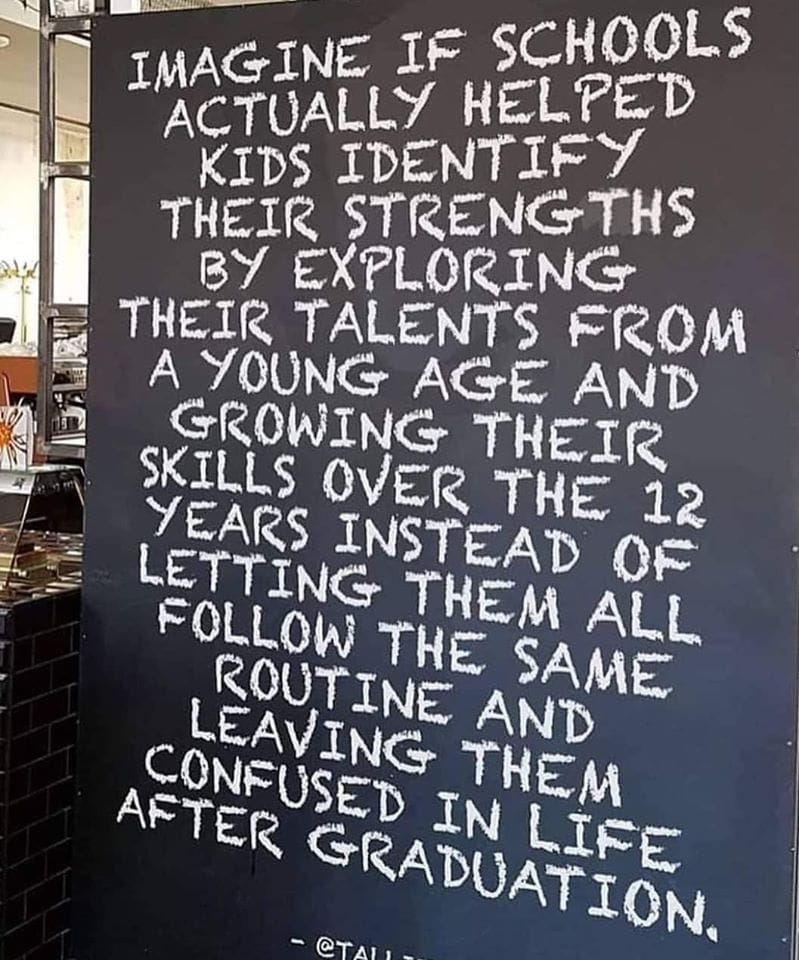
Occasionally, you’ll see someone put forth a visionary principle for public education, like the meme that wonders why schools don’t focus on their students’ strengths. Wouldn’t that be lovely?

Small classes, focused on individual talents and gifts, kind of like Corey DeAngelis’s magnet school. A warm and welcoming community of learners. Ample resources. Ask yourself WHY we don’t have that in every public school (worth noting: some schools get pretty close).

It’s not because educators—or schools, if you will– don’t want to meet student needs. They do.

Just who is trashing public education—and what are THEIR ultimate goals?

What about Homeschooling?

Families who choose to homeschool their children have never been on my negative/activist radar, as a veteran public school educator. I have had both positive and not-so-positive experiences with students who were homeschooled–from a pair of shy, well-behaved sisters who fit seamlessly into the middle school music program due to years of independent music lessons, to a sweet boy who had never really learned to read in the 7th grade and tended to wander aimlessly around the music room, once his mother finally decided to send him to school at age 12.

My ambivalence about homeschooling is likely because I became a teacher in a time when homeschoolers were often young hippie parents who worried that schools would suppress their children’s natural gifts in favor of compliance and standardization.

This was the era of Paulo Freire and Summerhill, and—perhaps my favorite book about education— “Teaching as a Subversive Activity,” by Neil Postman and Charles Weingartner. The subtitle is worth mentioning:  A No-Holds-Barred Assault on Outdated Teaching Methods-with Dramatic and Practical Proposals on How Education Can Be Made Relevant to Today’s World. (1971)

Today, homeschoolers are often escaping what they see as Godless classroom chaos, or a curriculum that acknowledges certain truths about our diversity and honest national history. The pandemic and its aftermath pushed parents on both sides of the masking question into involuntary home academics, and left people frustrated.

So much for drama and relevance, letting children direct their own learning, at their pace and honoring their interests. Instead, as David Labaree and Deborah Malizia note:

Schooling moved from a shared learning and cultural experience that generated a sense of community and common purpose to an individual competition for the grades, credits, extra-curricular achievements and degrees that determine students’ future life chances.

Once college enrollments surged in the mid-20th century, the struggle became a contest to gain admission into the most selective college possible. Rising levels of income inequality have only intensified the competition. One result is the devastating increase in student stress and social disconnection, in a setting where every student becomes a potential adversary in the race for extrinsic achievement, and the relentless pressure hurts students at all levels. 

This is not how schools were supposed to evolve—they were supposed to be sites for building citizenship, democratic equality and opportunity. But here we are.

Still. If Mama wants to educate her little ones at home, I’m OK with that, as long as my tax dollars are not paying for skiing lessons or $500 LEGO sets, part of a misguided voucher scheme.

We are likely to see those kiddos at some point, in the public system, perhaps middle school or high school when the home-school teacher’s curricular expertise across the board founders. Or when one of the kids wants to play in the band, join the chess club or the public school basketball team.

Just as public schools have tried to adapt to their surroundings and unplanned events, like a global pandemic, families have tried to custom-tailor their children’s education. I’m not saying that I think all of those pull-your-kids-out choices were good ones –thinking here about that 12-yr old non-reader, or kids whose parents reject the idea of getting along with people who are very different from you, in a pluralistic society.

But–a strong public school system, built on quality teaching and rich curriculum, still can serve multiple perspectives in a healthy  community, including the desire to educate one’s children at home.

Where I get off the homeschooling train is when homeschoolers refuse to follow community-driven policies. Vaccinations, for example. If you want a free, high-quality public education, or the opportunity to use public schools, at any point, as a springboard for your children’s ultimate goals, you may have to follow a few rules.

The Michigan Legislature is currently considering a registry of all school-age children. Homeschoolers would have to, by law, notify the state that they were homeschooling their children. Beyond that—things like curriculum and testing, which are largely controlled by legislation, for example—there is a great deal of freedom for homeschoolers.

This feels like common sense to me, much like a census or licensing vehicles. Where are the kids being homeschooled—are there are large number in a particular district? Why? Can we expect to see them return to the public school and prepare for that? Where are the kids who are not being schooled at all, home or otherwise—and are they safe? Why do homeschoolers find a simple registry threatening?

It’s interesting how many homeschoolers see this as government interference. Given the increases in homeschooling, this seems like critical data to have: Michigan is home to roughly 1.7 million school-age children, and 1.36 million are in public schools, while 182,000 are in private schools, according to 2022 Census data. That would leave about 150,000 students who are either homeschooled or have dropped out.

That’s a lot of kids. I’d be willing to bet that not all of them are being lovingly homeschooled by teachers with the skills to help them move forward academically.

The Return of the Tradteacher

Been reading about the tradwife lately? Although explicit definitions vary, the general gist is returning to a post-war conception of a stay-at-home wife, most likely with children (or planning for children), in relationships where men make all the family decisions, and control the finances. Reinforcing patriarchal norms and glorifying the satisfying and ‘natural’ role of housewife.

If you’re hearing a touch of cynicism there, well—I lived through a time when the tradwife, even if she was working, could not get a credit card or substantial business loan. While I certainly defend any woman’s right to stay home and support her children and spouse in places other than an outside workplace, the whole “tradwife” schtick (especially combined with the rollback of Roe) makes me itchy.

It also strikes me that tradwives are just another glitzy, social media-driven facet of a larger wave of backlash against a whole lot of un-trad trends in American society: Full-blown reproductive freedom. The continued shrinkage of mainline religions. Honoring personal sex/gender choices. Women running for office and corner offices–and winning. And so on.

I also see lots of pushback against untraditional teaching, curriculum and school organization models. The whole “Science of Reading” battle rings very familiar to those of us who started teaching in the 1970s, when teachers were pushing back against the “Why Johnny Can’t Read” –because teachers theoretically weren’t teaching phonics–crusade in the late 50s.

Nearly all of the folks who taught me were tradteachers, using trad methods, and when I entered the classroom, many of my teaching colleagues were 100% traditional-minded as well: Straight rows, direct instruction, textbook-based, daily homework, and off to the principal should you disobey orders. And some of those folks were effective teachers.

But lots of the opinion writing I see from Moms4Liberty, NYT columnists, conservative politicians and ed-bloggers focuses on how different education looks and feels from the classrooms they remember, decades ago—classrooms that may have been racially and economically monolithic, and headed by a series of teachers who did things in the same way.

Peter Greene recently had a good piece about Gloria Jean Merriex, a Florida teacher who broke out of her traditional mold and had some great success. A couple of lines jumped out at me:

Once she had her degree, she chose to teach at Duval Elementary, where for about twenty-five years she was a middle-of-the-road, competent-but-not-exceptional teacher.

Then came No Child Left Behind, and with it, high stakes testing. In Florida, that meant the FCAT, used to give each school a grade, with rewards for A schools and punitive “interventions” for F schools. In 2002, Duval was rated F.

Merriex was troubled. She concluded that if the school was going to be transformed, she would have to transform herself. She dumped the state pacing guides and teaching materials. When she got caught, she begged Duval principal Lee McNealy for a chance to give her methods a try, and McNealy had the guts and trust to give it to her.  Merriex developed materials and approaches of her own, and for the early 2000s, her choices were unconventional. She wrote raps and dances to do with her students for learning math vocabulary and basic processes. She used call and response, movement and arts in the math and reading classroom. If some of her techniques seem less radical twenty years later, that is in part because of her influence.

For many, perhaps most, teachers, their first years in the classroom might look very much like the way those newbies themselves were taught. It was certainly that way for me, wanting to be the World’s Greatest Band Director and following the exact procedures and ideas I had experienced in bands and at music camp in high school. For many years, I too was a competent-but-not-exceptional teacher, like Ms. Merriex.

I also broke out of the traditional mold, and while not all of the things I tried were big successes, I was able to redefine what I wanted students to take away, for the rest of their lives, from being in my classroom. I accomplished many of those goals. I read social media for music teachers now, and I see great changes in thinking about the Big Ideas—from competition to creativity—in music ed.

Traditional teaching—and like tradwives, the definitions are murky—is not always or even often the best bet. Especially if that teacher’s goal is to move every student under her watch forward.

Stanford Professor Jo Boaler is something of an iconoclast in non-traditional math education, and recently–no surprise–there’s been yet another dustup over Boaler’s ideas.

She advocates for ending tracking by ability in math classes, getting rid of timed tests and starting with conceptual understanding before introducing procedures. Most importantly, she wants to elevate the work that students tackle in math classes with more interesting questions that spark genuine curiosity and encourage students to think and wonder. Her goal is to expose students to the beauty of mathematical thinking.

Right there in the first sentence, there are three uber-traditional practices—tracking, timed tests, and doing a series of problems to iron in an algorithm, to get the right answers rather than seeking to understand the concepts underlying the calculation. And who’s out to get Boaler? Well, men who have been the beneficiaries of understanding and excelling at traditional mathematics.

It’s an enormously complex endeavor, teaching. Sticking to the habitual, and ignoring students who check out, only works for awhile. BUT—listen to legislators and parents talk about schooling, and a lot of what you’re hearing is somewhere between nostalgia and flat-out misinformation. The book-banning, faux CRT, Tik-tok blaming, skeptical-of-teachers crowd hasn’t got a clue about what it’s like to teach kids in 2024, beginning with some clarity about the purpose of public education.

As Jess Piper says, in a wonderful column called You Don’t Like It? Move!:

None of us is safe so long as there are folks living in states that are unsafe. They will roll over us first, and you next. The billionaires are using my state AG and other regressive state AGs to file suit to dismantle public schools. They sue to ban abortion and the medicine for self-managed abortions. They sue to stop college loan forgiveness. They sue to overturn civil rights and anti-discrimination policies.

As Piper says—hey, we can’t all move, or teach in a private school where we can craft our own processes, research and convictions. But returning to traditional methods isn’t the policy answer. You have to move forward. It’s the way of the world.  

Trust (Pandemic, Day #1475)

One of the essential truths in getting a message across is repeat, repeat, repeat. Like the mothers of toddlers, teachers are well aware of this fundamental veracity. No matter how the message is delivered—Pay attention! I’m only going to say this once!—well, no. You’re not.

You’re going to say it as many times as it takes to sink in, and even then, compliance and understanding are iffy.

Here’s my essential truth: It’s been close to 1500 days since the arrival of the COVID-19 pandemic in the United States. And we still haven’t perceived just how transformative it was, dealing with a global threat while trying to keep the things we value most safe. Those things being our health and well-being, our children and families, our communities and livelihoods.

Transformative is a neutral word for all the changes wrought by living through a crisis that killed an estimated seven million people, around the globe. Well over a million of those deaths have happened in the United States, making us the nation with the most COVID-19 deaths, world-wide.

That simple fact, alone—the United States, the place where we brag about having the “best” health care on the planet, was unable to suppress transmission. Once a vaccine was available—lightning fast!—getting folks to embrace medical science and stay on top of protection that might save their lives has been thoroughly politicized and divisive. Those things, on their own, were enough to make one realize that maybe our all-American political thinking was out of whack.

So I repeat: The pandemic has really done a number on us. On our economy. On our family gatherings. On what we expect from our employees, as well as our employers. On health care. On the way we feel about government. The things we value most–including our schools.

Call it The Great Re-ordering of Priorities.

It’s become a habit of mine, when reading stories about education: running the topic or issue through the filter of how they may have been impacted by the pandemic. Here’s one: absenteeism.

Student absences from school rose precipitously during the pandemic, peaking in 2021-22. Attendance rates are improving, overall, but are still higher than 2019.

What’s interesting is that schools with dismal, not-getting-better attendance rates aren’t always the ones you’d expect—absenteeism seems to be impacted by local conditions and initiatives, kids and parents re-ordering their priorities. Not up for school today? Go ahead—take a mental health day. Or five.

Schools struggling with attendance after a world-shaking event? Go figure. It’s going to take some time to fix that, and misinformation about how “unions” “closed” schools, abandoning kids to Zoom, doesn’t help.  From an article on school absences, in the NY Times:

School leaders, counselors, researchers and parents…offered many reasons for the absences: illness, mental health, transportation problems. But underlying it all is a fundamental shift in the value that families place on school, and in the culture of education during the pandemic.

Re-ordering the priorities. And not in a good way.

In her excellent blog, Jess Piper talks about the decline in civility at local school board meetings, among other things, triggered by a pandemic:

Recently, I saw this bad behavior up close and personal when I attended a BOE meeting at a school district outside of St Louis. Though I had an awful interaction with a parent or two in my tenure, I hadn’t witnessed the decline in civility and the outright disrespect shown in public. The lack of couth wasn’t just reserved for teachers, but was also aimed at administrators, board members, audience members, and community members.

One of the first to speak was a woman who brought her daughter to stand next to her while mom called the Superintendent names and defamed teachers. I was upset that the young girl had to stand there while her mother went over her time, refused to stop speaking when told her time was up, and still spoke, even raising her voice, when her microphone was eventually muted. She just kept going.

How did this young girl learn to treat her teachers? She learned disrespect and inappropriate behavior will be rewarded with a slew of applause.

Bingo. All the footage of parents pushing into buildings, upset about masking or sports or vaccinations hasn’t been conducive re-building respect and trust. And trust is a core resource in successful public schools.

Lucian Truscott has a great piece (link here) on realizing, in the grocery  store, that his fellow shoppers  weren’t maskedthat he himself, in fact, had stopped routinely masking. He acknowledged that he trusted himself and his neighbors to take responsibility for protecting themselves from COVID.

 It was a nice moment for him, thinking about the word trust—how long it takes to re-build simple neighborly trust, especially when it’s been shattered by transformative events. Expecting our public institutions to remain unchanged or “bounce back” is happy talk. We’re in the midst of some pretty significant shifts.

After the pandemic of 1918:

The Spanish Flu greatly affected the world economy, wiping out large numbers of healthy 18- to 40-year-olds. In Britain, during the Summer of 1918, in a single day 80 out of the 400 workers of a spinning factory perished. In many countries which had seen their male population decimated by the war, the pandemic left even fewer young men to run the farms and factories.

The resulting labor shortage enabled workers to demand better living and working conditions, public health care, as well as better wages. These became major demands of workers not only in Europe and the United States but in many other countries around the world. 

Once again: We are underestimating the impact on the nation, and especially our children. of living through a global catastrophe Let’s put our focus on the right priorities. In spite of all the challenges to public education, it’s still the best bang for your tax buck, in perpetuity. Good schools make for good communities.

Trust is a cornerstone. Repeat, repeat, repeat.