Absence Makes the Smart Go Wander

Recently, Bridge Magazine—a Michigan-focused news venue—ran a series of articles on the appalling numbers of absences that Michigan schoolchildren have been racking up since (and, let’s be honest, before) the pandemic.

Last year, more than a quarter of Michigan students, nearly 388,000, were considered “chronically absent,” which includes excused and unexcused absences — everything from sickness and appointments to skipping school without parents’ knowledge. Before the pandemic, there were 290,000 chronically absent students, or 19.7% of public school students. 

The definition of chronically absent? Ten percent of the school year, or 18 days. There’s a handy little infographic where you can see how your district ranks, and how their absence rate has fared in the past six years. I was happy to see that the suburban school where I taught for more than 30 years, and the district where I now live and volunteer have low absence rates, generally a mark of an economically secure community. Kind of like test scores.

Also—like test scores—high rates of absenteeism are something that outside observers (read: Bridge Magazine) seem to want to pin on school districts. Here’s a headline: Unlike Michigan, Indiana got tough on missing school. It’s already working. Bridge features a story about the low absence rate in Fremont, Indiana, just across the border, with a photo of a motherly kindergarten teacher and her (white) students.

‘New [Indiana] laws standardize school response to absences, threaten criminal action against students and families and create a reporting system that streams data daily from individual classrooms to state officials.

Fremont has fewer economically disadvantaged students (about 40%), which researchers tie to increased absenteeism, but district leaders say they also have stepped up effort to help get kids in school. Small buses pick up homeless students, schools offer telehealth and dentistry care and a countywide “teen court” serves as a first accountability step for some truant teens.’

Well, bully for Indiana—especially for picking up homeless kids and offering wraparound services for those who might be inclined to skip school because they can’t get there, or their clothes are dirty, or their tooth hurts. I’m guessing that if Michigan schools could lower their rate of disadvantaged students our absence rates would also drop. As for threatening criminal action—truancy has been a recurring issue since forever, and carrots work better than sticks in encouraging positive habits and behaviors.

In one of Bridge’s articles about the Shocking Absence Crisis, this interesting tidbit appeared:

‘Last year, 162 school districts — 59 traditional and 103 charters — faced potential financial penalties for school days when fewer than 75% of students showed up. In five districts, all charter schools, the 75% threshold wasn’t met at least 22 days, according to data provided to Bridge Michigan by the Michigan Department of Education.’ 

There are about 540 fully public (not charter) school districts in Michigan, and around 300 charter schools. Data is murky—but thumbnail math says that just over 10% of fully public school districts (which includes many large urban districts and small, remote rural schools) have serious attendance problems. Meanwhile, over a third of charter schools (which are smaller and more select) are struggling with absences—and the most egregious rates (the ones dragging down the statewide numbers) come from charter schools.

Bridge did not provide that analysis. Interesting.

When thinking about the results of so many kids missing school, Bridge naturally turns to test scores. I’m not even going to summarize, because it’s exactly what you’d expect: kids who don’t go to school very often get lower test scores and struggle to learn to read. But that doesn’t mean they’re dumb, or unworthy. It means we’re not digging into the real roots of the problem.

The more essential questions are why kids aren’t attending, and how to bring them back into the gotta-go-to-school fold. What people and programs might fill their needs, invite them into a safe community?

With elementary students, absences are tied to parent behaviors—so Fremont, Indiana has the right idea: buses, free health and dental care, after-school programs, etc. With older students, building communities—sports, clubs, co-ops, supervised hangouts—are lures, but in the end, teenagers come to school to learn, to let their minds wander. When that doesn’t happen, if there’s nobody dragging you out of bed in the morning, why bother?

Here’s a footnote to the discussion: Should Kids Miss School for Vacation? Parents Say Yes, Teachers Aren’t So Sure. Synopsis: Parents are defensive about getting better prices on a Disney or skiing vacation and pulling their kids from school for family fun. Teachers are resentful about being required to rustle up packets and other busy work while Kid misses classroom discussions and contributions to group projects. Grades become an issue.

Speaking personally, I’ve never flipped out over kids missing a few days, especially if you get advance warning and a request for work that comes back completed. Learning is never uniform and predictable, and learning (not filling boxes in the gradebook) is the ultimate goal. Right?

I’ve been asked to excuse a two-month absence for a boy traveling to Egypt with his energy engineer father, and dealt with a championship snowboarder who missed most of a marking period but came back with Olympic and career goals, and a fistful of medals.

The first boy was an A student. He couldn’t make up what he missed—but the life experience more than made up for that. The second boy read at a 2nd grade level, a fact reinforced by several teachers when his parents told us about the tour of events he’d entered. Finally, his mother said: So we shouldn’t let him do what he’s so great at—we should make him stay here and fail all his assignments? How does that help him?

I have thought about her many times. Partly about the privilege well-heeled white parents have in managing their children’s absences—but also in considering why students stop coming to school.

If kids aren’t showing up to school, maybe it’s not about better data streams or legal threats, or texting their parents at the right time.

Maybe they don’t want to stay in school and fail their assignments, convinced that nobody cares much. What should we be doing about that?

“Union Mouth”

So—when we’re immersed in the pre-election floodwaters of political revenge speech, it’s easy to snicker at the misfortune, if that’s the word, of right-wing social media edu-star Corey DeAngelis.

DeAngelis is—was?—the real deal, in education policy world. Not the kind of education policy that would re-build or energize our public schools, of course, but an attractive and even charismatic mouthpiece for the anti-union/school choice/privatization movement.

If you’re unclear on what happened to DeAngelis, last week—here’s the story.  (And here’s an interesting, even kind, response, from another one-time school choice advocate.)

If this were, say, 2014, when Corey DeAngelis was pursuing a skeezy “alternative career” that eventually became public knowledge, lots of folks would see it as an inside-baseball kind of chuckle—conservative education spokesperson gets caught being himself, ho-hum.

But the nature of public discussion about our schools has changed.

There have always been—going back to Thorndike vs. Dewey—vigorous arguments about the right way to do public education. Most people (including people who work in actual schools) don’t pay attention to these theories, philosophies and policies, unless they’re directly impacted. They focus on other aspects of schooling. And parents, by and large, are happy with the public schools their kids attend.

One of the things Corey DeAngelis contributed and honed, in these verbal ed skirmishes, was nastiness. The kind of unsubstantiated nastiness that we’re now hearing every day from political candidates on the right. Words like lazy, dumb, failing, greedy, groomers, socialists—and, of course, unions as root cause of all that is wrong with America and her children.

DeAngelis is one of the leading spokespersons, on social media, in the wave of anti-public education discourse we’ve experienced in the past eight years or so.  I wrote about some of the things he’s said, in respected publications, last May.

I posted a tweet about that blog post, asking WHY DeAngelis and others are trashing public education? What’s in it for them? Because this onslaught of anti-public education blather is not doing the nation and its children (no matter where they go to school) any good. This WHY was a serious question, BTW.

I got lots of tweeted responses, from DeAngelis’s army of followers, to whom I would ask the same question: What, actually, are you fighting for, when it comes to education?  Here are a few of those tweets:

Union Mouth! (followed by a string of vomit emojis)

I took my kids out of the gladiator academy/commie indoctrination center. Best choice I ever made.

Staffed by mediocrities (sic) who act like martyrs

Corey is bringing the future of education. Say goodbye to your current paradigm of croneyism and union interference.

The govt “school” system is nothing more than a taxpayer pipeline to labor union coffers, used to then (re-)elect politicians who promise more money for the pipeline. Education was never the point.

Public schools are a Dredge (sic) on society. Teachers are even worse.

And—my personal favorite:

Retire, you old hag.

I found myself blocking responses from people with names like—and I’m not making this up—Sexy Fart Bubble. Also wondering how school policy went from being a question of qualified staff and resource allocation to taking ugly potshots at teachers, school leaders and the millions of families who rely on public education.

I know better than to sputter about—or worse, respond—to random on-line vitriol. It’s acceptable now, evidently, to lie on public platforms; calling attention to falsehoods (or snickering at a messenger’s personal problems) is a distraction from focusing on what matters in debates about our schools.

Because—contrary to what Corey DeAngelis’s followers expressed, education has always been precisely the point. For better and worse, for everyone involved. Education has never been settled science. Our children are exposed to different influences and technologies than the previous generation of students; likewise, educational practice has to evolve.

Serving children’s educational needs adequately will—must—shift over time. And change is hard. Working through the changes, especially after a global disruption, demands civil discourse. Professional judgment. And an appreciation for facts.

Not lies.

So—no schadenfreude over seeing someone, whose minions called me “Union Mouth,” be exposed and having his name quickly erased from an array of education non-profit websites. There are far bigger fish to fry at the moment.

When one of your options for Leader of the Free World is seriously threatening to deport 30 million people, a large percentage of whom are children, it seems wrong to fuss over books somebody’s mom doesn’t like. Or spend a lot of time and effort trying to persuade people that teachers’ organizations, with their focus on working conditions in our schools, are harming children.

With all the free-floating fear and loathing in the American zeitgeist right now, it’s harder than ever to establish a classroom where students can develop the confidence to be a community. I am 100% on the side of educators who declare that students can’t learn unless they feel safe. The corollary to that is that teachers can’t learn and grow unless they feel safe, as well.

We are living in unsafe times.

If you want to influence policy change in public education, bring your best ideas and an open mind. Leave the nastiness behind.  

Just Who is Trashing Public Education?

Get ready for a big dump–a deliberately chosen word–of anti-public education blah-blah over the next five months. It’s about all the right wing’s got, for one thing–and it’s one of those issues that everybody has an opinion on, whether they went to public school. have children in public schools, or neither.

Public education is so big and so variable that there’s always something to get upset about. There’s always one teacher who made your child miserable, one assigned book that raises hackles, one policy that feels flat-out wrongheaded. There’s also someone, somewhere, who admires that teacher, feels that book is a classic and stoutly defends whatever it is—Getting rid of recess? The faux science of phonics? Sex education that promotes abstinence? —that someone else finds ridiculous or reprehensible.

Not to mention—teaching is the largest profession in the country. So many teachers, so many public schools, so much opportunity to find fault.

In other words, public education is the low-hanging fruit of political calculation. Always has been, in fact.

A few years back, when folks were going gaga over Hillbilly Elegy, seeing it as the true story of how one could rise above one’s station (speaking of blahblah)—the main thing that irritated me about ol’ J.D. Vance was his nastiness about public education. Vance has since parlayed a best-seller that appealed to those who think a degree from Yale equates to arriving at the top, into a political career—and putting the screws to affirmative action, in case anyone of color tries to enjoy the same leg-up he did.

J.D. Vance’s education—K-12, the military, Ohio State—was entirely in public institutions until he got into Yale Law School. He doesn’t have anything good to say about public ed, but it was free and available to him, a kid from the wrong side of the tracks. When I read Rick Hess’s nauseating interview with Corey DeAngelis in Education Week, I had a flashback to ol’ J.D., intimating that he achieved success entirely on his own, without help from that first grade teacher who taught him how to read and play nice with others.

DeAngelis says:

I went to government schools my entire K–12 education in San Antonio, Texas. However, I attended a magnet high school, which was a great opportunity. Other families should have education options as well, and those options shouldn’t be limited to schools run by the government. Education funding should follow students to the public, private, charter, or home school that best meets their needs. I later researched the effects of school choice initiatives during my Ph.D. in education policy at the University of Arkansas’ Department of Education Reform.

So—just to clarify—Corey DeAngelis went to public schools K-12, for his BA and MA degrees (University of Texas), as well as a stint in a PUBLICLY FUNDED program at the notoriously right-focused University of Arkansas. That’s approximately 22 years, give or take, of public education, the nation-building institution DeAngelis now openly seeks to destroy.

I’m not going to provide quotes from the EdWeek piece, because anyone reading this already knows the hyperbolic, insulting gist—lazy, dumb, unions, low bar, failing, yada yada. He takes particular aim at the unions—although it absolutely wasn’t the unions—shutting down schools during a global pandemic. He paints schools’ turn-on-a-dime efforts to hold classes on Zoom as an opportunity for clueless parents to see, first-hand, evidence of how bad instruction is. He never mentions, of course, the teachers, students and school staff who died from COVID exposure.

Enough of duplicitous public school critics. My point is this:

The people who trash public education—not a particular school, classroom or curricular issue, but the general idea of government-sponsored opportunity to learn how to be a good, productive American citizen—have a very specific, disruptive ax to grind:

I got what I needed. I don’t really care about anybody else.

This goes for your local Militant Moms 4 Whatever on a Mission, out there complaining about books and school plays and songs and health class. It’s not about parents’ “rights.” It’s about control. And never about the other families and kids, who may have very different values and needs.

It’s about taking the ‘public’ out of public education. And it’s 100% politically driven.

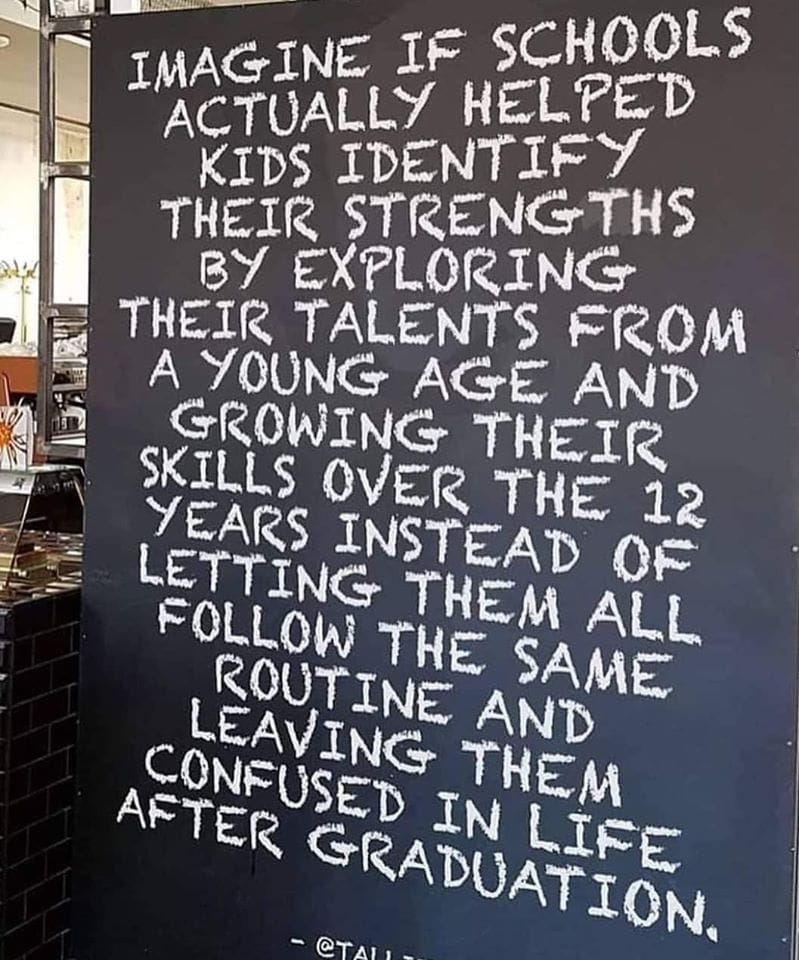
Occasionally, you’ll see someone put forth a visionary principle for public education, like the meme that wonders why schools don’t focus on their students’ strengths. Wouldn’t that be lovely?

Small classes, focused on individual talents and gifts, kind of like Corey DeAngelis’s magnet school. A warm and welcoming community of learners. Ample resources. Ask yourself WHY we don’t have that in every public school (worth noting: some schools get pretty close).

It’s not because educators—or schools, if you will– don’t want to meet student needs. They do.

Just who is trashing public education—and what are THEIR ultimate goals?

Do Public Schools Suck?

Some years ago, John Dubie, then a high school senior in Vermont, posted a very personal, autobiographical blog entitled “Big Picture Saved My Life.” John meant that statement literally—the Big Picture curriculum and program at South Burlington HS was the thing that kept him going when he was thinking about checking himself out.

I was stunned by the aftermath of the piece, which was picked up, reprinted and dissected in a number of other blogs. I was especially surprised by those commentaries that suggested John’s life was saved by leaving traditional public school.

The irony? Dubie spent much of the blog describing the first eight years of his education in a Catholic school, where he was generally seen as a disruptive loser by the faculty. And– the Big Picture Learning program he credits with making all the difference was housed in a traditional public school, in Burlington, Vermont,

Because I was the person who suggested John tell his story in public, this re-interpretation of his autobiography made me see red. I said as much, in the comments, noting that his generosity shouldn’t become a cheap excuse to slam public education again. I said: What I’m worried about here is protecting a young man who graciously shared a deeply personal reflection having his story–and his face– used to promote the idea that public education sucks.

The response I got: Seriously? Of course public education sucks.

Do public schools suck? Is that the conventional wisdom, the reflexive, global response these days? Do we have to start with the conviction that public education has failed, before we can transform or improve, regenerate or revitalize a fully public system?

I say no. In fact, the best time to change public education is now, while its strengths, resources and merits still exist.

What questions should we be asking about public education, before reflexively tearing it down? What facts shape the argument that public education, as a concept, is well worth saving?

  • All governance models–public, chartered, independent, parochial—have produced exciting schools and disastrous schools. There are plenty of students who thrive under direct-instruction, highly structured, traditional content-delivery models. And others who learn best through self-directed exploration of ideas and subjects that interest them. There is no one best way to learn.
  • Public education remains the Big Kahuna of governance models in the U.S. Why would you tear down the considerable and historic infrastructure of a system that has educated–however imperfectly–generations of (successful) Americans, instead of updating it, repairing its cracks and flaws and outright malfunctions? Other nations have retrofitted their public systems, using both research and imagination. Why wouldn’t we?
  • When and where public education is not meeting the needs of students, why is that so? Public education has been radically re-shaped in the last two decades, driven by “reform” policies and experiments that clearly aren’t yielding the expected results (and that’s a very sanguine assessment). If public schools suck, we certainly haven’t found the magic formula to fix them. Probably because the answers involve hard work, multiple strategies and serious investment.
  • Public education is the only “choice” when other options are exhausted, so public schools are filled with our poorest children, those whose parents cannot provide transportation or uniforms or help with algebra homework. Some of those schools are creatively addressing problems, building communities and family relationships, persisting even if testing data remains low. Do they suck?
  • Who’s saying that public education sucks–and why are they saying it? For some parents, the fact that their child doesn’t get a custom-tailored learning experience or enough attention is reason enough to believe that all public education is substandard. For others, there is a knee-jerk assumption that the only good education is a series of competitive-admission, high-ticket private schools. Much of the anti-public education drumbeat springs from a politicized, media-fed conviction that public schools have failed, based on testing data alone. You have to ask: What’s in it for the most vocal and persistent public school critics?
  • You don’t really know what a particular school or classroom is like until you’re there. We’ve all read the polling data that shows parents generally think the schools in their community are pretty good; it’s the schools in other places–scary urban places, or maybe just the next district over, or public schools across the nation–that are terrible. I’ve been in plenty of classrooms in Detroit Community Schools where there was order, curiosity, learning–and joy (and usually, about twice as many kids as there should be). In the middle of poverty, there are pockets of triumphant accomplishment.

Shouldn’t we be shoring up public education, as America’s best idea? Shouldn’t we be investing in repair, enhancement, innovation? Let’s stop with the facile pronouncements on the failure of public education–they reveal failure of imagination and democracy.