Are You an Instruction Geek?

I generally don’t pay much attention, anymore, to the rightwing young guns who dominate edu-social media. Mostly this is because they’re not providing any new content about what you might call school improvement—genuinely interesting or useful ideas for making lessons interesting, building curriculum that makes sense in 2024, figuring out better ways to assess student work and encouraging students to get excited about learning.

You know, the things that support the people actually doing the work of teaching in the public schools—where 82% of our K-12 students are educated. Instruction.

In the five decades since I started teaching, reading and writing about all aspects of schooling and education policy, there have been hundreds of such new ideas. Some were genius, some fizzled out, some—annual standardized testing springs to mind—are now part of what everyone thinks is normal, maybe even essential. Even though these ideas may have harmed many children.

The yappy bow-ties posting on the regular about how public education is a big fat failure aren’t offering us genius ideas. They’re focused on vandalizing one of America’s great strengths: a free, high-quality public education for every child, no matter what they bring to the table.

Prime example: Daniel Buck, whose X-label is “Instruction Geek.”

Buck actually did teach for a few years, shifting from public education to private, three schools in what looks like six years. Then he wrote a book and informed his following that he was, sadly, leaving the classroom to put his intellect to better use, writing blogs—as a ‘policy and editorial associate’ for a conservative non-profit.

For a guy who pretends to have cool, juicy ideas about instruction, lots of his posts seem pretty rigidly political and not about teachers’ professional work at all.  A sampling:

  • Conservatives need to start thinking about, building, and regaining control of our education institutions after school choice becomes the law of the land. Won’t do much good if all charter and private schools are stocked with teachers, curriculum, and policies out of ed schools.
  • Teachers, stop voting for Democrats. Their education policies sound nice but again and again just make our schools worse.
  • Once again, I repeat: MORE MONEY WILL NOT FIX AMERICAN SCHOOLS.
  • Students should be expected to obey their teachers. Seems pretty common sense to me but sadly, a statement that must be made.

The last one made me think that perhaps Mr. Buck’s former students had ideas of their own about, umm, instruction, but maybe I’m reading too much into his little outburst.

A couple of days ago, Mr. Geek Buck posted something that’s actually about instruction:

Sorry but one teacher cannot differentiate every lesson for 27 different kids whose reading level ranges from 1st to 11th and account for 6 different IEPS. The inclusion/no-tracking push is simply unworkable.

There were a few affirming responses—because clearly, classroom teaching is impossible; the only way to give each individual child precisely what they need is one-to-one tutoring. And, by the way, that doesn’t work so well either.

I started thinking about differentiation in my own classroom. My typical class size hovered around 65 middle school students. Their reading levels ran the K-12 gamut, and I frequently had a dozen or more special education students (with varying disabilities and strengths) in a class. Some students were inclined to disobedience, things that couldn’t be remedied by mere expectations. Oh—and they were all holding expensive noisemakers.

My job was teaching them to make pleasant and accurate musical sounds, then combine those sounds, using an entirely new symbolic language, into music, with regular performances for their parents, their peers and the community. I also had to weave some cultural and historical information into the instructional mix—things that would help them see the beauty and value and joy of what they were (inexpertly) crafting.

Everyone was included. Nobody was tracked (beyond being in the band with their grade-mates). Some of my band-teacher colleagues had auditions and sorted their students into a top ensemble, and lesser-light bands. The drawback to painstakingly dividing groups by “ability” is that ability is really hard to measure, and students who are deemed sub-par often drop out. Students also learn at different rates. The kid who’s way behind in September may be caught up in January and at the top of the class at the end of the year.

I’m fully willing to admit that there are many ways to teach kids important content, but I never met anybody who made 27 lesson plans for a single class. Most differentiation happens across the instructional cycle—presenting new material multiple times in multiple ways, offering different forms of an assignment, assessing work based on what you know about that student. Student choice can be a big part of differentiation.

And sometimes, of course, they all take the same 10-question quiz, so you can get a handle on who’s got it reasonably well, and whose understanding just isn’t there. That’s OK, too. You don’t have to divide them into tracks. They already know who’s smart and who is struggling.

I love nothing more than talking about instruction. Pedagogy is my jam. And I resent people self-appointing as instructional leaders and experts, when all they’re doing is using public schools for target practice.

Here’s one more from the iGeek:

Advocates are trying to retrofit schools to do all that families should / used to — from feeding three meals a day to teaching basic behavioral norms. They are failing at doing so. No public institution can correct for the breakdown of the family.

Be wary of the word “should”—always—but take a look at what teachers are accused of here: teaching good behavior and feeding kids. Maybe no public institution can truly fix the breakdown of families. But don’t schools get credit for at least trying?

Bomb Threats in Schools

Raise your hand if you’ve ever experienced a bomb threat in your school.

I have, perhaps a half-dozen times over the span of a few years, teaching at both a middle school and a high school. The first time was mostly confusing. There was a P.A. announcement, and—following fire drill procedures—we led our classes to the far edge of the parking lot, where they stood in ragged lines. Most of the students were nervous and joking about who might have called in a bomb threat. The police came, with dogs, and went through the building. Nada.

The next time it happened, that year, it was cold and snowing. Kids went outdoors without coats. Buses were dispersed as soon as the drivers could get there, and 600 shivering kids were sent to the HS, two miles away, and sat in the auditorium for a couple of hours. They were bored and restless and had to go to the bathroom NOW because it was AN EMERGENCY.

Teachers clustered in the aisles, quietly sharing the names of kids who were absent and speculating. Someone found a VCR in the projection booth and put on a G-rated movie, which acted as an ineffective numbing drug.  We ended up losing close to three hours before the building was cleared and we could go back.

Then it happened again. Kids were bused again. But this time, the Superintendent came in and tried to scare them straight. We WILL find the culprit, he said. He WILL be expelled, and maybe spend time in Juvie. If you’ve heard anybody say they know who did this, tell us. We’ll protect you and it’s the right thing to do. Just tell the principal or one of your teachers.

Now—I taught in a nearly all-white, suburban school, where most parents had college degrees and came to parent-teacher conferences. They didn’t want their kids to lose learning time because a couple of delinquents thought it was funny to call in what amounted to terrorist threats.

I mention that it was an all-white school not because Black or Hispanic parents would expect or tolerate bomb threats – they wouldn’t, then or now—but because there was no small, minority group of students to automatically blame (as, let’s be honest, would have happened, evidence-free). Whoever called in the threats was most likely one of our own white kids, living in a nice subdivision with their mom and dad.

The fourth time it happened, teachers were privately notified by notes sent from the office. See anything unusual in your classroom? Restrooms will be closed during passing time. There will be cops in the hall. There had been a bomb threat at the high school, too (where I was supposed to be headed, later in the afternoon). Rumors swirled.

In Michigan we take bomb threats very seriously. The worst school disaster in Michigan—the Bath School Massacre, nearly a century ago—killed 38 children and 6 adults, injuring 58 others. It was a homemade bomb, planted and set off by a school board member, angry about taxes. (Really.) Sometimes, tragedy set off by idiots actually happens.

The bomb threat caller at my school was eventually identified and known only to officials. Teachers were not informed, nor was the public, leading one to believe that the bomb caller was probably in the 7th grade or thereabouts. They disrupted learning, cost the district significant money and made a lot of people apprehensive. They made school leaders’ lives miserable, and spurred parent demands.

They metaphorically yelled FIRE! in a crowded theater. But nobody was injured or dead.  These days, when real-life school shooters have terrified, injured or killed more than 338,000 kids in the past quarter-century, that’s a success story.

Those calling in bomb threats to elementary and middle schools in Springfield, OH—not to mention a hospital and City Hall–are terrorists, all right. And the targets of their wrath are innocent children. They fall into the most dangerous category of would-be school bombers: Hate bombers. Those who would kill the vulnerable for ideological, racial, religious or ethnic reasons.

And, as the harried Mayor of Springfield correctly noted: It was their words that did it.

Whose words? Why, their own Senator from Ohio, who admitted he may have “created” the story of abducted dogs, cats and geese. And his blabbermouth running mate, who wants to run American Carnage Nation again.

Karine Jean-Pierre, Biden’s Press Secretary on the migrant pet hoax: What is happening here is an attempt to tear apart communities … maybe we should not have leaders who fall for fake internet conspiracy theories. We should think about that.

But, of course, Trump saw the pets-for-dinner story on TV. So it must be true.

I wonder if he saw the smashed windows and shutdowns. Or the Proud Boys.

Fomenting violence! Against children! What a disgrace.

If you’re still hanging around Twitter (and good on you if you’re not)—look up New York Times Pitchbot, authored by @DougJBalloon. Who may have made the most bitterly satirical post about the whole bomb threat situation in Ohio:

I have never been a supporter of Donald Trump. But if Democrats cannot keep his diehard fans from making bomb threats to schools, I’ll have no choice but to vote for him for a third time.

Forget the “Undecided.” Focus on the Timid.

I read the NY Times daily (I know, I know…) and am an avid follower of their political focus groups. Little sketched heads with thumbnail descriptors (“Bill, white, Florida, 73 years old, voted Trump in 2020”) and their responses to some pretty good policy- and character-focused questions.

To which, they give answers which make me wonder just who their 9th grade Civics teachers were. Lately, the spotlight has been on “undecided” voters, nearly all of whom, IMHO, decided long ago whether to vote and which holes they’ll be punching, behind the curtain, but are anxious to be recognized and asked about their views.

I guess there’s some social cachet in being an “undecided” voter—so discriminating!– but for anyone who can name the people running for President and Congress in their state and district, this election feels like there’s been plenty of information and exposure to what the candidates represent:    The New York Times says undecided voters want more “fine print” details. Really? They’re so lightly engaged that they haven’t made up their minds yet, but they want to dive into the intricacies of tax policy? Unlikely.

In addition, the 67 million people who tuned into the debate on Tuesday got an incredibly clear picture of the candidates’ character and policy goals (or lack thereof).

Here are the people who interest me: The timid. The folks who claim to not be interested in politics. The ones who blanch at the critiquing of men too old and confused to lead the most powerful nation on the planet. Who just want to, you know, get along.

Some of these are people whose votes represent old habits, the influence of their social circles. Some of them are fearful.

Whether that’s fear of change (Will the country finally get a woman in the White House? Will a new president mean that I lose privileges I currently enjoy?)–or fear of breaking away from baked-in but no longer relevant beliefs (Republicans are pro-business and therefore better understand economics, right?), it’s hard to say.

I have written about these voters before—the ones who seem to operate from the gut, whether their gut was telling them to be angry, suspicious… or joyful.

Fact-checking engages only the most involved and informed voters. It doesn’t matter how many times you point out who wrote Project 2025, and how deeply they are enmeshed in the Trump campaign, if you got an oversized postcard from Trump (got four this week) saying he’s disavowed it, well—who are you going to trust?

This is how voters get suckered into believing literally ridiculous claims (Pets for dinner! Executing newborns!) and conspiracies.

Since President Biden’s withdrawal in July, I have joined three Facebook groups and re-activated my interest in another, all groups of women who are planning to vote for Kamala Harris. One group goes all the way back to the Womens March in 2017. Collectively, there are over half a million women reading and posting to these particular groups. And there are hundreds more of these pages, around the country.

And what gets posted and discussed—long, long discussion threads—is fascinating.

It started out with middle-aged women in pearls, blue nail polish and Chuck Taylors. The things they’ve made—hand-painted signs, KAMALA quilts, jewelry and So. Much. Blue.  It was fun to skim, and thousands of new women were joining every day, calling out their towns and looking for friends’ names.

People would post stuff like: My husband says no yard signs, so I just made this blue wreath (beautiful photo) for our front door, and a few hundred women would compliment the wreath and a handful might wonder out loud why the wreath-maker doesn’t get a vote, re: yard signs.

The tone is generally upbeat—finding each other, sharing values—but there have been many, many thoughtful threads discussing how to deal with Trump voters among your friends and family. Some of those conversations are heartbreaking; you realize how divided we have become, and why.

There’s chat about issues, including but not limited to abortion. In every thread, there is someone who says Thank God for this group. I have nobody to talk to.

This is a real thing, this political loneliness. (See,for example: The Lonely Anger of Democratic Women in North Carolina.)

It all comes down to circles of influence. Who do we talk to? Who do we believe?

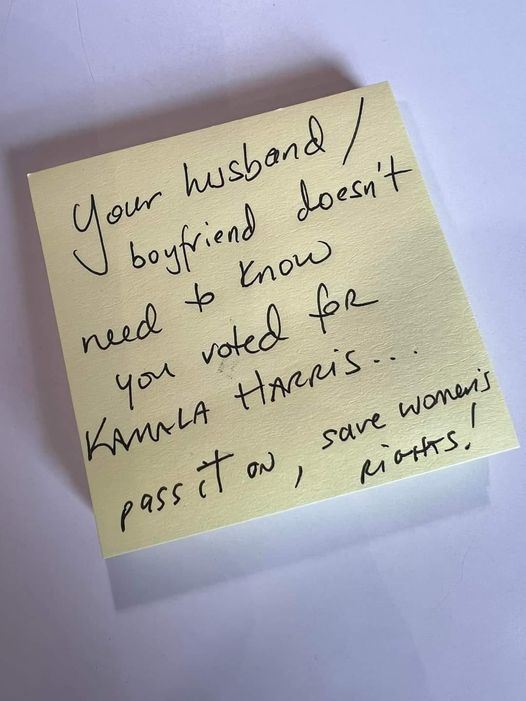
That’s why the post-it note campaign, reminding women that their vote is private, via a little fluorescent square in a public or business restroom, moved me to near-tears.

It’s easy, now, to think that my vote has always been my own, but I’ve lived through eras when women voted as their husbands told them to. My grandmother got to vote, for the first time, in 1924, at the age of 34. I asked her if she remembered who she voted for. She couldn’t, but she did remember asking her younger brother who to vote for.  And she voted for that party for the rest of her life—another 70 years!

This may be the year that women decide to take back our rights.

In the absolute privacy of the voting booth.

What Do Parents Know About Public Education?

Not much.

But don’t take my word for it. Kappan recently took a look at American adults’ knowledge of public schools:

Our findings shed light on a key question: What do adults know about U.S. education? Specifically, what do they know about what is taught, who makes decisions, the role of parents, and the belief systems driving education policy? Our results have important implications for how we might support children and improve the education system.

No kidding, Sherlock.

The survey results would come as no surprise to veteran public school educators: Half of adults don’t know what is/is not taught in their local school. Most are unsure about who’s making curricular decisions. Most are unclear on the impact of privatization on their public schools. Some of the surveyed issues (Critical Race Theory and learning loss) revealed a complete lack of understanding.

Least surprising finding: Adults’ perceptions of what’s happening in public schools mainly come from their own personal experiences (and this includes people with no K-12 children in the home). The percentage of people who read books or articles, watch cable news or videos, or listen to podcasts about education is small. People who get their education news from newspapers? Fifteen percent. Second highest source of ed news? Social media.

That’s a lot of guesswork, memes and faulty memories.

Kappan makes the case that more information means that the general public will make better choices around education—correctly evaluating the corrosive impact of privatization, say, or understanding why a teacher can’t create 30 different assignments, or seeing the benefits of teaching real history. Better communication will lead to better schools, they say.

Well, maybe.

As Larry Cuban says, we’ve been fixing public schools again and again and again, frequently with little or no evidence that our bright ideas will be effective:

Ideologies and political power matter far more than research-derived evidence. Very little evidence, for example, accompanied the New Deal economic and social reforms to combat the Great Depression in the 1930s. Nor did much evidence accompany the launching of Medicare or the Elementary and Secondary Education Act in the 1960s. And very little evidence drove federal oversight of U.S. public schools in No Child Left Behind (2002). Reform-driven policies are (and have been) hardly research-based.

Again—anyone who’s worked in a school for years can testify that, yes, ideologies and political power matter more than research or concrete evidence. And much of that local political power (elected boards, school administrators, influential parents) yields decisions based on personal experience, decades earlier. No evidence or data in sight.

Here’s an example. Some years ago, the curriculum director in my district proposed a new student reporting system for all our elementary students. Instead of grades—a single grade for each subject, plus a checklist for appropriate behaviors—he created a complex system wherein teachers would evaluate multiple objectives for each subject. The number of objectives would increase, in each of the six reporting cycles, until the final report card, which would include the entire years’ curriculum, laid out in sequence.

It meant the teachers would be evaluating—from introduction to mastery—well over 100 skills and knowledge nuggets. Six times a year, for 30 students. Parents would be given several pages of personalized data, a detailed guide to the entire grade-leveled curriculum, as laid out in the district’s master plan (which the teachers called ‘the black notebooks’), and concrete evidence of their children’s progress.

He actually got this plan through the school board, buoyed by professional journal articles about standards-based assessment. Teachers were less than enthused.

But the plan ultimately failed because parents emphatically did not want pages math and language skills. They wanted grades. They knew what a B+ meant. They did not want to know whether their child could calculate a percentage or identify the subject of a sentence. That was teachers’ work.

Another example: How do we cope with teacher shortages? States and districts all over the country are scrambling to fill positions. Any teacher could give you the right answer: Pay teachers more. Provide adequate resources. And give teachers control over their professional work.

Why are we even talking about reducing qualifications for teaching? Do parents want under-qualified pseudo-teachers heading their kid’s classroom? I doubt it. Recent surveys asked students which quality made teachers “good.”

If you’ve been a teacher, you know the top—73%–answer: They cared about me, as a person. If a would-be teacher cares about students and their learning, they’re willing to jump through the hoops of certification and preparation. They’re willing to invest in a professional teaching career.

And—what do parents know about college? That college is the path to a better job? That getting into the ‘right’ college means everything? Not so fast. College loans burden 43 million Americans who might otherwise be investing in housing. Or—attn, JD Vance!—starting a family.

Parents who support public education by putting their kids into neighborhood schools, then paying attention to what comes home—stories, student work—are doing exactly what makes schools community centers and produces good citizens.

My story about the Report Card from Hell is evidence of this. Parents felt free to critique a new plan (based on their personal experiences and preferences)—to the point that the plan was scrapped. Administrators got over their ‘research says’ biases. Teachers weren’t spending additional weekends cross-referencing student work and checklists, for information that could change tomorrow. The community was satisfied.

What communities need is not more information. It’s trust in their public schools.