
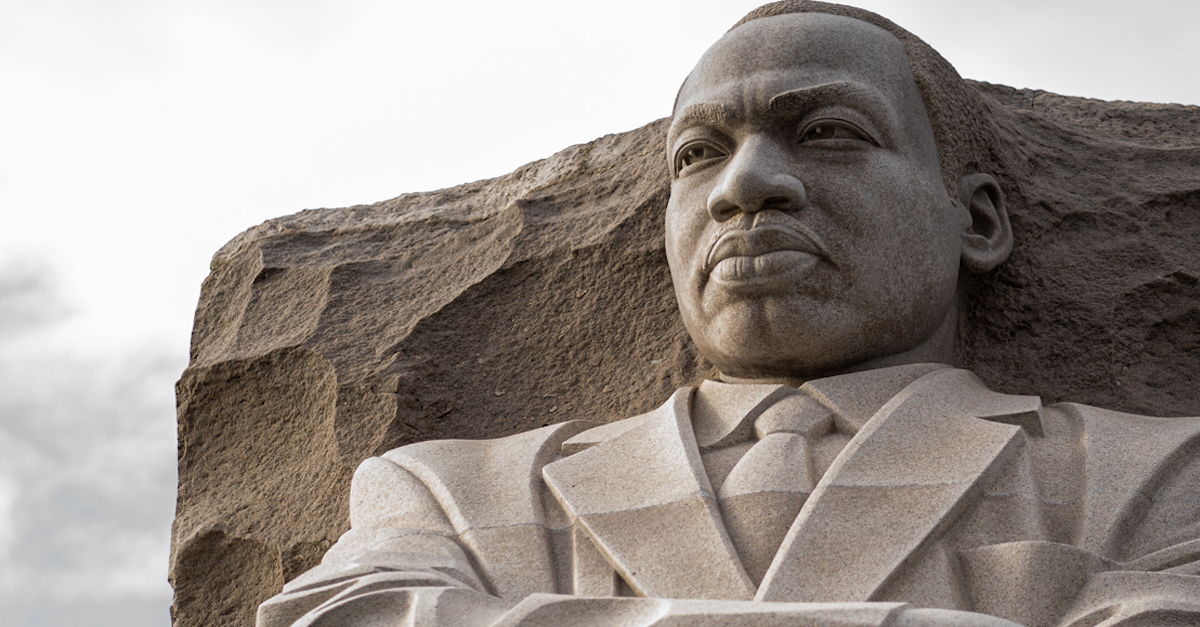
“The function of education is to teach one to think intensively and to think critically. Intelligence plus character — that is the goal of true education.” Martin Luther King, Jr.
There it was, again—a call for civics education, accompanied by the conviction that nobody teaches or takes Civics anymore– this time in Joyce Vance’s (excellent) newsletter. Vance says:
I keep returning to one core thought: civics education really matters. Its absence, at least in part, is what makes a Donald Trump and a MAGA movement possible. It’s the casual view among so many people that the form our government takes doesn’t matter. Living in a democracy isn’t something they view as important; politics is a spectator sport and not serious business.
So what’s not to agree with there? Beyond the fact that merely taking a Civics class in 8th or 9th grade won’t fix the problem of our malfunctioning civic understanding and engagement in young people (or their parents, for that matter).
Type ‘Civics’ into a search engine, and this is what AI will tell you:
Roughly 50% of American public school eighth graders took a civics class in 2018 and 2022. However, only 29% of those students had a teacher who primarily taught civics.
AI, apparently, does not understand the issues about disciplinary concentration vs. putting a certified body in front of a social studies class, but no matter. If half of all 8th graders took Civics in 2018, they were eligible to vote in 2024. Still more students likely took Civics in 9th grade or later—the Michigan Merit Curriculum, for example, prescribes Civics as a required HS course. If a significant majority of our students are taking civics, it’s not helping.
The tendency for states to focus on math and ELA, with less attention paid to social studies, fine arts and even science education is definitely a factor in a fading sense of what it means to be a representative democracy.
However—there are eight states that do not require a civics class: AL, DE, KS, ME, NJ, RI, WY and VT. For 50 years, the only secondary course required in the Michigan constitution—was civics. I’m not seeing a pattern, in these states, of a civics requirement (or lack thereof) leading to repression of a MAGA-type movement.
I think we’re ascribing a kind of magic to civics classes that doesn’t exist. Just as being required to take a Shakespeare class doesn’t necessarily lead to an appreciation of The Bard’s incredible depth of influence on English idioms and dramatic tropes, understanding the scaffolding and responsibilities of the three branches of government doesn’t always increase appreciation for them, or their ability to impact your life.
The National Civics Bee produced these questions for 8th grade contestants in 2024. Go ahead—take the quiz. Then ask yourself: Would knowing the correct answers to these inspire a sense of pride in our core democratic principles? (I got nine right—missed the one on standing committees.)
It’s pretty obvious that a significant proportion of the population doesn’t understand the limits of presidential power (including the president himself). Americans’ lack of civic knowledge, across the board, is a subject for hundreds of TikTok videos. Maybe it’s not about knowing the rules and norms—but having the savvy and venality to skew them to one’s benefit that is giving us a dictator on day one. Not really an example you really want to see in your Civics textbook.
What things do we imagine students might learn—and retain—in a traditional civics class? The three branches, the Constitution and Bill of Rights, how a bill becomes a law, all the building blocks of government? None of those dry informational tidbits are going to inspire kids who can now pretend to be part of a realistic video-game school shooting. Or watch the Capitol being overrun, or the richest man in the world pop out a Nazi salute.
Nor will a new focus on informing Joe Sixpack about Standing Congressional Committees being permanent help with what may be our most critical failings, as a democracy. Until we can reduce the dangerous inequity gap, control corporate power and develop a population that can identify and reject disinformation, we’re toast.
I’m sure there are civics teachers who are able to engage young teenagers in the concrete ways that our government will impact the rest of their lives (starting with their drivers licenses), and the value of honest and efficient leadership. I’m also sure that there are plenty of civics teachers who are terrified of honking off somebody’s mom by suggesting that we just elected a criminal.
But there would be real value in pushing civic literacy, if we could agree on what that looks like. Audrey Watters had a great piece today on what we mean when we talk about literacies. She points out that literacy isn’t simply the acquisition of a new skill; it is an acquiescence to a particular way of thinking – and new ways of thinking are suspect in 2025.
But new ways of thinking about “content”—relevant facts in a disciplinary course—are what we need, if we want to build civic engagement and genuine community. In truth, all content—all intelligence—is useless without character. Including what we might call civics.
Martin Luther King made that clear.
 Teacher in a strange land
We might start by reinvigorating student government. It became “not cool” around the time of the Vietnam War in my world. I don’t know if it ever regained any cache. What do class presidents do these days? Are there even class presidents? Of course, we have to make them relevant and give them a voice. Model them after the U.S. government. The House could be the 9th thru 11th grade, and the seniors could be the Senate. Add in the committee systems.
I could get excited about designing a civics project. Heck, that sounds like a good project based unit for a high school class or a Jr. High class. A mock debate of a bill in the House and Senate and the reconciliation process? If you want to create informed citizens then you better incorporate something that kids want to be informed about. I have next to no memory of my own “civics” instruction, and I’m pretty sure it wouldn’t have prepared me to be an informed voter in this last election.
LikeLike
Great comment– thanks. I was thinking the same thing, reading today about why the right is so ugly in their insistence on two genders/anti-trans initiatives. What if seniors, bumping up against voting age, were required to take an Issues in Civics class and discuss such initiatives? What if being 17 meant we trusted that you had absorbed enough content to be involved in debate and dialogue around how the country would be run?
At the very least, it might make them more likely to register and vote. Teaching the structure of government to 8th or 9th graders seems too early– an exercise in memorize, then forget.
My own memories of Civics class? A lot of memorize and forget. But I do remember my Civics teacher making us memorize “O Captain, My Captain” and explaining the grief around the Lincoln assassination after the Civil War was ended. Those lines still ring in my head.
LikeLike
It seems like you have some inaccurate information here— Massachusetts does indeed require civics education and has actually systematized and built out the civics requirement in innovative ways. Civics is taught in 8th grade.
the way that civics is taught in MA is also quite different than in some other states— According to a law passed by the MA general court, all K12 public school students must be given the opportunity to do a student-led civic action project in school at least twice in their educational careers. With lots of support and resources from the state DOE and from nonprofits that partner with schools, students identify problems in their community and targets for advocating for governmental solutions that address the root causes of the problems. This initiative to systematize and facilitate meaningful civics education was spearheaded by dedicated civics teachers throughout MA— and as somebody who’s worked with one of those teachers and who has facilitated a civic action project in my own classes, it’s a pretty incredible achievement.
Obviously the rote knowledge aspect of civics education isn’t a cure-all for anything- but please look into what is already being done and advocate for how it could work in your communities!
LikeLiked by 1 person
Thanks for the correction/clarification. The 11 states I mentioned came from one of those AI synopses about Civics, going back to 2018– there are, as of August 2024, 8 states that don’t require Civics. Thanks for sending me back to better, updated information. And especially thanks for the description of how Civics is being taught in Massachusetts– every state should endorse a hands-on, project-based instructional model for the teaching of the principles of civics. If there were ever a subject that called for action, not memorization, it would be Civics.
I follow a group of social studies teachers, across the country, and am always enthused about their instructional models, shared teaching materials and professional conversations.
LikeLike
It seems like you have some inaccurate information here— Massachusetts does indeed require civics education and has actually systematized and built out the civics requirement in innovative ways. Civics is taught in 8th grade.
the way that civics is taught in MA is also quite different than in some other states— According to a law passed by the MA general court, all K12 public school students must be given the opportunity to do a student-led civic action project in school at least twice in their educational careers. With lots of support and resources from the state DOE and from nonprofits that partner with schools, students identify problems in their community and targets for advocating for governmental solutions that address the root causes of the problems. This initiative to systematize and facilitate meaningful civics education was spearheaded by dedicated civics teachers throughout MA— and as somebody who’s worked with one of those teachers and who has facilitated a civic action project in my own classes, it’s a pretty incredible achievement.
Obviously the rote knowledge aspect of civics education isn’t a cure-all for anything- but please look into what is already being done and advocate for how it could work in your communities!
LikeLike
[…] Civics […]
LikeLike
[…] Given the Trump administration’s trial balloon—the well-funded, highly partisan and error-filled 1776 Project—and the fact that they’ve ignored the federal proscription against creating any curriculum at the federal level, this does not bode well for actual civics education. […]
LikeLike