Elizabeth Warren, Bernie Sanders and Education Policy Blunders

Here’s my theory of how Democrats can win the next election.

It doesn’t have anything to do with electability, because one man’s ‘electable’ is another woman’s ‘no thanks, old white dude.’ It also doesn’t have anything to do with one specific issue—because there are a dozen bona fide Hot! Burning! Critical! issues right now (the destruction of the planet, for starters) and nobody seems to be paying much attention to the one candidate who puts that at the top of his list.

We got troubles, right here in River City.

Fortunately for us, we also have at least a dozen pretty good candidates, probably more. And we have months of opportunity to hear lots more from each of them, to actually use the primary debates as a thoughtful winnowing, an in-depth national conversation on the full range of issues. We can not only pick a candidate, we can audition candidates for other Congressional roles, as potential cabinet members, judges and future political stars.

Unless Donald Trump doesn’t make it to the finish line— and even if the plug gets pulled mid-campaign— we are surely looking two old conservative white men as Republican opponents. While it may seem shallow and obvious to focus on demographics, Democrats can run a ticket that represents women, people of color and younger voters. If you put together women, POC and progressive youth as a voting bloc, that’s a considerably bigger cohort than 50%.  The trick is to get them excited about actually voting.

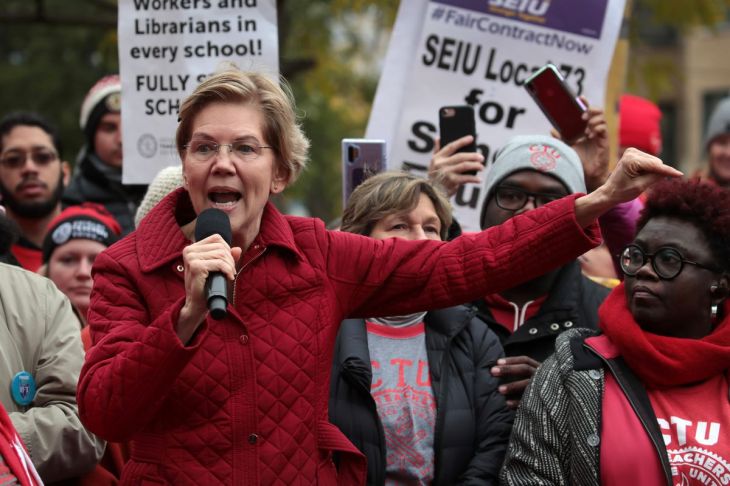
Which is why I was so disappointed to see educators—teachers! — going after Elizabeth Warren.

Not because she’s my top candidate. I don’t have a top candidate. In fact, I mistrust anyone who’s settled on The One. Because what that means is that you’ll start aggressively looking for flaws in the other candidates and focus entirely on your candidate’s virtues (real or imagined) and the narrow band of issues that mean the most to you. You’ll stop listening to negatives about your candidate (and they all have negatives).

You may actually start writing blogs about why you don’t like a potentially viable candidate, dredging up meh reasons that they cannot be trusted. You may throw around phrases like ‘hard pass’ and ‘no way in hell’ and ‘never liked her anyway.’ You may dig deep into things the candidate said decades ago, even stretch the truth, just a bit, to make your point and attract like-minded readers.

You can also start valuing things that don’t matter much, in the big picture: Which candidate publicly introduced an idea before the other candidates, for example. In building a coherent and comprehensive set of policy suggestions, first isn’t necessarily best. Nor is changing one’s mind a deal-breaker. I admire a candidate who looks at the evidence and then articulately shifts position.

Demanding that a candidate release a full accounting of his or her views on a particular subject RIGHT NOW is also foolish. Candidates deserve the right to listen to lots of potential voting groups and examine their own values before constructing a set of pledges and promises (which, as all adult voters, including MAGA types, know, are not guarantees).

So let’s talk specifics here: Charter schools—and Bernie Sanders vs. Elizabeth Warren.

I am ardently opposed to charter schools, based on the indisputable outcomes of a mature charter environment, the literal mountain of evidence that has accrued in my home state, Michigan. I’ve written about this at some length (here, here, here) and so has the local press (here).

Some of my former students teach in charters (because that’s the only place new teachers in MI can get jobs); people in my family teach in charters. It’s either that or don’t teach at all. They know how I feel—and mostly, they know what the evidence says. Charters, however—for worse, not ever better, are now deeply woven into the Michigan landscape, inescapable.

When I moved to the town where I now live, some 10 years ago, I joined the League of Women Voters and discovered they’d produced a paper in support of charter schools and choice in general. I was stunned. Didn’t they know what charters were doing to Detroit Public Schools—or why that mattered to them, ultimately?

I learned that the paper had been written when there was one mom-and-pop, hands-on learning/small class size/progressive curriculum charter in town. And some of the members’ grandchildren attended the school, happily. There was no evidence that the educational ecology had been negatively impacted.

That was then. Now, things really are different. There are more than enough data and school closings (and a local charter founder in prison for tax evasion). Anyone who’s paying attention can see what a terrible idea it is to give public money to privately—often secretively—managed schools.

But I understand that many states which have resisted charters, or maintained strong oversight and controlling legislation, are where Michigan was 10-15 years ago. Charters don’t seem like a big deal to some voters—not as big a deal as crushing student debt, the opioid crisis, climate change or the growing and dangerous gap between haves and have-nots. And alienating civic-minded, legislatively engaged parents whose children are in charters (or private schools, for that matter) is a politically unsavvy idea at the moment.

Deciding that one candidate—Warren– must be booted out of contention, simply because the woman who introduced her at a rally had ties to charter world feels nitpicky at best. Charging her with disloyalty because one of her education advisors got his start in Teach for America?

Well. I want to hear a lot more about Warren’s vision for K12. I want to hear what she thinks about rebuilding the teacher pipeline, using fully trained and qualified teachers (and promising to support better pay for important work), not two-year adventure teachers. But I refuse to judge any candidate on what amounts to skimpy, unspecific charges. Working for a non-profit or joining TFA out of college is not a full-throated declaration of principles.

Just as Buttigieg’s stint at McKinsey doesn’t mean he’s a raving conservative capitalist, and Klobuchar’s reputed binder-throwing doesn’t mean she’s abusive, and Harris’s record of doing her job as a big-city prosecutor doesn’t mean she lacks compassion—Warren’s staffers are not proof that she is anti-public education or anti-teacher. We all need to take a step back and look at the big picture.

We have several good, viable candidates. Let’s ask the hard questions. Let’s not pick our personal number-one and go after the others. Resist the lure of the all-American horse race, for once. Develop a list of five, rotating new faces in and out. Look for strengths, rather than inventing weakness. Allow for mind-changing (even for Uncle Joe Biden, and others whose records as governors and mayors are pretty clear). Waiting before pulling the trigger is almost always the best plan.

But what about charters? William Julius Wilson, in The Truly Disadvantaged, writing about policy, notes that the most popular and sticky public policies have benefits for everyone, even if their origin was around solving a problem for a specific group. Charter schools, at least rhetorically, were supposed to provide educational options, especially for those whose schools were not meeting their needs. Pretty quickly, they morphed into a back door for those who saw K-12 education as a giant, untapped market.

If Wilson is right, what we need is a system of schools that meet all children’s needs reasonably well. A plan to shut down charters through federal intervention will be neither universally popular nor sticky. We need to support all public schools—the suburban schools that are community centers, the urban schools with wrap-around services, the little boutique schools with unique curricula. We need to make public education so resource-rich and service-oriented—so popular and sticky– that charters can’t compete.

And we aren’t going to do that by trashing any of the Democratic candidates. That’s counter-productive.

PRIMARIES_DEM_FRONT_MAY6

Learning Styles: Detrimental or Useful?

Did you ever sit through a professional development workshop on learning styles? I have—at least twice. Once with the dreaded Outside Presenter (from a university that shall not be named), and once with a well-respected teacher in my building, both at least 20-25 years ago, when learning styles were a thing.

They’re not a thing anymore.

In fact, they’re ‘detrimental.’ According to a number of education psychology experts, learning styles themselves don’t exist, so actually it’s believing in them that’s detrimental. Detrimental to whom? Students. Teachers. Parents.

Shaylene Nancekivell, PhD, visiting scholar at the University of Michigan and lead researcher for a new study on the myth of learning styles, divides folks who believe in them–some 80%-95% of people across the globe, BTW—into two groups: Essentialists and Non-essentialists.

Psychological essentialism is the belief that certain categories of people have a true nature that is biologically based and highly predictive of many factors in their lives. People with essentialist opinions about learning styles may be more resistant to changing their strongly held views even when they learn that numerous studies have debunked the concept of learning styles.

Non-essentialists are ‘more flexible.’  The other group–those who understand that learning styles are myths that have been debunked by scientific research—doesn’t have a formal name. Let’s call them academic pedants.

And now you’ve just read the first reason why these cyclical pieces about how learning styles don’t exist drive me crazy: researchers set up experiments to examine a bit of ‘conventional wisdom’ that some (not all) teachers find useful–or have found useful at some point in their career.

They then inform teachers that their pet theories about teaching and learning are baloney. Next, they label them ‘essentialists’–and build straw teacher-men, speculating about how teachers use these silly, foolish ideas and, by the way, resist change.  Because, you know, they’re teachers.

Previous research has shown that the learning styles model can undermine education in many ways. Educators spend time and money tailoring lessons to certain learning styles for different students even though all students would benefit from learning through various methods. Students study in ways that match their perceived learning style even though it won’t help them succeed. Some teacher certification programs incorporate learning styles into their courses, which perpetuates the myth for the next generation of teachers. Academic support centers and a plethora of products also are focused on learning styles, despite the lack of scientific evidence supporting them.

I certainly agree with the last sentence. The number of ‘educational’ products that are built on theoretical quicksand is legion. And I can list a dozen ongoing ‘wars’ around the best way to teach important content, each with its own ‘research base’ and, probably, a vocal advocacy group. The shelf life of an educational theory is often short.

But correctly identifying ‘best practice’ that will help all students succeed is, and always has been, a moving target. Stamping out a belief in learning styles is hardly going lead to an erasure of what Nancekivell calls ‘maladaptive practice.’

In a Facebook discussion on the referenced article, I was touched when a friend (Nate Smith-Tyge) said this:  I do think the learning styles beliefs come from a good place.

I think so, too. Teachers are trying to reach kids by trying different strategies and modalities. Some will work better than others. If paying attention to the easiest, most efficient and indelible way to teach something to an individual child means a teacher is dabbling in learning styles, so be it.

As a 30-year music educator who frequently got the kids who were misidentified as ‘kinesthetic learners,’ I can testify that there are undoubtedly preferences and natural tendencies in learning to play an instrument.

Some students learn to play by reading their beginners method books. They learn the note names and memorize the fingering chart. Their focus is on note-reading, counting and blowing or bowing at the same time. It’s a tricky, uncoordinated multi-task at first, but eventually, through persistence, they get the pieces put together. Instrumental music teachers love kids like this—some teachers won’t let students even pick up their instruments until the preliminary cognitive/visual material is mastered.

Other kids learn to play instruments by watching others and doing what their mouths, arms and fingers do. They couldn’t care less what’s in the book. They want to play! They come in the second day, saying see what I can do! (In my neck of the woods, that was usually ‘Let’s Go Blue!’) How did they learn this? From watching YouTube or maybe an older brother who told them what keys to press.

These kids make the first group, still playing whole notes, heads in their books, nuts.  I always had students who complained that other students were watching their fingers or slide positions—which felt, to the note-readers, like cheating.

Still other novice musicians fool around, trial and error, until they can repeat a sequence of sounds: a tune. Parents were constantly telling me about their amazing child who could pick out any tune on the piano, or saxophone or trombone, after hearing it a few times. It’s hardly an unusual trait—auditory memory—but it’s definitely a learning preference.

It’s also the way many rock, pop and country musicians learn—strictly by listening, and remembering. No paper involved. A friend who plays bass tells me that in a gig with a new group of musicians, he seldom tells folks that he reads music; some people find it off-putting.

The Suzuki method of teaching basic instrumental skills relies on watching and listening, mimicking, repeating and improvising, to a far greater degree than traditional American music pedagogy. Suzuki students learn to DO, and to listen, rather than read, for a long time.

If I believed in learning styles (ha), I would say that Suzuki students exercise and develop their auditory and kinesthetic modes first and save the visual/verbal symbolic interpretation skills until students are older. There’s a lesson there for American educators.

The point is: there are multiple ways to learn to play a musical instrument. All of them have value, and none of them is a ‘best practice’ or ‘maladaptive.’

Dan Willingham is the national guru on the myth of learning styles. I once wrote a blog entitled ‘I Believe in Learning Styles’ and he graciously commented and engaged in a lively discussion about the semantic differences between preferences, abilities and learning styles.

I came away feeling as I still do today: I get the yada-yada about theories of mind and theories of instruction. But I still feel as if teachers who have found benefits from addressing those learning preferences, abilities and styles are coming from a good place. Their observations and gathered evidence matter, too.

louis-armstrong-1392118332-view-0

Is Your School Band Playing this Weekend? Thank a Teacher.

I’m not much of a flag waver, really. I always thought that author James Baldwin captured my feelings precisely in Notes of a Native Son when he wrote:

I love America more than any other country in the world, and, exactly for this reason, I insist on the right to criticize her perpetually.

These days, perpetual criticism is essential. We are headed into dark times, redefining the meaning of patriotism and sacrifice. It’s easy to lose faith in our government and the grand experiment—all men created equal—that founded this nation. It’s easy to let hope die when threats of another pointless war appear on the horizon.

I still believe, however, heart and soul, in the shining but imperfect ideals of a democratic education –equality under the law, the American common school, a free, high-quality education for all children, simply because they deserve it. Thirty years of teaching school have given me a hard crust of cynicism about many things related to education and America. But I never lost my enthusiasm for the Memorial Day parade.

For 25 years, my middle school band students marched through the small town where I taught and lived, in the Memorial Day Parade. There was a whole set of traditions around this event, which grew larger and more complicated every year: the aural passing down of our special drum cadences from the self-appointed 8th grade drumline leaders, mending the color guard flags originally purchased through a pizza sale back in ’88, and patching up hand-me-down snares and sousaphones scrounged from the high school.

There was never a budget for this–middle schools don’t typically have marching bands–but somehow there were always T-shirts, and cold drinks at the end of the parade route. We had a stunning handmade banner that two moms whipped up with lots of lamé and sequins. In my last year, we marched nearly 300 students, on a morning when the sky was a sapphire blue and Air Force jets flew overhead as we rounded the corner by the cemetery.

This took up a fair amount of teaching time. I would get on my knees and beg colleagues for 20 minutes on the Friday before the parade, to assemble five bands into a single marching unit and take a few spins around the parking lot. One year, as I was trying to get the back of the band to master pinwheel corners, the front rank (rambunctious 8th grade trombones) marched right up the sidewalk, opened the front doors, and led the band, playing America the Beautiful at top volume, through the school hallways. By the time I sprinted up to the head of the band (and the principal popped, red-faced, out of his office), marching through the school was a done deal–and became yet another annual tradition.

I was always clear with my students about the meaning and purpose of Memorial Day. They would occasionally whine about how boring America the Beautiful was–Mr. Holland’s band played Louie, Louie, right? I explained that they were old enough to dedicate a morning to thanking local patriots and acknowledging the sacrifices made by Americans over centuries. Older people, watching them march by, would be pleased to hear traditional music. It was about respect.

We do this, I told them, to remember and honor those who made it possible for you to live in this beautiful little town, in this safe world. People like my Uncle Don, who died in February 1945, part of the Fourth Marine Division which stormed Iwo Jima. Or Ray Shineldecker and Joey Hoeker, two high school classmates who lost their lives in Viet Nam. I had lots of funny stories to tell about Joey, who lived around the corner in my old neighborhood–a big, goofy kid who was what guidance counselors in the 1960s called “not college material.”

On our last band trip to Washington D.C., after performing on the steps of the Lincoln Memorial, I was loading tympani onto the buses as my students toured the Mall. A few girls came running up, calling “Mrs. Flanagan! We found him!” Found who, I asked.

Joey Hoeker, of course–on the Wall. And I lost it, right in front of all those kids.

I thank those who served and sacrificed so I can love my country, and criticize it, too. A hat tip to all the band teachers and student musicians who help make Memorial Day meaningful this weekend. And to hero teachers and band directors everywhere– donating yet another weekend to the community –please keep teaching, in spite of everything.

ad6983148d8af0964caf8092fc3eee04

The Teacher as Assessor

A little handmade meme has popped up recently in my Facebook feed, shared by Alexandra Penfold, a children’s author and food writer.

59605563_2873156839575307_2880536279395598336_n

Interesting, no? Being told—by scientific measurement, no less—that you were minimally proficient at the skill that was your heart’s desire and life goal. And then sailing on to the very wonderful career you planned, data be damned.

There are lots of implications here, most importantly that test scores are not even close to reality. The first question I would ask Penfold, if I could, is whether she was ever made to feel as if her skills were ‘remedial’—either by any of her teachers, or by her family. I doubt it.

But I have heard plenty of stories about kids who seemed to be fine, cooking right along, until they were derailed by surprising test results, causing a radical change in plans (different classes, different college, different career). Testing impacts lives—and Penfold probably missed the worst of the data fetishism that has become standard in American public education.

And yet, the alternative—the teacher as sole assessor–has come to feel almost random to us. Do we trust teachers—all teachers—to provide useful and accurate feedback, the kind that nurtures children’s dreams and also pushes them to excel? It’s a tall order.

Teachers develop their personal assessment skills and models over time. And building equity and encouragement into testing and grading (as opposed to using evaluation as sorting or punishing) takes a lot of trial and error. Some teachers are good at using grades and scores as investments in student growth. Others, not so much.

Universities don’t do enough to prepare teachers with a range of assessment strategies—but there are limits to the training even the best college programs provide. The only way to become seriously good at assessment—in ways that help students– is practice over time.

Here’s a story:
When I was a novice teacher (back in the 1970s, when merely suggesting that teachers ought to have common grading scales or practices was considered an insult to one’s academic freedom), one of my assignments was 5th grade beginning band. I met with students in like-instrument groups, twice a week.

There were no grades. Band was considered an elective activity, and none of the elementary electives were graded, largely because the teachers who taught them saw hundreds of students each week. I thought of myself as a Band Director, a more rigorous secondary teacher. I thought part of the reason my students weren’t making the progress I thought they should–backsliding between sessions, snickering when they made mistakes, not taking their learning seriously–was because they weren’t getting a grade.

So I graded them secretly. I had them play, every 2-3 weeks, one at a time, and took notes on a legal pad. I clustered them in groups—the stars, the competent ones, the not-yet-but-maybes, and those who really shouldn’t be in band next year, when they would be meeting daily and at last getting real letter grades. By the end of the year, I had a lot of unshared data on these students.

There was one little girl in the clarinets that I found hopeless. I got tired of switching her hands (left on top, right on the bottom, instead of the reverse) and putting the correct fingers over the holes. She was a sweet girl, chubby, bespectacled and earnest, but her clarinet playing was comprised mainly of squeaking (leaky fingers), honking and miscounting. In my rank ordering of about 20 clarinet players, she was dead last.

The pad went into the bottom of a cardboard box, when I moved up to the middle school the next year. The clarinet player moved up, too. In fact, I taught her for eight years, giving her the John Phillip Sousa award as a senior, as she headed off to the university as a music major.

I found the pad some years later. I had, of course, forgotten all about my earlier assessment of a girl whose persistence carried the day. It was easy to see how her initial failures were largely my fault; by the time I found the ‘assessment,’ I was much better at teaching beginning clarinets. I was also lots better at using the power of the test or grade to enhance learning.

But that’s the bottom line here: assessments have tremendous power, for progress or penalty.

Be careful out there.

Who Do I Appreciate? Music Teachers.

Like a lot of my educator colleagues, when it comes to Teacher Appreciation Week, I come down somewhere between surly and cynical, preferring actual respect and control of my professional work, not to mention adequate compensation, over a potluck lunch and a mug.

Being snotty about Teacher Appreciation Week is bad form, however—a cheap shot. Exhausted teachers everywhere deserve recognition and our gratitude for making it most of the way through the ’18-’19 marathon. And one subset of educators—music teachers—merit an entire month of appreciation.

Music teachers do it all. They teach 250 students a day, often in groups of 65, with each student holding a noisemaker. Elementary music teachers might see 500 students in a week, struggling to learn all their names, and packing five or six skills into a dozen 30-minute lessons per day. Music teachers take their students out and about, singing for the nursing home or marching in community parades. They’re responsible for hundreds of thousands of dollars’ worth of fragile, finicky equipment—and often have to raise the money to replace what’s broken or worn out or keep the music library fresh.

They deal with childish egos and children’s artistry, then put the results of their practice out there for untrained, opinionated parents to judge in concerts, musicals, contests and Friday football shows. They often sacrifice their home and family lives for the good of their programs, knowing that those programs can easily be cut at the next Board meeting, because they’re not ‘essential.’

I am part of a Facebook group of 26K music educators. What happens in BD Group stays in BD Group, but someone just asked if any of us had ever had to send a student home from a field trip or band camp. There were 158 horror stories shared (along with some great prophylactic advice), but none saying ‘…and then I stopped taking my students anywhere.’ Because everyone knows that what makes a music program memorable and magnetic is the concert at the State Capitol or the last night of band camp, when that large group of diverse kids has bonded into a weary but cohesive unit.

It’s easy to hack away at music teachers and their work. Everyone in the building or district or community has an opinion on what a ‘good’ elementary program, halftime show or orchestra concert looks and sounds like. I once got a letter from a Board member’s wife suggesting we raise money to buy capes to spice up the marching band shows. Her high school band had capes, and they were the ‘top band in the state.’ According to her, anyway. Multiply that by every, say, month—and you get the picture.

Or you can read an article entitled The Tragic Decline of Music Literacy and Quality,’ by Jon Henschen, a financial advisor from MN, which includes cheery bits like this:

Public school music programs have been in decline since the 1980’s, often with school administrations blaming budget cuts or needing to spend money on competing extracurricular programs. Prior to the 1980’s, it was common for homes to have a piano with children taking piano lessons. In 1909, piano sales were at their peak when more than 364,500 were sold, but sales have plunged to between 30,000 and 40,000 annually in the US.

Besides the decline of music literacy and participation, there has also been a decline in the quality of music which has been proven scientifically by Joan Serra, a postdoctoral scholar at the Artificial Intelligence Research Institute of the Spanish National Research Council in Barcelona. The results of the study revealed that timbral variety went down over time, meaning songs are becoming more homogeneous. Translation: most pop music now sounds the same.

One wonders if Henschen has ever listened to American pop music from the 1950s. In fact, his piece could easily have been written in the 1950s. We’ve been fighting to keep music literacy and quality from ‘declining’ for a century or more. And when I say ‘we’—I mean music educators.

Stories, studies and op-eds about the value of music education pop up regularly. Like this one, from a young man looking back with gratitude at his musical experiences in high school.

Or this one, thanking a battle-axe music teacher that Jon Henschen would have lauded, for straightening him out and putting him on a path to becoming a lifelong musician.

Or this video, a perfect illustration of the utter joy of singing.

And yet—somehow, the message about the critical value of music education gets lost, over and over again. Why is that? Serious question. Why haven’t we learned that music—all the arts, really—are about our very humanity? In fact, there is new evidence that the ability to keep a beat, that most basic of musical skills, is linked to the ability to read.

Now, music teachers everywhere already knew this, especially those entrusted with developing a steady beat or pitch recognition (yup—it’s science) or simple melody repetition with small, distracted children at 2:45 in the afternoon, a half-hour before the bus comes. But still– it’s nice to see.

I’ll put that research into my bulging digital file labeled Music Advocacy, perhaps pulling it out when the next wave of Phonics Warriors suggests that we need to be re-allocating resources currently spent on ‘specials,’ because, you know, Reading First.

In the meantime, Music Teachers: I see you. I hear you. I thank you for your creativity, persistence and sacrifices. You absolutely rock.

!cid_38D2104C-5653-4B27-962A-6FE6DC7B3C7B@myhome_westell

Who Is Gifted? Why Does It Matter?

Having authored a dozen or more columns on gifted education, it’s easy to predict reader response. It’s unfailing, in fact. There is a well-organized parent advocacy army associated with educating our brightest kids, always at the ready to respond to published commentary, claiming anything less than a full-bore endorsement of extra resources and programming for gifted kids is Not Enough. Because they deserve it.

Essentially, I agree with them. In fact, I got a Masters degree in Gifted Studies, back in the day (way back), because I thought I wasn’t challenging my most accomplished students and wanted new ways to deepen their musical learning. I actually thought I represented the ‘talented’ part of ‘Gifted and Talented.’

Stepping into Gifted World was revelation, however. Educators in the field were mostly interested in whether curriculum for the gifted should focus on acceleration or enrichment. (Acceleration won.) And, of course, the core disciplinary question was just who was entitled to such enhanced curriculum. I learned about the range of testing tools to identify giftedness and creativity. There were cutoffs and variables and labels. There was a fair amount of dissent, even hostility. And nobody was talking about kids with exceptional talents in the arts.

My thesis involved surveying music teachers around the state, who were very kind and willing to respond (in the days where that involved paper and the US Postal service). Most of them offered excellent ideas on strengthening and expanding musical excellence in their own classrooms, as well as special instruction, camps, honors ensembles and other challenges.

Although musical talent is overlooked in the ‘gifted’ discourse, I remain interested in gifted programming in public and private schools. I have taught any number of genuinely gifted students over 30+ years, kids whose interests and capacities, across the academic board, were extraordinary. I saw bright students who didn’t fit in formal programs for the gifted and sank like stones. I saw kids whose parents seemed to have one goal: winning non-existent academic races. I saw children whose unique and remarkable gifts seemed unrecognized—by everyone, including their own teachers.

Gifted programs have come and gone over the intervening decades (mostly gone, as funding dries up and the focus shifts to data-based accountability). But this week, I read an article from Hechinger that took me right back to grad school and the never fully-clarified question: Who is gifted?

The most troubling aspect of gifted classrooms is that they tend to be disproportionately filled with white and Asian students while bright black and Hispanic students often get overlooked. Indeed, gifted and talented programs can sometimes look like a clever tool to separate children by race or ethnicity in school. In New York City, for example, white and Asian parents who have the resources and/or inclination to prepare their four-year-olds to excel on standardized tests snag almost three quarters of the coveted seats. Meanwhile, black and Hispanic students make up more than 65 percent of the public school system.

The article focuses on slicing and dicing test data, asking insulting questions about whether ‘watering down’ a talent pool by allowing kids who test in the 92nd percentile to take classes with kids in the 99th percentile is ‘fair’–a word that presumes precise, certain numerical identification of ability and potential based on one test score (the MAP test, in this case). Fair to whom?

There are lots of presumptions in the article—that only certain students deserve to be offered special instruction, that students who missed a couple more questions on a computer-delivered test are inherently less capable than students who may have had two lucky guesses, and that segregating students in racially-similar schools makes identifying gifted kids and offering them tailored instruction easier.

Troubling, indeed.

The tsunami of readily available testing data has led to articles and arguments about percentages of a human quality as slippery and ill-defined as giftedness. It makes sentences like this possible:

Education experts, like the rest of us, argue endlessly over whether it’s a good idea to accept the trade-off between achievement and diversity.

Think about that. Should any educator—let alone an expert—see ‘accepting’ diversity as an option, and then only if it doesn’t get in the way of faster delivery of the same content? Or meaningless higher scores? There are a lot of questionable value judgments embedded in this one sentence.

It’s questions like these that make people skeptical about the value of exclusive programming for gifted children. If programming for the gifted is just another data-driven contest, a prize to be won, then it’s a waste of resources. There needs to be a solid rationale for offering bright children across the spectrum—rich and poor, black, brown and white—rich and stimulating curriculum, distinctive instruction and unique programming.

It was that rationale—kids deserve opportunities that match their capacities and talents—that drove me to study education for the gifted. It’s enough. But only if we can avoid excluding and ranking children, and hoarding opportunity through the use of achievement data.

Nor can we demand allocation of more resources for the gifted on the basis of ‘national security’ or ‘the Chinese are doing it,’ as this article does. National security is an important goal for every American citizen, no matter what their achievement test scores reveal.  We’re not going to accomplish security (not to mention life, liberty and the pursuit of happiness) without offering a meaningful education for every single child, no matter what they bring to the table. photo-1532168881420-27ec4ba493a6

Who Should Pay for Public Education?

Short answer: The public.

Short rationale: Public education is a public good. When it’s funded by taxes, and oversight is provided via elected boards, there is, at least nominally, a backstop against corruption and egregious inequity, and there is a public mechanism for expressing dissatisfaction as well as suggestions for improvement.

Does this always work out perfectly? Of course not. Hahahahhaha.

Does this then mean that perennially strapped public education should be open to ‘improvement’ plans funded by the very rich?

No. Because billionaires and their foundations have something other than the public good in mind when they offer school districts millions to follow a plan that sounds good to funders. Furthermore, there is no backstop against things going horribly wrong, once they’ve accepted the money and conditions, before the billionaire pulls out and claims that it’s the district’s fault that millions have been squandered.

See: Newark, New Jersey.

Foundations are not hoping to have enough money to send all the fifth graders to camp, or rebuild the orchestra program, or provide more modern science equipment. Billionaires and their organizations aren’t interested in small-potatoes needs. They want Big Sexy Ideas—like gutting tens of thousands of tailor-made local curricula (easily dismissed as a ‘patchwork’) and replacing them with national standards (which somehow will evolve into a ‘more rigorous’ national curriculum).

They want freedom (for schools to teach Creation ‘Science’)! They want accountability (which always translates, somehow, into more data, prone to errors, misinterpretations, and illegal release exposures)! They want something new and groundbreaking, something…personalized! That’s the ticket.

An argument sprang up on Twitter this morning, re: public schools taking Gates money.

Jennifer Binis says:

So. Gates is giving away money. People in different contexts in American education need money to implement projects, design new curriculum, or test new ideas. I’m getting the sense some think no one should apply for Gates money.

Apparently, there are those who look for places that have applied for Gates funding and work to put them on blast. Without understanding why said educators applied for funds or the parameters of the grant. It’s basically, “Gates bad.”

Gates makes many of the same mistakes most philanthropists make. But I legitimately don’t understand what anti-Gates people want grant applicants to do instead. Propose raising taxes? My wondering remains: where should educators get money from instead?

Well, that’s an easy one for me.
Public monies should pay for the core mission of public education, by which I mean instruction, curriculum and assessment. The daily operations of schools. Private money—lookin’ at you, Bill Gates—comes with strings and conditions. Always.

So yes, we should propose raising taxes to more adequately fund public schools, so they don’t have to apply for grants from foundations that will want control over aspects of their core work. Underfunding public education (and the rise of the Billionaire Social Entrepreneur Class) have pushed many public schools into a corner: they need more money to accomplish the things they want to be doing. The things they know will help their students flourish.

Schools can become dependent on grants. Teachers these days are often forced to Donors-Choose even basic supplies. We have abandoned truly adequate public education funding in favor of piecemeal begging and co-opting our principles for much-needed money. Public institutions, from roads, fire-fighting, hospitals and libraries to the military, need public funding. Because we all depend on them.

Binis again:

In other words, you’re saying everyone in education should be dependent on tax dollars for everything they do. That seems like an untenable, unsustainable model.  We’re not going to get out of it by telling people who accept private donations they’ve committed some grievous sin against public education.

To be clear: you’re saying get rid of the PTA. Get rid of every car wash, popcorn sale, and candy bar fundraiser. All theater performances and concerts need to be free. All sporting events need to stop charging admission or having private sponsors.

Well. I’ve never told people who accept private donations that they’re sinners. I’ve worked for three different organizations that took Gates money, and belong to another–and I’ve seen first-hand what happens when you take the big bucks. You stop trying to please your clients and members– and you start trying to do what it takes to get the next grant.

There’s also a difference between fund-raising for a specific, targeted purpose (athletics, the drama club, building the elementary library) and agreeing to play by the Gates Foundation’s grant rules. I’ve done both.  It’s often a matter of scale and expected outputs. The PTA knows precisely who will benefit from the Fall Carnival, and how. Gates is looking for confirmation of one of their Big Sexy Ideas—to ‘scale up,’ prove a point, tweak an idea.

I’m not saying that Foundations don’t sometimes do valuable work—of course they do. But they should never be considered a replacement—supplanting not supplementing—sufficient funding.

The Twitter conversation meandered, as they tend to do. But I’ll give the (spot-on) last word to Tim Fournier, long-time educator in Grand Rapids, Michigan:

I return to my previous three points that tend to get overlooked amid the side-spats. 1. Public Schools are underfunded 2. Big Philanthropy can corrupt as much as it can help. 3. Community independence should not be sold, no matter the lofty intentions.

Amen. piggy_bank_images_money

Image: Creative Commons

Hardly a Man is Now Alive

Does “the 18th of April” ring any bells for you?

Ten years ago, exactly, in my graduate seminar in education leadership (full of would-be superintendents working on PhDs at my well-respected research one university), our professor entered the room, struck a dramatic pose and said…

“On the 18th of April” (long pause, class attentive)

“In seventy-five” (long pause, dead silence)

“What?” (gray-haired Prof scans the room)

In a small voice, I say,

“Hardly a man is now alive
who remembers that famous day and year.”

(another pause, Professor smiling, nodding)
I clear my throat and say…

“It’s the one that begins ‘Listen my children…'”

(blank faces)

“and you shall hear…”

(still nada)

“of the midnight ride…”

(a couple of people are getting it now)

“of…?”

(muttered voice from the class) “umm, Paul Revere?”

Prof points to me and says “Don’t answer!” Then he asks: “Who’s the poet?”

When nobody–not one of the 20-odd people in the room– could answer, or would even try, he lets me tell the class. Longfellow.

“When did you learn that?” he asks.
Fifth grade. And I only know an abridged version. But still.
One if by land, two if by sea–and I on the opposite shore shall be…

I learned “O Captain, My Captain” (speaking of anniversaries) in 8th grade.

And the prologue to “Romeo and Juliet” in high school. Still with me, along with memorized King James scripture, lots of Cummings, Dickinson and Frost and an embarrassingly large cache of song lyrics.

Why aren’t we using poetry to teach history?

Well, two roads diverged in a yellow wood…

And we chose easily measured standardized test questions.

paul-revere-ride-collection-paul-revere-memorial-association-featured-3jpg

Do You Eat at Chick-Fil-A?

We just finished two cross-country journeys in a Subaru Forester with a large dog. It’s a 4-day/3-night trip, with long, 10-12 hour driving days culminating in overnight stays in mediocre, pet-welcoming LaQuintas. There is little time or opportunity for interesting restaurant meals. All food is in our little cooler, picked up at a quick-stop market (the kind attached to gas stations) or obtained in a drive-through situation.

Yes, lots of fast food.  Yes, I know it’s not good for us. By the second or third day, we don’t care.

On the upside, we play endless games of Twenty Questions, listen to talk radio and laugh a lot. Most of the trip is excruciatingly dull (lookin’ at yew, Texas panhandle). Because we’ve done this trip, out and back, for four years, we know how pointless it is to look for an interesting or healthy take-out meal on I-40, other than the odd Route 66 diner. McDonald’s makes good coffee and while we’re there, we might as well get a sausage biscuit—that’s the prevailing spirit of this driving marathon.

What we don’t do is eat at places that are politically problematic. Papa John’s, Wendy’s and Waffle House are out. And we never eat at Chick-Fil-A.  I don’t mean just on-the-road eating. Neither of us had ever eaten at a Chick-Fil-A. In our whole lives.

This is not much of a sacrifice. There isn’t a Chick-Fil-A within three hours of our house—and only ten in our whole home state. Having serious socio-political problems with the founding principles of CFA, then deciding not to eat there is an empty gesture—unlike not buying L.L. Bean flannel sheets, which are awfully nice in a cold Michigan winter. But I have heard—from any number of people, especially those who live in the South—that Chick-Fil-A sandwiches, waffle fries and lemonade are super-tasty. The best.

So you know what’s coming, right? We’re in Oklahoma, and very low on gas, plus we all need a rest, so to speak. And it’s dinner time–we’re hungry. We choose an exit that looks promising—one that features multiple gas stations and a shopping center, plus a confusing ramp that feeds drivers into a traffic circle. We take care of business first, feed the dog, then start looking for a fast-food restaurant.

And the only one there is a Chick-Fil-A. There might be a restaurant in the shopping center, hidden, but we can’t wait for take-out food. We drive both ways, going through the annoying circle three times, until we run out of civilization. If we’re going to eat now, instead of an unknown number of miles down the road, it’s Chick-Fil-A. So—pledging each other to secrecy—we agree to, just this once, eat the forbidden fruit.

I ordered the signature chicken sandwich, waffle fries and lemonade. I have to say I was anticipating a much better than average fast food meal.

But it was gross. The meat was tough and squished together with cheese and pickles—who puts cheese on a chicken sandwich? —and the chicken coating was flavorless. The fries were limp, underdone and cool. And the lemonade was your standard artificial lemon-flavored beverage that begins as a powder and ends with a chemical aftertaste. There was a boatload of ice. And to top it off, one napkin apiece. My husband’s meal was equally grim.

There was a perky teenage window attendant, who gave us back correct change with a smile. But that’s a pretty low bar.

Now—fast food is always a hit-and-miss affair (I should know). I’ve had some truly terrible Quarter Pounders with cheese on these trips. The most variable food, in our experience, comes from Sonic, where the milkshakes are usually yummy, but anything fried tastes like small chunks of seasoned concrete. It’s possible we ran into a bad Chick-Fil-A.

But that’s not the point. The message here is that I’ve spent a couple righteous decades avoiding Chick-Fil-A, and I wasn’t missing anything.  I thought about that lousy sandwich when I read about Grace Slick licensing one of her songs to Chick-Fil-A for a commercial, then giving the profits to an LGBTQ rights organization.  Way to take a lemon and make (real) lemonade, Grace.

I’m all for standing on your principles—or better yet, using an opportunity to publicly demonstrate what those principles are and why, as folks seem to be doing in San Jose, by hanging Gay Pride flags near a proposed Chick-Fil-A in the airport. For every person refusing to eat a CFA sandwich, there’s probably another one proudly consuming them, thinking they’re MAGA-food. The trick is not to win the war, but to make people think.

Pete Buttigieg, on the campaign trail in South Carolina, recently said that while he sincerely dislikes Chick-Fil-A’s politics, he ‘sort of’ likes its chicken.

Buttigieg suggested that he could forge a peace deal between the LGBTQ community and the Atlanta-based fast-food chain, which has donated millions over the years to groups that oppose same-sex marriage. He says, “So maybe if nothing else I can build that bridge. Maybe I’ll be in a position to negotiate that peace deal.”

I can think some other peace deals where we could use that approach.

Do you eat at Chick-Fil-A?

chick fil a peach milkshake bbq chicken

Risky Business: Long-term Damage to What America Does Best

Here’s a book to put on your short list: The Fifth Risk by Michael Lewis.

I’ve now read a number of books (somewhere between four and six, depending on how you categorize them) about the Trump campaign and presidency–by celebrated authors (Bob Woodward) and sarcastic geniuses (Matt Taibbi) and lesser-light authors and scribes. It was a weird, unprecedented campaign and an appalling, slapdash start to a presidency–everyone from Michael Wolff to Katie Tur to Chris Christie says so.

But this is the best book I’ve read, by a long chalk. It’s barely political, focusing on the present, rather than the campaign, the Russian interference, or the 2020 election. It is, however, a blood-chilling account of just what it might eventually mean, in terms of human lives and well-being, that our country is being–What? ‘Run’ isn’t the right word, nor is ‘managed.’ That our government has been taken over by a cabal of unqualified, loutish and greedy people who are in the process of dismantling decades, centuries even, of government policy that works. Just because they can.

Lewis is his usual cynical and incisive self, and the stories he presents are interesting–case studies of how the government protects people and nurtures innovation and provides basic information to make lives and livelihoods better, everything from safe energy to nutrition to the weather. The government is not perfect, or even close, of course, but it’s served us reasonably well for a couple hundred years.

Bye-bye to all that. Reading this book was the first time I considered just how much has already been undone and what some of the long-term consequences might be. Lewis has NOT written a polemic–just an inside peek at things we aren’t considering, because we’re so distracted by this administration’s behaviors, antics and moral failings.

If you’re one of those people who thinks the government is nothing but embedded corruption, you especially ought to read this book, as Lewis steps back from the spotlight and looks at a few less obvious things the government does, to keep us safe, healthy and informed—and to keep the lights on.

Among Lewis’s fascinating subjects is John MacWilliams, who was the Chief Risk Officer at the Department of Energy during the Obama administration. It’s MacWilliams who lists what he thinks are the five biggest risks America is facing. The first four: Nuclear weapons and waste, North Korea, keeping Iran from building a nuclear bomb, and the shaky, vulnerable patchwork that forms our electrical grid.

The fifth risk is program management. Here’s Lewis, explaining what that means:

“The risk a society runs when it falls into the habit of responding to long-term risks with short-term solutions. … ‘Program management’ is the existential threat that you never really even imagine as a risk. … It is the innovation that never occurs and the knowledge that is never created, because you have ceased to lay the groundwork for it. It is what you never learned that might have saved you.”

Lewis looks at the Departments of Energy, Commerce and Agriculture, beginning with the fact that the Trump administration was—to put it mildly—utterly unprepared to staff agencies and develop policy. He makes the work these federal agencies do fascinating—no easy task—and gives long-time government employees a pat on the back for a whole lot of behind-the-scenes work that goes completely unrecognized until it’s gone. Which is precisely the situation we’re facing—loss of essential services due to short-term thinking and deliberately installed incompetence.

As a teacher, I would have to say that no Secretary of Education has ever drawn as much attention and loathing as Betsy DeVos. No surprise to this lifelong Michigander who was introduced to the DeVos family in 1978, when they first got a school voucher initiative on the ballot. DeVos has most recently gotten a lot of bad press for her support of zeroing out the federal line item for Special Olympics, and suggesting that bigger classes just might lead to more learning.

But it’s instructive to think of these issues as loss leaders in the Trump education policy plan. Deep in the bowels of the Education Department, data has gone missing, special education funding threatened, for-profit ‘colleges’ supported, predatory loan programs tolerated, and 29 meaningful programs have been targeted for elimination.  And so much more, elevating short-term profits over the only justifiable reason to have an education department: to make the life prospects of our youngest citizens better.
Frank Bruni in his NYT newsletterAs things stand already, America will need years to climb out of the Trump trench in terms of international relations, minority disenfranchisement, a conservative stacking of courts and sheer indecency. I shudder to imagine the damage and the recovery period after two terms of Trump.

The book has a rushed feel, as if Lewis were impatient and needed to get this out before any more national treasures, useful data and successful programs are crushed. He lets the reader draw conclusions and make connections, resisting the temptation to share his own recommendations. And really—it’s not necessary. The book is better for it.

Something’s happening here. Read this book.

41ZTSdtYIlL._SX331_BO1,204,203,200_