
Maybe There Really Is a Learning Recession. But It’s Not What You’re Thinking.

You know how sometimes a headline will catch your eye and you’ll engage in a brief wrestling match with your intelligence and judgment: Is this clickbait? Is this AI? Could this, in any sense of the word, be real?

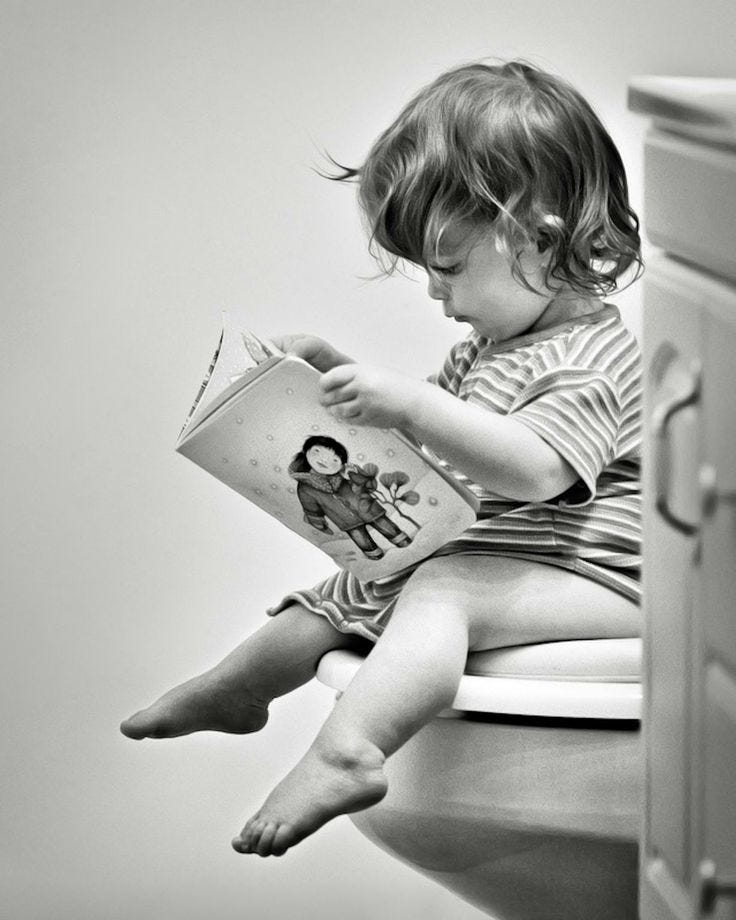
Here’s the headline that triggered that response in me: Who’s Responsible for Toilet Training? Schools or Families?

Here’s the gist, from an Education Week survey: Most [teacher] respondents agreed that, compared with two years ago, students are struggling more with basic skills and tasks—from following instructions to tying their own shoes and, in some instances, personal care, including toileting.

Mind you—we’re not talking about children with significant disabilities or the occasional kindergarten accident. We’re talking about the expectation that children will handle their own bathroom needs when they’re five years old vs. the prospect of teachers dealing with toilet assistance for 30 children, some of whom are still wearing pull-ups.

In addition, of course, to literacy, numeracy and putting on their snowsuits.

I have lots of teacher friends. Those in early childhood classrooms have been concerned about those basic skills and tasks for more than a few years now. They’re not calling it a learning recession—which is a stupid label—but they are noticing downward trends in the markers of independence that students bring to school. They’ve got stories.

Anne Lutz Fernandez, commenting on the “learning recession” designation in a new report gets this exactly right: Teachers and professors nationwide have been sounding the alarm for some time about the declines in student skills, knowledge, and behavior they’ve been seeing firsthand, much of which can’t be measured by standardized tests. But test scores are all that many political and educational leaders heed when it comes to school success.

I’m old enough to remember the rollout of No Child Left Behind—the dismay, once we realized that third grade would become the first year when children would be defined annually by their test scores. We were accustomed to standardized assessments—Michigan was giving the statewide MEAP test in 1970, in 4th, 7th and 10th grades—but it was easy to see that the general public would soon rely on test scores as the only reliable indicator of student progress.

It was also easy to see that those annual tests would begin to drive instruction, re-focus curriculum and put pressure on schools to raise scores. What we didn’t foresee, initially, was the long tail: statistical voodoo that calculated an individual teacher’s ‘value added,’ for example. Or closing down schools, often community centers in poor neighborhoods, with low test numbers. Or the pre-test pep assemblies, the frantic search for curricula that would boost scores, the third grade flunk rulesNot to mention the cheating.

What I find interesting in the “learning recession” talk is the approximate date that the test scores began going down: around 2013. Which would be the time when all K-12 students had experienced the Brave New World of NCLB and its subsequent federal incarnations.

Seniors graduating in 2013 would have taken all the standardized tests and experienced all the efforts to <cough> raise the data bar. From that point on, it should have been a steady upward climb. But no.

It was also, of course, just about the time 7th graders began asking for their own phones and one-to-one Chromebooks were district selling points. There is resistance to blaming sagging test scores on technology—when you spend a huge percentage of a district budget on tech hardware, software and training, it’s hard to admit you’ve been bamboozled.

Anne Lutz Fernandez, again: The problem with this phraseology [learning recession] is that it frames the crisis as one not of culture or human systems but one of business and economics. A key legacy of the accountability regime and its heavy reliance on standardized testing is the inability of politicians and pundits to see or discuss the work of schools in other terms.

Bingo. We might begin by admitting that test scores aren’t truth. And if test scores peaked and then diminished, it might have something to do with that fact. Nobody—including 3rd graders—wants to be defined by a number. When you’re old enough to understand that your test scores are more important to your school (and, perhaps, your teacher) than you, motivation for trying hard might diminish as well.

But that’s a cultural issue—like five year-olds who have not mastered toileting yet. If there is a recession, it touches many ordinary skills that are part of growing up and self-management, and it reflects on the world our youngest schoolchildren inhabit.

A culture fraught with disrespect, parental indifference to schools and learning, a lack of healthy play and human relationships. A country where AI memes serve as news, and political leaders lie and lie and lie. Where teaching is no longer defined as a profession.

If there is a learning recession, fixing it won’t happen by ratcheting up the stakes, once again. It calls for a new vision of which learning is important, and a new commitment to the children of this nation, as well as public education, which is—or used to be—America’s best idea.

Memorial Day, 2026

I’m not much of a flag waver, really. I always thought that author James Baldwin captured my feelings precisely in Notes of a Native Son when he wrote:

I love America more than any other country in the world, and, exactly for this reason, I insist on the right to criticize her perpetually.

These days, perpetual criticism is essential. We are immersed in dark times, I think, redefining the meaning of patriotism and sacrifice. It’s easy to lose faith in our government and the grand experiment—all men created equal—that founded this nation. It’s easy to let hope die when our rights have been systematically eroded by power-hungry politicians. When our children are not able to read certain books or study our actual national history, we’re in trouble.

I still believe, however, heart and soul, in the shining but imperfect ideals of a democratic education –equality under the law, the American common school, a free, high-quality education for all children, simply because they deserve it. Thirty-odd years of teaching school gave me a hard crust of cynicism about many things related to education and America. But I never lost my enthusiasm for the Memorial Day parade.

For 25 years, my middle school band students marched through the small town where I taught and lived, in the Memorial Day Parade. There was a whole set of traditions around this event, which grew larger and more complicated every year: the aural passing down of our special drum cadences from the self-appointed 8th grade drumline leaders, mending the color guard flags originally purchased through a pizza sale back in ’88, and patching up hand-me-down snares and sousaphones scrounged from the high school.

There was never a budget for this–middle schools don’t typically have marching bands–but somehow there were always T-shirts, and cold drinks at the end of the parade route. We had a stunning handmade banner that two moms whipped up with lots of lamé and sequins. In my last year, we marched nearly 300 students, on a morning when the sky was a sapphire blue and Air Force jets flew overhead as we rounded the corner by the cemetery.

This took up a fair amount of teaching time. I would get on my knees and beg colleagues for 20 minutes on the Friday before the parade, to assemble five bands into a single marching unit and take a few spins around the parking lot. One year, as I was trying to get the back of the band to master pinwheel corners, the front rank (rambunctious 8th grade trombones) marched right up the sidewalk, opened the front doors, and led the band, playing America the Beautiful at top volume, through the school hallways. By the time I sprinted up to the head of the band (and the principal popped, red-faced, out of his office), marching through the school was a done deal–and became yet another annual tradition.

I was always clear with my students about the meaning and purpose of Memorial Day. They would occasionally whine about how boring America the Beautiful was–Mr. Holland’s band played Louie, Louie, right? I explained that they were old enough to dedicate a morning to thanking local patriots and acknowledging the sacrifices made by Americans over centuries. Older people, watching them march by, would be pleased to hear traditional music. It was about respect.

We do this, I told them, to remember and honor those who made it possible for you to live in this beautiful little town, in this safe world. People like my Uncle Don, who died in February 1945, part of the Fourth Marine Division which stormed Iwo Jima. Or Ray Shineldecker and Joey Hoeker, two high school classmates who lost their lives in Viet Nam. I had lots of funny stories to tell about Joey, who lived around the corner in my old neighborhood–a big, goofy kid who was what guidance counselors in the 1960s called “not college material.”

On our last band trip to Washington D.C., after performing on the steps of the Lincoln Memorial, I was loading tympani onto the buses as my students toured the Mall. A few girls came running up, calling “Mrs. Flanagan! We found him!” Found who, I asked.

Joey Hoeker, of course–on the Wall. And I lost it, right in front of all those kids.

I thank those who served and sacrificed so I can love my country, and criticize it, too. A hat tip to all the band teachers and student musicians who help make Memorial Day meaningful this weekend.

And another hat tip to community bands, providing the same service. I’ll be in Northport, Michigan on Memorial Day–settling in the cemetery to play the National Anthem, Sousa marches–and a tribute to the Armed Services. Join us at 10:30 a.m. You won’t be sorry.

The Rule of the Free Market in Education

I spent 30-odd years teaching in a medium-sized school district that nearly doubled in size during that time period. Which meant that we kept outgrowing our facilities, asking for new schools via bond issues, and moving kids around to accommodate their educational needs.

In fact, the first year I taught in this district, our overcrowded middle school (grades 5-8) was on split sessions. I arrived at school at 6:30 a.m. and taught from 7:00 a.m. until noon. The guy who shared my classroom taught from 12:15 until 5:15 p.m.

Classes were 42 minutes long, with a 20-minute “nutrition break”—supervised by teachers—between 3rd and 4th period. Every teacher shared a classroom, all their textbooks and equipment. This was in the era before Xerox machines in every building, so making copies for instructional materials happened at the lone ditto machine (take a deep, alcohol-and-acetone scented breath) in the office. None of this was good.

Still, it often took multiple tries to get a millage or bond issue passed to build adequate space. And when those new buildings were completed, it was obvious that parents would want their children to enjoy the outcomes of their YES vote and send little Jason to the new school, the one with the computer lab.

There were no charter schools and the nearest Catholic high schools (one for girls, one for boys) were 35 or 40 miles away. You’d think we had a educational monopoly and could do what we wanted. But we were firmly under the control of the school board, as conservative and traditional a group of dairy farmers and local business owners as you can imagine.

The school board’s m.o.: How much does this cost? Can we get it cheaper? Is this some new-fangled educational fad, or something our students really need? Couldn’t we squeeze a couple more years out of the Social Studies series, and just have teachers tell the students that the USSR doesn’t exist anymore?

Every single board member ran on fiscal responsibility, with their own personal definition of ‘frills’—things that may have been nice but would cost more. Things like music, art and in-building libraries. The theory was: just because there was supply didn’t mean we should demand. As long as there was a football field and a big gymnasium, the rest of the programming we offered was on a “don’t ask for more or we’ll cut you completely” basis.

That was then.

We were a total free-market district with deep local control, run by large landowners and businessmen, supported by the taxes they (and all our modest rural families) paid. I wish I had a dollar for every time I heard a school board member or cranky old farmer say we were offering “just a basic education” at a board meeting.

What changed?

Technology, for starters. There was a long stretch of time beginning in the 90s when every millage election promised computers as irresistible selling point, giving kids ‘what they need for the future.’ Federal policy also ramped up grade 3-8 testing a quarter-century ago, simultaneously introducing a kind of fear-based ‘accountability.’

But the biggest change was the introduction of ‘choice’—a word that demands quotes. I would argue that my early experiences– school board members in overalls worried about overspending–was actually a kind of choice.

If you chose to live there, back then, you were either a farmer, or living on what used to be farmland, sold for development because the taxes were too high. You had to accept the fact that your rural school had shortened days, leaky buildings and overcrowded classrooms.

Three foreign languages and AP courses and 8-hour secondary days with time for an orchestra? Not here. Go back to those greedy, high-tax big-city districts around Detroit. So, yes, there was also a racist thread running through all the free-choosing.

Peter Greene sums up this attachment to the idea of unleashing free market forces and choice in education, the myths behind this tunnel vision, in this terrific piece. He covers all the things I came to see, teaching in one district for decades: We don’t want to share resources. We’re afraid of what ‘those kids’ would teach our kids. Competition is how to make schools and student learning better. People can realistically vote with their feet. The free market always works.

The idea that you can always get what you want, if you have enough money and power, has exponentially multiplied in the past couple of decades, supported by policy and legislation. It has nothing to do with improving student learning or innovations in teaching or curriculum, things that should change over time. As my friend and Michigan State School Board member, Dr. Mitchell Robinson asks:

Why is “zero government interference” right for some families, but “strong accountability” is demanded for those who send their kids to public schools?

Has any of this resulted in improvement, to any metric of school success, from parent satisfaction to (unreliable) standardized test scores? No.

Peter Greene gets the last word: School choice doesn’t have to be constructed on a framework of market dynamics. In fact, school choice could be done much better without those things– provided we accept the notion that the goal is to get the best possible education to every student, regardless of zip code. We could do it, if the goal were actual educational choice and not the conversion of a public societal good into one more commodities market.

This is the building where I interviewed for the job that lasted four decades.

 What Has Your Mother Given You?

Confession: I appropriated this prompt from Steven Bechloss, who provides such a thought-starter most Saturdays. He wrote about Ann Dunham, Barack Obama’s mother—inspiring—and, in what can only be described as striking contrast, the mothers of Lee Harvey Oswald (angry, controlling) and Nixon (per Nixon, a saint).

I’ve never been very excited about Mother’s Day. For starters, I disagree with the stylebooks’ use and placement of the apostrophe. What if you have two moms—and you love ‘em both the same? Why not just Mothers Day—acknowledging mothers without possessing one? But I digress.

Which may be something I got from my mother, who could turn a five-minute straightforward narrative into a half-hour of (amusing) verbal wandering around in backstory.  She also had a wicked sense of humor—she was Class Cut-up in her Muskegon (MI) HS yearbook, 1945.

My most memorable moments with my mom were not classic mother-daughter rituals. She never helped me pick out a wedding dress, and wasn’t present when I married my husband, in a judge’s chambers. She wasn’t there when I was in childbirth. She seldom commented on my major life decisions. We didn’t have long, rambling phone conversations because they would have been long distance—and her monetary meter would have been running.

But when I was in college, and came home late from summer jobs, we lay on either end of the couch eating ice cream and watching Johnny Carson and laughing at nothing much until tears ran down our cheeks. I always knew my mother loved me, and was proud of me, and that was enough.

The last words I said to my mother were “Love you,” and she replied, “Love you too, honey,” and then I hung up, and got on an airplane to Florida, for an education conference. I was awakened by a phone call early the next morning, telling me she was gone, at age 73, of a cerebral hemorrhage. It seemed like the final injustice, gone so soon, for a woman who lost her father at age seven, her husband at 52, and suffered a catastrophic health event a couple of weeks after she retired at 65, one that kept her hospitalized for months.

I know lots of people who have Mother Stories—adventurous moms, politically savvy wine moms of either party, domineering moms, crazy moms. I’ve heard people say that their mother was their biggest cheerleader, or nit-picky, never satisfied with their children’s life outcomes.

But not my mother. She never bailed me out, but she never made me feel like a failure, either. Instead, she was… steadfast. And kind of low-key and snarky. Fun to hang with, someone who took life as it came.

I think Steven Bechloss was looking at three typical models of mothers—the ones who shaped their sons for better or worse. During my 35 years in the classroom, I saw mothers who were high achievers and expected the same of their children. I saw bitter and controlling moms—and some who thought their sons could do no wrong, even when the evidence was flashing red, right in front of them.

But it always seemed to me that children are not possessions or projects or even direct reflections of their mothers. Good parenting helps, of course, but in the end, kids are born with self-determination, their own temperament and personality.      

I’m glad my mother let me be myself. I think it’s a practice worth considering, on Mothers (no apostrophe) Day.