The Legislature Goes to the Bathroom

I remember the first time I encountered unisex bathrooms.

I was traveling, with a backpack and not much money, in Europe, staying in youth hostels and tourist rooms, often in the homes of women I would meet at train stations holding up signs saying Zimmer zu vermieten. 

Near the end of the trip, an eight-week journey which I funded with just under $1000, I was in Munich, trying to find a cheap (really, really cheap) place to stay. Someone told me about a hostel camp, maybe an hour’s hike from the train station—a field outside the city where you could stay in a huge tent. If you got there early enough, there was also food.

I schlepped out there and stayed the last two nights of the trip, also visiting Dachau on my final day. It was bare bones—BYO sleeping bag and ground pad. There were unisex flush toilets in wooden cubicles, in a single concrete building of the type you’d find in any state park campground today. There were also warm-water showers, in a large room with no dividers for males and females. BYO towels and soap, as well.

The hardest part of adjusting to this was trying to act casual, as if I were used to waiting in line to use the toilet between Hans and Karl, or nonchalantly showering with a couple dozen mixed-gender strangers. Everyone else seemed pretty blasé about it. The vibe at the camp was international, friendly and very safe.

The year was 1976, the 200th anniversary of the home of the brave, land of the free.

Now, nearly a half-century later, some people have their knickers in a twist over newly remodeled unisex bathrooms in Michigan State University’s Campbell Hall, a beautiful dormitory on the oldest part of campus, which houses the Honors College.

The retrofitting took traditional community baths and turned them into lockable, fully enclosed private stalls, each with a shower, toilet and sink.  For a quick hand-wash or teeth brushing, there are also community sinks.

Apparently, the MSU Board got a letter of outrage from a parent, although students (who had to apply to live there) seem to be fine with the plan. There were some comments at the Board meeting about walking around after showering in a towel, but I chalk those up to people with too much time on their hands, wallowing in trad-nostalgia or perhaps sexual fantasies.

Back in the1970s, I lived in a co-ed dorm with community bathrooms. There were four floors—two community baths for women, two for men—although the dorm rooms alternated between men and women. I can’t tell you how many times I went to the women’s bathroom and found some dude walking out of a stall, because he didn’t feel like going upstairs. Lockable stalls with all you need sound vastly preferable to stumbling upon your roommate and her boyfriend showering together in the community bathroom.

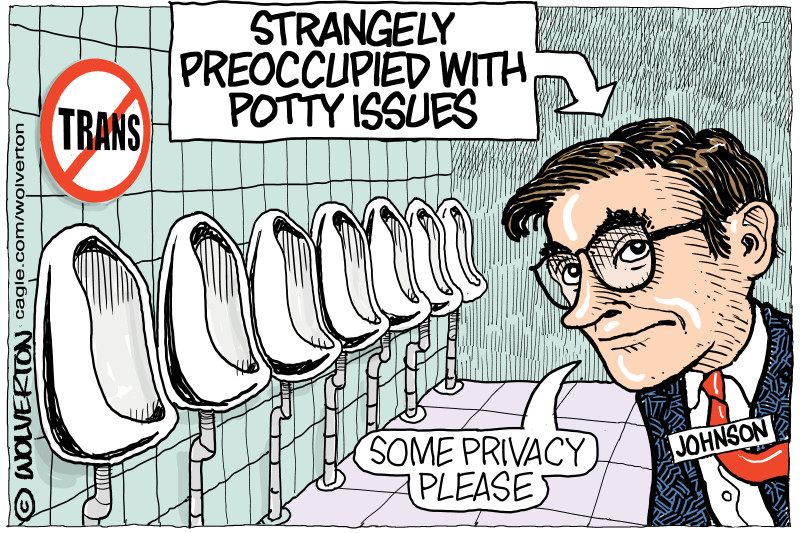
Makes me wonder why Republican legislators always bring up bathrooms when they want to gin up fear around gender expression. There really isn’t anything moral or magic about using the bathroom, with either gender.

There’s this: ‘Opposition to transgender inclusion has become a rallying cry for many conservatives. The debate is at the heart of a bill advancing in Michigan’s Republican-led House that aims to restrict bathroom use at schools and colleges on the basis of biological sex. 

Sponsoring Rep. Joseph Fox, R-Fremont, suggested Wednesday that allowing transgender students to use bathrooms of the gender they identify with is “traumatizing little girls.” He called it a “safety issue.”’

Then there’s this: “Michigan must stop making references to gender identity in sex educational materials provided to schools or risk losing millions of dollars in federal funding, according to President Donald Trump’s administration.” 

The State Board of Education is also currently hearing testimony on a new set of standards for sex education in Michigan:

“A recommendation that schools include instruction about gender identity or expression and sexual orientation by eighth grade has prompted criticism from several parental rights groups and Republican politicians. 

“These proposed standards cross into deeply personal and spiritual territory, normalizing behaviors that many families find harmful and contrary to their faith.’”

Traumatizing little girls? Normalizing behaviors that contradict families’ religious beliefs? And not being allowed to talk about it, in eighth grade sex ed classes, even if your parents say it’s OK?

It’s all about what’s happening in American bathrooms, evidently.

Gender-neutral bathrooms are commonplace in Europe.  Why is that? What do they understand that we don’t?

Trump and his “Aptitude for Music”

There are so many things to be said about the ongoing demolition of the American government that your average reader—even someone who follows politics closely–can’t keep up. Everything from the Massive Erroneous Deportation to the Declaration of Independence in the Oval Office to the biggest upward transfer of wealth in history. Not to mention Goodbye to the Department of Education.

Lots of great writing about where we find ourselves as a nation, as well—I am learning to get along without the Washington Post, with the great political commentary coming from independent newsletters like The Contrarian, Meidas, Robert Reich, Heather Cox Richardson, Lucian Truscott, The Education Wars and the Bulwark, which are only the ones I’m currently paying for. Can’t add much, beyond my personal open-mouthed horror, to the wall-to-wall political coverage available.

However. Here’s one inane Trump declaration where I have considerable expertise: Touring Kennedy Center, Trump Mused on His Childhood ‘Aptitude for Music.’ 

In case you’ve missed it (and you’re forgiven if you have): President Donald J. Trump — who recently overhauled the once-bipartisan board of directors at the John F. Kennedy Center for the Performing Arts and installed it with loyalists who elected him to serve as its chairman — held court Monday in a place that he had not publicly visited during either of his terms in office: the Kennedy Center.

Remarks were made to the Washington Post by Trump officials who recently toured the arts venue and described it as “filthy,” noted that it “smelled of vomit,” and added that they “saw rats.”

But not to worry! Trump alone can fix the Kennedy Center. In fact, Trump—who could have been a superb musician, if his parents hadn’t pushed him into becoming an outstanding athlete and phenomenally successful businessman instead— can add “born arts connoisseur” to his  already-substantial resume’. Because ‘the test’ showed what we’ve all missed: the guy who bragged about punching out his music teacher in second grade was really an untapped musical genius.  

First of all: Hahhahahhahaha.

Like all Trump anecdotes—Sir! Sir!– this one is mainly bullshit: He told the assembled board members that in his youth he had shown special abilities in music after taking aptitude tests ordered by his parents, according to three participants in the meeting. He could pick out notes on the piano, he told the board members.

If you polled actual music teachers, all of them could tell you stories about small children whose parents considered them exceptional, because they could dance to a beat , clap a rhythm or pick out a tune on the keyboard. Many of them had a great-grandmother who taught piano or uncle who was a whiz on the saxophone—thereby confirming that their talent was inherent, according to mom.

Some of those kids (especially the ones whose parents encouraged practice and persistence, attending every concert) turned out to be good musicians, after some basic musical instruction. Others, not so much.

Second: Testing children’s innate musical ability has fallen out of favor, for the same reasons that other standardized testing has been rightfully criticized. In the post-war years, a ‘musical abilities test’—the Seashore Test—was popular, often used to determine who should get to use expensive school-owned instruments. I took it myself, in the 4th grade.

What the Seashore Test did, mostly, was identify kids who had some musical experience—piano lessons, singing in the church choir, music-making in their families. Because the more you do music, the better your ‘ear’ and sense of rhythm. Kind of like the way kids who go on family trips to the library or museum get a leg up on other kids, when tested on their reading abilities or content knowledge.

Is there such a thing as talent? Sure. But testing as a means of determining talent—or taste, or creativity—when the testee is a child is pointless. Genuine, exceptional talent emerges as a result of passion and tenacity and, sometimes, good luck.

Here’s a story about my own failing in assessing talent, as a music teacher.

Why did such testing fade away? Because it missed a lot of students who became strong musicians—singers and trombonists, the lead in the school musical—down the road.

Lesson learned: ALL children should all enjoy making music in our schools. Because you never know if someday your child might be Chair of the Kennedy Center Board.

Diversity, Political Culture and Middle School Band

Like all educators, I’ve been following the repercussions of the “Dear Colleague” letter the federal government sent to public schools, threatening to cut off funding for schools that dabble in things like human rights and accurate history. The fact that the poor, strapped (snort) Department of Education used some of their evidently dwindling resources to set up a snitch line so parents could rat out teachers and school leaders is telling.

Dear Colleague, my ass.

More like Big Brother is watching. Or Here’s Our Grand Portal of baseless conspiracy theories and fear-mongering to support so-called “parents’ rights”—jump right in!

To make this all seem “normal,” the ED sent out a nine page read-what-our-lawyers-say explainer that further muddies the waters. The purpose of this second epistle seemed to be upping the threat while appearing to be efficient and legal-ish.

Many times, in my long career as a vocal and instrumental music teacher, I’ve had dear colleagues (ahem) express mild envy over that fact that the general public saw my subject discipline as what we used to call a “frill”—nice, but neither substantial nor essential.

Parents, these teachers suggested, didn’t really care about what kids were learning or singing in music class. It was an elective, not part of the more important career-preparation/serious-academics curriculum. In other words, my students were not being tested on the music curriculum, like theirs were. In band and choir class, we were just, you know, playing around. Fluff.

As you may imagine, I’ve written countless blogs and think pieces about what kids take away from a quality music program. If you think that the arts are a value-free zone—not tested, so not important—I’ve got news for you.

The classroom where I spent more than 30 years, teaching secondary vocal and instrumental music, was a platform for learning about lots more than the fingering for Eb and how long to hold a dotted quarter note. It was a place where we could explore how the music that students are marinating in, 24/7, came to be—a cultural voyage, through time and place, and the human response to make art reflecting the artist’s circumstances.

Proof of that–a couple of days ago, a young band director, on a Facebook page for instrumental music, asked his dear virtual colleagues for advice on this dilemma: His 8th grade band had been preparing Moscow 1941, a terrific composition, for an upcoming performance. Given the current fluctuating official opinion on Russia, Russia, Russia, he was stymied by his middle schoolers asking if they were playing a Russian march to show support for the Trump administration.

What do I do? he asked. Do I tell them Russians were the good guys in 1941, but not now? Do I say it’s just notes and rhythms, forget the title? Do I just pick something else? The kids like the piece and we have it ready for performance. Also—I’ve already talked to the kids about great Russian composers and the dark and moody music they have produced, over centuries.

First—I love that there’s an online forum for discussing these professional issues. Responses were mostly thoughtful, ranging from “tell kids the truth about Russia, then and now” (including a couple of good resources) to “get your principal involved.” There were also a few “avoid conflict, always—dump the piece” responses, which I took as evidence that teachers, in general, are rightfully anxious about threats from federal, state and local officials. Music programs are chronically in the crosshairs and choosing music that Trump-voting parents could misinterpret could be risky.

The discussion morphed into examples of band directors who chose music to represent Ukraine, and other masterworks inspired by political events, like Karel Husa’s Music for Prague, 1968. This is what the arts are supposed to do—help us make sense of the world.

Back in the 1990s, I bought a piece for my middle school bands called A Lantern in the Window, a musical depiction of the Underground Railroad. There was a quiet, spooky opening, followed by a pulse-pounding chase, and the piece ended with a richly harmonized quote from an old Negro spiritual, Steal Away to Jesus.

I programmed Lantern often, every two or three years, because it was a perfect teaching piece. There were multiple tempos and styles, and I could talk about the use of familiar songs, how a few measures could remind us of a powerful cultural idea.

Students always wondered why an enslaved person would believe in Jesus—and yes, these conversations had to be carefully handled. But they were worth it. They illustrated the power of music to tell an important story. And that, I thought, was the heart of my job.

Last week, “The President’s Own” Marine Band quietly canceled a concert program originally billed as the “Equity Arc Wind Symphony.” The performance was to be the culmination of a “multi-day music intensive with musicians from ‘The President’s Own’” and high school musician fellows selected through auditions organized by the Chicago-based Equity Arc, a nonprofit organization that provides “specialized mentoring support for young BIPOC musicians and helps institutions take meaningful steps toward equity and inclusion.”

When I see stories like this in the news, I wonder how music teachers, specifically, can stand against federal threats. Our job—our low-paying, high-importance, mega-stressful job—is to give children of all ages, colors and abilities the chance to love, understand and perform music. Politicizing that—for whatever stupid reason—is both wrong and damaging to children and to our American culture. That’s a good reason to push back.

I have empathy for teachers, like the band director worried about Moscow, 1941, but I also know that huge masses of the middle class workers will have to stand against the takeover of our government and our national culture in order to stop the carnage going on right now.

Deep breath. Buck up. There is lots of work to do.