What Europeans Think of Trump

Just got home from a two-week vacation in the Czech Republic and Germany, including a week in what used to be East Germany. All of us learn from travel, of course, but this trip—planned long before last year’s election—was an incisive tutorial on how the rest of the Western world sees where we’re headed.

As of today, there are warnings against travel to the United States for citizens of Canada, Germany, England, Denmark, Netherlands, and France—probably the easiest and most accessible nations for Americans to visit.

I grew up in Michigan, where Canada hardly felt like a foreign country. I have friends who live in Windsor, but work in Detroit. College students in Michigan have routinely made pilgrimages to Ontario, where the legal drinking age is 19. Losing that easy camaraderie is huge—and that’s without taking into account the auto industry’s dependence on Canadian-made parts and trade.

I was interested and a little anxious about what the vibe would be in Europe. I’m too old for rail passes/backpacks/hostels travel—we’d be staying in hotels and led by English-speaking guides—but if you pay attention, in between historic dates and landmarks, you can hear and see what daily life is like in places that used to be Russian-controlled territories, how they see themselves in the world, and their fears for the United States.

I was also curious about my fellow American travelers. Would they agree with Jim Acosta, who said: Think of the damage done to America’s standing in the world, in the minds of young people across the globe. They see a president who is often out of touch with the real world, thoroughly corrupt and vengeful, beginning his second term launching a crypto scheme and turning government against vulnerable migrants as well as his enemies, both real and imagined.

We began our journey in Prague, a gorgeous medieval city that has been overrun by competing rulers for centuries, part of the Holy Roman Empire as well as the Kingdom of Bohemia. The old core of the city was almost untouched by WWII, but our local walking tour guides–find ‘em on the internet–occasionally pointed out architectural anomalies, calling them Communist buildings, which (local joke) come in three colors: light gray, medium gray and dark gray.

Because the walking tour groups were nationally diverse, the focus was on the enchanting city and its rich history—including the Velvet Revolution of 1989, wherein the Czechs reclaimed their own heritage and autonomy.

Traveling into Germany—the former GDP, East Germany—was revelatory. Guides were excellent—they all knew the historical markers but would often tuck bits of human perspective in their remarks.

  • Our guide in Wittenberg was born in the 1950s and grew up there. In secondary school, she said, she studied Russian. It was the only “foreign” language available. She also studied Russian in college. When she was in her 30s, and the Wall came down, she decided she wanted to learn English—and did. I never wanted to speak another word of Russian, she said darkly.
  • In Potsdam, we visited the estate where the Potsdam conference was held and the iconic photo of Truman, Stalin and Churchill was taken, before Germany was carved up. Potsdam is a beautiful town, including the upscale neighborhood where Vladimir Putin and his KGB comrades lived, in the1980s, considering what other beautiful villages and terrain they might appropriate.
  • In Dresden, we got a quick tutorial on how much of Dresden was bombed into smithereens, in February of 1945. American woman (who should, IMHO, know better) asks the guide: Who bombed this city? The allies, he replies, tactfully. You mean us? She says. Why would we do that? Well, the guide says— revenge, maybe? Later, I hear the woman ask her husband if the Germans are communists, leaving me to wonder just what we are teaching in World History classes.
  • In Torgau, where the allied armies met the Russian army, effectively shoving the tattered German army out of their homeland, April 25, 1945, five days before Hitler took his own life in a bunker. We looked at the site where the armies met, on the Elbe river. Flags from the United States, Russian and Germany have flown there for 75 years, in a memorial. The flagpoles are now empty—and have been since earlier this year, when Germany decided the peace agreement no longer applied.

Our guide in Torgau pointed out that there were a few things—free child care, for one—that made living in East Germany easier (these kindergartens were shut down as “too socialist” after the reunification). On the other hand, the omnipresent occupying Russian soldiers were brutes. His great-grandmother was shot dead in the town square, for resisting the attentions of one of them. He reminded us that Hitler came to power peacefully, and stayed there, courtesy of the Nazi party.

  • Berlin, of course, is a kind of living museum. Most powerful moment in Berlin? The square where, in May of 1933, the Nazis held their first book-burning. There’s a memorial there. Our guide said, quietly: First they burn books. Then, they burn people. But there is a little free library in the square, with hammocks and beanbag chairs. It was a chilly day—but there were children there, reading. Hope.

Everywhere we went, people were kind and hospitable. And honest. Aware of how long it takes to overcome the destruction of a great nation.  As Jen Rubin wrote, this morning:

Other countries, much older than the United States, have gone through grim, even disastrous years, decades, or centuries. And yet in Europe, the spirit of liberal democracy (however imperfect) remains alive and well. A sense of the public good still thrives, and millions of people strive to keep the achievements of Western Civilization from the clutches of fascism, xenophobia, know-nothingism, and conspiracy-mongering. The world is carrying on, albeit with dismay, as Americans struggle through its Dark Age.

Amen.

RIP, Libraries and Museums

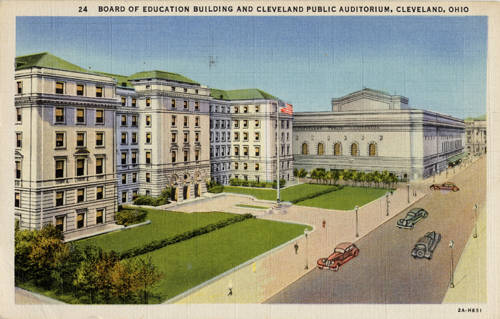
On our way home from the Network for Public Education conference, earlier this month, we jogged to the right and spent a night in Cleveland, so we could visit the Rock and Roll Hall of Fame. Our hotel, just a couple of blocks from the Hall of Fame, used to be the Cleveland Board of Education building, completed in 1931.

It’s a magnificent structure, all marble, soaring windows, colorful painted murals and wide hallways, with a bar named The Teachers’ Lounge. Who could resist?

It made me wonder about the value Cleveland currently places on their public schools, when a century ago they commissioned this monument to public education, likely assuming that generations of Ohio kids would be duly and proudly educated in Cleveland, and go on to do great things.

They don’t build ‘em like they used to—either our buildings or our midwestern dreams of progress.

The history of the Cleveland Metropolitan School District looks like the history of many big-city school districts, scarred by changing demographics and the public’s unwillingness to support all children with a free, high-quality, fully public education. Cleveland is not unique—there are still Pewabic pottery-tiled fireplaces in public schools built in the 1920s in Detroit. You can take a bike tour of historic, architect-designed schools in Chicago.

The ”high school movement”—when it became common for American youngsters to pursue education beyond the 8th grade—occurred in the first half of the 20th century. In 1910, the number of HS graduates in the United States was less than 10%, but by the outbreak of World War II, almost three-quarters of the student population attended high school. Many factors—mainly wars, rural-urban migration, and an economic depression—shaped the movement to make 12 years of education the norm.

And, of course, what was the norm for white kids did not necessarily apply to children of color. The Brown decision in the 1950s and school busing protests in the 1970s interrupted the rosy national vision of steadily increasing investment in our public services and institutions.

Not to put too fine a point on it, but America has always struggled with the concept of “all means all” –just who “deserves” to have nice things, like decent housing and basic health care. Schools. Libraries, museums and parks. A reliable, inexpensive postal service. Public universities. The kinds of services we share, places of mutual benefit. Our freedoms.

And now, we have elected a man whose fundamental life goal seems to be taking those things we share—the things we all deserve, and have worked for, as citizens in a constitutional republic– away from us.

Defunding public services and institutions. Privatizing the Post Office, which serves rural addresses that Federal Express won’t touch. Shutting down youth programs and the Summer Reading Club at your local library. Eliminating programs for veterans. Even—God help us—shutting down suicide hotlines for LGBTQ teens.

As I watch this wrenching tear-down of all the things that make for strong communities, I am staggered by this conundrum: Trump and his acolytes have embraced the idea of making America great again by attacking the very things that actually made us great, beginning with the solid belief in our future progress that drove the city of Cleveland to build a temple to public education, and finish it during the early years of the Depression, placing a statue of Abraham Lincoln on the manicured lawn in front.

Belief in our people and their future is behind untold numbers of beautiful, shared enterprises—theatres and hospitals, stadiums and churches. Monuments to philanthropy, and showcases for art and culture. National parks that tell our nation’s stories. Organizations established to help our fellow citizens.

What is behind the impulse to tear all this down, close it off, let it crumble, progress and humanity be damned? Who does this—and why?

None of this is genuinely about waste or fraud—or even evidence of out-of-control DEI thinking. How can there be too much equity or justice in a country that prides itself on inventing a new form of government?

From an article about Lindsey Halligan (see link for revelatory photo), now charged with “removing improper ideology” from Smithsonian museums:

“I would say that improper ideology would be weaponizing history,” Halligan says. “We don’t need to overemphasize the negative.” Halligan, 35, is a Trump attorney who seems to have tasked herself as a sort of commissioner — or expurgator, according to critics — of a premier cultural institution.

Trump is not much of a museumgoer. 

What he’s after is power and control and riches. The men who built the infrastructure of industrial America wanted power, control and riches as well. Some of them wanted to preserve the vile institution—slavery—that made their power and riches possible. We fought a bloody, devastating civil war over the very issue of who deserves to be represented in museums, check out books from the library, or send their children to free public schools.

And here we are, again.

The Rock and Roll Hall of Fame was wonderful. I’ve been a handful of times, and have taken 150 eighth graders—I’ve got stories—to wade around in the history of the music that has surrounded them since birth. The museum is 100% private, funded by wealthy donors and $39.50/per ticket fees. It will not be torn down, stripped for parts or sold to the highest bidder.

As I was wandering through the main exhibit hall on the lower level, I started thinking about how the roots of rock music, like the labor of enslaved workers, were essentially stolen from African-American blues and gospel singers, mixed with rough-edged country, hillbilly and western music. And then sold to the masses, after condescending  public dismissal as unimportant and vulgar.

Power and control and riches. Plus ça change, plus c’est la même chose.

Coming to Life: Woodchippers and Community Builders

Maybe it’s 35 years of working in a classroom, but here’s what I think: it’s too bad that there aren’t more teachers in Congress.

Teachers generally know how to encourage recalcitrant students, stand up to student bullies, kick butt and make it stick, not to put too fine a point on it. Congress is acting like that 7th hour class with the wrong mix of kids, people who just can’t seem to work together. And if you have to ask why it’s important for students to work together, you’ve obviously never been a teacher.

As I watch what I hope is the nascent rise of a nation coming to life, reclaiming its identity, I am reminded again and again of the basics of K-12 community-making: Be kind, a team player. Show up and persist. Build some joy into whatever you’re doing. And keep your promises. We’re in this together.

If your job involves teaching 30 unwilling 4th graders to master two-digit division, you have to show up and persist—and also build some fun into the persisting. Because joy is the end goal—having the skills to pursue a good life. Accomplishing something important.

Not sure what’s happening where you live—but here in Northern Michigan, people are paying attention and organizing. Plenty of social change movements fade away (I knit 16 pussy hats and can only locate one at the moment), but the upcoming events calendar is full. If it only takes 3.5% of the population to foment change, we can do this.

What’s on my agenda? A Zoom messaging workshop. A book group that is reading and discussing Project 2025. Even a sermon, last Sunday, on “Embracing Diversity.”

On Saturday, there was an empty-chair Town Hall, featuring a cutout of Jack Bergman, Congressional Representative for the largest—geographic—district (CD One) in Michigan. Bergman is not a Michigan native, and in fact his primary residence appears to be in Louisiana.  In 2016 and 2018 the Bergmans listed a metal storage building at 5070 South Cisco Lake Road as their single family residence. The problem with this is the fact that the building has electricity, but no rooms nor septic field and was used to store trailers and boats.

And yes, I think that it’s Michigan’s responsibility to offload an election denier and traitor to the military, where he was once a Brigadier General—especially since he has shown zero evidence of caring about his constituents, many of whom live in Michigan’s poorest and most remote counties. The ones where hospitals are dependent on Medicaid, for example. There are no Tesla dealerships in the entire Upper Peninsula.

The Town Hall was wonderful—seating was limited (and the weather was dicey) but over 1000 people attended, in person or via livestream. Questions were not pre-screened. Just people taking turns at the microphones, pouring out their anger, their pain, their uncertainty. A special education teacher (who got a rousing ovation). A ‘recovering psychiatrist’ who warned us (acknowledging the ethics violation) that we were being governed by a malignant narcissist. Moms, nurses, dishwashers, authors and physicians.

And this comment from a veteran:
“My son is a veteran. I am a veteran. My father is a veteran. My grandfather is a veteran. And my great-grandfather is a veteran. Jack Bergman, you are a veteran. You’re a jarhead like my dad… and like my father, like my entire family, you took a vow; a very important vow. You vowed to (and here, the audience joined in) defend the Constitution and the Republic against all enemies, foreign and domestic.

Where the [expletive] are your vows, Jack? You are a disgrace to the uniform. You are a disgrace to the office that you hold. You are a disgrace to this country. And Jack, if you are too feeble and too afraid to stand up for what is right and to fulfill your vows, then it is time for you to step aside and let somebody else do it. Semper Fi.”

Turning to see the speaker, I noticed that the man behind me, in camo zip-up and olive drab beanie, had tears streaming down his cheeks.

I think something is happening. What we need now is showing up and persisting, keeping the faith. Remembering to have fun—because we want to live joyfully, to move forward.

In two weeks, I’ll be at the Network for Public Education conference in Columbus, Ohio.

Trump (or Musk, or whoever’s running the country) is putting public education through the woodchipper at the moment. There is already a bill filed in the MI (yes, Michigan) legislature to support shutting down the federal Department of Education, essentially saying ‘just send us the money—we’ll take it from there.’

It’s all pretty grim. I need to get together with my people, which is what I’m planning to do in Columbus. We’re in this together.

Billionaire Ideas: Andrew, Bill and Elon

So—it was just one of those re-posted memes: a chalkboard suggesting that the “old days”—when the very rich built and named hospitals, schools and libraries—were preferable to whatever the very rich are doing with their money today.

There are a lot of ways to argue against that tossed-off sentiment: We shouldn’t have to rely on the beneficence of the wealthy in order to have good public services, for starters. Some of that wealth was ill-gotten, and some philanthropists were Not Good People, as well. Why can’t everybody be like McKenzie Scott (formerly Bezos)?

On the other hand, I was born in a hospital named for a local benefactor. I was a card-carrying patron of a Carnegie Library and attended college where every damned building seemed to be funded by someone with lots more money than I’d ever have.

Furthermore, Forbes magazine reinforced my belief that the 21st century uber-rich aren’t very forthcoming any more with dough for public buildings and programs: How generous are the super-rich, really? Not very, according to Forbes’ research. The members of the 2023 Forbes 400 list have collectively given more than $250 billion to charity, by our count—less than 6% of their combined net worth.

Which gets to the point of why I originally posted the meme: The mega-affluent today are busy going up in space in rocket ships, abusing low-paid, NON-unionized employees, and controlling national elections with underhanded tactics.

I’d rather have the theatres, hospitals, academic buildings and libraries. Or—here’s a thought—what about someone with fabulous wealth funding a climate change initiative? Or ending poverty?

Andrew Carnegie funded the building of 2,509 “Carnegie Libraries” worldwide between 1883 and 1929. Of those, 1,795 were in the United States: 1,687 public and 108 academic libraries. Others are scattered throughout Europe, South Africa, Barbados, Australia, and New Zealand. He also funded museums, established an endowment for international peace, supported scientific research, and other civic initiatives, including the Carnegie Foundation for the Advancement of Teaching. He bought or upgraded pipe organs in over 7600 churches.

And, yup, Andrew Carnegie was a robber baron in the most derogative sense of the word, using violence and ruthlessness in controlling the ill-paid and exploited workers who built his fortune. He was also an immigrant, who came to America penniless, and you know how Americans love a rags-to-riches tale. Biographers suggest he had an attack of conscience as he aged, and spent more and more of his wealth on civic projects.

In posting the chalkboard meme, I drew a lot of commentary because I mentioned Carnegie and all those libraries. Surprisingly, a lot of the negative feedback came from librarians, who popped up with passionate responses about Carnegie’s insider trading, sending goons to beat up strikers and trying to suppress the uprisings of the great unwashed by building them libraries.

It occurred to me that those librarians were universally well-read and not about to blindly worship old, filthy rich, controlling white men. Although, you know, thanks for the library.

Still. Although nobody can exactly defend the Titans of the Gilded Age, they left a lot of architecture and institutions for us to use, more than a century later. What have our still-living titans done with their immense wealth?

Bill Gates has funded the building of computer science centers at four universities (including, ironically, Carnegie Mellon), and purchased 40 square miles in the AZ desert west of Phoenix to build his own city of 200K residents, among other projects. From Salon:

There’s a deep-seated belief in libertarian-rampant Silicon Valley that the government and our political processes are slow and messy; to that end, many techies, mad with power, have attempted to start their own partially or fully-privatized cities. Gates’ entire philanthropic visionexemplified by the Bill and Melinda Gates Foundation, is predicated on the idea that rich people and technocrats know best how to manage the levers of society, and the rest of us peons should sit back and let the rich techies run our lives. 

If you’re an educator, you will have felt the Gates Foundation’s impact, from Common Core standards to teacher assessments to breaking up big schools into smaller ones. Have money, will implement. Then declare many of these “promising” concepts failures. Maybe the teachers weren’t following the curriculum with fidelity?

Honestly? I’d rather have buildings and state-of-the-art equipment than Billionaire Ideas changing our fundamental institutions.

Which brings us to Elon Musk, who has promised his and Donald Trump’s  proposed economic policies could lead to “initial severe overreaction” and “temporary hardship” in the economy if Trump wins the election. Trump’s mass deportations and Musk’s $2 trillion cut to federal spending could disrupt industries, lead to labor shortages, and increase prices.

Hmmm. Couldn’t he just build us a nice hospital or school or library?

Carnegie Library in Howell, Michigan.

How Do German Schools Teach Their Political History?

It was Ernest Boyer who declared that public education functions as a stage where Americans test and play out their deepest values and convictions.

Everything that happens around us shows up in public schools. Ask any teacher about keeping the outside world out of classroom dynamics. Ask any scolding pundit or self-righteous parent just how to stick to phonics and fractions when the very ground has shifted.

Can’t be done.

This might be a good place to quote Adolf HitlerHe alone, who owns the youth, gains the future.

A word about playing the Hitler card. I have been justifiably criticized for raising the specter of actual fascism in school politics. This is not a thing to take lightly, I know; hyperbole always weakens an argument.

But I want to write here about a nation that once had a lot of explaining to do on that front, and has—from available evidence—been able, over the long span of three generations, to reconcile their role in what happened in the 1930s and 1940s in Germany, triggering global catastrophe. Maybe we ought to pay attention.

Ten years ago, I had the revelatory experience of touring the Nazi Rally Grounds in Nuremberg, and visiting the Documentation Center there with an extraordinarily well-informed German guide, a doctoral student who was moonlighting as “World War II Tour” escort and educator.

It was a six-hour tour, and pricey, and you could sense the Americans we were traveling with growing weary of the information dump, wondering if the Christmas shop would still be open once the bus dropped us back off on the restored town square.

We wandered around the rally grounds and the man-made lake surrounding the building, once a Nazi headquarters and now the site of an extensive display of memorabilia and analysis. Our guide began by telling us that the impressive, forbidding structure we were looking at across the placid lake was not a museum.

Museums are for sharing cherished cultural artifacts, he said. There are plenty of those in Germany, and we encourage you to visit them. A documentation center, on the other hand, is a public record of a human failure—one for which Germany was responsible. It was Germans’ moral duty to keep the archived memory alive at the Documentation Center, in concentration camps, and courtrooms.

I wasn’t taking notes—I signed up for the tour with little foreknowledge of what I would see, how it would impact me. I remember a great deal of his running spiel. Our guide was an earnest, 30-something man in a plaid shirt, crooked tie and glasses, who carried two notebooks full of tabbed information and could give the veteran who asked precise information about range of Messerschmitt war planes.

A lot of the questions, in fact, came from men asking about military equipment and strategies, and not so many about the Holocaust or impact of the rise of fascism in Europe.

Asked whether Austria had a similar urge to document their own involvement with racial and religious discrimination, our guide made a face and declined to comment. Lesson Number One is that we always speak for ourselves, he said.

He spoke of regional political differences pre-War, how a country in acute financial distress could be utterly divided about causes and solutions. He talked about generational differences and how it took Germans three full generations to understand how a handful of men turned a fundamentally decent people into killers, persuading those for whom horrific prejudice was just not a deal-breaker, if Germany could be restored to greatness.

His grandparents, he said, were impressionable young people, just starting their family, during the rise of the Third Reich. They were gone now, but as a child he had been instructed by his parents not to listen to what Oma said about the terrible war years. She’s old, he’d been told. We’ll respect her for that. Don’t ask, and maybe she won’t tell.

His parents were the generation that bore their parents’ guilt. Then, as grandchildren of the Nazi legacy, his generation could finally claim to have actively worked to make sure it never happened again. In Germany, at least.

Questioned, he shared extensive data about the skinhead movement, a serious worry for the moderate government. But then he compared incidents of far-right violence in Germany to gun violence in America, a sobering contrast for anyone who was inclined to feel superior.

Someone asked the obvious question: How on earth could so many rational people buy into Hitler’s psychosis?

Ah, he said. This is where people from every nation must pay attention. Hitler was a genius at using available media and technology. Crystal radios were made cheap, and the same sticky message—an alternate, economically driven message of national pride—was pumped into all homes. “News” was what the party decided.

Public rallies were enormously effective. The Nuremberg site was chosen because it was cheap and easy to get to by train, and surrounding farms could house families and large groups of people from a single town, camping and sleeping in haylofts.

Everyone could participate—government was no longer centered in the industrial, better-educated north. A common enemy had been clearly identified, the future was brighter because there was a plan for everyone, not merely the political elites. The ultimate community-building success.

A man asked about the crumbling rally grounds, an “amazing historical facility.” Had there been any thought to restoring it? Our guide’s face darkened. “Let it rot,” he said. “Good riddance.”

I asked, as a teacher, what German schoolchildren were taught about Germany’s role in World War II. It was part of their national curriculum, he told us. They began with equity and community in early childhood, accepting differences and playing together. When students were 12, they read Anne Frank.Media literacy and logic and an intense focus on preparation for good, attainable, satisfying jobs were part of the program, in addition to history, economics and the predictable disciplines. We do not avoid our history, he said.

So what do you do in America, he asked?

Back in 2016, an honored fellow at the U.S. Holocaust Museum and recognized expert on World War II was suspended from his job after a parent complained when he pointed out parallels between Nazi Germany and the 2016 election to students. It took a national petition and a global spotlight to get him reinstated.

Also in 2016, in the nation’s leading McNewspaper, Rick Hesse and Checker Finn called the actions of teachers and school leaders attempting to calm their students’ real post-election fears “histrionics.”

That was eight years ago. And look where we are today.