Are Schools the Problem?

I was somewhere between irritated and curious when I saw the headline: America’s Children Are Unwell. Are Schools Part of the Problem? The subhead: From A.D.H.D. to anxiety, disorders have risen as the expectations of childhood have changed.

Well, yeah. A.D.H.D. is now better defined and diagnosed. And I certainly believe that anxiety is on the rise with our youngest people—their world came crashing down five years ago with a global pandemic.

Although I don’t think the subhead writers were thinking of this, anxiety must be through the roof for children of the undocumented, attending school while praying that their mom will come home after work and that they will still be citizens after the Supreme Court gets another whack at the Fourteenth amendment.

But have our expectations of children really changed? And are schools at fault?

Annoying headline aside, there’s a lot of alarming data in the article:

‘One million more children were diagnosed with A.D.H.D. in 2022 than in 2016. The numbers on autism are so shocking that they are worth repeating. In the early 1980s, one in 2,500 children had an autism diagnosis. That figure is now one in 31. Nearly 32 percent of adolescents have been diagnosed at some point with anxiety; the median age of “onset” is 6 years old. More than one in 10 adolescents have experienced a major depressive disorder, according to some estimates.’

It’s actually an informative read. Diane Ravitch deftly reviewed the piece in a blog post entitled Our Pressure Cooker Schools Are Destroying Children and Childhood. In fact, people have been writing about the ever-growing pressure on kids to excel for decades (especially those in high schools where getting into the Ivies or considering a gap year is common).

A couple of decades ago, ironically, we were talking about high-pressure Asian schools and why Singapore topped the international test scores. Was that what our kids needed—a literal kick in the pants? More competition? And why wasn’t the school providing that?

Here’s the thing: Schools in general—more about that word in a minute—aren’t the cause of students’ mental health issues. Schools do what they can with what they’re given, and what they are directed to do, for the most part.

First, a “school” is not precisely defined. Let’s say a good school has competent teachers, capable and cooperative support staff, thoughtful administrators, a clean and safe facility and enough resources to serve the kids assigned there. Those features can all be undone by bad policies and the social factors surrounding the school.

When the halls are lined with buckets catching snowmelt, when there is no library or science equipment, when one of the children hid a gun in his backpackwhere do we place blame? On voters who turned down the school bond issue? On the beleaguered principal? The careless parents who set a bad example? State legislatures that take money away from high-poverty public schools and give it to those who can afford private schools?

To say that “schools” are responsible for an uptick in mental health issues for students is not only unfair—it’s not accurate. The world—especially in 2025—is a scary place. For many (not all, but many) kids, school is the safest place for them to be, and I include in that number children who live in nice houses and have plenty to eat.

Have our expectations for children changed? Yes, and often in damaging ways.

Just talk to teachers. They’ll tell you that kindergarten is the new first grade. They’ll share stories of kids whose behavior is driven by shame and frustration. They’ll tell you that 15 minutes of outdoor play is a benefit, not a waste of time better used on worksheets. They’ll testify that building a cooperative community is always the first step toward learning, in pre-school and in chemistry class. They can tell stories about seeing kids work through an academic roadblock, with patience and humor—not shaming and blaming.

Veteran teachers will also pinpoint the time at which screen time and access to inappropriate, even dangerous, content began to change the way kids talk to and about each other.

Maybe we start addressing mental health issues by understanding just what it is that is making children anxious and distracted, and putting our attention and resources there.

 Don’t misunderstand—I’m not saying that schools (in addition to all the other jobs they’re expected to do) can “fix” a child with failing mental health. But schools can be a significant factor in contributing to a child’s sense of security, belonging and worth.
A Veteran Teacher’s Thoughts about ADHD

I can remember the first time I heard about ADHD. It was in the early 1990s—and the person who was educating me was the mother of one of my students. His teachers—six of us, plus an admin—were sitting around a table, meeting to discuss his classroom behaviors (not good), when she whipped out stapled packets of articles on ADD.

He’d been officially diagnosed, and she was part of a parent support group, which provided materials for teachers. The packets she gave us were thick—maybe 50 pages—and filled with scientific-sounding information about diagnosis and treatment of this disease, then thought to apply to perhaps three percent of all students.

Reading through it (rather than round-filing it, as a couple of colleagues did), you could see what was coming. The Attention-Deficit Era had begun. He wasn’t hyperactive or oppositional-defiant, or a troublemaker. Not anymore. He had ADD.

Let me say, upfront, that I believe ADHD is a real thing, and using medication judiciously to treat it is often a lifesaver for parents and teachers. Let me also say that the way some classrooms operate is not conducive to deep learning for a range of students who need lots of movement and hands-on activities. And—side note– this is often not their teachers’ fault, given our increasing national focus on testing, compliance and narrowing the curriculum. Raising the damned bar.

I was horrified to read in Paul Tough’s excellent piece in the NY Times Magazine, Have We Been Thinking About A.D.H.D. All Wrong?  that nearly a quarter of 17-year old boys in the United States have now been diagnosed as having ADHD. Tough does a good job of tracking the factors—drug treatments, specifically—that have made one in four boys unable to focus in a quiet classroom without chemical assistance.

He rightfully notes that ADHD symptoms also look like a lot of other things: anxiety, head injury, lead exposure and many other traumas.

But the piece ends on a hopeful note, with lots of testimony from young adult men who have found the right jobs and life circumstances and seldom experience troublesome ADHD symptoms. Which makes me ponder what there is about school that makes the kids we used to call hyperactive need drugs to get by every day, even though the medicines don’t improve their learning.

“Believing the problem lay in their environments rather than solely in themselves helped individuals allay feelings of inadequacy: Characterizing A.D.H.D. as a personality trait rather than a disorder, they saw themselves as different rather than defective.”

The kid whose mother insisted he had a disease, rather than merely being disobedient? He was, in fact, hyperactive and prone to (cheerfully) destroying order in a classroom. Once, while I was moving band equipment, chairs and stands across the hall from the band room for an assembly in the gym, I instructed him to load percussion equipment on a flat pushcart. (Teacher tip: Always give restless students an important job.)  

Instead, he assembled the drum set on the cart, then had another kid push him down the hall while he pounded out a little Metallica. Down the hall—and past the office. It didn’t end well for either of us. He wasn’t a bad drummer, by the way. According to mom, it was his favorite class.

I looked him up on internet, and he’s now a multimillion-selling real estate agent. Go figure.

I taught for two more decades after that day I first heard of ADD. Lots more students were diagnosed with ADD, over time—then, ADHD. My colleagues and I talked often about accurate language, and accurate diagnoses, and the differences in kids when they were medicated. Sometimes, parents let teachers know their child had been diagnosed—sometimes, they didn’t.

I took kids to camp and on field trips where I had to administer their ADHD medications, or have conversations with their concerned parents about behavior issues when they were unmedicated—at an evening performance or band camp.

And I often felt grateful that I was teaching band, with 65 students at once, all holding noisemakers. There was a lot of stimulation in the band room, plenty of activity. There was also discipline (because otherwise there would be chaos), but my attention-deficit kids could tolerate rules and procedures, as long as they were moving and doing things. Mostly.

I also taught 7th grade math for two years. I found that maintaining student focus with 28 students in a desks-and-chalkboard setting was often way more difficult than keeping 60 band kids on track.

Read Paul Tough’s piece, if you get a chance. It’s nuanced and layered with contradictions, like most things about schooling, and raising healthy children. We could be doing lots more for kids who are immersed in screens and entertainment daily, and have difficulty staying on task when that task involves paper and pencils.

But then—we could be doing a lot more for many kids, who bring their various backgrounds and issues to school. If only we had the resources. And a genuine commitment to the next generation.

SRFilterFavoriteBlackwhitesoft: kSREffectControlIntensityKey =

The Folly of Settled Science

It was on Morning Edition, seven years ago—a cheery little piece on how we now know just how to teach students with dyslexia how to read. Interesting, I thought then, expecting to hear about some new breakthrough technique in reading pedagogy. Instead, what I heard was this:

Dyslexia is the most common learning disability, affecting tens of millions of people in the United States. But getting help for children who have it in public school can be a nightmare. “They wouldn’t acknowledge that he had a problem. They wouldn’t say the word ‘dyslexia.’’’

Wow. Not true in my school. We talked about dyslexia and reading instruction endlessly, being very careful not to throw around the label (which impacts 3% to 7% of students, depending on how the condition is defined) indiscriminately. I found it hard to believe that parents who sought help for a genuinely dyslexic child would find the process ‘nightmarish.’

I spent most of my career in one school district, but teachers there expended a great deal of effort and analysis in teaching kids to read and reinforcing ‘reading across the curriculum’ in upper grades. Over three decades, and via my own children’s reading instruction there, I saw several reading programs come and go. I was part of countless conversations about how to incorporate new pedagogical thinking into practice. But–teachers refusing to identify the issues with a student who struggled to read? Never.

Turns out, the Morning Edition piece (in 2018, remember) wasn’t really about a new, proven strategy for helping kids with reading disabilities. The program was fanning new flames of the always-politicized Reading Wars:

Research shows that they learn to read better when they are explicitly taught the ways that sounds and letters correspond. And research shows that even students without dyslexia learn better this way. “I have started to call it not dyslexia but dysteachia. It’s the teachers who are not giving the right kind of instruction!”

Aha! Kids can’t read? It’s the teachers’ fault. Again.

The Reading Wars (which have been going on for over 100 years) tore local school boards apart in the 1990s, in an effort to determine which reading program was “the best.” Many of these bitter arguments were framed as “Phonics” vs. “Whole Language,” but anyone who’s studied the acquisition of literacy knows that’s a simplification so gross as to be useless. Reading instruction is never binary, or limited to right vs. wrong strategies.

The National Reading Panel, convened by a government department with an agenda, put forth a major report, designed to settle the question, once and for all—but the lone practitioner on the panel strongly disagreed with the methodology and policy implications that rolled out, post-reportif not with the actual findings. So, hardly a consensus among teachers.

Then the heavy hand of accountability pushed the discussion—the professional work of reading teachers—out of the classroom, and into whatever place it is that reading programs are measured by their efficacy in raising test scores. And possibly forcing children to repeat the third grade.

I am sincerely happy to know that students correctly identified with dyslexia, a complex, multi-layered diagnosis, seem to be more successful in learning to read, using a phonemic awareness/phonics-intensive program. Still, I am putting my faith, as always, in the discernment and expertise of the teacher.

Students classified as dyslexic have varying strengths and challenges and teaching them is too complex a task for a scripted, one-size-fits-all program. Optimal instruction—meaning the most effective methods for students with disabilities as well as those already reading fluently and making meaning–calls for teachers’ professional expertise and responsiveness, a full tool bag and the freedom to act on the basis of that professionalism.

It’s worth mentioning—again—that formal reading instruction in Finland does not begin until students are seven years of age, long after some children in the United States have been identified as dyslexic or learning disabled, because they’re unable to decode at age six.

Seven years ago, the author of the Morning Edition piece, Emily Hanford, claimed that the superiority of phonics/phonemic awareness instruction for all children—and the failure of whole language programs—was settled science, ‘like climate change.’

I certainly hope there’s never a rigid, unchanging agreement on the One Best Way to teach people of any age to read. All scholarly disciplines should undergo regular re-assessment, as research reshapes knowledge. There are still classrooms in the United States, after all, where evolution is not settled science.

I dug some of this information out from a piece I wrote in March of 2018 for Education Week, because yesterday, for the first time, I had an unpleasant skirmish on Bluesky.

I had posted a comment re: the just-released, drooping NAEP reading scores which are now being dissected in the media. There’s a lot of alarmism and pearl-clutching in the mainstream media, but here’s a pretty good piece from NPR. (The piece also reminds readers that “proficient” doesn’t mean adequate or even OK—it means considerably above average.)

While 4th and 8th grade reading scores overall are still below pre-pandemic levels, it’s worth remembering that this year’s fourth graders were in kindergarten when the pandemic hit, and many spent much of first grade, prime learn-to-read time, learning remotely. Fourth graders in the tested NAEP group did not experience typical reading instruction.

Scores for advantaged students—the top of the heap, economically—were actually strong; scores for the poorest quadrant were dismal. Nothing new, but that gap was much bigger in this round of testing. That is actually useful information. We should be putting more resources into the public schools that serve disadvantaged students (not vouchers to subsidize wealthy families choosing private or religious schools).

I thought about how the ‘settled science” of learning to read has become the “Science of Reading”—and how, over the past seven years, since I first heard that piece on Morning Edition, kids who were first learning to read then (and are now 8th graders) have not moved up the testing ladder, even though over 40 states now have laws or policies based on the so-called Science of Reading.

If SOR was the one best way, why haven’t scores been creeping up? It was a simple, non-hostile question.

Which drew a very hostile response from a Bluesky account that appears to be an online tutoring service with one of those improbably aspirational—think Rocket Reader!!–names.  He or she refused to give his/her name, and the exchange (wherein I kept asking for research supporting his/her claims) got increasingly antagonistic.

S/he kept returning to how old and out of touch I am, and insulting not only me, but other researchers and opinion writers with far more credibility than I on the topic of learning to read. His/her final comment (before I blocked him/her) was “Go live in the nursing home with Lucy Calkins!”

Here’s the thing, though. Having seen reading instruction up close and personal—as a professional, not a student—over decades, it’s very clear that it will never be settled (or, probably, science).  It’s complex and variable and entirely dependent on what students bring to the table.

We Need Hygge Classrooms in America

The ubiquitous FB meme:

In Iceland, books are exchanged as Christmas Eve presents, then you spend the rest of the night in bed reading them and eating chocolate. The tradition is part of a season called Jolabokafload, the Christmas Book flood, because Iceland, which publishes more books per capita than any other country, sells most of its books between September and November, due to people preparing for the upcoming holiday.

Nobody ever responds: That sounds awful! My family prefers watching our individual TVs!

Generally, commenters reply wistfully, longing for a country where learning is valued and books are ideal gifts, where the dark and cold are counterbalanced by intellectual curiosity and conversation.

Thanks to the Jolabokaflod, books still matter in Iceland, they get read and talked about. Excitement fills the air. Every reading is crowded, every print-run is sold. Being a writer in Iceland you get rewarded all the time: People really do read our books, and they have opinions, they love them or they hate them. At the average Christmas party, people push politics and the Kardashians aside and discuss literature.

Perhaps because I live in a region that gets 135 inches of snow each winter, these cozy, fireside literary chats are enormously appealing to me. As is the Danish concept of hygge:

The Danish art of contentment, comfort, and connection…a practical way of creating sanctuary in the middle of very real life.”

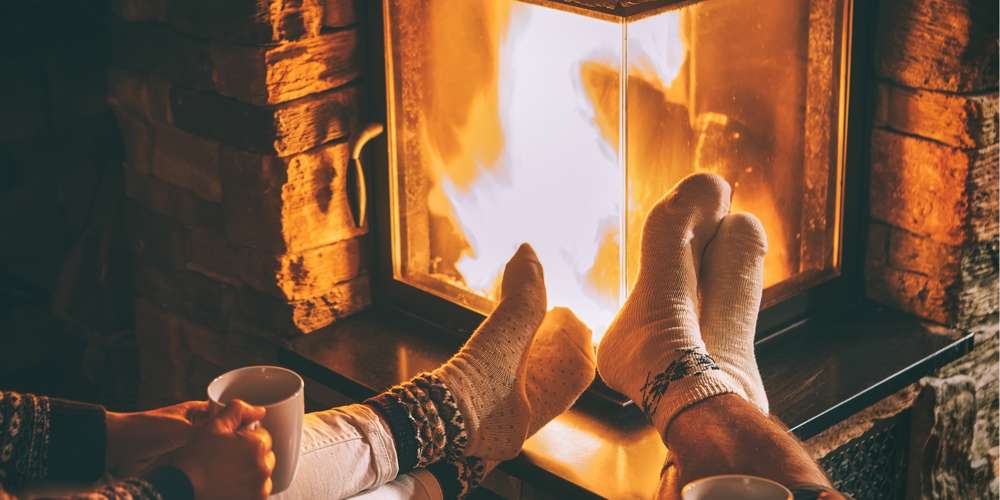
Hygge (hoo-ga), which has no direct translation into English—surprise!—is many things to many people: Woolen socks. Candles and other gentle light. Board games. Comfortable couches and cozy quilts. Warm drinks.

Although hygge seems to have Scandinavian roots, it’s not exclusively a cold-climate thing, evidently. A rustic cottage on a lake, with its beat-up furniture, mildewed paperbacks from the 1950s and second-hand bathing suits is very hygge, according to Meik Wiking, author of “The Little Book of Hygge” and, not coincidentally, CEO of the Happiness Research Institute in Copenhagen. The mere fact that there is a Happiness Research Institute, somewhere in the world, makes me—well, happy.

The interesting thing about hygge and Jolabokafload is their inherent intentionality. Citizens in Iceland and Denmark take contentment, comfort and connection seriously, and pursue them with deliberation. Choosing the right book for someone means you know that person, and what they might enjoy reading. Playing games with your family means connecting with them, laughing and teamwork.

So why don’t we pursue this, here in the land of the free, home of the brave? What keeps us, a nation that often proclaims itself the best country in the world, or at least on its way to becoming “great” again, from choosing to embrace contentment and connection?

Perhaps Scandinavians are better able to appreciate the small, hygge things in life because they already have all the big ones nailed down: free university education, social security, universal health care, efficient infrastructure, paid family leave, and at least a month of vacation a year. With those necessities secured, according to Wiking, Danes are free to become “aware of the decoupling between wealth and wellbeing.”

That decoupling between wealth and wellbeing is well-reflected in this headline: Children Need Homes, Not Charter Schools or Standardized Tests, and Definitely Not Tax Cuts for the Wealthy.

That’s where our intentionality lies in the U.S., where we’re spending our hard-earned tax dollars—canned curricula designed to raise test scores and alternative school governance models, endless expensive tests—when over 100,000 New York City schoolchildren were homeless last year. According to former Senator Orin Hatch, we don’t even have money for poor children’s basic health care. As a nation, we have linked simple human well-being to wealth, and sealed it with the tamper-proof cap of low opportunity.

Many teachers try to add hygge touches to the classrooms where their high-poverty students meet and work every day—from beanbag chairs to classroom sets of snowpants for outdoor play, from little free libraries to Cocoa Day. If school can become a place of connectivity, warmth and safety, they reason, students will keep coming back.

Happy Hygge-days, Teacher in a Strange Land readers. Thanks for all you do for your students.

Weaponizing Empathy and other Heritage Foundation Rhetoric for School Reform

When I first retired (from the classroom, not from working in education), I moved away from the school district where I had lived and taught. I’d been there for well over 30 years and had seen—up close and personal– the power of school boards to impact educational climate in a school district. I’d been watching through four decades of local policy-making— the good, the bad and the out-and-out malicious.

I’ve got stories.

And  I’ve written about the town where I lived and taught. In spite of its flaws, it was usually a good place to teach, if the definition of “good” is engaged parents, talented colleagues and kids who were encouraged at home to achieve.

The quality of school board leadership occasionally faltered over that time—with most of the squabbling over how to get by while spending a lot less—but there were long stretches where the school board served as a benign and supportive presence.

That was then. The Board now has morphed into something Christopher Rufo would be proud of. There was the podcast by Board members, sharing private information about student discipline. There was the “gender-affirming” bathroom policy. The anti-trans and anti-Pride policies. And so much more.

But I was dumbstruck on hearing this little clip from a recent meeting.

Board member says: This gets into the weaponization of empathy, where empathy is taught as the highest goal, the highest order. Do we teach empathy to the effect where students disregard parental authority—and accept anything and everything? Do we teach kids that any kind of judgment is bad?

Wait. What? Who is he accusing? And what is the weaponization of empathy?

Too much empathy leads to kids defying their parents, evidently. The moral ambiguity of school confuses students. That’s their big fear?

As a long-time classroom veteran who spent the beginning of every year working diligently to get kids to respect their peers, and care for other people’s feelings and property, this struck me as downright stupid.

Of course, empathy builds learning communities. It was right there in the (evidently outgrown) school mission statement:  “ …provide a positive environment for the development of productive and caring individuals of all ages.”

A social media convo developed around the clip, with commenters suggesting the end result of too much empathy was Doctors Without Borders or the Peace Corps.

Eventually somebody remarked:

It should come as no surprise that the Heritage Foundation has taken this term and used it as its own way of fighting against Social-Emotional Learning, and any other academic tools to help students.

If one of your school board members uses this term, they are in some way being educated by, or they are using talking points from the Heritage Foundation.

Then, the other shoe dropped. Aha. Weaponizing empathy is a Heritage Foundation thing, the concept of their plan, so to speak.

Click on this definition, from the Heritage Foundation’s own rhetoric.   It’s pretty vile.

EdWeek asks: Can Trump Force Schools to Change their Curricula? The Trump team’s best weapon for fulfilling this culture war campaign promise may be an under-the-radar office at the heart of the agency the once and future president has pledged to dismantle: The U.S. Department of Education’s office for civil rights, which enforces laws barring discrimination on the basis of sex, race, religion, and disability status.

That’s a lot of legal wrangling—and yes, I understand that bureaucracies can change, when their leadership changes.

But hey—if right-wingers get control of a school board, they can micro-manage a district, with thousands of students, turning it into a place where empathy—caring for and about their fellow students– is forbidden or scorned.

God help us all.

Trust (Pandemic, Day #1475)

One of the essential truths in getting a message across is repeat, repeat, repeat. Like the mothers of toddlers, teachers are well aware of this fundamental veracity. No matter how the message is delivered—Pay attention! I’m only going to say this once!—well, no. You’re not.

You’re going to say it as many times as it takes to sink in, and even then, compliance and understanding are iffy.

Here’s my essential truth: It’s been close to 1500 days since the arrival of the COVID-19 pandemic in the United States. And we still haven’t perceived just how transformative it was, dealing with a global threat while trying to keep the things we value most safe. Those things being our health and well-being, our children and families, our communities and livelihoods.

Transformative is a neutral word for all the changes wrought by living through a crisis that killed an estimated seven million people, around the globe. Well over a million of those deaths have happened in the United States, making us the nation with the most COVID-19 deaths, world-wide.

That simple fact, alone—the United States, the place where we brag about having the “best” health care on the planet, was unable to suppress transmission. Once a vaccine was available—lightning fast!—getting folks to embrace medical science and stay on top of protection that might save their lives has been thoroughly politicized and divisive. Those things, on their own, were enough to make one realize that maybe our all-American political thinking was out of whack.

So I repeat: The pandemic has really done a number on us. On our economy. On our family gatherings. On what we expect from our employees, as well as our employers. On health care. On the way we feel about government. The things we value most–including our schools.

Call it The Great Re-ordering of Priorities.

It’s become a habit of mine, when reading stories about education: running the topic or issue through the filter of how they may have been impacted by the pandemic. Here’s one: absenteeism.

Student absences from school rose precipitously during the pandemic, peaking in 2021-22. Attendance rates are improving, overall, but are still higher than 2019.

What’s interesting is that schools with dismal, not-getting-better attendance rates aren’t always the ones you’d expect—absenteeism seems to be impacted by local conditions and initiatives, kids and parents re-ordering their priorities. Not up for school today? Go ahead—take a mental health day. Or five.

Schools struggling with attendance after a world-shaking event? Go figure. It’s going to take some time to fix that, and misinformation about how “unions” “closed” schools, abandoning kids to Zoom, doesn’t help.  From an article on school absences, in the NY Times:

School leaders, counselors, researchers and parents…offered many reasons for the absences: illness, mental health, transportation problems. But underlying it all is a fundamental shift in the value that families place on school, and in the culture of education during the pandemic.

Re-ordering the priorities. And not in a good way.

In her excellent blog, Jess Piper talks about the decline in civility at local school board meetings, among other things, triggered by a pandemic:

Recently, I saw this bad behavior up close and personal when I attended a BOE meeting at a school district outside of St Louis. Though I had an awful interaction with a parent or two in my tenure, I hadn’t witnessed the decline in civility and the outright disrespect shown in public. The lack of couth wasn’t just reserved for teachers, but was also aimed at administrators, board members, audience members, and community members.

One of the first to speak was a woman who brought her daughter to stand next to her while mom called the Superintendent names and defamed teachers. I was upset that the young girl had to stand there while her mother went over her time, refused to stop speaking when told her time was up, and still spoke, even raising her voice, when her microphone was eventually muted. She just kept going.

How did this young girl learn to treat her teachers? She learned disrespect and inappropriate behavior will be rewarded with a slew of applause.

Bingo. All the footage of parents pushing into buildings, upset about masking or sports or vaccinations hasn’t been conducive re-building respect and trust. And trust is a core resource in successful public schools.

Lucian Truscott has a great piece (link here) on realizing, in the grocery  store, that his fellow shoppers  weren’t maskedthat he himself, in fact, had stopped routinely masking. He acknowledged that he trusted himself and his neighbors to take responsibility for protecting themselves from COVID.

 It was a nice moment for him, thinking about the word trust—how long it takes to re-build simple neighborly trust, especially when it’s been shattered by transformative events. Expecting our public institutions to remain unchanged or “bounce back” is happy talk. We’re in the midst of some pretty significant shifts.

After the pandemic of 1918:

The Spanish Flu greatly affected the world economy, wiping out large numbers of healthy 18- to 40-year-olds. In Britain, during the Summer of 1918, in a single day 80 out of the 400 workers of a spinning factory perished. In many countries which had seen their male population decimated by the war, the pandemic left even fewer young men to run the farms and factories.

The resulting labor shortage enabled workers to demand better living and working conditions, public health care, as well as better wages. These became major demands of workers not only in Europe and the United States but in many other countries around the world. 

Once again: We are underestimating the impact on the nation, and especially our children. of living through a global catastrophe Let’s put our focus on the right priorities. In spite of all the challenges to public education, it’s still the best bang for your tax buck, in perpetuity. Good schools make for good communities.

Trust is a cornerstone. Repeat, repeat, repeat.