Critical Issues and Minutiae of Public Education

I have been fascinated, in the past 48 hours, by online conversations about the tumultuous political week we have just lived through—especially the comments and questions generated by teachers.

Non-teachers are heartbroken or thrilled or both, by the Biden step-down. They’re nosing out the negative PR and potential VP picks of the presumptive new nominee. There are running threads and analyses around the assassination attempt, a mass shooting where everyone knew the intended (again, presumptive) target, a change from the faceless victims—many children, damn it—of other mass shootings.

So much is in flux. So many building blocks of democracy, teetering on the edge. Including public education.

But we’re approaching (in many parts of the country) the beginning of the school year. Much of the ongoing cyber-conversation around public education centers on clearing back-to-school lists (i.e., teachers begging for essential supplies the school can’t afford), the futility of professional development for yet another silver-bullet reading program, why teachers aren’t paid for setting up their classrooms and other garden-variety School Stuff. The kinds of issues and beefs we see annually.

There are a hundred things that weigh heavily on teachers’ minds as they prepare for another year. What I’m wondering is if teachers are focused on the trees, rather than the destruction of the public education forest. Because focusing on bulletin boards and class lists instead of the section of Project 2025 that deals with education feels do-able, not overwhelming. Or terrifying.

Washington Post advice columnist Carolyn Hax posted a letter about a “rude” teacher who created individual certificates for each of her students at the end of the year. The mother who wrote the letter was upset that individual kids were nicknamed Class Clown and Social Butterfly and–gasp!–her daughter was designated “Miss Manners.” So upset that she reported her ire to the superintendent, after the principal gently suggested these certificates were warm-hearted, not criticisms of children’s character.

Aside from the fact that many parents would be delighted or relieved were their child awarded recognition for having excellent manners—the letter bothered me way more than it should have. Because I have been that teacher, striving at the end of the year to recognize and acknowledge students’ achievements, but also their individual quirks, their signature traits, their contribution to the musical community we built.

Hax rightfully chides the mom for attacking a well-meaning second grade teacher, on the last day of school, no less. But what most folks—non-teachers—will miss is that the success of any teacher, broadly defined, lies in building honest relationships with kids who bring varying intellectual and emotional strengths to school.

Not everyone is an academic superstar or natural helper. Many students will need to be coaxed or cajoled into effort, participation and belonging. Those skills are just as important as content expertise, a full toolbag of instructional techniques and endlessly logged data.

My own end-of-year awards included every band kid. Now—decades later—I still hear from students who remember the last full day of school (after the instruments were all oiled and stored for the summer, the music sorted and filed, and the sink—yuck—cleaned and shiny): The thank-yous. The in-jokes for band members. The Jolly Ranchers. The camaraderie. I recently heard from a woman who remembered winning the “Most Improved Section” award—and she was the only oboe. She included a smiley face.

The Hax column drew hundreds of responses from teachers.

Today, I have been watching teachers on social media saying:  Be kind to the social studies teachers in your building. We’ll be working on overdrive!

Well, yes. You go, teachers. The world is on fire, and your job is to pretend that the only thing that matters is following the prescribed curriculum and keeping your head down in the classroom. We get it—and we love and support you.

But as we launch 2024-25, it is incumbent upon all of us whose livelihoods are not threatened by free speech to keep education policy and the very real threat to public education bubbling up every day on social media and in our friend groups.

 It’s been a wild couple of weeks. But keep your eyes on both the threat and the prize.

Man with Sixteen College Degrees Can’t Read

I mostly stay out of the Reading Wars. Not because I don’t have opinions on reading instruction. I emphatically do.  I avoid the controversy because—as a lifelong music teacher—expressing that opinion inevitably leads to a pack of Science of Reading enthusiasts pointing out that I am not a reading teacher, and therefore what do I know?

This is deeply ironic, as those same SOR fans also spend lots of time criticizing experienced reading specialists. Also–I have taught in the neighborhood of 4000-5000 kids, over 30+ years, to read music, relying on a wide array of pedagogical techniques.  But that form of reading instruction evidently carries no water with the SOR bullies.

I was intrigued today by a story in NY Times Magazine about Benjamin Bolger:

Benjamin B. Bolger has been to Harvard and Stanford and Yale. He has been to Columbia and Dartmouth and Oxford, and Cambridge, Brandeis and Brown. Overall, Bolger has 14 advanced degrees, plus an associate’s and a bachelor’s.

Bolger, who is now 48, got off to a rough start, with a disastrous car accident when he was two years old that seemed to trigger the breakup of his parents’ marriage.

Bolger’s mother spent much of her money in the ensuing custody battle, and her stress was worsened by her son’s severe dyslexia. In third grade, when Bolger still couldn’t read, his teachers said he wouldn’t graduate from high school. Recognizing that her boy was bright, just different, his mother resolved to home-school him — though “home” is perhaps not the right word: The two spent endless hours driving, to science museums, to the elite Cranbrook Academy of Art outside Detroit for drawing lessons, even to the Smithsonian’s National Air and Space Museum in Washington. At night she read to him: epic works of literature like “War and Peace” but also choose-your-own-adventure books and “Star Wars” novelizations.

It would be easy to project the next part of the story—he somehow “learned to read” and then caught up to his classmates. But that’s not what happened.

At 11, he began taking classes at Muskegon Community College. Still reading below a third-grade level, Bolger needed his mother to read his assigned texts out loud; he dictated papers back to her. At 16, he enrolled at the University of Michigan, moving with her into an off-campus apartment. He recorded his lectures so he could listen to them at home; his mother still read to him. Majoring in sociology, he graduated with a 4.0. He was 19.

There were some failures (as we traditionally define failure). Bolger dropped out of law school at Yale due to the heavy reading load. But then, of course, he got back up on the academic horse, and pursued other degrees—including a PhD from Harvard, successfully completed. He also married and has two rather beautiful children, for whom he’s designed an experience-intensive home-schooling program.

What’s interesting to me is that the NYTimes Magazine article doesn’t dwell on Bolger’s inability to read well (whatever that means). Only on the fact that he has more degrees than only one other person in the nation (who’s also from Michigan, for whatever that’s worth).

Given the laser focus, in 2024, on determining which reading program yields the best test scores, I am surprised that a long-form article in a major publication does not explore the question of how one gets a master’s in the Politics of Education from Columbia, for example, without being an expert at deciphering complex texts, close reading.

But the “does he read or doesn’t he?” question—the one where we now expect to see evidence or data—never gets raised again. The article does say he has multiple master’s degrees in writing, obtained after his dissertation was completed.

Things that ARE apparent in this article:

  • Third grade is WAY too early to label ANY child a non-reader (or punish them by retaining them). It’s too early for labels, period.
  • When it comes to effective learning (the kind that sticks, and can be applied), experiences trump worksheets.
  • Continuously reading to your children, even when they are supposedly “reading to learn” at age eight, is absolutely the right thing to do.
  • Visual interpretation of text symbols is not more efficient or of higher value than hearing that text read aloud.
  • Many, many children are “bright but different.”

This is where we morph into wondering why every child in America doesn’t get the hothouse treatment Bolger did, with his own personal learning coach/secretary/guidance counselor/mom. Worth noting: Bolger’s mother, at the time of the accident, was a schoolteacher.

I would be the first to say that such an individualized education is far beyond what any public school could be expected to provide for a bright-but-different child. Given the ongoing strenuous campaign to strip resources from public education, we’re not likely to see public schools turn their limited energies and resources to meeting individual needs in whatever ways parents demand.

Nor is this a pitch for home-schooling. Most kids are educated in public schools, and if the hundreds of pictures on my social media feeds are any indication, kids in 2024 are graduating, going to college, working at summer jobs or finishing the fourth grade a little taller and smarter. Bolger, in other words, just got lucky.

This is a pitch for not writing students off, at any point in their academic career.

You may be wondering what Benjamin Bolger does for a living. He’s a full-time private college-admissions consultant, charging clients $100K for four years’ of services, which I was surprised to learn is kind of cheap in Admissions Consultant World.

I find Bolger’s story rather amazing, an exploration of what it means to be intelligent, and well-educated. Many historical figures bypassed traditional education models and found their way to greatness and influence via their natural smarts and leadership. Bolger embraced the traditional path to success— degrees from prestigious colleges—but got there without the benefit of the K-12 college rat race. Or the ability to read at “grade level.”

There should be a lesson for the SOR devotees in there somewhere.

Just Who is Trashing Public Education?

Get ready for a big dump–a deliberately chosen word–of anti-public education blah-blah over the next five months. It’s about all the right wing’s got, for one thing–and it’s one of those issues that everybody has an opinion on, whether they went to public school. have children in public schools, or neither.

Public education is so big and so variable that there’s always something to get upset about. There’s always one teacher who made your child miserable, one assigned book that raises hackles, one policy that feels flat-out wrongheaded. There’s also someone, somewhere, who admires that teacher, feels that book is a classic and stoutly defends whatever it is—Getting rid of recess? The faux science of phonics? Sex education that promotes abstinence? —that someone else finds ridiculous or reprehensible.

Not to mention—teaching is the largest profession in the country. So many teachers, so many public schools, so much opportunity to find fault.

In other words, public education is the low-hanging fruit of political calculation. Always has been, in fact.

A few years back, when folks were going gaga over Hillbilly Elegy, seeing it as the true story of how one could rise above one’s station (speaking of blahblah)—the main thing that irritated me about ol’ J.D. Vance was his nastiness about public education. Vance has since parlayed a best-seller that appealed to those who think a degree from Yale equates to arriving at the top, into a political career—and putting the screws to affirmative action, in case anyone of color tries to enjoy the same leg-up he did.

J.D. Vance’s education—K-12, the military, Ohio State—was entirely in public institutions until he got into Yale Law School. He doesn’t have anything good to say about public ed, but it was free and available to him, a kid from the wrong side of the tracks. When I read Rick Hess’s nauseating interview with Corey DeAngelis in Education Week, I had a flashback to ol’ J.D., intimating that he achieved success entirely on his own, without help from that first grade teacher who taught him how to read and play nice with others.

DeAngelis says:

I went to government schools my entire K–12 education in San Antonio, Texas. However, I attended a magnet high school, which was a great opportunity. Other families should have education options as well, and those options shouldn’t be limited to schools run by the government. Education funding should follow students to the public, private, charter, or home school that best meets their needs. I later researched the effects of school choice initiatives during my Ph.D. in education policy at the University of Arkansas’ Department of Education Reform.

So—just to clarify—Corey DeAngelis went to public schools K-12, for his BA and MA degrees (University of Texas), as well as a stint in a PUBLICLY FUNDED program at the notoriously right-focused University of Arkansas. That’s approximately 22 years, give or take, of public education, the nation-building institution DeAngelis now openly seeks to destroy.

I’m not going to provide quotes from the EdWeek piece, because anyone reading this already knows the hyperbolic, insulting gist—lazy, dumb, unions, low bar, failing, yada yada. He takes particular aim at the unions—although it absolutely wasn’t the unions—shutting down schools during a global pandemic. He paints schools’ turn-on-a-dime efforts to hold classes on Zoom as an opportunity for clueless parents to see, first-hand, evidence of how bad instruction is. He never mentions, of course, the teachers, students and school staff who died from COVID exposure.

Enough of duplicitous public school critics. My point is this:

The people who trash public education—not a particular school, classroom or curricular issue, but the general idea of government-sponsored opportunity to learn how to be a good, productive American citizen—have a very specific, disruptive ax to grind:

I got what I needed. I don’t really care about anybody else.

This goes for your local Militant Moms 4 Whatever on a Mission, out there complaining about books and school plays and songs and health class. It’s not about parents’ “rights.” It’s about control. And never about the other families and kids, who may have very different values and needs.

It’s about taking the ‘public’ out of public education. And it’s 100% politically driven.

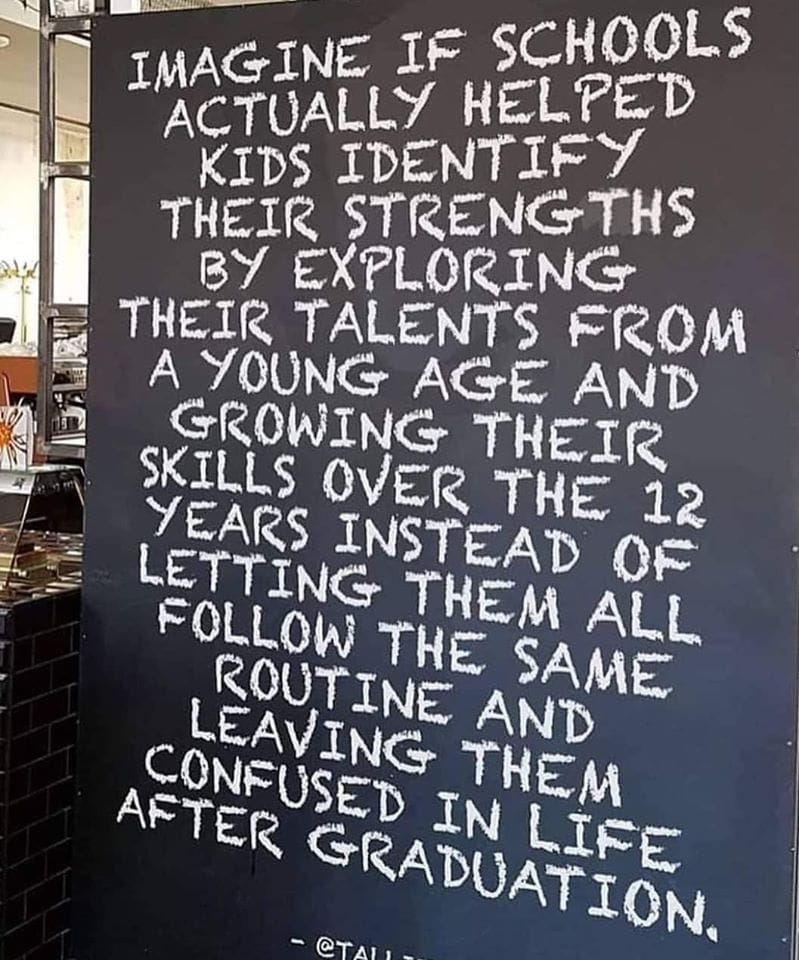
Occasionally, you’ll see someone put forth a visionary principle for public education, like the meme that wonders why schools don’t focus on their students’ strengths. Wouldn’t that be lovely?

Small classes, focused on individual talents and gifts, kind of like Corey DeAngelis’s magnet school. A warm and welcoming community of learners. Ample resources. Ask yourself WHY we don’t have that in every public school (worth noting: some schools get pretty close).

It’s not because educators—or schools, if you will– don’t want to meet student needs. They do.

Just who is trashing public education—and what are THEIR ultimate goals?

What about Homeschooling?

Families who choose to homeschool their children have never been on my negative/activist radar, as a veteran public school educator. I have had both positive and not-so-positive experiences with students who were homeschooled–from a pair of shy, well-behaved sisters who fit seamlessly into the middle school music program due to years of independent music lessons, to a sweet boy who had never really learned to read in the 7th grade and tended to wander aimlessly around the music room, once his mother finally decided to send him to school at age 12.

My ambivalence about homeschooling is likely because I became a teacher in a time when homeschoolers were often young hippie parents who worried that schools would suppress their children’s natural gifts in favor of compliance and standardization.

This was the era of Paulo Freire and Summerhill, and—perhaps my favorite book about education— “Teaching as a Subversive Activity,” by Neil Postman and Charles Weingartner. The subtitle is worth mentioning:  A No-Holds-Barred Assault on Outdated Teaching Methods-with Dramatic and Practical Proposals on How Education Can Be Made Relevant to Today’s World. (1971)

Today, homeschoolers are often escaping what they see as Godless classroom chaos, or a curriculum that acknowledges certain truths about our diversity and honest national history. The pandemic and its aftermath pushed parents on both sides of the masking question into involuntary home academics, and left people frustrated.

So much for drama and relevance, letting children direct their own learning, at their pace and honoring their interests. Instead, as David Labaree and Deborah Malizia note:

Schooling moved from a shared learning and cultural experience that generated a sense of community and common purpose to an individual competition for the grades, credits, extra-curricular achievements and degrees that determine students’ future life chances.

Once college enrollments surged in the mid-20th century, the struggle became a contest to gain admission into the most selective college possible. Rising levels of income inequality have only intensified the competition. One result is the devastating increase in student stress and social disconnection, in a setting where every student becomes a potential adversary in the race for extrinsic achievement, and the relentless pressure hurts students at all levels. 

This is not how schools were supposed to evolve—they were supposed to be sites for building citizenship, democratic equality and opportunity. But here we are.

Still. If Mama wants to educate her little ones at home, I’m OK with that, as long as my tax dollars are not paying for skiing lessons or $500 LEGO sets, part of a misguided voucher scheme.

We are likely to see those kiddos at some point, in the public system, perhaps middle school or high school when the home-school teacher’s curricular expertise across the board founders. Or when one of the kids wants to play in the band, join the chess club or the public school basketball team.

Just as public schools have tried to adapt to their surroundings and unplanned events, like a global pandemic, families have tried to custom-tailor their children’s education. I’m not saying that I think all of those pull-your-kids-out choices were good ones –thinking here about that 12-yr old non-reader, or kids whose parents reject the idea of getting along with people who are very different from you, in a pluralistic society.

But–a strong public school system, built on quality teaching and rich curriculum, still can serve multiple perspectives in a healthy  community, including the desire to educate one’s children at home.

Where I get off the homeschooling train is when homeschoolers refuse to follow community-driven policies. Vaccinations, for example. If you want a free, high-quality public education, or the opportunity to use public schools, at any point, as a springboard for your children’s ultimate goals, you may have to follow a few rules.

The Michigan Legislature is currently considering a registry of all school-age children. Homeschoolers would have to, by law, notify the state that they were homeschooling their children. Beyond that—things like curriculum and testing, which are largely controlled by legislation, for example—there is a great deal of freedom for homeschoolers.

This feels like common sense to me, much like a census or licensing vehicles. Where are the kids being homeschooled—are there are large number in a particular district? Why? Can we expect to see them return to the public school and prepare for that? Where are the kids who are not being schooled at all, home or otherwise—and are they safe? Why do homeschoolers find a simple registry threatening?

It’s interesting how many homeschoolers see this as government interference. Given the increases in homeschooling, this seems like critical data to have: Michigan is home to roughly 1.7 million school-age children, and 1.36 million are in public schools, while 182,000 are in private schools, according to 2022 Census data. That would leave about 150,000 students who are either homeschooled or have dropped out.

That’s a lot of kids. I’d be willing to bet that not all of them are being lovingly homeschooled by teachers with the skills to help them move forward academically.

What Happens When “Choice” Schemes Mature

Story from 1993:

I am finishing my year as Michigan Teacher of the Year, a whirlwind of heart-warming honors, random opportunities to speak, and learning just how ed-related organizations will try to co-opt The Teacher Voice. I am attending a 3-day music education conference in the summer, a gift from the Michigan School Vocal Music Assn, staying in a college dorm and actually having a blast, learning useful things and singing great literature, when I get a call from my husband. Yikes.

No cell phones or email at the time, so this is one of those scary moments—the central office crew at Alma College sends an emissary to the rehearsal hall, with the message: call your husband immediately. I take a handful of change and find a pay phone, heart pounding.

Nothing’s wrong at home—but my husband took an urgent call from the MI Chamber of Commerce. They need to speak to me. Today.

Turns out the MI Business Roundtable wants to shoot a TV commercial promoting a campaign to fix public education.They want me, the Teacher of the Year, to star in this commercial. The language, of course, is aspirational—our kids are our most precious resource, yada yada—but one of the aspects of the multi-prong campaign is offering families more choice.

They have set up a classroom, in an elementary school about 30 minutes away, where the filming is to take place. Someone will pick me up— this afternoon—and return me to Alma by dinnertime. They have already cleared this with the Department of Ed; one of my (unpaid) jobs as Teacher of the Year is serving as spokesperson for the Department and the Governor.

So I don the most teacher-like outfit I have on hand—your classic denim jumper—and get into the car with the Chamber of Commerce guy. He has to move his Bible and some Christian study materials to the backseat; he’s been listening to their inspirational cassettes on his long drive up. He’s unfailingly polite and appropriately grateful that I interrupted a summer workshop to film a commercial. He’s also really geeked about this campaign.

It’s not about funding, he says. It’s about freedom. Freedom for families to choose the schools that best fit their kids. But, I say–we turned down a ballot initiative to establish vouchers in Michigan back in 1978, two to one. The people have spoken on this issue. Haven’t they?

No, wait, he says. This is about sending your child to the PUBLIC school you want him to attend. Public schools will be open to all Michigan residents. Doesn’t matter which district you live in—your child can attend the public school of your choice.

Whoa. A half-dozen reasons why this is messy pop into my head. What about Detroit families who want their kids to go to Grosse Pointe—how will that work? What about transportation—if you don’t have a car and driver available every morning, how will your kids get to school? What about families only interested in scouting for the best sports teams? How will administrators plan for enough classrooms and teachers? And what about the value of neighborhood schools, serving as a community center?

Destabilizing those communities and significantly impacting their revenue streams doesn’t even occur to me at that point.

Chamber of Commerce Guy has already figured out that I’m probably a Democrat and union member and believer in public education for all, for better and worse. He’s grinning.

Wouldn’t you like to send YOUR kids to the school of your choice, he says. I note that we already have, by moving to the community where I teach. But what if you couldn’t afford to live there, he replies—if this campaign is successful, every child could attend the school where the Teacher of the Year works her magic. He raises his fist, chuckling—“Free the people!”

I was gobsmacked. I don’t remember much about shooting the commercial, except that it was in a first-grade classroom like those in the ‘50s, with a Palmer method letter border and a framed portrait of George Washington. We adjusted the camera angle to get the American flag in the background. I was holding an apple (which I got to keep, since I missed dinner). The script didn’t mention letting kids in poor schools choose wealthy schools, if they can get there, of course. It was more happy talk, children are our future, blahdy blah.

Mercifully, I have searched repeatedly and have been unable to find a copy of the commercial online, although I have a copy on videocassette buried in a box in my garage.

That was thirty years ago, when school choice was a sexy market-driven idea, whose ultimate ramifications were not well understood by parents or, frankly, by advocacy organizations like the Chamber, or by legislators or bureaucrats. People wanted the “freedom” to choose schools—who doesn’t value freedom?

Today, one in four Michigan children attends a school outside his/her district boundaries.

 The spread of choice statewide has accelerated as Michigan’s public-school enrollment has declined 11 percent to 1.38 million in the past decade, prompting competition among some districts.

Michigan law allows districts to open their doors to students from surrounding districts. Most of the state’s 540 public districts participate in some form, though several do not, including Birmingham, Grosse Pointe and Dearborn schools in metro Detroit. Districts can participate with all schools in their intermediate school district, typically their county, or more broadly with any district.

This article illustrates the consequences, especially for small and struggling districts, threatened by the law. It includes a district-by-district comparison of students lost, gained, and attending school outside their district zone. The winners and losers, in other words. Many of the examples are heartbreaking. Schools must compete—or die, literally. And a lot of the factors that draw in parents are unrelated to academic excellence, outstanding programs or a strong staff.

In fact, when asked, lots of adults defend choice for the sake of… choice. The individual trumps the commons. Caveat emptor. And we’re not even talking about vouchers or religious schools siphoning off money intended for public education.

Has any of this resulted in improvement, to any metric of school success—from parent satisfaction to unreliable-to-meaningless standardized test scores? No.

So why are we so stuck on the freedom to choose?