
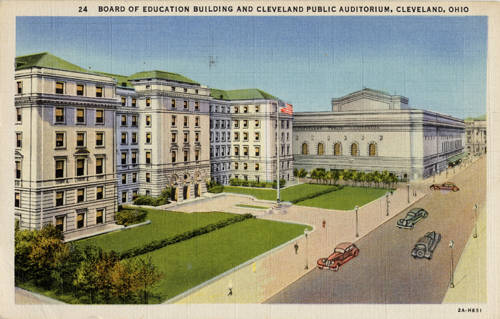
On our way home from the Network for Public Education conference, earlier this month, we jogged to the right and spent a night in Cleveland, so we could visit the Rock and Roll Hall of Fame. Our hotel, just a couple of blocks from the Hall of Fame, used to be the Cleveland Board of Education building, completed in 1931.
It’s a magnificent structure, all marble, soaring windows, colorful painted murals and wide hallways, with a bar named The Teachers’ Lounge. Who could resist?
It made me wonder about the value Cleveland currently places on their public schools, when a century ago they commissioned this monument to public education, likely assuming that generations of Ohio kids would be duly and proudly educated in Cleveland, and go on to do great things.
They don’t build ‘em like they used to—either our buildings or our midwestern dreams of progress.
The history of the Cleveland Metropolitan School District looks like the history of many big-city school districts, scarred by changing demographics and the public’s unwillingness to support all children with a free, high-quality, fully public education. Cleveland is not unique—there are still Pewabic pottery-tiled fireplaces in public schools built in the 1920s in Detroit. You can take a bike tour of historic, architect-designed schools in Chicago.
The ”high school movement”—when it became common for American youngsters to pursue education beyond the 8th grade—occurred in the first half of the 20th century. In 1910, the number of HS graduates in the United States was less than 10%, but by the outbreak of World War II, almost three-quarters of the student population attended high school. Many factors—mainly wars, rural-urban migration, and an economic depression—shaped the movement to make 12 years of education the norm.
And, of course, what was the norm for white kids did not necessarily apply to children of color. The Brown decision in the 1950s and school busing protests in the 1970s interrupted the rosy national vision of steadily increasing investment in our public services and institutions.
Not to put too fine a point on it, but America has always struggled with the concept of “all means all” –just who “deserves” to have nice things, like decent housing and basic health care. Schools. Libraries, museums and parks. A reliable, inexpensive postal service. Public universities. The kinds of services we share, places of mutual benefit. Our freedoms.
And now, we have elected a man whose fundamental life goal seems to be taking those things we share—the things we all deserve, and have worked for, as citizens in a constitutional republic– away from us.
Defunding public services and institutions. Privatizing the Post Office, which serves rural addresses that Federal Express won’t touch. Shutting down youth programs and the Summer Reading Club at your local library. Eliminating programs for veterans. Even—God help us—shutting down suicide hotlines for LGBTQ teens.
As I watch this wrenching tear-down of all the things that make for strong communities, I am staggered by this conundrum: Trump and his acolytes have embraced the idea of making America great again by attacking the very things that actually made us great, beginning with the solid belief in our future progress that drove the city of Cleveland to build a temple to public education, and finish it during the early years of the Depression, placing a statue of Abraham Lincoln on the manicured lawn in front.
Belief in our people and their future is behind untold numbers of beautiful, shared enterprises—theatres and hospitals, stadiums and churches. Monuments to philanthropy, and showcases for art and culture. National parks that tell our nation’s stories. Organizations established to help our fellow citizens.
What is behind the impulse to tear all this down, close it off, let it crumble, progress and humanity be damned? Who does this—and why?
None of this is genuinely about waste or fraud—or even evidence of out-of-control DEI thinking. How can there be too much equity or justice in a country that prides itself on inventing a new form of government?
From an article about Lindsey Halligan (see link for revelatory photo), now charged with “removing improper ideology” from Smithsonian museums:
“I would say that improper ideology would be weaponizing history,” Halligan says. “We don’t need to overemphasize the negative.” Halligan, 35, is a Trump attorney who seems to have tasked herself as a sort of commissioner — or expurgator, according to critics — of a premier cultural institution.
Trump is not much of a museumgoer.
What he’s after is power and control and riches. The men who built the infrastructure of industrial America wanted power, control and riches as well. Some of them wanted to preserve the vile institution—slavery—that made their power and riches possible. We fought a bloody, devastating civil war over the very issue of who deserves to be represented in museums, check out books from the library, or send their children to free public schools.
And here we are, again.
The Rock and Roll Hall of Fame was wonderful. I’ve been a handful of times, and have taken 150 eighth graders—I’ve got stories—to wade around in the history of the music that has surrounded them since birth. The museum is 100% private, funded by wealthy donors and $39.50/per ticket fees. It will not be torn down, stripped for parts or sold to the highest bidder.
As I was wandering through the main exhibit hall on the lower level, I started thinking about how the roots of rock music, like the labor of enslaved workers, were essentially stolen from African-American blues and gospel singers, mixed with rough-edged country, hillbilly and western music. And then sold to the masses, after condescending public dismissal as unimportant and vulgar.
Power and control and riches. Plus ça change, plus c’est la même chose.


 Teacher in a strange land