Is There Really a Decline in Pleasure Reading?

The mainstream media has been full of the bad news: new study shows that reading for pleasure has declined! Fewer people are reading for fun: From 2003 to 2023, the share of Americans who read for pleasure fell 40 percent, a sharp decline that is part of a continuing downward trend.

It’s easy to feel depressed about declining—what? literacy? —in the American citizenry. Just one more piece of evidence that schools are failing, blah, blah—nobody reads anymore!

But Anne Helen Peterson, in her substack, Culture Study, has a great piece dissecting the study that these scary headlines are based on. Maybe we’re not reading less; in fact, we may be taking in much more information and storytelling via means other than books.

Peterson posits six interesting theories about the way the study’s questions were framed and interpreted, and why we may need to re-evaluate what it means to be fully literate. She’s also a big-time book-reading enthusiast—not someone who sees the death of book-reading as inevitable in a digital world. Reading for pleasure is worth preserving, for all citizens. It broadens perspectives, makes us more interesting.

I immediately felt better after reading the piece. People aren’t reading less, necessarily; they’re reading differently. But I keep thinking about this story, told to me by a veteran teacher:

She started her career teaching in an elementary school, with reading blocks every day. She went back, as teachers sometimes do, to get a master’s degree in media and library science, then moved to a position in a middle school. A big part of her job there was managing young teenagers’ quests for information about whatever, using the internet as well as print resources.

After several years of staffing her school district’s seven libraries, the money ran out, libraries closed, and she was transferred back to a fourth grade. She said the most shocking thing about returning to a self-contained classroom was how much the kids hated reading.

It had been nearly two decades since she taught reading in an elementary classroom, and there was a palpable difference. Not just in the official reading program and instructional practice, but in the way students–both solid readers and those who struggled–responded to reading, in general. She was directed to follow daily scripts and a pacing chart, whether the students were ready to move on, or not.

She told me that—having already been involuntarily transferred away from a literacy-based job she loved and did well—she was no longer fearful of reprimands, and taught reading in ways that made sense to her fourth graders, including lengthy daily read-alouds that connected them to interesting stories. Their scores (and there are scores, in every story about reading) improved.

Headline today, from the right-leaning Detroit News: Michigan’s Reading Scores Continue to Slide for Youngest Students:

‘The results of the 2025 Michigan Student Test of Educational Progress, known as M-STEP, showed only 38.9% of third-graders and 42.4% of fourth-graders statewide scored proficient on the state’s English language arts (ELA) test, down from last year’s scores of 39.6% and 43.3%, respectively.

Eighth graders performed best in reading, with 65.3% proficient compared with 64.5% last year. Students in eighth grade take the PSAT, a precursor to the SAT, for math and English. Their social studies and science results come from the M-STEP.’

Read the data again. What do you notice? For starters—in every damned story about the so-called ‘reading crisis’—the undefined word ‘proficient’ appears. What does it mean? Everyone thinks they know. But ‘proficient’ (according to the Nation’s Report Card) does not mean ‘on grade level.’  It’s an indicator of advanced skills.

So there’s that. But did you notice that the worrisome ‘slide’ is .7% for third graders and .9% for fourth graders? Less than one percent? And that—miracle of miracles—Michigan 8th graders’ scores are a whopping 26.4% more proficient than Michigan 3rd graders?

There’s a lot to unpack here, but the Detroit News merrily goes on, blaming the fact that Michigan is coming late to legally mandated ‘Science of Reading,’ which kind of makes you wonder about what was wrong with the reading programs that produced success in two-thirds of the state’s 8th graders.

MI 8th graders took the PSAT, a national test, and the rest of Michigan’s kids took the statewide assessment, the M-STEP. Which is the most trustworthy? And why are scores so wildly different? These are questions the Detroit News does not address.

Nor does their reporting on reading scores factor in where the COVID pandemic impacted student instruction. In fact, I have seen op-ed commentary (NOT going to link) exclaim that because the pandemic is ‘over,’  reading scores should have ‘bounced back’—which reveals nothing more than a profound misunderstanding of education and public health data, mixed with contempt for public education.

Last year’s third and fourth graders were in pre-K and kindergarten during the worst years of the pandemic. The things they were coping with—fear and loss– as very young children, have left traces of damage, from school absenteeism to the very thing my friend mentioned: her fourth graders hated to read.

Why? Because learning to read had been a disrupted and difficult process, focused on improving scores, rather than developing an appreciation for an essential skill that would provide an enriched life, in multiple aspects? Including enjoyment—reading for pleasure?

Alfie Kohn:

‘The fact is that students’ days will be spent quite differently depending on whether the primary objective is to make them memorize what someone decided children of their age should know, on the one hand, or to help them “make fuller, deeper, and more accurate sense of their experiences,”on the other.’

I would call reading for pleasure a fuller, deeper and more accurate sense of our experiences—what it means to be a fully literate human being.

What I Learned from my Dad about Politics and How it Applies to 2026

I am a big fan of Jess Piper, a veteran teacher from Missouri, who left the classroom to run for office, and has since reshaped the conversation around why red-staters vote against their own interests. Piper writes often about a childhood spent bouncing around the south, and the family values that influenced her.

When people (including myself here) shake their heads and wonder how so many citizens–despite glaring, flagrant evidence to the contrary–can still stubbornly believe that Trump is leading the country  on the right track, it’s helpful to read Piper’s blog. She gets it.

Mostly, I read Piper for her insights on working-class voters–because my own father, were he still alive, would (despite many years of voting for Democrats, post-War) probably be a Trump supporter, voting against his own interests.

Not a careless, “protect my wealth” country-club Republican. But a grievance-driven voter who resented those he believed were simply and unfairly handed benefits and perks, things he would never enjoy, no matter how hard he worked.

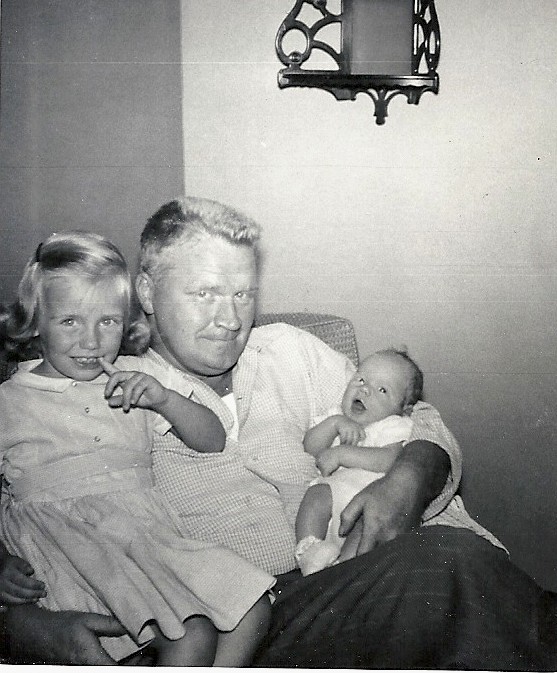
Fear and resentment—and the overwhelming conviction that the little guy never gets ahead—were deeply embedded in his character. That doesn’t mean he was not a good father; he absolutely was, caring for his family and living up to his responsibilities as a hard-working adult and citizen who never missed an election. He was a proud Teamster, a church-goer, and the man who drove me 90 miles one-way to take flute lessons at the university.

My dad served in World War II, in the Army Air Corps (later the US Air Force) in the Pacific theatre. His plane was shot down, in 1944, over the Sea of Japan, and the crew was rescued by an Australian sub. He lost his 19-year old brother Don in the first wave of Marines taking Iwo Jima in February of 1945. I wrote more about these things here, explaining why my dad really never got over the war. But it was more than his wartime experiences that molded his character.

He often expressed the sense that he’d been cheated—that other, less-deserving people were moving ahead, because they had money, or were currying favor, while he (a realist from the poor side of the tracks) was left behind. He voted for George Wallace in 1968, because Wallace claimed there wasn’t a dime’s worth of difference between the two parties: both were corrupt and run by elites. Sound familiar?

Thom Hartmann’s new piece– Culture Is Where Democracy Lives or Dies, Because Politics Always Follows the Story a Nation Tells Itself—goes some way to explaining what’s happening today, but also why my dad, surrounded by protests against the Vietnam war and girls burning their bras, turned to a man who supported segregation and repudiated progressivism: ’ Like no candidate before, Wallace harvested the anger of white Americans who resented the progressive changes of the 1960s. Wallace supporters feared the urban violence they saw exploding on television. With tough talk and a rough-hewn manner, Wallace inspired millions of conservative Democrats to break from their party.’

Like many of Trump’s supporters today, my dad saw Wallace as a truth-teller, an advocate for the working man, someone who would work to defend cultural norms around race, gender, authority and social policy. Even when those norms were outmoded, unjust or morally repugnant.

Today, I know better than trying to talk an irrational, ruby-red voter out of their convictions. I really do understand how pointless, even damaging, it is to accuse Trump voters of destroying democracy and erasing progress. Because I spent, literally, years of my life trying to (cough) enlighten my father, who treated me like other fathers of the era treated their know-it-all college-student kids: as spoiled brats who needed to let the real world take a whack at them.

My father died in 1980, of a brain tumor, at the untimely age of 58. I never changed him, but he never changed me. He thought a college education was a waste of time and money, although when I graduated, he came to commencement exercises and danced with me at the Holiday Inn afterward.

 Later, it dawned on me: the fact that he and my mother couldn’t contribute financially to my college education, and couldn’t help me navigate enrollment, might have been part of his insistence that college was for the privileged, not families like ours.

All of this happened in a time when news and opinion came from three mainstream TV channels and the Muskegon Chronicle. Who do Trump  voters turn to now for news? Is that source supporting their racism, sexism, xenophobia and bitterness? Is it filled with fact-free resentment?

Where do we start in changing minds and hearts? I wish I knew.

The Good News in August and Why It’s Baloney

It’s August. I admit that I am a sucker for the cute back-to-school photos—students holding little chalkboards, shiny floors and carefully stapled bulletin boards. Special props to veteran teachers, posing for their 26th year of sixth grade or new job as Dean of Students. Online, there are cheery little edu-pieces about team-building exercises and how to set work-life boundaries.

To which I say: Hahhahhahahhaa  (deep breath) hahhahahhahahah.

Because this is not just another start of school. This is (among other things) the first school year since 1979 when there hasn’t been a functional Department of Education. It’s a year when there’s now concrete evidence that addressing equity and appreciating diversity can get you fired. It’s a year when federal funding —especially for the neediest schools—can disappear overnight. Maybe never to return.

I can see you veteran teachers in the back of the room–surreptitiously writing lesson plans during the mandated PD–muttering about plenty of other terrible First Days, like the year they were on strike or the year the building had black mold–or the August when the district was short nine certified teachers and just who was going to teach those kids?

And that, actually, is my point. No matter what’s going on in the world, and how it impacts children (who actually are, as the songwriter said, our future), public schools open their doors every fall and teach children. All the children. Including those that the private school refused to enroll, and the charter school declared ‘not a good fit’ last year.

And teachers? Robert Reich: 94% of teachers have had to dip into their own pockets to buy school supplies. An estimated 1 in 6 have second jobs during the school year to make ends meet. The average Wall Street employee got a record $244,700 bonus last year. Something has gone terribly wrong.

With all due respect to Robert Reich, one of my personal top five political-thinker heroes, something went terribly wrong over a quarter-century ago. But—again, this is my point—nobody believes that the bus won’t come, the teacher won’t be meeting kids at the door, and school won’t start when they say it will. There may be too many kids, and too few resources, but our public schools will step up, one more time, and do their best. 

In short, the news about public education is both terrible—and steadily getting worse—while simultaneously heartening. No matter how punitive the policy, how insulting the rhetoric, public education is still reliably America’s best idea.

Jose Vilson made me think, this morning: ‘Not enough has been said about how our classrooms can be conduits for the societies we wish to live in.’ 

It’s a great piece, all about how kids learn to obey (or not) in our classrooms, and what that means in a city–or society–facing police and military suppression. Are public schools doing students a favor by insisting on authoritarian classrooms? There’s a great topic for educators: How we manage our classrooms has an impact on the world that we want to live in. Discuss.

Sherrilyn Ifill (also on my top five political thinkers list) called this our summer of discontent, saying:

We could use a little bit of magic – a dash of deus ex machina – to lift our chances of surviving this. But we can make what looks like magic happen by applying steady pressure. Magic is when your opponents defeat themselves. Pressure creates the conditions for self-defeat.

Fighting on multiple fronts exhausts our opponents (don’t believe we’re the only ones who are exhausted). Showing resolve makes your opposition doubt their invincibility. A sense of humor infuriates them. Creating beautiful things and showing love and compassion utterly confuses them. Remaining focused and strategic exposes their weak spots. Showing you’ll go to the wall increases their fear. Showing up with successive waves of troops confounds them.

And that’s my wish for teachers everywhere, headed back to school:

Make your classroom a conduit for the country you wish to live in. Create beautiful things for and with your students. Show them love and compassion and dedication. Ignore threats. Break rules. Show resolve and especially, a sense of humor. Generate steady pressure against the forces that would destroy your important world-building work.

Because the kids are worth it.

Men Who Like Books Start Out as Boys Who Read

Maureen Dowd, in a NYT article entitled Attention, Men: Books are Sexy!:

Men are reading less. Women make up 80 percent of fiction sales. “Young men have regressed educationally, emotionally and culturally,” David J. Morris wrote in a Times essay titled “The Disappearance of Literary Men Should Worry Everyone.”

The fiction gap makes me sad. A man staring into a phone is not sexy. But a man with a book has become so rare, such an object of fantasy, that there’s a popular Instagram account called “Hot Dudes Reading.”

It’s enough to make me re-up my abandoned Instagram account.

I also sincerely hope that Maureen and I are not a dying breed, older women (we are the exact same age) who find Men Who Read attractive. I once experienced a tiny swoon when I read that Stephen King carries a paperback with him, wherever he goes. You know, in case he has to wait 10 minutes in line at the post office.

This is more than just my elderly romantic fantasy, however. I think Men Who Read are—or should be—a national education goal. Not men who can decode, nor men who can type fast with their thumbs or pass tests about content. Men who actually enjoy reading.

Reading to use their imagination, rather than seeing prepackaged ideas on video. Reading and—important–evaluating information. Using the language they absorb, via reading, in their daily interactions with others. Reading for pleasure.

Personal story: When I met my husband, he told me about working third shift at the Stroh’s factory in Detroit, while he was in law school. His job involved dealing with a machine that flattened cardboard beer cases and needed tending only at certain times. The rest of the time he filled with reading, hours every night. He would take two books to work, in case he finished the first one. He read hundreds of library books, mostly popular fiction.

He is still that person, 46 years later. Swoon-worthy.

When I read (endlessly) and think about how we’re teaching reading these days, it strikes me that the discussion is almost entirely technical: Do we really have a “reading crisis?”  Why? Is it the fault of a program that was once popular and taught millions of kids to read, but is now being replaced, sometimes via legislation crafted by people who haven’t met first graders or stepped foot into their classrooms?

I recently had a conversation with a middle school teacher in Massachusetts who is a fan of phonics-intensive science of reading curricula, largely because she gets a high percentage of non-readers into her Language Arts classes, kids who have big brains but no reading skills. She’s had some success in getting them to read, using sound-it-out instructional materials they should have experienced in early grades.

Good for her. And good for all teachers who are searching (sometimes in secret) for the right strategies to get their particular kids to read. But I’d like to point out that if the technical skills of reading aren’t matched by reasons for reading, it’s like any other thing we learn to do, then abandon. I’m guessing my friend’s students want to learn to read, because they like her, and they find what she’s teaching them interesting.

From an Atlantic piece: ‘The science of reading started as a neutral description of a set of principles, but it has now become a brand name, another off-the-shelf solution to America’s educational problems. The answer to those problems might not be to swap out one commercial curriculum package for another—but that’s what the system is set up to enable.

A teacher must command a class that includes students with dyslexia as well as those who find reading a breeze, and kids whose parents read to them every night alongside children who don’t speak English at home.

There you have it. We’re looking, once again, for a one-size-fits-all solution to a technical, easily measured “problem”—reading scores—when what we really need is honest reasons for people to pick up a book. Or a newspaper. To enjoy a story, or a deep dive into current issues.

My dad, who didn’t graduate from HS and had a physical job all his life, came home from work every afternoon and read the newspaper. He was more literate than many college grads I know.

He had reasons for reading. He was not carrying a smartphone and had only three TV channels, undistinguished by political points of view. He read TIME and LIFE magazines. I disagreed with my father on almost every issue, back in the day, but he could marshal a political argument. Because he was a reader.

So why are reading scores dropping? Curriculum and poor teaching are lazy, one-note answers. If we want a truly literate population, we need to make reading and writing essential, something that kids can’t wait to do. Because it’s a passageway to becoming an adult, to succeeding in life, no matter what their goals are, or how they evolve.

We currently have a president who doesn’t read his daily briefings, and bases his critical viewpoints on hunger in Gaza on what he sees on TV. But we used to have a president who published an annual list of his ten favorite books.

Which one of them is a (sexy) role model?