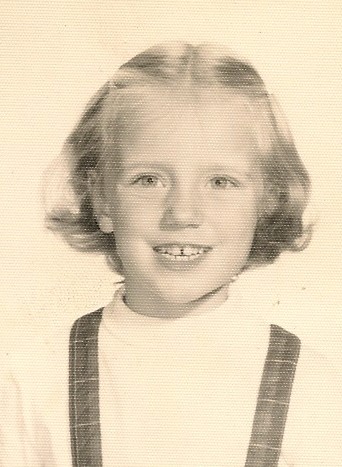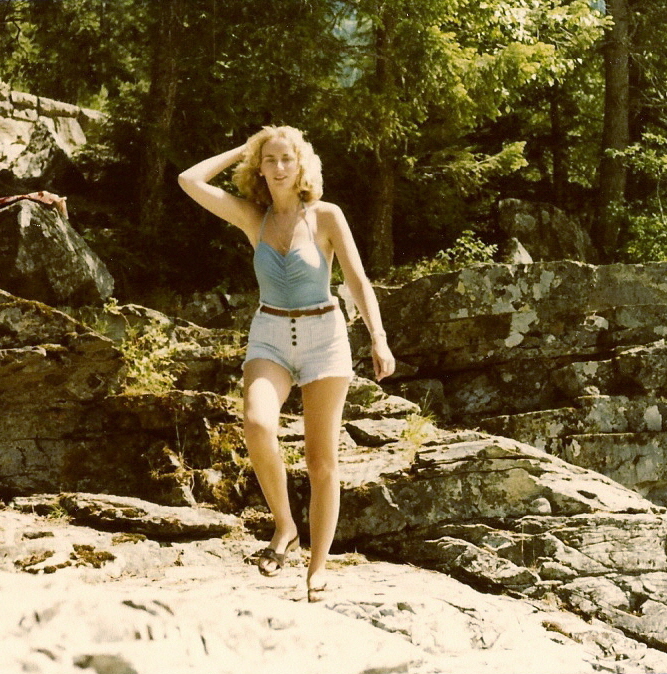
Confession: I appropriated this prompt from Steven Bechloss, who provides such a thought-starter most Saturdays. He wrote about Ann Dunham, Barack Obama’s mother—inspiring—and, in what can only be described as striking contrast, the mothers of Lee Harvey Oswald (angry, controlling) and Nixon (per Nixon, a saint).
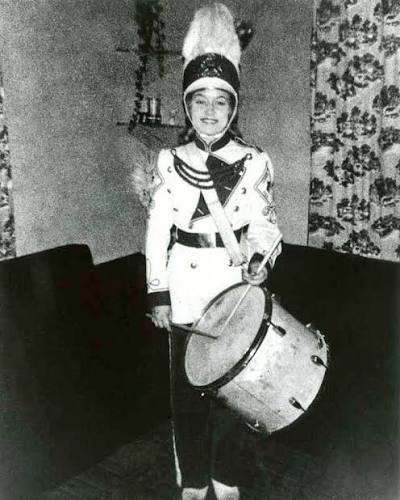
Which may be something I got from my mother, who could turn a five-minute straightforward narrative into a half-hour of (amusing) verbal wandering around in backstory. She also had a wicked sense of humor—she was Class Cut-up in her Muskegon (MI) HS yearbook, 1945.
My most memorable moments with my mom were not classic mother-daughter rituals. She never helped me pick out a wedding dress, and wasn’t present when I married my husband, in a judge’s chambers. She wasn’t there when I was in childbirth. She seldom commented on my major life decisions. We didn’t have long, rambling phone conversations because they would have been long distance—and her monetary meter would have been running.
But when I was in college, and came home late from summer jobs, we lay on either end of the couch eating ice cream and watching Johnny Carson and laughing at nothing much until tears ran down our cheeks. I always knew my mother loved me, and was proud of me, and that was enough.
The last words I said to my mother were “Love you,” and she replied, “Love you too, honey,” and then I hung up, and got on an airplane to Florida, for an education conference. I was awakened by a phone call early the next morning, telling me she was gone, at age 73, of a cerebral hemorrhage. It seemed like the final injustice, gone so soon, for a woman who lost her father at age seven, her husband at 52, and suffered a catastrophic health event a couple of weeks after she retired at 65, one that kept her hospitalized for months.
I know lots of people who have Mother Stories—adventurous moms, politically savvy wine moms of either party, domineering moms, crazy moms. I’ve heard people say that their mother was their biggest cheerleader, or nit-picky, never satisfied with their children’s life outcomes.
But not my mother. She never bailed me out, but she never made me feel like a failure, either. Instead, she was… steadfast. And kind of low-key and snarky. Fun to hang with, someone who took life as it came.
I think Steven Bechloss was looking at three typical models of mothers—the ones who shaped their sons for better or worse. During my 35 years in the classroom, I saw mothers who were high achievers and expected the same of their children. I saw bitter and controlling moms—and some who thought their sons could do no wrong, even when the evidence was flashing red, right in front of them.
But it always seemed to me that children are not possessions or projects or even direct reflections of their mothers. Good parenting helps, of course, but in the end, kids are born with self-determination, their own temperament and personality.
I’m glad my mother let me be myself. I think it’s a practice worth considering, on Mothers (no apostrophe) Day.
As a music educator, I was always interested in having my students create music, a goal that gets a lot of lip service in the profession (including being one of the four pillars of the National Music Content Standards).It’s a seductive idea—you’ll see music labeled as a creative art in all the curriculum literature.
In real-life music classrooms, it’s a lot more complicated. A whole lot of music education (often the kind preferred by administrators and parents in the community) might best be described as rehearse-rehearse-perform, with the goal being precisely accurate and thoroughly impressive reproduction of already-published music.
There are concerts, parades and halftime shows, maybe an elementary school musical or graded contests. Not a lot of time for messing around with the tools of music, let alone thinking about the cultural importance of music in students’ lives—or even pure enjoyment. In some secondary schools, music is all about competing.
I had some success with students creating their own music (more on that later), but one basic fact I taught all of my students, over more than 30 years, was that there are entertainers and there are songwriters and they are not always one and the same.
I am old enough to remember when folks started talking about intellectual property as something we needed to pay attention to, in schools. (About the time when schools got Xerox machines and the internet.) If you’ve ever been at a middle school talent show, watching kids lip sync and groove to pop tunes, you can identify the urge to copy something fun and sticky. The trick for educators is to get past copying, into generating your own ideas.
Acknowledging songwriters and composers is easy and worthwhile when you’re teaching K-12 music—their names are there on the printed page. Credit where credit is due is a great way to start students thinking about the music in their world and how much fun it might be to produce their own.
I am aware of co-writing credits where any performer’s suggestions about a piece of music turn into recognition (and probably financial reward). Maybe it’s impossible to tease out just who made the notes and lyrics so catchy in a simple, three-chord song.Songs—like recipes—feel like templates for creative exploration. A faster tempo and minor 2nd chord replacing that subdominant and voila! Take a sad song, and make it better.
The NYT piece is fascinating. If you haven’t read it, try naming some of the greatest living songwriters before checking their list. (Confession: there were three of the 30 songwriters I’d never heard of.) Several famous performers were asked to name their favorite songwriters—I found my list corresponded most strongly with Bonnie Raitt’s picks. There’s a quizto see if you know who wrote some of your go-to songs, and sound samples.
Here’s a free link.It’s a delicious wade into the craft of making sonic art.
So how did this go in my very ordinary middle school band room? At first, it had to do with technology, when kids had access to audio and video recording at home, and their compositions (solos or groups) could be submitted to me via cassette or disc, then email. The assignment was always broad, and I listened to a lot (and I mean A LOT) of meandering drum solos. But they were creating.
Middle school students were often surprised that ‘songwriters’ didn’t mean people who put music on paper, necessarily. Getting past that, to the idea of trying out an original melody on your band instrument, maybe having your friend the euphonium player drone some long notes underneath. Fooling around, then recording. The rubric for success was “sounds good to you.”
Then we got new warmup books that had blues scales in them and I started to do some of what might be called instructional scaffolding with second- and third-year band kids. We learned the basic twelve-bar blues progression, and kids started improvising blues riffs, using the notes in the chord sequence. The key was not being afraid to make mistakes—the exact opposite of how we usually teach musical performance.
I should repeat that, because that’s what creativity is, in a nutshell: not being anxious about trying something, trusting your own judgment, editing and listening to criticism. Trying again. Starting with a classic template—then making it your own.
One observation: once you encourage kids to create their own music, they’re going to want you to listen to any number of pieces they write. Nothing to do with grades or assignments—just fun.
We spend way too much time pursuing right answers. Isn’t it ironic?
Him: But isn’t AI going to make it impossible to tell who’s cheating? That’s what I’d be worried about if I was a teacher.
Me: What do you mean by cheating?
Him: Well, kids will get AI to write their papers and do their assignments. And teachers won’t know who wrote the paper and will be forced to give it a good grade. And if everyone gets good grades, there will be grade inflation, so it will be hard to pick out the really smart students for the top colleges.
Me: It’s not about cheating. It’s about actual learning. Students learn by doing the work, including making mistakes—whether that work is putting two blocks with three blocks to make five blocks, or testing pond water samples, producing an original haiku in class–or writing a research paper. When people talk about AI and cheating, they’re usually thinking about writing assignments—but there are many more paths to learning, K-12, than writing a paper or answering questions on a worksheet. Besides, teachers who know their students well, and have seen their skills in action, will understand how an AI-constructed response would compare to an actual response.
Him: (dubious) I suppose sharp teachers can catch them that way. Besides, you’ll have more time to ferret out cheaters when AI starts grading student work and writing your lesson plans.
Me: Only someone who knows the students and knows the usual flow of content and skills at that level can write useful lesson plans. And assessing student work is how teachers observe what their students have learned, and what they need next. I personally don’t see AI as being particularly useful in developing instructional materials, either. It certainly can’t develop relationships with kids or inspire them.
Him: Of course, this would all be different for you, as a band director—AI will change everything for regular teachers but maybe not for you. If band even exists as a class any more.
———–
Sigh. This conversation actually happened. And the man I was talking to was not an idiot. He had some magazine-article background knowledge about AI, saw its impact as inevitable and teachers as unfortunately unionized Luddites, unwilling to adapt to a rapidly changing world.
He was also right about musical performing groups—as a K-12 musical specialist, I have been having these conversations about electronic alternatives to learning to play an instrument or sing for three decades. Who would want to go to the trouble, a well-meaning friend who teaches English asked me, to learn to play the bassoon? Or even worry about singing in tune, now that auto-tune is available to fix hot musical stars’ vocal uncertainties?Why not grab a bunch of keyboards and software? Isn’t that all the instruction musicians need to, you know, put out musical content?
The great danger of using the range of AI products in the classroom has nothing to do with cheating, per se. Fact is, students have been cheating—in the ways we usually perceive as academic cheating—forever.
From writing dates on a shirt cuff to paying someone to take your SATs, cheating is deeply embedded in academic practice. If there is a potentially positive outcome here, it might be disconnecting old ideas about plagiarism and cheating. Instead, we might be teaching our students to assess information they are presented with, comparing it to different analyses, perhaps rooting out alternative facts that aren’t really factual.
Fact is: plagiarism is ill-defined, in an era when students have access to the Library of Congress in their raggedy jeans pockets: “Anybody who embarks on a study of plagiarism hoping for bright lines is in for a foggy shock. One of the pleasing facets of plagiarism is that it doesn’t exist—not in the eyes of the law, that is, and especially not if those eyes are American. There is intellectual-property law, and a law that prohibits the trafficking of counterfeit goods. There are laws against copyright infringement. If plagiarists are sent to prison, however, it will not be because they have filched a slice of poetry, or half a juicy ballad, and passed it off as their own. Plagiarism is not a crime. It is a sin.’”
I would also assert that learn-by-doing classes that require groups of learners (like band and choir, debate, drama and so many others) reward students for all the right habits: working together, interdependence, ongoing skill building toward a clear goal, aesthetic pleasure. Creativity, the antithesis of AI use.
When I first heard about influencers, I thought—in my predictable Baby Boomer way—that the whole idea was ridiculous. People whose ‘career’ was influencing other people, paid for by subscriptions and sponsorships? Shallow people, famous for being famous, possessed of zero actual expertise, espousing fake ideas and images to make (lots of) money?
But it turns out that influencers are in it for something more than money: actual influence.
In politics, they have become ‘an infestation’: “The internet is teeming with thousands of micro- and nano-influencers looking to make a name for themselves. These smaller influencers still have very engaged and loyal followers—making them important communication tools for campaigns. But they often lack an understanding of how politics works—or, more specifically, an appreciation for the tradeoffs that often must be made—and tend to spread content that revolves around conflict and misinformation.”
That’s what happens when you try to buy clout. You get what you pay for.
Over the past couple of years, I find that I have mostly stopped watching or reading the daily news in its conventional forms—newspapers, television, radio. I’m still consuming huge quantities of news, op-eds and information, but I like to think I’m paying for the most credible and valuable online content, verified facts and analysis.
Are my curated news providers giving me reliable information, and multiple trustworthy perspectives? Or are they just trying to influence me?
More importantly—test scores do lie, all the time. They’re also misinterpreted by journalists, some of whom probably mean well, but are being paid to make a particular point. Influencing your average reader to believe that Michigan public schools are failing, for example, tossing off context-free “data” as if it were God’s honest truth.
I am old enough to remember the first time I watched Fox News and began thinking about a future where there was no mainstream POV, and ordinary Joes could purchase the media stream that fit their beliefs. It seemed shocking at the time—but look. Here we are. At a point in history where the President of the United States gleefully posts an AI-generated video of himself wearing a crown and flying an airplane that drops shit on his constituents.
“Republicans are known to be far more aggressive at paying off social media influencers than Democrats. Pay-for-post schemes have been rampant throughout the conservative commentariat during the Trump years (as studiously documented by Will Sommer). One reason being that there is just a lot more money at play.”
What is our moral obligation to the kids we teach, when it comes to truth—and how they form their own opinions and civic engagement?
There’s a growing movement to expose lies and fact-check what gets circulated via social media. But how do we teach our students to be wary and cautious, to look at the background and motivation of those who put content out into the universe we share?
Also this: some influencers are doing good, sharing content that mainstream media is prevented or discouraged from programming. Some of my Facebook friends have had an amazing impact on my tiny northern Michigan community, simply by sharing their anger over what’s happening in the White House. There are days when I think we may get through this yet, just on the strength of local truth-tellers and people who act as social connectors.
Thoughts that make me feel better about where we get our news and how we interpret that news, both national stories and education stories: “A funny thing happened on the way to the erasure of American history in favor of a whitewashed authoritarianism. The American people began to preserve the truth of who we have been.”Heather Cox Richardson
“You need to tell your story. If you are not telling your story, someone else is telling your story for you.” In an era where school choice has increased competition in K–12 public education, that statement has never been more relevant or more urgent. Greg Wyman
If there’s one question on the minds of my friend group these days—old friends, fellow teachers, new acquaintances, anyone paying attention—it’s this: How can anyone, let alone a third of the population, look at current events in the United States in the past year, and believe that we are on the right track, doing OK, making our people and nation stronger?
Teaching has never been easy, but it’s really a miracle that so many fine teachers are still in the classroom and finding some satisfaction in their work there. According to an EdWeek Research Center survey on teacher morale, teachers described their feelings about teaching as a very lukewarm positive—a +13 on a 200-point scale, ranging from -100 to +100.
Last year, teachers were slightly more positive, at +18, but that’s hardly a ringing endorsement of the world’s most important and rewarding profession. Interesting nugget: teachers in Arkansas reported the highest morale (+24); Pennsylvania, the lowest (+1). Make of that what you will.
Which is why I loved reading Paper Girl: A Memoir of Home and Family in a Fractured America by Beth Macy.Macy, who also wrote Dopesick, a book that helped me understand opioid addiction, travels to her hometown of Urbana, Ohio, once a thriving town with good schools and a solid middle class. She was looking for reasons that people there voted—three-quarters of them—for Trump.
Among her heroes, the people who are still seeking to preserve what’s good and healthy in a failing Midwestern town, are teachers. The teachers she interviews, and whose work with and dedication to Urbana’s public school students is fierce and clear-eyed, are one of the last walls between kids making headway in life, and disaster.
Macy also remembers the teachers who helped her get away from a working-class background with the help of Pell grants, talent and a lot of luck. Her siblings were not so lucky—one of the most painful parts of her narrative are conversations with her brother and sisters, and her niece who suffered from a stepparent’s abuse.
It is through these conversations and seeing how despair and the empty promises of preachers and politicians impact the down and out, that I began to understand who votes for powerful liars, and why.
It also helps explain why Americans hate each other: The Pew Research Center finds that 53% of American adults describe the morality and ethics of our fellow citizens as “bad” (ranging from “somewhat bad” to “very bad”). In the 24 other countries polled by Pew, most people called their fellow citizens somewhat good or very good. At the opposite end of the spectrum from the United States is Canada, where 92% say their fellow Canadians are good, while just 7% say they’re bad.
Macy does a superb job of weaving anecdotes and memoir about growing up in a town that feels very familiar to me, also a Midwestern girl. She analyzes just what went wrong, much of it having to do with international trade, the dangerous equity gap, decades of negative political messaging about welfare queens. The demise of empathy, and the rise of right-wing pole-barn churches with fundamentalist men at the pulpit. Greed. Racism. Sexism.
Although the book won a number of awards (and was one of Barack Obama’s favorite books in 2025), I found the comments from readers enlightening. Either people loved it, finding that it deepened their understanding of just what is happening in the forgotten little towns across the country—or they hated it, believing Macy is encouraging people to talk to the enemy.
Which is a strategy that has not worked, commenters say. Unless we fight back—the “pound the negative message” model—we keep losing ground. Forget people in your past, your family. They’re the ones who voted him in. The enemy.
She’s also right about teachers—especially those with the courage to stand up for truth, for the kids they serve, no matter their prospects. Donation sent.
Here in northern Michigan, an elderly gentleman who’s spent his life working for progressive causes was so upset about seeing Barack and Michelle Obama portrayed as apesthat he called his neighbor, offering to fund signs to place around our small county, saying HATE HAS NO HOME HERE. She honored his request, designing and ordering signs.
During this process, the gentleman died. The signs will be ready next week, and planting one at the end of my driveway will be both advocacy and memorial. What I’d really like to see is a couple of those signs posted around our local school. Because that’s one of the few places where hate speech and hate actions are actively discouraged and prohibited.
Read Paper Girl. If you’re like me, you’ll love it.
We went to see Come From Awaythis week, at the Stephenson Theatre, part of the Phoenix Art Museum complex. It’s a show I’ve wanted to see for some time, recommended by friends and—well, it’s a musical. It was stunningly good, a show about the 38 planes stranded in Gander, Newfoundland, diverted there after 9/11—and the resonant after-effects of the good care Gander gave to nearly 7000 bedraggled and frightened strangers for five days.
We arrived early enough to have a glass of wine in the crowded lobby. There were no empty tables, but a table for eight had a couple of empty stools—and a “May we join you?” drew a nod. There were two couples, the women dressed in Scottsdale Expensive and the men in those slippery golf shirts. Like pretty much everyone there, to see the matinee, they were clearly retirees—and they were talking about the State of the Union address.
“Best State of the Union speech ever! Absolutely inspiring!” said striped golf shirt. His wife chimed in with “I loved it when he really gave it to the Democrats. They deserve it.” White golf shirt added—“And then, when he recognized the Olympic Hockey Team…well, USA! USA! And when he gave the goalie the Presidential medalthat just made my day…”
It was noisy in the lobby and the foursome turned to other topics, but I was bemused. I am used to thinking that Trump enthusiasts fit certain stereotypes—the kinds of people you see Jordan Klepper interviewing. The MAGAverse. Not people who paid good money to see a joyful musical about… the kindness of Canadians, on what was arguably the worst day in American history.
The show was great—you could actually hear people in the audience (OK, me too) sobbing near the end. See it somewhere, if you can. It’s a celebration of how human beings across the globe can rise to nearly any occasion, with humor and grace.
Doesn’t matter how many medals we win, when our government—NOTE: not our Olympians—humiliates us on the world stage. Again.
I have lived in Michigan all my life, and know that, until recently, most Michiganders didn’t even think of Canada as a foreign country. You can see Canada, right over the Detroit River—and trips to Windsor (drinking age: 19) were a kind of rite of passage for kids who grew up in the area, for better or worse.
I guess winning a gold medal in hockey—men’s hockey, anyway—was a juicy, easy-to-understand soundbite-level platform for a corrupt government to use as incentive to praise manly American victors by giving them some hamburgers and inviting them to be on TV. As Steven Beschloss says:
“That same evening, most of the members of the gold-medal-winning men’s U.S. hockey team tarnished their achievement and its power to unify the nation by attending the [SOTU] speech as Trump’s guests after meeting him earlier in the day at the White House. Their participation signals support for his lawless authoritarian regime, be it consciously or foolishly. (It should be noted that five players chose not to attend, including four who were born or grew up in Minnesota. Likewise, the gold medal-winning women’s hockey team declined an invitation.)
There are English lyrics, French lyrics, Bilingual and Indigenous citizens’ versions.
O Canada! Our home and native land! True patriot love in all of us command. With glowing hearts we see thee rise, The True North strong and free! From far and wide, O Canada, we stand on guard for thee. God keep our land glorious and free!
We are in Carlsbad, New Mexico at 5:30 on a Saturday night, hoping to grab a quick dinner at a Chili’s that seems to be THE happening place for families. There are kids running around outdoors—it’s a balmy 70 degrees—while their parents wait for a table. We grab the only two seats at the bar.
It’s clear that this is also the place where the working men of Carlsbad relax. All of the stools and tables in the bar area are filled with big, tattooed dudes. If we were in Michigan, they’d be in Carhartt, but here, it’s baseball caps and faded black T-shirts. The friendly, attractive bartender—who’s also wearing a black T-shirt with “Just Dump Him” surrounded by a heart–is taking drink orders in English and Spanish. She seems to know everyone in the place.
The guy sitting next to me is on his phone—speaking Spanish—in intense conversation, for maybe 10 minutes, punctuated by laughter. A teenager carrying a bucket of ice appears to refill the bar supply and the guy hails him. Cruz! the kid says—and they hug over the bar and chatter some more. It feels like we’re guests in this place, with the regulars just carrying on around us.
Then the guy next to me says—Do you mind if I ask something? Sure, I say (wiping my mouth—Chili’s does have great ribs). How long have you been married? he asks. Forty-seven years, we tell him. I knew it, he says. I’m jealous. I’ve been watching you interact. You have what I wanted, but I am divorced.
We chat for about 15 minutes, occasionally looping in another guy, sitting next to my husband, who has an artificial leg. They’re mine workers. We tell them we’re going to Carlsbad Caverns, a bucket list thing, and they offer (good) advice. We hear about their kids and see adorable photos. I show them photos of the dog we adopted, Atticus, a stray who was reclaimed and trained by inmates in a Michigan prison.
My husband asks for the check and the bartender says it’s already been paid—by Cruz. I turn to protest and he says he does this all the time (the bartender nods, yup, he does). I’m not rich, he says—but I have plenty. More than enough. My pastor showed me how giving comes back to you. I thank you for showing me that love can last for 47 years.
The next morning, we go to Carlsbad Caverns and they’re spectacular indeed. That evening, in another New Mexico hotel, we watch a fabulous half-time show, full of color and love. It’s also in Spanish.
Fact: There are over 50 million Spanish speakers in the United States, and half a billion world-wide. We’re one of the few countries where speaking a second language is not considered essential, and where many states and school districts do not emphasize the value of learning to address the world through more than one language lens.
My own pastor, Reverend Lynne Fry, wrote this, which summarizes the point beautifully:
I’m hearing many people saying, “I just wish there were translated subtitles or some English lyrics”….
This is the point.
Where else in the everyday white American experience are we asked to be in a situation where we don’t know the cultural code, don’t speak the language, we feel like we are missing something?
This is frequently what it feels like to be an immigrant, a foreigner, an outsider, a minority. This is what many of our grandparents or great grandparents dealt with. This is what millions of Americans still experience every day.
Those who are white, English-only speakers were invited to experience it for 15 minutes. For many, the discomfort was intolerable. Many didn’t even try.
When invited to walk a mile in someone else’s shoes, even if the fit is uncomfortable, will we?
What can—should—educators do to teach our children the beauty of other cultures, other languages, other faces? How can we reach over and share with the stranger?
Their music and media tell them individualism will pull them out of squalor. The people behind those messages shove the economic ladders from underneath them. (Jose Vilson)
One of the most stunning bits of clarifying data I’ve seen in the past few weeks is this chart from Media Matters, with data from February 2025:
It’s a graphic of most listened-to online news and commentary shows, color-coded and sized to represent the magnitude and political leanings of the American audience. It’s year-old data, remember—but it goes some way toward answering the question I’ve spent the past year obsessing over: Who ARE these people and how could they have re-elected the corrupt man who led the insurrection against their pretty-good government?
I’m old enough to remember 2008, when Barack Obama’s online media savvy and fund-raising prowess was attracting voters and the envy of the other party, stuck in Walter-Cronkite land. Kids who were primary consumers of social media then, are in their 30s now, and apparently have shifted to eating up Joe Rogan, Ben Shapiro and Nick Fuentes.
But what are kids listening to in 2026? I think the JLV, in two sentences, above, sums up what I’m thinking: They’re young. They’re being bamboozled by glitzy media and music, convinced that their own swagger will save them. And then it doesn’t. In fact, they’re a generation that almost certainly will experience less prosperity and fewer prospects than their parents’ generation.
I volunteer in an after-school program for middle-schoolers, usually on afternoons dedicated to homework (or missing assignments). It’s no secret to any teacher that a lot of incomplete and missing work happens because the students don’t know how to do it. They will finally tell you—I don’t get this—after making excuses and going to their locker or the bathroom three times. This happens a lot with math, but also with conventional Q & A, end-of-chapter reviews and short writing assignments.
Our kids have their own Chromebooks and most of the teachers provide several vetted information sources beyond the textbook, which is great. But only if students go there, and wade around. Unfortunately, chatbots have now given them a get-out-of-jail quick option.
These students are—I emphasize—not dumb (or any similar but less insulting word). After homework is completed, we often play board games or cards. They understand and can negotiate things that the games require—similes and other wordplay, strategy and logic, memory. Some are also readers (passing around personally owned books that I never ask to see). There are conversations full of humor and current music and YouTube video references.
But at age twelve or so—where are they getting their information about the world at large? On the day after the 2024 election, our coordinator stopped by to remind volunteers NOT to speak about the election. Not that any of the kids mentioned it. It was as if it hadn’t happened.
If we can’t count on legacy media, who’s going to sort through those red and blue bubbles of independent media? It’s going to take more than hope and good will to teach kids to be critical consumers of media and music, to discern the difference between glittering generalities and sometimes unpleasant truth.
Of course, teachers are proscribed from sharing their opinions on the best sources of accurate and unbiased information, lest they be labeled DEI or woke. Makes you wonder how the public opinion on DEI and woke, two ideas that were once debatable if not accepted, solidified into broadly understood negative concepts. Where did that “information” come from?
Because I hang out with middle schoolers on the regular, I don’t think it’s too late to take a stand for discretion around the truthfulness of media sources. But simply letting the red bubbles win is a mistake.
“A generation raised under the [moral tone set by FDR] went on to build the modern middle class, defeat fascism, and help construct a postwar world that valued democracy, human rights, and shared prosperity.
Contrast that with the bigoted, hateful, revenge-filled claptrap children have heard for the past decade from the emotionally stunted psychopath currently occupying the White House.” Thom Hartmann
My goal in blogging—something I’ve been doing for almost 25 years—has always been to write about what it’s like to be a teacher in the United States. I wanted to focus on teacher leadership, to write about the ‘inconsistencies and inspirations, the incomprehensible, immoral and imaginative, in American education.’
Because—back in 2001, when I got my first paid gig writing on the internet (there were unpaid local newspaper columns before that), there were many inspiring things to write about, from my own experience as a classroom teacher. There were also important questions about instruction, thorny policy issues and curricular problems to solve, but it really felt as if public school educators were on the same page—valuing democracy, human rights, shared prosperity, as Thom Hartmann says.
You could see a turning point coming. Topics from my December 28, 2016 “best blogs” review when I was writing for Education Week:Charters aren’t the answer. Women are disrespected even in a field where they’re a huge majority. We still don’t know what “teacher leadership” looks like—or might accomplish. Standards may shape practice, but they don’t automatically raise achievement. Competition and marketing aren’t the answer, either. And the future of public education is in serious jeopardy.
Going through the blogs I wrote this year was an exercise in dismay. Although I had many rewarding experiences volunteering in schools, in 2025, pulling the camera back to see where we’re going in pubic education is – no other word—monumentally depressing.
Here are 10 blogs from 2025 that I think represent our current trajectory, such as it is. Wish I could offer readers better news:
Speaking as a person who has spent decades working in public schools and with public school teachers across the country, schools are generally among the most conventional and cautious institutions on the planet, subject to pressures and opinions from a wide range of (often clueless) critics. And likely headed by someone who adamantly does not want to get phone calls from honked-off parents.
If we were to sit down together over a cup of coffee, I could tell you dozens of stories from my teaching career that illustrate both moral clarity in my classroom, as well as times when I absolutely failed at establishing a trusting, collaborative ecology. It’s probably enough to say that I got way better at it, over 30+ years.
Why would we abandon public schools’ infrastructure and experienced personnel? Crushing public education is not policy—it’s vandalism. It makes no sense.
Maybe the question is not: Is Public Education Over? Maybe the question is: What’s worth saving in public education?
Times do change. People do change. And I would assert that changing people for the better happens in good schools, every day. Not all classrooms, not all playgrounds, not all teachers—but public schooling is an overall force for good, for a better, healthier nation.
Actually, if you’re taking away (via federally approved punishments and reduced funding) inclusion, equity and diversity, what you’ve got left is exclusion of non-preferred students, discriminatory distribution of resources, and separation of student groups based on physical characteristics. In other words, Arkansas in 1957. What happens when a latter-day Orval Faubus emerges?
While it’s important for boys to have personal agency in their learning, and be trusted by their teachers, boys need to have role models, as well. Who are we offering up as heroes, men whose lives and actions are worthy and admirable? Men worth emulating, who care for their spouses and children, men whose values serve as guardrails, men who are civically engaged?
When I first heard about Elon Musk’s email blast to over two million federal employees directing them to submit approximately five bullet points of what they accomplished in the previous week, I was reminded of a couple of school administrators from my past.
Eugene Robinson called Musk’s scheme “an exercise in contempt”—also a great description of some of the so-called professional development teachers routinely endure. When a principal doesn’t trust their professional staff to know what they’d like to do with time available for their own learning or planning, you end up with meaningless exercises like “five things I did last week.”
Ultimately, it’s about control.
Who’s in Favor of Authoritarianism? For the current administration, bent on “saving” federal dollars for their own preferences, breaking up this monolith will be a giant display of power that impacts some 50 million students and their families. Think you’re in charge of your local school, your classroom? Think again. Easy peasy.
No, the federal government–and supporting Republicans and conservative courts–say. No, we don’t want your media literacy classes. No, we don’t want kids nosing around in issues like fairness and equity in our recent history. No speaking Spanish. No arts classes or events to help students make sense of the world they live in. No vaccines to protect them, or accurate health information.
My introduction to Diane Ravitch: I can’t remember precisely which education conference it was, but I was in graduate school, so it was between 2005 and 2010. Ravitch had just begun writing her Bridging Differences blog with Deborah Meier at Education Week, a sort of point-counterpoint exercise. I had also just read her book The Language Policefor a grad class, and—although she’d always been perceived as a right-wing critic of public education—found myself agreeing with some of her arguments.
She was on a panel at a conference session. I can’t remember the assigned topic, but after the presentation was opened up to questions, they were all directed to her. And she kept saying smart things about NCLB and testing and even unions. Finally, a gentleman got up to the microphone and said: Who ARE you—and what have you done with Diane Ravitch? The room exploded in laughter. Ravitch included.
And now, at age 87, she’s written a kind of expanded autobiography, An Education: How I Changed my Mind about Schools and Almost Everything Else. She tells us how her vast experience with education policy, across partisan and ideological lines, has left her with a well-honed set of ideas about how to build good schools and serve students well. How, in fact, to save public education, if we have the will to do so.
You get the sense, as Diane Ravitch wraps up “An Education,” that she is indeed wrapping up– she sees this as her last opportunity to get it all out there: Her early life. How she found happiness. Mistakes and regrets, and triumphs. It’s a very satisfying read, putting her life’s work in context.
For her followers and admirers (count me in), the book explains everything about her beliefs. Her working-to-middle-class roots and her family’s loyalty to FDR and what the Democrats stood for, during post-World War II America, go a long way to explaining how she eventually (with some major diversions) became an articulate proponent of public education.
I’m glad she included a nostalgic portrait of growing up in TX with a hard-working mother and feckless (and worse) father. The glimpses we get into public education in TX in the post-war years resonated with me–and it’s easy to see how going far away to an Ivy League college shaped her entire adulthood. Her classmates at Wellesley, like Ravitch, were ambitious and curious; I’m old enough to remember a time when female ambition was suspect.
The most fascinating part of the book, for me, was the middle third, where she wrote about researching the history of public education and being asked to sit on prestigious boards and serve as Assistant Secretary in the George H. W. Bush Department of Education. There’s a whole chapter on Famous Education Opinion Leaders (many of whom are still working to suppress full public education) taking Diane to lunch, tapping into her work ethic and offering her opportunities to be part of the power structure, to write and speak (and—big point—learn what they’re really up to).
N.B.: Award-winning teachers are also often asked to become part of the education establishment by sitting on boards, writing op-eds, and serving on task forces– and it can be easy to feel as if you’re contributing, at a higher level, when what you are actually doing is giving credence to people who have a very different, but hidden, agenda.
The final third of the book is the Diane Ravitch most educators know and respect. Her observations come from swimming in the ocean of education policy for decades– and they’re accurate. I expect Ravitch to continue to blog and write and speak, as long as she is able. She is the rare voice in education that has examined education ideas across the spectrum and found many popular notions weak or dangerous.
The book is a fine testament to a life spent searching for the truth about public education.