Who ARE these people? Part II

Earlier this year, I wrote a piece about people whose core political beliefs represented the sincere hope that the country would radically improve under the second Trump term. It was titled Who ARE These People?

It represented a sentiment I hear all the time: I can’t believe there are people who think Trump is the second coming. Who in their right mind could see him as a transformative leader? Who does not perceive the grifting, the rank incompetence, the prejudice, the lies—and the danger to a functioning democracy?

Companion questions: What percentage of the population understands and genuinely embraces Trump and the cadre of people surrounding him, currently disassembling our government? Who ARE the people who think it is Trump’s right to tear down the East Wing of the White House? Who ARE the people who believe that dangerous crime is surging, that food prices are dropping, that cutting SNAP benefits and Medicaid will teach those lazy slackers a lesson? Oh—and don’t use Tylenol!

And—key point—where are those folks getting their information? How do we counter obvious lies? Including lies published on official government websites and broadcast in airports?

Yeah—I know. You read this stuff, too—eye-popping, outrageous stories—and ask the same questions.

Maybe you’re wondering if teachers—underpaid and overworked—could have done more to establish the habit of questioning authority, discerning which evidence and rhetoric are reliable. Examining biases, looking at turning points in history, and so on.

Where were the people that Lucian Truscott calls yabbos educated? Who suggested to them that racism, sexism, and deceit were OK, if they were means to an end?

It’s exhausting.

This week Jonathon Last wrote this on The Bulwark:

Some large portion of voters do not appear to understand elementary, objective aspects of reality. We have jobs and lives, too. If we can understand reality, then they should be able to as well.

It does seem as though the last Democratic administration focused like a laser on economic issues. It managed the economy well, avoiding a recession and achieving a soft landing. It passed major, bipartisan legislation around Kitchen Table Issues like infrastructure spending. It kept the economy strong, with historically low unemployment and real-wage growth. It did not try to ban assault weapons but instead passed a gun-reform bill so sensible that it received bipartisan support. It successfully negotiated the most hawkish immigration reform bill in American history, only to have it sabotaged at the last minute by Donald Trump. These are actual things that happened in the real world over the course of 48 months.

Yet somehow all of this activity was invisible to voters? While these same people were highly attuned to the number of times LGBTQ appeared in the Democratic platform?

Which is it? Are the voters oblivious? Or are they discerning? Or does it depend on the situation: Willfully blind to some facts, but hyper-attuned to others?

Another theory is that voters are largely incapable of discerning reality, so expressed policy preferences matter much less than atmospherics and vibes. This theory holds that voters will respond more to entertainment or projections of strength than to a policy-based focus on the Real Issues.’

Whew. But probably—yes. Incapable of distinguishing reality from wish fulfillment. Rumor from news. Fool me once, twice, keep on fooling me, but it’s easy to vote (if you vote at all) by habit, not by analysis:

In fact, research into voting patterns in America suggests that it honestly doesn’t matter that much who or what a candidate looks like. When people go into the voting booth, they vote Republican or Democrat. When push comes to the ballot box, that little R and D matter more than all the Bud Light in the world.’

So. Here’s the real nub. If a third of American voters can’t tell fact from ugly fiction, or actually prefer to be governed by racists, quacks and the mentally diminished, if they are Republicans, what are we to do? Is this a permanent shift in American politics? Or are there ways to rebuild trust in our neighbors, our institutions, our national pride?

We can’t turn away if we want a just society. We can’t rely on the hope that seven million citizens singin’ songs and carryin’ signs will be enough. Because the destruction is too speeded up and too dangerous.  Rachel Bitecofer reminds us of a single line from a Warsaw Ghetto diary:

‘The writer had already lost his home, his livelihood, and most of his family. Rumors were spreading that deportations east meant death, and he wrote “We hear that being deported East means they are going to kill us, but there’s just no way the Germans would do that.”’

Lately, I have tried to focus on ways to reconnect with those who might regret their vote, or whose habitual partisan roots might finally seem like a bad habit. People who are becoming increasingly alarmed at seeing Bad Things happen, even though they remain safe and unharmed. Two thoughts:

(from Colorado organizer Pete Kolbenschlag):

‘This is the Ditch Principle: Your ditch neighbor may disagree with you about everything except keeping the water running —  so you start there. The neighbor who might pull you out of a snowbank doesn’t stop being your neighbor when you disagree about politics. Rural communities practice interdependence because isolation kills.’

(from Philosophy Professor Kate Manne):

‘How has Mamdani, an unapologetic socialist—and progressive Muslim and advocate for Palestinian rights—pulled off the feat of likely winning against the odds, against the tide, and against all early predictions? In part, I think, by calling forth the best from voters, rather than kowtowing to existing polling data.’

As a veteran educator, I hate saying this—but I don’t think this is something learned in required coursework, no matter how great your Civics curriculum is. Schools are a kind of stage, where society plays out its biases and beliefs, bad and good. Incorporating content standards into becoming a more responsible and caring human is something that can be modeled—but not tested and ranked.

There is no class syllabus that prescribes pulling your neighbor out of a snowbank—but if your dad pulls over on a snowy day to get a speeding classmate out of the ditch, you’ve learned an important lesson in interdependence. Likewise, there are teachers who call forth the best from students, by integrating facts and skills with compassion and curiosity.

I wish I had answers for these questions. What do YOU think?
Diane Ravitch Sums It All Up

My introduction to Diane Ravitch: I can’t remember precisely which education conference it was, but I was in graduate school, so it was between 2005 and 2010. Ravitch had just begun writing her Bridging Differences blog with Deborah Meier at Education Week, a sort of point-counterpoint exercise. I had also just read her book The Language Police for a grad class, and—although she’d always been perceived as a right-wing critic of public education—found myself agreeing with some of her arguments.

She was on a panel at a conference session. I can’t remember the assigned topic, but after the presentation was opened up to questions, they were all directed to her. And she kept saying smart things about NCLB and testing and even unions. Finally, a gentleman got up to the microphone and said:

Who ARE you—and what have you done with Diane Ravitch?
The room exploded in laughter. Ravitch included.

Ravitch has published two dozen books and countless articles. She is a historian—making her the Heather Cox Richardson of education history, someone who can remind you that when it comes to education policy, what goes around comes around. Her previous three books were, IMHO, masterpieces of analysis and logic, describing the well-funded and relentless campaign to destroy public education here in the U.S.

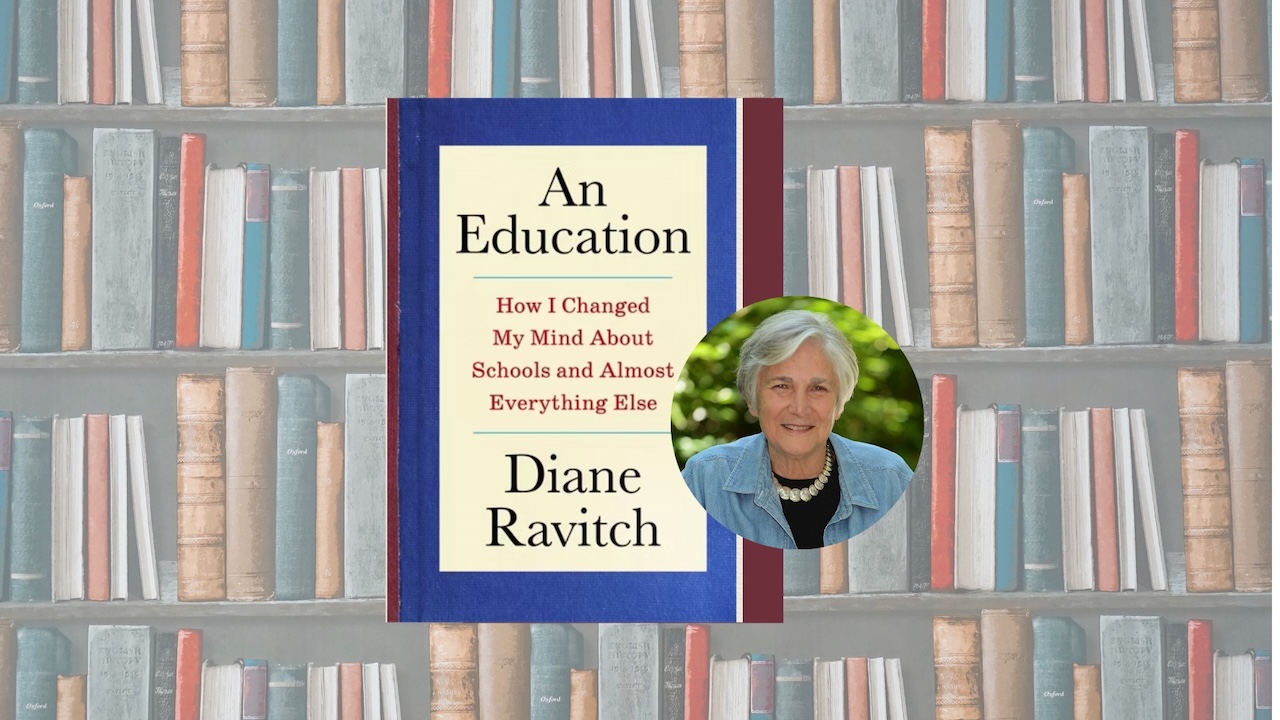
And now, at age 87, she’s written a kind of expanded autobiography, An Education: How I Changed my Mind about Schools and Almost Everything Else. She tells us how her vast experience with education policy, across partisan and ideological lines, has left her with a well-honed set of ideas about how to build good schools and serve students well. How, in fact, to save public education, if we have the will to do so.

You get the sense, as Diane Ravitch wraps up “An Education,” that she is indeed wrapping up– she sees this as her last opportunity to get it all out there: Her early life. How she found happiness. Mistakes and regrets, and triumphs. It’s a very satisfying read, putting her life’s work in context.

For her followers and admirers (count me in), the book explains everything about her beliefs. Her working-to-middle-class roots and her family’s loyalty to FDR and what the Democrats stood for, during post-World War II America, go a long way to explaining how she eventually (with some major diversions) became an articulate proponent of public education.

I’m glad she included a nostalgic portrait of growing up in TX with a hard-working mother and feckless (and worse) father. The glimpses we get into public education in TX in the post-war years resonated with me–and it’s easy to see how going far away to an Ivy League college shaped her entire adulthood. Her classmates at Wellesley, like Ravitch, were ambitious and curious; I’m old enough to remember a time when female ambition was suspect.

The most fascinating part of the book, for me, was the middle third, where she wrote about researching the history of public education and being asked to sit on prestigious boards and serve as Assistant Secretary in the George H. W. Bush Department of Education. There’s a whole chapter on Famous Education Opinion Leaders (many of whom are still working to suppress full public education) taking Diane to lunch, tapping into her work ethic and offering her opportunities to be part of the power structure, to write and speak (and—big point—learn what they’re really up to).

N.B.: Award-winning teachers are also often asked to become part of the education establishment by sitting on boards, writing op-eds, and serving on task forces– and it can be easy to feel as if you’re contributing, at a higher level, when what you are actually doing is giving credence to people who have a very different, but hidden, agenda.

The final third of the book is the Diane Ravitch most educators know and respect. Her observations come from swimming in the ocean of education policy for decades– and they’re accurate. I expect Ravitch to continue to blog and write and speak, as long as she is able. She is the rare voice in education that has examined education ideas across the spectrum and found many popular notions weak or dangerous.

The book is a fine testament to a life spent searching for the truth about public education.

Five stars.

The Legislature Goes to the Bathroom

I remember the first time I encountered unisex bathrooms.

I was traveling, with a backpack and not much money, in Europe, staying in youth hostels and tourist rooms, often in the homes of women I would meet at train stations holding up signs saying Zimmer zu vermieten. 

Near the end of the trip, an eight-week journey which I funded with just under $1000, I was in Munich, trying to find a cheap (really, really cheap) place to stay. Someone told me about a hostel camp, maybe an hour’s hike from the train station—a field outside the city where you could stay in a huge tent. If you got there early enough, there was also food.

I schlepped out there and stayed the last two nights of the trip, also visiting Dachau on my final day. It was bare bones—BYO sleeping bag and ground pad. There were unisex flush toilets in wooden cubicles, in a single concrete building of the type you’d find in any state park campground today. There were also warm-water showers, in a large room with no dividers for males and females. BYO towels and soap, as well.

The hardest part of adjusting to this was trying to act casual, as if I were used to waiting in line to use the toilet between Hans and Karl, or nonchalantly showering with a couple dozen mixed-gender strangers. Everyone else seemed pretty blasé about it. The vibe at the camp was international, friendly and very safe.

The year was 1976, the 200th anniversary of the home of the brave, land of the free.

Now, nearly a half-century later, some people have their knickers in a twist over newly remodeled unisex bathrooms in Michigan State University’s Campbell Hall, a beautiful dormitory on the oldest part of campus, which houses the Honors College.

The retrofitting took traditional community baths and turned them into lockable, fully enclosed private stalls, each with a shower, toilet and sink.  For a quick hand-wash or teeth brushing, there are also community sinks.

Apparently, the MSU Board got a letter of outrage from a parent, although students (who had to apply to live there) seem to be fine with the plan. There were some comments at the Board meeting about walking around after showering in a towel, but I chalk those up to people with too much time on their hands, wallowing in trad-nostalgia or perhaps sexual fantasies.

Back in the1970s, I lived in a co-ed dorm with community bathrooms. There were four floors—two community baths for women, two for men—although the dorm rooms alternated between men and women. I can’t tell you how many times I went to the women’s bathroom and found some dude walking out of a stall, because he didn’t feel like going upstairs. Lockable stalls with all you need sound vastly preferable to stumbling upon your roommate and her boyfriend showering together in the community bathroom.

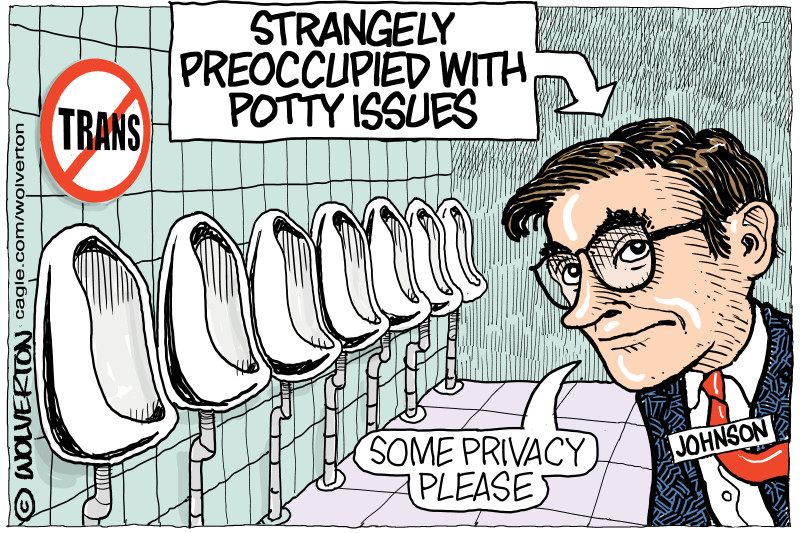
Makes me wonder why Republican legislators always bring up bathrooms when they want to gin up fear around gender expression. There really isn’t anything moral or magic about using the bathroom, with either gender.

There’s this: ‘Opposition to transgender inclusion has become a rallying cry for many conservatives. The debate is at the heart of a bill advancing in Michigan’s Republican-led House that aims to restrict bathroom use at schools and colleges on the basis of biological sex. 

Sponsoring Rep. Joseph Fox, R-Fremont, suggested Wednesday that allowing transgender students to use bathrooms of the gender they identify with is “traumatizing little girls.” He called it a “safety issue.”’

Then there’s this: “Michigan must stop making references to gender identity in sex educational materials provided to schools or risk losing millions of dollars in federal funding, according to President Donald Trump’s administration.” 

The State Board of Education is also currently hearing testimony on a new set of standards for sex education in Michigan:

“A recommendation that schools include instruction about gender identity or expression and sexual orientation by eighth grade has prompted criticism from several parental rights groups and Republican politicians. 

“These proposed standards cross into deeply personal and spiritual territory, normalizing behaviors that many families find harmful and contrary to their faith.’”

Traumatizing little girls? Normalizing behaviors that contradict families’ religious beliefs? And not being allowed to talk about it, in eighth grade sex ed classes, even if your parents say it’s OK?

It’s all about what’s happening in American bathrooms, evidently.

Gender-neutral bathrooms are commonplace in Europe.  Why is that? What do they understand that we don’t?

“Progressive” Schools

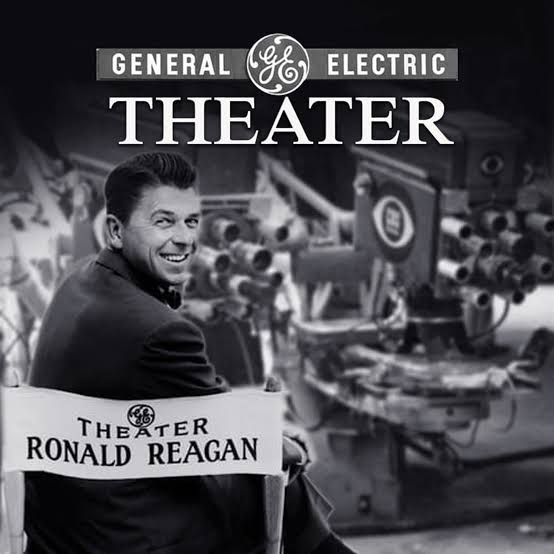
I’m old enough to remember Ronald Reagan hosting General Electric Theater, on Sunday nights, when he would look sincerely into the camera and say “General Electric, where progress is our most important product.”

Presumably, progress was both inevitable and desirable—a mashup of American technologies and innovation, bringing (GE again) good things to life. On television, anyway.

Who would stand in the way of progress? Certainly not schools, who were educating rapidly increasing numbers of Boomer kids, using the modern look-see method of reading instruction, and embracing New Math.

According to family legend, my first grade teacher sent home a note asking my mother to stop letting me read to her, in case she said or did something wrong, impeding my literary progress with pre-approved books about Dick and Jane. She stopped immediately. Teacher knew best.

Stephen Bechloss, on this Indigenous Peoples Day, shared a fine essay on progress:

“Examples of progress are all around us. I carry in my pocket a computer that gives me access to almost all the existing knowledge in the world. That same device allows me to instantaneously connect with family and friends thousands of miles away. I can flip a switch and light my kitchen. If my heart gives out, I can get a new one. I can fly in the sky and travel almost anywhere on the planet. Nearly everywhere I may go, I will meet people who know how to read.

The world is a wonder. Let’s not doubt it. The creative power of humankind has yielded a modern world that is safer, richer, more connected, more mobile and full of opportunity for more people than our ancestors could have imagined.”

Where did all this progress come from? In addition to the inherent creative power of humankind, progress is nurtured by education, wherein creativity and curiosity turn knowledge into progressive action: Machines. Ideas. Institutions. Literature and art.

Maybe even better government. Countries, for example, where everyone has health care, and citizens embrace collective efforts to address global issues like climate change. Progress—if you define progress as moving forward to solve problems, bring good things to life.

Possibly you’re raising your hand right now, itching to tell me that there are multiple definitions of progress and progressivism, or that the opposite of conservative is not liberal, but progressive. I would suggest that what we’re seeing now—the movement to damage public education—is not conservative. It’s authoritarian vandalism. But let’s try to agree on a definition of what it means to be progressive.

Miriam-Webster: A left-leaning political philosophy and reform movement that seeks to advance the human condition through social reform. Adherents hold that progressivism has universal application and endeavor to spread this idea to human societies everywhere.

It was not surprising to read this, in a must-read piece by Megan O’Matz and Jennifer Smith Richards at ProPublica: “In a 2024 podcast, Noah Pollak, now a senior adviser in the Education Department, bemoaned what he sees as progressive control of schools, which he said has led to lessons he finds unacceptable, such as teaching fourth graders about systemic racism.”

Progressive control of schools? Seriously?

Speaking as a person who has spent decades working in public schools and with public school teachers across the country, schools are generally among the most conventional and cautious institutions on the planet, subject to pressures and opinions from a wide range of (often clueless) critics. And likely headed by someone who adamantly does not want to get phone calls from honked-off parents.

I also say this as a person who taught fourth graders about systemic racism, in a general music unit from our REQUIRED music textbook, a collection of songs (Follow the Drinking Gourd; Swing Low, Sweet Chariot; Bring Me Little Water, Silvie and others) plus some pretty neutral fourth grade-appropriate text about the African formal and rhythmic roots of American popular music.

We were sitting on the big, round rug and one of the fourth graders asked why so many African-American songs (again, songs in our traditional music series) were about God. If their lives were so bad, he asked, why did they believe in heaven? It was a good question and led to an equally good discussion about what happens when people are oppressed—how they maintain cultural traditions, and hope.

If progressivism is about advancing the human condition, who’s against it? Besides the handful of people running the fatally compromised US Department of Education? The very people to whom diversity, inclusion and equity—progressive values– are anathema.

Convincing people that public school educators are a) raging leftists and b) persuading their students to defy their parents and adopt outrageous worldviews, then calling that progressivism is a fool’s errand. And 70 percent of the people who have first-hand experience with that—parents—generally believe that their public schools are doing the job they want them to do.

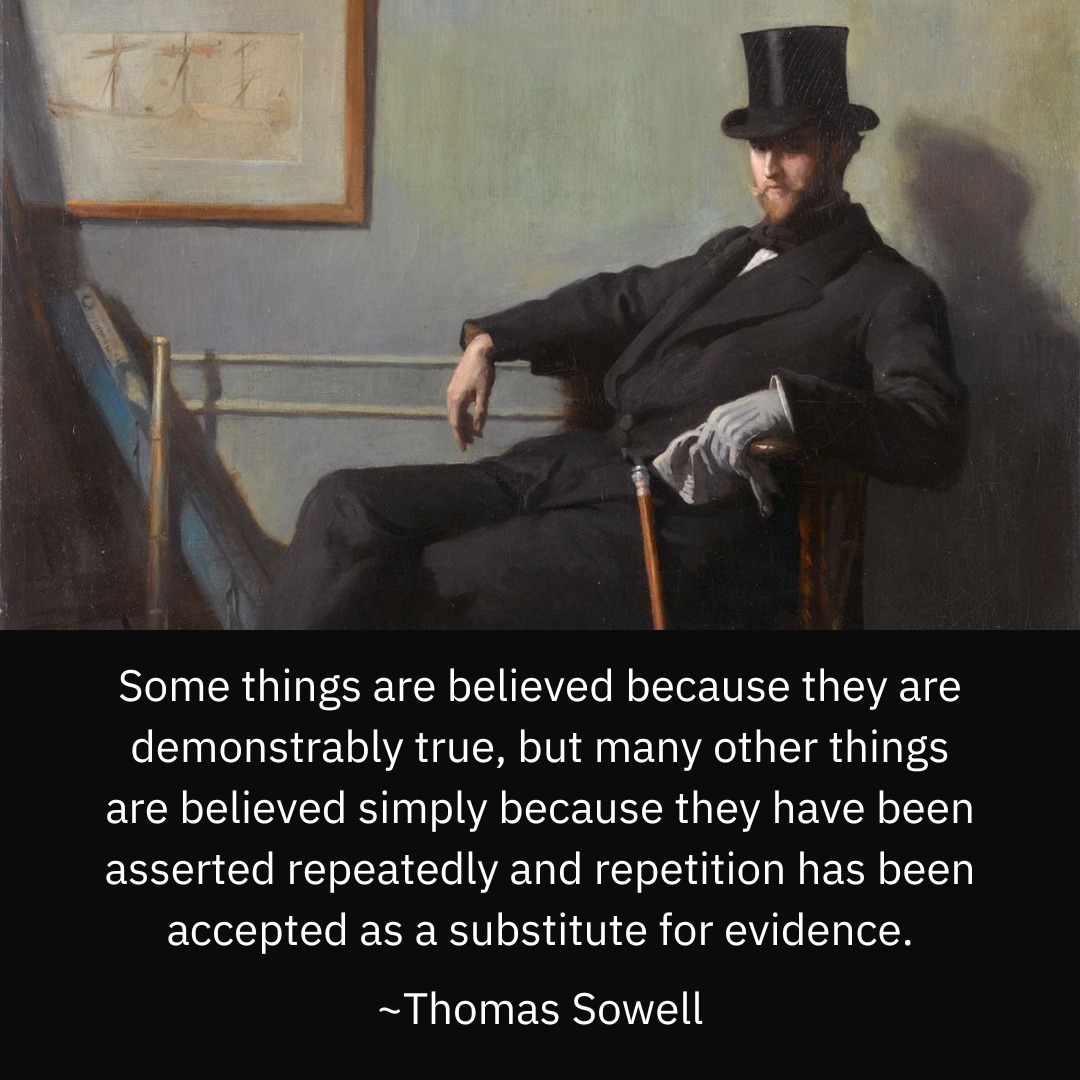
But societal shifts happen when false and unsubstantiated statements are repeated so often they become common knowledge. So be prepared to hear a lot of blah-blah about “progressive” public schools in the near future.

How about a Pause on the Race to Embed AI in Schools?

I haven’t written much about AI and education, for several reasons.

First, there are already many people writing compellingly and with considerable expertise about the uses and misuses of AI in the classroom. Some of those people will show up in this blog. Follow them. Read what they write.

Also, some years ago I developed a reputation for being a cranky Luddite. I wrote pieces about the downside of the ubiquitous online gradebook, accessible to parents 24/7, and other uses of computer programs that added to teachers’ workloads and didn’t fit with the important content and skills I was teaching students (lots of students) the old-fashioned way. The real costs of “free” programs and apps, no matter how glittery and hip, seemed obvious to me. Why didn’t other educators see this?

This came to a head when I was invited to be part of an online panel on ed technologies. Presenters sent me the language they planned to use to introduce me—did I approve? I confirmed, and then they messaged back: the bio had been created by ChatGPT. Ha-ha.

Finally, I haven’t written much about AI because I just find it hard to conceptualize how it could be useful in the classroom. In other fields, perhaps—with a lot of caveats, oversight and suspicion—but it runs contrary to the essential purpose of teaching and learning. Doesn’t it?

It’s never seemed right to let machines do the ‘thinking’ or ‘creating’ that is better done, or at least attempted, daily, by children. In short, I don’t get it. Maybe that’s because I haven’t been enlightened? So—shut up already?

I think many, if not most, practicing educators are in the same boat: Unclear about what AI actually is, and what use could be made of AI tools in their vital mission to make children independent thinkers, evaluators and creators.

For starters, who’s cool with Big Data collecting info on our public school kiddos’ engagement with their products? NEPC Report on digital platforms:  

While educators may see platforms as neutral tools, they are in fact shaped by competing interests and hidden imperatives. Teachers, students, and administrators are only one market. The other market involves data on performance, usage patterns and engagement—data flowing to advertisers, data brokers and investors, often without users’ knowledge or consent.’ 

A pretty good synopsis of what AI is, from Josh Marshall, Talking Points Memo:

“AI is being built, even more than most of us realize, by consuming everyone else’s creative work with no compensation. It’s less ‘thought’ than more and more refined statistical associations between different words and word patterns.” He goes on to make the salient point that the AI “products” being produced that will be “privately owned and sold to us.”

Doesn’t sound like something that schools need to quickly embrace, what with all our other problems, like teaching kids to read, rising absence rates and budgets stripped of our ability to feed children a nutritious breakfast and lunch.

Add in the environmental concerns and rampant intellectual property theft to teachers’ uncertainty about dumping more new, unvetted toys into an already-crammed curriculum. So I was thoroughly surprised to see the AFT get on the “AI in the classroom!!” bandwagon.

Why not take a pause—let’s call it a shutdown—on the race to embed AI in our schools? Why not sort through those competing interests and hidden imperatives? We’ve been bamboozled by climbing on attractive but ultimately damaging educational bandwagons before. Just who wants us on this one?

Well, scammers. And the folks who turned DEI into something to be avoided. Clueless Tik-Toking middle schoolers could up their game with AI. And right-wing edu-site The 74 says educators can save six hours a week by using AI to make worksheets, tests and exit tickets. Really? That’s an awful lot of worksheets.

Wouldn’t it make more sense to approach this transformative technology with great caution, holding fast to the evergreen principle of teaching and learning being a social endeavor? To look at the available research before being bedazzled by something new?

‘Participants, mostly undergraduate and graduate students, who constructed essays with the assistance of ChatGPT exhibited less brain activity during the task than those participants who were asked to write on their own. The AI-users were much less likely to be able to recall what they had written and felt less ownership over their work. Independent evaluators who reviewed the essays found the AI-supported ones to be lacking in individuality and creativity.’

If you want to read better pieces on AI, many are hyperlinked in this blog. But here are a few folks whose words and thoughts come from places of deep knowledge and experience:

Audrey Watters, the best Ed-Tech thinker on the planet,
for my money.

Pete Buttigieg, who thinks ahead of trends. Stop worrying about when he’s going to run for President and start absorbing his ideas on politics and relevant policy. Including AI.

Lucian Truscott, who writes about many things and made me understand why AI may ultimately fail: The men who run the big AI companies would do well to think through what they are doing with all those big buildings and all that electricity they consume. The “answer,” such as it is, to what they are seeking to accomplish may not exist, or it may be simpler than they think.

Educator Alfie Kohn, who points out that those most receptive to this technology are the people who know the least about it. This piece made my skin crawl.

My friend Peter Greene does a better job of debunking AI crapola than anyone I know. I credit this to his decades of classroom experience, during which he Paid Attention to Things—things more important than launching new products and making the big bucks.

So why should anyone pay attention to what a tech skeptic writes about AI in schools?

Because we’ll all be lured into making photos come to life, or relying on a questionable AI answer to an important question, or laughing at Russ Vought as Grim Reaper. Sticky and fun, but ultimately shallow, inconsequential.  Not what school-based learning should be.

Earlier this year, on a day when I made a (delicious) strawberry pie, I clicked on a song-writing app. Give us some lyrics, and a musical style, and we’ll write a song for you.

Here is my song: Strawberry Pie. Sticky and fun, but not much effort on my part.