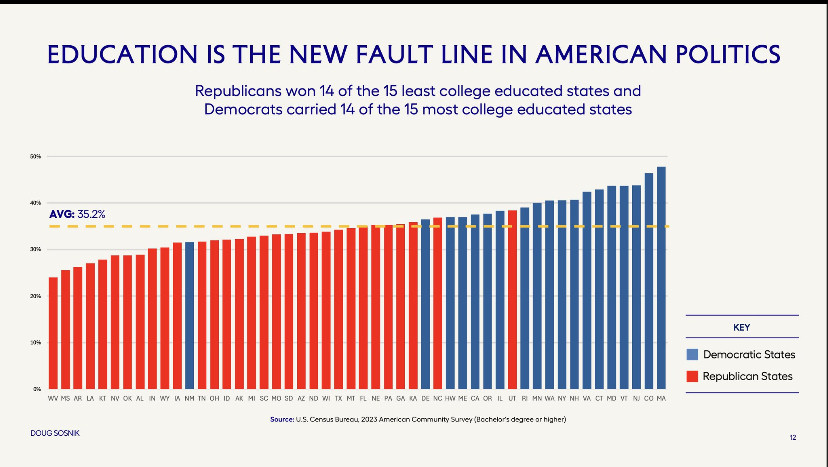
I’ve spent a lot of time considering this graphic.
IS education the fault line in American politics?
First shock: There are 33 states with more-educated people than (purple) Michigan, where there are world-class colleges and universities. What makes us an under-achiever?
2nd: Consider Trump’s mouth-blabber remark: “I love the poorly educated.” As well he should. They’re his base.
Digging deeper– what makes someone with a college degree more likely to vote Democratic? Does a college education make someone more broad-minded, more aware of the social and political factors influencing their well-being? Or is this all just about economics– being able to afford a college degree?
And personally–something I have been wrestling with since 2016–is there something I could have done, as a teacher, to model that broad-mindedness to my students?
I was talking with an acquaintance, and made a comment about ICE being reported in Leelanau County. Don’t you want to see illegal immigrants gone? she asked. Besides, they’re only picking up the ones with a criminal record.
I was dumbfounded. I knew she was likely a Republican; our points of contact have nothing to do with politics. But still– it came as a shock to know that she felt ICE was doing good, justifiable work– keeping her safe, here in nearly all-white Leelanau County.
This didn’t feel political. It felt personal. How could anyone who’s paying attention to the news support an out-of-control federal agency, ripping families apart and harming American citizens, with our tax dollars? Could you be a good person while accepting government-sponsored violence against innocent people?
There were lots of questions I could have asked, researched and validated arguments to be made, beginning with data about the non-criminals and citizens who have been detained. But–shamefully, I admit–I said nothing, just changed the subject to the reason we were meeting.
Thinking it over, I resolved not to just ‘let it go’ anymore. It’s true that many of these folks have made up their mind and are impervious to facts. And, at this moment, nobody is out in the streets when the wind chill is 25 below.
But–thinking people, actual good citizens, care about the people who live in and serve their communities. We are not seeing public safety being played out. We are seeing the base of a presidential posse–men with vicious grudges and biases empowered to destroy public services and schools. We all need to speak up.
Even when it’s socially awkward or unlikely to change minds.
Why? Well– read the article below. It’s a gift article, so you can read the whole thing.
It feels weird to be opining about professional development when teachers in Minnesota are dealing with the effects of mayhem in the street, poisoning the normal ebb and flow of public schooling.
Coincidentally, it was a group of dynamic teachers in the Twin Cities area who first showed me what it really could look like to be in charge of their own professional learning. More on that later.
First, let me say the obvious. Teachers actually are, and always will be, in charge of whatever they decide they need to improve their teaching. For some, it will be a career-long quest to learn and try new things, building a practice with what works best. Others might be less enthused about the latest mandated program. You can lead a teacher to PD, but you can’t make them believe it’s useful.
This is an evergreen issue, of course. My district dabbled in a ‘choose your own PD’ model for a few years, giving teachers the choice to work in their own rooms or attend planned presentations. The lure of hours of uninterrupted time to plan lessons, run copies, review new materials, catch up on grading or chat with a partner teacher was irresistible.
Going home without a tote bag full of work? Priceless. But when only a handful of people showed up for the paid presenter? Embarrassing for the administrator who did the hiring. I say this having been one of those presenters once, setting up for 35 attendees and then having only four show up for a half-day workshop on National Board Certification.
In fact, it was a group of National Board Certified Teachers from a public high school in Minneapolis who proved to me that teacher-led professional development could be incredibly exciting and precisely targeted to the work of teaching specific students.
The name of the HS is not important—but it was a school with a high percentage of immigrant students, so there were ESL issues and poverty issues and old-building facility issues. Sometimes the assigned curricula just did not work for the students they had.
A progressive principal bought into the idea of genuine teacher leadership and re-arranged the classic HS schedule so that he was teaching classes daily, opening up time for teachers to take on traditional administrative tasks. Like professional development.
Teachers surveyed their colleagues—What do you need to know to teach your students well? What issues do you want to talk about?—and set up weekly brown-bag lunch chats and after-school gatherings at a local restaurant, with snacks paid by the school budget. There was intensive mentoring for new teachers and regular time set aside for teachers to tweak curriculum, as they were teaching it. Peer observations and conversations were built into daily practice.
A lot of what they were doing was around the use of time, shaving it off here and adding it there—only an experienced teacher can understand the difference adding 20 minutes to lunch makes, where some of the best professional development happens spontaneously.
The most impressive thing was not that teachers were ‘in charge of their own PD’—but that teachers were collaborating to build professional learning and conversations that made sense to them, on the fly.
The first question from the audience (of teachers): Did everyone in your building buy into this new, ongoing PD model? Answer: No. A couple left the building for what they saw as greener pastures. But several skeptics stayed and eventually became converts. And now, they said, when we hire, we let new teachers know they will be surrounded by support in that first year. It’s who we are—a team.
We didn’t start this fire. But teachers—beaten down and dissed by our own government—will have a role to play in rebuilding the idea of representative democracy. Right now, that’s our best hope.
Their music and media tell them individualism will pull them out of squalor. The people behind those messages shove the economic ladders from underneath them. (Jose Vilson)
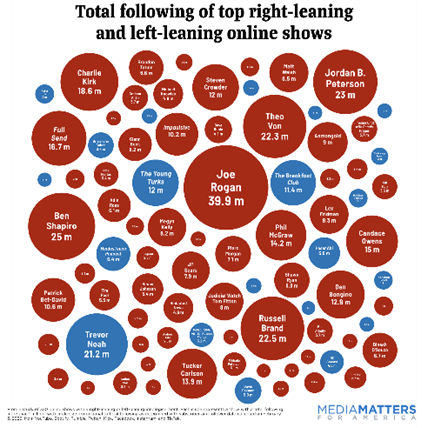
One of the most stunning bits of clarifying data I’ve seen in the past few weeks is this chart from Media Matters, with data from February 2025:
It’s a graphic of most listened-to online news and commentary shows, color-coded and sized to represent the magnitude and political leanings of the American audience. It’s year-old data, remember—but it goes some way toward answering the question I’ve spent the past year obsessing over: Who ARE these people and how could they have re-elected the corrupt man who led the insurrection against their pretty-good government?
I’m old enough to remember 2008, when Barack Obama’s online media savvy and fund-raising prowess was attracting voters and the envy of the other party, stuck in Walter-Cronkite land. Kids who were primary consumers of social media then, are in their 30s now, and apparently have shifted to eating up Joe Rogan, Ben Shapiro and Nick Fuentes.
But what are kids listening to in 2026? I think the JLV, in two sentences, above, sums up what I’m thinking: They’re young. They’re being bamboozled by glitzy media and music, convinced that their own swagger will save them. And then it doesn’t. In fact, they’re a generation that almost certainly will experience less prosperity and fewer prospects than their parents’ generation.
I volunteer in an after-school program for middle-schoolers, usually on afternoons dedicated to homework (or missing assignments). It’s no secret to any teacher that a lot of incomplete and missing work happens because the students don’t know how to do it. They will finally tell you—I don’t get this—after making excuses and going to their locker or the bathroom three times. This happens a lot with math, but also with conventional Q & A, end-of-chapter reviews and short writing assignments.
Our kids have their own Chromebooks and most of the teachers provide several vetted information sources beyond the textbook, which is great. But only if students go there, and wade around. Unfortunately, chatbots have now given them a get-out-of-jail quick option.
These students are—I emphasize—not dumb (or any similar but less insulting word). After homework is completed, we often play board games or cards. They understand and can negotiate things that the games require—similes and other wordplay, strategy and logic, memory. Some are also readers (passing around personally owned books that I never ask to see). There are conversations full of humor and current music and YouTube video references.
But at age twelve or so—where are they getting their information about the world at large? On the day after the 2024 election, our coordinator stopped by to remind volunteers NOT to speak about the election. Not that any of the kids mentioned it. It was as if it hadn’t happened.
If we can’t count on legacy media, who’s going to sort through those red and blue bubbles of independent media? It’s going to take more than hope and good will to teach kids to be critical consumers of media and music, to discern the difference between glittering generalities and sometimes unpleasant truth.
Of course, teachers are proscribed from sharing their opinions on the best sources of accurate and unbiased information, lest they be labeled DEI or woke. Makes you wonder how the public opinion on DEI and woke, two ideas that were once debatable if not accepted, solidified into broadly understood negative concepts. Where did that “information” come from?
Because I hang out with middle schoolers on the regular, I don’t think it’s too late to take a stand for discretion around the truthfulness of media sources. But simply letting the red bubbles win is a mistake.

 Teacher in a strange land