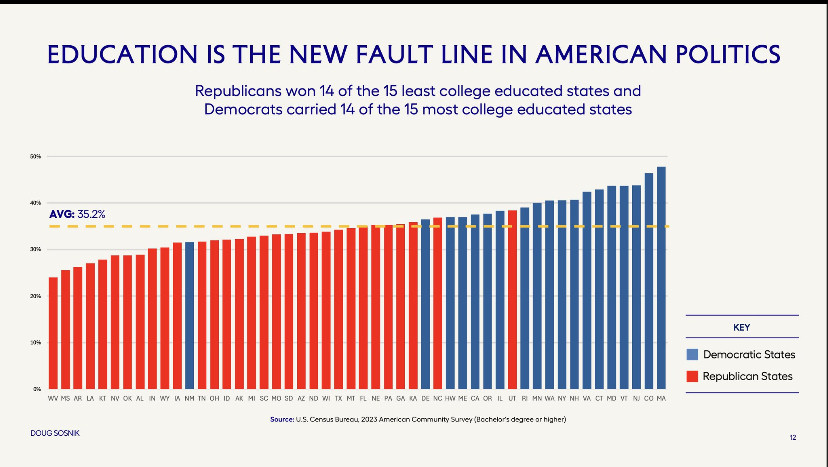
I’ve spent a lot of time considering this graphic.
IS education the fault line in American politics?
First shock: There are 33 states with more-educated people than (purple) Michigan, where there are world-class colleges and universities. What makes us an under-achiever?
2nd: Consider Trump’s mouth-blabber remark: “I love the poorly educated.” As well he should. They’re his base.
Digging deeper– what makes someone with a college degree more likely to vote Democratic? Does a college education make someone more broad-minded, more aware of the social and political factors influencing their well-being? Or is this all just about economics– being able to afford a college degree?
And personally–something I have been wrestling with since 2016–is there something I could have done, as a teacher, to model that broad-mindedness to my students?
I was talking with an acquaintance, and made a comment about ICE being reported in Leelanau County. Don’t you want to see illegal immigrants gone? she asked. Besides, they’re only picking up the ones with a criminal record.
I was dumbfounded. I knew she was likely a Republican; our points of contact have nothing to do with politics. But still– it came as a shock to know that she felt ICE was doing good, justifiable work– keeping her safe, here in nearly all-white Leelanau County.
This didn’t feel political. It felt personal. How could anyone who’s paying attention to the news support an out-of-control federal agency, ripping families apart and harming American citizens, with our tax dollars? Could you be a good person while accepting government-sponsored violence against innocent people?
There were lots of questions I could have asked, researched and validated arguments to be made, beginning with data about the non-criminals and citizens who have been detained. But–shamefully, I admit–I said nothing, just changed the subject to the reason we were meeting.
Thinking it over, I resolved not to just ‘let it go’ anymore. It’s true that many of these folks have made up their mind and are impervious to facts. And, at this moment, nobody is out in the streets when the wind chill is 25 below.
But–thinking people, actual good citizens, care about the people who live in and serve their communities. We are not seeing public safety being played out. We are seeing the base of a presidential posse–men with vicious grudges and biases empowered to destroy public services and schools. We all need to speak up.
Even when it’s socially awkward or unlikely to change minds.
Why? Well– read the article below. It’s a gift article, so you can read the whole thing.
It feels weird to be opining about professional development when teachers in Minnesota are dealing with the effects of mayhem in the street, poisoning the normal ebb and flow of public schooling.
Coincidentally, it was a group of dynamic teachers in the Twin Cities area who first showed me what it really could look like to be in charge of their own professional learning. More on that later.
First, let me say the obvious. Teachers actually are, and always will be, in charge of whatever they decide they need to improve their teaching. For some, it will be a career-long quest to learn and try new things, building a practice with what works best. Others might be less enthused about the latest mandated program. You can lead a teacher to PD, but you can’t make them believe it’s useful.
This is an evergreen issue, of course. My district dabbled in a ‘choose your own PD’ model for a few years, giving teachers the choice to work in their own rooms or attend planned presentations. The lure of hours of uninterrupted time to plan lessons, run copies, review new materials, catch up on grading or chat with a partner teacher was irresistible.
Going home without a tote bag full of work? Priceless. But when only a handful of people showed up for the paid presenter? Embarrassing for the administrator who did the hiring. I say this having been one of those presenters once, setting up for 35 attendees and then having only four show up for a half-day workshop on National Board Certification.
In fact, it was a group of National Board Certified Teachers from a public high school in Minneapolis who proved to me that teacher-led professional development could be incredibly exciting and precisely targeted to the work of teaching specific students.
The name of the HS is not important—but it was a school with a high percentage of immigrant students, so there were ESL issues and poverty issues and old-building facility issues. Sometimes the assigned curricula just did not work for the students they had.
A progressive principal bought into the idea of genuine teacher leadership and re-arranged the classic HS schedule so that he was teaching classes daily, opening up time for teachers to take on traditional administrative tasks. Like professional development.
Teachers surveyed their colleagues—What do you need to know to teach your students well? What issues do you want to talk about?—and set up weekly brown-bag lunch chats and after-school gatherings at a local restaurant, with snacks paid by the school budget. There was intensive mentoring for new teachers and regular time set aside for teachers to tweak curriculum, as they were teaching it. Peer observations and conversations were built into daily practice.
A lot of what they were doing was around the use of time, shaving it off here and adding it there—only an experienced teacher can understand the difference adding 20 minutes to lunch makes, where some of the best professional development happens spontaneously.
The most impressive thing was not that teachers were ‘in charge of their own PD’—but that teachers were collaborating to build professional learning and conversations that made sense to them, on the fly.
The first question from the audience (of teachers): Did everyone in your building buy into this new, ongoing PD model? Answer: No. A couple left the building for what they saw as greener pastures. But several skeptics stayed and eventually became converts. And now, they said, when we hire, we let new teachers know they will be surrounded by support in that first year. It’s who we are—a team.
We didn’t start this fire. But teachers—beaten down and dissed by our own government—will have a role to play in rebuilding the idea of representative democracy. Right now, that’s our best hope.
Their music and media tell them individualism will pull them out of squalor. The people behind those messages shove the economic ladders from underneath them. (Jose Vilson)
One of the most stunning bits of clarifying data I’ve seen in the past few weeks is this chart from Media Matters, with data from February 2025:
It’s a graphic of most listened-to online news and commentary shows, color-coded and sized to represent the magnitude and political leanings of the American audience. It’s year-old data, remember—but it goes some way toward answering the question I’ve spent the past year obsessing over: Who ARE these people and how could they have re-elected the corrupt man who led the insurrection against their pretty-good government?
I’m old enough to remember 2008, when Barack Obama’s online media savvy and fund-raising prowess was attracting voters and the envy of the other party, stuck in Walter-Cronkite land. Kids who were primary consumers of social media then, are in their 30s now, and apparently have shifted to eating up Joe Rogan, Ben Shapiro and Nick Fuentes.
But what are kids listening to in 2026? I think the JLV, in two sentences, above, sums up what I’m thinking: They’re young. They’re being bamboozled by glitzy media and music, convinced that their own swagger will save them. And then it doesn’t. In fact, they’re a generation that almost certainly will experience less prosperity and fewer prospects than their parents’ generation.
I volunteer in an after-school program for middle-schoolers, usually on afternoons dedicated to homework (or missing assignments). It’s no secret to any teacher that a lot of incomplete and missing work happens because the students don’t know how to do it. They will finally tell you—I don’t get this—after making excuses and going to their locker or the bathroom three times. This happens a lot with math, but also with conventional Q & A, end-of-chapter reviews and short writing assignments.
Our kids have their own Chromebooks and most of the teachers provide several vetted information sources beyond the textbook, which is great. But only if students go there, and wade around. Unfortunately, chatbots have now given them a get-out-of-jail quick option.
These students are—I emphasize—not dumb (or any similar but less insulting word). After homework is completed, we often play board games or cards. They understand and can negotiate things that the games require—similes and other wordplay, strategy and logic, memory. Some are also readers (passing around personally owned books that I never ask to see). There are conversations full of humor and current music and YouTube video references.
But at age twelve or so—where are they getting their information about the world at large? On the day after the 2024 election, our coordinator stopped by to remind volunteers NOT to speak about the election. Not that any of the kids mentioned it. It was as if it hadn’t happened.
If we can’t count on legacy media, who’s going to sort through those red and blue bubbles of independent media? It’s going to take more than hope and good will to teach kids to be critical consumers of media and music, to discern the difference between glittering generalities and sometimes unpleasant truth.
Of course, teachers are proscribed from sharing their opinions on the best sources of accurate and unbiased information, lest they be labeled DEI or woke. Makes you wonder how the public opinion on DEI and woke, two ideas that were once debatable if not accepted, solidified into broadly understood negative concepts. Where did that “information” come from?
Because I hang out with middle schoolers on the regular, I don’t think it’s too late to take a stand for discretion around the truthfulness of media sources. But simply letting the red bubbles win is a mistake.
“A generation raised under the [moral tone set by FDR] went on to build the modern middle class, defeat fascism, and help construct a postwar world that valued democracy, human rights, and shared prosperity.
Contrast that with the bigoted, hateful, revenge-filled claptrap children have heard for the past decade from the emotionally stunted psychopath currently occupying the White House.” Thom Hartmann
My goal in blogging—something I’ve been doing for almost 25 years—has always been to write about what it’s like to be a teacher in the United States. I wanted to focus on teacher leadership, to write about the ‘inconsistencies and inspirations, the incomprehensible, immoral and imaginative, in American education.’
Because—back in 2001, when I got my first paid gig writing on the internet (there were unpaid local newspaper columns before that), there were many inspiring things to write about, from my own experience as a classroom teacher. There were also important questions about instruction, thorny policy issues and curricular problems to solve, but it really felt as if public school educators were on the same page—valuing democracy, human rights, shared prosperity, as Thom Hartmann says.
You could see a turning point coming. Topics from my December 28, 2016 “best blogs” review when I was writing for Education Week:Charters aren’t the answer. Women are disrespected even in a field where they’re a huge majority. We still don’t know what “teacher leadership” looks like—or might accomplish. Standards may shape practice, but they don’t automatically raise achievement. Competition and marketing aren’t the answer, either. And the future of public education is in serious jeopardy.
Going through the blogs I wrote this year was an exercise in dismay. Although I had many rewarding experiences volunteering in schools, in 2025, pulling the camera back to see where we’re going in pubic education is – no other word—monumentally depressing.
Here are 10 blogs from 2025 that I think represent our current trajectory, such as it is. Wish I could offer readers better news:
Speaking as a person who has spent decades working in public schools and with public school teachers across the country, schools are generally among the most conventional and cautious institutions on the planet, subject to pressures and opinions from a wide range of (often clueless) critics. And likely headed by someone who adamantly does not want to get phone calls from honked-off parents.
If we were to sit down together over a cup of coffee, I could tell you dozens of stories from my teaching career that illustrate both moral clarity in my classroom, as well as times when I absolutely failed at establishing a trusting, collaborative ecology. It’s probably enough to say that I got way better at it, over 30+ years.
Why would we abandon public schools’ infrastructure and experienced personnel? Crushing public education is not policy—it’s vandalism. It makes no sense.
Maybe the question is not: Is Public Education Over? Maybe the question is: What’s worth saving in public education?
Times do change. People do change. And I would assert that changing people for the better happens in good schools, every day. Not all classrooms, not all playgrounds, not all teachers—but public schooling is an overall force for good, for a better, healthier nation.
Actually, if you’re taking away (via federally approved punishments and reduced funding) inclusion, equity and diversity, what you’ve got left is exclusion of non-preferred students, discriminatory distribution of resources, and separation of student groups based on physical characteristics. In other words, Arkansas in 1957. What happens when a latter-day Orval Faubus emerges?
While it’s important for boys to have personal agency in their learning, and be trusted by their teachers, boys need to have role models, as well. Who are we offering up as heroes, men whose lives and actions are worthy and admirable? Men worth emulating, who care for their spouses and children, men whose values serve as guardrails, men who are civically engaged?
When I first heard about Elon Musk’s email blast to over two million federal employees directing them to submit approximately five bullet points of what they accomplished in the previous week, I was reminded of a couple of school administrators from my past.
Eugene Robinson called Musk’s scheme “an exercise in contempt”—also a great description of some of the so-called professional development teachers routinely endure. When a principal doesn’t trust their professional staff to know what they’d like to do with time available for their own learning or planning, you end up with meaningless exercises like “five things I did last week.”
Ultimately, it’s about control.
Who’s in Favor of Authoritarianism? For the current administration, bent on “saving” federal dollars for their own preferences, breaking up this monolith will be a giant display of power that impacts some 50 million students and their families. Think you’re in charge of your local school, your classroom? Think again. Easy peasy.
No, the federal government–and supporting Republicans and conservative courts–say. No, we don’t want your media literacy classes. No, we don’t want kids nosing around in issues like fairness and equity in our recent history. No speaking Spanish. No arts classes or events to help students make sense of the world they live in. No vaccines to protect them, or accurate health information.
… A Fox host said this weekend that more Americans need to buy artificial Christmas trees because tree farms are needed for AI data centers: “There will be transmission lines that have to go through developments and farms. That’s the nature of a growing economy. Everybody needs to get on board. Buy a fake tree.” (Meidas)
I have never had an artificial tree. Some of my best friends, as the saying goes, have beautiful artificial trees, for all kinds of reasons—convenience, cleanliness, allergies—and I am seriously Not Judging.
But learning from Fox News that I should buy an artificial tree—presumably to make tree farming, a local industry, fail so that the devalued land could be looted for an AI data center—made my holiday blood boil.
Tree farms—like this one—do not despoil the rolling, wooded terrain of northern Michigan, unlike AI data centers. Most are family businesses, employing local people, investing for decades in trimming and watering, for an annual end-of-year payoff. Unlike AI data centers.
You’d think they’d jump at the chance to build a huge data factory—construction jobs in an uncertain economy when unemployment is rising? But no. They knew that “the nature of a growing economy” was going to come back to bite them with ugly power lines, jacked-up utility prices and the loss of 1500 acres of state-owned land.
When Fox News decides that fake trees are patriotic, urging us to buy plastic trees mostly made in China, to support the modern economy, something is very wrong.
But you already knew that.
We have purchased beautiful live trees from three different local sources—two of which have gone out of business in the past decade. We are scaling back this year, with a 9-foot Fraser Fir (the photo, a 12-foot Fraser, is from two years ago). Neither of us wants to get on anything higher than a stepstool anymore.
The tree cost $60, a $10 increase over last year, with the elderly, babushka-ed lady at the cash register apologizing to each and every customer. They have to charge more, she says, to stay in business. There are lots of post-teens working—hard—in the miserable cold, probably the same ones who had summer jobs trimming trees with machetes.
Our tree was cut less than 24 hours before we took it home, bundled and tied into the back of our pickup by those same local guys. It can eventually be chipped into mulch. It smells nice.
Best of all, it’s a subtle strike-back at the wave of Artificial “Intelligence” rolling toward us.
O Tannenbaum. Wie Treu sind deine Blatter.
Happy Holidays to all Teacher in a Strange Land readers.
Well, yeah. A.D.H.D. is now better defined and diagnosed. And I certainly believe that anxiety is on the rise with our youngest people—their world came crashing down five years ago with a global pandemic.
But have our expectations of children really changed? And are schools at fault?
Annoying headline aside, there’s a lot of alarming data in the article:
‘One million more children were diagnosed with A.D.H.D. in 2022 than in 2016. The numbers on autism are so shocking that they are worth repeating. In the early 1980s, one in 2,500 children had an autism diagnosis. That figure is now one in 31. Nearly 32 percent of adolescents have been diagnosed at some point with anxiety; the median age of “onset” is 6 years old. More than one in 10 adolescents have experienced a major depressive disorder, according to some estimates.’
It’s actually an informative read. Diane Ravitch deftly reviewed the piece in a blog post entitled Our Pressure Cooker Schools Are Destroying Children and Childhood. In fact, people have been writing about the ever-growing pressure on kids to excel for decades (especially those in high schools where getting into the Ivies or considering a gap year is common).
A couple of decades ago, ironically, we were talking about high-pressure Asian schools and why Singapore topped the international test scores. Was that what our kids needed—a literal kick in the pants? More competition? And why wasn’t the school providing that?
Here’s the thing: Schools in general—more about that word in a minute—aren’t the cause of students’ mental health issues. Schools do what they can with what they’re given, and what they are directed to do, for the most part.
First, a “school” is not precisely defined. Let’s say a good school has competent teachers, capable and cooperative support staff, thoughtful administrators, a clean and safe facility and enough resources to serve the kids assigned there. Those features can all be undone by bad policies and the social factors surrounding the school.
To say that “schools” are responsible for an uptick in mental health issues for students is not only unfair—it’s not accurate. The world—especially in 2025—is a scary place. For many (not all, but many) kids, school is the safest place for them to be, and I include in that number children who live in nice houses and have plenty to eat.
Just talk to teachers. They’ll tell you that kindergarten is the new first grade. They’ll share stories of kids whose behavior is driven by shame and frustration. They’ll tell you that 15 minutes of outdoor play is a benefit, not a waste of time better used on worksheets. They’ll testify that building a cooperative community is always the first step toward learning, in pre-school and in chemistry class. They can tell stories about seeing kids work through an academic roadblock, with patience and humor—not shaming and blaming.
Maybe we start addressing mental health issues by understanding just what it is that is making children anxious and distracted, and putting our attention and resources there.
Don’t misunderstand—I’m not saying that schools (in addition to all the other jobs they’re expected to do) can “fix” a child with failing mental health. But schools can be a significant factor in contributing to a child’s sense of security, belonging and worth.
I should probably preface what I’m about to say by noting that I self-identify as a liberal Christian. Without getting too far into the theological weeds—or alienating those who are rightfully skeptical about some current Christian churches’ lack of commitment to feeding the poor, etc.—I have been a church member and/or employee for decades, off and on.
All the way back to the 5th grade, in fact, playing “Angels We Have Heard on High”on my flute and swapping out my little-kid animal ears for a white robe and tinsel halo in the church Christmas pageant. Good times.
I retired—for good—from my last church music director position after Easter, and have since had the pleasant experience of being asked to play in several local churches, which are always looking for free talent.
Last summer, I was surprised to play a service and see two dozen teenagers seated together. There was a junior trad-wife fashion sense for the girls, all with long, curled hair and cute summer dresses. The girls were mostly carrying Bibles; the boys, with their llama-head haircuts, were carrying phones (and scrolling on them during the sermon).
Later, I learned that they were a newly organized chapter of Youth for Christ, meeting with their leaders (an attractive, early-20s married couple), in their home for coffee and prayer before school. Several of them had been baptized by that couple in Lake Michigan, earlier that month.
The guy sitting next to me at the service whispered that he was hoping that these kids were associated with Charlie Kirk’s Turning Point USA, which claims over 1000 chapters in high schools across the country: ‘Turning Point USA is also getting an assist from Republican leaders. The U.S. Department of Education announced it was partnering with the organization, along with dozens of other conservative groups, to launch a coalition to produce educational programming for schools and universities in advance of America’s 250th birthday next year.’
Eek.
I can’t tell you, precisely, what made me most uneasy about seeing perhaps 25 teenagers attending a conservative church en masse. None of the small, rural churches in this county have dozens of HS-aged members, for starters—so their organizational point was obviously somewhere other than an actual church. And the occasional teenager who showed up at the church where I worked never came dressed like a candidate on Bama Rushor looking like a Department of Labor poster boy.
And, miracle of miracles, parents in this conservative community didn’t like it. There were 78 non-consent forms, representing 109 minor children, filed with the Youth for Christ leaders and their organization, saying, essentially: Hands off our kids. If we want them to have religious experiences, we’re in charge of that.
But I want to return to the Christianity—if that’s the right word—inherent in recruiting members for your religious club from a public school setting. When I think about all the angst about not referencing equity, inclusion or diversity in school curricula, and all the book-banning Moms 4 Censorship types showing up at school board meetings, shouldn’t there have been outrage over paid recruiters “volunteering” and proselytizing during lunch?
In the season where Jesus sneaks into the daily life of families and communities—Joy to the World!—I am in favor of parents’ careful attention to who’s recruiting their kids.
‘If you’re not on TikTok, you might not have heard about the woman who’s been calling religious organizations to see how they respond to a mom’s request to source formula for her two-month-old daughter, whose cries you can hear in the background. (Nikalie does not have a two-month-old daughter; she plays a recording of a baby’s cries in the background).
Nikalie records the conversations (Kentucky, where she lives, is a one-party consent state, so this is legal) and then posts them to TikTok, along with a tally of how many organizations have offered to help and how many have declined. You can see all the videos here, but viewers have been compelled by the overall stats: only a quarter of the religious organizations she’s called have offered direct assistance. The larger the organization, the less likely it is to help.‘
Even if you’ve seen the Tiktok, I recommend reading the Culture Study piece, wherein Anne Helen Petersen deftly dissects this kind-of experiment, pointing out that some of the organizations that did not offer formula or money sent the caller to another resource, where they did.
She also raises the right questions: How do we help the needy efficiently, elevating proven logistics above feel-good impulses? Should religious institutions have serving the poor as an ongoing mission? (Yes.) And—why are there so many needy folks right now?
As a veteran teacher, in a relatively well-off suburban school system, I’ve been part of any number of school-based community service projects. My middle school used to have a canned goods drive around Thanksgiving.
Homerooms competed to see who could bring in the most cans, with the winning class getting donuts and cocoa. Piling the cans into an edifice—you can make a fairly impressive structure with hundreds of them—then plunking a few students in front of the Great Can Pyramid—well, there’s a shot for the monthly newsletter.
But it always bothered me. There were the rabid competitors—Come on! Just go where your mom stores cans and put a few in your gym bag!—who were definitely in it to win it. I mean, free donuts! From the bakery! There were also plenty of well brought-up girls who wanted to feed the poor (and maybe get their photo in the newsletter), counting and re-counting the cans.
The people who didn’t get mentioned: The Student Council advisor who had to transport a thousand-plus cans to the food bank. And food bank volunteers who had to organize the donations, throwing out outcoded or bulging cans of beets and butterbeans.
Not to mention the folks who depend on food banks, getting there early to get what they actually needed (formula, perhaps) and not be left with stuff that had been sitting in suburban cupboards for years, unused.
For several years, I was advisor to the National Junior Honor Society,the stated mission of which was acknowledging scholastic excellence in middle schoolers. Hey, I was always down to honor academic effort, and lots of my band kids were in the NJHS. It was one of those “make of it what you will” volunteer jobs, and I thought it was a place where some smart kids could wrestle with the idea that they were more fortunate than—well, the rest of the world. A middle school kind of noblesse oblige.
One year, we raised money by hosting a dance, then sent those proceeds to a homeless coalition in Detroit. It was a pretty bloodless project—the only outcome for us was a nice thank-you note from the nonprofit—but it was a good opportunity to talk about just who the homeless were, and how you get to be without shelter in the richest country in the world.
Another year, we “adopted” a family through the local Salvation Army (this was before their stance on LGBTQ folks was questioned), to provide a nicer Christmas. The first order of business, after raising a few hundred dollars, was discussing the word “adoption,” relative to extending charity to folks who are less well-off, but live in the same community. We were not adopting anyone; we were providing temporary, anonymous assistance.
Then, we went shopping. There were two cars full of 8th graders, with lists provided by the Salvation Army, pushing carts around Meijers, picking up a holiday dinner and gifts for everyone in our assigned family. What was interesting to me was the assumption that “the poor” weren’t like the kids in the NJHS; they should have to live with less expensive, less attractive products and even be grateful for them.
In our assigned family was a girl (14), who needed a warm winter jacket. The kids debated: the cheaper, ugly one or the acceptable style that was $20 more? This took a lot of time, standing in the aisle. I asked: Would YOU wear cheaper/ugly? No. Never in a million years. So—why should she? The answer (a good answer): because then we could get frozen macaroni and cheese for their Christmas dinner.
In the end, the chaperone mom and I kicked in extra cash, and we got them both. But life isn’t always like that.
I don’t think you can teach kids to care for their neighbors via school projects—but you can teach them to think about inequity and compassion. Just because SNAP benefits returned this month does not mean the less fortunate will be well fed in the long term. And the misfortunes of rising unemployment, rising food prices and rising social uncertainty will not be ending soon.
The foundations for eliminating food insecurity are cracking. The best gifts: Money and time. Happy Thanksgiving.
The world of education research is replete with studies that feel… unnecessary to folks who have spent their careers in front of K-12 classrooms. Primarily because so much good research is ignored in practice, and so much bad research becomes conventional wisdom.
There are lots of reasons why education research is suspect—or products are published to great fanfare, then sink like an oversized silver bullet: An analysis of 30 years of educational research by scholars at Johns Hopkins University found that when a maker of an educational intervention conducted its own research or paid someone to do the research, the results commonly showed greater benefits for students than when the research was independent. On average, the developer research showed benefits — usually improvements in test scores — that were 70 percent greater than what independent studies found.
Hmmm. I’d put my money on teacher perspectives about instructional strategies and materials, especially if teachers were in charge of their own professional work and offered ongoing opportunities to assess worthy curricula and teaching techniques.
(Dangerous but brave) subheading: The findings stand in contrast to conservative rhetoric about ‘indoctrination’ in the social studies. And surprise! The polls themselves were conducted by EdChoice, a nonprofit advocacy organization supporting school choice, and the Morning Consult Public Opinion Tracker.
‘More than 80% of K-12 teachers thought it was “very” or “extremely” important to teach students about the Constitution’s core values, and 62% found it similarly crucial to teach that America is a fundamentally good country. In both cases, teachers were more likely than parents or the public at large to favor teaching these concepts.’
Least surprising education research result, ever. Kind of shoots holes in the ‘teachers practice leftist brainwashing’ theory that the privatizers and public school vandals keep advancing. The study showed that 57 percent of parents thought schools should overtly teach patriotism and loyalty to the United State—the exact same percentage as teachers.
There’s more: ‘Both Democratic and Republican teachers were less likely than similarly affiliated members of the public to think it important to teach students to question government actions and policies.’
Again—totally predictable. Schools are inherently moderate and cautious, politically. Your teenager is far more likely to become radicalized—in either direction—via their online presence. Online—where there isn’t a caring and educated adult moderating the decontextualized content they are reading.