What’s better than DEI?

It was the headline that made me read the piece: Let DEI Practices Die. Replace Them With Something Better. I didn’t recognize (and won’t name) the author, but his position as Chair of Ed Reform at the University of Arkansas was a tip-off to what I was about to be served.

I read it because I couldn’t really think of anything “better” than DEI, as a values template for effective teaching and learning. More on what the author thinks is better, in a minute.

I am of the opinion that DEI no longer can be defined as three important values: the desirability of diversity in making an organization and its goals stronger, the principle of providing equitable resources instead of a dangerous gap between haves and have-nots, and the human need to be included.

As a teacher in a (mostly white) school, long before DEI was something that could be positioned as wrong and against the law, let alone “replaced,” I would have to say that inclusion, equity and valuing student diversity were and remain cornerstones of good classroom practice.

But I realize—and this is what I hoped to understand in reading the article—that policies loosely grouped as “DEI” (affirmative action springs to mind) were maybe a topic that hadn’t been discussed enough to be clarified. Maybe there are other ways to create policies that acknowledged the worth of every student, no matter what they brought to the table, and the struggle to give them resources, including knowledge, tailored to help them live productive lives.

As if.

The author begins with a quote from John McWhorter taken out of context, then lays out his thesis:  Linda McMahon signaled she wants to replace DEI with individual student agency, enabled by strong families and schools. He then proceeds to explain how he rose above his working-class station, even though he was forced to attend mediocre public schools, because his family instilled character and a work ethic into their children.

Unlike, of course, other—let’s call them ‘diverse’—families and children, who got into trouble and didn’t achieve. He pushes the success sequence (college, job, marriage, children) as his “something better” alternative to his skewed conception of DEI. As for student agency—something I heartily endorse and practiced for 30 years–he seems to confuse actual agency with a concept right-leaning educators raved about a decade ago: student grit (which leads to hard work, obeying orders and school success).

The whole piece feels like a narrow-vision essay on who deserves to succeed, buttressed by quotes from political leaders and deliberate lies about what teachers are telling students, topped with a light frosting of racism.

So—what should replace DEI?

Actually, if you’re taking away (via federally approved punishments and reduced funding) inclusion, equity and diversity, what you’ve got left is exclusion of non-preferred students, discriminatory distribution of resources, and separation of student groups based on physical characteristics. In other words, Arkansas in 1957. What happens when a latter-day Orval Faubus emerges?

How did we get to this place? And what can people who understand and support the genuine purpose of public education do prevent erosion of genuine diversity, equity and inclusion—not “DEI”– in our schools?

The Southern Poverty Law Center has a great piece on the anti-student inclusion groups and initiatives forming around the country—this goes way beyond Moms for Exclusion—and (important) who’s funding them: Together, these groups represent a growing trend: weaponizing public outrage and social media virality to enforce a narrow vision of education. Their strategies of harassment and public shaming have injected fear into discussions around race, gender and equity in the classroom.

So—one thing that can happen is resisting that fear, teachers intentionally developing collegial trust, clarifying their mission to serve all children well. And yes, I spent more than three decades in the classroom, most of those in a single district, and fully understand just how difficult that prescription would be. But still—courage and persistence are essential when you’re resisting something malign. And the anti-DEI movement is definitely malign.

I was taken by this piece by James Greenberg, shared by one of his Facebook friends:

This dislocation isn’t imaginary. It’s rooted in real structural shifts. The collapse of industrial jobs, the erosion of social mobility, the fragmentation of public education, the disappearance of local media—all contribute to a pervasive sense of loss. Add to that climate disasters, housing precarity, and the stripping of rural and working-class communities by extractive economics, and you get fertile ground for stories that promise a return to order—even if that order is cruel.

The “stolen America” narrative—amplified by cable news, talk radio, and algorithmic social media—offers a simple explanation: you are losing because others are taking what’s yours. It’s a lie, but a compelling one, because it replaces confusion with clarity. It locates blame. It gives identity to those who feel erased.”

I would add to Greenberg’s analysis—the COVID-19 pandemic. But I like his characterization of public education as fragmented. Because that is precisely what has happened to our public schools, even those who rode the COVID wave, then dug into repairing the damage it did to trust in our teachers and school leaders. The voucher craze isn’t about giving parents choices—it’s about breaking up successful school districts attempting to serve all students as best they can.

What can replace DEI? Nothing. If we lose our framework of serving all kids equitably, we go backwards 75 years.

Teach Your Children Well

It used to be fairly common in Traverse City, Michigan—a Michael Moore sighting. I once stood in line behind him at a Coldstone Creamery on Front Street (no longer there, alas). During the summer TC Film Festival (also no longer in existence), he was everywhere, leading panel discussions and walks around TC’s beautiful, turn-of-last-century downtown neighborhoods.

Michael Moore’s star has faded here, for various reasons. He’s never been an easy person to watch on TV, full of himself and, sometimes, an explosive but unreliable narrator of what’s happening in this country. You certainly know where he stands—but he can be a grating spokesperson.

Nevertheless, I read his free newsletter and found his April 30 column on the Vietnam Warwhere he points out that we’ve never as a nation, admitted our guilt or apologized–moving and worth deep consideration:

“They kicked the ass of a military superpower — and sent 60,000 of our young men home to us in wooden boxes (nine of them from my high school, two on my street) and hundreds of thousands more who returned without arms, legs, eyes or the mental capacity to live life to its fullest, forever affected, their souls crushed, their nightmares never-ending. All of them destroyed by a lie their own government told them about North Vietnam “attacking” us and the millions of Americans who at first believed the lie. This past November 5th showed just how easy it still is for an American president, a man who lies on an hourly basis, to get millions of his fellow citizens to fall for it. 

I think we need to do this for our children’s sake, for our grandchildren, for the sake of our future if there still is one for us. We should take just one day every year and participate in a national day of reckoning, recollection, reflection, and truth-telling, where together we actively seek forgiveness, make reparations and further our understanding of just how it happened and how easy it is for the wealthy and the political elites and the media to back such horror, and then to get the majority of the country to go along with it… at least at first. And how quickly after it’s over we decide that we never have to talk about it again. That we can learn nothing from it and change nothing after it. 

Teach our children this truth about us. About our history. Give them this knowledge and with it comes the opportunity for us to change and make different choices for our future. To be a different people. A peaceful people. The Germans did it. The Japanese, too.”

And here we are, again, creating an unnecessary war—this time on our own city streets. And the question bubbles up: Are we teaching our children the truth about the place where they live? And, even more important, what will happen if/when they believe the lies their government is peddling?

I was interested in this observation from the new National Teacher of the Year, Ashlie Crosson, from Pennsylvania: “Teachers shouldn’t shy away from using challenging texts and conversations in their classrooms, even if they touch on divisive topics.

It’s a reasonable statement you might expect from any accomplished teacher—but one that could now get you fired in some states and districts. Chaos and fear and flooding the zone are part of media assessments of public education in June 2025, along with smiling photos of HS graduates and end-of-year academic honors.

Robert Reich said it well:
“Why is Trump trying to cancel “Sesame Street,” which has helped children learn to read and count for over half a century? Why is he seeking to destroy Harvard University? Why is he trying to deter the world’s most brilliant scientists from coming to the United States?

Because he is trying to destroy American education — and with it, the American mind.”

Is there anything teachers can do to stop the ongoing attack on becoming genuinely well-educated? To not be fearful of ideas or painful truths?

Individual teachers are seldom visible enough to draw widescale media-fed wrath (which is why I found the new National TOY’s remarks brave)—political opponents of public education generally target teacher unions, well-endowed universities, and programs that provide free breakfast and lunch or wraparound healthcare for kids who need it.

With the upcoming NO KINGS National Protests, I’ve seen lots of social media memes urging people to do what they can. To march and carry signs, of course—but also to speak to those in their circle of influence, to write, to model democratic principles. To behave as engaged citizens—and to teach their children the truth about our history, with the goal of becoming a peaceful people.

Let’s teach our children well. (click—it’s worth it)


What Europeans Think of Trump

Just got home from a two-week vacation in the Czech Republic and Germany, including a week in what used to be East Germany. All of us learn from travel, of course, but this trip—planned long before last year’s election—was an incisive tutorial on how the rest of the Western world sees where we’re headed.

As of today, there are warnings against travel to the United States for citizens of Canada, Germany, England, Denmark, Netherlands, and France—probably the easiest and most accessible nations for Americans to visit.

I grew up in Michigan, where Canada hardly felt like a foreign country. I have friends who live in Windsor, but work in Detroit. College students in Michigan have routinely made pilgrimages to Ontario, where the legal drinking age is 19. Losing that easy camaraderie is huge—and that’s without taking into account the auto industry’s dependence on Canadian-made parts and trade.

I was interested and a little anxious about what the vibe would be in Europe. I’m too old for rail passes/backpacks/hostels travel—we’d be staying in hotels and led by English-speaking guides—but if you pay attention, in between historic dates and landmarks, you can hear and see what daily life is like in places that used to be Russian-controlled territories, how they see themselves in the world, and their fears for the United States.

I was also curious about my fellow American travelers. Would they agree with Jim Acosta, who said: Think of the damage done to America’s standing in the world, in the minds of young people across the globe. They see a president who is often out of touch with the real world, thoroughly corrupt and vengeful, beginning his second term launching a crypto scheme and turning government against vulnerable migrants as well as his enemies, both real and imagined.

We began our journey in Prague, a gorgeous medieval city that has been overrun by competing rulers for centuries, part of the Holy Roman Empire as well as the Kingdom of Bohemia. The old core of the city was almost untouched by WWII, but our local walking tour guides–find ‘em on the internet–occasionally pointed out architectural anomalies, calling them Communist buildings, which (local joke) come in three colors: light gray, medium gray and dark gray.

Because the walking tour groups were nationally diverse, the focus was on the enchanting city and its rich history—including the Velvet Revolution of 1989, wherein the Czechs reclaimed their own heritage and autonomy.

Traveling into Germany—the former GDP, East Germany—was revelatory. Guides were excellent—they all knew the historical markers but would often tuck bits of human perspective in their remarks.

  • Our guide in Wittenberg was born in the 1950s and grew up there. In secondary school, she said, she studied Russian. It was the only “foreign” language available. She also studied Russian in college. When she was in her 30s, and the Wall came down, she decided she wanted to learn English—and did. I never wanted to speak another word of Russian, she said darkly.
  • In Potsdam, we visited the estate where the Potsdam conference was held and the iconic photo of Truman, Stalin and Churchill was taken, before Germany was carved up. Potsdam is a beautiful town, including the upscale neighborhood where Vladimir Putin and his KGB comrades lived, in the1980s, considering what other beautiful villages and terrain they might appropriate.
  • In Dresden, we got a quick tutorial on how much of Dresden was bombed into smithereens, in February of 1945. American woman (who should, IMHO, know better) asks the guide: Who bombed this city? The allies, he replies, tactfully. You mean us? She says. Why would we do that? Well, the guide says— revenge, maybe? Later, I hear the woman ask her husband if the Germans are communists, leaving me to wonder just what we are teaching in World History classes.
  • In Torgau, where the allied armies met the Russian army, effectively shoving the tattered German army out of their homeland, April 25, 1945, five days before Hitler took his own life in a bunker. We looked at the site where the armies met, on the Elbe river. Flags from the United States, Russian and Germany have flown there for 75 years, in a memorial. The flagpoles are now empty—and have been since earlier this year, when Germany decided the peace agreement no longer applied.

Our guide in Torgau pointed out that there were a few things—free child care, for one—that made living in East Germany easier (these kindergartens were shut down as “too socialist” after the reunification). On the other hand, the omnipresent occupying Russian soldiers were brutes. His great-grandmother was shot dead in the town square, for resisting the attentions of one of them. He reminded us that Hitler came to power peacefully, and stayed there, courtesy of the Nazi party.

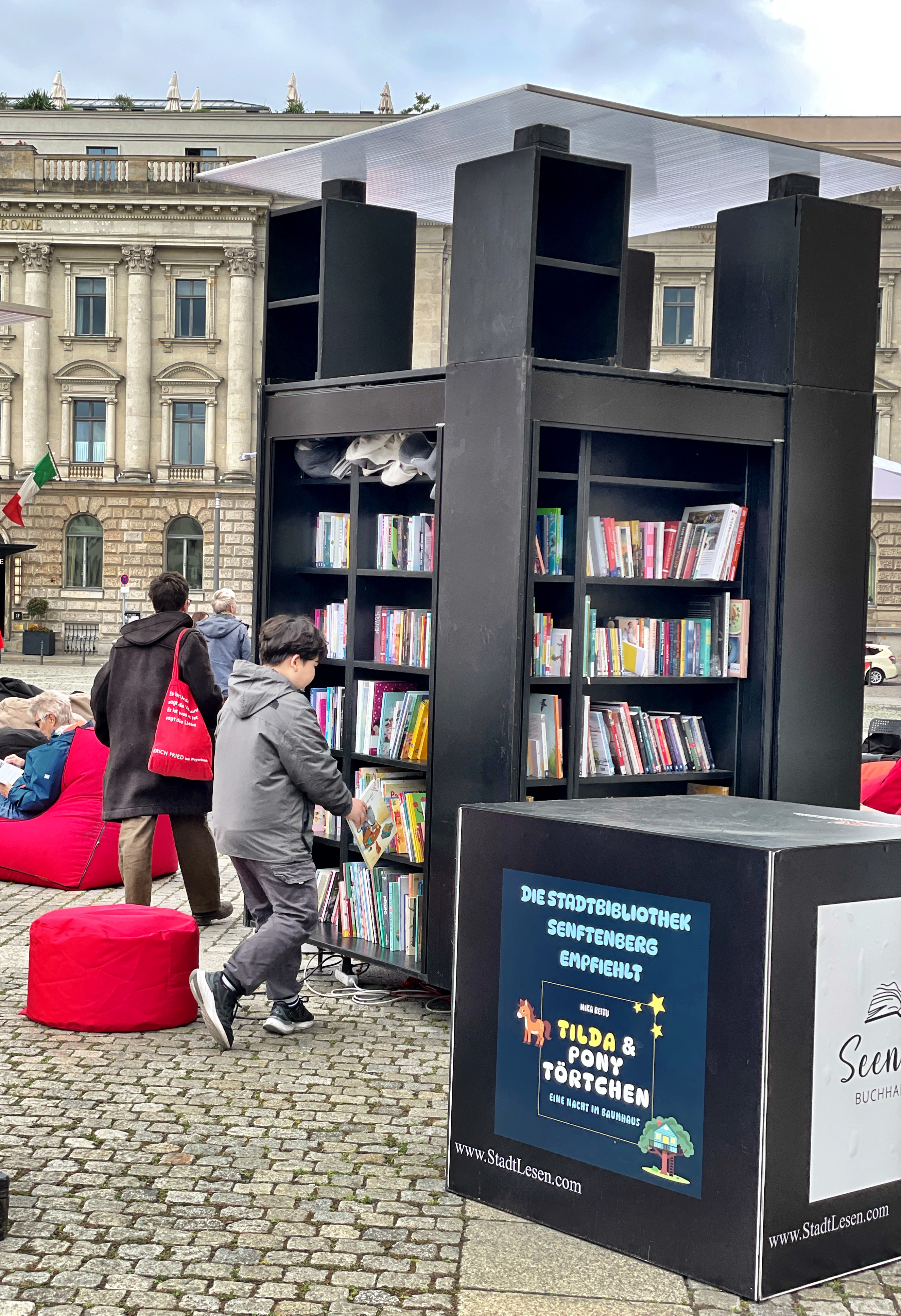
  • Berlin, of course, is a kind of living museum. Most powerful moment in Berlin? The square where, in May of 1933, the Nazis held their first book-burning. There’s a memorial there. Our guide said, quietly: First they burn books. Then, they burn people. But there is a little free library in the square, with hammocks and beanbag chairs. It was a chilly day—but there were children there, reading. Hope.

Everywhere we went, people were kind and hospitable. And honest. Aware of how long it takes to overcome the destruction of a great nation.  As Jen Rubin wrote, this morning:

Other countries, much older than the United States, have gone through grim, even disastrous years, decades, or centuries. And yet in Europe, the spirit of liberal democracy (however imperfect) remains alive and well. A sense of the public good still thrives, and millions of people strive to keep the achievements of Western Civilization from the clutches of fascism, xenophobia, know-nothingism, and conspiracy-mongering. The world is carrying on, albeit with dismay, as Americans struggle through its Dark Age.

Amen.

RIP, Libraries and Museums

On our way home from the Network for Public Education conference, earlier this month, we jogged to the right and spent a night in Cleveland, so we could visit the Rock and Roll Hall of Fame. Our hotel, just a couple of blocks from the Hall of Fame, used to be the Cleveland Board of Education building, completed in 1931.

It’s a magnificent structure, all marble, soaring windows, colorful painted murals and wide hallways, with a bar named The Teachers’ Lounge. Who could resist?

It made me wonder about the value Cleveland currently places on their public schools, when a century ago they commissioned this monument to public education, likely assuming that generations of Ohio kids would be duly and proudly educated in Cleveland, and go on to do great things.

They don’t build ‘em like they used to—either our buildings or our midwestern dreams of progress.

The history of the Cleveland Metropolitan School District looks like the history of many big-city school districts, scarred by changing demographics and the public’s unwillingness to support all children with a free, high-quality, fully public education. Cleveland is not unique—there are still Pewabic pottery-tiled fireplaces in public schools built in the 1920s in Detroit. You can take a bike tour of historic, architect-designed schools in Chicago.

The ”high school movement”—when it became common for American youngsters to pursue education beyond the 8th grade—occurred in the first half of the 20th century. In 1910, the number of HS graduates in the United States was less than 10%, but by the outbreak of World War II, almost three-quarters of the student population attended high school. Many factors—mainly wars, rural-urban migration, and an economic depression—shaped the movement to make 12 years of education the norm.

And, of course, what was the norm for white kids did not necessarily apply to children of color. The Brown decision in the 1950s and school busing protests in the 1970s interrupted the rosy national vision of steadily increasing investment in our public services and institutions.

Not to put too fine a point on it, but America has always struggled with the concept of “all means all” –just who “deserves” to have nice things, like decent housing and basic health care. Schools. Libraries, museums and parks. A reliable, inexpensive postal service. Public universities. The kinds of services we share, places of mutual benefit. Our freedoms.

And now, we have elected a man whose fundamental life goal seems to be taking those things we share—the things we all deserve, and have worked for, as citizens in a constitutional republic– away from us.

Defunding public services and institutions. Privatizing the Post Office, which serves rural addresses that Federal Express won’t touch. Shutting down youth programs and the Summer Reading Club at your local library. Eliminating programs for veterans. Even—God help us—shutting down suicide hotlines for LGBTQ teens.

As I watch this wrenching tear-down of all the things that make for strong communities, I am staggered by this conundrum: Trump and his acolytes have embraced the idea of making America great again by attacking the very things that actually made us great, beginning with the solid belief in our future progress that drove the city of Cleveland to build a temple to public education, and finish it during the early years of the Depression, placing a statue of Abraham Lincoln on the manicured lawn in front.

Belief in our people and their future is behind untold numbers of beautiful, shared enterprises—theatres and hospitals, stadiums and churches. Monuments to philanthropy, and showcases for art and culture. National parks that tell our nation’s stories. Organizations established to help our fellow citizens.

What is behind the impulse to tear all this down, close it off, let it crumble, progress and humanity be damned? Who does this—and why?

None of this is genuinely about waste or fraud—or even evidence of out-of-control DEI thinking. How can there be too much equity or justice in a country that prides itself on inventing a new form of government?

From an article about Lindsey Halligan (see link for revelatory photo), now charged with “removing improper ideology” from Smithsonian museums:

“I would say that improper ideology would be weaponizing history,” Halligan says. “We don’t need to overemphasize the negative.” Halligan, 35, is a Trump attorney who seems to have tasked herself as a sort of commissioner — or expurgator, according to critics — of a premier cultural institution.

Trump is not much of a museumgoer. 

What he’s after is power and control and riches. The men who built the infrastructure of industrial America wanted power, control and riches as well. Some of them wanted to preserve the vile institution—slavery—that made their power and riches possible. We fought a bloody, devastating civil war over the very issue of who deserves to be represented in museums, check out books from the library, or send their children to free public schools.

And here we are, again.

The Rock and Roll Hall of Fame was wonderful. I’ve been a handful of times, and have taken 150 eighth graders—I’ve got stories—to wade around in the history of the music that has surrounded them since birth. The museum is 100% private, funded by wealthy donors and $39.50/per ticket fees. It will not be torn down, stripped for parts or sold to the highest bidder.

As I was wandering through the main exhibit hall on the lower level, I started thinking about how the roots of rock music, like the labor of enslaved workers, were essentially stolen from African-American blues and gospel singers, mixed with rough-edged country, hillbilly and western music. And then sold to the masses, after condescending  public dismissal as unimportant and vulgar.

Power and control and riches. Plus ça change, plus c’est la même chose.

The Reason We Still Need Conferences

I am just back from the Network for Public Education conference, held this year in Columbus, Ohio. Columbus is an eight-hour drive from my house, and we arrived at the same time as ongoing flood warnings. But—as usual—it was well worth the time and effort expended.

For most of my career—35 years—I was a classroom teacher. Garden-variety teachers are lucky to get out of Dodge and attend a conference with their peers maybe once a year. Teachers don’t get airfare for conferences in other states and often end up sharing rides and rooms, splitting pizzas for dinner. They go with the intention of getting many new ideas for their practice toolboxes—lesson plans, subject discipline trends and tips, cool new materials—and to connect with people who do what they do. Be inspired, maybe, or just to commiserate with others who totally get it.

In the real world (meaning: not schools), this is called networking. Also in the real world—there’s comp time for days missed at a weekend conference, and an expense form for reimbursements. Conversely, in schools, lucky teachers get a flat grant to partially compensate for registration, mileage, hotel and meals. In many other schools, nobody goes to a conference, because there’s just not enough money, period.

When you hear teachers complaining about meaningless professional development, it’s often because of that very reason—there’s not enough money to custom-tailor professional learning, so everyone ends up in the auditorium watching a PowerPoint and wishing they were back in their classrooms.

Back in 1993, when Richard Riley was Secretary of Education, his special assistant, Terry Dozier, a former National Teacher of the Year, established the first National Teacher Forum. (In case you’re wondering, the Forums lasted just as long as the Clinton administration, and Riley, were in the WH.) Teachers of the Year from all 50 states attended. The purpose of the conference was to engage these recognized teachers in the decision-making that impacted their practice. In other words, policy.

It was probably the most memorable conference I ever attended. I took nothing home to use in my band classroom, but left with an imaginary soapbox and new ideas about how I could speak out on education issues, engage policymakers, and assign value to my experience as a successful teacher. The National Teacher Forum literally changed my life, over the following decades.

But—the idea that teachers would start speaking out, having their ideas get as much traction as novice legislators’ or Gates-funded researchers, was a hard sell. Education thinkers aren’t in the habit of recognizing teacher wisdom, except on a semi-insulting surface level. In the hierarchy of public education workers, teachers are at the lowest level of the pyramid, subject to legislative whims, accrued data and faulty analyses, and malign forces of privatization.

Which is why it was heartening to see so many teachers (most from Ohio) at the conference. The vibe was big-picture: Saving public education. Debunking current myths about things like AI and silver-bullet reading programs. Discussing how churches are now part of the push to destabilize public schools. New organizations and elected leaders popping up to defend democracy, school by school and state by state.  An accurate history of how public education has been re-shaped by politics. The resurgence of unions as defenders of public education.

Saving public education.  A phrase that has taken on new and urgent meaning, in the last three months. Every single one of the keynote speakers was somewhere between on-point and flat-out inspirational.

Here’s the phrase that kept ringing in my head: We’re in this together.

The last two speakers were AFT President Randi Weingarten and MN Governor Tim Walz. I’ve heard Weingarten speak a dozen times or more, and she’s always articulate and fired-up. But it was Walz, speaking to his people, who made us laugh and cry, and believe that there’s hope in these dark times.

He remarked that his HS government teacher—class of 24 students, very rural school—would never have believed that Tim Walz would one day be a congressman, a successful governor and candidate for Vice-President. It was funny—but also another reason to believe that public schools are pumping out leaders every day, even in dark times.

In an age where we can hear a speaker or transmit handouts digitally—we still need real-time conferences. We need motivation and personal connections. Places where true-blue believers in the power of public education can gather, have a conversation over coffee, hear some provocative ideas and exchange business cards. Network.

Then go home–and fight.

Goodbye to the Department of Education

Lots of my fellow ed-bloggers are musing fretfully about what appears to be the imminent demise of the Department of Education (ED, in DC insider parlance). There’s a lot to say about laying off half the employees at a vital federal institution and crushing its ongoing critical functions. Some are hanging on to the idea that only Congress can disappear the ED, but I have my doubts.

Chasten Buttigieg, spouse of the former Transportation Secretary (and person who lives near me) suggested on Bluesky today: If Linda McMahon and the Department of Education believe in “efficiency and accountability” (after laying off half of the department), then I’m sure they’ll gladly publish a list of every position that has been eliminated and why that position is no longer needed.

As if.

Speaking as a person who was already four years into her teaching career when Jimmy Carter got the ED through Congress and running, I clearly remember the parade of Famous Political Operatives (including Reagan, the Republican party and various right-wing caucuses) who pooh-poohed the idea that education was important enough to have its own Department and Secretary.

They were all operating from the same standpoint: Too much tax money for public education, too much federal say-so on what should be state and local decisions. Classic conservative positions. The Detroit News has been referring to public education as a massive entitlement program for years.

Those reasons were not enough to take down the ED, however. And the Department went merrily on, as bureaucratic institutions do, making things better for kids with disabilities and establishing programs to continuously improve public education. Theoretically.

Some of those programs and laws administered by ED—NCLB, grandchild of the ESEA, springs to mind—were not popular with those staffing the 13,000+ public school districts in the U.S. But the ED had a core function that we all could get behind, beautifully illustrated yesterday by this AP headline: The Education Department was created to ensure equal access. Who would do that in its absence?

Without the department, advocates worry the federal government would not look out in the same way for poor students, those still learning English, disabled students and racial and ethnic minorities.

There was a time when I would entertain arguments about whether the Department of Education was entirely a force for good. I was disabused of this notion by Renee Moore, a brilliant and dedicated educator who taught in the Mississippi Delta. Without a federal force to protect public education, she pointed out, Mississippi could easily slide backward into the segregated, utterly neglected public schools that made up its past. We can’t trust states to equitably take care of the children who live there, especially those in poverty, she said. The federal government gives us a backstop.

I thought about Renee this morning, when I read this statistic: The share of K12 funding provided by the federal government ranges from 23% in Mississippi to 7% in New York. Overall, in 2021-22, average federal education spending was 17% in states that voted for Trump in 2024 versus 11% in states that voted for Harris.

Education Week also had an interesting piece up today, Can Trump Do That? Which Actions on Education Are Legal, and Which Ones Aren’t? It’s paywalled, but the gist is that in 11 federal education programs that Trump has indicated he will destroy, in some way, he’s on legal (but distasteful) footing in only one. The rest, he technically can’t do, via a wave of his magic Elon-wand.

But we all know where Trump and Musk are going. We see it with our own disbelieving eyes. Rules, schmules. And the states that are going to get hurt the most are his most loyal base.

Lots of Trump’s executive orders are easily reversible. Don’t take your Sharpie to the Gulf of Mexico. But destroying the Department of Education is a Category Five injury to the concept of a free, high-quality education for every American child, regardless of what they bring to the table.

Diversity, Political Culture and Middle School Band

Like all educators, I’ve been following the repercussions of the “Dear Colleague” letter the federal government sent to public schools, threatening to cut off funding for schools that dabble in things like human rights and accurate history. The fact that the poor, strapped (snort) Department of Education used some of their evidently dwindling resources to set up a snitch line so parents could rat out teachers and school leaders is telling.

Dear Colleague, my ass.

More like Big Brother is watching. Or Here’s Our Grand Portal of baseless conspiracy theories and fear-mongering to support so-called “parents’ rights”—jump right in!

To make this all seem “normal,” the ED sent out a nine page read-what-our-lawyers-say explainer that further muddies the waters. The purpose of this second epistle seemed to be upping the threat while appearing to be efficient and legal-ish.

Many times, in my long career as a vocal and instrumental music teacher, I’ve had dear colleagues (ahem) express mild envy over that fact that the general public saw my subject discipline as what we used to call a “frill”—nice, but neither substantial nor essential.

Parents, these teachers suggested, didn’t really care about what kids were learning or singing in music class. It was an elective, not part of the more important career-preparation/serious-academics curriculum. In other words, my students were not being tested on the music curriculum, like theirs were. In band and choir class, we were just, you know, playing around. Fluff.

As you may imagine, I’ve written countless blogs and think pieces about what kids take away from a quality music program. If you think that the arts are a value-free zone—not tested, so not important—I’ve got news for you.

The classroom where I spent more than 30 years, teaching secondary vocal and instrumental music, was a platform for learning about lots more than the fingering for Eb and how long to hold a dotted quarter note. It was a place where we could explore how the music that students are marinating in, 24/7, came to be—a cultural voyage, through time and place, and the human response to make art reflecting the artist’s circumstances.

Proof of that–a couple of days ago, a young band director, on a Facebook page for instrumental music, asked his dear virtual colleagues for advice on this dilemma: His 8th grade band had been preparing Moscow 1941, a terrific composition, for an upcoming performance. Given the current fluctuating official opinion on Russia, Russia, Russia, he was stymied by his middle schoolers asking if they were playing a Russian march to show support for the Trump administration.

What do I do? he asked. Do I tell them Russians were the good guys in 1941, but not now? Do I say it’s just notes and rhythms, forget the title? Do I just pick something else? The kids like the piece and we have it ready for performance. Also—I’ve already talked to the kids about great Russian composers and the dark and moody music they have produced, over centuries.

First—I love that there’s an online forum for discussing these professional issues. Responses were mostly thoughtful, ranging from “tell kids the truth about Russia, then and now” (including a couple of good resources) to “get your principal involved.” There were also a few “avoid conflict, always—dump the piece” responses, which I took as evidence that teachers, in general, are rightfully anxious about threats from federal, state and local officials. Music programs are chronically in the crosshairs and choosing music that Trump-voting parents could misinterpret could be risky.

The discussion morphed into examples of band directors who chose music to represent Ukraine, and other masterworks inspired by political events, like Karel Husa’s Music for Prague, 1968. This is what the arts are supposed to do—help us make sense of the world.

Back in the 1990s, I bought a piece for my middle school bands called A Lantern in the Window, a musical depiction of the Underground Railroad. There was a quiet, spooky opening, followed by a pulse-pounding chase, and the piece ended with a richly harmonized quote from an old Negro spiritual, Steal Away to Jesus.

I programmed Lantern often, every two or three years, because it was a perfect teaching piece. There were multiple tempos and styles, and I could talk about the use of familiar songs, how a few measures could remind us of a powerful cultural idea.

Students always wondered why an enslaved person would believe in Jesus—and yes, these conversations had to be carefully handled. But they were worth it. They illustrated the power of music to tell an important story. And that, I thought, was the heart of my job.

Last week, “The President’s Own” Marine Band quietly canceled a concert program originally billed as the “Equity Arc Wind Symphony.” The performance was to be the culmination of a “multi-day music intensive with musicians from ‘The President’s Own’” and high school musician fellows selected through auditions organized by the Chicago-based Equity Arc, a nonprofit organization that provides “specialized mentoring support for young BIPOC musicians and helps institutions take meaningful steps toward equity and inclusion.”

When I see stories like this in the news, I wonder how music teachers, specifically, can stand against federal threats. Our job—our low-paying, high-importance, mega-stressful job—is to give children of all ages, colors and abilities the chance to love, understand and perform music. Politicizing that—for whatever stupid reason—is both wrong and damaging to children and to our American culture. That’s a good reason to push back.

I have empathy for teachers, like the band director worried about Moscow, 1941, but I also know that huge masses of the middle class workers will have to stand against the takeover of our government and our national culture in order to stop the carnage going on right now.

Deep breath. Buck up. There is lots of work to do.

Five Things Your Child’s Teacher Accomplished Last Week

When I first heard about Elon Musk’s email blast to over two million federal employees directing them to submit approximately five bullet points of what they accomplished in the previous week, I was reminded of a couple of school administrators from my past.

Eugene Robinson called Musk’s scheme “an exercise in contempt”—also a great description of some of the so-called professional development teachers routinely endure. When a principal doesn’t trust their professional staff to know what they’d like to do with time available for their own learning or planning, you end up with meaningless exercises like “five things I did last week.”

Ultimately, it’s about control.

Eugene Robinson, again: Thus begins the inevitable power struggle at the court of Mad King Donald, between his various ministers of state and his billionaire Lord High Executioner.

No word yet on whether the soon-to-be defunct Department of Education will demand five bullet points of the 3.8 million public school teachers in the U.S., given that 13.7% of the funding for public schools comes from the feds, give or take.

But there’s no need to put teachers through that particular, umm, wood chipper. I can supply the federal government with five bullet points that apply to all teachers, summarizing their most recent contribution to the education of America’s youth.

Here are five things that all teachers accomplished last week:

  • They showed up. They showed up when the driving was treacherous, even when their own homes were threatened by floods. They showed up when they were sick or hadn’t slept, because it’s easier to teach with a cold than find a sub. They showed up because it was test day, or the field trip, or opening night of the school play, or because a particular student didn’t do well with strangers at the head of the classroom. They showed up, because thanks to a global pandemic, we now know that virtual school is not the solution to cheap and easy public education. Personal relationships matter.
  • They planned a learning experience that failed. That’s par for the course, by the way. Most lesson plans fail to accomplish their goals, 100% and immediately. That’s because kids learn differently, through different means and at different rates. The slam-dunk lesson plan that teaches everyone all they need to know, challenging the brightest and scooping up the laggards, doesn’t exist. What happens when a lesson goes sideways today? Experienced teachers adapt and adjust–and reinforce tomorrow.
  • They dealt with diversity, equity and inclusion, even the AP teachers with classes of 12 well-behaved senior calculus students. D, E and I are endemic in K-12 education—not the fake shorthand of “woke,” but the bedrock truth-in-practice of embracing student differences, playing fair as a teacher, and building a learning community where everyone is valued.
  • They exposed themselves to the viral miasma of 30 small, touchy-feely children, or perhaps 150 sniffly teenagers, in their role as caretaker. Let me repeat that: they acted as caretakers, with the school being a safe and (key word) free place for children of all ages to spend their weekdays. The lack of affordable childcare across the country makes schools a first line of defense in an economy where parents need to be in the workplace.  And parents send their kids to school when they’re sick. #Truth                       
  • They did the intellectual heavy lifting of observation, instruction, assessment and accompanying record-keeping on the learning of a large number of children. This, of course, is a teacher’s actual job, and it’s harder than it looks to the casual observer. Teachers take their work home—not just grading and lesson plans but worries and concerns. Keeping tabs on the students in their charge—so they could learn.

Here are some things your child’s teachers did NOT do last week:

  • Go out for lunch at a nice restaurant and indulge in a glass of wine.
  • Use the bathroom whenever the urge arose.
  • Spend most of their day in an office or cubicle, blessedly alone with their thoughts and their work.
  • Talk to other adults for an extended time–on the phone, or in casual conversation.
  • Duck out for a medical appointment that had to be scheduled during the workday.
  • Decide to knock off early, and get in a round of golf.

So—should the Billionaire Lord High Executioner come after public school educators, further annihilating America’s once-proud, once-functional institutions, keep your heads down and just say no to the five bullets.

Bad Words in Schools

Over the past few years, I have volunteered in four local schools, in varied programs. And—as a retired veteran teacher—I understand why students’ identities and actions must be rigorously protected. But I want to share this recent experience, because—even with 30-odd years in various middle school and high school classrooms and plenty of exposure to Things Kids Say—it rocked me. Which school, which program—doesn’t matter.

It’s a marker about the coarsening of our culture—but the question is why.

So–there’s an 8th grade boy who’s talking to other middle school boys. They’re not huddling in the corner or trying not to be heard. The boy refers to a girl they know as a “Hawk Tuah girl”.  The other boys snicker. There is some head-turning in the room, including another adult volunteer.

What did you call her? she asks, curious. And the 8th grade boy proceeds to share an accurate definition of “hawk tuah”—out loud, with sound effects. Boys try to suppress their mirth, again. Girls walk away, clustering together. The other volunteer turns to me, wide-eyed, and says: Have you ever heard that word before?

Unfortunately, yes. Just didn’t expect to hear it explicated in a middle school classroom.

I’ve seen and heard plenty of appalling things in the classroom. I’ve heard angry students drop the F- bomb and nice girls call other nice girls ‘whores’ when their boyfriend showed interest. Also, if you haven’t been in a K-12 classroom since your own experience there, the line of what is acceptable and what will get you sent to the office has definitely moved over time.

My own vocabulary—both public and private—is hardly pure. Sometimes, I’m kind of like the dad in that You Tube video, trying to explain how the word fuck loses its power depending on how it’s used. Because this isn’t precisely about naughty words, per se.

Sending a kid who swears (especially if it’s not habitual) to the office isn’t ever likely to achieve anything useful. Plus—with social media and personally selected entertainment in every teenager’s pocket—it’s become harder and harder to say what is and is not overtly wrong.

The 8th grader learned how to define certain girls from watching videos and social media. He’s 13 and has no reliable filter for “inappropriate”—trust me—and he wasn’t swearing. So who do we blame for his language, let alone his idea that someone he knows and goes to school with just might be a Hawk Tuah girl, ha-ha? Do you call his parents? What will that yield?

I think about the well-meaning MI school official who compelled two middle schoolers to remove “Let’s Go Brandon” sweatshirts—and how the school got sued, won in court, but are now looking at an appeal supported by the so-called Liberty Justice Center.  I’m thinking there’s probably an assistant principal who wishes he’d just let those sweatshirts and the prepubescent political prisoners-in-training wearing them go.

Because that’s where we are now. There is no reliable list (like George Carlin’s seven dirty words) of what words are OK and Not OK.

Early in my career, I was called into the office by my principal, who said she’d fielded a complaint about me swearing in class—and the parent had already called the superintendent. I was genuinely mystified. What did I (supposedly) say?

Ass, she said. You said [Student] was an ass. Yesterday. He went home and told his mom you swore at him in class.

Well, the truth of the matter was this: The kid (a percussionist) was dropping cymbals on the tile floor. I directed him to stop. So he started kicking over suspended cymbals and temple blocks, which are on easily tipped stands. I took him out in the hall for a cheek-to-cheek, and chatted with him (severely, I admit) about why was he back there acting like a jackass? He had no response.

His mom, of course, hadn’t heard that part of the story. But when she did, she said that dropping equipment was no excuse for a teacher swearing. Damaging expensive equipment that all the bands use? Not a factor, apparently.

Today, language is at the heart of the ongoing, month-long trashing of our entire federal government—way more trigger words than George Carlin ever dreamed of. From a piece in the Atlantic:

Fear that other words could run afoul of the new [anti-DEI] edicts led anxious agency officials to come up with lists of potentially problematic words on their own. These included: Equity. Gender. Transgender. Nonbinary. Pregnant people. Assigned male at birth. Antiracist. Trauma. Hate speech. Intersectional. Multicultural. Oppression. Such words were scrubbed from federal websites.

Language is powerful. When we are afraid to speak freely, explore ideas, argue about meanings and outcomes from the language used in the classroom, we’re in real trouble. A whole lot of the purpose and success of a quality education depends on the language we use, and the way students understand it.

Should adults—calmly and dispassionately–explain to kids why their language may be offensive? I know that makes me sound old and out-of-touch.  

But I keep thinking about the girls in that classroom, listening to the boy describe sexual acts he’d heard about on social media, and the girls who were willing to engage in them. It felt like witnessing an obscenity, performed by someone who didn’t fully realize it was offensive, that it wasn’t just about sexual behaviors, but about denigrating all girls?

There’s been a cultural shift in schools.

Did it start with kids yelling “Build That Wall!” in November, 2016?

Who is in Favor of Authoritarianism? Are Schools Authoritarian?

In 2014, we went on a much-anticipated two week cruise—the Grand European, from Budapest to Amsterdam. On the first day, we took a day-long tour of Budapest, with a charming and articulate guide. First stop: Heroes Square.

Our guide was a proud and patriotic Hungarian, well-versed in her nation’s history, all the way back to Atilla the Hun. I am embarrassed to say I knew very little about modern-day Hungary, except for the fact that Hungarian citizens are universally musically literate, because of Zoltan Kodaly, whose method of teaching music to children is internationally renowned.

As the distracted touring group wandered around snapping pictures of the impressive statuary, our guide completed her thumbnail history and then, very quietly, said that Hungarians—so brave and bold—were losing their democratic independence to their authoritarian Prime Minister, Viktor Orban.

Glancing around, she spoke for perhaps two minutes about how he was suppressing freedoms and dismissing the courts, stealing money and power from the people. It was clear that she was nervous, and that this was not part of her assigned guide-spiel. Most of the Americans in this heavily American group were not paying attention to her final, whispered words: You Americans are lucky.

That was 10 years ago. Today, from a piece entitled The Path to American Authoritarianism:

Democracy is in greater peril today than at any time in modern U.S. history. America has been backsliding for a decade: between 2014 and 2021, Freedom House’s annual global freedom index, which scores all countries on a scale of zero to 100, downgraded the United States from 92 (tied with France) to 83 (below Argentina and tied with Panama and Romania), where it remains.

The country’s vaunted constitutional checks are failing. Trump violated the cardinal rule of democracy when he attempted to overturn the results of an election and block a peaceful transfer of power. Yet neither Congress nor the judiciary held him accountable, and the Republican Party—coup attempt notwithstanding—renominated him for president. Trump ran an openly authoritarian campaign in 2024, pledging to prosecute his rivals, punish critical media, and deploy the army to repress protest. He won, and thanks to an extraordinary Supreme Court decision, he will enjoy broad presidential immunity during his second term.

While this is a powerful statement, it is not difficult to find a dozen pieces, by credible authors, in credible publications, saying pretty much the same thing, over the last three weeks. We are headed toward Hungary (Global Freedom Score: 65) or perhaps Saudi Arabia (GFS: 8), where our President is now going to sell out Ukraine (GFS: 49).

It’s clear we are not the land of the free anymore. Nor are we the home the brave. We’re the home of the partisan cowardly and the feckless appeasers.

It is easy to point fingers at the clueless voters who wanted cheaper eggs (and, one hopes, a corresponding end to galloping and threatening bird flu). It’s a short distance from there to wondering why schools are turning out more and more dumb people. If people understood the importance of preserving our liberties, we wouldn’t find ourselves with a completely incompetent president. Again.

This—the ‘let’s blame schools’ rationale—is always popular when things are shaky politically. Richard Nixon blamed ‘bums blowing up campusesfor political unrest, rather than his own disastrous foreign policy. Academic and political scholars spent decades comparing Johnny and Ivan, invariably coming to the same conclusion: our schools suck, when it comes to preparing upstanding and industrious citizens. That we are now preparing to aid Russia in its criminal intent to capture some or all of a struggling democracy, Ukraine, is the ultimate irony.

Schooling is actually one of those public institutions where a kind of benign authoritarianism—because I said so—is commonplace, even approved. When Alabama Senator Tommy Tuberville suggested that kids who have ADHD don’t need medication—they need to be whipped with a belt—there were plenty of MAGA types nodding in agreement.

The rise in book-banning, the faux outrage over the fewer than 10 trans athletes (out of a half-million) in college sports, the equally faux outrage over “CRT” and “DEI” (both of which should require scare quotes)—these are happening because public education is funded and controlled by the government (as accountability requires).

There’s a reason why the Department of Education is being so quickly dismantled. It’s not a business (as everyone is fond of saying). It doesn’t make money. It’s entirely dependent on a mixture of public funding streams. There are accountability strings (state and federal) on nearly every aspect of the way public education runs, from where the money goes, qualifications for workers, rules for instructional materials and practices, punishments for low test scores, how to get kids to school, even when they prefer not to go.

For the current administration, bent on “saving” federal dollars for their own preferences, breaking up this monolith will be a giant display of power that impacts some 50 million students and their families. Think you’re in charge of your local school, your classroom? Think again. Easy peasy.

No, the federal government–and supporting Republicans and conservative courts–say. No, we don’t want your media literacy classes. No, we don’t want kids nosing around in issues like fairness and equity in our recent history. No speaking Spanish. No arts classes or events to help students make sense of the world they live in. No vaccines to protect them, or accurate health information.

No, we don’t want you out there teaching kids to ferret out the truth.

I think about our Hungarian guide all the time, especially recently, watching Tucker Carlson gush about what an amazing, transformative job Viktor Orban has done. At the time, she seemed a little desperate, sharing her political beliefs with American strangers.

Now, she seems like a prophet. Guard what you have. You never know when you’re going to elect a despot. Before our schools crumble, I hope every teacher will gather up their courage and speak truth to power, even to first graders.

As Steven Bechloss wrote: Despite this onslaught of gaslighting, aggression and attacks on facts, don’t assume we are powerless to respond. This is our duty to the future and the truth.