Work Hard. Be Nice. Or Don’t.

I hate it when retired teachers comment on how glad they are not to be in the classroom in 2024. Their reasons range from academic and justifiable (“teachers have lost their professional autonomy”) to annoying (“kids today…”) to reflections on teaching in the era of Trump, when general nastiness is perceived as strength.

When teachers leave the classroom early in their careers, we lose something that was once commonly understood, across a diverse nation: teachers as respected members of the community, educated people whose opinions were valued. Teachers taught kids to wash their hands, tie their shoes and read books, and hauled them up for threatening weaker kids on the playground.  And parents appreciated those efforts.

In between critical content, from calculating sales tax to constructing a coherent paragraph, teachers must build little communities where kids can work productively together, pass safely through the halls, and experience the parameters of getting along with others.

Are all teachers successful in nurturing this? Of course not.

But all teachers do understand that there is not a lot of learning happening without order, structure and consideration for others. Every single teacher, from green newbie to grizzled veteran, struggles with this.  And there’s turnover every year, a new set of behavioral challenges that need to be addressed.

It’s the foundation of that recently vilified educational concept: Social-emotional learning.

I am currently running for school board in the community where I (happily) live—a school district that is well-run and offers solid programming, a place where students are known and cared for. I attended a Board retreat last week, and as part of the goal setting process, the facilitator invited attendees to name teachers or other school staff who are doing an outstanding job.

A dozen hands went up immediately, and the comments made by Board members, administrators and parents were all about things staff members did to enhance students’ personal growth and well-being. In other words, social-emotional learning, woven into curriculum, instruction and school climate.

Understand: all teachers either consciously include social-emotional elements in their daily practice, or benefit from good SEL, instituted by other educators in the pipeline, teaching kids how to behave in school along with their ABCs.

This—empathically—does not refer to pre-packaged “character” curriculums, as one size never fits all. You can’t buy genuine social-emotional learning. It has to be custom-tailored to the kids in front of you.

If you try to remove genuine social-emotional considerations from instruction and classroom management, you’ve created more problems for yourself. It’s the old saw about kids needing to know the teacher cares and will try to make their classroom a safe space for everyone.

So they can learn.

I’ve read lots of pieces about the corrosive effects of SEL, which generally boil down to the fact that SEL, as a set of pedagogical ideas, is not value-neutral.  And that’s true. Social-emotional learning reflects the values of the teacher and school, whether explicitly expressed or not.

That’s really not what anti-SEL commenters are worried about, however. As self-titled “Instruction Geek” Daniel Buck says: At its worst, SEL is a means to slip progressive politics into the classroom.

Gasp! There’s the rub, all right. Things like examining evidence for truth? Not in my school!

In fact, there’s always been social-emotional learning in schools, from the dunce cap to the hand-slap ruler wielded by Sister Victorine against misbehavers in your fifth grade. Labeling it and examining it—whether you call it character education, or classroom rules—is a good thing. What are we trying to teach kids, besides Algebra and World History?

I’ve always been intrigued by the KIPP Charter Schools’ founding motto, established in 1994: Work hard. Be nice. Those are certainly two explicit values, values embedded in what I think Americans want from their public schools—academic rigor and cooperative students.

When the KIPP organization decided to drop that motto in the summer of 2020, here’s what their CEO, Richard Barth said: It ignores the significant effort required to dismantle systemic racism, places value on being compliant and submissive, supports the illusion of meritocracy, and does not align with our vision of students being free to create the future they want.

Which the Wall Street Journal and a dozen right-wing bloggers called “woke nonsense”—and worse.

If KIPP schools can re-think their expressed values, for the benefit of students, so can public school teachers. It’s possible for schools to reflect the values of their community, as well as cultivating the characteristics of civic engagement, kindness and diligence.

It’s how you build a learning community.

In Praise of Social Studies

In my long and checkered career as a classroom teacher, I taught instrumental and vocal music, mathematics, ESL and the occasional oddball middle school class necessitated by the fact that, as a (qualified) music teacher, my music classes could contractually be huge—so I could be assigned a class of kids left over in the scheduling process by putting 75 students in one beginning band class.

I learned a great deal while teaching things I wasn’t technically qualified to teach. But I never got to teach my favorite non-music subject: Social Studies. (Notice that I didn’t call this subject History or Economics, two narrowly defined class titles that are approved by the anti-public school mafia.)

I think that poor, maligned Social Studies, the last outpost of mostly-untested subjects, is probably the most critical academic field for K-12 students to explore, if we want them to become good neighbors and engaged citizens. It’s where they learn (theoretically), what it means to be an American.

But ask any third grade teacher what gets short shrift in their daily lessons. Or ask which secondary curricula is the most scrutinized by people who haven’t been in a classroom in decades.

When you hear people talk about how we need more Civics education in this nation, what they want is a range of social knowledge: history, of course, but also government, geography, sociology, political science and early-elementary trips to the fire house and the public library.

What it means to be an American. How we got to where we are—arguably, the most powerful nation on earth. What values we claim to embrace. How physical and historical features, and population migrations, shaped our culture.

Isn’t that critical, essential stuff? Not to mention engaging—when taught with the mindset that this is the content that one needs to know, to become a fully functional adult in the United States?

Today, which used to be the day we honored Christopher Columbus for a bunch of shady reasons, might be a good time to ask some questions about social studies, and their current place in the school curriculum.

My fear is that Social Studies, an incredibly rich and applicable field of interrelated content, will be further squeezed out of the curriculum, or become a dry, testable, bunch-of-facts sequence, none of which bears relevance to the diverse, often catastrophic world our students live in. What Hess calls catastrophism might just describe how passion has always shaped our politics.

And politics, civil or not, is just the means to get the world we want.

A couple of years ago, the Michigan Democrats posted a statement on their Facebook page:

The purpose of public education in a public school is not to teach students what parents want them to be taught. It is to teach them what society needs them to know. The client of the public school is not the parent, but the entire community, the public.”

The statement was quickly criticized—Parents’ Rights!—and walked back, but I think there’s some truth there. Parents want their children to be literate, and numerate, for sure. But when it comes to understanding what science tells us about climate change, or encouraging 18-year olds to become informed voters, should a subset of parents be able to shut that whole thing down?

Here’s a toast to social studies teachers everywhere, as we approach November 5. You go.

“Union Mouth”

So—when we’re immersed in the pre-election floodwaters of political revenge speech, it’s easy to snicker at the misfortune, if that’s the word, of right-wing social media edu-star Corey DeAngelis.

DeAngelis is—was?—the real deal, in education policy world. Not the kind of education policy that would re-build or energize our public schools, of course, but an attractive and even charismatic mouthpiece for the anti-union/school choice/privatization movement.

If you’re unclear on what happened to DeAngelis, last week—here’s the story.  (And here’s an interesting, even kind, response, from another one-time school choice advocate.)

If this were, say, 2014, when Corey DeAngelis was pursuing a skeezy “alternative career” that eventually became public knowledge, lots of folks would see it as an inside-baseball kind of chuckle—conservative education spokesperson gets caught being himself, ho-hum.

But the nature of public discussion about our schools has changed.

There have always been—going back to Thorndike vs. Dewey—vigorous arguments about the right way to do public education. Most people (including people who work in actual schools) don’t pay attention to these theories, philosophies and policies, unless they’re directly impacted. They focus on other aspects of schooling. And parents, by and large, are happy with the public schools their kids attend.

One of the things Corey DeAngelis contributed and honed, in these verbal ed skirmishes, was nastiness. The kind of unsubstantiated nastiness that we’re now hearing every day from political candidates on the right. Words like lazy, dumb, failing, greedy, groomers, socialists—and, of course, unions as root cause of all that is wrong with America and her children.

DeAngelis is one of the leading spokespersons, on social media, in the wave of anti-public education discourse we’ve experienced in the past eight years or so.  I wrote about some of the things he’s said, in respected publications, last May.

I posted a tweet about that blog post, asking WHY DeAngelis and others are trashing public education? What’s in it for them? Because this onslaught of anti-public education blather is not doing the nation and its children (no matter where they go to school) any good. This WHY was a serious question, BTW.

I got lots of tweeted responses, from DeAngelis’s army of followers, to whom I would ask the same question: What, actually, are you fighting for, when it comes to education?  Here are a few of those tweets:

Union Mouth! (followed by a string of vomit emojis)

I took my kids out of the gladiator academy/commie indoctrination center. Best choice I ever made.

Staffed by mediocrities (sic) who act like martyrs

Corey is bringing the future of education. Say goodbye to your current paradigm of croneyism and union interference.

The govt “school” system is nothing more than a taxpayer pipeline to labor union coffers, used to then (re-)elect politicians who promise more money for the pipeline. Education was never the point.

Public schools are a Dredge (sic) on society. Teachers are even worse.

And—my personal favorite:

Retire, you old hag.

I found myself blocking responses from people with names like—and I’m not making this up—Sexy Fart Bubble. Also wondering how school policy went from being a question of qualified staff and resource allocation to taking ugly potshots at teachers, school leaders and the millions of families who rely on public education.

I know better than to sputter about—or worse, respond—to random on-line vitriol. It’s acceptable now, evidently, to lie on public platforms; calling attention to falsehoods (or snickering at a messenger’s personal problems) is a distraction from focusing on what matters in debates about our schools.

Because—contrary to what Corey DeAngelis’s followers expressed, education has always been precisely the point. For better and worse, for everyone involved. Education has never been settled science. Our children are exposed to different influences and technologies than the previous generation of students; likewise, educational practice has to evolve.

Serving children’s educational needs adequately will—must—shift over time. And change is hard. Working through the changes, especially after a global disruption, demands civil discourse. Professional judgment. And an appreciation for facts.

Not lies.

So—no schadenfreude over seeing someone, whose minions called me “Union Mouth,” be exposed and having his name quickly erased from an array of education non-profit websites. There are far bigger fish to fry at the moment.

When one of your options for Leader of the Free World is seriously threatening to deport 30 million people, a large percentage of whom are children, it seems wrong to fuss over books somebody’s mom doesn’t like. Or spend a lot of time and effort trying to persuade people that teachers’ organizations, with their focus on working conditions in our schools, are harming children.

With all the free-floating fear and loathing in the American zeitgeist right now, it’s harder than ever to establish a classroom where students can develop the confidence to be a community. I am 100% on the side of educators who declare that students can’t learn unless they feel safe. The corollary to that is that teachers can’t learn and grow unless they feel safe, as well.

We are living in unsafe times.

If you want to influence policy change in public education, bring your best ideas and an open mind. Leave the nastiness behind.  

Are You an Instruction Geek?

I generally don’t pay much attention, anymore, to the rightwing young guns who dominate edu-social media. Mostly this is because they’re not providing any new content about what you might call school improvement—genuinely interesting or useful ideas for making lessons interesting, building curriculum that makes sense in 2024, figuring out better ways to assess student work and encouraging students to get excited about learning.

You know, the things that support the people actually doing the work of teaching in the public schools—where 82% of our K-12 students are educated. Instruction.

In the five decades since I started teaching, reading and writing about all aspects of schooling and education policy, there have been hundreds of such new ideas. Some were genius, some fizzled out, some—annual standardized testing springs to mind—are now part of what everyone thinks is normal, maybe even essential. Even though these ideas may have harmed many children.

The yappy bow-ties posting on the regular about how public education is a big fat failure aren’t offering us genius ideas. They’re focused on vandalizing one of America’s great strengths: a free, high-quality public education for every child, no matter what they bring to the table.

Prime example: Daniel Buck, whose X-label is “Instruction Geek.”

Buck actually did teach for a few years, shifting from public education to private, three schools in what looks like six years. Then he wrote a book and informed his following that he was, sadly, leaving the classroom to put his intellect to better use, writing blogs—as a ‘policy and editorial associate’ for a conservative non-profit.

For a guy who pretends to have cool, juicy ideas about instruction, lots of his posts seem pretty rigidly political and not about teachers’ professional work at all.  A sampling:

  • Conservatives need to start thinking about, building, and regaining control of our education institutions after school choice becomes the law of the land. Won’t do much good if all charter and private schools are stocked with teachers, curriculum, and policies out of ed schools.
  • Teachers, stop voting for Democrats. Their education policies sound nice but again and again just make our schools worse.
  • Once again, I repeat: MORE MONEY WILL NOT FIX AMERICAN SCHOOLS.
  • Students should be expected to obey their teachers. Seems pretty common sense to me but sadly, a statement that must be made.

The last one made me think that perhaps Mr. Buck’s former students had ideas of their own about, umm, instruction, but maybe I’m reading too much into his little outburst.

A couple of days ago, Mr. Geek Buck posted something that’s actually about instruction:

Sorry but one teacher cannot differentiate every lesson for 27 different kids whose reading level ranges from 1st to 11th and account for 6 different IEPS. The inclusion/no-tracking push is simply unworkable.

There were a few affirming responses—because clearly, classroom teaching is impossible; the only way to give each individual child precisely what they need is one-to-one tutoring. And, by the way, that doesn’t work so well either.

I started thinking about differentiation in my own classroom. My typical class size hovered around 65 middle school students. Their reading levels ran the K-12 gamut, and I frequently had a dozen or more special education students (with varying disabilities and strengths) in a class. Some students were inclined to disobedience, things that couldn’t be remedied by mere expectations. Oh—and they were all holding expensive noisemakers.

My job was teaching them to make pleasant and accurate musical sounds, then combine those sounds, using an entirely new symbolic language, into music, with regular performances for their parents, their peers and the community. I also had to weave some cultural and historical information into the instructional mix—things that would help them see the beauty and value and joy of what they were (inexpertly) crafting.

Everyone was included. Nobody was tracked (beyond being in the band with their grade-mates). Some of my band-teacher colleagues had auditions and sorted their students into a top ensemble, and lesser-light bands. The drawback to painstakingly dividing groups by “ability” is that ability is really hard to measure, and students who are deemed sub-par often drop out. Students also learn at different rates. The kid who’s way behind in September may be caught up in January and at the top of the class at the end of the year.

I’m fully willing to admit that there are many ways to teach kids important content, but I never met anybody who made 27 lesson plans for a single class. Most differentiation happens across the instructional cycle—presenting new material multiple times in multiple ways, offering different forms of an assignment, assessing work based on what you know about that student. Student choice can be a big part of differentiation.

And sometimes, of course, they all take the same 10-question quiz, so you can get a handle on who’s got it reasonably well, and whose understanding just isn’t there. That’s OK, too. You don’t have to divide them into tracks. They already know who’s smart and who is struggling.

I love nothing more than talking about instruction. Pedagogy is my jam. And I resent people self-appointing as instructional leaders and experts, when all they’re doing is using public schools for target practice.

Here’s one more from the iGeek:

Advocates are trying to retrofit schools to do all that families should / used to — from feeding three meals a day to teaching basic behavioral norms. They are failing at doing so. No public institution can correct for the breakdown of the family.

Be wary of the word “should”—always—but take a look at what teachers are accused of here: teaching good behavior and feeding kids. Maybe no public institution can truly fix the breakdown of families. But don’t schools get credit for at least trying?

Bomb Threats in Schools

Raise your hand if you’ve ever experienced a bomb threat in your school.

I have, perhaps a half-dozen times over the span of a few years, teaching at both a middle school and a high school. The first time was mostly confusing. There was a P.A. announcement, and—following fire drill procedures—we led our classes to the far edge of the parking lot, where they stood in ragged lines. Most of the students were nervous and joking about who might have called in a bomb threat. The police came, with dogs, and went through the building. Nada.

The next time it happened, that year, it was cold and snowing. Kids went outdoors without coats. Buses were dispersed as soon as the drivers could get there, and 600 shivering kids were sent to the HS, two miles away, and sat in the auditorium for a couple of hours. They were bored and restless and had to go to the bathroom NOW because it was AN EMERGENCY.

Teachers clustered in the aisles, quietly sharing the names of kids who were absent and speculating. Someone found a VCR in the projection booth and put on a G-rated movie, which acted as an ineffective numbing drug.  We ended up losing close to three hours before the building was cleared and we could go back.

Then it happened again. Kids were bused again. But this time, the Superintendent came in and tried to scare them straight. We WILL find the culprit, he said. He WILL be expelled, and maybe spend time in Juvie. If you’ve heard anybody say they know who did this, tell us. We’ll protect you and it’s the right thing to do. Just tell the principal or one of your teachers.

Now—I taught in a nearly all-white, suburban school, where most parents had college degrees and came to parent-teacher conferences. They didn’t want their kids to lose learning time because a couple of delinquents thought it was funny to call in what amounted to terrorist threats.

I mention that it was an all-white school not because Black or Hispanic parents would expect or tolerate bomb threats – they wouldn’t, then or now—but because there was no small, minority group of students to automatically blame (as, let’s be honest, would have happened, evidence-free). Whoever called in the threats was most likely one of our own white kids, living in a nice subdivision with their mom and dad.

The fourth time it happened, teachers were privately notified by notes sent from the office. See anything unusual in your classroom? Restrooms will be closed during passing time. There will be cops in the hall. There had been a bomb threat at the high school, too (where I was supposed to be headed, later in the afternoon). Rumors swirled.

In Michigan we take bomb threats very seriously. The worst school disaster in Michigan—the Bath School Massacre, nearly a century ago—killed 38 children and 6 adults, injuring 58 others. It was a homemade bomb, planted and set off by a school board member, angry about taxes. (Really.) Sometimes, tragedy set off by idiots actually happens.

The bomb threat caller at my school was eventually identified and known only to officials. Teachers were not informed, nor was the public, leading one to believe that the bomb caller was probably in the 7th grade or thereabouts. They disrupted learning, cost the district significant money and made a lot of people apprehensive. They made school leaders’ lives miserable, and spurred parent demands.

They metaphorically yelled FIRE! in a crowded theater. But nobody was injured or dead.  These days, when real-life school shooters have terrified, injured or killed more than 338,000 kids in the past quarter-century, that’s a success story.

Those calling in bomb threats to elementary and middle schools in Springfield, OH—not to mention a hospital and City Hall–are terrorists, all right. And the targets of their wrath are innocent children. They fall into the most dangerous category of would-be school bombers: Hate bombers. Those who would kill the vulnerable for ideological, racial, religious or ethnic reasons.

And, as the harried Mayor of Springfield correctly noted: It was their words that did it.

Whose words? Why, their own Senator from Ohio, who admitted he may have “created” the story of abducted dogs, cats and geese. And his blabbermouth running mate, who wants to run American Carnage Nation again.

Karine Jean-Pierre, Biden’s Press Secretary on the migrant pet hoax: What is happening here is an attempt to tear apart communities … maybe we should not have leaders who fall for fake internet conspiracy theories. We should think about that.

But, of course, Trump saw the pets-for-dinner story on TV. So it must be true.

I wonder if he saw the smashed windows and shutdowns. Or the Proud Boys.

Fomenting violence! Against children! What a disgrace.

If you’re still hanging around Twitter (and good on you if you’re not)—look up New York Times Pitchbot, authored by @DougJBalloon. Who may have made the most bitterly satirical post about the whole bomb threat situation in Ohio:

I have never been a supporter of Donald Trump. But if Democrats cannot keep his diehard fans from making bomb threats to schools, I’ll have no choice but to vote for him for a third time.

Forget the “Undecided.” Focus on the Timid.

I read the NY Times daily (I know, I know…) and am an avid follower of their political focus groups. Little sketched heads with thumbnail descriptors (“Bill, white, Florida, 73 years old, voted Trump in 2020”) and their responses to some pretty good policy- and character-focused questions.

To which, they give answers which make me wonder just who their 9th grade Civics teachers were. Lately, the spotlight has been on “undecided” voters, nearly all of whom, IMHO, decided long ago whether to vote and which holes they’ll be punching, behind the curtain, but are anxious to be recognized and asked about their views.

I guess there’s some social cachet in being an “undecided” voter—so discriminating!– but for anyone who can name the people running for President and Congress in their state and district, this election feels like there’s been plenty of information and exposure to what the candidates represent:    The New York Times says undecided voters want more “fine print” details. Really? They’re so lightly engaged that they haven’t made up their minds yet, but they want to dive into the intricacies of tax policy? Unlikely.

In addition, the 67 million people who tuned into the debate on Tuesday got an incredibly clear picture of the candidates’ character and policy goals (or lack thereof).

Here are the people who interest me: The timid. The folks who claim to not be interested in politics. The ones who blanch at the critiquing of men too old and confused to lead the most powerful nation on the planet. Who just want to, you know, get along.

Some of these are people whose votes represent old habits, the influence of their social circles. Some of them are fearful.

Whether that’s fear of change (Will the country finally get a woman in the White House? Will a new president mean that I lose privileges I currently enjoy?)–or fear of breaking away from baked-in but no longer relevant beliefs (Republicans are pro-business and therefore better understand economics, right?), it’s hard to say.

I have written about these voters before—the ones who seem to operate from the gut, whether their gut was telling them to be angry, suspicious… or joyful.

Fact-checking engages only the most involved and informed voters. It doesn’t matter how many times you point out who wrote Project 2025, and how deeply they are enmeshed in the Trump campaign, if you got an oversized postcard from Trump (got four this week) saying he’s disavowed it, well—who are you going to trust?

This is how voters get suckered into believing literally ridiculous claims (Pets for dinner! Executing newborns!) and conspiracies.

Since President Biden’s withdrawal in July, I have joined three Facebook groups and re-activated my interest in another, all groups of women who are planning to vote for Kamala Harris. One group goes all the way back to the Womens March in 2017. Collectively, there are over half a million women reading and posting to these particular groups. And there are hundreds more of these pages, around the country.

And what gets posted and discussed—long, long discussion threads—is fascinating.

It started out with middle-aged women in pearls, blue nail polish and Chuck Taylors. The things they’ve made—hand-painted signs, KAMALA quilts, jewelry and So. Much. Blue.  It was fun to skim, and thousands of new women were joining every day, calling out their towns and looking for friends’ names.

People would post stuff like: My husband says no yard signs, so I just made this blue wreath (beautiful photo) for our front door, and a few hundred women would compliment the wreath and a handful might wonder out loud why the wreath-maker doesn’t get a vote, re: yard signs.

The tone is generally upbeat—finding each other, sharing values—but there have been many, many thoughtful threads discussing how to deal with Trump voters among your friends and family. Some of those conversations are heartbreaking; you realize how divided we have become, and why.

There’s chat about issues, including but not limited to abortion. In every thread, there is someone who says Thank God for this group. I have nobody to talk to.

This is a real thing, this political loneliness. (See,for example: The Lonely Anger of Democratic Women in North Carolina.)

It all comes down to circles of influence. Who do we talk to? Who do we believe?

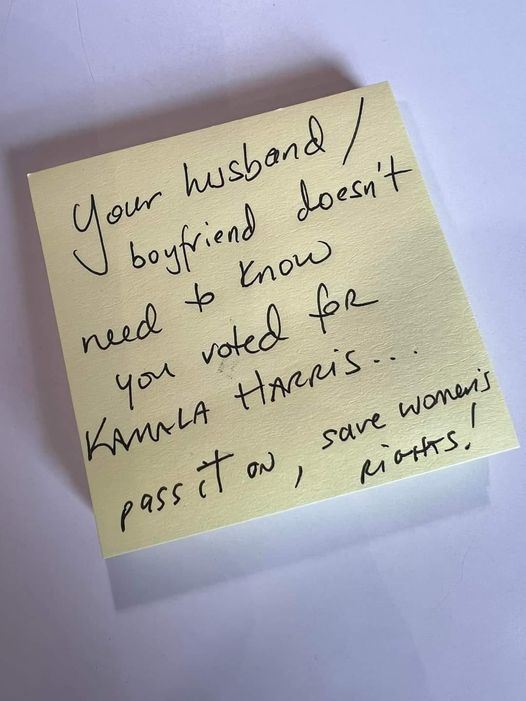
That’s why the post-it note campaign, reminding women that their vote is private, via a little fluorescent square in a public or business restroom, moved me to near-tears.

It’s easy, now, to think that my vote has always been my own, but I’ve lived through eras when women voted as their husbands told them to. My grandmother got to vote, for the first time, in 1924, at the age of 34. I asked her if she remembered who she voted for. She couldn’t, but she did remember asking her younger brother who to vote for.  And she voted for that party for the rest of her life—another 70 years!

This may be the year that women decide to take back our rights.

In the absolute privacy of the voting booth.

How People Vote. How People Choose a “Good” School. Is it Common Sense?

When my son—a Korean adoptee—was in 5th grade, he had a student teacher who was Korean-American. Alex idolized Mr. Thacker, one of the very few Asian faces in our 96% white community. Mr. Thacker took him fishing. When the district hired Mr. Thacker to teach 6th grade, I requested that Alex be placed in Mr. Thacker’s class the following year.

Alex’s 5th grade teacher caught me in the hallway after school, at the end of the year. You know Mr. Thacker is a newbie teacher, she said—and there are some excellent choices among the 6th grade veterans. This will be his first year of teaching. Someday, he’s going to be a great teacher, but…

I’d already had that conversation in my head—and gone with my heart. What mattered most to me was having a great role model. Even if that role model was still filling his instructional toolkit and mastering the curriculum. Kids learn more when they’re seen, acknowledged for who they are.

I think that’s how people vote, as well. When the candidate—for County Commission, Township Supervisor or President—acknowledges YOU and your beliefs, rings your chimes, you’re going to vote for them. Even if they’re racist, traitorous and don’t make a lot of sense.

Some of this is partisan, some mere habit. But driving downstate, along the western Michigan coastline last week, through largely white, economically stressed communities, I was stunned by the number of Trump signs. These are the people who think they were better off when their loved ones were dying from COVID but gas, which OPEC couldn’t get rid of, was $2 a gallon.

A couple days after Trump was elected, in 2016, there was a dust-up in a middle school cafeteria in Royal Oak, Michigan, with kids shouting “Build That Wall.”  It was handled quickly by school personnel, but a video surfaced, and was widely shared by teachers.

Here it comes, we said to each other. Chaos and racism have been set loose.

For anyone who has spent lots of time in a classroom, it’s clear that the attitudes and speech and actions of the wider world (and especially parents) show up– quickly– in the things their children do and say in school.

The campaign to demean public schools and teachers, ongoing since 2016 (and put on steroids in the pages of Project 2025), is reflected in the despicable remarks of the right-wing commentariat. Despicable remarks about Gus Walz and Ella Emhoff—not going to link to those—and top-of-ticket candidates will draw some voters in.  And those remarks will harm kids. Kids in our schools.

It’s easy to label them low-information voters—they are, in fact. But they’re also responding to old beliefs and stereotypes. They’ve been explicitly taught to reject mainstream media and fact-checking. They go with their gut and “their own research,” such as it is.

From a great piece in New Yorker:

Scott, who works in private equity, stuck by his guns… “I think Monica goes directly to sources of information.” This, he suggested, was not the right approach. “Use common sense,” he went on. “Food is much higher now. There’s so many things against restaurants right now.” The Biden-Harris Administration was at fault, he concluded. “They created this.” 

Maybe “common sense” isn’t all that it’s cracked up to be. Or easy to define.

Maybe “common sense” lies in a PR firm’s ability to give people license to embrace their biases, as well as their fantasies: Morning in America.  Boots, not flip-flops.  Make America Great Again.

With the wave of education ‘reform’ that started when Boots-not-Flipflops took office, and tried to recreate the Faux Texas Miracle nationally, lots of people who should have known better got on board. Tests! That’s the ticket! Now we’ll know how to identify a good school—data!

School choice orgs and spokespersons revved up the charters/vouchers machine. Every child deserves a good school—who could disagree? Not me, certainly.

But as the whole NCLB juggernaut lurched along, many of those reformers were dismayed to notice what choices untrained, garden-variety parents valued: Winning sports teams. Transportation. After-school childcare.  Programming for their kids that didn’t necessarily result in higher test scores, like an orchestra, drama club or robotics.

Maybe people choose schools—or teachers—the same way they vote. With their gut.

I taught school with guys like Tim Walz for more than three decades—the coach who taught Social Studies. Walz, as Jan Ressenger notes in this fine piece, is an unabashed apologist for public education:

What does it mean that after two decades of attacks—first with No Child Left Behind’s branding schools by their test scores as “failing,” and now since 2019, with blaming schools and teachers for school closures during COVID—someone running for Vice President of the United States just casually drops a comment celebrating public schools as America’s great contribution?

My favorite Tim Walz meme, making the rounds right now: This is a real thing that happened: Tim Walz was inducted into the West Mankato HS Sports Hall of Fame. He stuck around after the ceremony to help put the chairs away.

As I said—I know this guy. And thousands like him. The kind of teacher and coach who draws families to the local school, so their kids can have a role model. Someone who sees their kids and acknowledges them for who they are.

For those who think this is low-information, sentimental baloney: Walz, a former public school teacher and football coach in Mankato, Minnesota, draws on his experience as an educator to inform his political persona and policy beliefs, saying in a 2007 interview with Education Week—after he was elected to Congress—that teachers are “more grounded in what people really care about.”

As governor of Minnesota, he acted on that philosophy of caring by pushing for and signing into law a $72 billion state budget in May 2023 that significantly increased funding for the state’s public schools, provided for a new $1,750-per-child tax creditfree college tuition for families earning less than $80,000 per year, funding for free school meals for K-12 students statewide, and paid sick leave for workers, as well as a paid family and medical leave.

So there’s your policy.

As for Mr. Thacker? Still teaching. Still taking kids fishing. Still the kind of guy who hangs around and helps put the chairs away.

Hysterical Women

Truth nugget: Education policy is 100% shaped and impacted by the fact that three-quarters of the education workforce is female.

Another truth nugget: After Trump was elected in 2016, over a million women descended on Washington DC to march against what he stood for.

And now, after the events of Summer 2024? Well, do your own math, draw your own conclusions. Maybe start your own organization and host a national call.

As the inimitable Dahlia Lithwick noted: The court granted itself the imperial authority to confer upon the president powers of a king, but although Justices Sonia Sotomayor and Ketanji Brown Jackson said as much in their respective dissents, it fell to Big Daddy Chief Justice Roberts to intone to his readers that their aggregated dissents strike “a tone of chilling doom that is wholly disproportionate to what the Court actually does today.” Implying that the dissenters were overreacting, and without ever attempting to address the substance of their claims, Roberts accused them of “fear mongering on the basis of extreme hypotheticals about a future where the President ‘feels empowered to violate federal criminal law.’”

In other words, sit down ladies. You’re hysterical. We don’t appreciate your chilling doom or your extreme hypotheticals. A President who feels empowered to violate federal law? Hahaha! That could never happen!

This type of response could come in handy for pacifying those whose policy/practice wheelhouse is education. It’s a familiar tone policing strategy for those of us whose professional lives revolve around the classroom, especially in public schools. You’re overreacting! It’s only bus duty! What’s one more kid in your class? Why can’t you maintain control over 24 second graders on Zoom?

But. What if women were united to push the ed policy envelope?   Connie Schultz, wife of the SENIOR Senator from Ohio, Sherrod Brown, has some wise words about what happens when women organize: I know that something else—something glorious—often happens when women gather for a cause. I think of it as coming home.

More wise words, these from Kate Manne:

Many of you are now in the same position I am in: all in for Harris as the person who can beat Trump and head off the incalculable threat facing our country. We are terrified as/for girls, women, and any person who can get pregnant. We are terrified as/for the racially marginalized people who Trump has firmly in his sightlines. We are terrified for trans and queer folks who would face existential threats to their well-being and very existence under the next Trump administration. We are terrified for whatever semblance of democracy that remains and might perhaps be rebuilt. The list goes on. There is no question that Harris’s candidacy will open up a torrent of misogynoir, the intersection of misogyny and racism (particularly anti-Black racism, although Harris is also of course South Asian). It’s our job to fight it in our circles and even ourselves.

Do women have the power to transform thinking about the bedrock value of a strong public education system, in the face of Project 2025? Just a reminder:

Trump tells voters on his campaign site a few ways he would manage education:

  • Cut federal funding for schools that are “pushing critical race theory or gender ideology on our children” and open civil rights investigations into them for race-based discrimination.
  • End access for trans youth to sports.
  • Create a body that will certify teachers who “embrace patriotic values”.
  • Reward districts that get rid of teacher tenure.
  • Adopt a parents’ bill of rights.
  • Implement direct elections of school principals by parents.

That last suggestion is sheer folly, by the way —any teacher OR school administrator will tell you that it’s a recipe for never-ending chaos and enmity in schools. Besides, parents can run for the local School Board or elect people to that Board who will select appropriate school leaders for the community. I personally have seen, on multiple occasions, a group of parents make things hot for a principal, via a democratic process involving their elected board. I have also seen good administrators protected—by the same Board—from a single outraged, vindictive parent.

Kate Manne is right when she says we need to fight bad policy and reprehensible candidates “in our circles” and even in our selves. And nobody is going to fight against misogyny and racism more effectively than the people who are impacted. Therefore, protecting your public school may be most effectively accomplished by women, gathering for a cause.

Don’t want public education to be taken down by the slings and arrows of Moms4Liberty and Project 2025? Talk to your friends. Put up a sign. Donate. Volunteer. Organize in Zoom circles. Repeat vigorously for the next 82 days.

Derek Thompson of The Atlantic points out, in a revealing column that …parties aren’t remotely united by gender. After all, millions of women will vote for Trump this year. But the parties are sharply divided by their cultural attitudes toward gender roles and the experience of being a man or woman in America. When the VOTER Survey asked participants how society treats, or ought to treat, men and women, the gender gap exploded. Sixty-one percent of Democrats said women face “a lot” or “a great deal” of discrimination while only 19 percent of Republicans said so. In this case, the gender-attitude gap was more than six times larger than the more commonly discussed gender gap.

With a majority-female workforce, change will come only when women demand policy that invests in public education. Women teachers, often working mothers, value tenure. Women teachers do not want mandated certification of their “patriotic values.” And they don’t want a President or Congress that embraces the horror show of Project 2025, especially when it comes to education.

Reminder: The Chief Justice of the Supreme Court called his female colleagues “fear-mongers, on the basis of extreme hypotheticals.” In writing.

 Welcome to the Three-month Campaign! Seriously. Welcome.

More than four years ago, in April 2020, I wrote this ridiculously optimistic piece: A Dozen Good Things that Could (Just Maybe) Happen as a Result of this Pandemic.

Every now and then, I pull it up, shaking my head over the concept that an unprecedented global pandemic could shake loose great ideas and get folks to—tick-tock!—act on them, a kind of “if you only had six months to live…” scenario for the nation.

In my own defense, I had barely been out of the house for weeks and had been fixated on the horrifying numbers and clown-show daily ‘briefings’ from the White House. Doom-scrolling and baking aren’t conducive to embracing political realities.

I still think they were good, actionable options for change, however. Where I was totally wrong: the communal lessons that might be learned from surviving a pandemic, together. In fact, I was most wrong about the “together” part, which never really got a toehold, even as the virus took its terrible toll.

Some of us are uniters. And some are dividers. Lately, the dividers have been winning.

Response to the blog could be summarized as: I wish. People wished that the pandemic would lead to better health care, better air and water quality, renewed friendships. But they didn’t see even a global catastrophe moving the needle here in the land of the brave. The one good thing that came from the pandemic where I live? A third of my county finally got the internet.

In April of 2020, Joe Biden had just been named the presumptive nominee for President. In the previous ten months, we’d been exposed to 11 debates, with so many candidates (20) that they were sometimes split into two groups, debating on different nights. It seemed pretty clear that a full year and a half of campaigning did nobody (except perhaps the 2020 incumbent) any good.

Here’s what I wrote, in April of 2020:

How about a complete re-do of American elections?  For once, the hype is true: this election matters more than any in your lifetime. If the Democrats hang tough (and they should), we might get national mail-in voting with other policies that make registration and voting easier for the November election. Americans overwhelmingly want this.

There could be even more, given a Democratic Congress and Executive branch in the fall. We could jettison or alter the Electoral College.  We could also pass a law limiting the presidential primary, given the headaches, unnecessary spending and ultimate results we got. Canada, our closest and most similar neighbor, elected its last prime minister in eleven weeks.

Thought experiment: Imagine that Congress passed a law limiting primaries to six months, still way longer than other first-world nations, and set a national primary date with top-three, rank-order voting. That would mean campaigning for November 2020 would begin next month! Knowing what we know now about the world—would debates be about more than the horse race and which state votes first and gotcha questions? If we overturned Citizens United, and set spending limits (again, like other nations), we might ultimately get ourselves a reasonable set of qualified candidates and a fair election.

Am I glad Joe Biden eventually prevailed in 2020? Absolutely. And I agree with all the commentary about his successful presidency and heroic decision to stand down.

But I am flat-out amazed at what has happened in the past week, with so little primary-like fuss and fanfare, soundbites, rallies and pounced-on gaffes. And I can’t help wondering why we haven’t shut down the perpetual campaign machine in favor of limiting the time and money spent, given the results we get. Is this about the media and revenue streams?

I wish I had a dollar for every time someone complained about TV ads, mailings, yard signs and repellent messaging. And if I had a dollar for every voter who didn’t pay attention to politics, I’d be in the Forbes 500.

The three-month campaign ahead of us feels positively refreshing. It will be intense—it should be—but it will be over soon. Michigan voters can send in their ballots 40 days before November 5th. The end of September.

There’s been some talk about how risky the Harris candidacy is, floating the possibility of a mini-primary or reasons to re-think promoting the Vice President. But I think Rebecca Traister gets this exactly right in this column: The Case for Being Unburdened by What Has Been. The thrill of taking a huge risk on Kamala Harris.

 Our national political narrative [is] finally accurately mirroring our national reality: Everything is scary, we have never been here before, we don’t know if we can do this, and precisely because these stakes are so high, we are at last going to act like it, by taking unprecedented, untested, under-polled, creative measures to change, grow and fight at a pitch that meets the gravity of the urgent, existentially important task in front of us.

The word I like most here is “urgent.”  Things can go wrong with a long, leisurely primary season where a party eventually settles on just the right candidate. (See: 2016.) They’ve gone wrong in any number of elections, convention or primary, over two centuries plus. Sometimes, making a good-faith choice and jumping off the electoral cliff works out.

In the meantime, listen to Keb Mo. He’s got the right idea.

Critical Issues and Minutiae of Public Education

I have been fascinated, in the past 48 hours, by online conversations about the tumultuous political week we have just lived through—especially the comments and questions generated by teachers.

Non-teachers are heartbroken or thrilled or both, by the Biden step-down. They’re nosing out the negative PR and potential VP picks of the presumptive new nominee. There are running threads and analyses around the assassination attempt, a mass shooting where everyone knew the intended (again, presumptive) target, a change from the faceless victims—many children, damn it—of other mass shootings.

So much is in flux. So many building blocks of democracy, teetering on the edge. Including public education.

But we’re approaching (in many parts of the country) the beginning of the school year. Much of the ongoing cyber-conversation around public education centers on clearing back-to-school lists (i.e., teachers begging for essential supplies the school can’t afford), the futility of professional development for yet another silver-bullet reading program, why teachers aren’t paid for setting up their classrooms and other garden-variety School Stuff. The kinds of issues and beefs we see annually.

There are a hundred things that weigh heavily on teachers’ minds as they prepare for another year. What I’m wondering is if teachers are focused on the trees, rather than the destruction of the public education forest. Because focusing on bulletin boards and class lists instead of the section of Project 2025 that deals with education feels do-able, not overwhelming. Or terrifying.

Washington Post advice columnist Carolyn Hax posted a letter about a “rude” teacher who created individual certificates for each of her students at the end of the year. The mother who wrote the letter was upset that individual kids were nicknamed Class Clown and Social Butterfly and–gasp!–her daughter was designated “Miss Manners.” So upset that she reported her ire to the superintendent, after the principal gently suggested these certificates were warm-hearted, not criticisms of children’s character.

Aside from the fact that many parents would be delighted or relieved were their child awarded recognition for having excellent manners—the letter bothered me way more than it should have. Because I have been that teacher, striving at the end of the year to recognize and acknowledge students’ achievements, but also their individual quirks, their signature traits, their contribution to the musical community we built.

Hax rightfully chides the mom for attacking a well-meaning second grade teacher, on the last day of school, no less. But what most folks—non-teachers—will miss is that the success of any teacher, broadly defined, lies in building honest relationships with kids who bring varying intellectual and emotional strengths to school.

Not everyone is an academic superstar or natural helper. Many students will need to be coaxed or cajoled into effort, participation and belonging. Those skills are just as important as content expertise, a full toolbag of instructional techniques and endlessly logged data.

My own end-of-year awards included every band kid. Now—decades later—I still hear from students who remember the last full day of school (after the instruments were all oiled and stored for the summer, the music sorted and filed, and the sink—yuck—cleaned and shiny): The thank-yous. The in-jokes for band members. The Jolly Ranchers. The camaraderie. I recently heard from a woman who remembered winning the “Most Improved Section” award—and she was the only oboe. She included a smiley face.

The Hax column drew hundreds of responses from teachers.

Today, I have been watching teachers on social media saying:  Be kind to the social studies teachers in your building. We’ll be working on overdrive!

Well, yes. You go, teachers. The world is on fire, and your job is to pretend that the only thing that matters is following the prescribed curriculum and keeping your head down in the classroom. We get it—and we love and support you.

But as we launch 2024-25, it is incumbent upon all of us whose livelihoods are not threatened by free speech to keep education policy and the very real threat to public education bubbling up every day on social media and in our friend groups.

 It’s been a wild couple of weeks. But keep your eyes on both the threat and the prize.