
Tough Talk

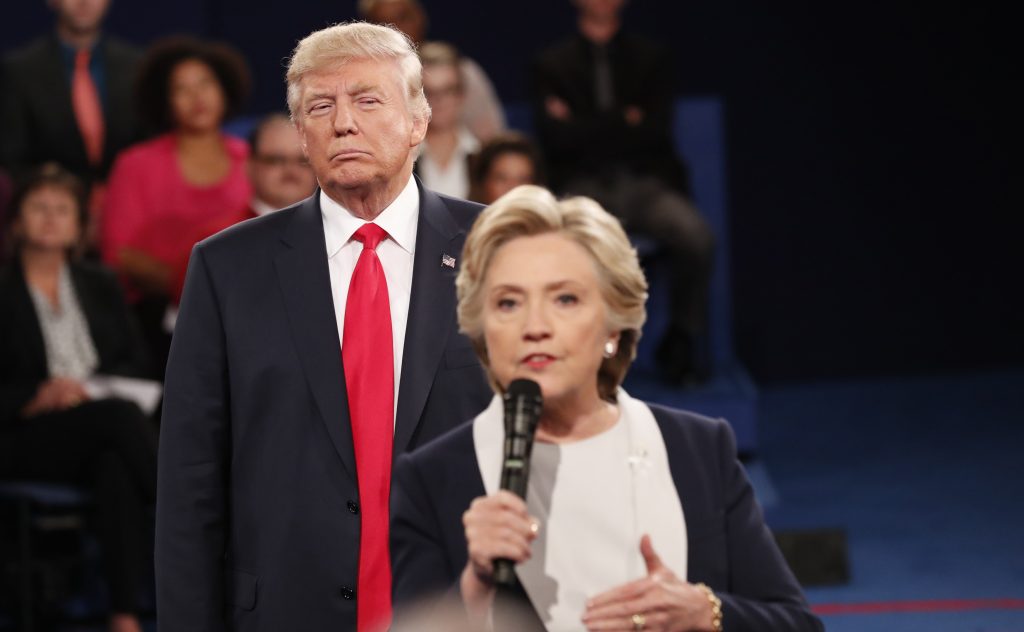
Scroll back with me to the presidential campaign of 2016, the so-called debates between the best qualified candidate ever to run for president, Hillary Clinton, and Biff Tannen You Know Who. Even with a decade of unprecedented political chaos intervening, those debates are memorable.

I thought I was watching Clinton destroy Trump, for varying reasons, in the first debate. She was prepared and articulate; he was a bully. He claimed she didn’t have the “stamina” to be president, and that not paying taxes made him smart. He did not follow the rules of debate, demanding more time and shouting over Clinton. I was convinced that she mopped the floor with him.

But it turned out that a lot of people found him purposeful. Or something. Remember all the Trump voters who love him because he “says what he thinks?”

An informal CNBC poll on its website found that 61% of people thought that Mr Trump won while 39% went for Mrs Clinton, but as CNBC itself points out, the poll is not scientific. A post-debate survey by Public Policy Polling of 1,002 debate-watchers found that 51% of national voters thought Mrs Clinton had won, with 40% choosing Mr Trump and 9% undecided.

There were two more debates, including a town hall format where Trump followed Mrs. Clinton around the stage, stalker-like, and the one exactly ten years ago where Hillary aptly pointed out that Putin preferred to have a puppet like Trump running the country and he snarled over her (again): You’re the puppet! You’re the puppet!

He also called her a nasty woman, and interrupted her three times as often as she broke into his answers. There was pundit talk of “male dominance.” And large percentages of viewers declared him the winner—not only of televised debates, but ultimately, at the polls.

Tough talk—name-calling, insinuations, intimidation, rudeness, shouting, domination, misleading statements bleeding into vicious lies. Why do we admire the aggressive blowhard? And what are we teaching our kids to emulate?

As a person whose entire professional career was driven by the goal of building cooperative communities of students, this is distressing to me. Of course, my secondary students had conflicts—talk to me about color guard spats at band camp sometime—but using civil language and considering the feelings of people in your chosen group, the band, were touchstones.

And civil language begins with leadership—teachers modeling both thoughtful disagreement and problem-solving. If the band director is always yelling at the kids, eventually they’re going to yell back. Then quit.

‘Former President Bill Clinton famously warned fellow Democrats that voters prefer “strong and wrong” over “weak but right.” His point was that tough talk resonates so powerfully among voters — especially low-information independents and moderates with weak ties to either major party — that strength can mask and even compensate for bad policies or poor governance.

Clinton’s mantra was a thinly veiled reference to George W. Bush’s governing failures, yet his warning is even more applicable during the Trump era.’

Remember “Boots vs. Flip-flops”—George Dubya cuttin’ brush in Crawford, Texas, while John Kerry went windsurfing? Which was supposed to prove that fumble-tongued Bush was a real man? When you look at the attack ads on James Talarico, nothing seems to have changed in TX, in the strong-and-wrong category.

It’s hard to even consider Vivek Ramaswamy’s ads against Amy Acton as ‘tough talk.’ They’re evil, abhorrent and socially damaging. And false, too—but remember that strong and wrong works on low-information voters. And we’ve certainly got plenty of those.

Pause.

So—after all my high-minded blah-blah about odious tough talk, and building community, I come here to confess my joy at seeing Democrats—finally—clapping back.

Barack Obama, tonight, speaking here in Michigan: “That well-known evil empire Canada. That historical adversary of ours. Canada! *laughs* It’s your neighbor. It’s a few minutes’ drive over the bridge! These are the people who gave us Martin Short and maple syrup. They are the nicest people! And somehow we’ve gotten them so mad.”

Obama’s genius is being funny while telling pointed truths. But there are other Democrats who have stepped out—using humor, but also biting accusation, righteous anger and verbal snark. In fact, I started a list, last year, when Gavin Newsom (or more likely, Gavin Newsom’s creative college intern) was mocking Trump’s words and actions, on Twitter and Bluesky, to hilarious effect.

Every time I saw an articulate elected Democrat call out the current administration with clear language—“travel with Natalie”—I tried to write their name down. Bonus points for verbal and pictorial humor. More bonus points for acting like a leader.

I look at the list frequently (it’s up to two pages now), to see who is still talking, being quoted and grabbing attention (in an attention economy). Your mileage may vary, of course, but keeping a list of democracy defenders has been instructive for me.

This isn’t a horse-race evaluation for 2028.  Who knows what the next two years will hold? But we do need to look for leadership—for the candidates and elected officials who will fearlessly describe the mess we’re in. And talk tough about what needs doing.

Who is both strong and right? And who will pursue justice, decency and order?
Does it Matter What Other Nations Think of Us? Why?

Here’s something I might ask middle school and high school students:

What do we, as Americans, think about other countries? Suppose I asked you, right now, what you think about, say, Germany? Or Nigeria? Or Thailand? Are there better countries and not-good countries? How do we judge? Where do we get our information?

And further—what do other countries think of us? Why?

On the question of what people in other countries think of Americans:

Two weeks ago, we were in Lisbon. On our last night, we went to the top floor of our hotel to see the city spread out below us, red tile roofs and undulating hills. Only one of the six elevators in the hotel went all the way up to the Skydeck, so we had to wait several minutes for the elevator to come to take us back down. One other person — an attractive 50-ish woman— was also waiting.

Hearing us talk, she turned to us and said ‘Where ya from?’

Assuming from her accent that she was also American, we said ‘Michigan. And you?’

I’m Canadian, she said. And I want to know—do you approve of your president? Because he’s ruined my life.

She said her husband was in the oil and gas industry and tariffs had caused their business to wobble, then fail. They built a new house (for more than two million dollars) and could no longer afford the payments. She was about to lose her new dream home. She was angry, and got angrier as she talked— she would never buy an American product again, never trust an American again, etc.

Finally, she said: Do Americans have ANY idea how much the world hates him— and Americans for voting for him TWICE? I mean, really. It begs belief. We told her we were working hard on flipping Congress in the midterms, and she cut us off, sharply. I don’t care about your midterms, she said. He has to go now. The world can’t afford two more years of his bullshit.

Our elevator arrived, and she refused to get in with us. We kept apologizing. She stood there with her arms folded across her chest and her mouth pinched, shaking her head.

I have thought often about getting into this kind of conversation while traveling, and what I would say, and it all seemed like weak sauce in the moment. Her take was: you’re hurting the rest of the world by accepting him. And it’s YOUR fault for not stopping him. Immediately. Waiting two years for an election that may or may not happen is just an excuse.

We were both rattled by it. We had just come from a lovely dinner, where we ate Portuguese food and drank their awesome wine, and were happy not to turn on the TV or doomscroll the evening away. We had the means to take a vacation from the daily chaos of life during the Trump administration. We have not been threatened by ICE or lost our Medicare.

Canada is—or was—Michigan’s largest trading partner. Most Michiganders don’t perceive Canada as a ‘foreign’ country. I have friends who teach in Detroit but live in Windsor. Last year, there were joint protests with people waving signs at each other, across the Detroit River.

Most of the folks we met in Portugal and Spain were polite and friendly and willing to discuss anything. On one English-speaking tour, an American asked our guide about Portuguese politics.

He gave us a thumbnail sketch, beginning with Prime Minister/Dictator Salazar (1932-1968) and the three largest parties jockeying for power currently: the fascists, the socialists, the democratic socialists. He expressed worry that fascism was growing across Europe and relief that the democratic socialists had just returned to power in Portugal. His use of the phrase ‘democratic socialists’ caused some Americans in our group to gasp, however.

All of this made me wonder: If a European visitor to the United States asked a guide about our politics, what would he say? Where do we learn about the goals and aims of political parties? We talk about civic engagement—but what about accurate information?

When the current administration is hawking public school educators to ensure they don’t discuss politics—and 59% of Americans get their political information from social media—how are Americans supposed to understand how the world sees them?

Just asking.

Rossio Square, Lisbon. My photo.

Information vs. Knowledge vs. Application

Let me cut to the chase: You should read Peter Greene’s piece, Teachers Should Know Stuff, if you’re involved in education in any way. Actually, you should subscribe and read all his work, because there is no more articulate observer-explainer of what actually happens in classrooms in American public schools. Plus, he’s funny, in a not-trying-too-hard way.

And teaching school is funny, in addition to being personally rewarding, critical to the health of democracy, and much harder and more intellectually complex than most people think. It’s an intrinsically human job, one that requires adaptability and a sense of humor.

Greene’s piece walks us through any number of Big Questions around modern pedagogy, including teacher preparation (good v. bad), the crushing impact of standardized testing on actual learning, and the vital importance of context expertise. He tosses in a few bits about the fallacy of believing AI is having a positive impact on learning, and the test-driven focus on Skills That Can be Measured vs. Concepts That Students Understand and can apply to their worldview and actual lives.

And he’s right. Teachers have to have deep content knowledge.

I can’t tell you how often, in my own 32 years of classroom practice, I was the Sage on the Stage, rather than the Guide on the Side. Happily, and correctly, so.

I was, after all, the best musician in the room, the person who knew how to shape a musical phrase, how to execute a dotted eighth-sixteenth pattern in various musical styles, and how to illustrate fingering options for an in-tune high F# on the flute. Plus buckets full of other musical and technical knowledge that my students needed to make a piece of music come alive, the whole point of being in band class.

I knew stuff. Things that could be demonstrated. Things that a method book or even a video could never explain. I could lead a lively discussion on how ragtime led to swing led to cool jazz and how the rhythms driving the music my students listened to were born in other places and spread by (voluntary and involuntary) immigration.  

Every year that I taught, I knew more stuff. I remained curious about better ways to teach what I knew—both the technical skills as well as the impact of music on American culture and human relationships.

I also—and this is important—spent time thinking about what my students were taking away from my class (besides the actual location of 5th position on the trombone), into adulthood. I’ve met plenty of younger teachers whose own K-12 experiences and college training have left them believing that we can actually measure useful learning in real time, via computer-delivered tests, and that’s our job.

Not so. We can measure short-term retention of skills and bits of information. But the thing about knowledge is that it is applicable and adaptable. It’s not embedded knowledge unless it’s useful to you in some way, over time. It’s just information, to remember or regurgitate, or not.

In addition to teaching band, choir and general music, I also spent two years teaching 7th grade math, one of the places where teachers were encouraged to be guides on the side, facilitating problem-solving using the algorithmic skills students had been taught to replicate.

I can still hear my students’ dismayed voices as they turned the page and saw (dunh dunh duh)… story problems! We were using a constructivist math curriculum, and I also heard from parents on the regular about how they couldn’t help their kids with word-based problems. (Usually because they “weren’t good at math.”)

But word problems ask students to apply the skills we all (sort of) learned. They are about the usefulness of math. Teaching students how to analyze what a word problem is asking them to do is way more difficult than having them replicate an algorithm.

And putting them in small groups to struggle with that process is not likely to yield knowledge, no matter how many facilitating questions you ask. It’s a time-intensive process, nudging them along. Good math teachers (and I wasn’t particularly good) need to know how to turn information plus skills into useful knowledge.

Worth noting: Repeated testing, scripted curricula and pacing charts–the central tools of standardization– often get in the way of developing useful knowledge, the stuff that 7th graders will still be using when they’re in their 40s.

I used to have a principal who, at every staff meeting and public event, would identify himself as the “lead learner” in our school. It was a private joke among the faculty that he found the phrase in some textbook for school administrators and kept repeating it because it seemed cool. In fact, he had a limited vision for student learning, centered around data, rather than enthusiasm, imagination or even the utility of what we were teaching.

 Peter Greene is right: Teachers need to know stuff, especially in an era where information is suspect, misleading and paywalled. When teachers are not seen as experts—or don’t see themselves as experts—we’re in trouble.

Defining the Future We Want

I was recently contacted by a group of civic-minded folks working on a project through one of those nonprofits you’d be keen to believe can actually change the world. Fund MI Future is a joint effort of nonpartisan community organizations, unions of working people, and policy experts striving to create shared prosperity for all Michiganders by fully and fairly funding our public services like schools, roads, access to care, and clean water.

What’s not to love, right?

This particular initiative is called “It Takes a Millage–Getting local campaigns to pass” and the bright and articulate voices in our Zoom meeting wanted to know how to engender support for schools and other public essentials, like libraries and parks. How could we build campaigns that gave citizens a voice in improving their own communities?

I wish I had a scrapbook of victories to share, stories where clusters of vocal citizens used the power of organizing, sharing information, then voting to better fund schools. But no.

In my long career as a public school teacher, I’ve been a part of at least two dozen campaigns to improve schools via taxation—millages to build much-needed new buildings or playgrounds, millages to support programming that the community wants or already loves. I’ve done school open houses, phone banking, and door knocking with other teachers to spread the word about what that extra $138/year would yield for kids in our community. Not to mention meeting with other districts who had successfully run school millage elections to figure out what their secret sauce was.

Spoiler alert: there is no sure-fire way to build support for something that benefits the community in general, including necessities like emergency services and fire-fighting. School districts that routinely pass millages don’t have a winning formula that they roll out at each election. What they do have is consistently good leadership and a sense of community: It’s our school. We like it here. Voting yes is good for kids and for long-term property values.

People’s willingness to spend a little more money on common benefits largely depends, I think, on how they’re feeling about their life circumstances and prospects at the moment. And in 2026, I’m not sensing a lot of confidence in current leadership or optimism about America’s future. And that hopelessness… trickles down. So to speak.

My new friends in the “It Takes a Millage” (smiling) campaign were not put off by my gloomy memories, however. They were looking for stories about times when The People decided to create their own future, piece by electoral piece. And those stories are out there—communities like mine, for example, that tax themselves to fund installation and pickup of bins for recycling. Zohran Mamdani is currently running a masterclass in providing community services and cohesion, in New York City. It can be done.

Again—it takes leadership. But also a vision of what we want—how we could improve our personal futures, as well as our neighbors’, in the places we live and work. If we want to use our collective power to make [Your Town Here] a better place, what does that look like, precisely?

Subhead from a recent piece by Jennifer Berkshire: The left has no vision for public schools – and that’s a big problem. (It’s an awesome piece.)

Berkshire is thinking about the lack of attention to public education in the current political discourse. The Right has “choice,” culture war memes, and the dismantling of public education via various means and narratives.

But who’s championing positive, future-focused change and equity in K-12 schools?

Which is why I found the idea of local initiatives, locally funded, so appealing.

I’ve had enough experience in education funding to know that, when it comes to schools, Americans are often welded to two ideas. Neither of them is particularly honorable:

  • It’s my money and I don’t want to share it with my community
  • I don’t want my children to go to school with “them” (whoever your own personal “them” is)

If we want a better future for our schools—and our parks, roads, libraries and public clinics—we need to build support for common goals. And we need to clearly define those goals for a better future.

What changes would you vote for, to improve your local schools?