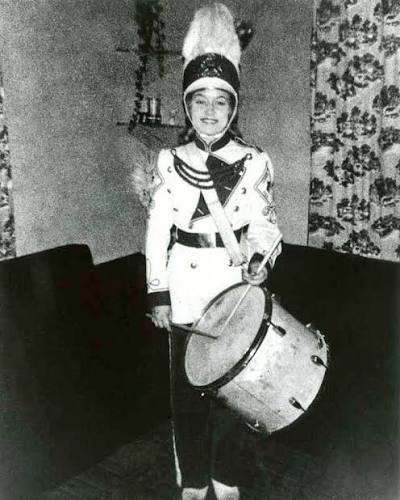
I can’t add anything to the outpouring of love and respect for Dolly Parton. She was phenomenal, in dozens of ways. As a musician, I appreciate her melodic genius and as a writer, I admire her gift for lyrical story-telling and poignancy. But what I’ve loved most, this week, is that black and white of photo of Dolly Parton, class of 1964, in her Sevier HS band uniform.
But when we think about the roots of a spectacular career in the arts—they all started somewhere, and Dolly’s did not spring from early identification of extraordinary talent, private lessons or expensive summer camps. They started at home, and were burnished at her garden-variety TN public school.
My personal children played in the band (percussion and trombone)—and both of them expressed impatience with my barely suppressed opinion that band kids were a breed apart. Several of their good-kid friends weren’t in the band—and they could both point, accurately, to some band kids who were not, in school vernacular, good citizens.
However. I built my professional career, and my life before and after that career, on what I learned as a school-aged musician—in band, and choir and youth symphony. School music programs literally sent me to college, the first in my family.
They gave me the skills to offer my services on Saturdays at a community center, as a teenager, giving private flute lessons and earning pocket money. My music teachers—in an ordinary blue-collar public school district—steered me toward scholarships at several levels, membership in the local professional wind ensemble, and opportunities to perform in public (which is one of the big benefits of playing in a school band, BTW—dealing with performance nerves and understanding the necessity of rehearsal).
Band kids sometimes face derision from their peers, especially in schools where instrumental music is low on the coolness totem pole. It takes some maturity to get past the name-calling, and that maturity develops on a continuum, assisted by parents and other adults in a student’s life.
Doing things for pleasure, building a community of friends, developing your own opinions—these are adulting skills. The band room can become a home for kids, the place at school where you can hang for hours (and dump your belongings and snack wrappers everywhere, driving your band teacher crazy). Simultaneously, these kids are being challenged to learn complex musical literature and skills, express powerful emotions, entertain their peers and work as a team, with every member’s contribution being important.
And it’s not easy! A couple of years ago, I was contacted by one of my former school administrators. As a retiree, he had decided to learn to play the guitar. He bought a guitar and started taking lessons. And it was frustratingly difficult.
He said that he always assumed learning to play a musical instrument was easy. After all, sixth graders in his building started band in September (in classes of 60 students) and put on a concert in December. How hard could it be?
As satisfying as that was to hear, what matters even more is the number of middle school band kids who push through the difficulty and experience the reward of performing together. That’s the real lesson.
As a middle school teacher, I spent a fair amount of time talking with kids—mostly 8th graders, going into high school—about what you might call their life plans. Were they thinking about college? Or the workforce? What should they focus on, as they reached the last phase of their free public schooling?
Most of the kids I taught were going to college—their (white, suburban) parents were planning on it. But very few kids in the 8th grade are settled on a career—and if they are, it often turns out to be the Wrong Thing.
More and more before I retired, my students (mostly boys) talked about wanting to be a billionaire. Didn’t seem to matter much how they got the money—professional sports or inventing a killer app, whatever. What was important was having a lot of money. To spend on cool things.
I have to believe that this desire to be rich has not abated among adolescents, given their current role models in Congress and the White House. It’s no secret that Americans admire the rich and famous, assuming they deserve their power. A look at the accrued wealth of US Senators will confirm: money gets people into office.
One would assume that in a time of rapidly rising prices, informed citizens—yup, the kids I had a hand in teaching—would understand that wealth inequality is driving many of our most egregious economic problems.
They’re grown up now. They understand that there are more important values than being filthy rich, right? Do they know that hoarding enormous wealth is not something to be admired?
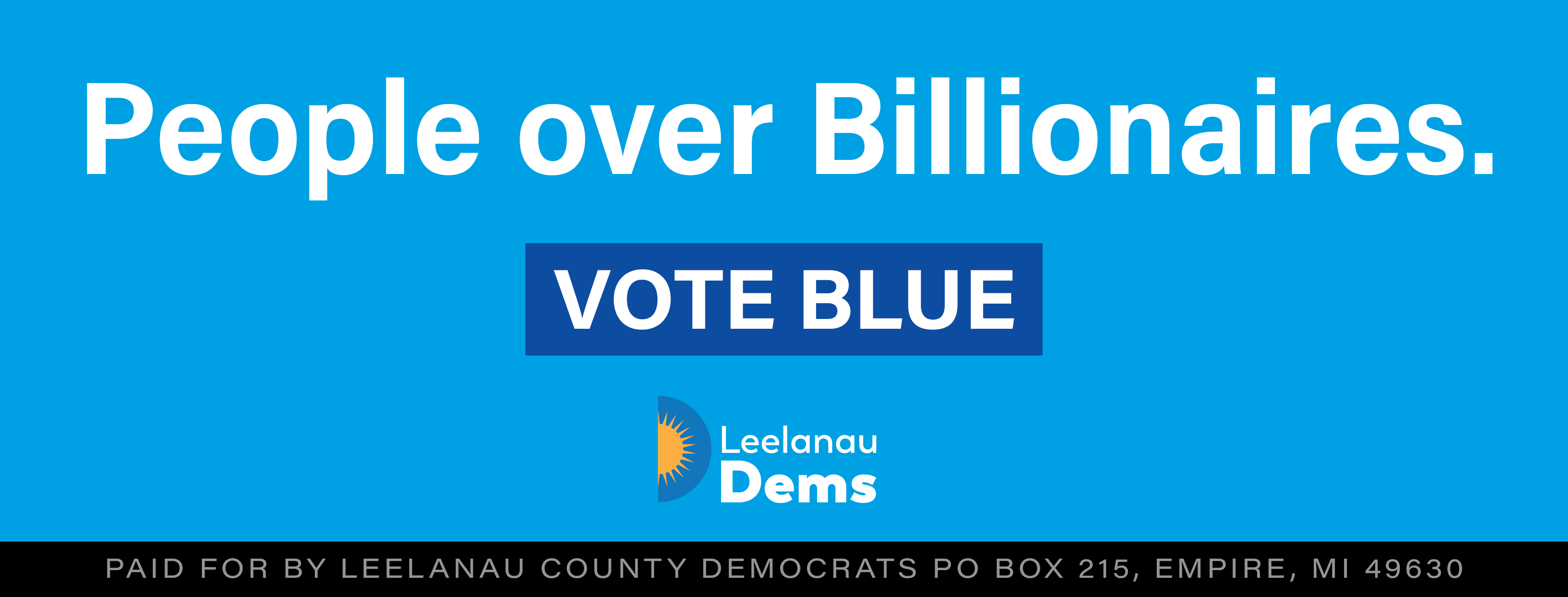
Recently, a billboard went up on a well-traveled county intersection, here in NW Michigan. People Over Billionaires, it said. Vote Blue.
And it started a furious local conversation around just what it meant–always the sign of an effective message. There were letters to the editor claiming that billionaires paid more than their share of taxes (!) and “gave back” to the community. (Spoiler: not true.)
Billionaires were our most productive citizens, the letters said–and we needed to respect them! There were also letters that pointed out, in much calmer and more elegant language than I’m using, that this thinking was pure bullshit.
I was kind of stunned by this—who thinks billionaires are rooting for the little people to enjoy better, publicly supported lives? Elon Musk? Jeff Bezos? Larry Ellison? The Waltons? One could go on and on. The word oligarchy might be used.
Last week, there was a widely shared cartoon floating around social media: An elderly gentleman is pushing a grocery cart. He says: ‘Tell me I’m wrong, but a country isn’t doing well if seniors can’t afford groceries, after working their whole lives.’
Seemed like a straightforward critique of steady inflation, to me, without getting into the weeds about tariffs or the national debt. I get groceries, like most Americans, and I know that prices have gone up significantly, and folks of both political persuasions on fixed incomes are hurting, on several fronts. But the comments were weird.
Leaving aside the usual flotilla of “you dumocrat libtards” remarks and obvious bot observations, there were dozens of people who claimed that they hadn’t found prices going up at all. Lots of accusations about greedy seniors wanting “free stuff” and spending younger generations’ money. Imagine having 45 years to save for retirement, then not doing so. Lazy!
Well, gee. Imagine going after the folks who built the middle-class economy, rather than the ones who destroyed it.
There’s been occasional talk, especially from those who study our history, about current parallels with the Gilded Age, c. 1870–1913. Trump frequently idealizes the late 19th century as America’s economic high point, especially embracing control of the economy with tariffs. Nobody in the Trump administration talks about soaring wealth inequality, dangerous corporate influence, or rampant corruption.
What gave people the idea that a plutocracy was a viable, even desirable, way to run the United States?
A couple days ago, Heather Cox Richardson had an excellent daily letter about the manifestations of wealth inequality—lack of accessible health care, loosening of regulations to benefit the very rich, etc. As she often does, she shared an historical publication that illuminates issues we are facing today: In 1883, sociologist William Graham Sumner published ‘What Social Classes Owe to Each Other,’ concluding that the answer was: nothing.
“Sumner called for a “laissez-faire” world in which those who failed should be permitted to sink into poverty and die to keep the U.S. from becoming a place where lazy people wanted a handout. In the end, such people needed to be purged from society for the good of the nation.
At the time, those succeeding in the industrializing economy nodded along with Sumner. The Republican New York Times editor wrote that even though Sumner’s “views are singularly hard and uncompromising, it is difficult to quarrel with their deductions, however one may feel one’s finer instinct hurt by their apparent cruelty.”
Apparent cruelty is what I found reading Project 2025, which has lots of–updated–language like Sumner’s.
But in the end, what will save us as a functional democracy is… people over billionaires. Right?
I am a National Board Certified Teacher. The National Board for Professional Teaching Standards (NBPTS) influenced a big chunk of my professional life and practice, and I remain—pretty much—a fan.
The founding ideas around the creation of an assessment that identified accomplished teaching drew me in, back in the mid-90s. I wasn’t sure, back then, that there could ever be a valid, reliable way to evaluate quality—or inadequate—teaching. I thought it was like Supreme Court Justice Potter Stewart’s remark about hard-core pornography: I know it when I see it.
Remember—this was before NCLB, and the advent of mandated testing for all public school children, beginning in the third grade. Some states (mine, for example) had been using statewide assessments for years, but nobody was talking about identifying or comparing teacher effectiveness by their students’ test scores– a ridiculous thought, given all the variables.
I was intrigued by the NBPTS process, and signed up to sit for certification as an Early Adolescence Generalist, paying my own fee ($2500, if I remember correctly) and (kind of recklessly) jumping in. The National Board, in 1995, did not offer an assessment for music teachers, so I decided to teach my 300 middle school band students ‘generalist’ lessons in math, language arts, science and social studies. I would NEVER recommend this, knowing what I learned, but I scored well and became a National Board Certified Teacher (NBCT).
Most people, including ed policy experts, university educators and teachers who have not experienced certification do not fully understand the National Board process (although many think they do). It’s difficult to explain, especially to educators and researchers whose entire careers have been shadowed by our national love affair with standardized testing.
The National Board asks teachers to hold their practice up to a set of teacher-created pedagogical and content-based standards, custom-written for various disciplinary and developmental levels. Teachers then reflect on how well their practice aligns with these standards, using videotapes of lessons, student work products across time and written self-evaluation. They also sit for on-demand examinations of their relevant content knowledge. Candidates’ portfolios and content exams were scored by teachers who taught the same subjects, at the same level.
It’s rigorous, and grueling—and often confusing for teachers who have never been asked the deep questions posed by the process: What is your convincing evidence that Student A understands ____? What misconceptions are evident in Student B’s remarks about ______? What other strategies have you tried to build competence in ________? Why is it important for students to have fluency in ______________? And so on, 12-20 pages for each of multiple portfolio tasks.
Many teachers—myself included—say that going through the National Board process was the best, most useful and personalized, professional development they ever had. I became a true-blue believer in the process. I then worked as a Teacher in Residence for NBPTS for two years and was part of a national team that devised the music assessment.
I was working for the National Board in their Outreach and Teacher Leadership departments when NCLB passed, 25 years ago. You could immediately see how NCLB’s foregrounding standardized testing would clash with the things most valued by the NBPTS principles and standards (again, established by actual teachers, not lawmakers, data-crunchers or education publishers).
The NBPTS standards were built on the idea of teacher expertise—knowing their students deeply, mastery of their subject discipline, possession of a full pedagogical tool bag—and continuous reflection on evidence of what was going well and what needed changing in their day to day practice.
NCLB, on the other hand, put faith in test scores as the only valid means of comparing schools (and, eventually, teachers)–and allocating carrots and sticks. There were lots of new rules to follow: the Highly Qualified Teacher requirements, for example, wiped out my NB certificate (Early Adolescence Generalist) which honored the classic middle-grades teacher who taught all subjects.
NBPTS was in the process of rolling out a number of new certificates, recruiting teachers to sit for certification, and building financial rewards for NBCTs into state policy and local contracts. They were becoming more corporate, changing a number of policies to streamline the business, something they probably needed to do to stay alive in the new political milieu.
One of the things that was proposed: machine scoring of teacher portfolios and/or content exams. NBCTs were adamantly opposed to the very idea. Many NBCTs, having had the positive experience of going through the process, had become scorers (a job only practicing teachers were allowed to do) in the summer. Others became candidate support providers, working with colleagues to examine their practice, building little communities that studied the standards, videotaping each other’s lessons and having productive conversations about teaching and learning.
The thought of saving money by machine-scoring parts of the assessment was a betrayal of the teacher leadership piece of NB certification—helping colleagues to understand and improve their own practice. Who would embrace an assessment that was evaluated by a bot?Not teachers whose work had been fairly judged. The National Board later eliminated their Teacher Leadership department. It was not a money-maker.
I left the National Board when they moved to Washington, DC, and returned to my music classroom, but continued, for a while, to help candidates and do workshops with schools or teacher associations that were interested in the NBPTS process. I have many NBCT friends who still do NB work, in spite of changes to NB certification that were less than teacher-friendly. I am now an outside—albeit informed—observer.
Recently, on a candidate support page, the question of using AI to write portfolio briefs emerged. A candidate had shared a draft analysis of her own teaching to an NBCT, who worried that the piece was so ‘well-written’ that it appeared to be composed by ChatGPT. The NBCT encouraged the candidate to think about ways that might make her writing seem more… human.
Now—writing skill is NOT assessed in the National Board process. Clarity of thought, presentation of believable evidence, convincing analysis of student progress—all of these are important, but smooth prose and impeccable syntax, not so much. I was struck by the idea that someone might think about using AI to write what’s supposed to be one’s own rationale and justification for things done as a teacher. The product could only be incoherent, if grammatically sound, slop.
Even worse—and here we have to, unsurprisingly, travel to Texas—some states are now questioning the National Board’s core contribution to teaching and learning: professional standards.
That’s correct. The NBPTS standards, for all ages and subjects, encourage equity and inclusion of all kids and embrace the diverse range of students taught in American public schools. In Texas, they’re trying to yank the very modest stipends given to TX teachers who have achieved National Board Certification.
Because money talks. Not all states offer a financial reward to NBCTs or contribute to certification fees. And many NBCTs are like me—curious about defining the markers of good teaching, convinced that all kids deserve an accomplished teacher. The money is seldom enough to make the 200-400 hour intensive challenge of certification worthwhile.
In earlier days, NBPTS got a lot of bipartisan support—a way to reward hard-working, demonstrably effective teachers that wasn’t graduate credit hours or seniority. Right to work states were fans of paying a handful of excellent teachers a little more cash, knowing that teachers are capitalists, too.
It’s ironic that it might be right-wing politics and AI that damage a worthwhile endeavor to improve teaching. Or maybe the word is predictable.
And now he wants to be my senator. Again. Meet Mike Rogers.
I spent most of my life and nearly all of my teaching career in Livingston County, Michigan—a ruby-red, rural-turning-suburban area in the ring outside Detroit. My first principal used to refer to our school district as the far edge of white flight—folks with enough resources to move to a bucolic county with lots of land for their ten-acre dream homes, an hour-long commute into the city, and a population that is 94% white and less than 1% Black.
Although I have always identified as a Democrat, I used to vote in the Republican primary, because it was the only way I had some say in who was representing me in local offices and the state legislature. Beginning in 1995, Mike Rogers was my state senator, and later, my representative in Congress. He was, at the time, very much a country club Republican—bland, moderate, uncontroversial and generally well-liked. I never voted for him, but I knew lots of people who did. I also didn’t fear him.
Rogers’ family was well-known in Livingston County. His dad was a public school administrator and football coach, and his mother ran the Chamber of Commerce. One of his brothers was in the state legislature. He won local elections by wide margins, but when he decided to run for Congress, in 2000, squeaked into office by 111 votes. It was redmap gerrymandering that made his subsequent elections ironclad.
Rogers and I lived in the same small town for most of his political career. I used to see him in Meijers and at local events, shaking hands. Once, we were both on a panel at a Chamber of Commerce breakfast where the topic was education policy. Mr. Rogers’ take on education, as a congressman, was that the feds had no business making or even influencing education policy—he was Mr. Local Control. He asked me, his designated foil, what purpose a federal Education Department served.
My answer was two-fold: First, a national Ed Department can serve as center for policy research on best practices and ideas in public education, economies of scale. Why re-invent the wheel in 50 states?
Not Michigan! he scoffed, ignoring the obvious example of Detroit Public Schools, 50 miles down the road, a city that many of his constituents escaped, after the auto industry built enormous wealth on the backs of immigrant laborers. But who cares about children in a city whose resources have been extracted? Not his problem.
After the panel dispersed, Rogers was surrounded by obsequious local businessmen—and I hurried back to my 3rd hour class, which a colleague was generously covering until my return.
In 2015, Mike Rogers decided not to run for Congress anymore. He launched a career in radio—a kind of mild-mannered Rush Limbaugh—and moved to Florida, where he was happily ensconced in Cape Coral for nearly a decade, starting new businesses, and serving as a defense lobbyist and National Security expert for CNN. He occasionally put out feelers to see if there was a possibility of becoming President.
Expect to hear that little bon mot often on the Rogers campaign trail this fall, along with finger-pointing about DEI and the weaponization of empathy. Plus a whole lot of anti-Muslim, free-floating racism.
Remember– Mike Rogers used to present as a country club Republican, hometown boy made good, moderate conservative, ex-FBI, and deficit-cutter.
Mr. Rogers is perfectly willing to do whatever it takes to please The King. In 2024, he bought a tear-down lakeside cottage in Michigan, moved in with his sister-in-law in his old hometown to run his campaign, and started building a new home on the lake. Which could be his Michigan address should he win, but an easy, lucrative place to sell should he lose. No risk, reward either way.
There are lots of reasons to distrust Mike Rogers, beginning with his “go as the wind blows” beliefs and policies (and place of residence). There are lots of Republicans who fall into that camp—Tommy Tuberville springs to mind.
But I keep thinking about that Chamber of Commerce breakfast, where MY sitting congressman didn’t see why children in Michigan deserved equity.