Teachers are Patriots! Who Knew?

The world of education research is replete with studies that feel… unnecessary to folks who have spent their careers in front of K-12 classrooms. Primarily because so much good research is ignored in practice, and so much bad research becomes conventional wisdom.

For example—scientific inquiries  affirm that the best age to begin formal reading instruction would be about seven years old. Ask any early childhood teacher what our literacy success rate would be were we to initiate two-hour formal reading blocks in second grade, leaving room in kindergarten and first grade for lots of read-alouds, rhyming, picture books, letter-sound correspondence activities and development of oral language.

It’s more than that. Teachers with a few years under their belt have well-developed opinions about the best special education placements, the benefits of free play, and why taking your students outdoors yields physical and intellectual growth. Teachers can speak articulately about the post-pandemic changes in student behaviors.

How do they know about these things? Experience. Paying attention to what happens in their daily practice.

You might say that teachers’ observations and informal experiments—Teach it this way? Or that?—are the most valuable action research data to build a successful practice. But don’t say it too loud, because research is tied tightly to the source of the money that funds it—and the commercial products and politics that drive educational change.

There are lots of reasons why education research is suspect—or products are published to great fanfare, then sink like an oversized silver bullet:  An analysis of 30 years of educational research by scholars at Johns Hopkins University found that when a maker of an educational intervention conducted its own research or paid someone to do the research, the results commonly showed greater benefits for students than when the research was independent. On average, the developer research showed benefits — usually improvements in test scores —  that were 70 percent greater than what independent studies found.

Hmmm. I’d put my money on teacher perspectives about instructional strategies and materials, especially if teachers were in charge of their own professional work and offered ongoing opportunities to assess worthy curricula and teaching techniques.

Keeping the problems with ed research in mind (a book-length topic), I was amused to see this headline in Education Week this morning: Teachers Value ‘Patriotic’ Education More than Most Americans.

(Dangerous but brave) subheading: The findings stand in contrast to conservative rhetoric about ‘indoctrination’ in the social studies. And surprise! The polls themselves were conducted by EdChoice, a nonprofit advocacy organization supporting school choice, and the Morning Consult Public Opinion Tracker.

‘More than 80% of K-12 teachers thought it was “very” or “extremely” important to teach students about the Constitution’s core values, and 62% found it similarly crucial to teach that America is a fundamentally good country. In both cases, teachers were more likely than parents or the public at large to favor teaching these concepts.’

Least surprising education research result, ever. Kind of shoots holes in the ‘teachers practice leftist brainwashing’ theory that the privatizers and public school vandals keep advancing. The study showed that 57 percent of parents thought schools should overtly teach patriotism and loyalty to the United State—the exact same percentage as teachers.

There’s more: ‘Both Democratic and Republican teachers were less likely than similarly affiliated members of the public to think it important to teach students to question government actions and policies.’

Again—totally predictable. Schools are inherently moderate and cautious, politically. Your teenager is far more likely to become radicalized—in either direction—via their online presence. Online—where there isn’t a caring and educated adult moderating the decontextualized content they are reading.

I am a retired teacher, but I spent more than three decades explicitly teaching my students about being an engaged citizen, and appreciating the cultural mix that is America. I am a patriot.

Like most teachers, I am grateful to be an American. I didn’t need research to tell me so.

Diane Ravitch Sums It All Up

My introduction to Diane Ravitch: I can’t remember precisely which education conference it was, but I was in graduate school, so it was between 2005 and 2010. Ravitch had just begun writing her Bridging Differences blog with Deborah Meier at Education Week, a sort of point-counterpoint exercise. I had also just read her book The Language Police for a grad class, and—although she’d always been perceived as a right-wing critic of public education—found myself agreeing with some of her arguments.

She was on a panel at a conference session. I can’t remember the assigned topic, but after the presentation was opened up to questions, they were all directed to her. And she kept saying smart things about NCLB and testing and even unions. Finally, a gentleman got up to the microphone and said:

Who ARE you—and what have you done with Diane Ravitch?
The room exploded in laughter. Ravitch included.

Ravitch has published two dozen books and countless articles. She is a historian—making her the Heather Cox Richardson of education history, someone who can remind you that when it comes to education policy, what goes around comes around. Her previous three books were, IMHO, masterpieces of analysis and logic, describing the well-funded and relentless campaign to destroy public education here in the U.S.

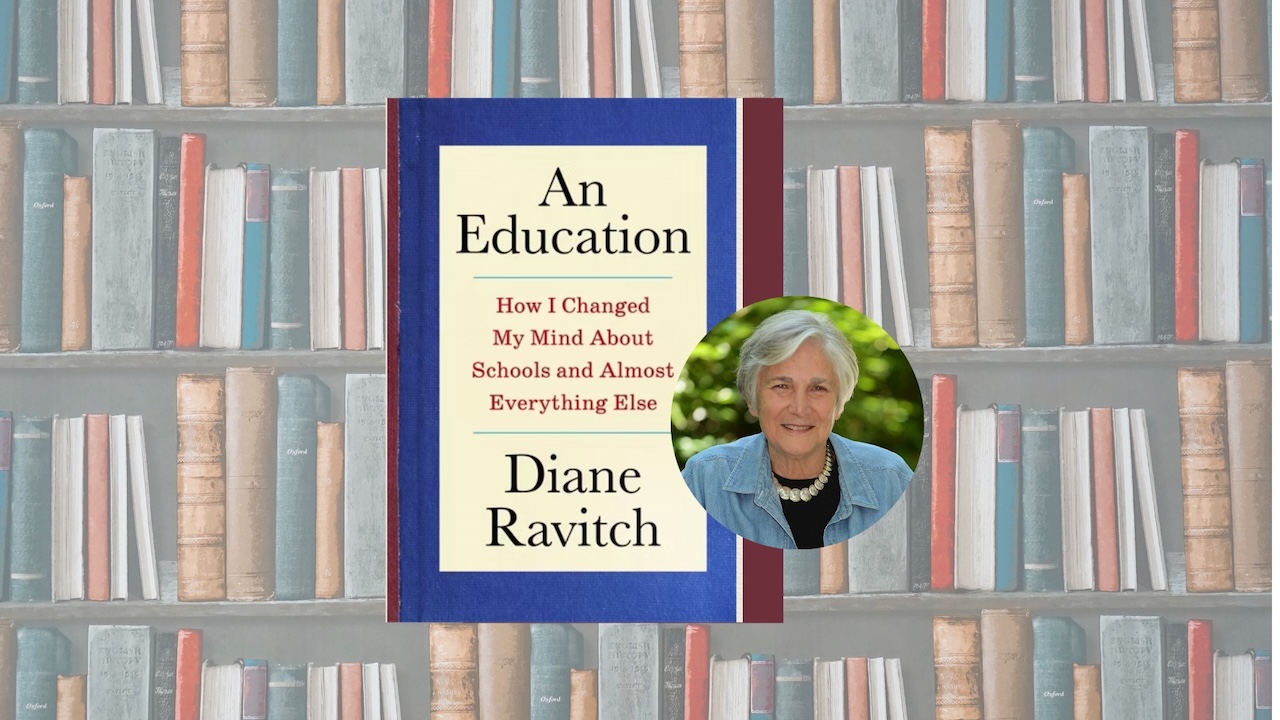
And now, at age 87, she’s written a kind of expanded autobiography, An Education: How I Changed my Mind about Schools and Almost Everything Else. She tells us how her vast experience with education policy, across partisan and ideological lines, has left her with a well-honed set of ideas about how to build good schools and serve students well. How, in fact, to save public education, if we have the will to do so.

You get the sense, as Diane Ravitch wraps up “An Education,” that she is indeed wrapping up– she sees this as her last opportunity to get it all out there: Her early life. How she found happiness. Mistakes and regrets, and triumphs. It’s a very satisfying read, putting her life’s work in context.

For her followers and admirers (count me in), the book explains everything about her beliefs. Her working-to-middle-class roots and her family’s loyalty to FDR and what the Democrats stood for, during post-World War II America, go a long way to explaining how she eventually (with some major diversions) became an articulate proponent of public education.

I’m glad she included a nostalgic portrait of growing up in TX with a hard-working mother and feckless (and worse) father. The glimpses we get into public education in TX in the post-war years resonated with me–and it’s easy to see how going far away to an Ivy League college shaped her entire adulthood. Her classmates at Wellesley, like Ravitch, were ambitious and curious; I’m old enough to remember a time when female ambition was suspect.

The most fascinating part of the book, for me, was the middle third, where she wrote about researching the history of public education and being asked to sit on prestigious boards and serve as Assistant Secretary in the George H. W. Bush Department of Education. There’s a whole chapter on Famous Education Opinion Leaders (many of whom are still working to suppress full public education) taking Diane to lunch, tapping into her work ethic and offering her opportunities to be part of the power structure, to write and speak (and—big point—learn what they’re really up to).

N.B.: Award-winning teachers are also often asked to become part of the education establishment by sitting on boards, writing op-eds, and serving on task forces– and it can be easy to feel as if you’re contributing, at a higher level, when what you are actually doing is giving credence to people who have a very different, but hidden, agenda.

The final third of the book is the Diane Ravitch most educators know and respect. Her observations come from swimming in the ocean of education policy for decades– and they’re accurate. I expect Ravitch to continue to blog and write and speak, as long as she is able. She is the rare voice in education that has examined education ideas across the spectrum and found many popular notions weak or dangerous.

The book is a fine testament to a life spent searching for the truth about public education.

Five stars.

The Legislature Goes to the Bathroom

I remember the first time I encountered unisex bathrooms.

I was traveling, with a backpack and not much money, in Europe, staying in youth hostels and tourist rooms, often in the homes of women I would meet at train stations holding up signs saying Zimmer zu vermieten. 

Near the end of the trip, an eight-week journey which I funded with just under $1000, I was in Munich, trying to find a cheap (really, really cheap) place to stay. Someone told me about a hostel camp, maybe an hour’s hike from the train station—a field outside the city where you could stay in a huge tent. If you got there early enough, there was also food.

I schlepped out there and stayed the last two nights of the trip, also visiting Dachau on my final day. It was bare bones—BYO sleeping bag and ground pad. There were unisex flush toilets in wooden cubicles, in a single concrete building of the type you’d find in any state park campground today. There were also warm-water showers, in a large room with no dividers for males and females. BYO towels and soap, as well.

The hardest part of adjusting to this was trying to act casual, as if I were used to waiting in line to use the toilet between Hans and Karl, or nonchalantly showering with a couple dozen mixed-gender strangers. Everyone else seemed pretty blasé about it. The vibe at the camp was international, friendly and very safe.

The year was 1976, the 200th anniversary of the home of the brave, land of the free.

Now, nearly a half-century later, some people have their knickers in a twist over newly remodeled unisex bathrooms in Michigan State University’s Campbell Hall, a beautiful dormitory on the oldest part of campus, which houses the Honors College.

The retrofitting took traditional community baths and turned them into lockable, fully enclosed private stalls, each with a shower, toilet and sink.  For a quick hand-wash or teeth brushing, there are also community sinks.

Apparently, the MSU Board got a letter of outrage from a parent, although students (who had to apply to live there) seem to be fine with the plan. There were some comments at the Board meeting about walking around after showering in a towel, but I chalk those up to people with too much time on their hands, wallowing in trad-nostalgia or perhaps sexual fantasies.

Back in the1970s, I lived in a co-ed dorm with community bathrooms. There were four floors—two community baths for women, two for men—although the dorm rooms alternated between men and women. I can’t tell you how many times I went to the women’s bathroom and found some dude walking out of a stall, because he didn’t feel like going upstairs. Lockable stalls with all you need sound vastly preferable to stumbling upon your roommate and her boyfriend showering together in the community bathroom.

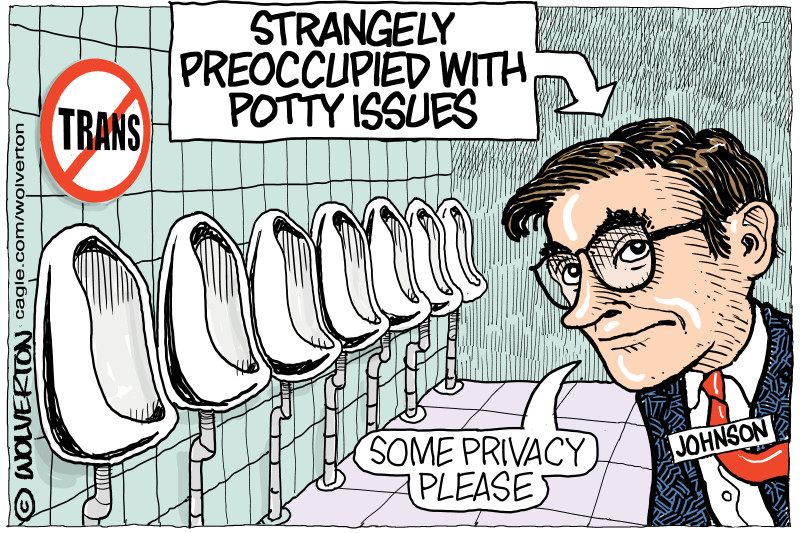
Makes me wonder why Republican legislators always bring up bathrooms when they want to gin up fear around gender expression. There really isn’t anything moral or magic about using the bathroom, with either gender.

There’s this: ‘Opposition to transgender inclusion has become a rallying cry for many conservatives. The debate is at the heart of a bill advancing in Michigan’s Republican-led House that aims to restrict bathroom use at schools and colleges on the basis of biological sex. 

Sponsoring Rep. Joseph Fox, R-Fremont, suggested Wednesday that allowing transgender students to use bathrooms of the gender they identify with is “traumatizing little girls.” He called it a “safety issue.”’

Then there’s this: “Michigan must stop making references to gender identity in sex educational materials provided to schools or risk losing millions of dollars in federal funding, according to President Donald Trump’s administration.” 

The State Board of Education is also currently hearing testimony on a new set of standards for sex education in Michigan:

“A recommendation that schools include instruction about gender identity or expression and sexual orientation by eighth grade has prompted criticism from several parental rights groups and Republican politicians. 

“These proposed standards cross into deeply personal and spiritual territory, normalizing behaviors that many families find harmful and contrary to their faith.’”

Traumatizing little girls? Normalizing behaviors that contradict families’ religious beliefs? And not being allowed to talk about it, in eighth grade sex ed classes, even if your parents say it’s OK?

It’s all about what’s happening in American bathrooms, evidently.

Gender-neutral bathrooms are commonplace in Europe.  Why is that? What do they understand that we don’t?

How about a Pause on the Race to Embed AI in Schools?

I haven’t written much about AI and education, for several reasons.

First, there are already many people writing compellingly and with considerable expertise about the uses and misuses of AI in the classroom. Some of those people will show up in this blog. Follow them. Read what they write.

Also, some years ago I developed a reputation for being a cranky Luddite. I wrote pieces about the downside of the ubiquitous online gradebook, accessible to parents 24/7, and other uses of computer programs that added to teachers’ workloads and didn’t fit with the important content and skills I was teaching students (lots of students) the old-fashioned way. The real costs of “free” programs and apps, no matter how glittery and hip, seemed obvious to me. Why didn’t other educators see this?

This came to a head when I was invited to be part of an online panel on ed technologies. Presenters sent me the language they planned to use to introduce me—did I approve? I confirmed, and then they messaged back: the bio had been created by ChatGPT. Ha-ha.

Finally, I haven’t written much about AI because I just find it hard to conceptualize how it could be useful in the classroom. In other fields, perhaps—with a lot of caveats, oversight and suspicion—but it runs contrary to the essential purpose of teaching and learning. Doesn’t it?

It’s never seemed right to let machines do the ‘thinking’ or ‘creating’ that is better done, or at least attempted, daily, by children. In short, I don’t get it. Maybe that’s because I haven’t been enlightened? So—shut up already?

I think many, if not most, practicing educators are in the same boat: Unclear about what AI actually is, and what use could be made of AI tools in their vital mission to make children independent thinkers, evaluators and creators.

For starters, who’s cool with Big Data collecting info on our public school kiddos’ engagement with their products? NEPC Report on digital platforms:  

While educators may see platforms as neutral tools, they are in fact shaped by competing interests and hidden imperatives. Teachers, students, and administrators are only one market. The other market involves data on performance, usage patterns and engagement—data flowing to advertisers, data brokers and investors, often without users’ knowledge or consent.’ 

A pretty good synopsis of what AI is, from Josh Marshall, Talking Points Memo:

“AI is being built, even more than most of us realize, by consuming everyone else’s creative work with no compensation. It’s less ‘thought’ than more and more refined statistical associations between different words and word patterns.” He goes on to make the salient point that the AI “products” being produced that will be “privately owned and sold to us.”

Doesn’t sound like something that schools need to quickly embrace, what with all our other problems, like teaching kids to read, rising absence rates and budgets stripped of our ability to feed children a nutritious breakfast and lunch.

Add in the environmental concerns and rampant intellectual property theft to teachers’ uncertainty about dumping more new, unvetted toys into an already-crammed curriculum. So I was thoroughly surprised to see the AFT get on the “AI in the classroom!!” bandwagon.

Why not take a pause—let’s call it a shutdown—on the race to embed AI in our schools? Why not sort through those competing interests and hidden imperatives? We’ve been bamboozled by climbing on attractive but ultimately damaging educational bandwagons before. Just who wants us on this one?

Well, scammers. And the folks who turned DEI into something to be avoided. Clueless Tik-Toking middle schoolers could up their game with AI. And right-wing edu-site The 74 says educators can save six hours a week by using AI to make worksheets, tests and exit tickets. Really? That’s an awful lot of worksheets.

Wouldn’t it make more sense to approach this transformative technology with great caution, holding fast to the evergreen principle of teaching and learning being a social endeavor? To look at the available research before being bedazzled by something new?

‘Participants, mostly undergraduate and graduate students, who constructed essays with the assistance of ChatGPT exhibited less brain activity during the task than those participants who were asked to write on their own. The AI-users were much less likely to be able to recall what they had written and felt less ownership over their work. Independent evaluators who reviewed the essays found the AI-supported ones to be lacking in individuality and creativity.’

If you want to read better pieces on AI, many are hyperlinked in this blog. But here are a few folks whose words and thoughts come from places of deep knowledge and experience:

Audrey Watters, the best Ed-Tech thinker on the planet,
for my money.

Pete Buttigieg, who thinks ahead of trends. Stop worrying about when he’s going to run for President and start absorbing his ideas on politics and relevant policy. Including AI.

Lucian Truscott, who writes about many things and made me understand why AI may ultimately fail: The men who run the big AI companies would do well to think through what they are doing with all those big buildings and all that electricity they consume. The “answer,” such as it is, to what they are seeking to accomplish may not exist, or it may be simpler than they think.

Educator Alfie Kohn, who points out that those most receptive to this technology are the people who know the least about it. This piece made my skin crawl.

My friend Peter Greene does a better job of debunking AI crapola than anyone I know. I credit this to his decades of classroom experience, during which he Paid Attention to Things—things more important than launching new products and making the big bucks.

So why should anyone pay attention to what a tech skeptic writes about AI in schools?

Because we’ll all be lured into making photos come to life, or relying on a questionable AI answer to an important question, or laughing at Russ Vought as Grim Reaper. Sticky and fun, but ultimately shallow, inconsequential.  Not what school-based learning should be.

Earlier this year, on a day when I made a (delicious) strawberry pie, I clicked on a song-writing app. Give us some lyrics, and a musical style, and we’ll write a song for you.

Here is my song: Strawberry Pie. Sticky and fun, but not much effort on my part.

Political Violence in the Classroom

In November of 2016, right after Donald Trump was elected for the first time, seventh graders at Royal Oak Middle School were captured on video shouting “Build that wall! Build that wall!”  in the school lunchroom. It drew immediate attention and media coverage, but like all once-shocking incidents, quickly faded from public view.

As events of the last week unfolded, it struck me that the blurry kids in the video would now be about the same age as Tyler Robinson, the man who shot Charlie Kirk. Were they now part of the cluster of young white men who spend all their time online, getting radicalized? Do they follow Nick Fuentes or hang out on 4Chan?

Or—best case scenario—had they merely been immature, clueless, early-adolescent jerks whose irresponsible, harmful “prank” of insulting and perhaps scaring classmates of color, was made clear to them by a community of teachers and parents? In one of the news clips from 2016, the Royal Oak Superintendent talks about how the perpetrators will be dealt with summarily, keeping in mind that youthful mistakes can be learning experiences.

Exactly.

Clueless early-adolescent jerks are a regular feature in middle school teachers’ clientele. Kids do dumb things. In between teaching students about the Bill of Rights and single-variable equations, teachers do double duty as both role models and arbitrators of appropriate behavior.

Because—despite the persistent myth that teachers should just spout content and inculcate skills, nothing more—learning happens in context. When some part of your class feels rejected, afraid or angry about being harassed in the cafeteria, nobody learns. Much of what we absorb in school are lessons about right and wrong. Civility and respect.

Things that weren’t on the lesson plan–no matter how old your students, or which subject you’re teaching. School is where students learn to deal with personal differences, taking turns and not always getting your way. And teachers—witness the illustration for this blog, just posted by a friend in a series of photos of her classroom—create materials, lessons and discussions to that effect, right out of the gate, even though it’s often considered not their job or, any more, none of their business.

We are at a point, this week, where teachers in twelve states have been fired or suspended for making remarks online about Charlie Kirk’s murder. In some states—you can guess which—state officials are inviting anonymous tips on teachers who may have said something in class that offended somebody, although the veracity of who said what, reported by students, then routed through parents, has to be uncertain at best.

Not to mention a giant waste of time at the beginning of the school year, as teachers are trying to build community and trust. Nor is any of this reducing the likelihood of the most politicized and terrifying violence in our classrooms: school shootings.

While teachers should absolutely keep their partisan loyalties to themselves, speaking about political violence is speaking about current events. As Brittany Page says:

“Political violence” isn’t just a conservative activist getting murdered.

Political violence is a Supreme Court that gives the green light for people to be stopped and detained based on their perceived race or ethnicity, what language they speak, where they work, and where they happen to be standing.

It is found in a society that tells you to start a GoFundMe to pay for your life-saving healthcare so your family doesn’t go bankrupt when you draw the short stick.

Click on the link. It’s a powerful piece, proof that we are all wading around in political violence every day, no matter how much they want us to shut up about it. It’s evil. To pretend it doesn’t exist makes it even more dangerous for all of us, including children.

How did we get here? Jonathan V. Last, at The Bulwark, said this:

Things have changed and it’s not hard to pinpoint the moment when the normalization of political violence re-emerged among our political elites. To pretend otherwise would be to hide our heads in the sand—to deny the plain political reality of the moment. But it doesn’t have to stay that way. Times change; people change.

The best part of that quote comes at the end. Times do change. People do change. And I would assert that changing people for the better happens in good schools, every day. Not all classrooms, not all playgrounds, not all teachers—but public schooling is an overall force for good, for a better, healthier nation.

In my time in the classroom, there have been regular encounters with politicized issues, from shootings to 9/11. In 1988, one of my students lost his father over Lockerbie Scotland, enroute to Detroit via Pan Am Flight 103, which was carrying a bomb planted by a Libyan citizen. Did we talk about that? Yes. I also know his pain was ultimately mitigated by the simple act of going to school each day.

Robert Reich:If you examine our history, you’ll see that the core of that identity has not been the whiteness of our skin, or the uniformity of our ethnicity, or agreement on religion, or like-mindedness about sexual preference or orientation.

The core of our national identity has been the ideals we share: our commitments to the rule of law, to democratic institutions of government, to truth, to tolerance of our differences, to equal political rights, and to equal opportunity.

Every clause in that last paragraph ought to be taught every day in every classroom in America. It’s the antidote to political violence.

What I Still Believe about Public Education

A few years back, I was facilitating a day-long workshop of self-identified teacher leaders in a western state. The topic: Blogging as a Tool for Change. It was a room chock-full of smart, feisty, articulate educators, eager to share their experiences, to let the world know how complicated and important their work was.

There were teachers whose students’ families were largely undocumented—they talked about student registration cards where there were no listed addresses or phone numbers. Some of them taught in districts where all the homes cost more than a million dollars; some of them taught on an Indian reservation. All of their stories were powerful.

Then a prospective blogger asked: Where will we get our ideas for what to blog about? How will we frame our experiences as part of a bigger picture? (I told you they were smart.)

It won’t be a problem, I assured them. Not if you follow the news, read education journalism, and think every day about the world our children will live in, what things you can teach them that they will use for their whole lives. I told them I kept an always-full folder on my desktop, where I dumped articles, quotes, links to reports, ideas to develop.

I told them there was plenty to write about. Start with provocative questions—something like Is this the end of public education? (hearty laughter around the room)

This was in the early days of the first Trump administration, when Betsy DeVos suggested that one reason guns were essential in schools was to shoot marauding grizzly bears on the playground. There are always lots of reasons to be snarky about or irritated by big-picture ed policy stories. But the demise of something as central to the United States’ stability and political dominance as public education felt like a bridge too far.

Besides, all teachers with a few years under their belts are familiar with the education pendulum. First, we “all” (OK, some) believe in one immutable pedagogical fundamental, then a new way comes along, and we shift (or are involuntarily shifted) to new practice. Until the Next Big Thing comes along.

Moral: Be wary of the silver bullet. And understand that every new administration brings its own bag of ideas designed to ‘fix’ all the existing problems.

Remember when personal devices were dubbed the Library of Congress in every HS student’s pocket—and now entire states are banning cell phones in the classroom? New Math? Grit? Americans seem to be susceptible to the latest and (frequently not) greatest. There are things of value in almost every trend or program. But no education trend is the One Best Way.

Five years later, I actually wrote a blog titled The Demise of Genuinely Public Education:
You might think I would be applying the evergreen ‘this too will pass’ theory to what’s happening today, confident that the pendulum will swing, the pandemic angst will fade, and we’ll be back to our highly imperfect normal: public education under siege, but still standing. It’s taken some time for me to come to this opinion, but I foresee the end of what we currently call public education.

That was a hard thing to write. I think public education is genuinely America’s best idea: a free, high-quality education for every child, no matter what they bring to the table.

One of my favorite education writers and thinkers, Jennifer Berkshire, recently posted this piece: Is Public Education Over? It’s a terrific, wide-ranging read that pulls no punches in listing a number of blockheaded, failed education reforms that we seem to have learned nothing from (sometimes, both ends of the pendulum are disasters):

Part of what’s so frustrating about our current moment is that by leaning into a deeply unpopular vision for public schools—test them, close them, make them compete—a certain brand of Democrat is essentially incentivizing parents to seek out test-free alternatives. Consider too that we’re in the midst of a fierce intraparty debate over what Democrats need to do to win. For the education reform wing of party, the answer to the question is to go hard at teachers’ unions and double down on school accountability, while also embracing school vouchers.

Berkshire mentions that major media outlets (not that they are bastions of truth and integrity anymore) are routinely posting op-ed content about the end of public schools as we knew them—despite the fact that upwards of 80% of all American kids still go to public schools.

Why would we abandon public schools’ infrastructure and experienced personnel? Crushing public education is not policy—it’s vandalism. It makes no sense.

Maybe the question is not: Is Public Education Over? Maybe the question is: What’s worth saving in public education?

Things to salvage from public education: Neighborhood schools. Honoring diversity. World-class universities. Scholarship and community. Music and art. I could list 100 things.

We have entered a whole new phase of threat to public education. Many things that seemed impossible—like quasi-military forces marching on Chicago-–are now daily news. Education funding is threatened (or yanked) and will remain iffy for some time.

Not a great way to start the 2025-26 school year. And yet—I was in a classroom last weekend, two days before school started, and there were all the names of kids in the new class, taped to their desks. By a teacher, getting ready.

I still believe that public education is the answer to the rising tide lifting all boats.

And I pray that it survives.

Photo: My grandmother, in front of her public school, 11-2-1900. She’s 4th from the right.

What I Learned from my Dad about Politics and How it Applies to 2026

I am a big fan of Jess Piper, a veteran teacher from Missouri, who left the classroom to run for office, and has since reshaped the conversation around why red-staters vote against their own interests. Piper writes often about a childhood spent bouncing around the south, and the family values that influenced her.

When people (including myself here) shake their heads and wonder how so many citizens–despite glaring, flagrant evidence to the contrary–can still stubbornly believe that Trump is leading the country  on the right track, it’s helpful to read Piper’s blog. She gets it.

Mostly, I read Piper for her insights on working-class voters–because my own father, were he still alive, would (despite many years of voting for Democrats, post-War) probably be a Trump supporter, voting against his own interests.

Not a careless, “protect my wealth” country-club Republican. But a grievance-driven voter who resented those he believed were simply and unfairly handed benefits and perks, things he would never enjoy, no matter how hard he worked.

Fear and resentment—and the overwhelming conviction that the little guy never gets ahead—were deeply embedded in his character. That doesn’t mean he was not a good father; he absolutely was, caring for his family and living up to his responsibilities as a hard-working adult and citizen who never missed an election. He was a proud Teamster, a church-goer, and the man who drove me 90 miles one-way to take flute lessons at the university.

My dad served in World War II, in the Army Air Corps (later the US Air Force) in the Pacific theatre. His plane was shot down, in 1944, over the Sea of Japan, and the crew was rescued by an Australian sub. He lost his 19-year old brother Don in the first wave of Marines taking Iwo Jima in February of 1945. I wrote more about these things here, explaining why my dad really never got over the war. But it was more than his wartime experiences that molded his character.

He often expressed the sense that he’d been cheated—that other, less-deserving people were moving ahead, because they had money, or were currying favor, while he (a realist from the poor side of the tracks) was left behind. He voted for George Wallace in 1968, because Wallace claimed there wasn’t a dime’s worth of difference between the two parties: both were corrupt and run by elites. Sound familiar?

Thom Hartmann’s new piece– Culture Is Where Democracy Lives or Dies, Because Politics Always Follows the Story a Nation Tells Itself—goes some way to explaining what’s happening today, but also why my dad, surrounded by protests against the Vietnam war and girls burning their bras, turned to a man who supported segregation and repudiated progressivism: ’ Like no candidate before, Wallace harvested the anger of white Americans who resented the progressive changes of the 1960s. Wallace supporters feared the urban violence they saw exploding on television. With tough talk and a rough-hewn manner, Wallace inspired millions of conservative Democrats to break from their party.’

Like many of Trump’s supporters today, my dad saw Wallace as a truth-teller, an advocate for the working man, someone who would work to defend cultural norms around race, gender, authority and social policy. Even when those norms were outmoded, unjust or morally repugnant.

Today, I know better than trying to talk an irrational, ruby-red voter out of their convictions. I really do understand how pointless, even damaging, it is to accuse Trump voters of destroying democracy and erasing progress. Because I spent, literally, years of my life trying to (cough) enlighten my father, who treated me like other fathers of the era treated their know-it-all college-student kids: as spoiled brats who needed to let the real world take a whack at them.

My father died in 1980, of a brain tumor, at the untimely age of 58. I never changed him, but he never changed me. He thought a college education was a waste of time and money, although when I graduated, he came to commencement exercises and danced with me at the Holiday Inn afterward.

 Later, it dawned on me: the fact that he and my mother couldn’t contribute financially to my college education, and couldn’t help me navigate enrollment, might have been part of his insistence that college was for the privileged, not families like ours.

All of this happened in a time when news and opinion came from three mainstream TV channels and the Muskegon Chronicle. Who do Trump  voters turn to now for news? Is that source supporting their racism, sexism, xenophobia and bitterness? Is it filled with fact-free resentment?

Where do we start in changing minds and hearts? I wish I knew.

The Good News in August and Why It’s Baloney

It’s August. I admit that I am a sucker for the cute back-to-school photos—students holding little chalkboards, shiny floors and carefully stapled bulletin boards. Special props to veteran teachers, posing for their 26th year of sixth grade or new job as Dean of Students. Online, there are cheery little edu-pieces about team-building exercises and how to set work-life boundaries.

To which I say: Hahhahhahahhaa  (deep breath) hahhahahhahahah.

Because this is not just another start of school. This is (among other things) the first school year since 1979 when there hasn’t been a functional Department of Education. It’s a year when there’s now concrete evidence that addressing equity and appreciating diversity can get you fired. It’s a year when federal funding —especially for the neediest schools—can disappear overnight. Maybe never to return.

I can see you veteran teachers in the back of the room–surreptitiously writing lesson plans during the mandated PD–muttering about plenty of other terrible First Days, like the year they were on strike or the year the building had black mold–or the August when the district was short nine certified teachers and just who was going to teach those kids?

And that, actually, is my point. No matter what’s going on in the world, and how it impacts children (who actually are, as the songwriter said, our future), public schools open their doors every fall and teach children. All the children. Including those that the private school refused to enroll, and the charter school declared ‘not a good fit’ last year.

And teachers? Robert Reich: 94% of teachers have had to dip into their own pockets to buy school supplies. An estimated 1 in 6 have second jobs during the school year to make ends meet. The average Wall Street employee got a record $244,700 bonus last year. Something has gone terribly wrong.

With all due respect to Robert Reich, one of my personal top five political-thinker heroes, something went terribly wrong over a quarter-century ago. But—again, this is my point—nobody believes that the bus won’t come, the teacher won’t be meeting kids at the door, and school won’t start when they say it will. There may be too many kids, and too few resources, but our public schools will step up, one more time, and do their best. 

In short, the news about public education is both terrible—and steadily getting worse—while simultaneously heartening. No matter how punitive the policy, how insulting the rhetoric, public education is still reliably America’s best idea.

Jose Vilson made me think, this morning: ‘Not enough has been said about how our classrooms can be conduits for the societies we wish to live in.’ 

It’s a great piece, all about how kids learn to obey (or not) in our classrooms, and what that means in a city–or society–facing police and military suppression. Are public schools doing students a favor by insisting on authoritarian classrooms? There’s a great topic for educators: How we manage our classrooms has an impact on the world that we want to live in. Discuss.

Sherrilyn Ifill (also on my top five political thinkers list) called this our summer of discontent, saying:

We could use a little bit of magic – a dash of deus ex machina – to lift our chances of surviving this. But we can make what looks like magic happen by applying steady pressure. Magic is when your opponents defeat themselves. Pressure creates the conditions for self-defeat.

Fighting on multiple fronts exhausts our opponents (don’t believe we’re the only ones who are exhausted). Showing resolve makes your opposition doubt their invincibility. A sense of humor infuriates them. Creating beautiful things and showing love and compassion utterly confuses them. Remaining focused and strategic exposes their weak spots. Showing you’ll go to the wall increases their fear. Showing up with successive waves of troops confounds them.

And that’s my wish for teachers everywhere, headed back to school:

Make your classroom a conduit for the country you wish to live in. Create beautiful things for and with your students. Show them love and compassion and dedication. Ignore threats. Break rules. Show resolve and especially, a sense of humor. Generate steady pressure against the forces that would destroy your important world-building work.

Because the kids are worth it.

Men Who Like Books Start Out as Boys Who Read

Maureen Dowd, in a NYT article entitled Attention, Men: Books are Sexy!:

Men are reading less. Women make up 80 percent of fiction sales. “Young men have regressed educationally, emotionally and culturally,” David J. Morris wrote in a Times essay titled “The Disappearance of Literary Men Should Worry Everyone.”

The fiction gap makes me sad. A man staring into a phone is not sexy. But a man with a book has become so rare, such an object of fantasy, that there’s a popular Instagram account called “Hot Dudes Reading.”

It’s enough to make me re-up my abandoned Instagram account.

I also sincerely hope that Maureen and I are not a dying breed, older women (we are the exact same age) who find Men Who Read attractive. I once experienced a tiny swoon when I read that Stephen King carries a paperback with him, wherever he goes. You know, in case he has to wait 10 minutes in line at the post office.

This is more than just my elderly romantic fantasy, however. I think Men Who Read are—or should be—a national education goal. Not men who can decode, nor men who can type fast with their thumbs or pass tests about content. Men who actually enjoy reading.

Reading to use their imagination, rather than seeing prepackaged ideas on video. Reading and—important–evaluating information. Using the language they absorb, via reading, in their daily interactions with others. Reading for pleasure.

Personal story: When I met my husband, he told me about working third shift at the Stroh’s factory in Detroit, while he was in law school. His job involved dealing with a machine that flattened cardboard beer cases and needed tending only at certain times. The rest of the time he filled with reading, hours every night. He would take two books to work, in case he finished the first one. He read hundreds of library books, mostly popular fiction.

He is still that person, 46 years later. Swoon-worthy.

When I read (endlessly) and think about how we’re teaching reading these days, it strikes me that the discussion is almost entirely technical: Do we really have a “reading crisis?”  Why? Is it the fault of a program that was once popular and taught millions of kids to read, but is now being replaced, sometimes via legislation crafted by people who haven’t met first graders or stepped foot into their classrooms?

I recently had a conversation with a middle school teacher in Massachusetts who is a fan of phonics-intensive science of reading curricula, largely because she gets a high percentage of non-readers into her Language Arts classes, kids who have big brains but no reading skills. She’s had some success in getting them to read, using sound-it-out instructional materials they should have experienced in early grades.

Good for her. And good for all teachers who are searching (sometimes in secret) for the right strategies to get their particular kids to read. But I’d like to point out that if the technical skills of reading aren’t matched by reasons for reading, it’s like any other thing we learn to do, then abandon. I’m guessing my friend’s students want to learn to read, because they like her, and they find what she’s teaching them interesting.

From an Atlantic piece: ‘The science of reading started as a neutral description of a set of principles, but it has now become a brand name, another off-the-shelf solution to America’s educational problems. The answer to those problems might not be to swap out one commercial curriculum package for another—but that’s what the system is set up to enable.

A teacher must command a class that includes students with dyslexia as well as those who find reading a breeze, and kids whose parents read to them every night alongside children who don’t speak English at home.

There you have it. We’re looking, once again, for a one-size-fits-all solution to a technical, easily measured “problem”—reading scores—when what we really need is honest reasons for people to pick up a book. Or a newspaper. To enjoy a story, or a deep dive into current issues.

My dad, who didn’t graduate from HS and had a physical job all his life, came home from work every afternoon and read the newspaper. He was more literate than many college grads I know.

He had reasons for reading. He was not carrying a smartphone and had only three TV channels, undistinguished by political points of view. He read TIME and LIFE magazines. I disagreed with my father on almost every issue, back in the day, but he could marshal a political argument. Because he was a reader.

So why are reading scores dropping? Curriculum and poor teaching are lazy, one-note answers. If we want a truly literate population, we need to make reading and writing essential, something that kids can’t wait to do. Because it’s a passageway to becoming an adult, to succeeding in life, no matter what their goals are, or how they evolve.

We currently have a president who doesn’t read his daily briefings, and bases his critical viewpoints on hunger in Gaza on what he sees on TV. But we used to have a president who published an annual list of his ten favorite books.

Which one of them is a (sexy) role model?

A “Moment of Reckoning” or Just More Empty Hysteria?

I’ve been more or less off the grid for the past two weeks, vacationing in Alaska and determined not to let the repellent Epstein Saga or other assorted travesties spoil the snow-capped mountain vistas. Which means that a whole lot of education-related stories have been waiting in my mailbox.

Lurking bad news, for the most part (even Trump “returning” five-point-something billion to schools is tainted by the knowledge that we’ll see those cuts againand more). Most of the bad news is cuts, in fact—or scams, like this voucher doozy in Arizona.

Can I just say that education journalists could do the citizenry a solid by continuously reporting all the resources—human and material—that have already been lost? Or by informing parents and communities about residual effects of a global pandemic or unwarranted attacks on public education?

Instead, we get idiotic headlines like this one: A Moment of Reckoning for Michigan Schools. (Cue disaster music.)

The headline is followed up with a series of articles with titles like Michigan spent big to fix schools. The result: Worse scores and plenty of blame. And Mississippi turned around its schools. Its secret? Tools Michigan abandoned.

The “effective tool” that Michigan abandoned? Our late-but-not-lamented Third Grade Flunk law, valid critiques of which centered on the damage done to kids by being forced to repeat a grade, the financial burden on schools as they are compelled to provide an additional year of instruction to large segments of their elementary population, and the complete lack of proof that these laws work.

Makes you wonder where this unsubstantiated condemnation comes from—that’s the disappointing part. These articles (and more just like them, hacking away at our public schools) are from Bridge Magazine, a fairly centrist, nonpartisan publication that focuses on issues in the Mitten State.

I interviewed its founder, eminent journalist Phil Power, shortly after Bridge launched, in 2011, and invited him to speak to the Michigan Teacher Forum, where he proclaimed his undying support for public education and especially for the hard-working teachers in Michigan public schools. Bridge seems to have moved on from those ideas, however, adopting a common politicized perspective: Oh no! Our state is falling behind other states!

There’s a lot to debunk in the series of Bridge articles (wherein I found precisely one veteran teacher quoted, mildly suggesting that the silver-bullet “Science of Reading” prescription was only one of the ways that students learned to read), but I am too jet-lagged to tackle these, point-by-point, at the moment.

State Senator Dayna Polehanki, a former teacher, did some debunking, however. From her Facebook post:

“While I won’t denigrate Mississippi’s efforts to improve its academics, the picture being painted by at least one Michigan publication that Mississippi is outperforming Michigan on the NAEP reading test (“The Nation’s Report Card”) is MISLEADING.

While Mississippi has *scored higher than Michigan ONE TIME over the past decade on the Grade 4 NAEP reading test . . .

Michigan has *scored higher than Mississippi EVERY TIME over the past decade on the Grade 8 NAEP reading test.

The assertion in the Michigan publication that Michigan “abandoned” our 3rd grade read-or-flunk law to our detriment is not supported by test score data.

It’s not surprising that states that flunk their “worst” 3rd grade readers achieve elevated results ahead of the Grade 4 NAEP reading test, but these elevated test scores tend to flatten over time (by Grade 8 NAEP reading), like they do with Mississippi.

This is borne out in NAEP data from other states as well, like Florida, which also flunks its worst performing 3rd grade readers.”

In fact, there are plenty of pieces debunking the “Mississippi Miracle,” from its deceptive gaming of the system, to right-wing blah-blah claiming that raising 4th grade reading scores isn’t enough—that Mississippi needs vouchers, immediately, to solve its poverty-related education problems.

What all these pieces have in common might be called uninformed–or “lazy,” take your pick–journalism. Education data is not easy to interpret, nor is it truth. One example: A NAEP score of “Proficient” doesn’t mean “on grade level” as most people (including some education journalists) seem to think it does.

Worse, relying solely on test scores doesn’t tell us how successful schools actually are. For that, we need to look at a wide range of factors. It’s interesting that, two weeks before Bridge launched its so-called Moment of Reckoning, they published a piece noting that only 9% of the state’s public schools currently have a full-time librarian.

Think that has anything to do with our faltering reading scores?    

In the end, schools are comprised of people and programming. The more instruction is tailored to the students in that school, the more dedicated and skilled the personnel are, the better the results. Score competitions with other states are pointless.

There are hundreds of ways to improve student learning: Universal free preschool attached to high-quality childcare. Smaller classes, especially for our youngest learners. Recruiting, training and paying a long-term teaching force. Stable housing and health care for all children. A hot breakfast and lunch, plus plenty of recess time. Government supports for public education. I could go on.

None of these are free, or likely to come down the pike in Michigan or anywhere else in the near future.

Are we reckoning with that?