Old 2024 me would have said yes– part of the peaceful transfer of power, respect for the office if not the man, norms and institutions, blah blah. Even though Trump did not invite Biden to the WH or attend the 2021 inauguration, we go high when they go low. Maybe.
But now– I am saying “You are right to sit this one out, Michelle Obama.” Partly this is because I read Rachel Bitecofer’s book “Hit ’em Where It Hurts”wherein she points out that in American politics, nice and respectful politicians lose. And in order to govern for justice and equity, to get things done, you actually have to win.
It’s one thing to call the returning president tRump, or elderly golfer, or any number of clever pejoratives. You can dissect his “speeches” and comment on his addled goals. But it’s not funny any more, if it ever was. The man is immoral and malevolent. He’s going to cause a lot of damage and heartache.
So why is anyone duty-bound to stand by, quietly, and watch him take the oath of office?
Not showing up is a tangible, noticeable act of resistance. A statement of principles. Not today, Satan.
I used to blog for Education Week—for nine years, in fact. And at the end of each year, the teacher bloggers were asked to choose our ten best blogs and post a piece about them. We were given viewership statistics (for our personal blog only), so we’d know which ones got the most eyeballs. And invariably, the most popular ones—the winners–were my least favorite pieces.
I’m writing for myself and like-minded readers these days, so I’m not sharing the most-read 2024 columns from Teacher in a Strange Land. I’m sharing eight blogs that I think best reflect the, well, Strange Land we find ourselves in, educationally speaking.
Before I list them, I’d suggest you read two recent—important– blog posts from Peter Greene. The first informs his regular readers (I’m among them): If you have ever had an urge to send money my way, I ask that you transfer that urge to someone whose work you appreciate and who has, however shyly or boldly, held their hat out. Plunk down some bucks for the work that you value and that you want to see staying in the world.
You’ve probably noticed that the most famous people who write about education are often not educators. The best—most accurate, most creative, most humane—writing about schools and learning comes from people (like Peter) who’ve done the work and have first-hand observations about doing right by children. In 2024 alone, I have subscribed to seven newsletters, paying a modest fee and developing an informed reading habit on screens, rather than newspapers and magazines. Some of those writers have interactive publishing modes and write back.
I have favorite ed writers—and it is those writers who introduce me to other ed writers. Which is Peter Greene’s second point: Share the good stuff. If you’re wondering who to read, click here. There are dozens of suggestions, curated by Greene. But first, subscribe to his blog, because his work is terrific, soaked in reality. And free.
The scariest thing to me about the abuse teachers are taking, across the country, is its impact on curriculum. Here’s the thing: you really can’t outsource teacher judgment. You can prescribe and script and attempt to control everything that happens in the classroom, but it doesn’t work that way.
Simple theoretical questions—like “which method produces greater student understanding of decomposing geometric shapes?”—have limited utility. They’re not sexy, and don’t get funding. Maybe what we need to do is stop ranking the most influential researchers in the country, and teach educators how to run small, valid and reliable studies to address important questions in their own practice, and to think more about the theoretical frameworks underlying their work in the classroom.
Board member says: “This gets into the weaponization of empathy, where empathy is taught as the highest goal, the highest order. Do we teach empathy to the effect where students disregard parental authority—and accept anything and everything? Do we teach kids that any kind of judgment is bad?”
Wait. What? Who is he accusing? And what is the weaponization of empathy?
Too much empathy leads to kids defying their parents, evidently. The moral ambiguity of school confuses students. That’s their big fear?
There are, indeed, public schools where media literacy is a formal part of the curriculum. There are outstanding digital literacy resources for students, supported by high-quality research. What’s missing is the will and the urgency of the need to educate kids about distinguishing between truth and whatever it is they’re getting on TikTok.
Or, unfortunately, at their kitchen tables or their church or on the bus. Misinformation—can you remember Things You Used to Believe?—has always been a factor in growing up and becoming educated. Disinformation is a darker thing altogether. Especially when it comes from people who should, theoretically, represent integrity. Legislators, for example.
Adults’ perceptions of what’s happening in public schools mainly come from their own personal experiences (and this includes people with no K-12 children in the home). The percentage of people who read books or articles, watch cable news or videos, or listen to podcasts about education is small. People who get their education news from newspapers? Fifteen percent. Second highest source of ed news? Social media.
That’s a lot of guesswork, memes and faulty memories.
It strikes me that tradwives are just another glitzy, social media-driven facet of a larger wave of backlash against a whole lot of un-trad trends in American society: Full-blown reproductive freedom. The continued shrinkage of mainline religions. Honoring personal sex/gender choices. Women running for office and corner offices–and winning. And so on.
Hey, I know it’s the holiday season, the end of a long, incredibly stressful and disappointing year. You’re entitled to a few days’ respite and mindless merry-making before returning to your job, if you are lucky enough to have a job that offers vacation time off over the holidays. I get it.
But as we move into a loosely organized resistance to whatever the hell comes next—Measles? The end of special education? Further loss of reproductive rights?—I think it would behoove us to poke around in the causes of what made has now made us, the so-called Greatest Nation on Earth, vulnerable to the likes of Elon Musk and Vladimir Putin.
That was not a rhetorical question, by the way. Who IS seriously listening to what Trump and his acolytes are currently saying they intend to do? Are we all just opening gifts and going to the movies, eating ourselves into a stupor, because nothing can be done? Why is the Titanic backing up, planning to hit the iceberg again?
Think back to a time when it absolutely felt like nothing could be done—and we (everyone on earth) were facing an existential crisis: March 2020, as COVID rolled around the globe, and its potential as history-making killer became obvious.
My working theory for why we were confused enough, as a nation, to vote Donald Trump back into office, centers around the divisions, deprivations and misconceptions we all experienced during the COVID-19 pandemic.
We are still living with the repercussions, but pretending that it’s done, gone forever.
Here are six ideas about how the pandemic is still with us, impacting our institutions and daily life:
We totally underestimated the impactof a pandemic, before it occurred, and since, whenever we declared our personal liberation from living with a potentially mortal disease. We underestimated our capacity for coping with danger, and we underestimated the need to see ourselves as in charge, not helpless in the face of that danger. We underestimated the fear and lack of patience. We were panicked but—living in a rugged individualism/patriarchy—pretended not to be. We talked endlessly about when we could return to normal.
We especially underestimated the impact on children—on their emotional security, their need to play and learn with children their own age, their need to succeed at tasks set for them, as they built a mature personality. We’re still feeling those insecurities in our schools and often, responding with more pressure, rather than flexibility and the gift of time. We’re still having trouble getting kids to show up at school, a flashing red light for school leaders.
The pandemic was socially disruptive.It took families away from landmark gatherings—weddings, holidays and even funerals. It ruined existing workplace norms; we’re still trying to hire workers and adjust prices. The entire labor market has been disrupted, and the people in control don’t like the backlash of workers (including teachers) demanding more money. Mask-wearing (to keep either wearer or the people they encountered safe) became controversial.
The pandemic unsettled traditional religious beliefs and practices.Injecting the divine into a global pandemic was confusing to believers: Did God send us a lethal pandemic for a reason? If you trusted in Jesus, did that mean you didn’t need to wear a mask? Attendance at churches, which impacted their ability to stay afloat financially, dwindled—causing many churches to close, and others to put more faith in a Christian nationalism theology, where humans were in control.
The pandemic was politically disruptive.Donald Trump’s leadership style during the last year of his presidency—the Ivermectin and the bleach, the assertion that we’d be packing the churches by Easter, his drive around in a limosine to wave at fans while being treated for COVID at Walter Reed—was horrifying. But establishment of the Big Lie and the January 6th Insurrection at the Capitol ripped the fabric of American politics more than the previous hundred years’ worth of wars and rebellions. For every person who felt relief at having Uncle Joe in the WH, passing useful legislation, rebuilding international relationships and remembering the dead, there was an angry voter who thought he’d stolen the presidency (and pissed off that he still had to wear a mask in the grocery store).
Which brings me back to the last days of 2024, where we—like the heedless citizens in “Don’t Look Up”—are standing on the tracks of democracy, facing an oncoming train, but feeling too hopeless to muster a response.
Would it be too 2016 of me to suggest that this is absurd, embarrassing, worrisome stuff? As 2024 ends, the prevailing attitude toward the manic stylings and overheated threats of the once and future President, even among his diehard critics, seems to be more one of purposeful indifference than of explicit resistance; call it surrender or simply resignation to the political reality that Trump, despite it all, is twenty-five days away from returning to the Oval Office.
Or, as Paul Waldman suggests in a terrific piece, everything is just awful: You can date it back as far as you like, but the prime suspect is the covid pandemic, a trauma that still profoundly affects us. That’s true not just for those who lost family members or businesses, or whose kids basically lost a year of schooling, but for everyone, the way it blanketed the country in misery and left us at each other’s throats. One of the most revealing data points is that during the pandemic, pedestrian deaths skyrocketed. People were just driving angry.
Back in the early days of the pandemic, sitting here, lonely, at my computer, I imagined a dozen ways that surviving a global pandemic might lead to improvements in our habits and way of life. Read it—it’s embarrassing to imagine that I believed a country that chose Donald Trump over Hillary Clinton could turn the corner on a dozen issues and needs, courtesy of a pandemic that brought us together. We should all know better, now.
A couple of days ago, Dr. Vin Gupta (speaking of pandemic heroes) wrote this: I’d recommend everyone regardless of medical risk bring a mask on your airplane journey, a disinfectant wipe to clean the seat you’re in and hand sanitizer. It’s going to be on you alone to protect your health. Warning signs are everywhere.
There you have it. It’s on you. Me, too. Let’s work together.
In Iceland, books are exchanged as Christmas Eve presents, then you spend the rest of the night in bed reading them and eating chocolate. The tradition is part of a season called Jolabokafload, the Christmas Book flood, because Iceland, which publishes more books per capita than any other country, sells most of its books between September and November, due to people preparing for the upcoming holiday.
Nobody ever responds:That sounds awful! My family prefers watching our individual TVs!
Thanks to the Jolabokaflod, books still matter in Iceland, they get read and talked about. Excitement fills the air. Every reading is crowded, every print-run is sold. Being a writer in Iceland you get rewarded all the time: People really do read our books, and they have opinions, they love them or they hate them. At the average Christmas party, people push politics and the Kardashians aside and discuss literature.
The Danish art of contentment, comfort, and connection…a practical way of creating sanctuary in the middle of very real life.”
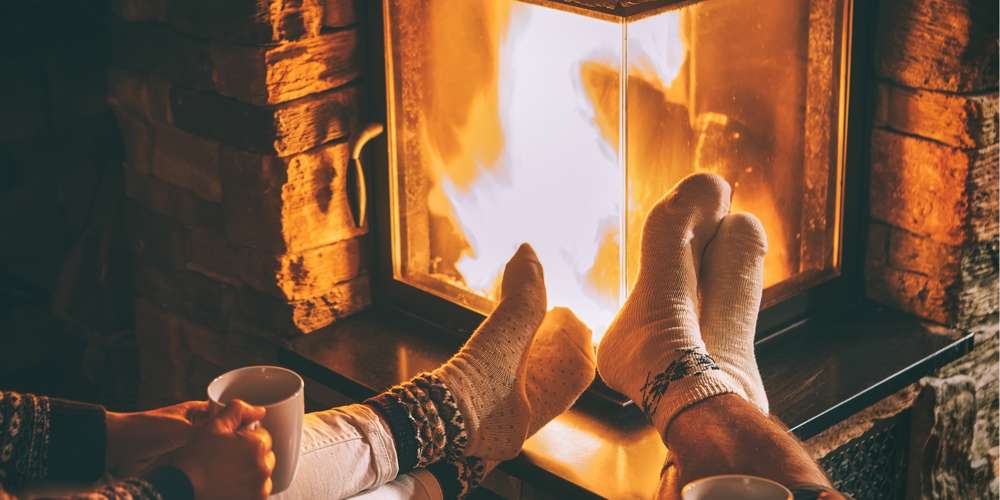
Hygge (hoo-ga), which has no direct translation into English—surprise!—is many things to many people: Woolen socks. Candles and other gentle light. Board games. Comfortable couches and cozy quilts. Warm drinks.
Although hygge seems to have Scandinavian roots, it’s not exclusively a cold-climate thing, evidently. A rustic cottage on a lake, with its beat-up furniture, mildewed paperbacks from the 1950s and second-hand bathing suits is very hygge, according to Meik Wiking, author of “The Little Book of Hygge”and, not coincidentally, CEO of the Happiness Research Institute in Copenhagen. The mere fact that there is a Happiness Research Institute, somewhere in the world, makes me—well, happy.
The interesting thing about hygge and Jolabokafload is their inherent intentionality. Citizens in Iceland and Denmark take contentment, comfort and connection seriously, and pursue them with deliberation. Choosing the right book for someone means you know that person, and what they might enjoy reading. Playing games with your family means connecting with them, laughing and teamwork.
So why don’t we pursue this, here in the land of the free, home of the brave? What keeps us, a nation that often proclaims itself the best country in the world, or at least on its way to becoming “great” again, from choosing to embrace contentment and connection?
Perhaps Scandinavians are better able to appreciate the small, hygge things in life because they already have all the big ones nailed down: free university education, social security, universal health care, efficient infrastructure, paid family leave, and at least a month of vacation a year. With those necessities secured, according to Wiking, Danes are free to become “aware of the decoupling between wealth and wellbeing.”
That’s where our intentionality lies in the U.S., where we’re spending our hard-earned tax dollars—canned curricula designed to raise test scores and alternative school governance models, endless expensive tests—when over 100,000 New York City schoolchildren were homeless last year. According to former Senator Orin Hatch, we don’t even have money for poor children’s basic health care. As a nation, we have linked simple human well-being to wealth, and sealed it with the tamper-proof cap of low opportunity.
Many teachers try to add hygge touches to the classrooms where their high-poverty students meet and work every day—from beanbag chairs to classroom sets of snowpants for outdoor play, from little free libraries to Cocoa Day. If school can become a place of connectivity, warmth and safety, they reason, students will keep coming back.
Happy Hygge-days, Teacher in a Strange Land readers. Thanks for all you do for your students.
But I really like tracking what I read. First, it helps when you’re intermittently reading a series by the same author, and the titles are interchangeable. It’s a lot better than taking a book home from the library, and 10 pages in, when it’s starting to feel familiar, wishing you’d kept a list.
Then, there are the easily confused books. The Woman in the Window. Or the train. Or Cabin 10. Or just… The Women. (I’ve read ‘em all—can’t recommend any of them.)
For about 10 years, I’ve been trying to read 100 books a year, and for eight of those years, I’ve made the goal, and sometimes significantly exceeded it. It’s a nice round number. I give myself credit for physical books read as well as audio books (usually a small percentage of the total—they take more time). Fiction and non-fiction. And I only log the ones I finish.
But this year, I’m way behind. I blame Donald Trump.
The only other year that I didn’t make the goal was 2016 (and got off to a slow start in 2017, what with the Womans March and joining groups and deciding to run for office and knitting pink hats).
This year, I was about 8 books ahead of my goal in June. When Biden dropped out of the race, and Kamala Harris quickly became The One, I found that the long stretches of time dedicated to reading were transferred to activities centered around politics. Including a ridiculous amount of time spent where I am right now: in front of my computer.
It’s summer, I’d tell myself. Check a big fat beach read out of the library! When I did, it would sit in my reading corner until I brought it back, a month later. A month filled with doom-scrolling, sign-delivering, attending debates, wading in hope, drowning in despair.
And in the last month? No books. Just endless commentary. Seventeen takes on the same depressing story (Matt Gaetz? Really?), each with its unique, snarky—and depressing—viewpoint.
Speaking as a person whose most-read column was a screed against the Pizza Hut Book-it Campaign, because it turned kids reading for pleasure into a competition where discounted pizza coupons were the prize, you’d think I could blow this off, and just be happy I read a lot of books.
When I first retired (from the classroom, not from working in education), I moved away from the school district where I had lived and taught. I’d been there for well over 30 years and had seen—up close and personal– the power of school boards to impact educational climate in a school district. I’d been watching through four decades of local policy-making— the good, the bad and the out-and-out malicious.
I’ve got stories.
And I’ve written about the town where I lived and taught. In spite of its flaws, it was usually a good place to teach, if the definition of “good” is engaged parents, talented colleagues and kids who were encouraged at home to achieve.
The quality of school board leadership occasionally faltered over that time—with most of the squabbling over how to get by while spending a lot less—but there were long stretches where the school board served as a benign and supportive presence.
Board member says: This gets into the weaponization of empathy, where empathy is taught as the highest goal, the highest order. Do we teach empathy to the effect where students disregard parental authority—and accept anything and everything? Do we teach kids that any kind of judgment is bad?
Wait. What? Who is he accusing? And what is the weaponization of empathy?
Too much empathy leads to kids defying their parents, evidently. The moral ambiguity of school confuses students. That’s their big fear?
As a long-time classroom veteran who spent the beginning of every year working diligently to get kids to respect their peers, and care for other people’s feelings and property, this struck me as downright stupid.
A social media convo developed around the clip, with commenters suggesting the end result of too much empathy was Doctors Without Borders or the Peace Corps.
Eventually somebody remarked:
It should come as no surprise that the Heritage Foundation has taken this term and used it as its own way of fighting against Social-Emotional Learning, and any other academic tools to help students.
If one of your school board members uses this term, they are in some way being educated by, or they are using talking points from the Heritage Foundation.
Then, the other shoe dropped. Aha. Weaponizing empathy is a Heritage Foundation thing, the concept of their plan, so to speak.
But hey—if right-wingers get control of a school board, they can micro-manage a district, with thousands of students, turning it into a place where empathy—caring for and about their fellow students– is forbidden or scorned.
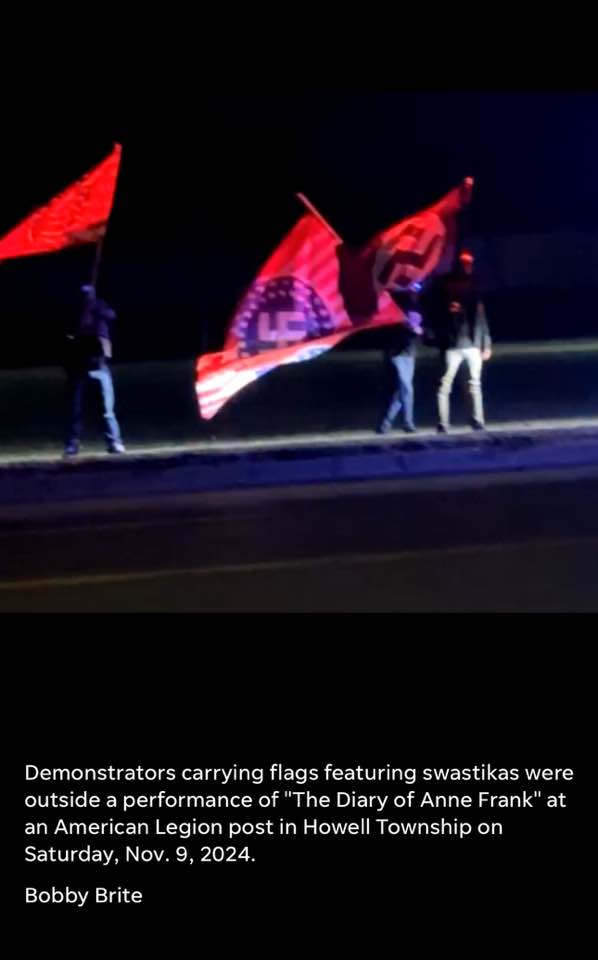
Last week, in Howell, Michigan, the town where I used to live, a local youth theatre group was putting on a production of the play version of The Diary of Anne Frank—probably the same version put on in my high school, back in the 1960s, when that kind of drama-club effort was considered a worthy stretch.
This performance was happening at—of all places—the local American Legion Post. And a few veterans were hanging around outside when some junior Nazis, masked and waving swastika flags, showed up. They called the cops, who arrived promptly, then escorted the flag wavers across the street.
There have been other hate marches in the county this year. Not going to link to articles, but the same group of masked dudes with Nazi gear and Trump flags have been showing up on the regular around town, on overpasses and at outdoor events in the summer, mixing a little terror and intimidation into life in a small, generally placid, Midwestern town. Among my local teacher friends, there have been quiet on-line conversations—some colleagues have had these young men in class and recognize them.
We’re in for trouble.
It was predictable, no matter which way the election went. All the disreputable talk and threats and violence have been set loose; the election just gave them a bump. The particular young men who were being babysat by the Sherriff’s men told bystanders that they were protecting “Pureville.” Doesn’t get more explicit than that.
And public schools, the stage on which society builds their hopes for the future, will suffer.
Nobody reading this, I’m confident, now believes that what’s been set in motion will die down quickly. To wit:
There is the ongoing flood of racist texts to Black students, including middle schoolers, across multiple states. These anonymous texts tell them to report to the plantation. Some of the texts address the students by name.
There’s the whole “Your Body/My Choice” assault: Over a 24-hour period following Trump’s election, there was a 4,600% increase in the usage of the phrase “your body, my choice” on X. The phrase has made its way offline as well, with young girls and parents across the country using social media to share instances of harassment involving it.
And they are undeniably in the just-getting-started phase.
Most of what I’ve been reading in Ed World over the past two weeks have been pieces on education policy. Will Trump close the Department of Education? What about Head Start, Title I and IDEA? Will RFK Jr. be crossing the country to destroy vaccine mandates?
In practice, both horrifying and devastating. But I’m more interested in the daily lives of schools, right now. As policies, guardrails and traditional practices fall, it will take time to vacate safety codes and equity-supporting statutes.
Fueling the racist, xenophobic, and homophobic attacks on public school curricula, teachers and school librarians, and on Black, Hispanic, gay and transgender children who are now portrayed by Trump and his MAGA crowd as dangerous or threatening.
On the first page of the introduction to Project 2025:America under the ruling and cultural elite … children suffer the toxic normalization of transgenderism with drag queens and pornography invading their school libraries.
These are things that the chronic public school critics and disaffected students can address now: Redefining pornography. Tormenting kids who are trying to understand their own sexuality. Bringing a gun to school or taking one downtown. Terrorizing Black and brown classmates, for fun. Bringing that slut who refuses to go out with you to heel.
None of these involves changing policy or shutting down the Department of Education.
DeAngelis is—was?—the real deal, in education policy world. Not the kind of education policy that would re-build or energize our public schools, of course, but an attractive and even charismatic mouthpiece for the anti-union/school choice/privatization movement.
If this were, say, 2014, when Corey DeAngelis was pursuing a skeezy “alternative career” that eventually became public knowledge, lots of folks would see it as an inside-baseball kind of chuckle—conservative education spokesperson gets caught being himself, ho-hum.
But the nature of public discussion about our schools has changed.
One of the things Corey DeAngelis contributed and honed, in these verbal ed skirmishes, was nastiness. The kind of unsubstantiated nastiness that we’re now hearing every day from political candidates on the right. Words like lazy, dumb, failing, greedy, groomers, socialists—and, of course, unions as root cause of all that is wrong with America and her children.
I posted a tweet about that blog post, asking WHY DeAngelis and others are trashing public education? What’s in it for them? Because this onslaught of anti-public education blather is not doing the nation and its children (no matter where they go to school) any good. This WHY was a serious question, BTW.
I got lots of tweeted responses, from DeAngelis’s army of followers, to whom I would ask the same question: What, actually, are you fighting for, when it comes to education? Here are a few of those tweets:
Union Mouth! (followed by a string of vomit emojis)
I took my kids out of the gladiator academy/commie indoctrination center. Best choice I ever made.
Staffed by mediocrities (sic) who act like martyrs
Corey is bringing the future of education. Say goodbye to your current paradigm of croneyism and union interference.
The govt “school” system is nothing more than a taxpayer pipeline to labor union coffers, used to then (re-)elect politicians who promise more money for the pipeline. Education was never the point.
Public schools are a Dredge (sic) on society. Teachers are even worse.
And—my personal favorite:
Retire, you old hag.
I found myself blocking responses from people with names like—and I’m not making this up—Sexy Fart Bubble. Also wondering how school policy went from being a question of qualified staff and resource allocation to taking ugly potshots at teachers, school leaders and the millions of families who rely on public education.
I know better than to sputter about—or worse, respond—to random on-line vitriol. It’s acceptable now, evidently, to lie on public platforms; calling attention to falsehoods (or snickering at a messenger’s personal problems) is a distraction from focusing on what matters in debates about our schools.
Because—contrary to what Corey DeAngelis’s followers expressed, education has always been precisely the point. For better and worse, for everyone involved. Education has never been settled science. Our children are exposed to different influences and technologies than the previous generation of students; likewise, educational practice has to evolve.
Serving children’s educational needs adequately will—must—shift over time. And change is hard. Working through the changes, especially after a global disruption, demands civil discourse. Professional judgment. And an appreciation for facts.
So—no schadenfreude over seeing someone, whose minions called me “Union Mouth,” be exposed and having his name quickly erased from an array of education non-profit websites. There are far bigger fish to fry at the moment.
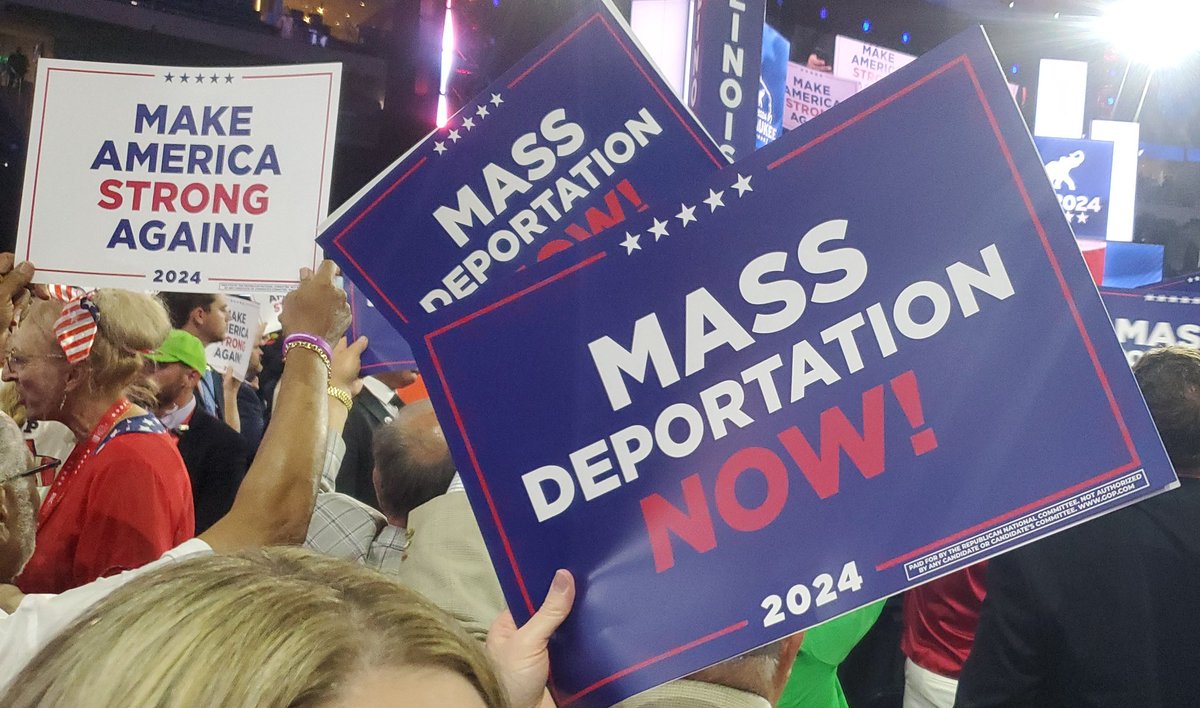
When one of your options for Leader of the Free World is seriously threatening to deport 30 million people, a large percentage of whom are children, it seems wrong to fuss over books somebody’s mom doesn’t like. Or spend a lot of time and effort trying to persuade people that teachers’ organizations, with their focus on working conditions in our schools, are harming children.
With all the free-floating fear and loathing in the American zeitgeist right now, it’s harder than ever to establish a classroom where students can develop the confidence to be a community. I am 100% on the side of educators who declare that students can’t learn unless they feel safe. The corollary to that is that teachers can’t learn and grow unless they feel safe, as well.
We are living in unsafe times.
If you want to influence policy change in public education, bring your best ideas and an open mind. Leave the nastiness behind.
I generally don’t pay much attention, anymore, to the rightwing young guns who dominate edu-social media. Mostly this is because they’re not providing any new content about what you might call school improvement—genuinely interesting or useful ideas for making lessons interesting, building curriculum that makes sense in 2024, figuring out better ways to assess student work and encouraging students to get excited about learning.
You know, the things that support the people actually doing the work of teaching in the public schools—where 82% of our K-12 students are educated. Instruction.
In the five decades since I started teaching, reading and writing about all aspects of schooling and education policy, there have been hundreds of such new ideas. Some were genius, some fizzled out, some—annual standardized testing springs to mind—are now part of what everyone thinks is normal, maybe even essential. Even though these ideas may have harmed many children.
The yappy bow-ties posting on the regular about how public education is a big fat failure aren’t offering us genius ideas. They’re focused on vandalizing one of America’s great strengths: a free, high-quality public education for every child, no matter what they bring to the table.
Buck actually did teach for a few years, shifting from public education to private, three schools in what looks like six years. Then he wrote a book and informed his following that he was, sadly, leaving the classroom to put his intellect to better use, writing blogs—as a ‘policy and editorial associate’ for a conservative non-profit.
For a guy who pretends to have cool, juicy ideas about instruction, lots of his posts seem pretty rigidly political and not about teachers’ professional work at all. A sampling:
Conservatives need to start thinking about, building, and regaining control of our education institutions after school choice becomes the law of the land. Won’t do much good if all charter and private schools are stocked with teachers, curriculum, and policies out of ed schools.
Teachers, stop voting for Democrats. Their education policies sound nice but again and again just make our schools worse.
Once again, I repeat: MORE MONEY WILL NOT FIX AMERICAN SCHOOLS.
Students should be expected to obey their teachers. Seems pretty common sense to me but sadly, a statement that must be made.
The last one made me think that perhaps Mr. Buck’s former students had ideas of their own about, umm, instruction, but maybe I’m reading too much into his little outburst.
A couple of days ago, Mr. Geek Buck posted something that’s actually about instruction:
Sorry but one teacher cannot differentiate every lesson for 27 different kids whose reading level ranges from 1st to 11th and account for 6 different IEPS. The inclusion/no-tracking push is simply unworkable.
I started thinking about differentiation in my own classroom. My typical class size hovered around 65 middle school students. Their reading levels ran the K-12 gamut, and I frequently had a dozen or more special education students (with varying disabilities and strengths) in a class. Some students were inclined to disobedience, things that couldn’t be remedied by mere expectations. Oh—and they were all holding expensive noisemakers.
My job was teaching them to make pleasant and accurate musical sounds, then combine those sounds, using an entirely new symbolic language, into music, with regular performances for their parents, their peers and the community. I also had to weave some cultural and historical information into the instructional mix—things that would help them see the beauty and value and joy of what they were (inexpertly) crafting.
Everyone was included. Nobody was tracked (beyond being in the band with their grade-mates). Some of my band-teacher colleagues had auditions and sorted their students into a top ensemble, and lesser-light bands. The drawback to painstakingly dividing groups by “ability” is that ability is really hard to measure, and students who are deemed sub-par often drop out. Students also learn at different rates. The kid who’s way behind in September may be caught up in January and at the top of the class at the end of the year.
I’m fully willing to admit that there are many ways to teach kids important content, but I never met anybody who made 27 lesson plans for a single class. Most differentiation happens across the instructional cycle—presenting new material multiple times in multiple ways, offering different forms of an assignment, assessing work based on what you know about that student. Student choice can be a big part of differentiation.
And sometimes, of course, they all take the same 10-question quiz, so you can get a handle on who’s got it reasonably well, and whose understanding just isn’t there. That’s OK, too. You don’t have to divide them into tracks. They already know who’s smart and who is struggling.
I love nothing more than talking about instruction. Pedagogy is my jam. And I resent people self-appointing as instructional leaders and experts, when all they’re doing is using public schools for target practice.
Here’s one more from the iGeek:
Advocates are trying to retrofit schools to do all that families should / used to — from feeding three meals a day to teaching basic behavioral norms. They are failing at doing so. No public institution can correct for the breakdown of the family.
Be wary of the word “should”—always—but take a look at what teachers are accused of here: teaching good behavior and feeding kids. Maybe no public institution can truly fix the breakdown of families. But don’t schools get credit for at least trying?
I read the NY Times daily (I know, I know…) and am an avid follower of their political focus groups. Little sketched heads with thumbnail descriptors (“Bill, white, Florida, 73 years old, voted Trump in 2020”) and their responses to some pretty good policy- and character-focused questions.
To which, they give answers which make me wonder just who their 9th grade Civics teachers were. Lately, the spotlight has been on “undecided” voters, nearly all of whom, IMHO, decided long ago whether to vote and which holes they’ll be punching, behind the curtain, but are anxious to be recognized and asked about their views.
In addition, the 67 million people who tuned into the debate on Tuesday got an incredibly clear picture of the candidates’ character and policy goals (or lack thereof).
Here are the people who interest me: The timid. The folks who claim to not be interested in politics. The ones who blanch at the critiquing of men too old and confused to lead the most powerful nation on the planet. Who just want to, you know, get along.
Some of these are people whose votes represent old habits, the influence of their social circles. Some of them are fearful.
Whether that’s fear of change (Will the country finally get a woman in the White House? Will a new president mean that I lose privileges I currently enjoy?)–or fear of breaking away from baked-in but no longer relevant beliefs (Republicans are pro-business and therefore better understand economics, right?), it’s hard to say.
Fact-checking engages only the most involved and informed voters. It doesn’t matter how many times you point out who wrote Project 2025, and how deeply they are enmeshed in the Trump campaign, if you got an oversized postcard from Trump (got four this week) saying he’s disavowed it, well—who are you going to trust?
Since President Biden’s withdrawal in July, I have joined three Facebook groups and re-activated my interest in another, all groups of women who are planning to vote for Kamala Harris. One group goes all the way back to the Womens March in 2017. Collectively, there are over half a million women reading and posting to these particular groups. And there are hundreds more of these pages, around the country.
And what gets posted and discussed—long, long discussion threads—is fascinating.
It started out with middle-aged women in pearls, blue nail polish and Chuck Taylors. The things they’ve made—hand-painted signs, KAMALA quilts, jewelry and So. Much. Blue. It was fun to skim, and thousands of new women were joining every day, calling out their towns and looking for friends’ names.
People would post stuff like: My husband says no yard signs, so I just made this blue wreath (beautiful photo) for our front door, and a few hundred women would compliment the wreath and a handful might wonder out loud why the wreath-maker doesn’t get a vote, re: yard signs.
The tone is generally upbeat—finding each other, sharing values—but there have been many, many thoughtful threads discussing how to deal with Trump voters among your friends and family. Some of those conversations are heartbreaking; you realize how divided we have become, and why.
There’s chat about issues, including but not limited to abortion. In every thread, there is someone who says Thank God for this group. I have nobody to talk to.
It all comes down to circles of influence. Who do we talk to? Who do we believe?
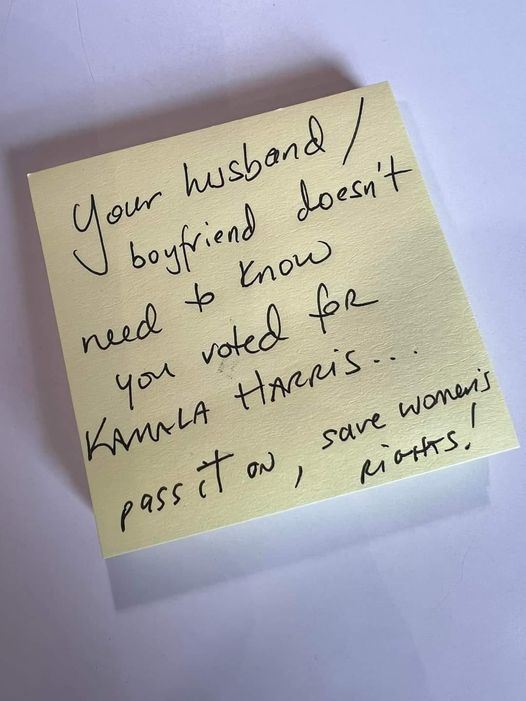
That’s why the post-it note campaign, reminding women that their vote is private, via a little fluorescent square in a public or business restroom, moved me to near-tears.
It’s easy, now, to think that my vote has always been my own, but I’ve lived through eras when women voted as their husbands told them to. My grandmother got to vote, for the first time, in 1924, at the age of 34. I asked her if she remembered who she voted for. She couldn’t, but she did remember asking her younger brother who to vote for. And she voted for that party for the rest of her life—another 70 years!
This may be the year that women decide to take back our rights.





 Teacher in a strange land