“Union Mouth”

So—when we’re immersed in the pre-election floodwaters of political revenge speech, it’s easy to snicker at the misfortune, if that’s the word, of right-wing social media edu-star Corey DeAngelis.

DeAngelis is—was?—the real deal, in education policy world. Not the kind of education policy that would re-build or energize our public schools, of course, but an attractive and even charismatic mouthpiece for the anti-union/school choice/privatization movement.

If you’re unclear on what happened to DeAngelis, last week—here’s the story.  (And here’s an interesting, even kind, response, from another one-time school choice advocate.)

If this were, say, 2014, when Corey DeAngelis was pursuing a skeezy “alternative career” that eventually became public knowledge, lots of folks would see it as an inside-baseball kind of chuckle—conservative education spokesperson gets caught being himself, ho-hum.

But the nature of public discussion about our schools has changed.

There have always been—going back to Thorndike vs. Dewey—vigorous arguments about the right way to do public education. Most people (including people who work in actual schools) don’t pay attention to these theories, philosophies and policies, unless they’re directly impacted. They focus on other aspects of schooling. And parents, by and large, are happy with the public schools their kids attend.

One of the things Corey DeAngelis contributed and honed, in these verbal ed skirmishes, was nastiness. The kind of unsubstantiated nastiness that we’re now hearing every day from political candidates on the right. Words like lazy, dumb, failing, greedy, groomers, socialists—and, of course, unions as root cause of all that is wrong with America and her children.

DeAngelis is one of the leading spokespersons, on social media, in the wave of anti-public education discourse we’ve experienced in the past eight years or so.  I wrote about some of the things he’s said, in respected publications, last May.

I posted a tweet about that blog post, asking WHY DeAngelis and others are trashing public education? What’s in it for them? Because this onslaught of anti-public education blather is not doing the nation and its children (no matter where they go to school) any good. This WHY was a serious question, BTW.

I got lots of tweeted responses, from DeAngelis’s army of followers, to whom I would ask the same question: What, actually, are you fighting for, when it comes to education?  Here are a few of those tweets:

Union Mouth! (followed by a string of vomit emojis)

I took my kids out of the gladiator academy/commie indoctrination center. Best choice I ever made.

Staffed by mediocrities (sic) who act like martyrs

Corey is bringing the future of education. Say goodbye to your current paradigm of croneyism and union interference.

The govt “school” system is nothing more than a taxpayer pipeline to labor union coffers, used to then (re-)elect politicians who promise more money for the pipeline. Education was never the point.

Public schools are a Dredge (sic) on society. Teachers are even worse.

And—my personal favorite:

Retire, you old hag.

I found myself blocking responses from people with names like—and I’m not making this up—Sexy Fart Bubble. Also wondering how school policy went from being a question of qualified staff and resource allocation to taking ugly potshots at teachers, school leaders and the millions of families who rely on public education.

I know better than to sputter about—or worse, respond—to random on-line vitriol. It’s acceptable now, evidently, to lie on public platforms; calling attention to falsehoods (or snickering at a messenger’s personal problems) is a distraction from focusing on what matters in debates about our schools.

Because—contrary to what Corey DeAngelis’s followers expressed, education has always been precisely the point. For better and worse, for everyone involved. Education has never been settled science. Our children are exposed to different influences and technologies than the previous generation of students; likewise, educational practice has to evolve.

Serving children’s educational needs adequately will—must—shift over time. And change is hard. Working through the changes, especially after a global disruption, demands civil discourse. Professional judgment. And an appreciation for facts.

Not lies.

So—no schadenfreude over seeing someone, whose minions called me “Union Mouth,” be exposed and having his name quickly erased from an array of education non-profit websites. There are far bigger fish to fry at the moment.

When one of your options for Leader of the Free World is seriously threatening to deport 30 million people, a large percentage of whom are children, it seems wrong to fuss over books somebody’s mom doesn’t like. Or spend a lot of time and effort trying to persuade people that teachers’ organizations, with their focus on working conditions in our schools, are harming children.

With all the free-floating fear and loathing in the American zeitgeist right now, it’s harder than ever to establish a classroom where students can develop the confidence to be a community. I am 100% on the side of educators who declare that students can’t learn unless they feel safe. The corollary to that is that teachers can’t learn and grow unless they feel safe, as well.

We are living in unsafe times.

If you want to influence policy change in public education, bring your best ideas and an open mind. Leave the nastiness behind.  

Are You an Instruction Geek?

I generally don’t pay much attention, anymore, to the rightwing young guns who dominate edu-social media. Mostly this is because they’re not providing any new content about what you might call school improvement—genuinely interesting or useful ideas for making lessons interesting, building curriculum that makes sense in 2024, figuring out better ways to assess student work and encouraging students to get excited about learning.

You know, the things that support the people actually doing the work of teaching in the public schools—where 82% of our K-12 students are educated. Instruction.

In the five decades since I started teaching, reading and writing about all aspects of schooling and education policy, there have been hundreds of such new ideas. Some were genius, some fizzled out, some—annual standardized testing springs to mind—are now part of what everyone thinks is normal, maybe even essential. Even though these ideas may have harmed many children.

The yappy bow-ties posting on the regular about how public education is a big fat failure aren’t offering us genius ideas. They’re focused on vandalizing one of America’s great strengths: a free, high-quality public education for every child, no matter what they bring to the table.

Prime example: Daniel Buck, whose X-label is “Instruction Geek.”

Buck actually did teach for a few years, shifting from public education to private, three schools in what looks like six years. Then he wrote a book and informed his following that he was, sadly, leaving the classroom to put his intellect to better use, writing blogs—as a ‘policy and editorial associate’ for a conservative non-profit.

For a guy who pretends to have cool, juicy ideas about instruction, lots of his posts seem pretty rigidly political and not about teachers’ professional work at all.  A sampling:

  • Conservatives need to start thinking about, building, and regaining control of our education institutions after school choice becomes the law of the land. Won’t do much good if all charter and private schools are stocked with teachers, curriculum, and policies out of ed schools.
  • Teachers, stop voting for Democrats. Their education policies sound nice but again and again just make our schools worse.
  • Once again, I repeat: MORE MONEY WILL NOT FIX AMERICAN SCHOOLS.
  • Students should be expected to obey their teachers. Seems pretty common sense to me but sadly, a statement that must be made.

The last one made me think that perhaps Mr. Buck’s former students had ideas of their own about, umm, instruction, but maybe I’m reading too much into his little outburst.

A couple of days ago, Mr. Geek Buck posted something that’s actually about instruction:

Sorry but one teacher cannot differentiate every lesson for 27 different kids whose reading level ranges from 1st to 11th and account for 6 different IEPS. The inclusion/no-tracking push is simply unworkable.

There were a few affirming responses—because clearly, classroom teaching is impossible; the only way to give each individual child precisely what they need is one-to-one tutoring. And, by the way, that doesn’t work so well either.

I started thinking about differentiation in my own classroom. My typical class size hovered around 65 middle school students. Their reading levels ran the K-12 gamut, and I frequently had a dozen or more special education students (with varying disabilities and strengths) in a class. Some students were inclined to disobedience, things that couldn’t be remedied by mere expectations. Oh—and they were all holding expensive noisemakers.

My job was teaching them to make pleasant and accurate musical sounds, then combine those sounds, using an entirely new symbolic language, into music, with regular performances for their parents, their peers and the community. I also had to weave some cultural and historical information into the instructional mix—things that would help them see the beauty and value and joy of what they were (inexpertly) crafting.

Everyone was included. Nobody was tracked (beyond being in the band with their grade-mates). Some of my band-teacher colleagues had auditions and sorted their students into a top ensemble, and lesser-light bands. The drawback to painstakingly dividing groups by “ability” is that ability is really hard to measure, and students who are deemed sub-par often drop out. Students also learn at different rates. The kid who’s way behind in September may be caught up in January and at the top of the class at the end of the year.

I’m fully willing to admit that there are many ways to teach kids important content, but I never met anybody who made 27 lesson plans for a single class. Most differentiation happens across the instructional cycle—presenting new material multiple times in multiple ways, offering different forms of an assignment, assessing work based on what you know about that student. Student choice can be a big part of differentiation.

And sometimes, of course, they all take the same 10-question quiz, so you can get a handle on who’s got it reasonably well, and whose understanding just isn’t there. That’s OK, too. You don’t have to divide them into tracks. They already know who’s smart and who is struggling.

I love nothing more than talking about instruction. Pedagogy is my jam. And I resent people self-appointing as instructional leaders and experts, when all they’re doing is using public schools for target practice.

Here’s one more from the iGeek:

Advocates are trying to retrofit schools to do all that families should / used to — from feeding three meals a day to teaching basic behavioral norms. They are failing at doing so. No public institution can correct for the breakdown of the family.

Be wary of the word “should”—always—but take a look at what teachers are accused of here: teaching good behavior and feeding kids. Maybe no public institution can truly fix the breakdown of families. But don’t schools get credit for at least trying?

Forget the “Undecided.” Focus on the Timid.

I read the NY Times daily (I know, I know…) and am an avid follower of their political focus groups. Little sketched heads with thumbnail descriptors (“Bill, white, Florida, 73 years old, voted Trump in 2020”) and their responses to some pretty good policy- and character-focused questions.

To which, they give answers which make me wonder just who their 9th grade Civics teachers were. Lately, the spotlight has been on “undecided” voters, nearly all of whom, IMHO, decided long ago whether to vote and which holes they’ll be punching, behind the curtain, but are anxious to be recognized and asked about their views.

I guess there’s some social cachet in being an “undecided” voter—so discriminating!– but for anyone who can name the people running for President and Congress in their state and district, this election feels like there’s been plenty of information and exposure to what the candidates represent:    The New York Times says undecided voters want more “fine print” details. Really? They’re so lightly engaged that they haven’t made up their minds yet, but they want to dive into the intricacies of tax policy? Unlikely.

In addition, the 67 million people who tuned into the debate on Tuesday got an incredibly clear picture of the candidates’ character and policy goals (or lack thereof).

Here are the people who interest me: The timid. The folks who claim to not be interested in politics. The ones who blanch at the critiquing of men too old and confused to lead the most powerful nation on the planet. Who just want to, you know, get along.

Some of these are people whose votes represent old habits, the influence of their social circles. Some of them are fearful.

Whether that’s fear of change (Will the country finally get a woman in the White House? Will a new president mean that I lose privileges I currently enjoy?)–or fear of breaking away from baked-in but no longer relevant beliefs (Republicans are pro-business and therefore better understand economics, right?), it’s hard to say.

I have written about these voters before—the ones who seem to operate from the gut, whether their gut was telling them to be angry, suspicious… or joyful.

Fact-checking engages only the most involved and informed voters. It doesn’t matter how many times you point out who wrote Project 2025, and how deeply they are enmeshed in the Trump campaign, if you got an oversized postcard from Trump (got four this week) saying he’s disavowed it, well—who are you going to trust?

This is how voters get suckered into believing literally ridiculous claims (Pets for dinner! Executing newborns!) and conspiracies.

Since President Biden’s withdrawal in July, I have joined three Facebook groups and re-activated my interest in another, all groups of women who are planning to vote for Kamala Harris. One group goes all the way back to the Womens March in 2017. Collectively, there are over half a million women reading and posting to these particular groups. And there are hundreds more of these pages, around the country.

And what gets posted and discussed—long, long discussion threads—is fascinating.

It started out with middle-aged women in pearls, blue nail polish and Chuck Taylors. The things they’ve made—hand-painted signs, KAMALA quilts, jewelry and So. Much. Blue.  It was fun to skim, and thousands of new women were joining every day, calling out their towns and looking for friends’ names.

People would post stuff like: My husband says no yard signs, so I just made this blue wreath (beautiful photo) for our front door, and a few hundred women would compliment the wreath and a handful might wonder out loud why the wreath-maker doesn’t get a vote, re: yard signs.

The tone is generally upbeat—finding each other, sharing values—but there have been many, many thoughtful threads discussing how to deal with Trump voters among your friends and family. Some of those conversations are heartbreaking; you realize how divided we have become, and why.

There’s chat about issues, including but not limited to abortion. In every thread, there is someone who says Thank God for this group. I have nobody to talk to.

This is a real thing, this political loneliness. (See,for example: The Lonely Anger of Democratic Women in North Carolina.)

It all comes down to circles of influence. Who do we talk to? Who do we believe?

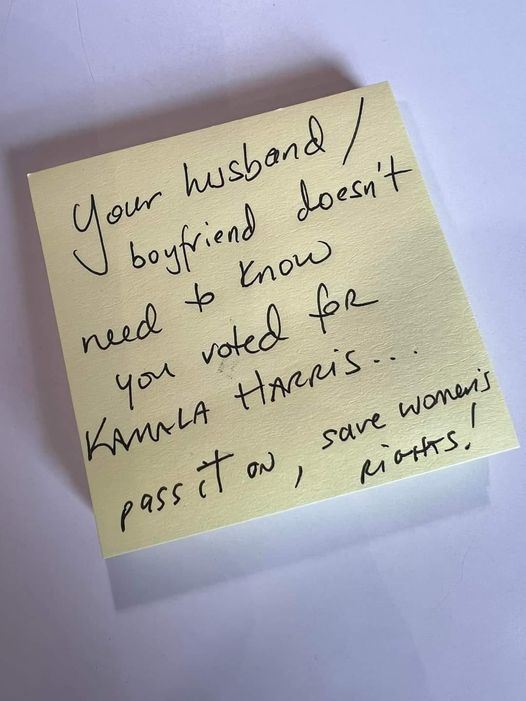
That’s why the post-it note campaign, reminding women that their vote is private, via a little fluorescent square in a public or business restroom, moved me to near-tears.

It’s easy, now, to think that my vote has always been my own, but I’ve lived through eras when women voted as their husbands told them to. My grandmother got to vote, for the first time, in 1924, at the age of 34. I asked her if she remembered who she voted for. She couldn’t, but she did remember asking her younger brother who to vote for.  And she voted for that party for the rest of her life—another 70 years!

This may be the year that women decide to take back our rights.

In the absolute privacy of the voting booth.

What Do Parents Know About Public Education?

Not much.

But don’t take my word for it. Kappan recently took a look at American adults’ knowledge of public schools:

Our findings shed light on a key question: What do adults know about U.S. education? Specifically, what do they know about what is taught, who makes decisions, the role of parents, and the belief systems driving education policy? Our results have important implications for how we might support children and improve the education system.

No kidding, Sherlock.

The survey results would come as no surprise to veteran public school educators: Half of adults don’t know what is/is not taught in their local school. Most are unsure about who’s making curricular decisions. Most are unclear on the impact of privatization on their public schools. Some of the surveyed issues (Critical Race Theory and learning loss) revealed a complete lack of understanding.

Least surprising finding: Adults’ perceptions of what’s happening in public schools mainly come from their own personal experiences (and this includes people with no K-12 children in the home). The percentage of people who read books or articles, watch cable news or videos, or listen to podcasts about education is small. People who get their education news from newspapers? Fifteen percent. Second highest source of ed news? Social media.

That’s a lot of guesswork, memes and faulty memories.

Kappan makes the case that more information means that the general public will make better choices around education—correctly evaluating the corrosive impact of privatization, say, or understanding why a teacher can’t create 30 different assignments, or seeing the benefits of teaching real history. Better communication will lead to better schools, they say.

Well, maybe.

As Larry Cuban says, we’ve been fixing public schools again and again and again, frequently with little or no evidence that our bright ideas will be effective:

Ideologies and political power matter far more than research-derived evidence. Very little evidence, for example, accompanied the New Deal economic and social reforms to combat the Great Depression in the 1930s. Nor did much evidence accompany the launching of Medicare or the Elementary and Secondary Education Act in the 1960s. And very little evidence drove federal oversight of U.S. public schools in No Child Left Behind (2002). Reform-driven policies are (and have been) hardly research-based.

Again—anyone who’s worked in a school for years can testify that, yes, ideologies and political power matter more than research or concrete evidence. And much of that local political power (elected boards, school administrators, influential parents) yields decisions based on personal experience, decades earlier. No evidence or data in sight.

Here’s an example. Some years ago, the curriculum director in my district proposed a new student reporting system for all our elementary students. Instead of grades—a single grade for each subject, plus a checklist for appropriate behaviors—he created a complex system wherein teachers would evaluate multiple objectives for each subject. The number of objectives would increase, in each of the six reporting cycles, until the final report card, which would include the entire years’ curriculum, laid out in sequence.

It meant the teachers would be evaluating—from introduction to mastery—well over 100 skills and knowledge nuggets. Six times a year, for 30 students. Parents would be given several pages of personalized data, a detailed guide to the entire grade-leveled curriculum, as laid out in the district’s master plan (which the teachers called ‘the black notebooks’), and concrete evidence of their children’s progress.

He actually got this plan through the school board, buoyed by professional journal articles about standards-based assessment. Teachers were less than enthused.

But the plan ultimately failed because parents emphatically did not want pages math and language skills. They wanted grades. They knew what a B+ meant. They did not want to know whether their child could calculate a percentage or identify the subject of a sentence. That was teachers’ work.

Another example: How do we cope with teacher shortages? States and districts all over the country are scrambling to fill positions. Any teacher could give you the right answer: Pay teachers more. Provide adequate resources. And give teachers control over their professional work.

Why are we even talking about reducing qualifications for teaching? Do parents want under-qualified pseudo-teachers heading their kid’s classroom? I doubt it. Recent surveys asked students which quality made teachers “good.”

If you’ve been a teacher, you know the top—73%–answer: They cared about me, as a person. If a would-be teacher cares about students and their learning, they’re willing to jump through the hoops of certification and preparation. They’re willing to invest in a professional teaching career.

And—what do parents know about college? That college is the path to a better job? That getting into the ‘right’ college means everything? Not so fast. College loans burden 43 million Americans who might otherwise be investing in housing. Or—attn, JD Vance!—starting a family.

Parents who support public education by putting their kids into neighborhood schools, then paying attention to what comes home—stories, student work—are doing exactly what makes schools community centers and produces good citizens.

My story about the Report Card from Hell is evidence of this. Parents felt free to critique a new plan (based on their personal experiences and preferences)—to the point that the plan was scrapped. Administrators got over their ‘research says’ biases. Teachers weren’t spending additional weekends cross-referencing student work and checklists, for information that could change tomorrow. The community was satisfied.

What communities need is not more information. It’s trust in their public schools.

Hysterical Women

Truth nugget: Education policy is 100% shaped and impacted by the fact that three-quarters of the education workforce is female.

Another truth nugget: After Trump was elected in 2016, over a million women descended on Washington DC to march against what he stood for.

And now, after the events of Summer 2024? Well, do your own math, draw your own conclusions. Maybe start your own organization and host a national call.

As the inimitable Dahlia Lithwick noted: The court granted itself the imperial authority to confer upon the president powers of a king, but although Justices Sonia Sotomayor and Ketanji Brown Jackson said as much in their respective dissents, it fell to Big Daddy Chief Justice Roberts to intone to his readers that their aggregated dissents strike “a tone of chilling doom that is wholly disproportionate to what the Court actually does today.” Implying that the dissenters were overreacting, and without ever attempting to address the substance of their claims, Roberts accused them of “fear mongering on the basis of extreme hypotheticals about a future where the President ‘feels empowered to violate federal criminal law.’”

In other words, sit down ladies. You’re hysterical. We don’t appreciate your chilling doom or your extreme hypotheticals. A President who feels empowered to violate federal law? Hahaha! That could never happen!

This type of response could come in handy for pacifying those whose policy/practice wheelhouse is education. It’s a familiar tone policing strategy for those of us whose professional lives revolve around the classroom, especially in public schools. You’re overreacting! It’s only bus duty! What’s one more kid in your class? Why can’t you maintain control over 24 second graders on Zoom?

But. What if women were united to push the ed policy envelope?   Connie Schultz, wife of the SENIOR Senator from Ohio, Sherrod Brown, has some wise words about what happens when women organize: I know that something else—something glorious—often happens when women gather for a cause. I think of it as coming home.

More wise words, these from Kate Manne:

Many of you are now in the same position I am in: all in for Harris as the person who can beat Trump and head off the incalculable threat facing our country. We are terrified as/for girls, women, and any person who can get pregnant. We are terrified as/for the racially marginalized people who Trump has firmly in his sightlines. We are terrified for trans and queer folks who would face existential threats to their well-being and very existence under the next Trump administration. We are terrified for whatever semblance of democracy that remains and might perhaps be rebuilt. The list goes on. There is no question that Harris’s candidacy will open up a torrent of misogynoir, the intersection of misogyny and racism (particularly anti-Black racism, although Harris is also of course South Asian). It’s our job to fight it in our circles and even ourselves.

Do women have the power to transform thinking about the bedrock value of a strong public education system, in the face of Project 2025? Just a reminder:

Trump tells voters on his campaign site a few ways he would manage education:

  • Cut federal funding for schools that are “pushing critical race theory or gender ideology on our children” and open civil rights investigations into them for race-based discrimination.
  • End access for trans youth to sports.
  • Create a body that will certify teachers who “embrace patriotic values”.
  • Reward districts that get rid of teacher tenure.
  • Adopt a parents’ bill of rights.
  • Implement direct elections of school principals by parents.

That last suggestion is sheer folly, by the way —any teacher OR school administrator will tell you that it’s a recipe for never-ending chaos and enmity in schools. Besides, parents can run for the local School Board or elect people to that Board who will select appropriate school leaders for the community. I personally have seen, on multiple occasions, a group of parents make things hot for a principal, via a democratic process involving their elected board. I have also seen good administrators protected—by the same Board—from a single outraged, vindictive parent.

Kate Manne is right when she says we need to fight bad policy and reprehensible candidates “in our circles” and even in our selves. And nobody is going to fight against misogyny and racism more effectively than the people who are impacted. Therefore, protecting your public school may be most effectively accomplished by women, gathering for a cause.

Don’t want public education to be taken down by the slings and arrows of Moms4Liberty and Project 2025? Talk to your friends. Put up a sign. Donate. Volunteer. Organize in Zoom circles. Repeat vigorously for the next 82 days.

Derek Thompson of The Atlantic points out, in a revealing column that …parties aren’t remotely united by gender. After all, millions of women will vote for Trump this year. But the parties are sharply divided by their cultural attitudes toward gender roles and the experience of being a man or woman in America. When the VOTER Survey asked participants how society treats, or ought to treat, men and women, the gender gap exploded. Sixty-one percent of Democrats said women face “a lot” or “a great deal” of discrimination while only 19 percent of Republicans said so. In this case, the gender-attitude gap was more than six times larger than the more commonly discussed gender gap.

With a majority-female workforce, change will come only when women demand policy that invests in public education. Women teachers, often working mothers, value tenure. Women teachers do not want mandated certification of their “patriotic values.” And they don’t want a President or Congress that embraces the horror show of Project 2025, especially when it comes to education.

Reminder: The Chief Justice of the Supreme Court called his female colleagues “fear-mongers, on the basis of extreme hypotheticals.” In writing.

 Welcome to the Three-month Campaign! Seriously. Welcome.

More than four years ago, in April 2020, I wrote this ridiculously optimistic piece: A Dozen Good Things that Could (Just Maybe) Happen as a Result of this Pandemic.

Every now and then, I pull it up, shaking my head over the concept that an unprecedented global pandemic could shake loose great ideas and get folks to—tick-tock!—act on them, a kind of “if you only had six months to live…” scenario for the nation.

In my own defense, I had barely been out of the house for weeks and had been fixated on the horrifying numbers and clown-show daily ‘briefings’ from the White House. Doom-scrolling and baking aren’t conducive to embracing political realities.

I still think they were good, actionable options for change, however. Where I was totally wrong: the communal lessons that might be learned from surviving a pandemic, together. In fact, I was most wrong about the “together” part, which never really got a toehold, even as the virus took its terrible toll.

Some of us are uniters. And some are dividers. Lately, the dividers have been winning.

Response to the blog could be summarized as: I wish. People wished that the pandemic would lead to better health care, better air and water quality, renewed friendships. But they didn’t see even a global catastrophe moving the needle here in the land of the brave. The one good thing that came from the pandemic where I live? A third of my county finally got the internet.

In April of 2020, Joe Biden had just been named the presumptive nominee for President. In the previous ten months, we’d been exposed to 11 debates, with so many candidates (20) that they were sometimes split into two groups, debating on different nights. It seemed pretty clear that a full year and a half of campaigning did nobody (except perhaps the 2020 incumbent) any good.

Here’s what I wrote, in April of 2020:

How about a complete re-do of American elections?  For once, the hype is true: this election matters more than any in your lifetime. If the Democrats hang tough (and they should), we might get national mail-in voting with other policies that make registration and voting easier for the November election. Americans overwhelmingly want this.

There could be even more, given a Democratic Congress and Executive branch in the fall. We could jettison or alter the Electoral College.  We could also pass a law limiting the presidential primary, given the headaches, unnecessary spending and ultimate results we got. Canada, our closest and most similar neighbor, elected its last prime minister in eleven weeks.

Thought experiment: Imagine that Congress passed a law limiting primaries to six months, still way longer than other first-world nations, and set a national primary date with top-three, rank-order voting. That would mean campaigning for November 2020 would begin next month! Knowing what we know now about the world—would debates be about more than the horse race and which state votes first and gotcha questions? If we overturned Citizens United, and set spending limits (again, like other nations), we might ultimately get ourselves a reasonable set of qualified candidates and a fair election.

Am I glad Joe Biden eventually prevailed in 2020? Absolutely. And I agree with all the commentary about his successful presidency and heroic decision to stand down.

But I am flat-out amazed at what has happened in the past week, with so little primary-like fuss and fanfare, soundbites, rallies and pounced-on gaffes. And I can’t help wondering why we haven’t shut down the perpetual campaign machine in favor of limiting the time and money spent, given the results we get. Is this about the media and revenue streams?

I wish I had a dollar for every time someone complained about TV ads, mailings, yard signs and repellent messaging. And if I had a dollar for every voter who didn’t pay attention to politics, I’d be in the Forbes 500.

The three-month campaign ahead of us feels positively refreshing. It will be intense—it should be—but it will be over soon. Michigan voters can send in their ballots 40 days before November 5th. The end of September.

There’s been some talk about how risky the Harris candidacy is, floating the possibility of a mini-primary or reasons to re-think promoting the Vice President. But I think Rebecca Traister gets this exactly right in this column: The Case for Being Unburdened by What Has Been. The thrill of taking a huge risk on Kamala Harris.

 Our national political narrative [is] finally accurately mirroring our national reality: Everything is scary, we have never been here before, we don’t know if we can do this, and precisely because these stakes are so high, we are at last going to act like it, by taking unprecedented, untested, under-polled, creative measures to change, grow and fight at a pitch that meets the gravity of the urgent, existentially important task in front of us.

The word I like most here is “urgent.”  Things can go wrong with a long, leisurely primary season where a party eventually settles on just the right candidate. (See: 2016.) They’ve gone wrong in any number of elections, convention or primary, over two centuries plus. Sometimes, making a good-faith choice and jumping off the electoral cliff works out.

In the meantime, listen to Keb Mo. He’s got the right idea.

Critical Issues and Minutiae of Public Education

I have been fascinated, in the past 48 hours, by online conversations about the tumultuous political week we have just lived through—especially the comments and questions generated by teachers.

Non-teachers are heartbroken or thrilled or both, by the Biden step-down. They’re nosing out the negative PR and potential VP picks of the presumptive new nominee. There are running threads and analyses around the assassination attempt, a mass shooting where everyone knew the intended (again, presumptive) target, a change from the faceless victims—many children, damn it—of other mass shootings.

So much is in flux. So many building blocks of democracy, teetering on the edge. Including public education.

But we’re approaching (in many parts of the country) the beginning of the school year. Much of the ongoing cyber-conversation around public education centers on clearing back-to-school lists (i.e., teachers begging for essential supplies the school can’t afford), the futility of professional development for yet another silver-bullet reading program, why teachers aren’t paid for setting up their classrooms and other garden-variety School Stuff. The kinds of issues and beefs we see annually.

There are a hundred things that weigh heavily on teachers’ minds as they prepare for another year. What I’m wondering is if teachers are focused on the trees, rather than the destruction of the public education forest. Because focusing on bulletin boards and class lists instead of the section of Project 2025 that deals with education feels do-able, not overwhelming. Or terrifying.

Washington Post advice columnist Carolyn Hax posted a letter about a “rude” teacher who created individual certificates for each of her students at the end of the year. The mother who wrote the letter was upset that individual kids were nicknamed Class Clown and Social Butterfly and–gasp!–her daughter was designated “Miss Manners.” So upset that she reported her ire to the superintendent, after the principal gently suggested these certificates were warm-hearted, not criticisms of children’s character.

Aside from the fact that many parents would be delighted or relieved were their child awarded recognition for having excellent manners—the letter bothered me way more than it should have. Because I have been that teacher, striving at the end of the year to recognize and acknowledge students’ achievements, but also their individual quirks, their signature traits, their contribution to the musical community we built.

Hax rightfully chides the mom for attacking a well-meaning second grade teacher, on the last day of school, no less. But what most folks—non-teachers—will miss is that the success of any teacher, broadly defined, lies in building honest relationships with kids who bring varying intellectual and emotional strengths to school.

Not everyone is an academic superstar or natural helper. Many students will need to be coaxed or cajoled into effort, participation and belonging. Those skills are just as important as content expertise, a full toolbag of instructional techniques and endlessly logged data.

My own end-of-year awards included every band kid. Now—decades later—I still hear from students who remember the last full day of school (after the instruments were all oiled and stored for the summer, the music sorted and filed, and the sink—yuck—cleaned and shiny): The thank-yous. The in-jokes for band members. The Jolly Ranchers. The camaraderie. I recently heard from a woman who remembered winning the “Most Improved Section” award—and she was the only oboe. She included a smiley face.

The Hax column drew hundreds of responses from teachers.

Today, I have been watching teachers on social media saying:  Be kind to the social studies teachers in your building. We’ll be working on overdrive!

Well, yes. You go, teachers. The world is on fire, and your job is to pretend that the only thing that matters is following the prescribed curriculum and keeping your head down in the classroom. We get it—and we love and support you.

But as we launch 2024-25, it is incumbent upon all of us whose livelihoods are not threatened by free speech to keep education policy and the very real threat to public education bubbling up every day on social media and in our friend groups.

 It’s been a wild couple of weeks. But keep your eyes on both the threat and the prize.

I am a Patriot

I am a patriot and I love my country. Because my country is all I know.

Jackson Browne

Of all the things manifested by the upheaval dividing this nation politically, the appropriation of the concept of patriotism by the right wing troubles me the most. Why? Because my country is all I know–and I am loyal to its virtues and principles, while fully recognizing its many tribulations.

I’m sure that every citizen registered to vote in November feels the same way: they’re voting to save the country from sliding into despotism, to secure freedom, the blessings of liberty, yada yada. The fact that the two distinct roads to said patriotism diverge in a black forest of confusion, even violence, is terrifying, however.

Who’s the patriot? And who deserves to have their lives and values suppressed?

Watching the news, and reading—one laborious, revolting chapter at a time—Project 2025, it’s pretty clear that the authors of that document feel that their activist zeal to change the nation is driven by patriotism, their love of country, And if that drifts over the line to white nationalism, well… many of our leading Senators are down with that, too.

It’s funny. One of the things I was never uncomfortable teaching or promoting in the classroom was an explicitly pro-America, patriotic point of view. Musically, and culturally, I endorsed patriotic traditions and celebrated the musical innovations that sprang from so-called melting pot.

Kind of ironic, considering how I felt about the Vietnam war, and the arguments I used to have with my father, a WWII veteran. My country, right or wrong, was his modus operandi. But I thought then, back in the 1970s, and even now, that loving the place where you live, where your ancestors settled, where you’ve put down roots and built community, means you can also be clear-eyed about mending  its every flaw.

I am a patriot. And I love my country.

I love the idea that it took decades of discourse for the early, 18th century Rebels (by no means a majority) to organize in resisting colonial rule, fighting the imposition of taxation without representation (which still resonates today). I think all children in America should know the truth about our Founding Fathers, and their multi-racial legacies.  I think elementary schools should hold mock elections and HS Social Studies teachers should organize voter registration drives. I think flying the national flag—right side up—is everyone’s prerogative.

I also think the Superintendent of Schools in Norman, Oklahoma, who declared “We’re not going to have Bibles in our classrooms”—after a memo from Ryan Walters, their moronic State Superintendent specifying that all OK classrooms will offer Bible-based instruction—is a patriot.

A patriot who understands our foundational principles–the separation of church and state, for example. Perhaps even a patriot who sees citizenship-building, not just job training, as a core purpose of public schools.

Can patriotism be taught?

E.D. Hirsch just published a book in which he states that we can:

 “…transform future citizens into loyal Americans.” Hirsch feels that “patriotism is the universal civil religion that our schools need to support on moral and pragmatic grounds as the glue that holds us together.” He believes the foundation of patriotism is in a shared knowledge base, which all citizens must have to participate together in a community or engage in communication. Hirsch states, “we can create specific standards, so each classroom becomes a speech community whose members all understand what is being said, because they all possess the needed relevant background knowledge.”

This is classic, evidence-free Hirschian blah-blah. If only everyone analyzed the Articles of Confederacy together, or memorized the Gettysburg address, or studied Julius Caesar in the 8th grade (using Hirsch’s handy-dandy curriculum guides, of course), we’d all get a boost of love-yer-country loyalty? Because we’d all be on the same academic wavelength?

Having spent decades hanging out with actual middle schoolers, who were taught a fairly universal set of ideas and skills, I can tell you that more standardization will not make anyone more aware of the virtues or drawbacks of real life in a diverse democracy. Furthermore, the whole idea is vaguely reminiscent of other, failed social movements.

You can model genuine patriotism. You can teach patriotic–and protest–arts and literature, to enlarge students’ perspectives on what it means to endure hardship and sacrifice in the service of one’s country. You can toss out provocative ideas—Should everyone be compelled to recite the Pledge of Allegiance?—and your average fourteen year old will undoubtedly have an opinion, which you can then dissect and examine.

But you can’t make kids love the United States of America.

No T-shirt or baseball cap, let alone a traditional school curriculum, can do that. It comes from maturity, and the heart.

My Country ‘Tis of Thee (Land of Inequity)  Song by Reina del Cid

Labor Day. Happy Birthday to Me.

So—I just had a birthday. A big, round-number birthday. All my life, my birthday has taken place in and around Labor Day weekend, and—fairly often—happened on the first day of school. For my entire elementary school career, my new school shoes, binder and pencil box were ‘birthday presents.’ (Sad trombone.) Kindergarten: But I didn’t mind.…

Unsubstantiated Things People Say about Public Education

There are plenty of unsubstantiated clichés people have traditionally expressed—and probably believe– about education: Private schools are better than public schools. Sports keep kids in school who would otherwise drop out.  We should flunk 3rd graders who struggle with reading. Public education is broken, and choice is the only solution. I could go on. And…

Band Kids. They’re the Best.

I can’t add anything to the outpouring of love and respect for Dolly Parton. She was phenomenal, in dozens of ways. As a musician, I appreciate her melodic genius and as a writer, I admire her gift for lyrical story-telling and poignancy. But what I’ve loved most, this week, is that black and white of…

The Grinch Who Stole Teacher Appreciation Week

I’ve always been of the opinion that teachers get so few routine perks in their professional lives they deserve every random treat or award that meanders their way–from sticky little misspelled mash notes to free use of a leased SUV.

After all, there aren’t many workplaces where professionals end up providing their own materials, cleaning services and professional development. There aren’t many college-educated specialists who gladly share their expertise for free–or attend a weekend conference on their own dime, then arrive at work on Monday morning, without a thought for “comp time.” Because if they didn’t show up, someone would have to pay. And it shouldn’t be the teacher next door, or their students.

For these reasons, and a hundred more, nobody begrudges teachers the tokens of appreciation that come their way this week, from the handmade construction-paper cards to the potluck lunch from the PTA. I love it when teachers invite their former students to check in on Facebook–or when they post their stats (years of experience, states/countries/schools, degrees, subjects and so on). It’s good to see colleagues reclaim their honor or share a few points of pride.

But it’s time we asked ourselves just who gets ‘appreciated’ once a year–and whose work is considered vital, essential, and fully professional year-round, with no need for annual symbolic gestures. There’s something about Teacher Appreciation Week that smacks of a pat on the head for being willing to go the distance without adequate compensation or support. We’re supposed to persist and excel ‘for the kids’–a phrase that teachers rightfully perceive as specious and manipulative.

It doesn’t help that National Charter Schools Week is scheduled right after Teacher Appreciation Week (not an accident, folks). The Center for Education Reform, an organization that promotes charter schools, posted the following about Teacher Appreciation week:

‘Rather than evolve and adapt to changes in the 180-year-old factory model system of education, rather than create a new path for teachers that supports their growth over mandating uniformity and lock step acceptance of rules, [teacher associations] have dug in their heels and decided character assassination and anti-charter propaganda is best.’

So much for boosting the spirits and self-respect of teachers during their special week, eh?

Actually, I don’t know a single teacher who isn’t interested in growth–or doing a little rule-breaking, evolving and adapting. In fact, the current walk-outs, anti-voucher campaigns and eloquent education blogs are evidence that teachers are no longer satisfied with flowery sentiments or coffee mugs.

Teachers are telling their communities and state leaders that they’re sick of being underpaid do-gooders and want not only adequate salaries but control over their professional work. They want the resources necessary to succeed—but also a measure of autonomy, acknowledgment of their acquired expertise.

Perhaps teachers are tired of waiting for policymakers to speak to the fact that their working conditions and public respect–measured by classroom authority, as well as wages and benefits–are diminishing every year. Maybe teachers are ready to demand what they need and deserve, rather than hang around hoping to be ‘appreciated’ every May.

Is this a lasting change? Will exasperated teachers not rest until they’ve transformed public education?

Here’s a few crucial but often forgotten facts: In number, teachers are the largest profession in the United States. And collectively, they have the power to demand and win changes to funding and salaries. It’s a stark reminder in our post-Pandemic revival of labor influence.

Policymakers have long relied on teachers’ hearts growing three sizes through the magic of watching children light up with the joy of learning, yada yada. But as the Grinch himself might say–magic doesn’t pay the rent.

DIS-Information in Schools

You may have heard the story, a couple days back, about a Republican legislator in Michigan posting a photo of buses at the Detroit Metropolitan Airport, claiming the buses were transporting “illegal invaders.”  News stories politely suggested that he was erroneously referring to undocumented immigrants—after all, Representative Matt Maddock is still in the Michigan House—before confirming that the buses were, in reality, transporting four men’s basketball teams competing in this weekend’s Sweet 16 and Elite Eight games in Detroit.

Was Maddock (whose wife, Meshawn, was recently Co-Chair of the beleaguered Michigan Republican party) simply misinformed? Doubtful that he was hanging around a major metropolitan airport (which is not, by the way, in his district), watching planes and buses come and go, and simply, you know, got the wrong impression about a few dozen young men—tall ones– getting on buses.

Nor has he apologized for what might have been a dangerous trigger, inviting local yahoos to saddle up and head for the airport. In fact, he’s continued to post:

“We know this is happening. 100,000’s of illegals are pouring into our country. We know it’s happening in Michigan. Our own governor is offering money to take them in! Since we can’t trust the #FakeNews to investigate, citizens will. The process of investigating these issues takes time. The whole nation knows about the Democrat illegal invasion human trafficking criminal enterprise. Why does the media only work to cover it up?”

Welcome to Detroit, college athletes.

Back in the day, as part of what used to be called a ‘unit,’ my 7th grade English teacher, Alison Olding, taught us the difference between misinformation (when you think you know something, but it’s wrong) and disinformation (when you deliberately plant known falsehoods). There were plenty of examples to share with a group of 7th graders, back then, and now. Spreading misinformation in middle school (a daily occurrence) is always wrong, but making stuff up to harm someone else is a special kind of reprehensible.

And yet, here we are, hip-deep in AI deepfakes and college professors hosting far-right websites protecting “the American way of life”  and government interventions to suppress social media and—God help us—Russian disinformation about their insatiable, immoral war in Ukraine:

 “The strategy that matters most for the Kremlin is not the military strategy, but rather the spread of disinformation that causes the West to back away and allow Russia to win. That disinformation operation echoes the Russian practice of getting a population to believe in a false reality so that voters will cast their ballots for the party of oligarchs. In this case, in addition to seeding the idea that Ukraine cannot win and that the Russian invasion was justified, the Kremlin is exploiting divisions already roiling U.S. politics.” 

Kinda makes you wonder: Didn’t any of the Republican congressmen on the pro-Putin side learn about misinformation and disinformation in school? How to sort out fact from fiction? How to research questions around information that may or may not be true—and how to accurately evaluate sources that may be biased, or flat-out lying?

It’s a serious and critical education question. There are, indeed, public schools where media literacy is a formal part of the curriculum. There are outstanding digital literacy resources for students, supported by high-quality research. What’s missing is the will and the urgency of the need to educate kids about distinguishing between truth and whatever it is they’re getting on TikTok.

Or, unfortunately, at their kitchen tables or their church or on the bus. Misinformation—can you remember Things You Used to Believe?—has always been a factor in growing up and becoming educated. Disinformation is a darker thing altogether. Especially when it comes from people who should, theoretically, represent integrity. Legislators, for example.

Discussing this with one of my favorite cyber-colleagues, Barth Keck, he said: I teach these very strategies in my Media Literacy class. Sadly, I fear most adults nowadays – including the people on this platform – lack the patience or interest in employing them. I just discussed this point with a colleague who teaches Speech & Debate. He’s seeing kids parrot talking points rather than thinking deeply about issues. Whom are they parroting? Many adults are a lost cause; it’s the kids who need to learn to think critically.

A short piece in the Michigan Advance made this point simply: Disinformation makes our communities less safe. We are not powerless in this plight. Disinformation pulls apart our communities, and community itself is key to fighting back.

Even when it’s uncomfortable or not neighborly or involves a guy you may have enthusiastically voted for, once. When someone is spreading disinformation—even if it’s disinformation that faintly echoes your beliefs about the southern border, federal lawmakers or who deserves a handout—it’s wrong, and they need to be called out. For the sake of your school and community.

Disinformation IN schools is often disinformation ABOUT schools. All of those laws nominally designed to “protect” students from things that make folks uncomfortable—like classroom discussions about lynchings or honest talk in health class about sexual preferences—only open the door for students to absorb misinformation and disinformation when they don’t get the truth in school.

Here’s a heartbreaking and lethal example. My school used to offer, as part of community education, a hunter safety class. You had to be a certain age, produce appropriate licensing, learn about (and be tested on) the safe use of firearms, including keeping them secured when not in use.

Michigan is a hunting state. Opening Day in deer season is often a school holiday. We weren’t thinking about guns as evidence of masculinity or patriotism—or revenge. Our parents weren’t giving us handguns as an early Christmas present.  Our legislators weren’t posing with the whole family carrying assault weapons.  That’s the disinformation part.

From a piece on the 2022 school shooting in Oxford, MI:

What’s particularly hypocritical here is that the most strident defenders of this [gun] culture skew conservative and talk a lot about what isn’t appropriate for children and teenagers. What they think is inappropriate often includes educating kids about sex, about the fact that some people are gay or transsexual and about racism. It’s a perverse state of affairs: Exposing children to simple facts is dangerous but exposing them to machines designed to kill is not. You can’t get your driver’s license until you’re a teenager, or buy cigarettes and alcohol until you’re 21, but much earlier than that, kids can, with adult supervision, legally learn how to end someone’s life.

In Michigan, the shooter’s parents are going to prison for providing their son with disinformation; families and a school district are forever torn.

Once more: communities are the key to fighting disinformation. Start now.