The Folly of Settled Science

It was on Morning Edition, seven years ago—a cheery little piece on how we now know just how to teach students with dyslexia how to read. Interesting, I thought then, expecting to hear about some new breakthrough technique in reading pedagogy. Instead, what I heard was this:

Dyslexia is the most common learning disability, affecting tens of millions of people in the United States. But getting help for children who have it in public school can be a nightmare. “They wouldn’t acknowledge that he had a problem. They wouldn’t say the word ‘dyslexia.’’’

Wow. Not true in my school. We talked about dyslexia and reading instruction endlessly, being very careful not to throw around the label (which impacts 3% to 7% of students, depending on how the condition is defined) indiscriminately. I found it hard to believe that parents who sought help for a genuinely dyslexic child would find the process ‘nightmarish.’

I spent most of my career in one school district, but teachers there expended a great deal of effort and analysis in teaching kids to read and reinforcing ‘reading across the curriculum’ in upper grades. Over three decades, and via my own children’s reading instruction there, I saw several reading programs come and go. I was part of countless conversations about how to incorporate new pedagogical thinking into practice. But–teachers refusing to identify the issues with a student who struggled to read? Never.

Turns out, the Morning Edition piece (in 2018, remember) wasn’t really about a new, proven strategy for helping kids with reading disabilities. The program was fanning new flames of the always-politicized Reading Wars:

Research shows that they learn to read better when they are explicitly taught the ways that sounds and letters correspond. And research shows that even students without dyslexia learn better this way. “I have started to call it not dyslexia but dysteachia. It’s the teachers who are not giving the right kind of instruction!”

Aha! Kids can’t read? It’s the teachers’ fault. Again.

The Reading Wars (which have been going on for over 100 years) tore local school boards apart in the 1990s, in an effort to determine which reading program was “the best.” Many of these bitter arguments were framed as “Phonics” vs. “Whole Language,” but anyone who’s studied the acquisition of literacy knows that’s a simplification so gross as to be useless. Reading instruction is never binary, or limited to right vs. wrong strategies.

The National Reading Panel, convened by a government department with an agenda, put forth a major report, designed to settle the question, once and for all—but the lone practitioner on the panel strongly disagreed with the methodology and policy implications that rolled out, post-reportif not with the actual findings. So, hardly a consensus among teachers.

Then the heavy hand of accountability pushed the discussion—the professional work of reading teachers—out of the classroom, and into whatever place it is that reading programs are measured by their efficacy in raising test scores. And possibly forcing children to repeat the third grade.

I am sincerely happy to know that students correctly identified with dyslexia, a complex, multi-layered diagnosis, seem to be more successful in learning to read, using a phonemic awareness/phonics-intensive program. Still, I am putting my faith, as always, in the discernment and expertise of the teacher.

Students classified as dyslexic have varying strengths and challenges and teaching them is too complex a task for a scripted, one-size-fits-all program. Optimal instruction—meaning the most effective methods for students with disabilities as well as those already reading fluently and making meaning–calls for teachers’ professional expertise and responsiveness, a full tool bag and the freedom to act on the basis of that professionalism.

It’s worth mentioning—again—that formal reading instruction in Finland does not begin until students are seven years of age, long after some children in the United States have been identified as dyslexic or learning disabled, because they’re unable to decode at age six.

Seven years ago, the author of the Morning Edition piece, Emily Hanford, claimed that the superiority of phonics/phonemic awareness instruction for all children—and the failure of whole language programs—was settled science, ‘like climate change.’

I certainly hope there’s never a rigid, unchanging agreement on the One Best Way to teach people of any age to read. All scholarly disciplines should undergo regular re-assessment, as research reshapes knowledge. There are still classrooms in the United States, after all, where evolution is not settled science.

I dug some of this information out from a piece I wrote in March of 2018 for Education Week, because yesterday, for the first time, I had an unpleasant skirmish on Bluesky.

I had posted a comment re: the just-released, drooping NAEP reading scores which are now being dissected in the media. There’s a lot of alarmism and pearl-clutching in the mainstream media, but here’s a pretty good piece from NPR. (The piece also reminds readers that “proficient” doesn’t mean adequate or even OK—it means considerably above average.)

While 4th and 8th grade reading scores overall are still below pre-pandemic levels, it’s worth remembering that this year’s fourth graders were in kindergarten when the pandemic hit, and many spent much of first grade, prime learn-to-read time, learning remotely. Fourth graders in the tested NAEP group did not experience typical reading instruction.

Scores for advantaged students—the top of the heap, economically—were actually strong; scores for the poorest quadrant were dismal. Nothing new, but that gap was much bigger in this round of testing. That is actually useful information. We should be putting more resources into the public schools that serve disadvantaged students (not vouchers to subsidize wealthy families choosing private or religious schools).

I thought about how the ‘settled science” of learning to read has become the “Science of Reading”—and how, over the past seven years, since I first heard that piece on Morning Edition, kids who were first learning to read then (and are now 8th graders) have not moved up the testing ladder, even though over 40 states now have laws or policies based on the so-called Science of Reading.

If SOR was the one best way, why haven’t scores been creeping up? It was a simple, non-hostile question.

Which drew a very hostile response from a Bluesky account that appears to be an online tutoring service with one of those improbably aspirational—think Rocket Reader!!–names.  He or she refused to give his/her name, and the exchange (wherein I kept asking for research supporting his/her claims) got increasingly antagonistic.

S/he kept returning to how old and out of touch I am, and insulting not only me, but other researchers and opinion writers with far more credibility than I on the topic of learning to read. His/her final comment (before I blocked him/her) was “Go live in the nursing home with Lucy Calkins!”

Here’s the thing, though. Having seen reading instruction up close and personal—as a professional, not a student—over decades, it’s very clear that it will never be settled (or, probably, science).  It’s complex and variable and entirely dependent on what students bring to the table.

Why Senate Cabinet Hearings are a Lesson for Schools

Here’s a reflective statement that will probably irritate—or enrage—my fellow music educators: When it comes to inappropriate behavior on the part of educators, performing arts teachers have a bad reputation. Often deservedly so.

Offhand—and I’m only one music teacher—I can think of a dozen instances of band, orchestra and choir teachers who have been accused of sexually unacceptable behaviors with students. Am I going to name them? I am not—although I have written about my own experience with a sexual predator/band director who used his power in that position in destructive, demeaning ways. For years.

Why are teachers in certain disciplines and grade levels more prone to sexually abusive behaviors? Opportunity. When you take students to camp, or on regular field trips—or when you are responsible for private lessons or after-school rehearsals—there are plenty of occasions when bad stuff can happen.

I kept thinking about this, watching the Hegseth hearings. Stuff that used to be distasteful and shameful is now, per Markwayne Mullins, a mere “mistake” up to and including criminal acts Why did Hegseth do it? Because he could. Sound familiar?

Holly Berkley Fletcher has a great piece on the hearings in Bulwark: Mullin went on, “The only reason I am here and not in prison is because my wife loved me, too. . . I’m not perfect, but I found somebody that thought I was perfect . . . but just like our Lord and Savior forgave me, my wife’s had to forgive me more than once, too.”

Mullin’s mini-sermon was a lasagna of problematic messaging—the lauding of a woman for sticking with an abusive man, more generally giving women responsibility for men’s redemption, and calling longstanding patterns of behavior a “mistake.” Oh, and there was also the obligatory reference to Jesus—whom Hegseth also repeatedly invoked to get out of every jam free.

David Brooks, in the NY Times, had a hissy fit about all the ‘character’ questions lobbed at Hegseth, calling them “short attention span” and “soap opera” queries. He lists some undeniably concerning realities about our military and the global conditions it might be called upon to address—and hey, all of that is fine, and very relevant.

But. Character still matters in the application of expertise (which, it must be noted, Hegseth has pretty much none of, either). Being in charge of our military is the ultimate “opportunity for malfeasance” job.

As I watched the brand-new, low-information Senator from Montana—not naming him either—joke with Hegseth about how many genders there were and how many pushups he could do, I thought about how this works in my bailiwick—public school teaching.

What do we ask new teachers or principals, in hiring interviews? Questions that reveal character? Or questions strictly related to the disciplinary knowledge and pedagogical skills necessary for the job? More specifically, how did all those music teachers I’m not naming get hired?

(And yes, I do realize, that merely getting someone certified to teach is often the best many districts can do, in 2025, given teacher shortages.)

Not all that long ago, Michigan was a teacher exporting state. Recent grads, who would have preferred to teach near home, were actively recruited by other states, often in the south. Interviews and job offers were done by telephone—before Zoom, where you can at least see the person you’re talking to. A number of my former students moved out of state to begin their teaching careers after a couple of phone calls netted them a job.

I used to wonder how administrators or hiring teams felt they knew enough about a person to believe they would do a good job with the children entrusted to them, with only a phone conversation. One of my formers, on her way to South Carolina, told me that her interviewer said they were impressed with her local university’s reputation as a teacher-prep institute, and her resume’ (which, it must be noted, showed zero experience as an actual teacher).

As Fine Arts Department Chair for many years in my district, I sat on lots of hiring committees. A strong resume’ is a good reason to interview, as are references. But there are things—character things, maybe even “soap opera” things—that emerge in an interview.

The guy who’s too slick, and can’t meet your eyes. The person who makes promises when they have no idea whether they can keep them. Worst of all, the teacher who’s leaving their previous district because the principal is “dysfunctional.” Things like this emerge when you ask character-related questions. And you use your human judgment skills to observe and evaluate.

This week, we’ve had a front row seat for the most important and consequential job interviews in the nation. Every person being grilled by senators has a comprehensive, publicly available resume’. And each of them deserve to have the nation watching them squirm or deflect or repeat their pre-arranged, “anonymous smear” responses.

Who’s going to get hired? As always, the person the administrator wants. But establishing a public record of questions asked and answered—or avoided—is critical.

And no question—not a single one—is unfair or irrelevant.

TIASL Best Blogs of 2024

I used to blog for Education Week—for nine years, in fact. And at the end of each year, the teacher bloggers were asked to choose our ten best blogs and post a piece about them. We were given viewership statistics (for our personal blog only), so we’d know which ones got the most eyeballs. And invariably, the most popular ones—the winners–were my least favorite pieces.

I’m writing for myself and like-minded readers these days, so I’m not sharing the most-read 2024 columns from Teacher in a Strange Land. I’m sharing eight blogs that I think best reflect the, well, Strange Land we find ourselves in, educationally speaking.

Before I list them, I’d suggest you read two recent—important– blog posts from Peter Greene. The first informs his regular readers (I’m among them): If you have ever had an urge to send money my way, I ask that you transfer that urge to someone whose work you appreciate and who has, however shyly or boldly, held their hat out. Plunk down some bucks for the work that you value and that you want to see staying in the world.

You’ve probably noticed that the most famous people who write about education are often not educators. The best—most accurate, most creative, most humane—writing about schools and learning comes from people (like Peter) who’ve done the work and have first-hand observations about doing right by children. In 2024 alone, I have subscribed to seven newsletters, paying a modest fee and developing an informed reading habit on screens, rather than newspapers and magazines. Some of those writers have interactive publishing modes and write back.

I have favorite ed writers—and it is those writers who introduce me to other ed writers. Which is Peter Greene’s second point: Share the good stuff. If you’re wondering who to read, click here. There are dozens of suggestions, curated by Greene. But first, subscribe to his blog, because his work is terrific, soaked in reality. And free.

Here are my eight picks:

Do Core Democratic Values Belong in Schools? Some Say No.
When looking at curricular change over the past five years—immediately preceding the onset of the COVID pandemic—it’s easy to see that there were plenty of precursors to the anti-wokebook-banningteacher-punishing mess we find ourselves in as we slowly recover from that major shock to the public education system.

The scariest thing to me about the abuse teachers are taking, across the country, is its impact on curriculum. Here’s the thing: you really can’t outsource teacher judgment. You can prescribe and script and attempt to control everything that happens in the classroom, but it doesn’t work that way.

My Research is Better Than Your Research:

Simple theoretical questions—like “which method produces greater student understanding of decomposing geometric shapes?”—have limited utility. They’re not sexy, and don’t get funding. Maybe what we need to do is stop ranking the most influential researchers in the country, and teach educators how to run small, valid and reliable studies to address important questions in their own practice, and to think more about the theoretical frameworks underlying their work in the classroom.

Ignoring the Real World in the Classroom:

What happens when teachers can’t take questions about the daily news? It makes us look like idiots, for starters. Uninformed content-dispensers, unable to connect facts to causes or outcomes. What have our students learned from our unwillingness to discuss national crises, like 9/11?

Weaponizing Empathy and other Heritage Foundation Rhetoric for School Reform:

I was dumbstruck on hearing this little clip from a recent school board meeting.

Board member says: “This gets into the weaponization of empathy, where empathy is taught as the highest goal, the highest order. Do we teach empathy to the effect where students disregard parental authority—and accept anything and everything? Do we teach kids that any kind of judgment is bad?”

Wait. What? Who is he accusing? And what is the weaponization of empathy?

Too much empathy leads to kids defying their parents, evidently. The moral ambiguity of school confuses students. That’s their big fear?

DIS-Information in Schools:

There are, indeed, public schools where media literacy is a formal part of the curriculum. There are outstanding digital literacy resources for students, supported by high-quality research. What’s missing is the will and the urgency of the need to educate kids about distinguishing between truth and whatever it is they’re getting on TikTok.

Or, unfortunately, at their kitchen tables or their church or on the bus. Misinformation—can you remember Things You Used to Believe?—has always been a factor in growing up and becoming educated. Disinformation is a darker thing altogether. Especially when it comes from people who should, theoretically, represent integrity. Legislators, for example.

What do parents know about public education:

Adults’ perceptions of what’s happening in public schools mainly come from their own personal experiences (and this includes people with no K-12 children in the home). The percentage of people who read books or articles, watch cable news or videos, or listen to podcasts about education is small. People who get their education news from newspapers? Fifteen percent. Second highest source of ed news? Social media.

That’s a lot of guesswork, memes and faulty memories.

Man with Sixteen College Degrees Can’t Read:  

Things that ARE apparent in this article:

  • Third grade is WAY too early to label ANY child a non-reader (or punish them by retaining them). It’s too early for labels, period.
  • When it comes to effective learning (the kind that sticks, and can be applied), experiences trump worksheets.
  • Continuously reading to your children, even when they are supposedly “reading to learn” at age eight, is absolutely the right thing to do.
  • Visual interpretation of text symbols is not more efficient or of higher value than hearing that text read aloud.
  • Many, many children are “bright but different.”

The Return of the Trad Teacher:

It strikes me that tradwives are just another glitzy, social media-driven facet of a larger wave of backlash against a whole lot of un-trad trends in American society: Full-blown reproductive freedom. The continued shrinkage of mainline religions. Honoring personal sex/gender choices. Women running for office and corner offices–and winning. And so on.

I also see lots of pushback against untraditional teaching, curriculum and school organization models. The whole “Science of Reading” battle rings very familiar to those of us who started teaching in the 1970s, when teachers were pushing back against the “Why Johnny Can’t Read” –because teachers theoretically weren’t teaching phonics–crusade in the late 50s.

Thanks for reading. Remember: Share the good stuff.

Whiplash: Worst Teacher Movie Ever

If you’ve been paying attention to the DOGE Brothers—Elon-n-Vivek—lately, as they explain their personal theories around the failures of American parents to instill tenacity and a work ethic in our young citizens, you may have seen Ramaswamy’s rant on our deficit culture: A culture that venerates Cory from “Boy Meets World” or Zach & Slater over Screech in “Saved by the Bell” … will not produce the best engineers. More movies like “Whiplash,” fewer reruns of “Friends.”

Ramaswamy goes on at some length, all Tiger Dad, about the virtues of immigrant parenting vs. native-born slacker parenting. As a veteran teacher, and thus long-time observer of American parenting, I think he’s flat-out wrong. True, there are parents who simply want to make things easy for their kids. But there are also plenty of non-immigrant parents who run a tight ship, academically, pushing their kids toward competitive excellence, breathing down their necks. The idea of hard work leading to a better life is not exclusive to immigrants.

It’s tempting to ignore the DOGE boys’ blah-blah on Twitter, although our incoming President has anointed them fixers of the entire political economy. It’s hard to see how your average Trump voter will suddenly decide that it’s time to claw their way to STEM careers via choosing the right TV characters to admire, or deciding not to (Vivek’s words) venerate mediocrity any more.

But we’re not going to nurture talent and work toward genuine accomplishment via movies like Whiplash, which is possibly the worst movie about education ever produced.

OK, maybe not the worst movie ever. But a stylish, seductive acting tour de force based on All the Wrong Stuff. An excellent showcase for two major talents–J.K. Simmons and Miles Teller–but with precisely the wrong message, for young people who want to excel in spite of setbacks, for educators, and for anyone who ever hoped making music was a rewarding, life-affirming pleasure instead of just another competition.

Several years ago, I had a very talented drummer–call him “Zach”– in one of my middle school bands. Zach was a natural–great innate rhythmic sense, great unforced stick technique and most important, a kind of fearlessness you don’t often see in an 8th grade percussionist. When something went wrong in the music-reading process he–perfectly illustrating the cliché– never missed a beat. Zach was what teachers call a “good kid,” to boot–polite, friendly, and willing to let other kids have the spotlight often, even though he knew he was a better drummer.

Zach’s mother was a physician, and at our first parent-teacher conference, she let me know that my ace drummer’s biological father (someone he now saw only sporadically, once or twice a year) was also a musician. She was clear: her son’s formal musical education would be ending with 8th grade; it was “too risky” to have Zach get involved in the high school band program, even though he was interested in doing so.

Zach was bound for better things than music, she said, adding a few bits of folk wisdom about how musicians aren’t trustworthy, goal-oriented or even rational, and make terrible husbands and fathers. It was her story, and she was sticking to it.

When I saw Whiplash I remembered that conversation with Zach’s mother. Because Whiplash is pretty much a dishonest conflation of myths (the only way to pursue excellence is through cut-throat competition) and truths (a lot of music teachers embrace that myth, the blood-and-thunder school of music teaching). The artist as anti-social and single-minded, driven stereotype.

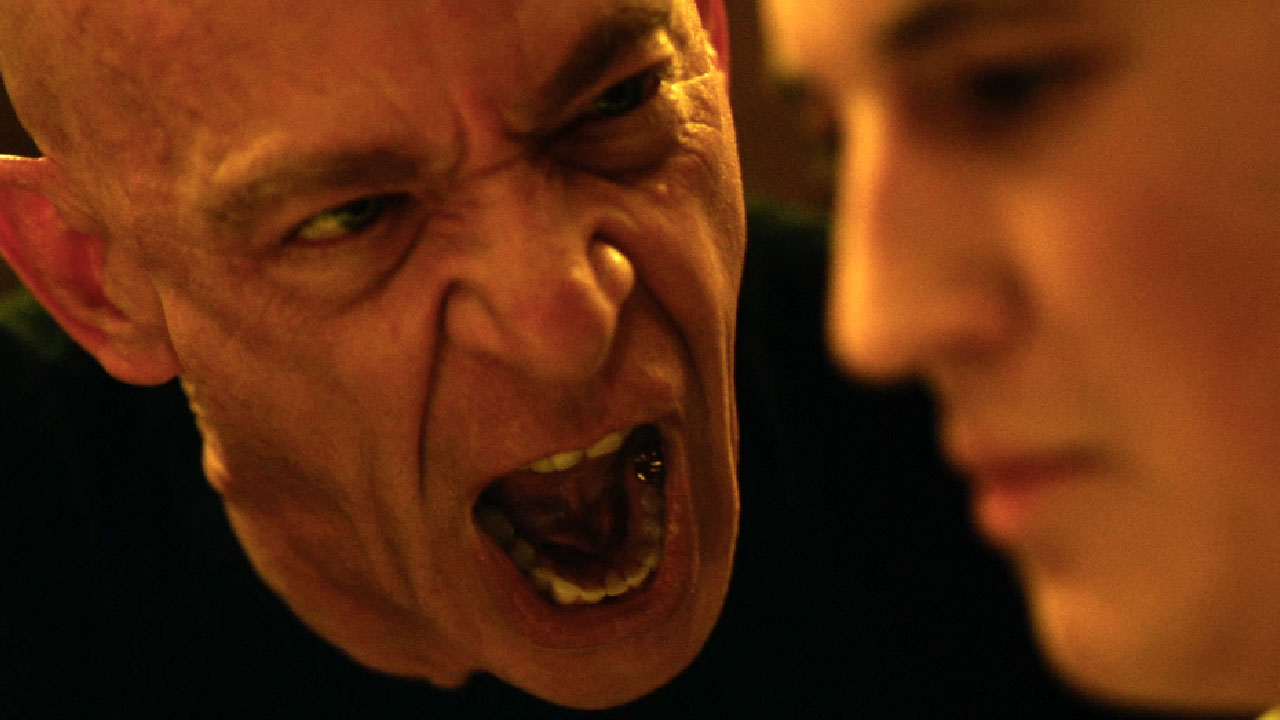
When I watched J.K. Simmons, playing Fletcher, the tyrannical jazz band director, scream “MY tempo! MY tempo!” I flashed back to all the petty dictators I’ve seen on the conductor’s box, over 50 years of being a professional musician and school music teacher. I’ve witnessed at least a dozen school band directors say the exact same thing, transforming into little Napoleans, using their baton as weapon, “proving” that students must be prodded into worshipful obedience in order to play well.

Here’s the thing: you can be a superb, meticulous, demanding music teacher without being a hostile jerk. You can also be a driven, determined, even obsessed music student, bent on creative brilliance and perfection, without being inhuman or ruthless.

In a movie supposedly about “what it takes” to achieve true excellence in performance, we never saw Fletcher teach, or drummer Miles Teller’s ambitious character, Nieman, learn anything about music via guidance, example or instruction. Everything that was accomplished happened via psychological manipulation: Terror. Lies. Tricks. Bodily abuse. Even, God help us, suicide.

It was a movie designed to prove Zach’s mother right: music is a rough, vicious game, filled with people whose talent means more to them than family or human relationships. It’s about ego–and winning.

Except–it isn’t, really. Music is available to everyone, from the supremely talented to the amiable, out-of-tune amateur. It’s what we were meant to do as human beings–sing and play and express our own ideas.

Let’s not turn anyone away, Mr. Ramaswamy.

Weaponizing Empathy and other Heritage Foundation Rhetoric for School Reform

When I first retired (from the classroom, not from working in education), I moved away from the school district where I had lived and taught. I’d been there for well over 30 years and had seen—up close and personal– the power of school boards to impact educational climate in a school district. I’d been watching through four decades of local policy-making— the good, the bad and the out-and-out malicious.

I’ve got stories.

And  I’ve written about the town where I lived and taught. In spite of its flaws, it was usually a good place to teach, if the definition of “good” is engaged parents, talented colleagues and kids who were encouraged at home to achieve.

The quality of school board leadership occasionally faltered over that time—with most of the squabbling over how to get by while spending a lot less—but there were long stretches where the school board served as a benign and supportive presence.

That was then. The Board now has morphed into something Christopher Rufo would be proud of. There was the podcast by Board members, sharing private information about student discipline. There was the “gender-affirming” bathroom policy. The anti-trans and anti-Pride policies. And so much more.

But I was dumbstruck on hearing this little clip from a recent meeting.

Board member says: This gets into the weaponization of empathy, where empathy is taught as the highest goal, the highest order. Do we teach empathy to the effect where students disregard parental authority—and accept anything and everything? Do we teach kids that any kind of judgment is bad?

Wait. What? Who is he accusing? And what is the weaponization of empathy?

Too much empathy leads to kids defying their parents, evidently. The moral ambiguity of school confuses students. That’s their big fear?

As a long-time classroom veteran who spent the beginning of every year working diligently to get kids to respect their peers, and care for other people’s feelings and property, this struck me as downright stupid.

Of course, empathy builds learning communities. It was right there in the (evidently outgrown) school mission statement:  “ …provide a positive environment for the development of productive and caring individuals of all ages.”

A social media convo developed around the clip, with commenters suggesting the end result of too much empathy was Doctors Without Borders or the Peace Corps.

Eventually somebody remarked:

It should come as no surprise that the Heritage Foundation has taken this term and used it as its own way of fighting against Social-Emotional Learning, and any other academic tools to help students.

If one of your school board members uses this term, they are in some way being educated by, or they are using talking points from the Heritage Foundation.

Then, the other shoe dropped. Aha. Weaponizing empathy is a Heritage Foundation thing, the concept of their plan, so to speak.

Click on this definition, from the Heritage Foundation’s own rhetoric.   It’s pretty vile.

EdWeek asks: Can Trump Force Schools to Change their Curricula? The Trump team’s best weapon for fulfilling this culture war campaign promise may be an under-the-radar office at the heart of the agency the once and future president has pledged to dismantle: The U.S. Department of Education’s office for civil rights, which enforces laws barring discrimination on the basis of sex, race, religion, and disability status.

That’s a lot of legal wrangling—and yes, I understand that bureaucracies can change, when their leadership changes.

But hey—if right-wingers get control of a school board, they can micro-manage a district, with thousands of students, turning it into a place where empathy—caring for and about their fellow students– is forbidden or scorned.

God help us all.

How Do German Schools Teach Their Political History?

It was Ernest Boyer who declared that public education functions as a stage where Americans test and play out their deepest values and convictions.

Everything that happens around us shows up in public schools. Ask any teacher about keeping the outside world out of classroom dynamics. Ask any scolding pundit or self-righteous parent just how to stick to phonics and fractions when the very ground has shifted.

Can’t be done.

This might be a good place to quote Adolf HitlerHe alone, who owns the youth, gains the future.

A word about playing the Hitler card. I have been justifiably criticized for raising the specter of actual fascism in school politics. This is not a thing to take lightly, I know; hyperbole always weakens an argument.

But I want to write here about a nation that once had a lot of explaining to do on that front, and has—from available evidence—been able, over the long span of three generations, to reconcile their role in what happened in the 1930s and 1940s in Germany, triggering global catastrophe. Maybe we ought to pay attention.

Ten years ago, I had the revelatory experience of touring the Nazi Rally Grounds in Nuremberg, and visiting the Documentation Center there with an extraordinarily well-informed German guide, a doctoral student who was moonlighting as “World War II Tour” escort and educator.

It was a six-hour tour, and pricey, and you could sense the Americans we were traveling with growing weary of the information dump, wondering if the Christmas shop would still be open once the bus dropped us back off on the restored town square.

We wandered around the rally grounds and the man-made lake surrounding the building, once a Nazi headquarters and now the site of an extensive display of memorabilia and analysis. Our guide began by telling us that the impressive, forbidding structure we were looking at across the placid lake was not a museum.

Museums are for sharing cherished cultural artifacts, he said. There are plenty of those in Germany, and we encourage you to visit them. A documentation center, on the other hand, is a public record of a human failure—one for which Germany was responsible. It was Germans’ moral duty to keep the archived memory alive at the Documentation Center, in concentration camps, and courtrooms.

I wasn’t taking notes—I signed up for the tour with little foreknowledge of what I would see, how it would impact me. I remember a great deal of his running spiel. Our guide was an earnest, 30-something man in a plaid shirt, crooked tie and glasses, who carried two notebooks full of tabbed information and could give the veteran who asked precise information about range of Messerschmitt war planes.

A lot of the questions, in fact, came from men asking about military equipment and strategies, and not so many about the Holocaust or impact of the rise of fascism in Europe.

Asked whether Austria had a similar urge to document their own involvement with racial and religious discrimination, our guide made a face and declined to comment. Lesson Number One is that we always speak for ourselves, he said.

He spoke of regional political differences pre-War, how a country in acute financial distress could be utterly divided about causes and solutions. He talked about generational differences and how it took Germans three full generations to understand how a handful of men turned a fundamentally decent people into killers, persuading those for whom horrific prejudice was just not a deal-breaker, if Germany could be restored to greatness.

His grandparents, he said, were impressionable young people, just starting their family, during the rise of the Third Reich. They were gone now, but as a child he had been instructed by his parents not to listen to what Oma said about the terrible war years. She’s old, he’d been told. We’ll respect her for that. Don’t ask, and maybe she won’t tell.

His parents were the generation that bore their parents’ guilt. Then, as grandchildren of the Nazi legacy, his generation could finally claim to have actively worked to make sure it never happened again. In Germany, at least.

Questioned, he shared extensive data about the skinhead movement, a serious worry for the moderate government. But then he compared incidents of far-right violence in Germany to gun violence in America, a sobering contrast for anyone who was inclined to feel superior.

Someone asked the obvious question: How on earth could so many rational people buy into Hitler’s psychosis?

Ah, he said. This is where people from every nation must pay attention. Hitler was a genius at using available media and technology. Crystal radios were made cheap, and the same sticky message—an alternate, economically driven message of national pride—was pumped into all homes. “News” was what the party decided.

Public rallies were enormously effective. The Nuremberg site was chosen because it was cheap and easy to get to by train, and surrounding farms could house families and large groups of people from a single town, camping and sleeping in haylofts.

Everyone could participate—government was no longer centered in the industrial, better-educated north. A common enemy had been clearly identified, the future was brighter because there was a plan for everyone, not merely the political elites. The ultimate community-building success.

A man asked about the crumbling rally grounds, an “amazing historical facility.” Had there been any thought to restoring it? Our guide’s face darkened. “Let it rot,” he said. “Good riddance.”

I asked, as a teacher, what German schoolchildren were taught about Germany’s role in World War II. It was part of their national curriculum, he told us. They began with equity and community in early childhood, accepting differences and playing together. When students were 12, they read Anne Frank.Media literacy and logic and an intense focus on preparation for good, attainable, satisfying jobs were part of the program, in addition to history, economics and the predictable disciplines. We do not avoid our history, he said.

So what do you do in America, he asked?

Back in 2016, an honored fellow at the U.S. Holocaust Museum and recognized expert on World War II was suspended from his job after a parent complained when he pointed out parallels between Nazi Germany and the 2016 election to students. It took a national petition and a global spotlight to get him reinstated.

Also in 2016, in the nation’s leading McNewspaper, Rick Hesse and Checker Finn called the actions of teachers and school leaders attempting to calm their students’ real post-election fears “histrionics.”

That was eight years ago. And look where we are today.

Backward, in High Heels

If someone suggests a Women’s March, so help me… (Twitter comment)

I remember sitting in the teachers’ lunchroom at my middle school, January 2001, and having a woman I like and consider a good teacher exclaim–after Dubya was finally declared president-by-hanging-chad– “Doesn’t it feel good to have a nice, respectable family in the White House?”

It didn’t feel all that great to me–and that feeling grew worse and worse, as we rolled through 9/11, Abu Ghraib, the Iraq war and the financial meltdown.

Still–she was sort of right. It is undeniable that character matters in public leadership. Or should. Turns out, however, that good character—the kind of person whom we can trust to lead– is very much in the eye of the beholder. Welcome to 2024.

Nobody needs to hear what I think about what went wrong with this election. I would describe myself as bewildered. Sorting through the post-mortem will take time.

But I have to say that my one niggling worry, watching Kamala Harris run an energizing, upbeat, intersectional campaign through these last 100 days, was this: She’s a woman.

Backwards, in high heels, and all that. Please don’t let this be another case of a fully qualified woman passed over for a blowhard jerk.

The campaign downplayed the “firsts”—first woman, first Black woman—but mixed in with the horror of who got elected and what they promised to do, is the bone-deep conviction that this loss had a lot to do with sexism, coupled with racism. What America is “not ready for.”  

And lies. So many lies. If there’s anything the nation “isn’t ready for,” it’s the truth about our residual prejudices and historic power-hoarding.

It’s not just women and people of color who were betrayed by the election, of course. The Republican party dropped $215 million on anti-trans ads ($134 per trans person in America). And Capitol police officers, who put their lives on the line on January 6, 2021: “Why the f— did I risk my life on Jan. 6 to defend our elected officials, our government, from the mob that this person sent to the Capitol, only for him to be returned to power?”  The list of people who were betrayed—and have good reason to believe they will further lose ground—is endless.

So—I am only speaking for myself here. But as the meme says: We ask women why they don’t come forward when they are sexually assaulted. It’s because we live in a world where an abuser can become President.

In a must-read article in Atlantic, Xochitl Gonzalez says this:
Sexism, it turned out, was not a bug but a feature of the Trump years. Misogyny certainly appears to come naturally to Trump, but it was strategically amplified—through surrogates and messaging—to attract supporters, particularly younger men of all races. 

Many of these young men apparently see Trump—with his microphone-fellating pantomime and his crowds chanting the word bitch—as presidential. Misogyny helps disempowered men feel empowered. After Trump’s victory, the right-wing activist Nick Fuentes tweeted: “Your body, my choice. Forever.” It really is a man’s world now.

And here’s what’s making me saddest, right now:

Trump’s return to power—his imminent control over the Supreme Court and the federal judiciary, the coming dissolution of the very idea of the government providing any sort of guardrail against corporate power, carceral violence, and environmental destruction—is the beginning of a political era that will likely last decades.

I’m not sure I have decades.

What seemed—last week—like a more equitable way of addressing (and I hate this phrase) the war of the sexes has melted away. And for me, it’s personal. Here’s my story—one I’ve shared before—about a very powerful man using that power to abuse women:

I did my student teaching in the mid-1970s. I was assigned to a male band director (they were 98% male, back then), who told me at our first meeting that he was accepting me as student teacher because he needed a free assistant. He had a top leadership position in the state organization for instrumental music teachers which took him to many conferences and meetings. He said that he never would have consented to taking a woman as a student teacher—the university had merely asked him if he was interested, and he assumed that, naturally, I would be a young man, ready and willing to do the things he didn’t have time to do for a semester.

He repeated those remarks to the audience at my first concert. By then, it had become a polished story–“I said yes–and then they told me it was a woman!” (Audience hilarity.) I, of course, was making the morning coffee, re-ordering his messy music files and writing his monthly columns–the man couldn’t construct a coherent sentence–for the state organization newsletter.

I was also being sexually harassed and bribed by the promise of a good evaluation and letters of recommendation, something that I very much needed to get a job in a male-dominated field.

I put up with it for about a month, making up excuses to leave early so we wouldn’t be alone together. He grew more aggressive. Finally, I went to the student teaching supervisor from my university. I have repressed a lot of memories about that time–but I can remember that meeting as if it were last week. The supervisor, behind his large polished-wood desk, was wearing a red ski sweater. Behind him, multiple holiday photos of his family, in front of a fireplace, the lovely wife and four children.

I told him my story, in detail. He leaned back, hands folded over his chest. “Are you sure you’re not leading him on?” he asked. Then he ticked off the reasons why he would not recommend another placement: It was too late and would cost me another semester in time and fees. Nobody would take me, once the story of my accusation became public–and it surely would, possibly all over the state given the man’s public profile.

I would be seen as a too-sensitive whiner in a male-dominated field. I thought you wanted to be a lady band director, he said. This is what it’s like. Either handle it yourself or drop out now.

So I handled it, as best I could. I can’t say I learned anything about being an excellent music educator during the remaining three months–the man never turned his classes over to me, not even for a single rehearsal. His pedagogy was best described as intimidation and humiliation. Plus openly flirting with high school girls.

I worked individually with students in the practice rooms (where I learned, from a sweet flute player, that Mr. Exemplary Band Director was also having sex with his students). The one time I was allowed to stand on his podium and conduct a number, he stalked around behind me, making faces and mocking my conducting.

I got through, by “ignoring” lots and lots of grabbing. I had proof that telling anyone what was going on would reflect badly on me–that I would be labeled the spiteful “nasty woman” who was seeking to take down someone who had earned his considerable fame.

After graduation, I got a job far away from the man, in spite of his mediocre evaluation (which specified that I would be best placed as an elementary music teacher, as secondary band directors needed more “stamina” than I had). I built a successful 30+-year career as a band director, including being named Michigan Teacher of the Year. When I saw him at music conferences, I avoided him.

Famous Band Director lost his job–very publicly–about a decade later, when a student finally came forward, supported by her parents, to report that he had lured her into a sexual relationship. He denied it, in the newspaper pieces, then pointed out that the school had one of the state’s top band programs–all because of him.

Mostly, I stopped thinking about him, after that. Then, a few years ago, after community band rehearsal, one of my colleagues, a man I deeply respect, caught up with me after rehearsal, asking “Did you hear that [Famous Band Director] died?”

The first words out of my mouth were: I hope he rots in hell.

Taking a deep breath, I mentioned I’d done my student teaching with the man. My friend already knew–the man had been having breakfast regularly with a group of retired band directors, and had talked about me. Explaining why this monster had been invited to the breakfast club, after being fired for sexually abusing students, my friend said: We took pity on him.

I realized that the Band Director’s breakfast companions, a kind of Old Boys Club, had probably been fed a fabricated storyline about me, too. I felt like I was going to vomit. And nearly 40 years had passed.

 — – – – – – – – – – –

We just elected a convicted sexual abuser BACK into the White House.  Anita Hill, who has also had plenty of time to muse on why people don’t believe women, is right–we should be focused on the victims of sexual assault, and not the perpetrators.  They’re not strongmen, or role models.

Because paying attention to bullies and sexual abusers feeds their megalomania. And lets them train a new generation of persecutors, the white men who feel they’re entitled to power and the women who hope to bask in their reflected glory.

Work Hard. Be Nice. Or Don’t.

I hate it when retired teachers comment on how glad they are not to be in the classroom in 2024. Their reasons range from academic and justifiable (“teachers have lost their professional autonomy”) to annoying (“kids today…”) to reflections on teaching in the era of Trump, when general nastiness is perceived as strength.

When teachers leave the classroom early in their careers, we lose something that was once commonly understood, across a diverse nation: teachers as respected members of the community, educated people whose opinions were valued. Teachers taught kids to wash their hands, tie their shoes and read books, and hauled them up for threatening weaker kids on the playground.  And parents appreciated those efforts.

In between critical content, from calculating sales tax to constructing a coherent paragraph, teachers must build little communities where kids can work productively together, pass safely through the halls, and experience the parameters of getting along with others.

Are all teachers successful in nurturing this? Of course not.

But all teachers do understand that there is not a lot of learning happening without order, structure and consideration for others. Every single teacher, from green newbie to grizzled veteran, struggles with this.  And there’s turnover every year, a new set of behavioral challenges that need to be addressed.

It’s the foundation of that recently vilified educational concept: Social-emotional learning.

I am currently running for school board in the community where I (happily) live—a school district that is well-run and offers solid programming, a place where students are known and cared for. I attended a Board retreat last week, and as part of the goal setting process, the facilitator invited attendees to name teachers or other school staff who are doing an outstanding job.

A dozen hands went up immediately, and the comments made by Board members, administrators and parents were all about things staff members did to enhance students’ personal growth and well-being. In other words, social-emotional learning, woven into curriculum, instruction and school climate.

Understand: all teachers either consciously include social-emotional elements in their daily practice, or benefit from good SEL, instituted by other educators in the pipeline, teaching kids how to behave in school along with their ABCs.

This—empathically—does not refer to pre-packaged “character” curriculums, as one size never fits all. You can’t buy genuine social-emotional learning. It has to be custom-tailored to the kids in front of you.

If you try to remove genuine social-emotional considerations from instruction and classroom management, you’ve created more problems for yourself. It’s the old saw about kids needing to know the teacher cares and will try to make their classroom a safe space for everyone.

So they can learn.

I’ve read lots of pieces about the corrosive effects of SEL, which generally boil down to the fact that SEL, as a set of pedagogical ideas, is not value-neutral.  And that’s true. Social-emotional learning reflects the values of the teacher and school, whether explicitly expressed or not.

That’s really not what anti-SEL commenters are worried about, however. As self-titled “Instruction Geek” Daniel Buck says: At its worst, SEL is a means to slip progressive politics into the classroom.

Gasp! There’s the rub, all right. Things like examining evidence for truth? Not in my school!

In fact, there’s always been social-emotional learning in schools, from the dunce cap to the hand-slap ruler wielded by Sister Victorine against misbehavers in your fifth grade. Labeling it and examining it—whether you call it character education, or classroom rules—is a good thing. What are we trying to teach kids, besides Algebra and World History?

I’ve always been intrigued by the KIPP Charter Schools’ founding motto, established in 1994: Work hard. Be nice. Those are certainly two explicit values, values embedded in what I think Americans want from their public schools—academic rigor and cooperative students.

When the KIPP organization decided to drop that motto in the summer of 2020, here’s what their CEO, Richard Barth said: It ignores the significant effort required to dismantle systemic racism, places value on being compliant and submissive, supports the illusion of meritocracy, and does not align with our vision of students being free to create the future they want.

Which the Wall Street Journal and a dozen right-wing bloggers called “woke nonsense”—and worse.

If KIPP schools can re-think their expressed values, for the benefit of students, so can public school teachers. It’s possible for schools to reflect the values of their community, as well as cultivating the characteristics of civic engagement, kindness and diligence.

It’s how you build a learning community.

Nine Reasons Why Standardized Tests and Grades Shouldn’t Necessarily Match Up

Headline from a recent piece in Education Week: Grades and Standardized Test Scores Aren’t Matching Up. Here’s Why.

Let me give you the gist: Grades are unreliable, whereas standardized test scores scientifically measure real content knowledge. Grades are given by teachers. Therefore, teachers’ grades are not to be trusted, and teachers should receive additional training on how to accurately measure what students know. There’s also a jab at grade inflation, post- pandemic. Who is quoted in the article? That’s right, the College Board and the ACT folks.

From my point of view: a) Sure, additional training for preservice teachers on the art and purpose of assessment would be very useful. b) Also useful: a common understanding of what a grade means. Is it a representation of a student’s progress—or an evaluation of how well they’re meeting pre-set standards—or an educated guess about how the student will do in college?

I don’t think teachers’ grades and standardized tests should, necessarily, measure the same things. Furthermore, standardized tests don’t have relationships with students, or know what the student brought to the table, when starting the course. 

I have written lots about grades as assessment, including the piece I’m including, below, about the Soft Bigotry of Low Grades. It begins with an essay on “low expectations” then morphs into nine points about grading that teachers understand (and argue about).

Whoever wrote the phrase ‘soft bigotry of low expectations’ back in the early days of the Bush (W) administration, was a genius. In one nifty sound bite, the blame for the so-called achievement gap was placed squarely on the shoulders of educators, those barrel-bottom, unimaginative civil servants slogging along in low-paying careers.

Not only were veteran teachers unable to conceive of their students’ success (presumably, getting into a competitive-admissions college)—they were also bigots, kind of. Perhaps they hadn’t read 25 books on racism, been hooked on The Wire, or stayed for two grueling years in a no-excuses charter before heading off to Goldman Sachs. They were just stuck in those dead-end teaching jobs.

Early in the ‘reform’ days—a couple decades ago—Disruptor types were prone to proclaiming that high expectations for all students were, in fact, a positive disruption to what they assumed was the low and unimaginative level of teaching practice endemic in public education. Especially in schools filled with kids who took home backpacks full of peanut butter and whole wheat crackers every Friday.

If only teachers had faith in their students, cracking the academic whip and believing they could someday rise above their circumstances and excel—well, then things would be different. What we needed was new—high and rigorous—standards, better aligned curricula, more sorting-out data. We needed ‘choice’ to remove kids from low-expectations government schools.

And of course, better teachers, teachers who embodied these great expectations and were willing to rip up unacceptable assignments. Even if it made kids cry.

The ‘low expectations’ trope became a thing. The 74 was still printing pieces about it, 18 years later, using phrases like ‘complacency is also still alive and well’ and ‘having teachers who were confident that their students would complete college made a real difference in their college attainment.’

The 74’s suggestions for improvement? You won’t be surprised: higher standards, more testing and raising the cutoff scores, rigorous curriculum—and better teachers, the kind who expected more. Nary a mention of better health care, better jobs with higher wages, better childcare options, better support networks for people in poverty. Or less racism.

When I read that Fordham was releasing a new report entitled Great Expectations: The Impact of Rigorous Grading Practices on Student Achievement, I assumed it would be more of the same: a screed against ‘grade inflation’ that urged teachers to use the threat of bad grades as ‘motivator’ in getting kids to Learn More (and score better on high-stakes tests, quantitative ‘proof’ of learning).

Turns out I was right.  Here’s the first paragraph of the summary:
We know from previous survey research that teachers who hold high expectations for all of their students significantly increase the odds that those young people will go on to complete high school and college. One indicator of teachers’ expectations is their approach to grading—specifically, whether they subject students to more or less rigorous grading practices. Unfortunately, “grade inflation” is pervasive in U.S. high schools, as evidenced by rising GPAs even as SAT scores and other measures of academic performance have held stable or fallen. The result is that a “good” grade is no longer a clear marker of knowledge and skills.

Here’s how my 30-odd years’ worth of grading some 5000 students (at least 35K individual grades) squares with the statement above:

  • High expectations are a good thing, all right—but they are not commensurate with giving more unsatisfactory marks. In fact, being a ‘tough grader’ often means that the teacher is not meeting a substantial chunk of kids where they are, then moving them forward. The easiest thing in the world is giving a low or failing grade and blaming it on the student. The hard thing is figuring out how to help that child achieve at the level he’s capable of.
  • The longer I taught, the higher my expectations were, as I learned what students at different developmental levels were able to do—but that was not reflected in the grades I gave. I assumed it was because I had become a better teacher and was getting better results as my teacher tool bag filled. I could see with my own eyes that I had underestimated what my students could learn and apply, if they chose to work at it.
  • I seriously doubt that teachers’ expectations—as defined here by more rigorous grading– have much, if any, impact on kids’ completing college, or even high school. A teacher who encourages a student to think big, to push herself, to reach for the stars and so on, may indeed have a long-term positive effect on a student, especially one with self-doubts. Setting students on a path to higher education and life success is a long-term, K-12 project, one that can’t be accomplished by teachers alone and certainly not by dropping the grading scale a few points to teach them a lesson.
  • Grades aren’t real, although the argument can be made that they’re more real than a standardized test score (which the report also uses to make the claim that ‘raising the bar’ has a salutary effect on student outcomes). No matter how schools try to standardize grading, the human judgment factor creeps in. As it should. Students see their grades as something ‘given’ by the teacher, no matter how many times teachers insist that grades are ‘earned’ and can be accurately, precisely, mathematically granted.*
  • Grade inflation isn’t real either. I am always amused by disgruntled edu-grouches who insist that Harvard, say, is awash in grade inflation. When an institution turns away 94.6% of the students who have the temerity to apply, why are we shocked when the crème de la crème who are admitted get all A’s?
  • If we were doing our jobs better, by Fordham’s metrics—following rigorous standards, choosing engaging and challenging curricula, assessing frequently—wouldn’t the desired outcome be better grades?
  • The worst kind of grading practice is the bell curve. Curving grades has gone out of fashion, but you still see its aftereffects in reports like this that bemoan the overly high percentage of students whose work is deemed good or superior. If you’ve ever had a class filled with go-getters (and I’ve had many), you’ll know it’s possible to teach to the highest standards and have every child in the class performing at a high level. Someone does NOT have to fail. What the researchers here seem to be endorsing is a curve where students in high-poverty schools are not compared with their peers, but with kids in advantaged schools—then taking the top-scoring kids down a peg or two, for their own good.
  • Bad grades don’t motivate most kids to try harder, although this seems to be the sweeping conclusion of the report, which studied 8th and 9th Algebra students in North Carolina. The researchers noted that students in advantaged schools were more likely to make gains when receiving a lower grade. There are lots of charts and graphs showing how teachers who give lower grades initially cause an uptick in standardized assessment scores eventually. This is more likely to happen if that teacher went to a ‘selective’ college or is an experienced veteran teacher, by the way. As for the poor students who go to rural or urban schools—well, they get good grades that don’t reflect what they’ve really learned. Therefore, maybe we should give them lower grades, too, as an early reality check.
  • I repeat: bad grades don’t usually motivate kids, unless there’s someone at home checking up on them, they plan on going to college and care about their GPA. In that case, a lower grade may serve as a heads-up that more effort may be necessary. Do 8th grade Algebra students and students in advantaged schools where most kids are college bound fit into that category? Yes.

Students who do well in school also know how to study effectively– or seek extra help when something is difficult for them. They’re not as likely to think that the tough-grading Algebra teacher doesn’t like them, or that they’ve finally found a subject they can’t successfully master. Lots of previous successes have given them the confidence to pursue a challenging subject.

What struck me about the report was the facile conclusion that a subset of (higher-achieving) students was motivated by a lower-than-expected grade into learning more.

Extrapolating that into a declaration that tougher grading would lead to higher achievement is giving way to much credence to a cranky-pants theory, the one where a kick in the pants is what kids these days really need.

*In my 30+ year career, I taught math for two years. Prior to that, I collected various data to develop and tweak a defensible grading process for teaching instrumental and vocal music. Music is a challenging discipline in which to assess using hard numbers, trust me; I envied my math teacher friends whose grades were always clean, clear percentages. Then I taught math and discovered—eh, you can juke the stats in math, too, through assignment weighting, partner quizzes (recommended by our math series), late assignment policies, re-takes, homework evaluation policies—and so much more. Grading—in any subject or level– is not science. Never has been.

“Union Mouth”

So—when we’re immersed in the pre-election floodwaters of political revenge speech, it’s easy to snicker at the misfortune, if that’s the word, of right-wing social media edu-star Corey DeAngelis.

DeAngelis is—was?—the real deal, in education policy world. Not the kind of education policy that would re-build or energize our public schools, of course, but an attractive and even charismatic mouthpiece for the anti-union/school choice/privatization movement.

If you’re unclear on what happened to DeAngelis, last week—here’s the story.  (And here’s an interesting, even kind, response, from another one-time school choice advocate.)

If this were, say, 2014, when Corey DeAngelis was pursuing a skeezy “alternative career” that eventually became public knowledge, lots of folks would see it as an inside-baseball kind of chuckle—conservative education spokesperson gets caught being himself, ho-hum.

But the nature of public discussion about our schools has changed.

There have always been—going back to Thorndike vs. Dewey—vigorous arguments about the right way to do public education. Most people (including people who work in actual schools) don’t pay attention to these theories, philosophies and policies, unless they’re directly impacted. They focus on other aspects of schooling. And parents, by and large, are happy with the public schools their kids attend.

One of the things Corey DeAngelis contributed and honed, in these verbal ed skirmishes, was nastiness. The kind of unsubstantiated nastiness that we’re now hearing every day from political candidates on the right. Words like lazy, dumb, failing, greedy, groomers, socialists—and, of course, unions as root cause of all that is wrong with America and her children.

DeAngelis is one of the leading spokespersons, on social media, in the wave of anti-public education discourse we’ve experienced in the past eight years or so.  I wrote about some of the things he’s said, in respected publications, last May.

I posted a tweet about that blog post, asking WHY DeAngelis and others are trashing public education? What’s in it for them? Because this onslaught of anti-public education blather is not doing the nation and its children (no matter where they go to school) any good. This WHY was a serious question, BTW.

I got lots of tweeted responses, from DeAngelis’s army of followers, to whom I would ask the same question: What, actually, are you fighting for, when it comes to education?  Here are a few of those tweets:

Union Mouth! (followed by a string of vomit emojis)

I took my kids out of the gladiator academy/commie indoctrination center. Best choice I ever made.

Staffed by mediocrities (sic) who act like martyrs

Corey is bringing the future of education. Say goodbye to your current paradigm of croneyism and union interference.

The govt “school” system is nothing more than a taxpayer pipeline to labor union coffers, used to then (re-)elect politicians who promise more money for the pipeline. Education was never the point.

Public schools are a Dredge (sic) on society. Teachers are even worse.

And—my personal favorite:

Retire, you old hag.

I found myself blocking responses from people with names like—and I’m not making this up—Sexy Fart Bubble. Also wondering how school policy went from being a question of qualified staff and resource allocation to taking ugly potshots at teachers, school leaders and the millions of families who rely on public education.

I know better than to sputter about—or worse, respond—to random on-line vitriol. It’s acceptable now, evidently, to lie on public platforms; calling attention to falsehoods (or snickering at a messenger’s personal problems) is a distraction from focusing on what matters in debates about our schools.

Because—contrary to what Corey DeAngelis’s followers expressed, education has always been precisely the point. For better and worse, for everyone involved. Education has never been settled science. Our children are exposed to different influences and technologies than the previous generation of students; likewise, educational practice has to evolve.

Serving children’s educational needs adequately will—must—shift over time. And change is hard. Working through the changes, especially after a global disruption, demands civil discourse. Professional judgment. And an appreciation for facts.

Not lies.

So—no schadenfreude over seeing someone, whose minions called me “Union Mouth,” be exposed and having his name quickly erased from an array of education non-profit websites. There are far bigger fish to fry at the moment.

When one of your options for Leader of the Free World is seriously threatening to deport 30 million people, a large percentage of whom are children, it seems wrong to fuss over books somebody’s mom doesn’t like. Or spend a lot of time and effort trying to persuade people that teachers’ organizations, with their focus on working conditions in our schools, are harming children.

With all the free-floating fear and loathing in the American zeitgeist right now, it’s harder than ever to establish a classroom where students can develop the confidence to be a community. I am 100% on the side of educators who declare that students can’t learn unless they feel safe. The corollary to that is that teachers can’t learn and grow unless they feel safe, as well.

We are living in unsafe times.

If you want to influence policy change in public education, bring your best ideas and an open mind. Leave the nastiness behind.