Diane Ravitch Sums It All Up

My introduction to Diane Ravitch: I can’t remember precisely which education conference it was, but I was in graduate school, so it was between 2005 and 2010. Ravitch had just begun writing her Bridging Differences blog with Deborah Meier at Education Week, a sort of point-counterpoint exercise. I had also just read her book The Language Police for a grad class, and—although she’d always been perceived as a right-wing critic of public education—found myself agreeing with some of her arguments.

She was on a panel at a conference session. I can’t remember the assigned topic, but after the presentation was opened up to questions, they were all directed to her. And she kept saying smart things about NCLB and testing and even unions. Finally, a gentleman got up to the microphone and said:

Who ARE you—and what have you done with Diane Ravitch?
The room exploded in laughter. Ravitch included.

Ravitch has published two dozen books and countless articles. She is a historian—making her the Heather Cox Richardson of education history, someone who can remind you that when it comes to education policy, what goes around comes around. Her previous three books were, IMHO, masterpieces of analysis and logic, describing the well-funded and relentless campaign to destroy public education here in the U.S.

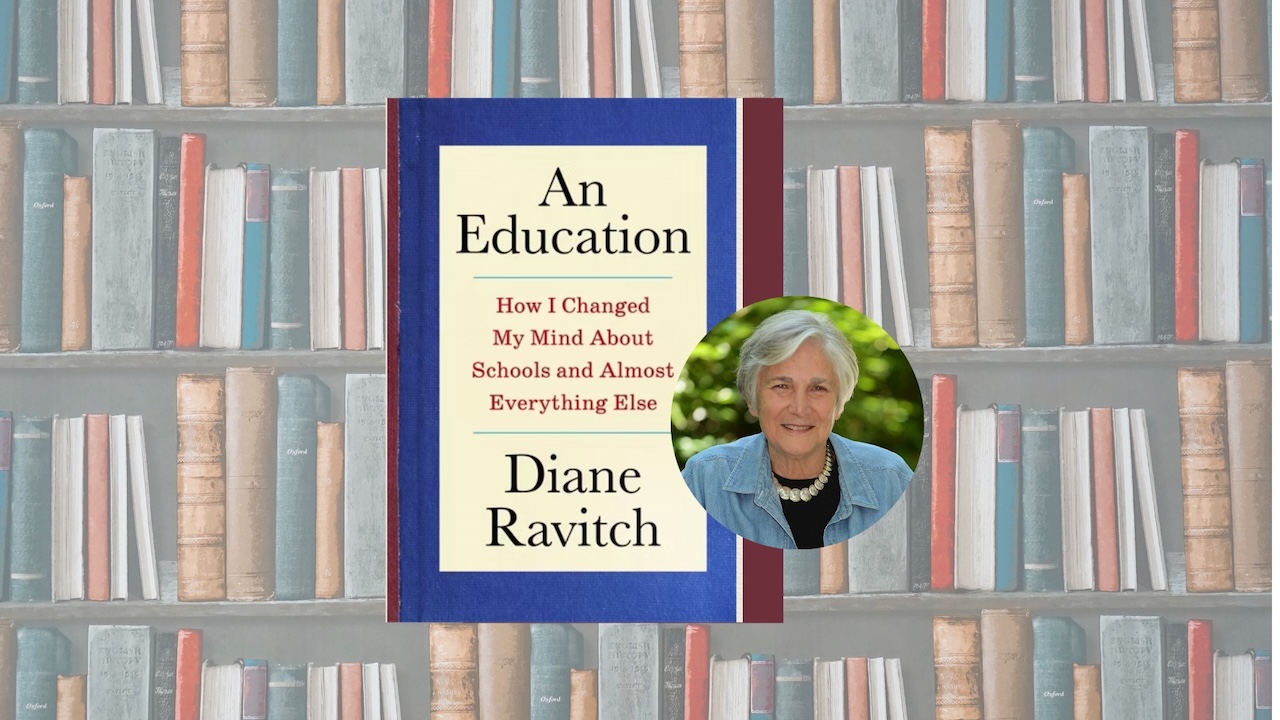
And now, at age 87, she’s written a kind of expanded autobiography, An Education: How I Changed my Mind about Schools and Almost Everything Else. She tells us how her vast experience with education policy, across partisan and ideological lines, has left her with a well-honed set of ideas about how to build good schools and serve students well. How, in fact, to save public education, if we have the will to do so.

You get the sense, as Diane Ravitch wraps up “An Education,” that she is indeed wrapping up– she sees this as her last opportunity to get it all out there: Her early life. How she found happiness. Mistakes and regrets, and triumphs. It’s a very satisfying read, putting her life’s work in context.

For her followers and admirers (count me in), the book explains everything about her beliefs. Her working-to-middle-class roots and her family’s loyalty to FDR and what the Democrats stood for, during post-World War II America, go a long way to explaining how she eventually (with some major diversions) became an articulate proponent of public education.

I’m glad she included a nostalgic portrait of growing up in TX with a hard-working mother and feckless (and worse) father. The glimpses we get into public education in TX in the post-war years resonated with me–and it’s easy to see how going far away to an Ivy League college shaped her entire adulthood. Her classmates at Wellesley, like Ravitch, were ambitious and curious; I’m old enough to remember a time when female ambition was suspect.

The most fascinating part of the book, for me, was the middle third, where she wrote about researching the history of public education and being asked to sit on prestigious boards and serve as Assistant Secretary in the George H. W. Bush Department of Education. There’s a whole chapter on Famous Education Opinion Leaders (many of whom are still working to suppress full public education) taking Diane to lunch, tapping into her work ethic and offering her opportunities to be part of the power structure, to write and speak (and—big point—learn what they’re really up to).

N.B.: Award-winning teachers are also often asked to become part of the education establishment by sitting on boards, writing op-eds, and serving on task forces– and it can be easy to feel as if you’re contributing, at a higher level, when what you are actually doing is giving credence to people who have a very different, but hidden, agenda.

The final third of the book is the Diane Ravitch most educators know and respect. Her observations come from swimming in the ocean of education policy for decades– and they’re accurate. I expect Ravitch to continue to blog and write and speak, as long as she is able. She is the rare voice in education that has examined education ideas across the spectrum and found many popular notions weak or dangerous.

The book is a fine testament to a life spent searching for the truth about public education.

Five stars.

Is There Really a Decline in Pleasure Reading?

The mainstream media has been full of the bad news: new study shows that reading for pleasure has declined! Fewer people are reading for fun: From 2003 to 2023, the share of Americans who read for pleasure fell 40 percent, a sharp decline that is part of a continuing downward trend.

It’s easy to feel depressed about declining—what? literacy? —in the American citizenry. Just one more piece of evidence that schools are failing, blah, blah—nobody reads anymore!

But Anne Helen Peterson, in her substack, Culture Study, has a great piece dissecting the study that these scary headlines are based on. Maybe we’re not reading less; in fact, we may be taking in much more information and storytelling via means other than books.

Peterson posits six interesting theories about the way the study’s questions were framed and interpreted, and why we may need to re-evaluate what it means to be fully literate. She’s also a big-time book-reading enthusiast—not someone who sees the death of book-reading as inevitable in a digital world. Reading for pleasure is worth preserving, for all citizens. It broadens perspectives, makes us more interesting.

I immediately felt better after reading the piece. People aren’t reading less, necessarily; they’re reading differently. But I keep thinking about this story, told to me by a veteran teacher:

She started her career teaching in an elementary school, with reading blocks every day. She went back, as teachers sometimes do, to get a master’s degree in media and library science, then moved to a position in a middle school. A big part of her job there was managing young teenagers’ quests for information about whatever, using the internet as well as print resources.

After several years of staffing her school district’s seven libraries, the money ran out, libraries closed, and she was transferred back to a fourth grade. She said the most shocking thing about returning to a self-contained classroom was how much the kids hated reading.

It had been nearly two decades since she taught reading in an elementary classroom, and there was a palpable difference. Not just in the official reading program and instructional practice, but in the way students–both solid readers and those who struggled–responded to reading, in general. She was directed to follow daily scripts and a pacing chart, whether the students were ready to move on, or not.

She told me that—having already been involuntarily transferred away from a literacy-based job she loved and did well—she was no longer fearful of reprimands, and taught reading in ways that made sense to her fourth graders, including lengthy daily read-alouds that connected them to interesting stories. Their scores (and there are scores, in every story about reading) improved.

Headline today, from the right-leaning Detroit News: Michigan’s Reading Scores Continue to Slide for Youngest Students:

‘The results of the 2025 Michigan Student Test of Educational Progress, known as M-STEP, showed only 38.9% of third-graders and 42.4% of fourth-graders statewide scored proficient on the state’s English language arts (ELA) test, down from last year’s scores of 39.6% and 43.3%, respectively.

Eighth graders performed best in reading, with 65.3% proficient compared with 64.5% last year. Students in eighth grade take the PSAT, a precursor to the SAT, for math and English. Their social studies and science results come from the M-STEP.’

Read the data again. What do you notice? For starters—in every damned story about the so-called ‘reading crisis’—the undefined word ‘proficient’ appears. What does it mean? Everyone thinks they know. But ‘proficient’ (according to the Nation’s Report Card) does not mean ‘on grade level.’  It’s an indicator of advanced skills.

So there’s that. But did you notice that the worrisome ‘slide’ is .7% for third graders and .9% for fourth graders? Less than one percent? And that—miracle of miracles—Michigan 8th graders’ scores are a whopping 26.4% more proficient than Michigan 3rd graders?

There’s a lot to unpack here, but the Detroit News merrily goes on, blaming the fact that Michigan is coming late to legally mandated ‘Science of Reading,’ which kind of makes you wonder about what was wrong with the reading programs that produced success in two-thirds of the state’s 8th graders.

MI 8th graders took the PSAT, a national test, and the rest of Michigan’s kids took the statewide assessment, the M-STEP. Which is the most trustworthy? And why are scores so wildly different? These are questions the Detroit News does not address.

Nor does their reporting on reading scores factor in where the COVID pandemic impacted student instruction. In fact, I have seen op-ed commentary (NOT going to link) exclaim that because the pandemic is ‘over,’  reading scores should have ‘bounced back’—which reveals nothing more than a profound misunderstanding of education and public health data, mixed with contempt for public education.

Last year’s third and fourth graders were in pre-K and kindergarten during the worst years of the pandemic. The things they were coping with—fear and loss– as very young children, have left traces of damage, from school absenteeism to the very thing my friend mentioned: her fourth graders hated to read.

Why? Because learning to read had been a disrupted and difficult process, focused on improving scores, rather than developing an appreciation for an essential skill that would provide an enriched life, in multiple aspects? Including enjoyment—reading for pleasure?

Alfie Kohn:

‘The fact is that students’ days will be spent quite differently depending on whether the primary objective is to make them memorize what someone decided children of their age should know, on the one hand, or to help them “make fuller, deeper, and more accurate sense of their experiences,”on the other.’

I would call reading for pleasure a fuller, deeper and more accurate sense of our experiences—what it means to be a fully literate human being.

Men Who Like Books Start Out as Boys Who Read

Maureen Dowd, in a NYT article entitled Attention, Men: Books are Sexy!:

Men are reading less. Women make up 80 percent of fiction sales. “Young men have regressed educationally, emotionally and culturally,” David J. Morris wrote in a Times essay titled “The Disappearance of Literary Men Should Worry Everyone.”

The fiction gap makes me sad. A man staring into a phone is not sexy. But a man with a book has become so rare, such an object of fantasy, that there’s a popular Instagram account called “Hot Dudes Reading.”

It’s enough to make me re-up my abandoned Instagram account.

I also sincerely hope that Maureen and I are not a dying breed, older women (we are the exact same age) who find Men Who Read attractive. I once experienced a tiny swoon when I read that Stephen King carries a paperback with him, wherever he goes. You know, in case he has to wait 10 minutes in line at the post office.

This is more than just my elderly romantic fantasy, however. I think Men Who Read are—or should be—a national education goal. Not men who can decode, nor men who can type fast with their thumbs or pass tests about content. Men who actually enjoy reading.

Reading to use their imagination, rather than seeing prepackaged ideas on video. Reading and—important–evaluating information. Using the language they absorb, via reading, in their daily interactions with others. Reading for pleasure.

Personal story: When I met my husband, he told me about working third shift at the Stroh’s factory in Detroit, while he was in law school. His job involved dealing with a machine that flattened cardboard beer cases and needed tending only at certain times. The rest of the time he filled with reading, hours every night. He would take two books to work, in case he finished the first one. He read hundreds of library books, mostly popular fiction.

He is still that person, 46 years later. Swoon-worthy.

When I read (endlessly) and think about how we’re teaching reading these days, it strikes me that the discussion is almost entirely technical: Do we really have a “reading crisis?”  Why? Is it the fault of a program that was once popular and taught millions of kids to read, but is now being replaced, sometimes via legislation crafted by people who haven’t met first graders or stepped foot into their classrooms?

I recently had a conversation with a middle school teacher in Massachusetts who is a fan of phonics-intensive science of reading curricula, largely because she gets a high percentage of non-readers into her Language Arts classes, kids who have big brains but no reading skills. She’s had some success in getting them to read, using sound-it-out instructional materials they should have experienced in early grades.

Good for her. And good for all teachers who are searching (sometimes in secret) for the right strategies to get their particular kids to read. But I’d like to point out that if the technical skills of reading aren’t matched by reasons for reading, it’s like any other thing we learn to do, then abandon. I’m guessing my friend’s students want to learn to read, because they like her, and they find what she’s teaching them interesting.

From an Atlantic piece: ‘The science of reading started as a neutral description of a set of principles, but it has now become a brand name, another off-the-shelf solution to America’s educational problems. The answer to those problems might not be to swap out one commercial curriculum package for another—but that’s what the system is set up to enable.

A teacher must command a class that includes students with dyslexia as well as those who find reading a breeze, and kids whose parents read to them every night alongside children who don’t speak English at home.

There you have it. We’re looking, once again, for a one-size-fits-all solution to a technical, easily measured “problem”—reading scores—when what we really need is honest reasons for people to pick up a book. Or a newspaper. To enjoy a story, or a deep dive into current issues.

My dad, who didn’t graduate from HS and had a physical job all his life, came home from work every afternoon and read the newspaper. He was more literate than many college grads I know.

He had reasons for reading. He was not carrying a smartphone and had only three TV channels, undistinguished by political points of view. He read TIME and LIFE magazines. I disagreed with my father on almost every issue, back in the day, but he could marshal a political argument. Because he was a reader.

So why are reading scores dropping? Curriculum and poor teaching are lazy, one-note answers. If we want a truly literate population, we need to make reading and writing essential, something that kids can’t wait to do. Because it’s a passageway to becoming an adult, to succeeding in life, no matter what their goals are, or how they evolve.

We currently have a president who doesn’t read his daily briefings, and bases his critical viewpoints on hunger in Gaza on what he sees on TV. But we used to have a president who published an annual list of his ten favorite books.

Which one of them is a (sexy) role model?

A “Moment of Reckoning” or Just More Empty Hysteria?

I’ve been more or less off the grid for the past two weeks, vacationing in Alaska and determined not to let the repellent Epstein Saga or other assorted travesties spoil the snow-capped mountain vistas. Which means that a whole lot of education-related stories have been waiting in my mailbox.

Lurking bad news, for the most part (even Trump “returning” five-point-something billion to schools is tainted by the knowledge that we’ll see those cuts againand more). Most of the bad news is cuts, in fact—or scams, like this voucher doozy in Arizona.

Can I just say that education journalists could do the citizenry a solid by continuously reporting all the resources—human and material—that have already been lost? Or by informing parents and communities about residual effects of a global pandemic or unwarranted attacks on public education?

Instead, we get idiotic headlines like this one: A Moment of Reckoning for Michigan Schools. (Cue disaster music.)

The headline is followed up with a series of articles with titles like Michigan spent big to fix schools. The result: Worse scores and plenty of blame. And Mississippi turned around its schools. Its secret? Tools Michigan abandoned.

The “effective tool” that Michigan abandoned? Our late-but-not-lamented Third Grade Flunk law, valid critiques of which centered on the damage done to kids by being forced to repeat a grade, the financial burden on schools as they are compelled to provide an additional year of instruction to large segments of their elementary population, and the complete lack of proof that these laws work.

Makes you wonder where this unsubstantiated condemnation comes from—that’s the disappointing part. These articles (and more just like them, hacking away at our public schools) are from Bridge Magazine, a fairly centrist, nonpartisan publication that focuses on issues in the Mitten State.

I interviewed its founder, eminent journalist Phil Power, shortly after Bridge launched, in 2011, and invited him to speak to the Michigan Teacher Forum, where he proclaimed his undying support for public education and especially for the hard-working teachers in Michigan public schools. Bridge seems to have moved on from those ideas, however, adopting a common politicized perspective: Oh no! Our state is falling behind other states!

There’s a lot to debunk in the series of Bridge articles (wherein I found precisely one veteran teacher quoted, mildly suggesting that the silver-bullet “Science of Reading” prescription was only one of the ways that students learned to read), but I am too jet-lagged to tackle these, point-by-point, at the moment.

State Senator Dayna Polehanki, a former teacher, did some debunking, however. From her Facebook post:

“While I won’t denigrate Mississippi’s efforts to improve its academics, the picture being painted by at least one Michigan publication that Mississippi is outperforming Michigan on the NAEP reading test (“The Nation’s Report Card”) is MISLEADING.

While Mississippi has *scored higher than Michigan ONE TIME over the past decade on the Grade 4 NAEP reading test . . .

Michigan has *scored higher than Mississippi EVERY TIME over the past decade on the Grade 8 NAEP reading test.

The assertion in the Michigan publication that Michigan “abandoned” our 3rd grade read-or-flunk law to our detriment is not supported by test score data.

It’s not surprising that states that flunk their “worst” 3rd grade readers achieve elevated results ahead of the Grade 4 NAEP reading test, but these elevated test scores tend to flatten over time (by Grade 8 NAEP reading), like they do with Mississippi.

This is borne out in NAEP data from other states as well, like Florida, which also flunks its worst performing 3rd grade readers.”

In fact, there are plenty of pieces debunking the “Mississippi Miracle,” from its deceptive gaming of the system, to right-wing blah-blah claiming that raising 4th grade reading scores isn’t enough—that Mississippi needs vouchers, immediately, to solve its poverty-related education problems.

What all these pieces have in common might be called uninformed–or “lazy,” take your pick–journalism. Education data is not easy to interpret, nor is it truth. One example: A NAEP score of “Proficient” doesn’t mean “on grade level” as most people (including some education journalists) seem to think it does.

Worse, relying solely on test scores doesn’t tell us how successful schools actually are. For that, we need to look at a wide range of factors. It’s interesting that, two weeks before Bridge launched its so-called Moment of Reckoning, they published a piece noting that only 9% of the state’s public schools currently have a full-time librarian.

Think that has anything to do with our faltering reading scores?    

In the end, schools are comprised of people and programming. The more instruction is tailored to the students in that school, the more dedicated and skilled the personnel are, the better the results. Score competitions with other states are pointless.

There are hundreds of ways to improve student learning: Universal free preschool attached to high-quality childcare. Smaller classes, especially for our youngest learners. Recruiting, training and paying a long-term teaching force. Stable housing and health care for all children. A hot breakfast and lunch, plus plenty of recess time. Government supports for public education. I could go on.

None of these are free, or likely to come down the pike in Michigan or anywhere else in the near future.

Are we reckoning with that?

Book-banning, Book-burning, Book reading—and Truth

Cue (the 1970s): Nervous young candidate for a job teaching music steps out of her dad’s car—she doesn’t own a car, yet–in a small Michigan town on the rural outer ring surrounding Detroit, where little villages are interspersed with working farmland. The town is charming, full of old houses and 19th century buildings. The principal she’s meeting proposes they take a walk around the town while interviewing.

He gives her a thumbnail history of the Hartland Music Hall, the cemetery and the “1921 Building”—the first high school in the county. They end their walk at the Cromaine Library, the crown jewel of this little village. It’s exquisite—built in 1927, before the Wall Street Crash that sent the country spiraling into Depression—with beautiful Georgian windows, and a working fireplace. Every child in the Hartland Schools comes to the Cromaine Library and gets a library card, the principal tells her—it’s part of the school district.

Of course, I got that job (and bought a car)—and raised my family in that little town, taking my personal children to that library hundreds of times. My husband served on the library board, for a time. It was (beautifully) expanded in 1980 and has remained, for nearly 100 years, the heart of the community, a hub for both kids and adults—and for learning.

I was sickened to read that the Cromaine Library Board (like, unfortunately, the Hartland School Board) has now been co-opted by right-wing morality scolds. Serving on library boards—like school boards and other civic oversight jobs for volunteers—is a thankless job, but also a power-grabbing opportunity for those who’d really prefer to live in an anti-DEI town. In an anti-DEI world, in fact.

“For the Hartland Cromaine District Library in Livingston County, the conversation on labeling books started in 2022. Over time and with the election of new library Board of Trustees members, the conversation became much more pointed.

Much of that had to do with the election of Bill Bolin, the pastor of the FloodGate Church in Brighton, and his elevation to the president of the Cromaine District Library board in January. Bolin and his church have been written about by various publications, including Tim Alberta detailing Bolin’s mixture of right-wing conspiratorial politics and Christianity. Bolin also features throughout Alberta’s 2023 book, “The Kingdom, the Power, and the Glory: American Evangelicals in an Age of Extremism.”

Bolin:
“I desire to protect children from the harm that can befall them over coercive behavior. The approach I am suggesting, along with certain colleagues, is a commonsense approach to changing the sexual tone and nature of some library policies and practices.”

Bolin said the Board [under his leadership] would discuss controversial items on the agenda, including the removal of June LGBTQ+ Pride displays, labeling certain books that may be deemed controversial, moving books to an age restricted area, providing supervision in the teen area to monitor “behavior” and returning the Pledge of Allegiance to monthly meetings.

Bolin then recited a potential warning label he had created warning adults of the dangers of providing such material to children. But Bolin wasn’t talking about dirty magazines in a seedy retail store: he was talking about books within the community’s public library. Bolin added that a list of books that could be recommended for labeling was being compiled with at least 80 titles, minimum.

The article goes on to say that the Board was advised by the ACLU and their own law firm that they’re setting themselves up for legal pushback. A meeting gets heated and the Sheriff is called to escort those endorsing leaving the books on the shelves out of the room. It’s shocking—and nauseating. I loved this library.

Several attendees note that Bolin hopes this case will be the showcase legal action in front of the Supreme Court. Bolin muses on his belief that: “legal discourse was changing in America, indicating that courts in the era of Trump might be turning the tide to support measures much like the one being discussed by the Cromaine District Library board.”

And maybe that’s the saving grace—this is not just happening here, in small towns in the Midwest. When Georgia high schools can no longer present classic theatre like “The Crucible”which is how I learned about the McCarthy hearings, as a HS student—then we all need to rise up. Show up at board meetings. And speak.  

Free choice of reading. It’s right there in the Bill of Rights. Remember?

In a previous column, I wrote about the moving experience of standing in the Square where—on May 10, 1933—students (students!) supporting the emergent Nazi party burned books. Thousands and thousands of books that the party said were too Jewish (including classic works of literature and philosophy) or not German enough: In 1933, Nazi German authorities aimed to synchronize professional and cultural organizations with Nazi ideology and policy (Gleichschaltung).

That’s precisely what’s happening in what I used to think of as my little town: synchronizing professional and cultural organizations with Trumpian ideology and policy.

Only engaged citizens can stop this.

What Europeans Think of Trump

Just got home from a two-week vacation in the Czech Republic and Germany, including a week in what used to be East Germany. All of us learn from travel, of course, but this trip—planned long before last year’s election—was an incisive tutorial on how the rest of the Western world sees where we’re headed.

As of today, there are warnings against travel to the United States for citizens of Canada, Germany, England, Denmark, Netherlands, and France—probably the easiest and most accessible nations for Americans to visit.

I grew up in Michigan, where Canada hardly felt like a foreign country. I have friends who live in Windsor, but work in Detroit. College students in Michigan have routinely made pilgrimages to Ontario, where the legal drinking age is 19. Losing that easy camaraderie is huge—and that’s without taking into account the auto industry’s dependence on Canadian-made parts and trade.

I was interested and a little anxious about what the vibe would be in Europe. I’m too old for rail passes/backpacks/hostels travel—we’d be staying in hotels and led by English-speaking guides—but if you pay attention, in between historic dates and landmarks, you can hear and see what daily life is like in places that used to be Russian-controlled territories, how they see themselves in the world, and their fears for the United States.

I was also curious about my fellow American travelers. Would they agree with Jim Acosta, who said: Think of the damage done to America’s standing in the world, in the minds of young people across the globe. They see a president who is often out of touch with the real world, thoroughly corrupt and vengeful, beginning his second term launching a crypto scheme and turning government against vulnerable migrants as well as his enemies, both real and imagined.

We began our journey in Prague, a gorgeous medieval city that has been overrun by competing rulers for centuries, part of the Holy Roman Empire as well as the Kingdom of Bohemia. The old core of the city was almost untouched by WWII, but our local walking tour guides–find ‘em on the internet–occasionally pointed out architectural anomalies, calling them Communist buildings, which (local joke) come in three colors: light gray, medium gray and dark gray.

Because the walking tour groups were nationally diverse, the focus was on the enchanting city and its rich history—including the Velvet Revolution of 1989, wherein the Czechs reclaimed their own heritage and autonomy.

Traveling into Germany—the former GDP, East Germany—was revelatory. Guides were excellent—they all knew the historical markers but would often tuck bits of human perspective in their remarks.

  • Our guide in Wittenberg was born in the 1950s and grew up there. In secondary school, she said, she studied Russian. It was the only “foreign” language available. She also studied Russian in college. When she was in her 30s, and the Wall came down, she decided she wanted to learn English—and did. I never wanted to speak another word of Russian, she said darkly.
  • In Potsdam, we visited the estate where the Potsdam conference was held and the iconic photo of Truman, Stalin and Churchill was taken, before Germany was carved up. Potsdam is a beautiful town, including the upscale neighborhood where Vladimir Putin and his KGB comrades lived, in the1980s, considering what other beautiful villages and terrain they might appropriate.
  • In Dresden, we got a quick tutorial on how much of Dresden was bombed into smithereens, in February of 1945. American woman (who should, IMHO, know better) asks the guide: Who bombed this city? The allies, he replies, tactfully. You mean us? She says. Why would we do that? Well, the guide says— revenge, maybe? Later, I hear the woman ask her husband if the Germans are communists, leaving me to wonder just what we are teaching in World History classes.
  • In Torgau, where the allied armies met the Russian army, effectively shoving the tattered German army out of their homeland, April 25, 1945, five days before Hitler took his own life in a bunker. We looked at the site where the armies met, on the Elbe river. Flags from the United States, Russian and Germany have flown there for 75 years, in a memorial. The flagpoles are now empty—and have been since earlier this year, when Germany decided the peace agreement no longer applied.

Our guide in Torgau pointed out that there were a few things—free child care, for one—that made living in East Germany easier (these kindergartens were shut down as “too socialist” after the reunification). On the other hand, the omnipresent occupying Russian soldiers were brutes. His great-grandmother was shot dead in the town square, for resisting the attentions of one of them. He reminded us that Hitler came to power peacefully, and stayed there, courtesy of the Nazi party.

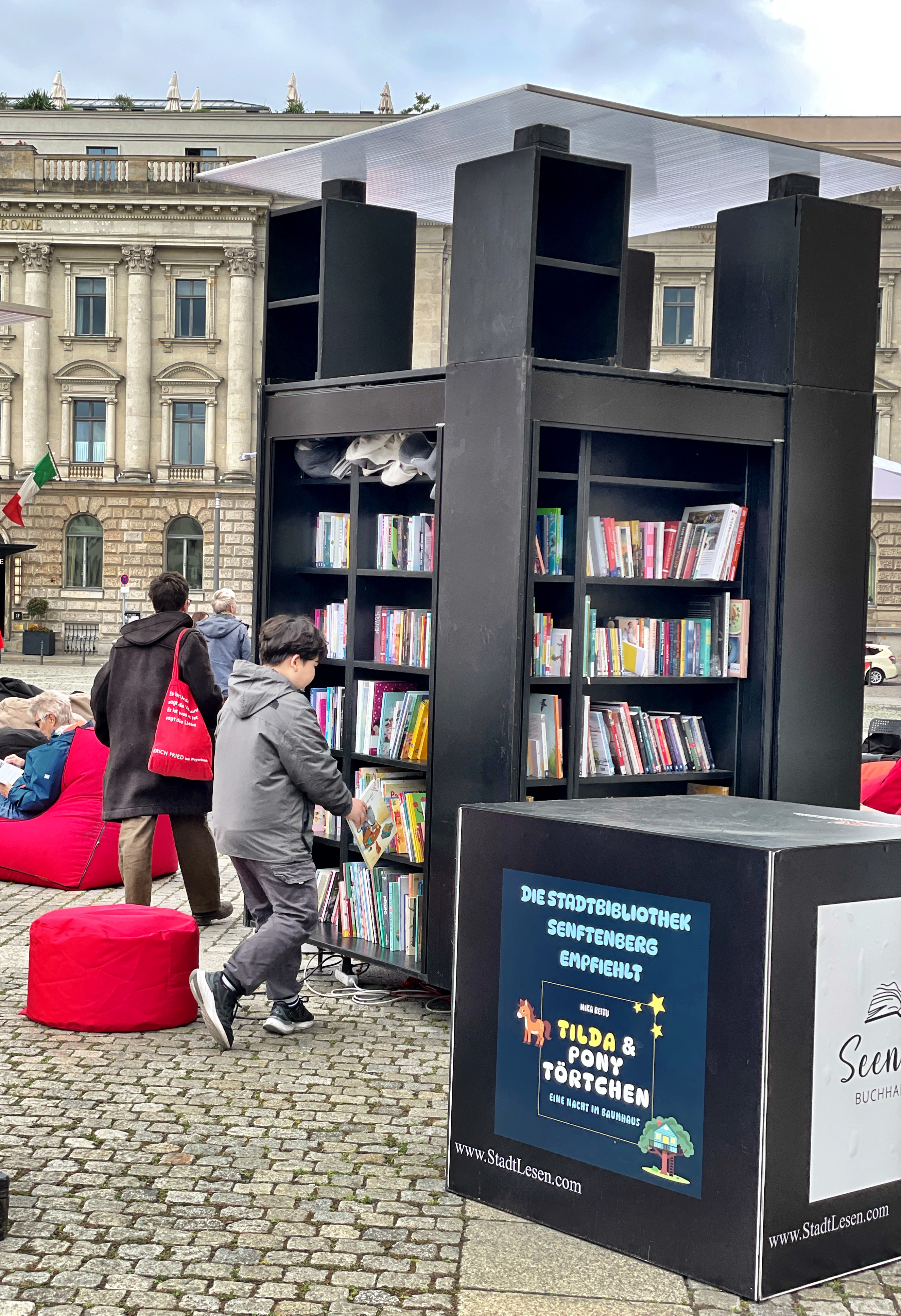
  • Berlin, of course, is a kind of living museum. Most powerful moment in Berlin? The square where, in May of 1933, the Nazis held their first book-burning. There’s a memorial there. Our guide said, quietly: First they burn books. Then, they burn people. But there is a little free library in the square, with hammocks and beanbag chairs. It was a chilly day—but there were children there, reading. Hope.

Everywhere we went, people were kind and hospitable. And honest. Aware of how long it takes to overcome the destruction of a great nation.  As Jen Rubin wrote, this morning:

Other countries, much older than the United States, have gone through grim, even disastrous years, decades, or centuries. And yet in Europe, the spirit of liberal democracy (however imperfect) remains alive and well. A sense of the public good still thrives, and millions of people strive to keep the achievements of Western Civilization from the clutches of fascism, xenophobia, know-nothingism, and conspiracy-mongering. The world is carrying on, albeit with dismay, as Americans struggle through its Dark Age.

Amen.

Are Women the Cause of Reluctance to Read?

I remember learning–perhaps in a grad class or professional development session, years ago–that boys didn’t like to read about girl things. You know—relationships, communication, emotions, the finer points of making a home or enriching family life. Boys wanted to read stories about adventures, we were told. Starring, naturally, other boys.

Ergo, if we wanted to turn boys into enthusiastic readers, we needed books where boys did boy stuff—creeks, animals, cars, fights, danger, you name it. Write it and they will come.

I thought about this when re-reading A Separate Peace this month. My book club is doing a “Books You’ve Already Read—or should have read” month, and I thought it was time to re-read a book that I put on my Top Ten list for decades.

(Seriously—I kept continuously updated top ten lists of books, movies and LPs until I had both children and a full-time job. There are still some gems on those lists—but also some really embarrassing stuff.)

I wouldn’t, however, call Separate Peace an embarrassing pick. I read it in high school, although not as a class novel. In the late 60s, my public high school adopted a choice-based language arts curriculum. Instead of English 9/10/etc, there was an array of semester-long courses. I took journalism, speed reading and Great Books, a totally wonderful class where students did nothing but read books, then journal their impressions.

There was a list of great books (SP was on it), but you could also deviate, with the teacher’s permission. It was that teacher—Mrs. Palmer—who introduced me to Daphne du Maurier, Virginia Woolf, and Madeleine L’Engel.

It’s hard for me to put my finger now on why I loved Separate Peace so much. Partly, it was the boarding school setting—what it would be like to live in dorms, with other students whose parents weren’t scraping to pay the mortgage, for whom college was a certainty, not a stretch.

Mostly, though, I think it was because—spoiler—there’s a death in the book, under unusual circumstances, leading the reader (this teenaged reader, anyway) to muse on Big Meaningful Issues. In case you’re wondering whether I noticed the homoerotic flavor of the relationship between the narrator and his best friend, the answer (1969) is no and (2025) yes.

But here’s what really jumped out at me, some 50+ years later: there are no women in this book. Aside from a couple of sentences mentioning a screechy school nurse, and a sentence describing a classmate’s mother as kindly, there is zero female presence in this book. There’s plenty of adventure, danger, scrapes and disobedience. Even a student-led tribunal, and a World War. But not a single woman, or girl.

From a recent article in The Guardian, about a newly formed publishing house that intends to publish only books by men: 

Cook said the publishing landscape has changed “dramatically” over the past 15 years as a reaction to the “prevailing toxic male-dominated literary scene of the 80s, 90s and noughties”. Now, “excitement and energy around new and adventurous fiction is around female authors – and this is only right as a timely corrective”.

“This new breed of young female authors, spearheaded by Sally Rooney et al, ushered in a renaissance for literary fiction by women, giving rise to a situation where stories by new male authors are often overlooked, with a perception that the male voice is problematic,” he said.

Hunh. I wasn’t really paying attention to any toxic literary scene in the 1980s and 90s, due to the aforementioned family and job. But I was still reading a lot—and was deeply involved in whether and what my students were reading. Or not reading.

It was a time when getting any kind of reading material—from comic books to Captain Underpants— into kids’ hands was the prescription for reluctant readers. There was a rolling bookshelf in my band room, filled with books about music and musicians. Some had some vaguely naughty photos. I purchased all of them, and they were well used.

My take on any reduction in male readers in the 21st century is that omnipresent screens, not problematic masculine voices, are responsible.

Still. What I notice about this (well-meant, I assume) announcement is that it only took a couple of decades for men to perceive that women were “ushering in a renaissance,” then set up their own literary clubhouse, no girls allowed.

There’s also this:
Less than half of parents find it fun to read aloud to their children, new research shows. Only 40% of parents with children aged 0 to 13 agreed that “reading books to my child is fun for me”, according to a survey conducted by Nielsen and publisher HarperCollins. The survey shows a steep decline in the number of parents reading aloud to young children, with 41% of 0- to four-year-olds now being read to frequently, down from 64% in 2012.

A significant gender disparity was identified, with 29% of 0- to two-year-old boys being read to every day or nearly every day compared with 44% of girls of the same age.

Plus this, ominously: Many parents focus on the literacy element of reading, seeing it as a skill, rather than encouraging a love for reading in their children.

So—who’s not reading, and why?

If you talk to the Science of Reading crowd, boys’ reading difficulties and reluctance to read can be laid at the feet of teachers who were never taught the only correct protocols for reading instruction, or—worse—fail to use them with fidelity, a word I have come to loathe when applied to pedagogy.

And since the overwhelming majority of early-grades teachers are women, this can be construed as another way in which women are not paying attention to the needs of boys. But it’s so much more complex than phonemic awareness, yada yada.

The Great Books class at my high school only lasted a few years, then fell when the “cafeteria curriculum” became outmoded, in favor of … what? I forget. Back to Basics? One of our cyclical returns to The Canon—in which white male-authored books have literally always been deemed more worthy of study?

All children deserve to be read to, daily, even when they’re able to read themselves. Stories about both boys and girls. Because that’s how they learn to be curious about the real world.

Version 1.0.0

RIP, Libraries and Museums

On our way home from the Network for Public Education conference, earlier this month, we jogged to the right and spent a night in Cleveland, so we could visit the Rock and Roll Hall of Fame. Our hotel, just a couple of blocks from the Hall of Fame, used to be the Cleveland Board of Education building, completed in 1931.

It’s a magnificent structure, all marble, soaring windows, colorful painted murals and wide hallways, with a bar named The Teachers’ Lounge. Who could resist?

It made me wonder about the value Cleveland currently places on their public schools, when a century ago they commissioned this monument to public education, likely assuming that generations of Ohio kids would be duly and proudly educated in Cleveland, and go on to do great things.

They don’t build ‘em like they used to—either our buildings or our midwestern dreams of progress.

The history of the Cleveland Metropolitan School District looks like the history of many big-city school districts, scarred by changing demographics and the public’s unwillingness to support all children with a free, high-quality, fully public education. Cleveland is not unique—there are still Pewabic pottery-tiled fireplaces in public schools built in the 1920s in Detroit. You can take a bike tour of historic, architect-designed schools in Chicago.

The ”high school movement”—when it became common for American youngsters to pursue education beyond the 8th grade—occurred in the first half of the 20th century. In 1910, the number of HS graduates in the United States was less than 10%, but by the outbreak of World War II, almost three-quarters of the student population attended high school. Many factors—mainly wars, rural-urban migration, and an economic depression—shaped the movement to make 12 years of education the norm.

And, of course, what was the norm for white kids did not necessarily apply to children of color. The Brown decision in the 1950s and school busing protests in the 1970s interrupted the rosy national vision of steadily increasing investment in our public services and institutions.

Not to put too fine a point on it, but America has always struggled with the concept of “all means all” –just who “deserves” to have nice things, like decent housing and basic health care. Schools. Libraries, museums and parks. A reliable, inexpensive postal service. Public universities. The kinds of services we share, places of mutual benefit. Our freedoms.

And now, we have elected a man whose fundamental life goal seems to be taking those things we share—the things we all deserve, and have worked for, as citizens in a constitutional republic– away from us.

Defunding public services and institutions. Privatizing the Post Office, which serves rural addresses that Federal Express won’t touch. Shutting down youth programs and the Summer Reading Club at your local library. Eliminating programs for veterans. Even—God help us—shutting down suicide hotlines for LGBTQ teens.

As I watch this wrenching tear-down of all the things that make for strong communities, I am staggered by this conundrum: Trump and his acolytes have embraced the idea of making America great again by attacking the very things that actually made us great, beginning with the solid belief in our future progress that drove the city of Cleveland to build a temple to public education, and finish it during the early years of the Depression, placing a statue of Abraham Lincoln on the manicured lawn in front.

Belief in our people and their future is behind untold numbers of beautiful, shared enterprises—theatres and hospitals, stadiums and churches. Monuments to philanthropy, and showcases for art and culture. National parks that tell our nation’s stories. Organizations established to help our fellow citizens.

What is behind the impulse to tear all this down, close it off, let it crumble, progress and humanity be damned? Who does this—and why?

None of this is genuinely about waste or fraud—or even evidence of out-of-control DEI thinking. How can there be too much equity or justice in a country that prides itself on inventing a new form of government?

From an article about Lindsey Halligan (see link for revelatory photo), now charged with “removing improper ideology” from Smithsonian museums:

“I would say that improper ideology would be weaponizing history,” Halligan says. “We don’t need to overemphasize the negative.” Halligan, 35, is a Trump attorney who seems to have tasked herself as a sort of commissioner — or expurgator, according to critics — of a premier cultural institution.

Trump is not much of a museumgoer. 

What he’s after is power and control and riches. The men who built the infrastructure of industrial America wanted power, control and riches as well. Some of them wanted to preserve the vile institution—slavery—that made their power and riches possible. We fought a bloody, devastating civil war over the very issue of who deserves to be represented in museums, check out books from the library, or send their children to free public schools.

And here we are, again.

The Rock and Roll Hall of Fame was wonderful. I’ve been a handful of times, and have taken 150 eighth graders—I’ve got stories—to wade around in the history of the music that has surrounded them since birth. The museum is 100% private, funded by wealthy donors and $39.50/per ticket fees. It will not be torn down, stripped for parts or sold to the highest bidder.

As I was wandering through the main exhibit hall on the lower level, I started thinking about how the roots of rock music, like the labor of enslaved workers, were essentially stolen from African-American blues and gospel singers, mixed with rough-edged country, hillbilly and western music. And then sold to the masses, after condescending  public dismissal as unimportant and vulgar.

Power and control and riches. Plus ça change, plus c’est la même chose.

The Folly of Settled Science

It was on Morning Edition, seven years ago—a cheery little piece on how we now know just how to teach students with dyslexia how to read. Interesting, I thought then, expecting to hear about some new breakthrough technique in reading pedagogy. Instead, what I heard was this:

Dyslexia is the most common learning disability, affecting tens of millions of people in the United States. But getting help for children who have it in public school can be a nightmare. “They wouldn’t acknowledge that he had a problem. They wouldn’t say the word ‘dyslexia.’’’

Wow. Not true in my school. We talked about dyslexia and reading instruction endlessly, being very careful not to throw around the label (which impacts 3% to 7% of students, depending on how the condition is defined) indiscriminately. I found it hard to believe that parents who sought help for a genuinely dyslexic child would find the process ‘nightmarish.’

I spent most of my career in one school district, but teachers there expended a great deal of effort and analysis in teaching kids to read and reinforcing ‘reading across the curriculum’ in upper grades. Over three decades, and via my own children’s reading instruction there, I saw several reading programs come and go. I was part of countless conversations about how to incorporate new pedagogical thinking into practice. But–teachers refusing to identify the issues with a student who struggled to read? Never.

Turns out, the Morning Edition piece (in 2018, remember) wasn’t really about a new, proven strategy for helping kids with reading disabilities. The program was fanning new flames of the always-politicized Reading Wars:

Research shows that they learn to read better when they are explicitly taught the ways that sounds and letters correspond. And research shows that even students without dyslexia learn better this way. “I have started to call it not dyslexia but dysteachia. It’s the teachers who are not giving the right kind of instruction!”

Aha! Kids can’t read? It’s the teachers’ fault. Again.

The Reading Wars (which have been going on for over 100 years) tore local school boards apart in the 1990s, in an effort to determine which reading program was “the best.” Many of these bitter arguments were framed as “Phonics” vs. “Whole Language,” but anyone who’s studied the acquisition of literacy knows that’s a simplification so gross as to be useless. Reading instruction is never binary, or limited to right vs. wrong strategies.

The National Reading Panel, convened by a government department with an agenda, put forth a major report, designed to settle the question, once and for all—but the lone practitioner on the panel strongly disagreed with the methodology and policy implications that rolled out, post-reportif not with the actual findings. So, hardly a consensus among teachers.

Then the heavy hand of accountability pushed the discussion—the professional work of reading teachers—out of the classroom, and into whatever place it is that reading programs are measured by their efficacy in raising test scores. And possibly forcing children to repeat the third grade.

I am sincerely happy to know that students correctly identified with dyslexia, a complex, multi-layered diagnosis, seem to be more successful in learning to read, using a phonemic awareness/phonics-intensive program. Still, I am putting my faith, as always, in the discernment and expertise of the teacher.

Students classified as dyslexic have varying strengths and challenges and teaching them is too complex a task for a scripted, one-size-fits-all program. Optimal instruction—meaning the most effective methods for students with disabilities as well as those already reading fluently and making meaning–calls for teachers’ professional expertise and responsiveness, a full tool bag and the freedom to act on the basis of that professionalism.

It’s worth mentioning—again—that formal reading instruction in Finland does not begin until students are seven years of age, long after some children in the United States have been identified as dyslexic or learning disabled, because they’re unable to decode at age six.

Seven years ago, the author of the Morning Edition piece, Emily Hanford, claimed that the superiority of phonics/phonemic awareness instruction for all children—and the failure of whole language programs—was settled science, ‘like climate change.’

I certainly hope there’s never a rigid, unchanging agreement on the One Best Way to teach people of any age to read. All scholarly disciplines should undergo regular re-assessment, as research reshapes knowledge. There are still classrooms in the United States, after all, where evolution is not settled science.

I dug some of this information out from a piece I wrote in March of 2018 for Education Week, because yesterday, for the first time, I had an unpleasant skirmish on Bluesky.

I had posted a comment re: the just-released, drooping NAEP reading scores which are now being dissected in the media. There’s a lot of alarmism and pearl-clutching in the mainstream media, but here’s a pretty good piece from NPR. (The piece also reminds readers that “proficient” doesn’t mean adequate or even OK—it means considerably above average.)

While 4th and 8th grade reading scores overall are still below pre-pandemic levels, it’s worth remembering that this year’s fourth graders were in kindergarten when the pandemic hit, and many spent much of first grade, prime learn-to-read time, learning remotely. Fourth graders in the tested NAEP group did not experience typical reading instruction.

Scores for advantaged students—the top of the heap, economically—were actually strong; scores for the poorest quadrant were dismal. Nothing new, but that gap was much bigger in this round of testing. That is actually useful information. We should be putting more resources into the public schools that serve disadvantaged students (not vouchers to subsidize wealthy families choosing private or religious schools).

I thought about how the ‘settled science” of learning to read has become the “Science of Reading”—and how, over the past seven years, since I first heard that piece on Morning Edition, kids who were first learning to read then (and are now 8th graders) have not moved up the testing ladder, even though over 40 states now have laws or policies based on the so-called Science of Reading.

If SOR was the one best way, why haven’t scores been creeping up? It was a simple, non-hostile question.

Which drew a very hostile response from a Bluesky account that appears to be an online tutoring service with one of those improbably aspirational—think Rocket Reader!!–names.  He or she refused to give his/her name, and the exchange (wherein I kept asking for research supporting his/her claims) got increasingly antagonistic.

S/he kept returning to how old and out of touch I am, and insulting not only me, but other researchers and opinion writers with far more credibility than I on the topic of learning to read. His/her final comment (before I blocked him/her) was “Go live in the nursing home with Lucy Calkins!”

Here’s the thing, though. Having seen reading instruction up close and personal—as a professional, not a student—over decades, it’s very clear that it will never be settled (or, probably, science).  It’s complex and variable and entirely dependent on what students bring to the table.

We Need Hygge Classrooms in America

The ubiquitous FB meme:

In Iceland, books are exchanged as Christmas Eve presents, then you spend the rest of the night in bed reading them and eating chocolate. The tradition is part of a season called Jolabokafload, the Christmas Book flood, because Iceland, which publishes more books per capita than any other country, sells most of its books between September and November, due to people preparing for the upcoming holiday.

Nobody ever responds: That sounds awful! My family prefers watching our individual TVs!

Generally, commenters reply wistfully, longing for a country where learning is valued and books are ideal gifts, where the dark and cold are counterbalanced by intellectual curiosity and conversation.

Thanks to the Jolabokaflod, books still matter in Iceland, they get read and talked about. Excitement fills the air. Every reading is crowded, every print-run is sold. Being a writer in Iceland you get rewarded all the time: People really do read our books, and they have opinions, they love them or they hate them. At the average Christmas party, people push politics and the Kardashians aside and discuss literature.

Perhaps because I live in a region that gets 135 inches of snow each winter, these cozy, fireside literary chats are enormously appealing to me. As is the Danish concept of hygge:

The Danish art of contentment, comfort, and connection…a practical way of creating sanctuary in the middle of very real life.”

Hygge (hoo-ga), which has no direct translation into English—surprise!—is many things to many people: Woolen socks. Candles and other gentle light. Board games. Comfortable couches and cozy quilts. Warm drinks.

Although hygge seems to have Scandinavian roots, it’s not exclusively a cold-climate thing, evidently. A rustic cottage on a lake, with its beat-up furniture, mildewed paperbacks from the 1950s and second-hand bathing suits is very hygge, according to Meik Wiking, author of “The Little Book of Hygge” and, not coincidentally, CEO of the Happiness Research Institute in Copenhagen. The mere fact that there is a Happiness Research Institute, somewhere in the world, makes me—well, happy.

The interesting thing about hygge and Jolabokafload is their inherent intentionality. Citizens in Iceland and Denmark take contentment, comfort and connection seriously, and pursue them with deliberation. Choosing the right book for someone means you know that person, and what they might enjoy reading. Playing games with your family means connecting with them, laughing and teamwork.

So why don’t we pursue this, here in the land of the free, home of the brave? What keeps us, a nation that often proclaims itself the best country in the world, or at least on its way to becoming “great” again, from choosing to embrace contentment and connection?

Perhaps Scandinavians are better able to appreciate the small, hygge things in life because they already have all the big ones nailed down: free university education, social security, universal health care, efficient infrastructure, paid family leave, and at least a month of vacation a year. With those necessities secured, according to Wiking, Danes are free to become “aware of the decoupling between wealth and wellbeing.”

That decoupling between wealth and wellbeing is well-reflected in this headline: Children Need Homes, Not Charter Schools or Standardized Tests, and Definitely Not Tax Cuts for the Wealthy.

That’s where our intentionality lies in the U.S., where we’re spending our hard-earned tax dollars—canned curricula designed to raise test scores and alternative school governance models, endless expensive tests—when over 100,000 New York City schoolchildren were homeless last year. According to former Senator Orin Hatch, we don’t even have money for poor children’s basic health care. As a nation, we have linked simple human well-being to wealth, and sealed it with the tamper-proof cap of low opportunity.

Many teachers try to add hygge touches to the classrooms where their high-poverty students meet and work every day—from beanbag chairs to classroom sets of snowpants for outdoor play, from little free libraries to Cocoa Day. If school can become a place of connectivity, warmth and safety, they reason, students will keep coming back.

Happy Hygge-days, Teacher in a Strange Land readers. Thanks for all you do for your students.