The Return of the Tradteacher

Been reading about the tradwife lately? Although explicit definitions vary, the general gist is returning to a post-war conception of a stay-at-home wife, most likely with children (or planning for children), in relationships where men make all the family decisions, and control the finances. Reinforcing patriarchal norms and glorifying the satisfying and ‘natural’ role of housewife.

If you’re hearing a touch of cynicism there, well—I lived through a time when the tradwife, even if she was working, could not get a credit card or substantial business loan. While I certainly defend any woman’s right to stay home and support her children and spouse in places other than an outside workplace, the whole “tradwife” schtick (especially combined with the rollback of Roe) makes me itchy.

It also strikes me that tradwives are just another glitzy, social media-driven facet of a larger wave of backlash against a whole lot of un-trad trends in American society: Full-blown reproductive freedom. The continued shrinkage of mainline religions. Honoring personal sex/gender choices. Women running for office and corner offices–and winning. And so on.

I also see lots of pushback against untraditional teaching, curriculum and school organization models. The whole “Science of Reading” battle rings very familiar to those of us who started teaching in the 1970s, when teachers were pushing back against the “Why Johnny Can’t Read” –because teachers theoretically weren’t teaching phonics–crusade in the late 50s.

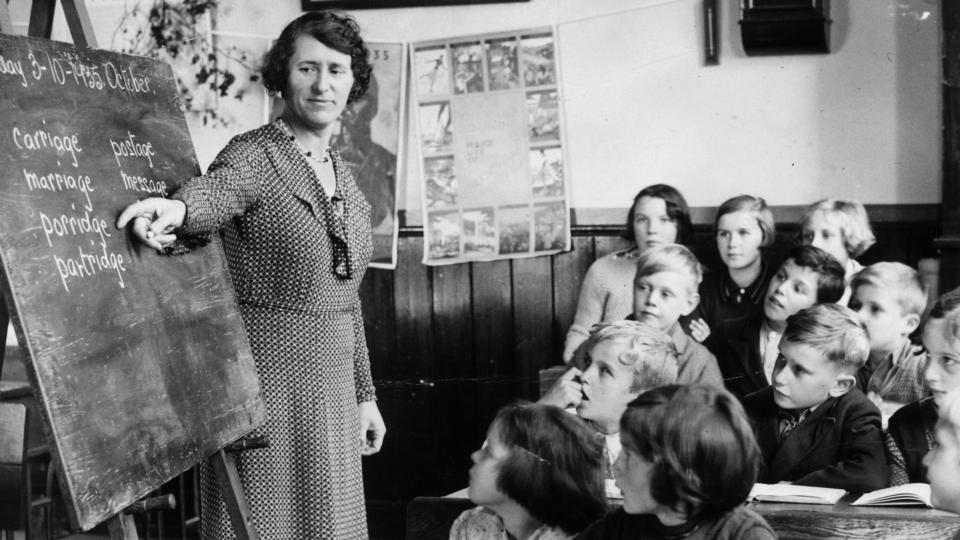
Nearly all of the folks who taught me were tradteachers, using trad methods, and when I entered the classroom, many of my teaching colleagues were 100% traditional-minded as well: Straight rows, direct instruction, textbook-based, daily homework, and off to the principal should you disobey orders. And some of those folks were effective teachers.

But lots of the opinion writing I see from Moms4Liberty, NYT columnists, conservative politicians and ed-bloggers focuses on how different education looks and feels from the classrooms they remember, decades ago—classrooms that may have been racially and economically monolithic, and headed by a series of teachers who did things in the same way.

Peter Greene recently had a good piece about Gloria Jean Merriex, a Florida teacher who broke out of her traditional mold and had some great success. A couple of lines jumped out at me:

Once she had her degree, she chose to teach at Duval Elementary, where for about twenty-five years she was a middle-of-the-road, competent-but-not-exceptional teacher.

Then came No Child Left Behind, and with it, high stakes testing. In Florida, that meant the FCAT, used to give each school a grade, with rewards for A schools and punitive “interventions” for F schools. In 2002, Duval was rated F.

Merriex was troubled. She concluded that if the school was going to be transformed, she would have to transform herself. She dumped the state pacing guides and teaching materials. When she got caught, she begged Duval principal Lee McNealy for a chance to give her methods a try, and McNealy had the guts and trust to give it to her.  Merriex developed materials and approaches of her own, and for the early 2000s, her choices were unconventional. She wrote raps and dances to do with her students for learning math vocabulary and basic processes. She used call and response, movement and arts in the math and reading classroom. If some of her techniques seem less radical twenty years later, that is in part because of her influence.

For many, perhaps most, teachers, their first years in the classroom might look very much like the way those newbies themselves were taught. It was certainly that way for me, wanting to be the World’s Greatest Band Director and following the exact procedures and ideas I had experienced in bands and at music camp in high school. For many years, I too was a competent-but-not-exceptional teacher, like Ms. Merriex.

I also broke out of the traditional mold, and while not all of the things I tried were big successes, I was able to redefine what I wanted students to take away, for the rest of their lives, from being in my classroom. I accomplished many of those goals. I read social media for music teachers now, and I see great changes in thinking about the Big Ideas—from competition to creativity—in music ed.

Traditional teaching—and like tradwives, the definitions are murky—is not always or even often the best bet. Especially if that teacher’s goal is to move every student under her watch forward.

Stanford Professor Jo Boaler is something of an iconoclast in non-traditional math education, and recently–no surprise–there’s been yet another dustup over Boaler’s ideas.

She advocates for ending tracking by ability in math classes, getting rid of timed tests and starting with conceptual understanding before introducing procedures. Most importantly, she wants to elevate the work that students tackle in math classes with more interesting questions that spark genuine curiosity and encourage students to think and wonder. Her goal is to expose students to the beauty of mathematical thinking.

Right there in the first sentence, there are three uber-traditional practices—tracking, timed tests, and doing a series of problems to iron in an algorithm, to get the right answers rather than seeking to understand the concepts underlying the calculation. And who’s out to get Boaler? Well, men who have been the beneficiaries of understanding and excelling at traditional mathematics.

It’s an enormously complex endeavor, teaching. Sticking to the habitual, and ignoring students who check out, only works for awhile. BUT—listen to legislators and parents talk about schooling, and a lot of what you’re hearing is somewhere between nostalgia and flat-out misinformation. The book-banning, faux CRT, Tik-tok blaming, skeptical-of-teachers crowd hasn’t got a clue about what it’s like to teach kids in 2024, beginning with some clarity about the purpose of public education.

As Jess Piper says, in a wonderful column called You Don’t Like It? Move!:

None of us is safe so long as there are folks living in states that are unsafe. They will roll over us first, and you next. The billionaires are using my state AG and other regressive state AGs to file suit to dismantle public schools. They sue to ban abortion and the medicine for self-managed abortions. They sue to stop college loan forgiveness. They sue to overturn civil rights and anti-discrimination policies.

As Piper says—hey, we can’t all move, or teach in a private school where we can craft our own processes, research and convictions. But returning to traditional methods isn’t the policy answer. You have to move forward. It’s the way of the world.  

Quote of the Day

Sometimes, Facebook bubbles up a worthy glimpse of the past. This awesome quote– from 12 years ago– appeared on my page this morning, causing me to reflect on how much we’ve lost in the past decade. Wood is reflecting here on a remarkably different era– where Michelle Rhee was on the cover of TIME magazine, brooming out “ineffective” teachers, and Teach for America was growing, not shrinking and re-branding. His school was building on the reforms of the 1990s, with student-focused programming and the valuing of teacher expertise. If nothing else, it rebuts the tired cliche’ that “factory model” schools have not changed in the past century– schools have changed radically in just a dozen years. George Wood’s school was in Ohio, where “reformers” see their #1 goal as expanding private school vouchers.

“For the past 18 years, I have worked as a HS/MS school principal alongside a dedicated staff and a committed community to improve a school. In that time, we have increased graduation and college-going rates, engaged our students in more internships and college courses, created an advisory system that keeps tabs on all of our students, and developed the highest graduation standards in the state (including a Senior Project and Graduation Portfolio).

But reading the popular press and listening to the chatter from Washington, I have just found out that we are not part of the movement to ‘reform’ schools. You see, we did not do all the stuff that the new ‘reformers’ think is vital to improve our schools. We did not fire the staff, eliminate tenure, or go to pay based on test scores. We did not become a charter school. We did not take away control from a locally elected school board and give it to a mayor. We did not bring in a bunch of two-year short-term teachers.

Nope, we did not do any of these things. Because we knew they would not work.”

George Wood

Do Public Schools Suck?

Some years ago, John Dubie, then a high school senior in Vermont, posted a very personal, autobiographical blog entitled “Big Picture Saved My Life.” John meant that statement literally—the Big Picture curriculum and program at South Burlington HS was the thing that kept him going when he was thinking about checking himself out.

I was stunned by the aftermath of the piece, which was picked up, reprinted and dissected in a number of other blogs. I was especially surprised by those commentaries that suggested John’s life was saved by leaving traditional public school.

The irony? Dubie spent much of the blog describing the first eight years of his education in a Catholic school, where he was generally seen as a disruptive loser by the faculty. And– the Big Picture Learning program he credits with making all the difference was housed in a traditional public school, in Burlington, Vermont,

Because I was the person who suggested John tell his story in public, this re-interpretation of his autobiography made me see red. I said as much, in the comments, noting that his generosity shouldn’t become a cheap excuse to slam public education again. I said: What I’m worried about here is protecting a young man who graciously shared a deeply personal reflection having his story–and his face– used to promote the idea that public education sucks.

The response I got: Seriously? Of course public education sucks.

Do public schools suck? Is that the conventional wisdom, the reflexive, global response these days? Do we have to start with the conviction that public education has failed, before we can transform or improve, regenerate or revitalize a fully public system?

I say no. In fact, the best time to change public education is now, while its strengths, resources and merits still exist.

What questions should we be asking about public education, before reflexively tearing it down? What facts shape the argument that public education, as a concept, is well worth saving?

  • All governance models–public, chartered, independent, parochial—have produced exciting schools and disastrous schools. There are plenty of students who thrive under direct-instruction, highly structured, traditional content-delivery models. And others who learn best through self-directed exploration of ideas and subjects that interest them. There is no one best way to learn.
  • Public education remains the Big Kahuna of governance models in the U.S. Why would you tear down the considerable and historic infrastructure of a system that has educated–however imperfectly–generations of (successful) Americans, instead of updating it, repairing its cracks and flaws and outright malfunctions? Other nations have retrofitted their public systems, using both research and imagination. Why wouldn’t we?
  • When and where public education is not meeting the needs of students, why is that so? Public education has been radically re-shaped in the last two decades, driven by “reform” policies and experiments that clearly aren’t yielding the expected results (and that’s a very sanguine assessment). If public schools suck, we certainly haven’t found the magic formula to fix them. Probably because the answers involve hard work, multiple strategies and serious investment.
  • Public education is the only “choice” when other options are exhausted, so public schools are filled with our poorest children, those whose parents cannot provide transportation or uniforms or help with algebra homework. Some of those schools are creatively addressing problems, building communities and family relationships, persisting even if testing data remains low. Do they suck?
  • Who’s saying that public education sucks–and why are they saying it? For some parents, the fact that their child doesn’t get a custom-tailored learning experience or enough attention is reason enough to believe that all public education is substandard. For others, there is a knee-jerk assumption that the only good education is a series of competitive-admission, high-ticket private schools. Much of the anti-public education drumbeat springs from a politicized, media-fed conviction that public schools have failed, based on testing data alone. You have to ask: What’s in it for the most vocal and persistent public school critics?
  • You don’t really know what a particular school or classroom is like until you’re there. We’ve all read the polling data that shows parents generally think the schools in their community are pretty good; it’s the schools in other places–scary urban places, or maybe just the next district over, or public schools across the nation–that are terrible. I’ve been in plenty of classrooms in Detroit Community Schools where there was order, curiosity, learning–and joy (and usually, about twice as many kids as there should be). In the middle of poverty, there are pockets of triumphant accomplishment.

Shouldn’t we be shoring up public education, as America’s best idea? Shouldn’t we be investing in repair, enhancement, innovation? Let’s stop with the facile pronouncements on the failure of public education–they reveal failure of imagination and democracy.

The Mental Energy of Teaching

Interesting tweet from @EdFuller_PSU:

The one thing non-teachers simply do not and cannot grasp is how MENTALLY EXHAUSTING IT IS TO TEACH ALL DAY. There are very, very few jobs that require the constant mental attention that teaching does. I’d love to see all the people criticizing teachers to teach for a week. (Caps are Fuller’s.)

There are over 750 responses, running about 30 to one some form of confirmation, most of which are from teachers or parents. The odd pushback (i.e., @Angrydocsx: Surgery, nursing, working on an oil rig, construction, being a lineman, etc… Teachers are great but get over yourself.) are either from people who feel their jobs are equally taxing, or your garden-variety anti-teacher/anti-union/you-suck-so-shut-up tweets.

Side note: I think surgery and nursing are also incredibly demanding and find @Angrydoc’s immediate shift to oil rigs and linemen in cherry pickers—dangerous, outdoor male-dominated jobs—telling.

Fuller (who, not coincidentally, was a HS teacher before moving into higher education) puts his finger on the thing that makes teaching exhausting—you’re on all the time, making decisions on the fly and—if you’re doing the job right—taking sincere responsibility for teaching…something, to students who may not particularly want to be taught.

He did not say teaching was the most mentally exhausting job in the world—there are others where you can’t take a break or turn your back—only that the need to constantly pay attention and adapt were factors that many folks did not perceive, when they thought about teaching. A number of the tweeted responses, in fact, were from people who thought they’d give teaching a try, but concluded that it wasn’t the job they thought it would be.

Larry Cuban recently compared teachers’ decision-making to playing jazz and rebounding in basketball—two complex skills that depend on prior learning and practice for automaticity. He includes two footnotes about the number of decisions teachers typically make:

*Researchers Hilda Borko and Richard Shavelson summarized studies that reported .7 decisions per minute during interactive teaching.

*Researcher Philip Jackson said that elementary teachers have 200 to 300 exchanges with students every hour (between 1200-1500 a day), most of which are unplanned and unpredictable calling for teacher decisions, if not judgments.

Cuban notes that those studies are older, and invites readers to share any newer research—but those figures ring absolutely true to me. Interactions, decisions, re-direction, pop-up questions, wait time, modeling, judgments. On and on and on. Teaching is all about an on-your-feet response to whatever crops up. It’s the essence of unpredictability, and every day is exhausting.

What Fuller’s tweet and the plethora of responses clearly illustrates: There is no such thing as successful scripted teaching or “effective” fidelity to pre-constructed lessons. Also: the more you teach, if you’re paying attention, the more fluid the decision-making becomes, and the more tools in your mental (and emotional) tool bag. Experience matters. Perception matters. Judgment matters.

When I had been teaching for more than 25 years, I took a two-year sabbatical to work at a national education non-profit. There was an opportunity to pursue an alternate career in our contract language, but even though I knew I could return to teaching, I was certain that this new job was my off-ramp.

At first, it was great. I had my own cubicle, with a computer and a phone and–get this–a secretary. We took an hour for lunch, occasionally going out to a restaurant (and, also occasionally, having a glass of wine). We could use the bathroom as often as we liked. I could pop into someone else’s office and have a long chat about some issue that had arisen. I could leave early to go to the dentist. We were doing a lot of conferences and workshops—on weekends, because our clients were educators—and if we were in another city for the weekend, we didn’t return to work until Wednesday or Thursday: comp time!

I found the workload easy and the pace relaxed. I liked the people I worked with. But after the first year, I started thinking about going back to teaching. It took a long time to work through the reasons. Teaching offered less money, less prestige and way more what might be called mandatory time on task.

What I finally concluded was this: When I left the school building at night, and walked across the parking lot, I could describe the good I had done that day, things students had learned, progress made. I didn’t get that daily confirmation at the non-profit (which was much-admired). Lots of days were focused on strengthening the business end of the non-profit’s work. I didn’t get to hang out with kids, either.

I taught a lot of subjects and varied grade levels during my career, speaking of mental exhaustion. I taught large middle school and high school band classes (65+ students), and 7th grade math in the first year of a new, “connected” curriculum that the old math teachers loathed. I taught vocal and instrumental music in every grade from pre-K to 12. By far the most mentally challenging class I ever taught was general music to a group of 12 Pre-K children, mostly four years old, in my last year in the classroom.

These kiddos were all over the place, maturity-wise. My biggest challenge at first was getting them all to sit, not sprawl or run around, on the circular rug in my classroom. I had them for 50 minutes, twice a week (yup—too long, I know, but that’s the way the schedule was set up), so the first time they came to my room, I prepared a lesson plan with seven different activities, from listening to marching. Seven!

They ran through that plan in about 20 minutes. I remember thinking: I’m supposed to be good at this! I hope nobody makes an unscheduled visit to my room.

Although I got much better at teaching very young children, thanks to the generous suggestions of my colleagues, it was a mental attention marathon, day in and day out. Did they understand that word? Why aren’t his hands coming together when he claps? How much time is left? Wait— is she actually spitting?

When we speak of teacher professionalism, we think of content knowledge, instructional expertise, being a respected contributor to a school learning community. But a big part of professionalism is accepting responsibility for what happens in your worksite, for expending the continuous mental energy to create a successful and skilled practice.

The last word about the way the public sees teacher professionalism, from Jose Vilson:

Over the last few decades, pundits and policymakers have derided the professionalism of teachers because “accountability” or whatever. No matter how many degrees and certificates they get, how many years of experience they accumulate, or student commendations they collect, American society looks at teachers and says “Oh, that’s nice!” but also, “How do you do it? Couldn’t be me!” “You and your union make the job easy, right?” and my personal favorite, “I couldn’t stand me when I was a child. How does that work out with 30 of them?!” In other words, even though many people think only a special set of people can do the job, they also think anyone can do it.

“My Research is Better than Your Research” Wars

When I retired from teaching (after 32+ years), I enrolled in a doctoral program in Education Policy. (Spoiler: I didn’t finish, although I completed the coursework.) In the first year, I took a required, doctoral-level course in Educational Research.

In every class, we read one to three pieces of research, then discussed the work’s validity and utility, usually in small, mixed groups. It was a big class, with two professors and candidates from all the doctoral programs in education—ed leadership, teacher education, administration, quantitative measurement and ed policy. Once people got over being intimidated, there was a lot of lively disagreement.

There were two HS math teachers in the class; both were enrolled in the graduate program in Administration—wannabe principals or superintendents. They brought in a paper they wrote for an earlier, masters-level class summarizing some action research they’d done in their school, using their own students, comparing two methods of teaching a particular concept.

The design was simple. They planned a unit, using two very different sets of learning activities and strategies (A and B) to be taught over the same amount of time. Each of them taught the A method to one class and the B method to another—four classes in all, two taught the A way and two the B way. All four classes were the same course (Geometry I) and the same general grade level. They gave the students identical pre- and post-tests, and recorded a lot of observed data.

There was a great deal of “teacher talk” in the summary of their results (i.e., factors that couldn’t be controlled—an often-disrupted last hour class, or a particularly talkative group—but also important variables like the kinds of questions students asked and misconceptions revealed in homework). Both teachers admitted that the research results surprised them—one method got significantly better post-test results and would be utilized in re-organizing the class for next year. They encouraged other teachers to do similar experiments.

These were experienced teachers, presenting what they found useful in a low-key research design. And the comments from their fellow students were brutal. For starters, the  teachers used the term ‘action research’ which set off the quantitative measurement folks, who called such work unsupportable, unreliable and worse.

There were questions about their sample pool, their “fidelity” in teaching methods, the fact that their numbers were small, and the results were not generalizable. Several people said that their findings were useless, and the work they did was not research. I was embarrassed for the teachers—many of the students in the course had never been teachers, and their criticisms were harsh and even arrogant.

At that point, I had read dozens of research reports, hundreds of pages filled with incomprehensible (to me) equations and complex theoretical frameworks. I had served as a research assistant doing data analysis on a multi-year grant designed to figure out which pre-packaged curriculum model yielded the best test results. I sat in endless policy seminars where researchers explicated wide-scale “gold standard” studies, wherein the only thing people found convincing were standardized test scores. Bringing up Daniel Koretz or Alfie Kohn or any of the other credible voices who found standardized testing data at least questionable would draw a sneer.

In our small groups, the prevailing opinion was that action research wasn’t really research, and the two teachers’ work was biased garbage. It was the first time I ever argued in my small group that a research study had validity and utility, at least to the researchers, and ought to be given consideration.

In the end, it came down to the fact that small, highly targeted research studies seldom got grants. And grants were the lifeblood of research (and notoriety of the good kind for universities and organizations that depend on grant funding). And we were there to learn how to do the kind of research that generated grants and recognition.

(For an excellent, easy-reading synopsis of “evidence-based” research, see this new piece from Peter Greene.)

I’ve never been a fan of Rick Hess’s RHSU Edu-Scholar Public Influence Rankings, speaking of long, convoluted equations. It’s because of these mashed-up “influence” rankings that people who aren’t educators get spotlights (and money).

So I was surprised to see Hess proclaim that scholars aren’t studying the right research questions:

There are heated debates around gender, race, and politicized curricula. These tend to turn on a crucial empirical claim: Right-wingers insist that classrooms are rife with progressive politicking and left-wingers that such claims are nonsense. Who’s correct? We don’t know, and there’s no research to help sort fact from fiction. Again, I get the challenges. Obtaining access to schools for this kind of research is really difficult, and actually conducting it is even more daunting. Absent such information, though, the debate roars dumbly on, with all parties sure they’re right.

I could tell similar tales about reading instruction, school discipline, chronic absenteeism, and much more. In each case, policymakers or district leaders have repeatedly told me that researchers just aren’t providing them with much that’s helpful. Many in the research community are prone to lament that policymakers and practitioners don’t heed their expertise. But I’ve found that those in and around K–12 schools are hungry for practical insight into what’s actually happening and what to do about it. In other words, there’s a hearty appetite for wisdom, descriptive data, and applied knowledge.

The problem? That’s not the path to success in education research today. The academy tends to reward esoteric econometrics and critical-theory jeremiads. 

Bingo. Esoteric econometrics get grants.

Simple theoretical questions—like “which method produces greater student understanding of decomposing geometric shapes?”—have limited utility. They’re not sexy, and don’t get funding. Maybe what we need to do is stop ranking the most influential researchers in the country, and teach educators how to run small, valid and reliable studies to address important questions in their own practice, and to think more about the theoretical frameworks underlying their work in the classroom.

As Jose Vilson recently wrote:

Teachers ought to name what theories mobilize their work into practice, because more of the world needs to hear what goes into teaching. Treating teachers as automatons easily replaced by artificial intelligence belies the heart of the work. The best teachers I know may not have the words right now to explain why they do what they do, but they most certainly have more clarity about their actions and how they move about the classroom.

In case you were wondering why I became a PhD dropout, it had to do with my dissertation proposal. I had theories and questions around teachers who wanted to lead but didn’t want to leave the classroom. I was in possession of a large survey database from over 2000 self-identified teacher leaders (and permission to use the data).

None of the professors in Ed Policy thought this dissertation was a useful idea, however. The data was qualitative, and as one well-respected professor said– “Ya gotta have numbers!” There were no esoteric econometrics involved—only what teachers said about their efforts to lead–say, doing some action research to inform their own instruction–being shut down.

And so it goes.