O Christmas Tree

A Fox host said this weekend that more Americans need to buy artificial Christmas trees because tree farms are needed for AI data centers: “There will be transmission lines that have to go through developments and farms. That’s the nature of a growing economy. Everybody needs to get on board. Buy a fake tree.”  (Meidas)

I live in northern Michigan. Michigan is the third highest producer of Christmas trees in the U.S., harvesting around 2 million trees each year. We have over 500 tree farms, most concentrated in the upper half of the Mitten.

Friends of mine, growing up, had low-paying summer jobs trimming the little firs and pines into their eventual iconic triangle shapes. It’s a crappy job in early summer—dangerous and scratchy—but hey. Lots of teenagers have crappy jobs. It’s America.

I have never had an artificial tree. Some of my best friends, as the saying goes, have beautiful artificial trees, for all kinds of reasons—convenience, cleanliness, allergies—and I am seriously Not Judging.

But learning from Fox News that I should buy an artificial tree—presumably to make tree farming, a local industry, fail so that the devalued land could be looted for an AI data center—made my holiday blood boil.

Tree farms—like this one—do not despoil the rolling, wooded terrain of northern Michigan, unlike AI data centers. Most are family businesses, employing local people, investing for decades in trimming and watering, for an annual end-of-year payoff. Unlike AI data centers.

As it happens, a proposed AI Data Center in nearby Kalkaska was withdrawn after resistance to the project was quickly organized. I was surprised—Kalkaska is the quintessential up-north town, with pine-paneled bars and pot shops as the main business thrust, plus a giant trout fountain in the middle of town.

You’d think they’d jump at the chance to build a huge data factory—construction jobs in an uncertain economy when unemployment is rising?  But no. They knew that “the nature of a growing economy” was going to come back to bite them with ugly power lines, jacked-up utility prices and the loss of 1500 acres of state-owned land.

When Fox News decides that fake trees are patriotic, urging us to buy plastic trees mostly made in China, to support the modern economy, something is very wrong.

But you already knew that.

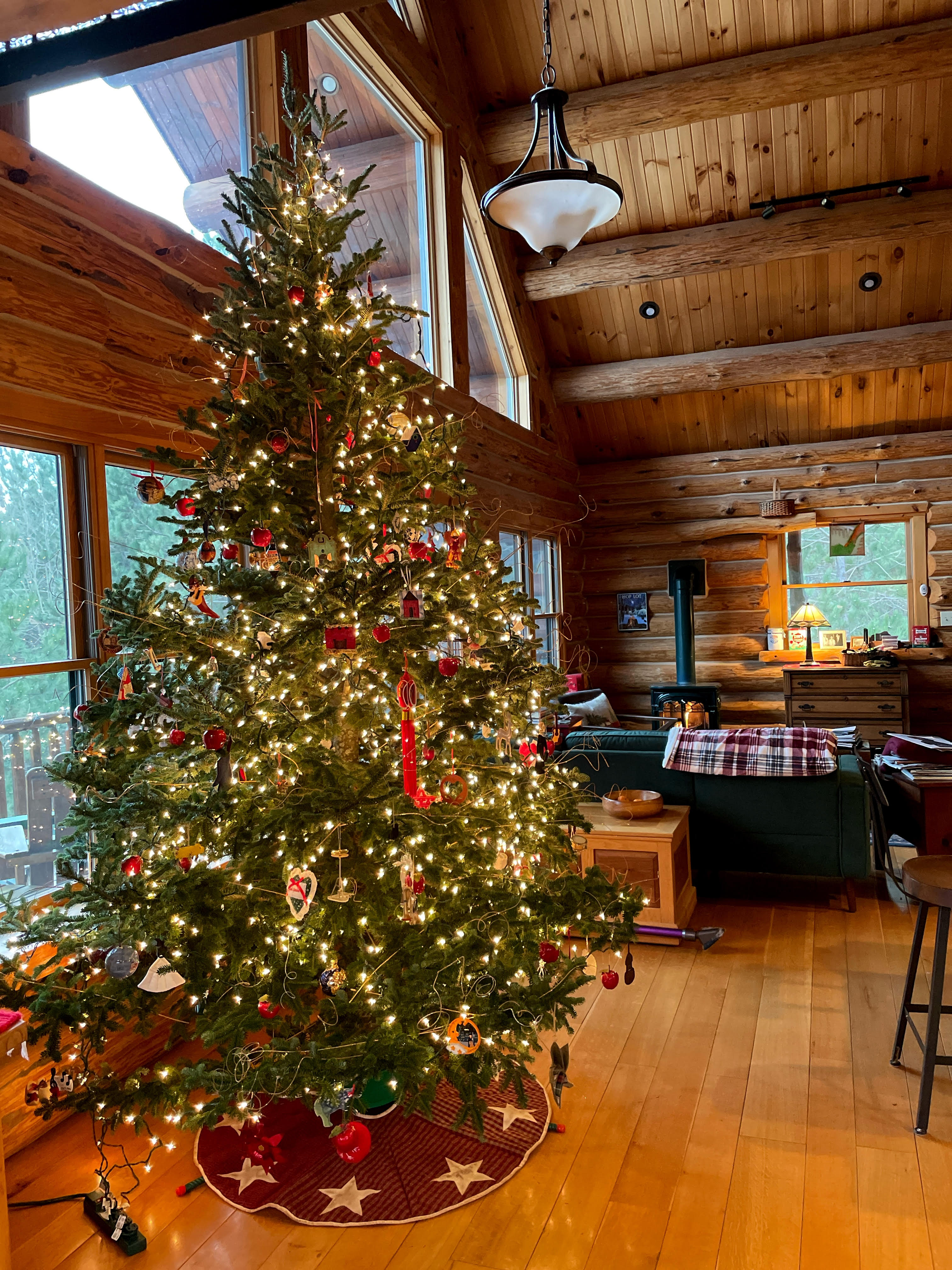
We have purchased beautiful live trees from three different local sources—two of which have gone out of business in the past decade. We are scaling back this year, with a 9-foot Fraser Fir (the photo, a 12-foot Fraser, is from two years ago). Neither of us wants to get on anything higher than a stepstool anymore.

The tree cost $60, a $10 increase over last year, with the elderly, babushka-ed lady at the cash register apologizing to each and every customer. They have to charge more, she says, to stay in business. There are lots of post-teens working—hard—in the miserable cold, probably the same ones who had summer jobs trimming trees with machetes.

Our tree was cut less than 24 hours before we took it home, bundled and tied into the back of our pickup by those same local guys. It can eventually be chipped into mulch. It smells nice.

Best of all, it’s a subtle strike-back at the wave of Artificial “Intelligence” rolling toward us.

O Tannenbaum. Wie Treu sind deine Blatter.

Happy Holidays to all Teacher in a Strange Land readers.

Gratitude and Canned Goods—Teaching Children to Care

From one of my must-reads, Culture Study, on November 12:

If you’re not on TikTok, you might not have heard about the woman who’s been calling religious organizations to see how they respond to a mom’s request to source formula for her two-month-old daughter, whose cries you can hear in the background. (Nikalie does not have a two-month-old daughter; she plays a recording of a baby’s cries in the background).

Nikalie records the conversations (Kentucky, where she lives, is a one-party consent state, so this is legal) and then posts them to TikTok, along with a tally of how many organizations have offered to help and how many have declined. You can see all the videos here, but viewers have been compelled by the overall stats: only a quarter of the religious organizations she’s called have offered direct assistance. The larger the organization, the less likely it is to help.

Even if you’ve seen the Tiktok, I recommend reading the Culture Study piece, wherein Anne Helen Petersen deftly dissects this kind-of experiment, pointing out that some of the organizations that did not offer formula or money sent the caller to another resource, where they did.

She also raises the right questions: How do we help the needy efficiently, elevating proven logistics above feel-good impulses? Should religious institutions have serving the poor as an ongoing mission? (Yes.) And—why are there so many needy folks right now?

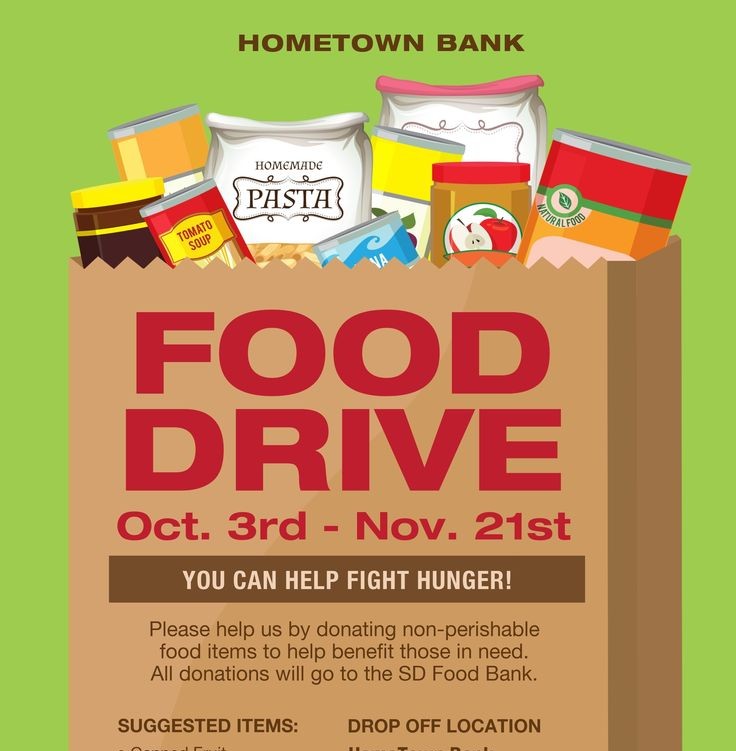
As a veteran teacher, in a relatively well-off suburban school system, I’ve been part of any number of school-based community service projects. My middle school used to have a canned goods drive around Thanksgiving.

Homerooms competed to see who could bring in the most cans, with the winning class getting donuts and cocoa. Piling the cans into an edifice—you can make a fairly impressive structure with hundreds of them—then plunking a few students in front of the Great Can Pyramid—well, there’s a shot for the monthly newsletter.

But it always bothered me. There were the rabid competitors—Come on! Just go where your mom stores cans and put a few in your gym bag!—who were definitely in it to win it. I mean, free donuts! From the bakery! There were also plenty of well brought-up girls who wanted to feed the poor (and maybe get their photo in the newsletter), counting and re-counting the cans.

The people who didn’t get mentioned: The Student Council advisor who had to transport a thousand-plus cans to the food bank. And food bank volunteers who had to organize the donations, throwing out outcoded or bulging cans of beets and butterbeans.

Not to mention the folks who depend on food banks, getting there early to get what they actually needed (formula, perhaps) and not be left with stuff that had been sitting in suburban cupboards for years, unused.

For several years, I was advisor to the National Junior Honor Society, the stated mission of which was acknowledging scholastic excellence in middle schoolers. Hey, I was always down to honor academic effort, and lots of my band kids were in the NJHS. It was one of those “make of it what you will” volunteer jobs, and I thought it was a place where some smart kids could wrestle with the idea that they were more fortunate than—well, the rest of the world. A middle school kind of noblesse oblige.

One year, we raised money by hosting a dance, then sent those proceeds to a homeless coalition in Detroit. It was a pretty bloodless project—the only outcome for us was a nice thank-you note from the nonprofit—but it was a good opportunity to talk about just who the homeless were, and how you get to be without shelter in the richest country in the world.

Another year, we “adopted” a family through the local Salvation Army (this was before their stance on LGBTQ folks was questioned), to provide a nicer Christmas. The first order of business, after raising a few hundred dollars, was discussing the word “adoption,” relative to extending charity to folks who are less well-off, but live in the same community. We were not adopting anyone; we were providing temporary, anonymous assistance.

Then, we went shopping. There were two cars full of 8th graders, with lists provided by the Salvation Army, pushing carts around Meijers, picking up a holiday dinner and gifts for everyone in our assigned family. What was interesting to me was the assumption that “the poor” weren’t like the kids in the NJHS; they should have to live with less expensive, less attractive products and even be grateful for them.

In our assigned family was a girl (14), who needed a warm winter jacket. The kids debated: the cheaper, ugly one or the acceptable style that was $20 more? This took a lot of time, standing in the aisle. I asked: Would YOU wear cheaper/ugly? No. Never in a million years. So—why should she? The answer (a good answer): because then we could get frozen macaroni and cheese for their Christmas dinner.

In the end, the chaperone mom and I kicked in extra cash, and we got them both. But life isn’t always like that.

I don’t think you can teach kids to care for their neighbors via school projects—but you can teach them to think about inequity and compassion. Just because SNAP benefits returned this month does not mean the less fortunate will be well fed in the long term. And the misfortunes of rising unemployment, rising food prices and rising social uncertainty will not be ending soon.

The foundations for eliminating food insecurity are cracking. The best gifts: Money and time. Happy Thanksgiving.

What I Learned from my Dad about Politics and How it Applies to 2026

I am a big fan of Jess Piper, a veteran teacher from Missouri, who left the classroom to run for office, and has since reshaped the conversation around why red-staters vote against their own interests. Piper writes often about a childhood spent bouncing around the south, and the family values that influenced her.

When people (including myself here) shake their heads and wonder how so many citizens–despite glaring, flagrant evidence to the contrary–can still stubbornly believe that Trump is leading the country  on the right track, it’s helpful to read Piper’s blog. She gets it.

Mostly, I read Piper for her insights on working-class voters–because my own father, were he still alive, would (despite many years of voting for Democrats, post-War) probably be a Trump supporter, voting against his own interests.

Not a careless, “protect my wealth” country-club Republican. But a grievance-driven voter who resented those he believed were simply and unfairly handed benefits and perks, things he would never enjoy, no matter how hard he worked.

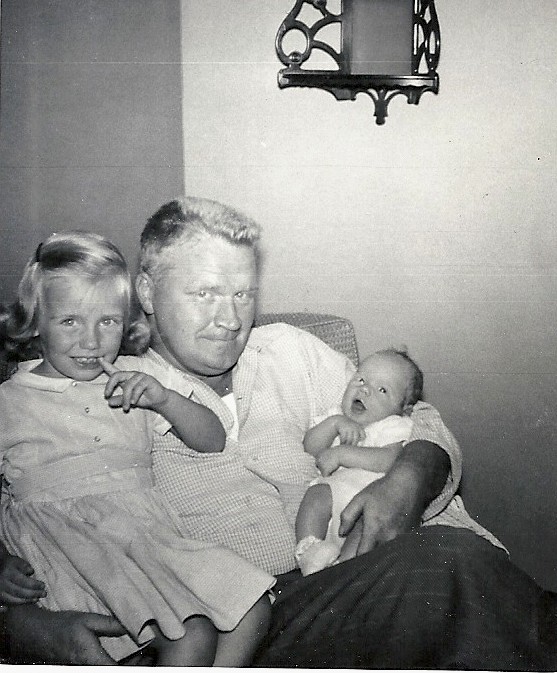
Fear and resentment—and the overwhelming conviction that the little guy never gets ahead—were deeply embedded in his character. That doesn’t mean he was not a good father; he absolutely was, caring for his family and living up to his responsibilities as a hard-working adult and citizen who never missed an election. He was a proud Teamster, a church-goer, and the man who drove me 90 miles one-way to take flute lessons at the university.

My dad served in World War II, in the Army Air Corps (later the US Air Force) in the Pacific theatre. His plane was shot down, in 1944, over the Sea of Japan, and the crew was rescued by an Australian sub. He lost his 19-year old brother Don in the first wave of Marines taking Iwo Jima in February of 1945. I wrote more about these things here, explaining why my dad really never got over the war. But it was more than his wartime experiences that molded his character.

He often expressed the sense that he’d been cheated—that other, less-deserving people were moving ahead, because they had money, or were currying favor, while he (a realist from the poor side of the tracks) was left behind. He voted for George Wallace in 1968, because Wallace claimed there wasn’t a dime’s worth of difference between the two parties: both were corrupt and run by elites. Sound familiar?

Thom Hartmann’s new piece– Culture Is Where Democracy Lives or Dies, Because Politics Always Follows the Story a Nation Tells Itself—goes some way to explaining what’s happening today, but also why my dad, surrounded by protests against the Vietnam war and girls burning their bras, turned to a man who supported segregation and repudiated progressivism: ’ Like no candidate before, Wallace harvested the anger of white Americans who resented the progressive changes of the 1960s. Wallace supporters feared the urban violence they saw exploding on television. With tough talk and a rough-hewn manner, Wallace inspired millions of conservative Democrats to break from their party.’

Like many of Trump’s supporters today, my dad saw Wallace as a truth-teller, an advocate for the working man, someone who would work to defend cultural norms around race, gender, authority and social policy. Even when those norms were outmoded, unjust or morally repugnant.

Today, I know better than trying to talk an irrational, ruby-red voter out of their convictions. I really do understand how pointless, even damaging, it is to accuse Trump voters of destroying democracy and erasing progress. Because I spent, literally, years of my life trying to (cough) enlighten my father, who treated me like other fathers of the era treated their know-it-all college-student kids: as spoiled brats who needed to let the real world take a whack at them.

My father died in 1980, of a brain tumor, at the untimely age of 58. I never changed him, but he never changed me. He thought a college education was a waste of time and money, although when I graduated, he came to commencement exercises and danced with me at the Holiday Inn afterward.

 Later, it dawned on me: the fact that he and my mother couldn’t contribute financially to my college education, and couldn’t help me navigate enrollment, might have been part of his insistence that college was for the privileged, not families like ours.

All of this happened in a time when news and opinion came from three mainstream TV channels and the Muskegon Chronicle. Who do Trump  voters turn to now for news? Is that source supporting their racism, sexism, xenophobia and bitterness? Is it filled with fact-free resentment?

Where do we start in changing minds and hearts? I wish I knew.

Ten Questions that Felt Worth Answering

Cleaning out some files, I came across these questions (in a file creatively labeled Ten Questions). I have no clue where/when they originated. It was either answer them or plunk myself in front of, you know, the Trial, on TV.

Grande Soy Green Tea Frappuccino with Extra Whip or House Blend Black?

(Sing to the tune of “Holy, Holy, Holy”):

Coffee, coffee, coffee. Praise the strength of coffee. Early in the morn we rise, with thoughts of only thee.

If you were going to write a book, what would its title be?

“The Genuinely Professional Teacher: Way Overdue”

Rate graphic novels on a scale of 1-10, with 1 representing “useless” and 10 representing “simply amazing.”

Two or three. Just not worth the effort to scale down the words in favor of stylized art. I realize this is not a popular opinion and the fault may lie with me, as geriatric reader.


What member of your digital network has had the greatest impact on your professional growth?

There are an awful lot of people I see only online who have made me a better thinker, writer and activist, and their impact has waxed and waned (and sometimes waxed again) over time. Blogging for Ed Week where I had a good editor helped tighten and tone down my writing, and helped me understand the difference between well-supported opinion and simply venting. When it comes to education blogs, Jan Ressenger’s writing is what I aspire to, if I had to name someone.


How do you feel about the holidays?

Which holidays? Oh—those holidays. It’s the most wonderful time of the year?
What is the best gift that you’ve ever gotten?

A piccolo. Completely unexpected. And an item I would prefer to pick out myself. But–in one of those rare, grace-filled moments–I got the perfectly chosen present that I didn’t even know I wanted.

If you had an extra $100 to give away to charity, who would you give it to?

The World Central Kitchen.

What are you the proudest of?

Choosing to follow my principles rather than a paycheck, on a couple of memorable occasions.


What was the worst trouble that you ever got into as a child?

My parents bought me a two-wheeler for my 6th birthday, and I was afraid to ride it without training wheels. My mother told me if I didn’t work up the courage to ride it, they’d take it away. So I got up on the bike, went forward about 25 feet, then had to turn, to stay on the sidewalk. The bike wobbled, tipped, and I fell, hitting my head on a large rock placed at the corner of the sidewalk and driveway, giving myself a concussion. In my first grade school photo, you can see the bruising—and the shiner.

What was the last blog entry that you left a comment on? What motivated you to leave a comment on that entry?

Peter Greene’s Curmudgucation– he’s written 5000 blogs, a ridiculous number, especially considering he wrote most of them while teaching full time (and parenting twins). And his blogs have only gotten sharper (and funnier). He’s an excellent role model for teachers who want to write about what happens every day in their classroom—and why public education is worth saving. Peter also serves as Curator in Chief for Ed-Blog World, at the Network for Public Education. If you want to read a selection of great education writers, check out NPE’s Blog Post of the Day.

Feel free to share your own answers—all ten or selected queries.