The Amazing Power of Snowpants

It started out as a simple Facebook dispatch from Detroit Public Schools teacher Ann Turner (now retired), an early childhood educator, on the day after southeast Michigan’s first real snowstorm.

We were not able to go out and enjoy the REAL stuff today as only two of my students have snow pants and boots. I would love to gather enough so that all 16 of my students can enjoy and love Michigan winters and snow as much as I do. I have four pairs of snow pants that my own girls have outgrown and two that I picked up at a resale shop. If your child has outgrown last year’s snow pants and/or boots and you would like to donate them to my winter closet, I would be so appreciative. Thanks!

Within two hours, there were 25 responders–fellow teachers and friends, sharing information about sizes, bargain sales and where to drop off donations and purchases. Ann promised to pass any extras on to the other teachers in the building, all of whom have “winter closets”–and know about the restorative power of recess in a Michigan winter. Ann’s next post, the Monday following:

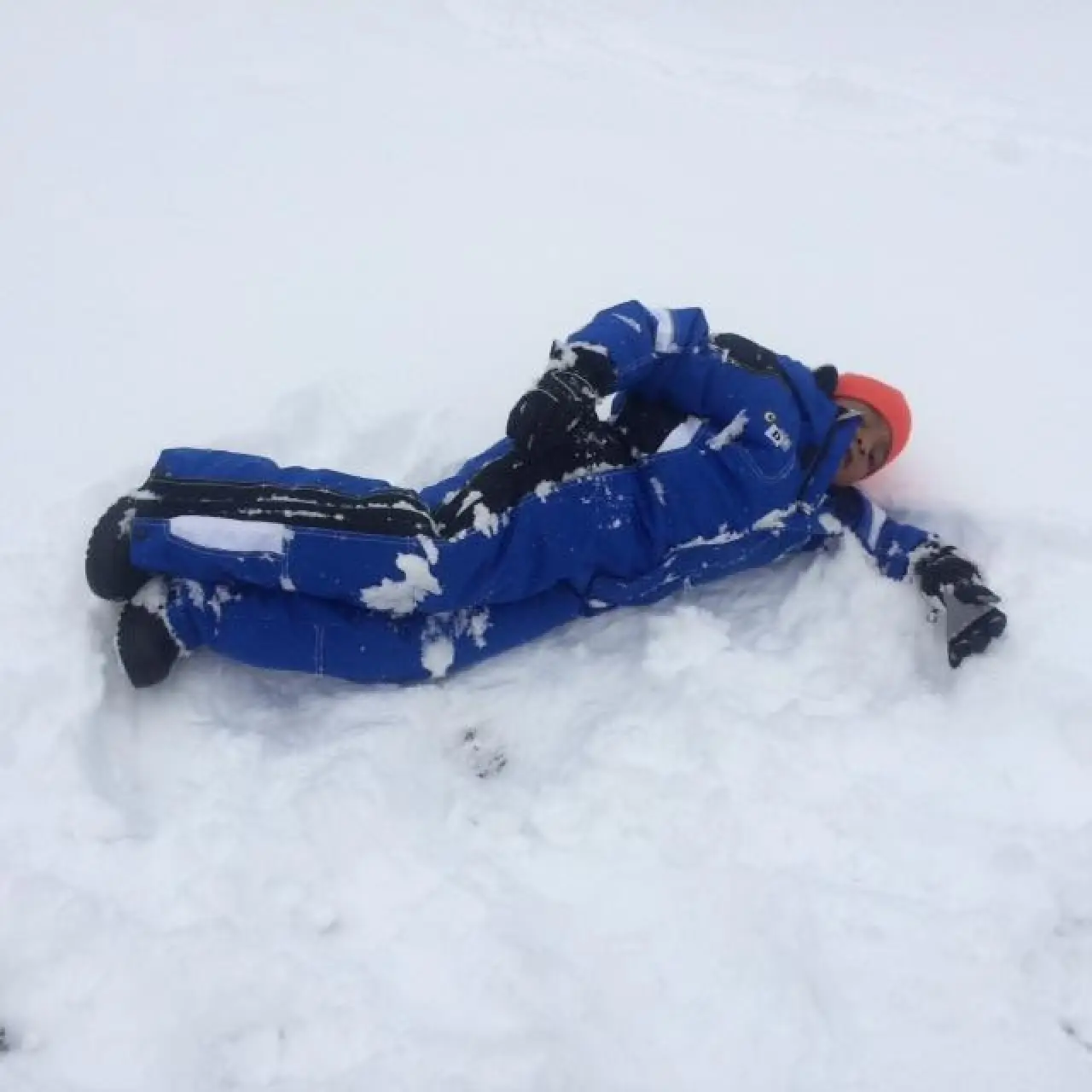
I was SOOOO excited to get to school today because I knew that this would be our first GREAT snow day with all of our new gear! I am not sure who was more excited–me or the kiddos!! After everyone got suited up (that was exhausting), we headed out and we played and we played and we played some more. Some of the kids were amazed at how they could roll around in the snow without getting wet or cold. We made snow cakes, we walked in sled tracks, we made snow angels, we threw the snow, we laughed and we played some more.

When everyone was good and tuckered out, we went in and made hot chocolate. Isn’t that just the perfect day? The first thing they told their parents at pick-up? All about their adventure–and the last thing they said to me is “Are we going out tomorrow?” Thank you ALL for making a difference in the lives of children! Thanking everyone is difficult because some of you were the messengers or middlemen. I hope that you will be able to convey our gratitude to those who assisted in getting these babes suited up!

There’s more–photos and stories–and then, the collecting of snow gear morphed into a full-scale Girl Scout troop project, with the girls shopping the post-Christmas sales with their cookie money.

It’s important, however, to look past the do-good/feel-good aspects of this heartwarming story.

  • Only two of Turner’s students had appropriate clothing for winter–and, trust me, snowpants are vital for kids in a Michigan winter. What other essentials are missing in their lives and learning? How do these missing elements contribute to the media-fed narrative of “failing” schools?
  • Children in Finland play outside for 15 minutes after every 45-minute lesson. Because the Finns structure their school day using research demonstrating the necessity of invigorating free play for young children. While Turner goes outside to monitor and play with her students, teachers in Finland take coffee and chat breaks with their colleagues. Pauses, movement and conversation consolidate learning and make it stick–anyone who’s ever tried to gather up participants to return to a workshop PowerPoint after a break recognizes this.
  • Playing outside in warm clothing, using sleds and snow toys–with follow-up hot chocolate– represented a special treat to the children at Palmer Park Academy in Detroit, courtesy of a dedicated teacher and her kind-hearted friends and colleagues. Kudos to Turner. But–the children in her class deserve free play and a refreshing drink every day, year-round, as part of best pedagogical practice for very young children. The research on this is iron-clad.
  • Inevitably, there were questions about whether Turner’s foray to the playground was approved by administrators as an “educational” activity. Since Michigan’s former governor once proposed pre-kindergarten testing as a means of determining whether Michigan was getting a bang for its pre-school funding bucks, this is a legitimate worry for early childhood teachers. Will this healthy exercise reduce test scores–is it more important to stay inside and do some more worksheets?

Anyone who looked at Turner’s photos would have an answer for that. But people making policy around early childhood education aren’t necessarily paying attention to snow angels, rosy cheeks and face-splitting grins.

We Need Hygge Classrooms in America

The ubiquitous FB meme:

In Iceland, books are exchanged as Christmas Eve presents, then you spend the rest of the night in bed reading them and eating chocolate. The tradition is part of a season called Jolabokafload, the Christmas Book flood, because Iceland, which publishes more books per capita than any other country, sells most of its books between September and November, due to people preparing for the upcoming holiday.

Nobody ever responds: That sounds awful! My family prefers watching our individual TVs!

Generally, commenters reply wistfully, longing for a country where learning is valued and books are ideal gifts, where the dark and cold are counterbalanced by intellectual curiosity and conversation.

Thanks to the Jolabokaflod, books still matter in Iceland, they get read and talked about. Excitement fills the air. Every reading is crowded, every print-run is sold. Being a writer in Iceland you get rewarded all the time: People really do read our books, and they have opinions, they love them or they hate them. At the average Christmas party, people push politics and the Kardashians aside and discuss literature.

Perhaps because I live in a region that gets 135 inches of snow each winter, these cozy, fireside literary chats are enormously appealing to me. As is the Danish concept of hygge:

The Danish art of contentment, comfort, and connection…a practical way of creating sanctuary in the middle of very real life.”

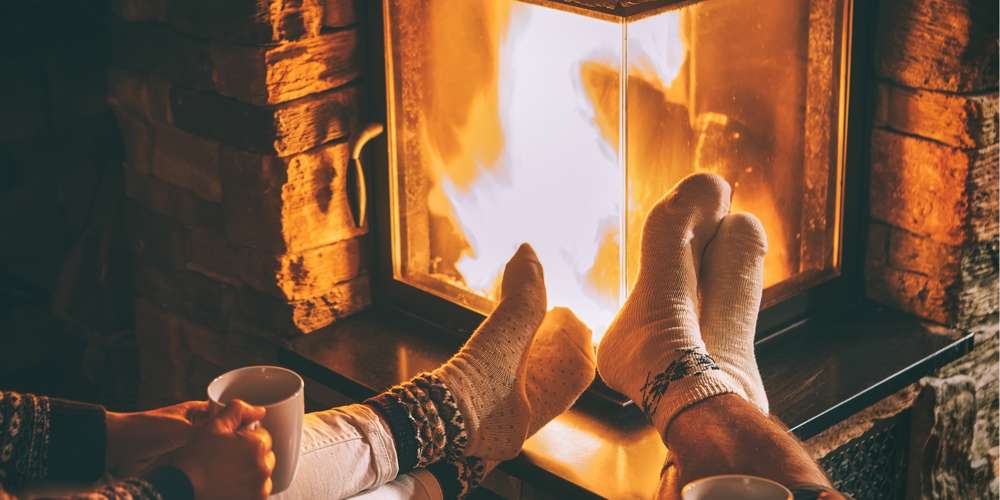
Hygge (hoo-ga), which has no direct translation into English—surprise!—is many things to many people: Woolen socks. Candles and other gentle light. Board games. Comfortable couches and cozy quilts. Warm drinks.

Although hygge seems to have Scandinavian roots, it’s not exclusively a cold-climate thing, evidently. A rustic cottage on a lake, with its beat-up furniture, mildewed paperbacks from the 1950s and second-hand bathing suits is very hygge, according to Meik Wiking, author of “The Little Book of Hygge” and, not coincidentally, CEO of the Happiness Research Institute in Copenhagen. The mere fact that there is a Happiness Research Institute, somewhere in the world, makes me—well, happy.

The interesting thing about hygge and Jolabokafload is their inherent intentionality. Citizens in Iceland and Denmark take contentment, comfort and connection seriously, and pursue them with deliberation. Choosing the right book for someone means you know that person, and what they might enjoy reading. Playing games with your family means connecting with them, laughing and teamwork.

So why don’t we pursue this, here in the land of the free, home of the brave? What keeps us, a nation that often proclaims itself the best country in the world, or at least on its way to becoming “great” again, from choosing to embrace contentment and connection?

Perhaps Scandinavians are better able to appreciate the small, hygge things in life because they already have all the big ones nailed down: free university education, social security, universal health care, efficient infrastructure, paid family leave, and at least a month of vacation a year. With those necessities secured, according to Wiking, Danes are free to become “aware of the decoupling between wealth and wellbeing.”

That decoupling between wealth and wellbeing is well-reflected in this headline: Children Need Homes, Not Charter Schools or Standardized Tests, and Definitely Not Tax Cuts for the Wealthy.

That’s where our intentionality lies in the U.S., where we’re spending our hard-earned tax dollars—canned curricula designed to raise test scores and alternative school governance models, endless expensive tests—when over 100,000 New York City schoolchildren were homeless last year. According to former Senator Orin Hatch, we don’t even have money for poor children’s basic health care. As a nation, we have linked simple human well-being to wealth, and sealed it with the tamper-proof cap of low opportunity.

Many teachers try to add hygge touches to the classrooms where their high-poverty students meet and work every day—from beanbag chairs to classroom sets of snowpants for outdoor play, from little free libraries to Cocoa Day. If school can become a place of connectivity, warmth and safety, they reason, students will keep coming back.

Happy Hygge-days, Teacher in a Strange Land readers. Thanks for all you do for your students.

Gifts of Christmas Past

In a holiday-themed archetype of legislative overreach, Alabama passed an ethics law back in 2011, forbidding K-12 school teachers from accepting expensive presents.  Previous legislation set a $100 limit on individual gifts to public workers, but the 2011 law specified that gifts to teachers be limited to those of nominal value. The stated purpose: to reinforce ethical practices by state employees.

This was such a big deal that the AL Ethics Commission was receiving about 25 calls a day from parents who didn’t want to get their children’s teachers in trouble. The Ethics Commission released a detailed report, letting parents know that cookies, hand lotion and mugs are OK. What I found interesting was what was forbidden. Four examples: hams, turkeys, cash and “anything a teacher could re-sell.”

I was a classroom teacher for more than 30 years. I received hundreds of Christmas and end-of-year gifts over that time. And I never got a turkey or a ham. Maybe that’s an Alabama thing?

Nor did I ever get cash– and if I had been slipped a card with cash, I would have returned it immediately. In fact, I don’t know any teacher who would accept cash or an extravagant gift, especially if they thought the gift came with strings attached. The teachers I know have a whole shelf full of holiday mugs with “from Brittany, 1998″ written in Sharpie on the bottom.

Besides the obvious issues of unenforceability and heavy-handed mistrust of those charged with educating Alabama’s most precious resource, the whole brouhaha in Alabama had a kind of cheesy self-righteousness about it.

Does a $25 Starbucks gift card come with expectations built in? What if it’s given by a shy first grader who noticed his teacher often brings a Starbucks cup to school? When does the impulse to give a hard-working teacher a nice token of appreciation morph into a calculation of what special favors might be granted through a generous present?

Jim Sumner, director of the Alabama Ethics Commissionwas in favor of clamping down on all public workers. No gifts, period:

It takes away the sense of entitlement that people have built up over the years that people serving the public need gifts.

Sense of entitlement?

Several states have laws limiting the gifts that public employees can receive. About ten states have even tougher rules, not even allowing public employees to get a free cup of coffee. Research tells us public officials and employees are rarely influenced by a meal paid for by a lobbyist or by a gift. But states send a message with firm ethics laws and build confidence among the public that leaders can’t be bought.

Theoretically.

Here’s what I wish I could tell Jim Sumner: Teaching offers many very rewarding experiences, but it’s not and never has been about the great swag.

I’m not sure I ever had a “sense of entitlement” as a public worker– but then, I never came in contact with lobbyists and don’t think most people consider non-elected teachers “public officials.” I’m not sure I ever had anything–like a legislative vote–that could be bought.

Alabama Ethics Director Sumner: “if [a parent] said, ‘I don’t care what the new law is, I’m going to give them a cruise,” that’s a different case …”

A cruise? I can’t speak for legislators–who, after all, can change much more than a mere grade–but I’d be hard pressed to find a teacher who regularly went on international junkets, courtesy of Pearson, the way state education officials have. Don’t we have much bigger fish to fry, educationally speaking, than fretting about setting strict guidelines for what parents can spend on a present?

The whole dustup felt sad to me– part of the impulse to punish and control something that happens rather naturally everywhere: kids giving presents to their teachers. All presents from students are good presents.  They’re appreciated, but the sentiments around giving are what’s treasured.

Thinking back over all the gifts I got –there must be 50 music-themed Christmas tree ornaments– one stands out. I had a kid in my 6th hour jazz band, who came to class the day before winter vacation with what looked very much like a tightly wrapped bottle of wine. “My mom says don’t open it until you get home, and keep it in your drawer today,” he said, all innocence.

When I got home, I unwrapped it. It was a bottle of wine–a very nice bottle, in fact. I saw the boy’s mother in the grocery store over holiday break. “About the gift…” I said and she held up her hand. “You absolutely deserved it,” she said. “We won’t speak of it again.”

Public Education: The Bully and the Dream

“You never change things by fighting the existing reality. To change something, build a new model that makes the existing model obsolete”   (R. Buckminster Fuller)

Buckminster Fuller’s well-known quote was a touchstone for me, in my 30-odd years—and some of them were really odd—of classroom teaching. Whenever things at school started feeling oppressive or dumb—there’s got to be a better way to do X—coming up with a new plan was always a better bet than complaining about the old way. Launch first, ask permission later.

I can pull dozens of examples out of memory here. One major shift I made, for example, as a result of disenchantment with competitive music-making, was dumping ‘chairs and challenges’ in seating my band students.  Nobody was doing it at the time. Here’s another: Starr Sackstein’s work on re-thinking grading in favor of different ways to assess student work.

Why fight back against typical practices, if you can devise a better way? School used to be the perfect place to institute new ideas. Let a thousand pilot projects bloom.

I was intrigued to see this, posted at Bluesky, from DeRay McKesson:

Our goal is not to switch places with the bully, but to end bullying. We focus on tactics—how do we beat the bully?—but don’t remember to prepare for the day when the bully is no more. If we don’t have a vision for our desired future, how can we plan to achieve it? When we confront the bully, we reclaim our imagination. 

If we confront the bully, we reclaim our imagination. We can create a vision for our desired future. Makes sense to me. Feels a lot like Buckminster Fuller: Come up with something better, then make it happen. Stop fighting.

Now– McKesson, a decade ago, was a Teach for America alum, a charter school supporter, and later, a school administrator. He seems to have left public education (and all its flaws) behind, focusing on activism, BLM, social media and podcasts. He wrote a book. He fought with people on Twitter. 

But– I think he’s right. If all we’re doing right now (guiltily raising hand) is re-posting that video clip of Linda McMahon getting body-slammed, we’re not helping preserve, let alone improve, public education. When our focus is on fighting bad policy, especially policy that hasn’t yet been enacted, we need to have better ideas—dreams, if you will—about what public education should look like in our back pocket.

I say this because the incoming administration has dreams:  

Donald Trump’s vision for education revolves around a single goal: to rid America’s schools of perceived “ wokeness ” and  “left-wing indoctrination.” The president-elect wants to forbid classroom lessons on gender identity and structural racism. He wants to abolish diversity and inclusion offices. He wants to keep transgender athletes out of girls’ sports.

A bible in every classroom. Not to mention vouchers—or whatever visionary scholarship name you want to give them–for all.

Trump’s first term was full of rhetoric and short on action, all Betsy DeVos and grizzly bears, when it came to education policy. Lots more anti-public education non-profits sprang up (and some died), and lots of charter schools also sprang up, using public funds, then failed. But the Department of Education chugged on, as usual, and 85% of kids were enrolled in a public school, a slow slide down from 90% a decade ago.

Educators I know are prone to being frustrated when national political discourse doesn’t include ideas about public education.  But that can actually be a bonus. States and local districts are where the policy-making rubber meets the road, when it comes to making public schools better. Policy that genuinely improves what’s happening in public schools looks like what Tim Walz was able to accomplish in Minnesota.

Trump, on the other hand, has a lot of ideas that are deeply unpopular: What Trump will certainly do is pick splashy fights that he can win through executive orders. 

So—returning to Buckminster Fuller or DeRay McKesson—what does OUR vision look like?

Here’s one take on that question, from Steve Nelson.

 All human learning is interconnected. Depriving children of rich, complex experiences in the service of dull training for standardized math and reading exams actually stunts their math and reading development. Ironic and dumb.

We’re still fighting the bullies who instituted mandatory standardized testing for 8-yr olds, and use the data gathered to harm children. We’re arguing with the idiots who destroyed public education in AZ,  in favor of paying for ski lessons and Lego kits for rich kids. We’re brawling with Christian nationalists over Bible-based curricula in Texas public schools.

Where has all this verbal combat gotten us?

Maybe it’s time to create that vision of what schooling could look like—for the same money, with the same workforce, in the same buildings. Imagining that future.

I have a few ideas about that. What does your vision for public education look like?  

Boom! Boom boom! It’s Deer Season

So– we live in the northern Michigan woods. And beginning last Friday, we have been hearing shooting. Lots and lots of shooting. It’s deer season (firearms) up north.

Our little grocery store-cum-gas station has a deer pole, and offers butchery, so a drive into the P.O. involves passing a large pile of dead deer, awaiting their turn to be gutted and sliced. Not a pretty picture.

And yet. None of this bothers me.

I’m not a gun owner (or gun-owning defender). Deer browse my compost pile, and I try to remain quiet on the porch, so they can get a big mouthful of rotten pumpkins or potato peelings, while I watch. Venison? Meh, except in chili.

I’ve been run into by deer four times– most recently, an $8K hit on the truck–and I know that controlling the deer population is a benefit to us and to them. Balance of nature and all that.

Plus– the annual ritual of deer hunting just doesn’t faze me. The whole rigamarole of blaze orange and hanging out at pine-paneled bars and doe permits vs. how many points– it’s all OK by me. You (and a half-dozen of your unwashed, unshaven friends) do you.

Probably, this is because I grew up in Michigan. My dad was a hunter, going out with my uncles and great-uncles. Everybody I knew had a ramshackle place up north where the guys went to hunt, in November. Women stayed home, watched the kids, got together with the other “deer widows” to play poker.

The school district where I first taught took the first week of deer season off, mostly because it was too dangerous for kids to wait for the bus when the woods were full of hunters. The next place I taught only took Opening Day off, which I saw as a civilized upgrade.

I know there are people who feed their families with game, but that’s not the reason I’m down with hunting. I guess I see it as a throwback to earlier times, a connection to an era when people secured their own food in the wild. Men hanging with men, suffering from cold and tedium, relieved by gunshots and whiskey and flinging the carcass over the hood of the car and using the meat (instead driving past unused and grisly remains beside the road, a daily occurrence this time of year).

I was amused by Garrison Keillor’s description of deer hunting and fishing (we have ice fishing here, too, in northern MI):

“Men hunt for the same reason they fish, in order to escape the company of women. Minnesota is a state of thousands of lakes and each one gives men an opportunity for refuge, sitting in a rowboat or a fishing shack out on the ice where nobody will say, “When are you going to clean out the garage?” Or “You keep talking about going to teacher conferences at the kids’ school but when is this going to happen if ever?” or “Why do you insist on dribbling coffee down the front of the kitchen cabinet and not wiping it up?”

Not many women fish because they know they can buy excellent salmon, tuna, or halibut for a tiny fraction of the cost of a boat and motor and trailer and a pickup to tow it. Ever compare salmon and northern pike? God created pike for cat food.”

Just heard another shot. Boom. Deer season.

In Praise of Social Studies

In my long and checkered career as a classroom teacher, I taught instrumental and vocal music, mathematics, ESL and the occasional oddball middle school class necessitated by the fact that, as a (qualified) music teacher, my music classes could contractually be huge—so I could be assigned a class of kids left over in the scheduling process by putting 75 students in one beginning band class.

I learned a great deal while teaching things I wasn’t technically qualified to teach. But I never got to teach my favorite non-music subject: Social Studies. (Notice that I didn’t call this subject History or Economics, two narrowly defined class titles that are approved by the anti-public school mafia.)

I think that poor, maligned Social Studies, the last outpost of mostly-untested subjects, is probably the most critical academic field for K-12 students to explore, if we want them to become good neighbors and engaged citizens. It’s where they learn (theoretically), what it means to be an American.

But ask any third grade teacher what gets short shrift in their daily lessons. Or ask which secondary curricula is the most scrutinized by people who haven’t been in a classroom in decades.

When you hear people talk about how we need more Civics education in this nation, what they want is a range of social knowledge: history, of course, but also government, geography, sociology, political science and early-elementary trips to the fire house and the public library.

What it means to be an American. How we got to where we are—arguably, the most powerful nation on earth. What values we claim to embrace. How physical and historical features, and population migrations, shaped our culture.

Isn’t that critical, essential stuff? Not to mention engaging—when taught with the mindset that this is the content that one needs to know, to become a fully functional adult in the United States?

Today, which used to be the day we honored Christopher Columbus for a bunch of shady reasons, might be a good time to ask some questions about social studies, and their current place in the school curriculum.

My fear is that Social Studies, an incredibly rich and applicable field of interrelated content, will be further squeezed out of the curriculum, or become a dry, testable, bunch-of-facts sequence, none of which bears relevance to the diverse, often catastrophic world our students live in. What Hess calls catastrophism might just describe how passion has always shaped our politics.

And politics, civil or not, is just the means to get the world we want.

A couple of years ago, the Michigan Democrats posted a statement on their Facebook page:

The purpose of public education in a public school is not to teach students what parents want them to be taught. It is to teach them what society needs them to know. The client of the public school is not the parent, but the entire community, the public.”

The statement was quickly criticized—Parents’ Rights!—and walked back, but I think there’s some truth there. Parents want their children to be literate, and numerate, for sure. But when it comes to understanding what science tells us about climate change, or encouraging 18-year olds to become informed voters, should a subset of parents be able to shut that whole thing down?

Here’s a toast to social studies teachers everywhere, as we approach November 5. You go.

Are You an Instruction Geek?

I generally don’t pay much attention, anymore, to the rightwing young guns who dominate edu-social media. Mostly this is because they’re not providing any new content about what you might call school improvement—genuinely interesting or useful ideas for making lessons interesting, building curriculum that makes sense in 2024, figuring out better ways to assess student work and encouraging students to get excited about learning.

You know, the things that support the people actually doing the work of teaching in the public schools—where 82% of our K-12 students are educated. Instruction.

In the five decades since I started teaching, reading and writing about all aspects of schooling and education policy, there have been hundreds of such new ideas. Some were genius, some fizzled out, some—annual standardized testing springs to mind—are now part of what everyone thinks is normal, maybe even essential. Even though these ideas may have harmed many children.

The yappy bow-ties posting on the regular about how public education is a big fat failure aren’t offering us genius ideas. They’re focused on vandalizing one of America’s great strengths: a free, high-quality public education for every child, no matter what they bring to the table.

Prime example: Daniel Buck, whose X-label is “Instruction Geek.”

Buck actually did teach for a few years, shifting from public education to private, three schools in what looks like six years. Then he wrote a book and informed his following that he was, sadly, leaving the classroom to put his intellect to better use, writing blogs—as a ‘policy and editorial associate’ for a conservative non-profit.

For a guy who pretends to have cool, juicy ideas about instruction, lots of his posts seem pretty rigidly political and not about teachers’ professional work at all.  A sampling:

  • Conservatives need to start thinking about, building, and regaining control of our education institutions after school choice becomes the law of the land. Won’t do much good if all charter and private schools are stocked with teachers, curriculum, and policies out of ed schools.
  • Teachers, stop voting for Democrats. Their education policies sound nice but again and again just make our schools worse.
  • Once again, I repeat: MORE MONEY WILL NOT FIX AMERICAN SCHOOLS.
  • Students should be expected to obey their teachers. Seems pretty common sense to me but sadly, a statement that must be made.

The last one made me think that perhaps Mr. Buck’s former students had ideas of their own about, umm, instruction, but maybe I’m reading too much into his little outburst.

A couple of days ago, Mr. Geek Buck posted something that’s actually about instruction:

Sorry but one teacher cannot differentiate every lesson for 27 different kids whose reading level ranges from 1st to 11th and account for 6 different IEPS. The inclusion/no-tracking push is simply unworkable.

There were a few affirming responses—because clearly, classroom teaching is impossible; the only way to give each individual child precisely what they need is one-to-one tutoring. And, by the way, that doesn’t work so well either.

I started thinking about differentiation in my own classroom. My typical class size hovered around 65 middle school students. Their reading levels ran the K-12 gamut, and I frequently had a dozen or more special education students (with varying disabilities and strengths) in a class. Some students were inclined to disobedience, things that couldn’t be remedied by mere expectations. Oh—and they were all holding expensive noisemakers.

My job was teaching them to make pleasant and accurate musical sounds, then combine those sounds, using an entirely new symbolic language, into music, with regular performances for their parents, their peers and the community. I also had to weave some cultural and historical information into the instructional mix—things that would help them see the beauty and value and joy of what they were (inexpertly) crafting.

Everyone was included. Nobody was tracked (beyond being in the band with their grade-mates). Some of my band-teacher colleagues had auditions and sorted their students into a top ensemble, and lesser-light bands. The drawback to painstakingly dividing groups by “ability” is that ability is really hard to measure, and students who are deemed sub-par often drop out. Students also learn at different rates. The kid who’s way behind in September may be caught up in January and at the top of the class at the end of the year.

I’m fully willing to admit that there are many ways to teach kids important content, but I never met anybody who made 27 lesson plans for a single class. Most differentiation happens across the instructional cycle—presenting new material multiple times in multiple ways, offering different forms of an assignment, assessing work based on what you know about that student. Student choice can be a big part of differentiation.

And sometimes, of course, they all take the same 10-question quiz, so you can get a handle on who’s got it reasonably well, and whose understanding just isn’t there. That’s OK, too. You don’t have to divide them into tracks. They already know who’s smart and who is struggling.

I love nothing more than talking about instruction. Pedagogy is my jam. And I resent people self-appointing as instructional leaders and experts, when all they’re doing is using public schools for target practice.

Here’s one more from the iGeek:

Advocates are trying to retrofit schools to do all that families should / used to — from feeding three meals a day to teaching basic behavioral norms. They are failing at doing so. No public institution can correct for the breakdown of the family.

Be wary of the word “should”—always—but take a look at what teachers are accused of here: teaching good behavior and feeding kids. Maybe no public institution can truly fix the breakdown of families. But don’t schools get credit for at least trying?

Forget the “Undecided.” Focus on the Timid.

I read the NY Times daily (I know, I know…) and am an avid follower of their political focus groups. Little sketched heads with thumbnail descriptors (“Bill, white, Florida, 73 years old, voted Trump in 2020”) and their responses to some pretty good policy- and character-focused questions.

To which, they give answers which make me wonder just who their 9th grade Civics teachers were. Lately, the spotlight has been on “undecided” voters, nearly all of whom, IMHO, decided long ago whether to vote and which holes they’ll be punching, behind the curtain, but are anxious to be recognized and asked about their views.

I guess there’s some social cachet in being an “undecided” voter—so discriminating!– but for anyone who can name the people running for President and Congress in their state and district, this election feels like there’s been plenty of information and exposure to what the candidates represent:    The New York Times says undecided voters want more “fine print” details. Really? They’re so lightly engaged that they haven’t made up their minds yet, but they want to dive into the intricacies of tax policy? Unlikely.

In addition, the 67 million people who tuned into the debate on Tuesday got an incredibly clear picture of the candidates’ character and policy goals (or lack thereof).

Here are the people who interest me: The timid. The folks who claim to not be interested in politics. The ones who blanch at the critiquing of men too old and confused to lead the most powerful nation on the planet. Who just want to, you know, get along.

Some of these are people whose votes represent old habits, the influence of their social circles. Some of them are fearful.

Whether that’s fear of change (Will the country finally get a woman in the White House? Will a new president mean that I lose privileges I currently enjoy?)–or fear of breaking away from baked-in but no longer relevant beliefs (Republicans are pro-business and therefore better understand economics, right?), it’s hard to say.

I have written about these voters before—the ones who seem to operate from the gut, whether their gut was telling them to be angry, suspicious… or joyful.

Fact-checking engages only the most involved and informed voters. It doesn’t matter how many times you point out who wrote Project 2025, and how deeply they are enmeshed in the Trump campaign, if you got an oversized postcard from Trump (got four this week) saying he’s disavowed it, well—who are you going to trust?

This is how voters get suckered into believing literally ridiculous claims (Pets for dinner! Executing newborns!) and conspiracies.

Since President Biden’s withdrawal in July, I have joined three Facebook groups and re-activated my interest in another, all groups of women who are planning to vote for Kamala Harris. One group goes all the way back to the Womens March in 2017. Collectively, there are over half a million women reading and posting to these particular groups. And there are hundreds more of these pages, around the country.

And what gets posted and discussed—long, long discussion threads—is fascinating.

It started out with middle-aged women in pearls, blue nail polish and Chuck Taylors. The things they’ve made—hand-painted signs, KAMALA quilts, jewelry and So. Much. Blue.  It was fun to skim, and thousands of new women were joining every day, calling out their towns and looking for friends’ names.

People would post stuff like: My husband says no yard signs, so I just made this blue wreath (beautiful photo) for our front door, and a few hundred women would compliment the wreath and a handful might wonder out loud why the wreath-maker doesn’t get a vote, re: yard signs.

The tone is generally upbeat—finding each other, sharing values—but there have been many, many thoughtful threads discussing how to deal with Trump voters among your friends and family. Some of those conversations are heartbreaking; you realize how divided we have become, and why.

There’s chat about issues, including but not limited to abortion. In every thread, there is someone who says Thank God for this group. I have nobody to talk to.

This is a real thing, this political loneliness. (See,for example: The Lonely Anger of Democratic Women in North Carolina.)

It all comes down to circles of influence. Who do we talk to? Who do we believe?

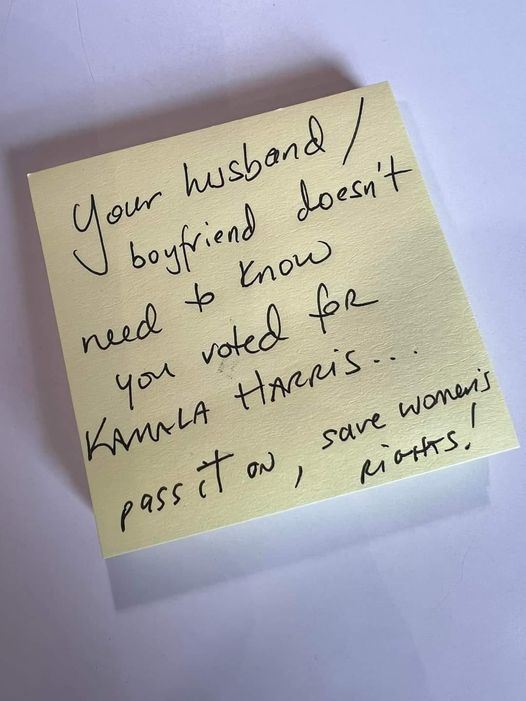
That’s why the post-it note campaign, reminding women that their vote is private, via a little fluorescent square in a public or business restroom, moved me to near-tears.

It’s easy, now, to think that my vote has always been my own, but I’ve lived through eras when women voted as their husbands told them to. My grandmother got to vote, for the first time, in 1924, at the age of 34. I asked her if she remembered who she voted for. She couldn’t, but she did remember asking her younger brother who to vote for.  And she voted for that party for the rest of her life—another 70 years!

This may be the year that women decide to take back our rights.

In the absolute privacy of the voting booth.

What Do Parents Know About Public Education?

Not much.

But don’t take my word for it. Kappan recently took a look at American adults’ knowledge of public schools:

Our findings shed light on a key question: What do adults know about U.S. education? Specifically, what do they know about what is taught, who makes decisions, the role of parents, and the belief systems driving education policy? Our results have important implications for how we might support children and improve the education system.

No kidding, Sherlock.

The survey results would come as no surprise to veteran public school educators: Half of adults don’t know what is/is not taught in their local school. Most are unsure about who’s making curricular decisions. Most are unclear on the impact of privatization on their public schools. Some of the surveyed issues (Critical Race Theory and learning loss) revealed a complete lack of understanding.

Least surprising finding: Adults’ perceptions of what’s happening in public schools mainly come from their own personal experiences (and this includes people with no K-12 children in the home). The percentage of people who read books or articles, watch cable news or videos, or listen to podcasts about education is small. People who get their education news from newspapers? Fifteen percent. Second highest source of ed news? Social media.

That’s a lot of guesswork, memes and faulty memories.

Kappan makes the case that more information means that the general public will make better choices around education—correctly evaluating the corrosive impact of privatization, say, or understanding why a teacher can’t create 30 different assignments, or seeing the benefits of teaching real history. Better communication will lead to better schools, they say.

Well, maybe.

As Larry Cuban says, we’ve been fixing public schools again and again and again, frequently with little or no evidence that our bright ideas will be effective:

Ideologies and political power matter far more than research-derived evidence. Very little evidence, for example, accompanied the New Deal economic and social reforms to combat the Great Depression in the 1930s. Nor did much evidence accompany the launching of Medicare or the Elementary and Secondary Education Act in the 1960s. And very little evidence drove federal oversight of U.S. public schools in No Child Left Behind (2002). Reform-driven policies are (and have been) hardly research-based.

Again—anyone who’s worked in a school for years can testify that, yes, ideologies and political power matter more than research or concrete evidence. And much of that local political power (elected boards, school administrators, influential parents) yields decisions based on personal experience, decades earlier. No evidence or data in sight.

Here’s an example. Some years ago, the curriculum director in my district proposed a new student reporting system for all our elementary students. Instead of grades—a single grade for each subject, plus a checklist for appropriate behaviors—he created a complex system wherein teachers would evaluate multiple objectives for each subject. The number of objectives would increase, in each of the six reporting cycles, until the final report card, which would include the entire years’ curriculum, laid out in sequence.

It meant the teachers would be evaluating—from introduction to mastery—well over 100 skills and knowledge nuggets. Six times a year, for 30 students. Parents would be given several pages of personalized data, a detailed guide to the entire grade-leveled curriculum, as laid out in the district’s master plan (which the teachers called ‘the black notebooks’), and concrete evidence of their children’s progress.

He actually got this plan through the school board, buoyed by professional journal articles about standards-based assessment. Teachers were less than enthused.

But the plan ultimately failed because parents emphatically did not want pages math and language skills. They wanted grades. They knew what a B+ meant. They did not want to know whether their child could calculate a percentage or identify the subject of a sentence. That was teachers’ work.

Another example: How do we cope with teacher shortages? States and districts all over the country are scrambling to fill positions. Any teacher could give you the right answer: Pay teachers more. Provide adequate resources. And give teachers control over their professional work.

Why are we even talking about reducing qualifications for teaching? Do parents want under-qualified pseudo-teachers heading their kid’s classroom? I doubt it. Recent surveys asked students which quality made teachers “good.”

If you’ve been a teacher, you know the top—73%–answer: They cared about me, as a person. If a would-be teacher cares about students and their learning, they’re willing to jump through the hoops of certification and preparation. They’re willing to invest in a professional teaching career.

And—what do parents know about college? That college is the path to a better job? That getting into the ‘right’ college means everything? Not so fast. College loans burden 43 million Americans who might otherwise be investing in housing. Or—attn, JD Vance!—starting a family.

Parents who support public education by putting their kids into neighborhood schools, then paying attention to what comes home—stories, student work—are doing exactly what makes schools community centers and produces good citizens.

My story about the Report Card from Hell is evidence of this. Parents felt free to critique a new plan (based on their personal experiences and preferences)—to the point that the plan was scrapped. Administrators got over their ‘research says’ biases. Teachers weren’t spending additional weekends cross-referencing student work and checklists, for information that could change tomorrow. The community was satisfied.

What communities need is not more information. It’s trust in their public schools.

How People Vote. How People Choose a “Good” School. Is it Common Sense?

When my son—a Korean adoptee—was in 5th grade, he had a student teacher who was Korean-American. Alex idolized Mr. Thacker, one of the very few Asian faces in our 96% white community. Mr. Thacker took him fishing. When the district hired Mr. Thacker to teach 6th grade, I requested that Alex be placed in Mr. Thacker’s class the following year.

Alex’s 5th grade teacher caught me in the hallway after school, at the end of the year. You know Mr. Thacker is a newbie teacher, she said—and there are some excellent choices among the 6th grade veterans. This will be his first year of teaching. Someday, he’s going to be a great teacher, but…

I’d already had that conversation in my head—and gone with my heart. What mattered most to me was having a great role model. Even if that role model was still filling his instructional toolkit and mastering the curriculum. Kids learn more when they’re seen, acknowledged for who they are.

I think that’s how people vote, as well. When the candidate—for County Commission, Township Supervisor or President—acknowledges YOU and your beliefs, rings your chimes, you’re going to vote for them. Even if they’re racist, traitorous and don’t make a lot of sense.

Some of this is partisan, some mere habit. But driving downstate, along the western Michigan coastline last week, through largely white, economically stressed communities, I was stunned by the number of Trump signs. These are the people who think they were better off when their loved ones were dying from COVID but gas, which OPEC couldn’t get rid of, was $2 a gallon.

A couple days after Trump was elected, in 2016, there was a dust-up in a middle school cafeteria in Royal Oak, Michigan, with kids shouting “Build That Wall.”  It was handled quickly by school personnel, but a video surfaced, and was widely shared by teachers.

Here it comes, we said to each other. Chaos and racism have been set loose.

For anyone who has spent lots of time in a classroom, it’s clear that the attitudes and speech and actions of the wider world (and especially parents) show up– quickly– in the things their children do and say in school.

The campaign to demean public schools and teachers, ongoing since 2016 (and put on steroids in the pages of Project 2025), is reflected in the despicable remarks of the right-wing commentariat. Despicable remarks about Gus Walz and Ella Emhoff—not going to link to those—and top-of-ticket candidates will draw some voters in.  And those remarks will harm kids. Kids in our schools.

It’s easy to label them low-information voters—they are, in fact. But they’re also responding to old beliefs and stereotypes. They’ve been explicitly taught to reject mainstream media and fact-checking. They go with their gut and “their own research,” such as it is.

From a great piece in New Yorker:

Scott, who works in private equity, stuck by his guns… “I think Monica goes directly to sources of information.” This, he suggested, was not the right approach. “Use common sense,” he went on. “Food is much higher now. There’s so many things against restaurants right now.” The Biden-Harris Administration was at fault, he concluded. “They created this.” 

Maybe “common sense” isn’t all that it’s cracked up to be. Or easy to define.

Maybe “common sense” lies in a PR firm’s ability to give people license to embrace their biases, as well as their fantasies: Morning in America.  Boots, not flip-flops.  Make America Great Again.

With the wave of education ‘reform’ that started when Boots-not-Flipflops took office, and tried to recreate the Faux Texas Miracle nationally, lots of people who should have known better got on board. Tests! That’s the ticket! Now we’ll know how to identify a good school—data!

School choice orgs and spokespersons revved up the charters/vouchers machine. Every child deserves a good school—who could disagree? Not me, certainly.

But as the whole NCLB juggernaut lurched along, many of those reformers were dismayed to notice what choices untrained, garden-variety parents valued: Winning sports teams. Transportation. After-school childcare.  Programming for their kids that didn’t necessarily result in higher test scores, like an orchestra, drama club or robotics.

Maybe people choose schools—or teachers—the same way they vote. With their gut.

I taught school with guys like Tim Walz for more than three decades—the coach who taught Social Studies. Walz, as Jan Ressenger notes in this fine piece, is an unabashed apologist for public education:

What does it mean that after two decades of attacks—first with No Child Left Behind’s branding schools by their test scores as “failing,” and now since 2019, with blaming schools and teachers for school closures during COVID—someone running for Vice President of the United States just casually drops a comment celebrating public schools as America’s great contribution?

My favorite Tim Walz meme, making the rounds right now: This is a real thing that happened: Tim Walz was inducted into the West Mankato HS Sports Hall of Fame. He stuck around after the ceremony to help put the chairs away.

As I said—I know this guy. And thousands like him. The kind of teacher and coach who draws families to the local school, so their kids can have a role model. Someone who sees their kids and acknowledges them for who they are.

For those who think this is low-information, sentimental baloney: Walz, a former public school teacher and football coach in Mankato, Minnesota, draws on his experience as an educator to inform his political persona and policy beliefs, saying in a 2007 interview with Education Week—after he was elected to Congress—that teachers are “more grounded in what people really care about.”

As governor of Minnesota, he acted on that philosophy of caring by pushing for and signing into law a $72 billion state budget in May 2023 that significantly increased funding for the state’s public schools, provided for a new $1,750-per-child tax creditfree college tuition for families earning less than $80,000 per year, funding for free school meals for K-12 students statewide, and paid sick leave for workers, as well as a paid family and medical leave.

So there’s your policy.

As for Mr. Thacker? Still teaching. Still taking kids fishing. Still the kind of guy who hangs around and helps put the chairs away.